
Readers: this blog is set in the future (sometime after the year 2020). Each entry assumes there has been a 5th revolution in the US — the Revenge Revolution. More about the Revenge Revolution and author, Entry #1. List and general description of entries to date.
Note: most entries are formatted as conversations. Characters appear in a number of entries, with many entries building on previous conversations. Profile of characters. You’ll catch on quickly. Thanks for your time and interest…and comments.
Scene: Jordan’s office, Washington, DC
Gelly: “Jordan, Greenie just called. She’d like to stop by later this morning, OK?”
Jordan: “What’s she want to talk about?”
 Gelly: “Some background for articles she writing about the Revenge Revolution. She said no preparation necessary…at least for now.”
Jordan: “I can see where this headed. My calendar is clean for a while, right?”
Gelly: “You’re good through early afternoon.”
Jordan: “OK, please tell her anytime this morning.”
(Greenie arrives)
 Greenie: “Hello, Gelly…and you, too, Jordan.”
Jordan: “Why am I always the second fiddle around here?”
Greenie: “You should be the third fiddle but we’re nice to you. Hello, Jordan.”
Jordan: “Nice to see you Greenie. What’s on your mind?”
Greenie: “Gelly, if you’re not too busy, you might want to stay for this discussion.”
Gelly: “I’m good for a while. Thanks, I’ll stay.”
 Greenie: “As I’ve been working on articles about the causes of the Revenge Revolution, one idea keeps rattling around in my head.”
Jordan: “And the idea is…?”
Greenie: “Probably more of a question than an idea. I wonder how much long-term cultural heritage affects behavior in the present day.”
Jordan: “Are you talking behavior any place in the world or just the US?”
Greenie: “The focus is the United States but the answer probably applies to any number of other countries.”
 Gelly: “Has anyone studied this before? Seems like an ideal topic for a graduate thesis or a book.”
Greenie: “I’m sure there have been a number of studies but my specific concern is how long-term cultures might affect behavior in the 21st Century US…and if such behavior had any influence on the Revenge Revolution?”
 Jordan: “Interesting. If I may, let me try to reframe the question. ‘If the United States is to be a melting pot of different cultures, do some parts of the cultures not melt?’…or something like that.”
Gelly: “Hmmm. Greenie, do you have any particular cultures in mind?”
Greenie: “There’s no particular logic to my order of cultures…as far as I can tell. I started out thinking about blacks, then American Indians. Then added Western Europeans, Asians, Jews, Muslims…and the list got long very quickly. Like I said, I don’t think there’s any particular order, at least for now.”
Gelly: “Now, may I try to frame the question?”
Greenie: “Please.”
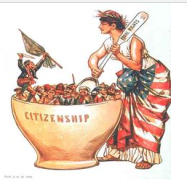 Gelly: “In the US, for a particular culture, what part of the culture melts in the pot and what part doesn’t melt?”
Jordan: “One more try at phrasing, ‘What part of the culture should melt in the US pot and what part of the culture shouldn’t melt?”
Greenie: “Now I think we are making progress. For some people, the answer to the question would be ‘all citizens of the US should have the same characteristics…like homogenized milk.’”
 Gelly: “And for those who want homogenized milk, their measurement yardstick is ‘if you don’t think like me and/or have the same values as me, then you’re not a real member of the American tribe.’”
Jordan: “Alright, so Greenie, tell me, please, how the question about what part of culture should melt or shouldn’t melt links back to causes of the Revenge Revolution?”
Greenie: “The Revenge Revolution was, in many respects, a rebellion against tribal mentality. The populous rebelled against the ‘I’m-1.0%-and-therefore better-than-you’ tribe, against the arrogance of the ‘I’m-a-member-of-the-legislature’ tribe, against the ‘guns-for-everyone’ tribe, and against a bunch of other self-centered groups.”
Gelly: “Do you really think those tribes were formed by cultures or for some other reason?”
Greenie: “Both. What I’m trying to determine…or understand…is which tribes were primarily the result of long-term culture…and then within those tribes what factors might have influenced participation in the Revenge Revolution.”
 Jordan: “Seems to me we should take a few examples of tribes and test the theory, at least to determine if there might be any link between long-term culture, the tribes as you describe them and the Revenge Revolution.”
Gelly: “OK, where do you want to start…I mean, which tribes?”
Greenie: “There’s several ways to define tribes. And I’m not sure of the best approach. But let’s start with a tribe we should understand, at least in part. Let’s look in the mirror first…and take a look at Jews.”
 Jordan: “I’ll buy that idea. Before we start, let me call Rock Man and see when he’s available to provide his insight on blacks.”
Gelly: “What about your native American buddy…you know, Two Dogs. I know his name is not really Two Dogs, but you know who I mean.”
Jordan: “Yes, I know who you mean. And I won’t tell him you called him Two Dogs, although I’m sure he would find that funny.”
Greenie: “While you’re calling your buddies, Gelly and I are going downstairs and get some good coffee. Want some?”
(To be continued)
 Matt: “Actually two things…and both are fundamental to building long-term relationships with friends, business colleagues, constituents…in fact, building a relationship with anyone.”
 Matt: “Rhetorical question, I know, ‘How do you develop a relationship with someone who’s all over the map?’ One day left, one day right, one day up, one day down…I mean, how do you work with such a person?”
 Jordan: “That’s funny, Trumpthong. I don’t even want to think about that. Anyway, the word is Trumpong, which is what I call Trump’s version of strategic ping-pong. The never-ending back-and-forth. Change your position day-to-day, sometimes even during the same day. Then bounce back to the original position. Back-and-forth just like ping-pong.”
 Matt: “Mythomania? Is that yet another made-up word?”
 Jordan: “Yep, an abnormal tendency to exaggerate or lie.”
 Jordan: “Not all at once, of course. Over time more and more people felt like the model for one of Evard Munch’s paintings. They just couldn’t take it anymore and wanted to scream.”
 Jordan: “True, but hard-core Trumpsters aren’t running the show any more. They got thrown out by the Revenge Revolution. I’m still convinced many of the hard-core Trumpsters were brainwashed. Their support of Trump’s policies was often contrary to their own best interests. The hard-core never seemed to understand the consequences of the proposed policies.”
 Matt: “Each one of the sections could be a worth a couple of books…and 1-2 semester class or even a public lecture series.”
 Jordan: “So, why don’t you two work together, already?”
 Jordan: “Never admitting a mistake was really his downfall.”
 Jordan: “What a great way to start a presidency. Go to confession and beg for forgiveness.”
 Jordan: “I know what you’re saying. Since Trump did the country such a favor, maybe we should put his face on Mount Rushmore.”
 Matt: “First of all, if Trump really cared about these kids…actually many were young adults…he could have let Obama’s Executive Order continue or issued another one. What was so pressing?”
 Matt: “Trump’s rationale wasn’t really about whether these children had legal standing. Trump’s argument was ‘those illegals’ were stealing jobs that Trump claimed rightfully belonged to Trump supporters. In reality the DACA kids were creating jobs and likely qualified for higher-tech jobs…jobs that many Trump supporters weren’t qualified for.”
 Matt: “The DACA Detour, as I call it, was an effort to steer away from the every widening Russia investigation. Many in the public realized the terrible precedent that DACA set. DACA finally got evangelicals off their butt and they started saying no to Trump.”
 Jordan: “The question is what did the deal accomplish? The Republicans would have passed legislation for the debt ceiling to keep the government operating, even if it took having Democrats join them. But Trump’s ego needed a fix, like right now, so he gave McConnell and Ryan the finger on camera and proceeded to play footsie with Pelosi.”
 alienating virtually everyone in Congress and much of the public.”
 Matt: “Jordan, thanks for taking time to meet. Gelly said you were busy trying to catch up after taking last week off.”
 Jordan: “That’s interesting. So your premise, if I can call it such, is that actions of ordinary citizens might have accelerated the Revenge Revolution. How will you support the idea?”
 Matt: “At the beginning of the Obama Administration there was lots of frustration with Congress. Really frustration with Congress and the Executive branch. Despite the frustration, the discourse was reasonably civil.”
 Jordan: “C’mon, Matt. You don’t think Fox News was an outlet for these guys?”
 Jordan: “Despite Larry, Moe and Curly, I mean O’Reilly, Hannity and Rushman, the Republican presidential candidates seemed to keep a reasonable lid on things. McCain and Romney were both professional, save a few slips here and there. Palin was another story…she’s still looking for Russia or some polar bear.”
 Matt: “You know what. The king kept throwing red meat to fringe-group supporters in order to feed his fragile ego.”
 Jordan: “Ironically, that’s exactly what happened. Voters said, ‘Throw the bums out.’”
 Jordan: “When you mentioned individuals taking action, I recall an editorial written by the rabbi emeritus at our temple. The content was personal but also laid out a call to action. Hard to ignore.”
 Matt: “Was she OK with free speech?”
 Matt: “Evangelicals. Why did do many support Trump? Obviously, not all evangelicals supported Trump but a very high percentage did…even after he’d been in office for 6-7 months. For evangelicals, all of Trump’s unethical behavior before the election which continued after the election…yet they continued to support him.”
 Jordan: “No logical reason. I think the fundamentalists forgot their scripture. Someplace in Torah…probably Leviticus but I’m not sure…there’s a section that talks about when leaders are humble and admit mistakes, the populous will also be more humble and caring.”
 usrevolution5