• Home
  • Booklets/Grouped Entries
  • Tech Tsunami
  • List of Entries to Date
  • About the Author

usrevolution5

~ USA Headed for a 5th Revolution! Why?

usrevolution5

Category Archives: Economics

#522: Dumb and Dumber: Sledgehammer Efficiency and Tariffs

04 Friday Apr 2025

Posted by Jordan Abel in Back Asswards Thinking, Economics, Societal Issues, Stupid Is as Stupid Does, Trump 47, Uncategorized

≈ Leave a comment

Tags

donald-trump, elon-musk, politics, trump

Welcome to a discussion about the 5th Revolution in the US, which I’ve titled the “Revenge Revolution.” For more about the Revenge Revolution and the author, click “About the Author” tab.  Periodically I write a “sense check” about the status of the Revolution. The previous “sense check” was ENTRY #519. Yes, we are currently embroiled in the “Revenge Revolution.”

BEGIN ENTRY #522: Scene: you’ve decided that parts of your house need updating. The HVAC system seems a bit inefficient and probably should be updated. The roof might need a few repairs to prevent future leaks.

You are not sure what else might need to be improved. So, to help you call in someone who claims to be an expert in revamping systems that are supposedly outdated or could use some preventive maintenance. You and the self-proclaimed expert agree on a start date, and the expert arrives at the scheduled time.

The expert is accompanied by a team of people you have never met. Most are young and don’t look to have the credentials of someone in the skilled trades needed for the proposed scope of work.  You watch inquisitively as the work team unloads from the truck a set of tools of destruction – sledgehammers, chainsaw-like devices, crowbars, etc. – but no tools that you expected to be used for repairing and preventive maintenance. 

The expert tells the team to “Have at it,“ and you watch in horror as the team immediately begins destroying structural components of your house. As the expert gets ready to leave, you ask, “What’s going on here?“

Expert replies, “We’re going to make your house better.“ You reply, “But where are the plans? How do I know what you’re going to do? It looks as if you’re trying to tear the house down, not make improvements.“

“Don’t be concerned,” the alleged expert says, “we’ll rebuild everything later. But first we must tear up and tear out everything we don’t like. Step aside while the team makes your house more efficient with our sledgehammers and chainsaws.”

And so goes the approach Trump and the Muskovites are taking to “increase the efficiency” of your Federal government. The mantra of the Trump/Muskovites group has been, “Don’t plan, just break, then blame someone else and walk away.”

For those unfamiliar with Trump’s career, he has taken this same approach to virtually every major real estate project. The Trump Tower on 5th Avenue, for example, replaced one of the most beautiful buildings in midtown Manhattan. Do you think he tried to save any of the building and incorporate into Trump Tower? Of course not. Trump’s approach — demolish the building and then send the beautiful stonework to the dump. Fortunately, some of the stonework was saved thanks to a scrap dealer, but with no support from Trump.

As far as efficiency, virtually everyone agrees that most organizations, public and private, have some areas where efficiency could be improved. However, anyone with an ounce of brains knows that breaking or destroying something is relatively easy — give me a sledgehammer and chainsaw.  What takes longer and some serious thought is how to make an organization more efficient while maintaining its integrity, and keeping it running relatively smoothy during the transition. 

What Trump and Musk are doing to the Federal government might seem exciting to some MAGAts. But their approach to increasing efficiency is back asswards. Breaking something takes no brains. Further, breaking often has serious consequences that are hard to reverse. When a Federal agency is eviscerated, the result can increase the risk to national security.

“Oops, you mean, we just fired all the key people who guard the US’ nuclear weapons? And oops, you mean, we also deleted all their contact information? And, oops, since they all had top-secret clearances, the contact information isn’t in other databases?” (Yes, it is true.) How did Trump and Musk respond to such an egregious and inexcusable error? Ho hum. “DOD and the public, you need to get over it.  Everyone makes a minor mistake now and then.”

Whether or not you’re a Trump supporter, Trump and Musk have demonstrated they are incapable of managing the most basic tasks in government. Yes, managing an operation in the Federal government is far more complicated than operating a small family-owned real estate business or being a TV personality.

Managing an operation in the Federal in government is not like being some tech guru who thinks software solves all problems. 

If you still are happy with what Trump and Musk are doing, wait until your life is seriously disrupted by a non-functioning Federal agency that was effectively destroyed by the Trump regime. In the meantime, you’ll soon be reminded each day of the consequences of another “dumb-and-dumber” strategy – stiff virtually across-the-board tariffs for our best trading partners. Other than a select few examples, tariffs do not work, generate inflation and can lead to a severe recession and even Depression.

More on tariffs soon. In the meantime, take a look at the consequences of the Smoot-Hawley Tariff Act of 1930. END ENTRY #522

Other Topics. Interested in more info about climate change, what’s required to electrify a fleet of cars/trucks, and an array of other topics, visit another page of this website, https://usrevolution5.com/jrd-thought-comments/

#479. Economics 101 for Republicans in Congress

20 Saturday May 2023

Posted by Jordan Abel in Economics, Uncategorized

≈ Leave a comment

Welcome to a discussion about the upcoming 5th Revolution in the US, which I’ve titled the “Revenge Revolution.” For more about the Revenge Revolution and the author, Entry #1.  Periodically I write a “sense check” to assess whether a revolution in the US is possible or whether the entire exercise is based on a statistical aberration — i.e., a roughly 50-year cycle between major upheavals in the US Entry #476 was the most recent “sense check.”

BEGIN #479. The recent Republican rants in the House of Representatives about not raising the federal debt ceiling has stimulated other Republican supporters to make equally ill-informed and often comical comments about taxes and the economy. Many of these Republicans claim economics is nothing more than common sense and policies should be developed accordingly.

True, some aspects of economics are common sense.  But many are not.  Now, if the Republican zealots only applied common sense to many of their claims about how the economy works.

The following is a list of some of the more obvious uneducated, politically motivated statements about the economy. The list is in no particular order of importance.

#1 Claim.  Everyone should pay taxes. Many people pay no tax at all, and that’s not fair!

#1 Response.  Yes, some people pay no income tax, including a surprising number of wealthy people.  Most of the wealthy who pay no income tax are likely Republican – e.g., Donald J Trump who paid no income tax for many years.  Further, many corporations pay no income tax either, even those making substantial profits.

The claim that people don’t pay tax assumes income tax is the only form of tax. Apparently, Republicans have forgotten that sales taxes, usage fees, excise taxes, property taxes, et al are real taxes.  Taxes other than income taxes are generally highly regressive.  Since lower-income people spent a much higher percentage of their income, sales taxes become a greater proportion of income than high-income earners.  Same with property taxes.  While technically not a tax, lower-income earners also pay a higher percentage of income for FICA and Medicare. 

#2 Claim.  The US needs to cut back on payments for Social Security and Medicare.  The programs are nothing but handouts.

#2 Response.  The claim implies payments for Social Security and Medicare are not linked to any contribution by participants.  Social Security and Medicare are insurance programs. One can argue whether the premiums charged are adequate and possibly should be increased for some groups – extending FICA contributions to all wages, for example.  However, the programs are not without funding from the recipients.

When hard-core Republicans face possible economic consequences from tax changes, they seem to squeal like little piggies.  When Trump was declared the winner in the 2016 presidential election, a longtime friend, and ardent Trump supporter, immediately sent out an email encouraging  everyone to write their representatives in Congress and remind them to not reduce any payments for Social Security and Medicare.  Let’s see if I get this right.  Vote for Trump, a candidate who wanted to cut Social Security and Medicare, then immediately write House Reps and Senators to not Implement a major policy because their personal finances would be affected.  What class in Logic 101 did I miss?

#3 Claim.  The US can’t afford all the debt. We’re going to become like Venezuela.

#3 Response.  Obviously, the Fox News talking heads have been the source of this information. For Republicans, the US debt only matters when a Democrat is in office.  No Republicans squawked when Trump proposed a huge tax cut that every credible economic forecaster predicted would increase the deficit.  I guess the cat got Republicans’ tongues.  And the forecasters were right.  Just four years of the Trump administration generated about 25% of the total national debt.  The effect of the Trump tax cut continues to increase the deficit. 

When reviewing the debt, one should look at total debt as a percentage of income and ideally as a percentage of wealth.  For the US, at a minimum view debt as a % of GDP. 

When you ask one of the “no-debt” zealots if they ever bought a house, most reply, “of course.“  Follow that question with, “Did you ever take out a mortgage?” The response is again, “Of course. Otherwise, I couldn’t afford to buy the house.”  The final question, “What was the amount of the mortgage compared to your annual income?”  The response is usually along the lines of, “Probably three times or more than my income. What’s the issue?” 

Well, zealot, your debt, i.e., your mortgage, was far greater than your annual income. Why are you so concerned that the US government, which has a much lower debt relative to its annual income, is going to go broke?  You’re the one who says the country should be run like a private household. 

Also, mmm, zealot, why did debt as a % of GDP balloon under Trump?  Did I miss another class in Logic 101?

#4 Claim.  The tax rate is too high! The wealthy people pay all the taxes. There should be a flat tax.

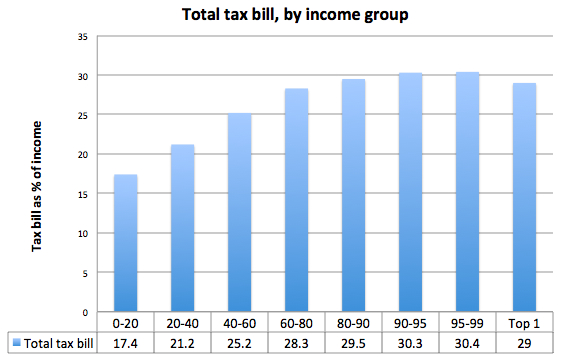
#4 Response.  What do you think the effective tax rate is by income group?  What percentage of income is paid in taxes for lower-income groups, middle and higher-income groups?  The tax burden is not just income tax but all taxes – sales tax, property taxes, etc.  And don’t claim that renters don’t pay property taxes.  Landlords pass the tax on to renters and likely more.

Gee, zealot, looking at tax burden by group indicates that the tax rate is surprisingly flat across all groups. Lower-income people pay a disproportionate amount of sales and property taxes as a percentage of income. The total for lower-income groups is almost 20% of income.  The highest groups are about 30%.  And these calculations were before the Trump tax cut which lowered taxes on the wealthy.

More to come. End #479.

Other Topics. Interested in more info about climate change, what’s required to electrify a fleet of cars/trucks, what it was like to work day-to-day with Lee Iacocca and an array of other topics? Visit another page of this website, https://usrevolution5.com/jrd-thought-comments/

#443 Why Are US Gas Prices Linked to Spot Prices?

20 Sunday Mar 2022

Posted by Jordan Abel in Common Sense Policies, Economics, Gov't Policy, Uncategorized

≈ Leave a comment

Welcome to a discussion about the upcoming 5th Revolution in the US, which I’ve titled the “Revenge Revolution.” For more about the Revenge Revolution and the author, Entry #1.  Periodically I write a “sense check” to assess whether a revolution in the US is possible or whether the entire exercise is based on a statistical aberration — i.e., a roughly 50-year cycle between major upheavals in the US. Entry #430 was the most recent “sense check.”

ENTRY #443 BEGINS: With the rise in gasoline prices, many politicians and their supporters are blaming the Biden administration for the price increases and also demanding that the Biden administration expand the number of leases on Federal land, including allowing drilling in the Artic National Wildlife preserve.  The rhetoric makes for good campaign soundbites, but who or what really determines the price of gasoline in the US? And, is there a more effective way to manage gas prices?

Crude oil is a commodity.  Like virtually every commodity, there is an exchange where contracts are negotiated and traded.  The price for a barrel of oil on the exchanges, aka “spot price, can fluctuate wildly based on how oil traders view the potential impact of world events on crude-oil supply and/or demand. The benchmark quality for these contracts is based on oil produced in West Texas (West Texas Intermediate) or the North Sea area (Brent crude).

In the US, pump prices for gasoline generally track changes in the spot price.  The spot price, however, bears almost no relation to the cost of production.

As the US has produced a larger share of domestic consumption, the rationale for linking the price of crude-oil as feeder stock to pump prices has been minimized, if not eliminated.  According to data from the US Energy Information Administration, for CY2021 the US exported more petroleum (crude oil and related products) than it imported – exports of 8.63 mmb/d vs. imports of 8.47 mmb/d. 

in CY2021 more than 50% of the imports were from Canada.  Some of the exports may be linked to trade agreements with other countries and/or to ensure that certain countries friendly to the US have a constant supply of oil and/or refined petroleum-based products.

Given the widespread concern within the US about fluctuating gasoline prices, why does the US continue to link gasoline prices at the pump to spot prices? Aside from the link benefiting the oil companies, either no one in Congress understands the issue or the oil lobby is in the pockets of many members of Congress, or possibly both.

Even if the US imported say 50% of daily consumption, one needs to ask whether it is necessary to link pump prices to spot prices. If the cost of 50% of gasoline is stable, then why does the pump price fluctuate solely based on the other 50%?

A solution to more stable pump prices would be to set a national price for gasoline (and diesel).  For discussion set the price without any taxes at $3.00/gallon.  Over time, the $3.00 price would be adjusted for inflation.  As is done now, the state and the Federal governments could add a tax to the $3.00/gallon price.

Would a fixed national price reduce supply of crude and gasoline? Businesses do not like uncertainty. The greater the uncertainty, the higher the required profit margin to compensate for the risk. The premium for uncertainty applies at each stage of the supply chain. The more stable or known the raw material cost for a product, the lower the premium for the finished product.

In the oil-and-gas business, most of the cost is incurred up front – exploration, leasing the land, drilling and installing equipment to operate the well. Improvements in processes and technology have reduced significantly the likelihood of a dry hole. Further, 3D imaging has increased the accuracy of the estimated size of the reservoir and the expected production rate.  Once in operation, the cost of extracting oil is minimal in most fields.

The Biden administration might be well served to conduct a comprehensive analysis of anticipated crude-oil supply based on different fixed prices.  Given the effectiveness of applying technology in exploration and drilling techniques, a safe bet would be US production could be maintained for many years extracting oil from existing fields and reopening abandoned fields. Further, with a known, or certain price for gasoline and possibly other refined oil products, US production likely would increase, not decrease.

With such a large domestic supply and production base, why does the US continue to allow the world spot price to have such an enormous impact on the pump price?  A fixed national price for gasoline and diesel (before tax) might be an example how the political parties can work together to solve real problems. The solution to managing gasoline pump prices might also eliminate some of the political divisions that seem to be making a 5th US Revolution more likely. ENTRY #443 ENDS

Other Topics. Interested in more info about climate change, what’s required to electrify a fleet of cars/trucks, what it was like to work day-to-day with Lee Iacocca and an array of other topics? Visit another page of this website, https://usrevolution5.com/jrd-thought-comments/  

#395 Post COVID-19 — How Do We Repurpose Human Capital? (Part 2)

28 Wednesday Oct 2020

Posted by Jordan Abel in Economics, Education Issues, Gov't Policy, Societal Issues, Tech Tsunami, Uncategorized

≈ Leave a comment

Readers: some of the dialogue in this blog is set in the future (sometime after the year 2020). Entries addressing events in the the future assume there has been a 5th revolution in the US — the Revenge Revolution. More about the Revenge Revolution, a list of earlier revolutions and the author, Entry #1.

Periodically I write a “sense check” to assess whether in the next few years, a revolution in the US is still possible or whether the entire exercise is based on a statistical aberration — i.e., a roughly 50-year cycle between major upheavals in the US.  Most recent sense check, ENTRY #387.  

Some of the entries are part of a series.  Several series are available as easy-to-read booklets for download:

  • Coming technology tsunami and the implications for the US, Tech Tsunami Booklet with Supplement
  • Working with Lee Iacocca after he left Chrysler, 2019Q3 Iacocca Personal Observations. 
  • GM EV1 — behind-the-scenes events affecting development and introduction of the GM EV1, the first modern electric vehicle. 2020Q1 GM EV-1 Story Behind the Story Booklet
  • Trump Supporters Brainwashed? A series discussing why Republics have abandoned basic principals, Are Trump Republicans Brainwashed 2020Q1  Related article published 10/07/20.  Op-Ed piece in NYT about how people bend their thinking to justify beliefs.  Example is Fox News Information about Covid-19, 20 10 07 Fox News Still in Coronavirus Bubble aka Brainwashed
  • Who took out the Donald?  Who/what groups are most likely to “take out” Trump? The booklet was written early in the Trump administration but still worth a read. Who Took Out the Donald Entries with Update
  • Revenge Revolution — description of what form the revolution might take, 20 01 07 Start of Revolution

Prelude to the current series of entries: I’ve concluded Trump is a lunatic and the administration filled with lapdogs save a couple of people at CDC.  Instead of wasting time commenting on actions by Trump, I thought it more productive to begin discussing what happens in the US once the coronavirus is more under control.  #378 began the series. At this point not sure how many entries.  Comments and suggestions welcome.

ENTRY #395: What has happened to unemployment during the Coronavirus? How severe is unemployment?

Counting the number of people who have filed unemployment claims paints a grim picture. Beginning March 2020, claims per week jumped dramatically.  Toward the end of March, new claims for unemployment for just one week  totaled nearly 7 million.  New claims per week have fallen since but seven months after the peak in March new claims are on average more than 3x higher than earlier on 2020.

Keep in mind these numbers are new claims. The numbers represent new people who are now unemployed. Obviously, some people who filed claims will be called back to work or find another job, but the net amount of those unemployed keeps increasing.  Further, throughout the 2020/2021 winter, the number of weekly new claims for unemployment is likely to remain extraordinarily high by historic standards.

What about the people who are self-employed?  You know, 1099 contract workers, consultants, musicians, even undocumented workers?  What’s happened to their workload?  They all pay taxes.

Contract, or gig workers, have seen jobs dry up as well. There is a provision in the CARES Act (Coronavirus Aid, Relief and Economic Security) that enables gig workers to file for a limited amount of economic relief.  The program is administered by states, which makes tracking claims nearly impossible. 

Nevertheless, if we add the number of gig workers seeking  CARES-based income supplement to those filing unemployment claims, the total likely exceeds 1,000,000 every week since early March 2020.  Like those employed by companies, the number of gig workers working fewer hours will increase during the winter.

Some may comment, “Is unemployment really that bad? I mean, the unemployment rate lately has been less than 10.0%. And it bounced back fast following the spike in the Spring.  Early in the Obama Administration, unemployment reached 10.0% and it took years to decline. What’s the big deal?  Trump’s done much better than Obama ever did.”

How Is the Unemployment Rate Calculated?  The unemployment rate is the ratio of those unemployed and looking for work to those in the workforce – those employed and unemployed.  Let’s say there are a thousand people in the workforce. 100 are unemployed and actively looking for a job and 900 are working. The unemployment rate would be 10.0%, or 100/1,000.

Now let’s assume that 50 of the 100 unemployed get discouraged and quit looking for a job. The new unemployment rate would be 50 actively looking for work / 950 (900 employed + 50 actively working), or 5.3%.

What happened to the unemployment rate?  The rate dropped from 10.0% to 5.3%, even though the only change was 50 people became discouraged and quit looking for work.  

What Else Does the Unemployment Rate Not Count? Let’s say that of the 900 people working, 200 are being forced to work part-time because their employer reduced their hours.  Even though working part time, the 200 are counted as “fully employed” when calculating the unemployment rate.   

So what’s the real unemployment/underemployment rate when one considers those who are only working part time and those who are so discouraged about finding another job they quit looking for work?  We know the rate is not 5.3%, which would be the official government number. 

The real rate is more like 30.0% — 200 underemployed, 50 unemployed and looking and 50 unemployed but who’ve quit looking.  In our example, there are 300 out of 1,000 who are either unemployed or underemployed and looking for more work.

If the numbers in this simple example seem ridiculously high, the 30.0% rate probably understates the true underemployment rate the US experiencing in Fall 2020.  Even for professional economists, calculating a reasonable estimate of unemployment/underemployment is nearly impossible because the Trump Administration refuses to disclose what most of us would consider any credible information about many parts of the economy.

As stated in Entry #394, the unemployment problem will not go away post COVID-19. During the initial lockdown to control the virus, organizations began to understand how to conduct operations with far fewer people than in the past. Consumers also began to think differently.

The change in thinking will affect some sectors of the post-COVID-19 economy more than others.  Portions of the service sector will be particularly hard hit.  Even with a vaccine, how many people will be willing to attend sporting events if there are thousands of other people jammed next to one another? How many people will be willing to eat in crowded restaurants, travel on crowded airplanes, ride jam-packed trains/buses, stay in unfamiliar hotels, go to amusement parks, etc.?  While we won’t know the extent for a number of years, assuming a 25-30% loss of pre-COVID-19 travel-and-entertainment-related jobs would be a reasonable estimate. 

Manufacturing output should rise post-virus but the number of jobs in manufacturing will continue to erode relative to output.  The trend will continue to replace workers with more automation, use of sophisticated software and robotics.

What’s the Solution? After mulling over this problem for a number of months, my conclusion is a two-pronged solution is necessary.

  1. WPA-like programs that focus on building/rebuilding critical infrastructure throughout the United States. Yes, such programs require lots of manual labor.  And no, such programs are not a long-term solution.  However, WPA-like programs will employ a portion of the workforce that will have an extremely difficult time transitioning to a digital-based economy. Plus, WPA-like programs will address much of the US infrastructure that needs repairing and upgrading.
  2. Repurposing many existing jobs.  Initial repurposing training for some jobs could be completed in 10-12 weeks.  The basic training would be followed by a job using the skills learned and additional on-the-job training (OJT). 

Will some of the jobs after basic training be considered “make work”? Yes, but any kind of training includes time to practice and expand basic skills.

When I joined General Motors following undergrad (many moons ago), I worked at Cadillac HQ in Detroit.  At the time the Clark Street Cadillac facility was huge, including two assembly line, paint shop, welding, full engine machining and a bunch of other stuff.  The campus totaled nearly 50 acres and included many buildings with 3-4 stories. Who knows how many million square feet of floor space.  For someone who likes cars and manufacturing, the facility was like one giant candy store.

My initial assignment was in a department called “Project Control.”  The department’s primary function was to evaluate various proposed expenditures – new equipment in Engine Machining Department, e.g.

Truth be known, most of my early assignments really were “make work,” since the guys in the department who’d been around awhile already knew the answer. But I’d be given an assignment and off I go to find some department located in this huge complex. 

The purposes of these assignments were: (i) can he find the way out to the department and back without getting lost too many times; (ii) help me begin to understand the breadth and depth of the complexity involved in manufacturing a car/truck; (iii) can he understand the scope and purpose of the proposed project and write a coherent recommendation?

What do I remember from those early days on the job? Frankly I do not remember any specific project. What I do remember is beginning to understand that manufacturing components for a vehicle and then assembling that vehicle is an incredibly complicated task, but also one that fascinates me to this day.

I also remember discovering all kinds of places in the plant to eat. One cafeteria, for example, had great pastrami sandwiches every Thursday. I also remember finding vending machines that dispensed ice cream bars. The bars would just fit inside the canister for the plant-wide pneumatic tube system.  While on these assignments one of my tasks might be to send ice cream bars back to the office via the tube system.

While some of those assignments were make-work, I think the learning from those assignments served me and GM well for my entire career. I’ve also applied many of the lessons learned to situations post GM.

Now back to the problem at hand.  How do we, societal we, train people to transition to a more digital economy?  First, we need to understand and appreciate that the training will not be completed overnight. We also need to understand that some of the projects, especially those early in the training cycle, will seem like make work. And, we also need to understand that some people will not be able to make the transition as effectively.

However, if we don’t start transitioning now, then the US will continue to fall behind countries with more advanced or more disciplined education systems and/or fall behind countries that have fully committed to a digital economy.  How do we truly make America great again?  To be continued, including some discussion about changes in approach to education, from K through grad school.

#394 Post COVID-19 — How Do We Repurpose Fixed Assets and Human Capital? (Part 1)

21 Wednesday Oct 2020

Posted by Jordan Abel in Economics, Education Issues, Gov't Policy, Societal Issues, Tech Tsunami, Uncategorized

≈ Leave a comment

Readers: some of the dialogue in this blog is set in the future (sometime after the year 2020). Entries addressing events in the the future assume there has been a 5th revolution in the US — the Revenge Revolution. More about the Revenge Revolution, a list of earlier revolutions and the author, Entry #1.

Periodically I write a “sense check” to assess whether in the next few years, a revolution in the US is still possible or whether the entire exercise is based on a statistical aberration — i.e., a roughly 50-year cycle between major upheavals in the US.  Most recent sense check, ENTRY #387.  

Some of the entries are part of a series.  Several series are available as easy-to-read booklets for download:

  • Coming technology tsunami and the implications for the US, Tech Tsunami Booklet with Supplement
  • Working with Lee Iacocca after he left Chrysler, 2019Q3 Iacocca Personal Observations. 
  • GM EV1 — behind-the-scenes events affecting development and introduction of the GM EV1, the first modern electric vehicle. 2020Q1 GM EV-1 Story Behind the Story Booklet
  • Trump Supporters Brainwashed? A series discussing why Republics have abandoned basic principals, Are Trump Republicans Brainwashed 2020Q1  Related article published 10/07/20.  Op-Ed piece in NYT about how people bend their thinking to justify beliefs.  Example is Fox News Information about Covid-19, 20 10 07 Fox News Still in Coronavirus Bubble aka Brainwashed
  • Who took out the Donald?  Who/what groups are most likely to “take out” Trump? The booklet was written early in the Trump administration but still worth a read. Who Took Out the Donald Entries with Update
  • Revenge Revolution — description of what form the revolution might take, 20 01 07 Start of Revolution

Prelude to the current series of entries: I’ve concluded Trump is a lunatic and the administration filled with lapdogs save a couple of people at CDC.  Instead of wasting time commenting on actions by Trump, I thought it more productive to begin discussing what happens in the US once the coronavirus is more under control.  #378 began the series. At this point not sure how many entries.  Comments and suggestions welcome.

ENTRY #394: Note: Yikes, the craziness of the Trump administration has continued the last couple of weeks. Trump and a substantial portion at his staff contracted the COVID-19.  After a few days hospitalization at Walter Reed Army Medical Center, and after taking a host of unapproved drug cocktails plus some steroids, Trump claimed that he was feeling better than any time in the last 20 years.  Must have been a rough 20 years.

Then, in only Trump fashion, he claimed getting COVID-19 was a blessing from G_d. Of course, who else would G_d choose to save the world from this scourge? Mother Teresa? An epidemiologist? No, the Harvard/MIT grad, Trump. Well, maybe Trump didn’t go to Harvard or MIT but just ask and he’ll tell you he’s a stable genius and one of G_d’s favorites.

A bit of irony was part of Trump’s treatment at Walter Reed included cells obtained from an abortion. Where was the outrage from Trump and the far-right about stem cells from an abortion? Cat apparently got their tongue.

More seriously, and the focus of this entry is the major restructuring of the US economy that’s going to occur whether or not there is a vaccine or even cure for COVID-19. The US is faced with an economic upheaval that may rival what occurred during the first and second phases of the Industrial Revolution.

Industrial Revolution Phase I started in earnest around 1800 with the introduction of machines and devices that replaced handcrafting. These machines could complete a task in a fraction of the time and with higher precision than the work done by hand.  Phase I also benefited from the refinement of the steam engine, which allowed the engine to power such mobile devices as a locomotive.  The locomotive enabled the creation of a railroad network to deliver goods to more locations.  Steam-powered tractors used in agriculture resulted in significantly higher output per man-hour of labor.

What I’ve labeled as Phase II of the Industrial Revolution started about 1900.  Two major breakthroughs: (i) introduction of the internal-combustion engine, which was smaller and lighter than a comparable output steam engine, and (ii) standardization of parts. Standardizing parts, originally developed by the rifle manufacturing industry for easy replacement in the field, was later adopted by manufacturers of transportation – automobiles, locomotives and aircraft.  Standardization enabled the use of assembly lines, which lowered labor cost per unit and increased quality.

Phase II also resulted in workers shifting from agriculture to manufacturing jobs.  The shift required workers to have a different set of skills, although for most workers skills required for jobs in manufacturing were limited and could be learned on the job. 

The vast majority of manufacturing companies, especially automotive, were based in the Northeast and Midwest, both of which experienced a major influx of immigrants and southern blacks leaving the farm.  While the manufacturing companies made enormous profits, hourly workers were not well paid until the companies faced work stoppages as the UAW and other unions gained membership.  Following WWII the economy steadily improved and wages for factory workers increased to the point that many enjoyed what could be called a “middle-class lifestyle.”

The plethora of well-paying manufacturing jobs began to erode in the 1980’s with the introduction of: (i) companies shifting production of goods to plants outside the US; (ii) robotics and somewhat later, artificial intelligence-based programs.

Rather than the disruption being caused by a change in required job skills, as seen in Phases I and Phase II of the Industrial Revolution, jobs were shifted outside the US due, in part, to: (i) US tax laws on corporations, which ended up favoring job shifts rather than penalizing job shifts; (ii) erroneous analysis of costs by the employer.  Shifting jobs outside the US accelerated further in the 1990s and by the early 2000s, a substantial number of manufacturing jobs had been shifted outside the US.

The analysis of costs justifying the shift to plants outside the US often focused primarily on labor costs per unit rather than a more holistic approach that accounted for all costs associated with manufacturing.  High labor costs were blamed on union contracts and therefore the only way to keep costs down was to move jobs to a different location.  But were labor costs really too high? 

Following is an example I experienced personally.  While the story is a data point of one, my experience is the thinking of the Board was fairly typical among many companies, large and small. 

One of my jobs post GM was running a company in northern California that assembled electric scooters.  When I took the job the Board said to shift assembly out of northern California (Sonoma County) to China, where labor costs were much lower.  I resisted and within seven months we had increased productivity (with virtually no capital expenditures) to a level where we could double the labor costs in California and pay the Chinese workers zero and it would have been cheaper to continue to produce in California.  Why?  When all related costs were considered, producing in Northern California – in the middle of wine country, no less – was cheaper.  Such a holistic approach to calculating costs apparently was not considered by many companies. 

In addition to being affected by jobs shifting elsewhere, many assembly and other semi-skilled workers in the US are facing another growing threat — robots. The increased use of robotics and AI represents a fundamental shift in how goods are designed, manufactured, assembled and processed for shipment.  The shipment of these goods to the buyer’s location is going to be disrupted as autonomous vehicles migrate from testbed demonstrations to daily use.    

As if implementation of technology were not enough of a formidable threat, these workers face yet another threat caused by COVID-19. To control the spread of the virus, many employers mandated that staff work from home. COVID-19 restrictions also forced many businesses to close, at least temporarily, although more and more businesses are closing permanently.

Within the service sector, the great unknown is to what degree travel and entertainment and supporting businesses will be changed post-COVID-19.  By the time the threat of the virus subsides, will a substantial portion of the population have become less interested in traveling on crowded airplanes, sailing on petri-dish-like cruise ships with hundreds of others, eating in crowded restaurants, or attending sporting events with tens of thousands of others? 

If so, then many assets supporting travel and entertainment will become obsolete – airplanes, hotels, restaurants, theme parks, cruise ships, large athletic stadia, etc.  Some of the buildings can be repurposed but what does one do with a surplus jet liner, cruise ship or football stadium? 

In the retail sector, the shift toward on-line shopping in not new.  For several decades, the brick-and-mortar retail sector has been facing disruption.  The shift toward internet sales, both personal and business, started to take hold in the late 1990s, early 2000s. While some of the shift to internet sales replaced transactions previously completed using 800#’s, most of the shift has been new.    

Restrictions associated with COVID-19 have been like a rocket ship propelling the shift forward.  In a manner of months, forced isolation may have accelerated on-line shopping patterns an amount that otherwise would have taken 10-20 years to achieve.  The shift to the internet and the number of store closings generate the question, “What to do with all the empty retail space?” 

Thus, any plan to stimulate the economy post-COVID-19 needs to address job creation as well as how to repurpose many assets associated with the service sector.  One assumption seems certain – the mix of output in US economy will be different post-COVID-19 than pre-COVID-19.  Making America great again will not be looking in the rear-view mirror and trying to recapture what once was.  The Pre-COVID economy and valuation of assets is as long gone as Wally and the Beaver.    

The US, and many countries worldwide, will have a blob of dislocated assets that have little or no value in their current configuration. Repurposing some of the fixed assets could be fairly straightforward.  Office buildings, shopping centers, many factories could be converted into housing, assisted living facilities and schools.  Converting shopping centers to housing seems ideal to help address the shortage of affordable housing in many cities. 

What do we do with surplus airplanes and cruise ships?  Beyond scrap metal, there’s not much use.  What about surplus infrastructure supporting the air-travel industry?  Some surplus airfields could become ideal recreation centers.  Or, the airfield could be reforested to support wildlife and help address global warming. 

The more difficult problem is how to repurpose human capital.  Without significant training, how do you take someone who was in a semi-skilled job – say an assembly plant or sewing clothing – and have the person perform in a job requiring a more advanced skill set?  How does society repurpose service workers, especially those in travel-related Industries? 

Even many semi-skilled, white-collar workers will be displaced post-COVID-19.  As organizations adjust to more remote working, some middle management jobs likely will be eliminated.

Repurposing the human assets is a daunting task for government and organizations.  In terms of required job skills, Phase III of the Industrial Revolution will be the opposite of Phases I and Phase II.  In Phases I/II new jobs often required less skill, or a skill that was relatively easy to learn on the job. 

Phase III job skills will be more advanced.  Robots and AI-based machines can replace many existing lower-skilled jobs.  OJT will be very difficult.  An example.  There is a company in Fort Wayne, IN that makes exhaust systems for many auto OEM’s.  The plant runs 24×7.  Despite the high output, the plant has few employees.

At first glance, bending pipe a few ways for an exhaust system seems simple enough.  However, the exhaust system might be different for the same model car/truck with a different engine.  Plus there are at least three different auto OEM’s serviced by this plant, which complicates production schedules. 

Bending pipe is a bit more complicated than it seems.  When pipe is bent, one side becomes thinner and the other side of the bend tends to crinkle. 

The Fort Wayne company’s solution to pipe bending and complicated production schedules is a highly automated process to bend the pipe and to change configurations automatically.  Most workers at the plant are skilled in computer programming.  There are no manual “pipe benders.”  The only non-skilled jobs are the lift-truck operators moving raw material to the beginning of and off the end of the line.  In a few years, the lift-truck operators could be replaced by autonomous lift trucks. 

For the US, post-COVID-19 the training of unemployed workers for new skills will be more difficult than repurposing fixed assets.  How do we approach solving this problem? More thoughts in the next entry.  For some guidance, see the existing write-up titled “Technology Tsunami.” (https://usrevolution5.com/wp-content/uploads/2020/01/tech-tsunami-booklet-with-supplement-1.pdf)

#389. Where Do We Go from Here? (#11 in Series)

27 Monday Jul 2020

Posted by Jordan Abel in Causes of the Revolution, Economics, Lessons of Revolution, Societal Issues, Uncategorized

≈ Leave a comment

Readers: some of the dialogue in this blog is set in the future (sometime after the year 2020). Entries addressing events in the The future assume there has been a 5th revolution in the US — the Revenge Revolution. More about the Revenge Revolution, a list of earlier revolutions and the author, Entry #1.

Periodically I write a “sense check” to assess whether in the next few years, a revolution in the US is still possible or whether the entire exercise is based on a statistical aberration — i.e., a roughly 50-year cycle between major upheavals in the US.  Most recent sense check, ENTRY #387.  

Some of the entries are part of a series.  Several series are available as easy-to-read booklets for download:

  • Working with Lee Iacocca after he left Chrysler, 2019Q3 Iacocca Personal Observations. 
  • GM EV1 — behind-the-scenes events affecting development and introduction of the GM EV1, the first modern electric vehicle. 2020Q1 GM EV-1 Story Behind the Story Booklet
  • Coming technology tsunami and the implications for the US, Tech Tsunami Booklet with Supplement
  • Trump Supporters Brainwashed? A series discussing why Republics have abandoned basic principals, Are Trump Republicans Brainwashed 2020Q1
  • Who took out the Donald?  Who/what groups are most likely to “take out” Trump? Who Took Out the Donald Entries with Update
  • Revenge Revolution — description of what form the revolution might take, 20 01 07 Start of Revolution

Prelude to the current series of entries: I’ve concluded Trump is a lunatic and the administration filled with lapdogs save a couple of people at CDC.  Instead of wasting time commenting on actions by Trump, I thought it more productive to begin discussing what happens in the US once the coronavirus is more under control.  #378 began the series. At this point not sure how many entries.  Comments and suggestions welcome.

ENTRY #389: We are approaching the end of July 2020. Fewer than 100 days until the presidential election.  What’s happening? Just a bit.

  1. Coronavirus remains unchecked in many locations
  2. No clear strategy from the White House yet addressing the Coronavirus
  3. Growing effort to ban the Confederate flag and to remove statues honoring generals who fought against the US
  4. Growing effort to rename buildings, sports teams, schools, organizations and brand-name products that some group might consider offensive
  5. Sending non-uniformed federal troops to various cities to arrest often peaceful protestors.  Trump ordered the troops “to protect the cities from destruction.”  Of course, troops were sent only to cities with Democratic mayors.  None of the mayors asked for the troops.
  6. Sputtering economy that may beginning to backslide.  Meanwhile, Senate Republicans are so divided they cannot come to agreement on a stimulus package.
  7. Cancelling the Republican Convention in Jacksonville, Florida that Trump insisted on moving from Charlotte, NC because the NC governor had mandated rules for wearing masks and limiting the number of people who could gather in public places.
  8. Icing on the cake is both humorous and tragic.  Last week Trump was bragging to Fox News about how he “aced” a test designed to detect likely onset of Alzheimer’s.  His remarks were pathetic but memorable.  Trump claimed remembering five words, “Person, woman, man, camera and TV,” qualified him as an incredibly smart person.  Donald, I hate to tell you, a 5-year old can do the same thing, and the 5-year old can also identify an elephant.

Widespread uncertainty in any environment tends to lead to widespread chaos. No one in the White House, no one in Congress and certainly no one in the public, knows what’s next. Nor does anybody in the Trump administration seem to know how to fix the current problems, or even care about fixing current problems.

The most clear-cut answer to reduce the risk of contracting and to reduce the number of cases of the coronavirus comes from an epidemiologist who merely states facts – wear a mask and stay 6’ away from others.  However, even such a simple gesture from a highly trained professional has been met with strong resistance, starting with the Trump administration.  Finally, this past week, Trump suggested wearing a mask might be OK, although not for him.

In a series of earlier entries, I noted that many Trump supporters seem to be brainwashed. If there were ever a concrete example of brainwashing, the refusal to wear a mask is it.  One does not need an epidemiological degree to understand a face covering will slow penetration of inbound/outbound particles.

I wonder if any of these Republicans have ever watched the movie, “Lawrence of Arabia”.   Trumpsters, why do you think the guys riding in the desert on horseback and on camels covered their face with scarves? Without a scarf, blowing sand tends to get in the mouth and nose, and really doesn’t taste great.

Wearing a mask reduces the dispersion of particles when you breathe, cough or sneeze, thereby reducing the likelihood of contaminating others.  But since Trump has implied and even stated masks are for wimps, or at least he did so until only a day or so ago, no self-respecting brainwashed Republican wants to be seen wearing a mask.

In their brainwashed state, Republicans don’t need a mask because they are immune from the coronavirus. Only liberals need masks, and who cares if liberals are infected because of some Republican?

The two ends of “should-I-wear-a-mask?” spectrum were highlighted in a couple of recent Facebook posts. One post equated forcing people to wear masks in public locations as similar to Nazi’s forcing Jews to wear a yellow star. Not even remotely a legitimate comparison. But the guy who posted the entry is a hardcore Trumpster.

The other extreme regarding wearing a mask was lighthearted. The post was a quote, “Walmart is only asking you to wear a mask. You can still wear your pajamas and still leave your bra and your teeth at home.”

While Trump politicizing wearing a mask is baffling, even more baffling is the effort by the Trump administration to reduce funds allocated for testing the public for infection. Using Trump’s logic, if there are no tests, then the number of reported infections will decline. The decline in infections will prove that Trump has done a great job addressing the issue. Welcome to logic in Trump World.

Let’s put the brainwashed Trumpsters aside, and address the economy post coronavirus and post Revenge Revolution. The Coronavirus has been the catalyst for accelerating the shift to a new economic model.

In the post-coronavirus world, wealth will still be created the way wealth has always been created – integrating and/or processing individual components so the end product is more valuable than the individual components – aka, manufacturing. Manufacturing categories include a wide range of industries — farming, mining, automotive, software development, construction, etc.

The GDP also includes non-manufacturing categories, or “services.” Services include such industries as travel-and-entertainment – hotels, casinos, air travel, cruise ships – food service, retail, banking, professional services, including medical, and a host of other occupations. Think of services as “transferring money from one pocket to another.”  While many services are essential and generate many jobs, no societal wealth is created with the transfer of money between pockets.  However, services can result in individuals or companies becoming wealthy.

Like all past major shifts in the economy – agrarian to industrial, e.g. – some individuals and some companies will benefit. Other individuals and companies will be left behind and lose wealth. The shift often can be swift and brutal.  An example is the shift from steam-powered locomotives to diesel locomotives in the 1930’s.  Within a few years of introduction, diesel locomotives dominated and production of steam locomotives stopped.

Unfortunately, when these economic shifts occur, some in society will be hard hit.  If we use the experience of workers during the coronavirus shutdown as a proxy, then workers most at risk might be those in the middle – jobs above entry level that require some level of advanced education but not jobs that require skills for critical thinking.

During the coronavirus shutdown, many people in the United States got a surprise.  Critical workers included grocery-store clerks, sanitation workers, emergency-response teams, transit workers and other seemingly out of the limelight, lower-paid employees. While society was surprised about which jobs were “critical,” organizations discovered that many employees were in fact, “non-critical.”  Such workers included certain clerical staff, middle managers, sales staff, and other support personnel.

An open question in the post-coronavirus economy is what happens to central cities or other areas where offices are clustered? If people continue to work from home, and only need an office part-time, and if support staffs are reduced, what happens to all the office buildings in say Manhattan, Chicago, Los Angeles, etc.? What happens to the infrastructure – subways and light rail – restaurants and other jobs dependent upon office workers?

People still need space to work and food to eat. However, will those working at home look for a somewhat larger house? Will those working from home begin to order in more meals rather than going to nearby restaurants?

While the future of the economy and future size and style of homes are uncertain, one certainty is the United States and other developed countries are going to face huge dislocations and changes to the norm. Covid-19 accelerated the arrival and intensity of the technology tsunami. The next decade is going to be a wild ride. (More about coming technology tsunami, Tech Tsunami Booklet with Supplement.)

One variable sitting on top of the economic and social changes post coronavirus is action required to mitigate the impact of climate change.  The argument is moot whether climate change is natural or man-made.  Climate change is here and is not going away.

Next blog entry we’ll discuss how some proposed actions to address climate change might cause further economic and social dislocations.  Stay tuned.

#383 Job Creation to Address Climate Change

25 Monday May 2020

Posted by Jordan Abel in Affordable Solutions, Common Sense Policies, Economics, Gov't Policy, Societal Issues

≈ Leave a comment

Readers: this blog is set in the future (sometime after the year 2020). Each entry assumes there has been a 5th revolution in the US — the Revenge Revolution. More about the Revenge Revolution, a list of earlier revolutions and the author, Entry #1.

Periodically I write a “sense check” to assess whether in the next few years, a revolution in the US is still possible or whether the entire exercise is based on a statistical aberration — i.e., a roughly 50-year cycle between major upheavals in the US.  Most recent sense check, Entry #365.  

Some of the entries are part of a series.  Several series are available as easy-to-read booklets for download:

  • Working with Lee Iacocca after he left Chrysler, 2019Q3 Iacocca Personal Observations. 
  • GM EV1 — behind-the-scenes events affecting development and introduction of the GM EV1, the first modern electric vehicle. 2020Q1 GM EV-1 Story Behind the Story Booklet
  • Coming technology tsunami and the implications for the US, Tech Tsunami Booklet with Supplement
  • Trump Supporters Brainwashed? A series discussing why Republics have abandoned basic principals, Are Trump Republicans Brainwashed 2020Q1
  • Who took out the Donald?  Who/what groups are most likely to “take out” Trump? Who Took Out the Donald Entries with Update
  • Revenge Revolution — description of what form the revolution might take, 20 01 07 Start of Revolution

Prelude: I’ve concluded Trump is a lunatic and the administration filled with lapdogs save a couple of people at CDC.  Instead of wasting time commenting on actions by Trump, I thought it more productive to begin discussing what happens in the US once the coronavirus is more under control.  #378 began the series. At this point not sure how many entries.  Comments and suggestions welcome.

ENTRY #383 BEGINS: Is there a simple, understandable way to get virtually everyone in the United States to support actions to address climate change? Secure support from the left, right, center, techies, climate deniers, etc.?

My conclusion is, “yes.” The simple approach is to link climate action to job creation.

Post-CIVID-19, the US is likely to experience an unemployment rate of 10+% for at least five (5) years, if not longer. Many pre-COVID-19 jobs will be lost permanently.

How does the US re-energize the economy post COVID-19? Focus on creating jobs associated with technologies that will reduce carbon emissions. Not just jobs installing solar panels and putting up wind generators but a wide range of jobs.

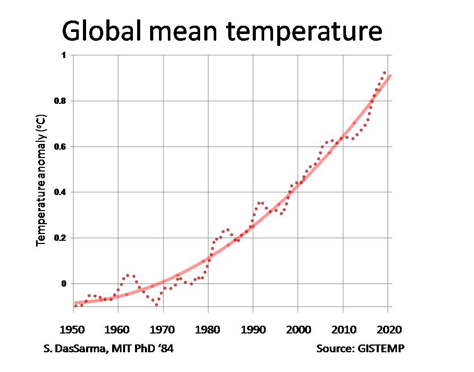
There are numerous technologies that could be implemented to reduce carbon emissions. Why point fingers about who’s right and who’s wrong about the causes of climate change? If you think climate change is fake news, then you need to talk to people worldwide in coastal cities. If you think climate change is just part of the earth’s natural warming and cooling cycle, then take a hard look at the chart of temperature change just since 1950.  Now imagine that same amount of increase by the end of the century.

OK, even if you don’t believe the climate data, the US still has a major problem – and that long-term economic growth. Don’t believe the economy is going to return to pre-COVID days. Look in your history books and study what’s happened after every major economic disruption or war – things change dramatically. Post-COVID-19 will be no different.

So let’s begin thinking about how to create new products and new jobs that also reduce the impact of climate change. If you’re still in denial about climate change, then just focus on the job creation part.

Yes, science is sometimes difficult to understand. Science denial is also a major talking point with many politicians.

Job creation, however, is not hard to understand. Jobs generate income and help people to a better life. Job creation also appeals to both sides of the political aisle. Rather than blaming someone else, why not start asking, “Is there a way to stimulate the economy long-term and address climate change? Is there a way to ensure a better lifestyle for our children and grandchildren”?

In this discussion, seems that scientists might be better off to spend less time on CO2 PPM, mean temperature – for many people it is difficult to understand or appreciate what a couple of degrees Celsius means – loss of amphibians, greater intensity of hurricanes, etc. Important topics? Yes. But not a front-line topic when you’re out of a job, which many people are going to be for some time.

Making the message about actions to address climate change more positive and less about how people must be prepared to “sacrifice” is also not necessary. With the right technology, people won’t experience sacrifice.

What’s the sacrifice with a more efficient HVAC? An electric lawn mower? (I use a manual push mower and time to cut is about the same as the neighbor’s gas-powered mower.) An electric car? Attractive solar panels on the roof that look like shingles? More trees? And many other ways to reduce CO2 that are not “sacrifices” and can be configured as fun, new products.

Some groups are working on taking a more jobs-focused approach to help gain support for actions to address climate change. I’m part of such a group. Let me know if you’d like to learn more. Comments welcome, as always.

#382 Religious Institutions: Next Big-Box Stores? (con’t) (We Gotta Get…Part 5)

16 Saturday May 2020

Posted by Jordan Abel in Economics, Innovative Thinking: Ideas and Products, Societal Issues, Uncategorized

≈ Leave a comment

Readers: this blog is set in the future (sometime after the year 2020). Each entry assumes there has been a 5th revolution in the US — the Revenge Revolution. More about the Revenge Revolution, a list of earlier revolutions and the author, Entry #1.

Periodically I write a “sense check” to assess whether in the next few years, a revolution in the US is still possible or whether the entire exercise is based on a statistical aberration — i.e., a roughly 50-year cycle between major upheavals in the US.  Most recent sense check, Entry #365.  

Some of the entries are part of a series.  Several series are available as easy-to-read booklets for download:

  • Working with Lee Iacocca after he left Chrysler, 2019Q3 Iacocca Personal Observations. 
  • GM EV1 — behind-the-scenes events affecting development and introduction of the GM EV1, the first modern electric vehicle. 2020Q1 GM EV-1 Story Behind the Story Booklet
  • Coming technology tsunami and the implications for the US, Tech Tsunami Booklet with Supplement
  • Trump Supporters Brainwashed? A series discussing why Republics have abandoned basic principals, Are Trump Republicans Brainwashed 2020Q1
  • Who took out the Donald?  Who/what groups are most likely to “take out” Trump? Who Took Out the Donald Entries with Update
  • Revenge Revolution — description of what form the revolution might take, 20 01 07 Start of Revolution

Prelude: I’ve concluded Trump is a lunatic and the administration filled with lapdogs save a couple of people at CDC.  Instead of wasting time commenting on actions by Trump, I thought it more productive to begin discussing what happens in the US once the coronavirus is more under control.  #378 began the series. At this point not sure how many entries.  Comments and suggestions welcome.

ENTRY #382 CONTINUES ENTRY #381: Technology Tsunami Impact. Efforts to address the coronavirus accelerated the implementation of technology in a wide variety of occupations. Going forward many US workers will be affected by what some of us have labeled the “technology tsunami.”

The negative effect on income over the next few years could be much greater than previously anticipated. During COVID-19 “stay-at-home” mandates, organizations realized certain workers were not necessary and other work could be completed using artificial intelligence-based software/hardware. As a result, even as the economy begins to recover, more blue-collar and white-collar workers of all ages are going to be faced with possibly accepting a lower-paying job or no job.

Will workers of different age cohorts be affected differently by the technology tsunami[1]? How will religious institutions be affected? Workers currently age 50+, even though they should have more financial resources, may be hit harder by the technology tsunami since many are less familiar with advanced technology and they have fewer years before retirement to try and recoup lost earnings.

Double-Whammy Tsunami. Another tsunami headed toward US shores is the retirement tsunami. What we as a society don’t talk about and certainly what has not been addressed at the Federal level is how unprepared white and blue-collar workers are for retirement.

The retirement tsunami has been caused in large part by employers eliminating employer-funded defined-benefit retirement programs and transferring to workers the responsibility for accumulating adequate savings for retirement. The potential impact of the tsunami has been made worse by erosion of personal income from the accelerating cost of housing, medical and college tuition. Workers have far less left over to save for retirement.

In a recent poll by Center for Retirement Research at Boston College, 75%, or 3 out of 4 people age 50-62 had jobs that fell into a “non-traditional” category — meaning, those without employer-provided retirement plans and health insurance. According to the report, workers in non-traditional jobs can expect their retirement income to be as much as 26% lower than that of people who spent their 50’s and early 60’s in positions with full benefit packages, according to the center’s findings.

The lower available income will likely affect consideration for contributions to religious institutions. (An article in the NYT 05/03/2020 described how some underfunded retirees are moving in with their children.)

What about the impact of the technology and retirement tsunamis on the finances of younger workers? Don’t they have 30-35 years to recoup lost earnings from a coronavirus economic slowdown? Unfortunately, a greater percentage of younger age cohorts are likely to be even less prepared for retirement than those currently age 50-62.

If costs for housing, medical, education and retirement continue to exceed gains in income, the cumulative effect will erode discretionary income further. Unless there is a fundamental change in funding of health care costs, retirement programs and advanced education, more and more people will be underfunded for retirement. Thus, younger cohorts, already less committed to religious institutions than previous generations at the same age, are also facing even more pressures on discretionary income.

What will make a bad situation worse is a prolonged economic slump associated with the coronavirus shutdowns. The rate at which people have been furloughed is unprecedented – in just two months, 36,000,000 filed new claims for unemployment, and more claims are likely in the next few weeks. In early May 2020 the “official” unemployment rate was 14.7%. However, the unemployment rate does not count those who are not actively looking for work.

The unprecedented increase in the number of people formerly employed has caused many to become so discouraged as to not look for work. These “discouraged” were excluded from the unemployment calculation. Had people who were recently employed but now discouraged been included, the rate would have been 21-22%, approximating the same as the height of the Great Depression in the 1930’s.

Despite proclamations from Trump, few people in business, few economists and few in the general public expect the economy to bounce back once more restrictions associated with the coronavirus are lifted. Even if employment in the manufacturing sector increases over the next 24-30 months as companies begin bringing jobs back to the US, overall economic growth will be very slow and unemployment is likely to remain at >10%.

Some portions of the service sector employment seem likely to experience a permanent loss of jobs. After “stay-at-home” restrictions are lifted, how many consumers will immediately return to restaurants, attend sporting events, go to shopping centers, travel by plane? How many members of religious institutions will be willing to risk infection by attending services, especially crowded during holidays?

Like the general public, members of religious institutions are likely to remain cautious until an effective vaccine has become widely available – on the optimistic side 18-24 months based on analysis of experienced doctors and researchers. Even with the vaccine will the public’s behavior be changed permanently?

During that 18-24 months and maybe forever, how many members of religious institutions will have their economic circumstances negatively affected? Many formerly employed in the service sector will not have employer-funded health insurance and even fewer will have an employer-funded retirement program. Where do these former employees turn for help? Their jobs are gone, or at least not coming back for some time. Finding another job will be extremely difficult since the economy will be growing slowly at best.

While many congregants will remain emotionally committed to their specific religious institution, how many will be faced with lower discretionary income? How many will be able to continue supporting their church, synagogue or mosque?

Eyeballs vs Butts in Seats – Post Coronavirus Behavior. The “stay-at-home” mandate associated with the coronavirus forced organizations to accelerate electronic communications using Zoom, Skype, FaceTime, etc. For religious institutions many people attending services in person pre-COVID-19 are now live-streaming. But what happens post-COVID-19? How many people will forego physically attending services and choose to continue live-streaming?

How many will ask, “Why go through the hassle of getting dressed, fighting traffic, when I can relax at home?” Further, how many will ask, “If I’m going to live stream, is there a service at another location that I would rather attend? I used to live in New Jersey, what about watching the service where I used to go?”

An issue for religious institutions is how to make live-streaming a reason to remain linked to a particular congregation. Live-stream services are somewhat like a media event. The target for live-streaming is capturing as many eyeballs as possible.   The trend toward live-streaming is likely to continue. Think about the difference between generations in comfort level with certain media venues.

While the risk is relatively small now, a concern with live-streaming is whether a religious institution’s service can be “competitive” with larger, more high-profile congregations. For a specific institution, if clergy and/or the Board of Directors has not done so, they should watch services from “higher-profile” congregations, especially those in major metro areas.

Religious Institutions Expense Pressure. Are religious institutions turning into under-utilized big-box stores? If fewer people attend services, whether weekly or during holidays, then do religious institutions need their current facility? Some congregations have expanded main buildings and/or other facilities based on the assumption membership would continue to grow. Part of the rationale has been that a more attractive and functional facility would help attract new members.

The downside of a larger facility is a higher burn rate for overhead, including staff. The larger facility also requires additional non-recurring expense for replacement of equipment and other critical maintenance.

A strategy sometimes employed when expenses exceed revenue is to defer maintenance expense and/or defer setting aside adequate funds for future maintenance and equipment replacement. While such a strategy might work for a year or two, kicking maintenance costs down the road increases the financial burden on future congregants, many of whom may be less prone to support the institution.

Are many religious institutions facing the same fate as many big-box stores? Unfortunately, all indications suggest the answer seems to be “yes.” Big-box stores and department stores, even high-end ones are facing severe financial pressure. The impact of actions taken to slow COVID-19 have merely hastened a trend toward fewer stores and, in many cases, bankruptcy. Well-known department stores J.C. Penny and Neiman-Marcus being a recent examples.

Possible Solutions. Some organizations – for-profit and not-for-profit – have survived major challenges by rethinking how to operate. Religious institutions face the choice – either rethink how to operate or likely disappear.

Survival for many religious institutions seems possible only by starting with a clean sheet of paper. Rethinking how to operate means more than cutting staff. Cutting staff is an incremental change and not a fundamental change. Clergy and the Board of these institutions should remember the adage, “No organization ever saved its way into prosperity.”

An organization needs to consider ideas that many congregants might view as radical. For example, holding talks with another congregation about: (i) a single back-office support staff: (ii) using one of the two buildings for weekly services. The services would be at separate times but use the same building. Holiday services could be at different times and use part of the other building, if necessary; (iii) lease out part of one of the buildings; (iv) plus other ideas.

The radical thinking should include a cash-flow forecast that incorporates such variables as:

  1. Number of existing members by age cohort
  2. Number of members by age cohort over time (some data likely exist)
  3. Distribution of contributions by age cohort – currently and ideally over time. Individual members would be assigned a random number so impossible to link contribution to a specific member
  4. Projected membership scenarios through 2030 and ideally 2050 by age cohort – would include new members and members who leave
  5. Projected revenue scenarios through 2030 and ideally 2050 by age cohort. Scenarios would reflect different attitudes by cohort toward religion and use of electronic communication. Revenue projections would include different approaches – “traditional’ approach to contributions, pay to watch live-streaming or some type of subscription model.
  6. Impact on revenue of different operating scenarios – stand-alone entity, combined facility, use of part of one facility for other purposes, etc.
  7. Expense forecast by year for:
    1. Staff and other recurring expenses as stand-alone entity and combined back-office staffs
    2. Unusual maintenance and equipment replacement – current and joint-use facility
    3. Expenses under the different operating scenarios

Constructing an Excel-type model (and the supporting math) for the financial projections is not particularly difficult.   Often the most difficult barrier is getting the “key executives” and/or committee members involved with the issue to: (i) acknowledge and appreciate the importance of getting ahead of the curve; (ii) begin to truly think innovatively; (iii) put aside excuses and biases and commit to considering practical solutions.

As with most strategic difficult issues, waiting until the problem becomes obvious is waiting too long and makes any kind of turnaround exceedingly difficult and problematic. A high-profile example is the Trump administration’s handling of COVID-19, starting with denial of early warning signs and then refusing to accept opinions of people with experience in key areas.

Over the next 24-36 months – and maybe longer – many religious institutions will face severe cash-flow shortfalls. Waiting until the cash-flow train wreck becomes obvious will result in even more dire consequences. While no guarantee, starting to discuss issues outlined herein and completing a study to assess potential consequences carries no risk. There is no downside to a study. Waiting until the problem becomes obvious has significant risk.

[1] For a more detailed discussion about the coming technology tsunami and possible solutions, download booklet I wrote titled “Technology Tsunami.”


#381: Religious Institutions Next Big Box Stores? (We Gotta…Part 4)

09 Saturday May 2020

Posted by Jordan Abel in Causes of the Revolution, Economics, Societal Issues, Uncategorized

≈ 1 Comment

Readers: this blog is set in the future (sometime after the year 2020). Each entry assumes there has been a 5th revolution in the US — the Revenge Revolution. More about the Revenge Revolution, a list of earlier revolutions and the author, Entry #1.

Periodically I write a “sense check” to assess whether in the next few years, a revolution in the US is still possible or whether the entire exercise is based on a statistical aberration — i.e., a roughly 50-year cycle between major upheavals in the US.  Most recent sense check, Entry #365.  

Some of the entries are part of a series.  Several series are available as easy-to-read booklets for download:

  • Working with Lee Iacocca after he left Chrysler, 2019Q3 Iacocca Personal Observations. 
  • GM EV1 — behind-the-scenes events affecting development and introduction of the GM EV1, the first modern electric vehicle. 2020Q1 GM EV-1 Story Behind the Story Booklet
  • Coming technology tsunami and the implications for the US, Tech Tsunami Booklet with Supplement
  • Trump Supporters Brainwashed? A series discussing why Republics have abandoned basic principals, Are Trump Republicans Brainwashed 2020Q1
  • Who took out the Donald?  Who/what groups are most likely to “take out” Trump? Who Took Out the Donald Entries with Update
  • Revenge Revolution — description of what form the revolution might take, 20 01 07 Start of Revolution

Prelude: I’ve concluded Trump is a lunatic and the administration filled with lapdogs save a couple of people at CDC.  Instead of wasting time commenting on actions by Trump, I thought it more productive to begin discussing what happens in the US once the coronavirus is more under control.  #378 began the series. At this point not sure how many entries.  Comments and suggestions welcome.

ENTRY #381: The future of religious institutions is being influenced by three factors over which the institutions have no control. These exogenous variables directly affect the near and long-term financial viability of many such institutions:

  1. Changing membership demographics, especially less favorable attitudes by younger generations toward religion
  2. Downward pressure on family discretionary income from multiple sources
  3. Migration to more electronic communication, in part because of sustained concern about large gatherings post coronavirus

The pressures will intensify in the coming years. Without some fundamental strategies to address the effects of these pressures, many religious institutions could become financially insolvent and forced to dissolve. Further the pressures are not specific to one or two religions. All religions are likely to be affected.

Demographic Pressure. There are numerous articles and studies (Pew Research, e.g.) indicating younger generations are less attracted to religions of all types. The younger generations also attend services less than previous generations at the same age.

When viewing the data, some believe that as younger generations age they will act more like their parents and grandparents, thus “adopting” much of the behavior of previous generations. By adopting attitudes and behavior of previous generations, these younger cohorts, therefore will become more favorable to religion and more supportive of religious institutions.

The clergy and the “Board of Directors” of a religious institution should not make the assumption re “adopting behavior.” One only needs to track age cohorts over time to realize younger age cohorts do not adopt the attitudes of their parents’ generation when they reach the same age.

Rather than adopting behavior, empirical evidence suggests cohorts “retain” attitudes and behaviors established in their early twenties. Some examples of “retaining” values range from attitudes of different generations toward such social issues as use of drugs, casual sex, age for marriage to preferred brands of vehicles to preferred style of house and furniture. One only has to ask “What happened to the appeal of darker-wood furniture as well as fine china and crystal with the generations under age 40″ to realize tastes and preferences are different?[1]

Pressure on the Revenue Stream.  Since roughly the mid-1960’s each succeeding age cohort has been faced with increased pressure on discretionary income[2]. Every religious institution should assume one or more of these pressures on discretionary income will continue, thereby making it more difficult for families to provide financial support. Pressures are:

  1. Medical costs increasing faster than income
  2. Housing prices (and rents) increasing faster than income
  3. College tuition increasing at a rate much faster than inflation and income
  4. Retirement savings burden being transferred to employees as employer-funded defined-benefit retirement programs have been eliminated

The economic pressures caused by each one of these factors probably could be managed by most families. However, when the increases in all factors are combined – each one has a similar pattern of costs outpacing income – the result is a significant erosion in discretionary income.  

A real-world example of the impact of these pressures was evident during a recent PBS News Hour broadcast. An ER- vehicle technician in New York City described the mental and economic pressures associated with the coronavirus. The interviewer asked the ER technician about salary – about $40,000 per year. As anyone familiar with the cost of living in any of the NY boroughs, $40k for a family is tight. Worse for the technician was that his employer, apparently a contractor to the City of New York, did not provide health insurance.

Here’s the guy taking people to the hospital to get treated for coronavirus (or some other emergency) but who does not have employer-paid health insurance. Even worse the technician can’t afford private health insurance because the Trump administration eliminated many features of Obamacare and eliminated insurance exchanges.

Housing Prices/Monthly Rental. The chart is for price increases of houses and rent compared to growth in median income, adjusted for inflation. While the data are national, people living in some metro areas have faced the problem of housing prices-HOA dues/rents and insurance rising even faster than noted on the chart.

Real estate taxes are also increasing. Although relatively low compared to NY/NJ/CT, housing costs and taxes in many areas are still high and a further erosion of discretionary income.  These costs result is less money available for contributions to a given institution.

College Costs. Since the 1960’s, early 1970’s tuition at public and private colleges has more than doubled as a percent of family income in inflation-adjusted dollars. Costs for elite universities have increased even faster. Even with some assistance, overall costs for higher education are likely twice as high as a percent of family income over the past couple of generations. The impact of the coronavirus may make the disparity worse. Tax revenue in virtually every state has fallen dramatically. To balance future budgets states may need to cut support for higher education.

End of this entry. More next week about the impact on contributions of: (i) technology replacing jobs; (ii) retirement savings shortfall; (iii) electronic “competition” from other religious institutions.

[1] For more analysis of “adoption” and “retention” please download paper I wrote at University of Michigan in 1987 titled “A Nation in Transition.” The paper addressed how differences in attitudes between pre-Boomer and Boomer cohorts could affect how America would view its role internationally. The paper included a comparison of a variety of attitudes. (87 12 08 Nation in Transition) 

[2] Discretionary income is the amount of an individual’s income left for spending after paying taxes and paying for personal necessities, such as food, shelter and clothing. Discretionary income includes money spent or allocated to luxury items, vacations and non-essential good/services, including contributions.

#375 Leadership in a Crisis: Chaos or Confidence?

21 Saturday Mar 2020

Posted by Jordan Abel in Causes of the Revolution, Economics, Federal Budget, Gov't Policy, Stupid Is as Stupid Does, Uncategorized

≈ Leave a comment

Readers: this blog is set in the future (sometime after the year 2020). Each entry assumes there has been a 5th revolution in the US — the Revenge Revolution. More about the Revenge Revolution, a list of earlier revolutions and the author, Entry #1.

Periodically I write a “sense check” to assess whether in the next few years, a revolution in the US is still possible or whether the entire exercise is based on a statistical aberration — i.e., a roughly 50-year cycle between major upheavals in the US.  Most recent sense check, Entry #365.  

Some of the entries are part of a series.  Several series are available as easy-to-read booklets for download:

  • Working with Lee Iacocca after he left Chrysler, 2019Q3 Iacocca Personal Observations. 
  • GM EV1 — behind-the-scenes events affecting development and introduction of the GM EV1, the first modern electric vehicle. 2020Q1 GM EV-1 Story Behind the Story Booklet
  • Coming technology tsunami and the implications for the US, Tech Tsunami Booklet with Supplement
  • Trump Supporters Brainwashed? A series discussing why Republics have abandoned basic principals, Are Trump Republicans Brainwashed 2020Q1
  • Who took out the Donald?  Who/what groups are most likely to “take out” Trump? Who Took Out the Donald Entries with Update
  • Revenge Revolution — description of what form the revolution might take, 20 01 07 Start of Revolution

Prelude: there is an endless number of inconsistencies in information from the Trump administration about the spread of the coronavirus and/or actions to mitigate the spread. Rather than beat a dead horse, I’ve chosen a few that are representative but not necessarily the most egregious.

ENTRY #375 BEGINS: During the Great Depression FDR understood that instilling hope in people would help bring the country together and help reduce the likelihood of societal chaos. FDR started his first term by stating, “The only thing we have to fear is fear itself.”

FDR followed his inaugural address with a series of “fireside chats,” during which he outlined problems and proposed solutions. (If you’ve never heard any of the “fireside chats,” they’re available on the internet.) The fireside chats helped build confidence in the capabilities of the Roosevelt administration and a foundation of hope in a time of great uncertainty.

The umbrella for recovery from the Great Depression was called the “New Deal.” The New Deal included a series of programs to provide work and income (and self-respect) for all types of unemployed workers. The New Deal work programs – WPA, CCC, and many others – included significantly expanding infrastructure in the United States, which laid the groundwork for economic growth for many decades to come.

The lesson of FDR’s understanding of creating hope and maintaining self-respect seems to have been lost on the Trump Administration. Whereas the cause of society’s uncertainty today is different than during the 1930’s, the importance of instilling hope in society and avoiding instilling fear remains the same.

Unfortunately, since day #1 in office, Trump has promoted chaos and fear. Even cabinet members who were selected because of a relationship with Trump, have been cast aside for daring to disagree with Trump. As noted in several previous entries (#374 is an example), the result of Trump‘s management style has been a cabinet that is filled with incompetents.

Trump has also consistently displayed incompetence on substantive issues. The combination has reduced people’s confidence in the ability of government to manage crises. What about the public’s confidence in the competence of the White House in dealing with the coronavirus? Did Trump take the approach of FDR and layout problems and proposed solutions?

In a press conference March 20, 2020, a reporter asked Trump and Mike Pompeo, Secretary of State, when the administration first learned of the extent of the coronavirus problem in China. Pompeo asked the Homeland Security director to answer – the reply was “January 3.”

Did the Trump administration convey such information to the public? Did the administration take any action to ensure critical medical supplies would be on hand should the virus spread to the US? No, not even outside the public purview. As recently as March 3rd – two months after learning about the major problems in China – Trump declared publicly the coronavirus was a hoax.

When cases started appearing in the US, Trump claimed there were only 15 cases (there were at least 60). And of the 15 cases, Trump claimed only one or two were serious. A few days thereafter, Trump declared the virus would magically disappear, like some miracle. According to Trump, the US, unlike other countries, had the coronavirus under control.

On March 19 information became available that the Senate Committee on Intelligence had been briefed on the severity of the problem in February. The chairman of the committee, Richard Burr (R-NC), used the information to sell stock in industries that might be affected and to warn a small group of high-dollar donors about the growing problem. Did Burr inform the public? No. (Gee, I wonder what the outcry would be from Fox News, Lindsey Graham and other Trump lapdogs if Burr were a Democrat?)

Despite declarations from King Trump, the number of people infected in the US kept increasing exponentially. Then after several governors and mayors had implemented severe restrictions on travel and gatherings, King Trump declared, “I always knew this would lead to a pandemic.” Right Donald – liar, liar, pants on fire.”

Aside from the bonehead declarations by the president, the performance of the Trump administration this past week or so has been better, but remains mixed. Public confidence in the Center for Disease Control (CDC) seems to have improved as doctors have begun telling the truth about the intensity of the coronavirus and how citizens should behave. Comments from CDC personnel often have directly conflicted with claims made by Trump, even when Trump is standing next to the CDC spokesperson.

In addition, state and local officials have continued to provide guidance. Examples include governors of Michigan and Washington as well as governors/mayors in the New York tristate area. There are still some bumps in these declarations and differences of opinion but action is being taken.

As far as calming fear, Trump might have convinced the hardcore supporters he’s competent, but no one else seems convinced that he or key White House staff/cabinet officials knows what to do. Once the public began to understand more about they could be affected by the virus and then began to understand proposed government programs to respond, mild panic set in.

People rushed to buy food and staples. Stocks of toilet paper were depleted because people were concerned the material used to make facemasks would stop production of toilet paper. A simple explanation of manufacturing capacity for TP, and lead times from factory to food stores would have mitigated most concerns. A similar explanation for many food products would have helped. But as of this date, nary a word from the White House about supply chains.

The uncertainty also spooked investors, who hate uncertainty. The result has been a frenzy with huge daily swings in the market, mostly down. The major indexes, Trump’s personal barometer of job performance, have declined to a point where all the gains realized since inauguration have been wiped out. In less than two months the major indexes have fallen 25-30%.

The near freefall of the stock market has affected consumer confidence as has the projection of a double-digit drop in GDP in 2020:Q2, and double-digit unemployment. The trifecta hit on confidence will exaggerate the virus-related slowdown in purchases of durable goods as well as home sales and construction.

The run-up in the stock market proceeding the recent crash also left the public with another headache – an additional $1,000,000,000,000 Federal debt. The 2017 tax cut was essentially a wealth transfer program to the rich, making them even richer. Think of it as socialism for the rich. Little, if any of the tax cut actually filtered down to the middle and lower-income categories.

The end result was the rich got considerably richer and everyone else got stuck with the bill — $2,700+ for every man, woman and child in the US. For a family of four, they should think of the tax cut as their gift of more than $10,000 to the very wealthy. (For more about the fallacy of trickle-down economics, which was used to justify the wealth transfer, see blog entry xxx.)

While an economic stimulus will help some people pay bills in the short-term, the real issue is mitigating the effects of the virus. Because currently there is no vaccine (forget Trump’s claim) and no known cause, there is no way to stop infections. The government’s plan is to “flatten the curve” of the rate of infection so the number of people needing hospitalization stays within the capacity of the hospital system.

Actions to “flatten the curve of infection” include restricting the number of people who can gather together. In some areas, the restriction is 100 people, some areas it is 50 people and some areas 10 people. Surprisingly, as of 03/18, about 10 states had no restrictions, including Texas.

The flip side of restrictions on crowd control is the negative impact on commerce. Restaurants, bars, hotels, gyms, movie theaters, theme parks and even religious institutions have been ordered to close. Sporting events have been canceled or delayed. Airlines have cut back flights by 50% or more.

Even such mundane tasks as garbage pickup have been affected. In our neighborhood, the sanitation department also picks up twigs, leaves and other yard waste. This week the yard-waste truck was about an hour late because, according to a man on the truck, they could not take off because of the 50-person restriction and had to wait for the sanitation workers to leave the building. (Yard waste pickup has now been suspended.)

The effect of these restrictions will be a significant increase in unemployment and decline in GDP. Although some believe the jump in unemployment will be temporary, my belief is that any rebound in employment will leave many unemployed as organizations realize how to operate with fewer employees by implementing more technology. The depressing effect on employment could last for a number of years. (For more information about the effects of technology on potential unemployment, see ”Tech Tsunami Booklet with Supplement” )

While both economic and medical programs are needed, most proposed actions by the White House seem more focused on the economy and less on ensuring medical care is available for those affected. An example is the proposed payment of $1,000-$2,000 per family for some period. The intent seems worthwhile, helping to address income shortfalls for many service workers.

The effect of such programs on confidence is more problematic. The proposed program would link the amount of payment to family size and family income. Thus, the more income one earned (there’s a cap), the bigger the check from the government. Does anyone in the Trump administration or the Republican Senate understand basic economics? People with lower incomes who get laid off have no savings. At least give everyone the same amount.

Doubtless the irony of the proposed economic program has been lost on the White House and the Republican Senators. Isn’t giving away money directly to families socialism? Only a couple of weeks ago Republicans were characterizing as socialism any Democratic proposal for income support or student-loan forgiveness. Or, as often stated by Trumpsters, maybe such programs were really like communism. Well, aren’t socialism and communism the same?

Okay, the idea of supplementing income in the short-term makes economic sense. But there’s no need for a tax cut for corporations. In case Trump and Republicans don’t understand, taxes first require revenue and then a profit. If the public is not working there’s no demand and no revenue – and duh, no profit or tax due.

The proposed programs also have a flip side. #1, the proposed program would increase the federal debt in FY2020 at least another $1,000,000,000,000 and closer to $2,000,000,000,000. Thus, by the time Trump completes four years in office, the Federal debt will have increased more than $3,000,000,000,000…and likely more. The increase is remarkably high given that unlike Obama, Trump inherited a very strong economy that should have resulted in a smaller annual deficit and possibly annual surplus. Like I asked earlier, does anyone in the White House, Trump’s cabinet or the Republican Senate understand basic economics?

So where have all the Republican fiscal conservatives been while Trump ran up the federal debt? Apparently in hiding and waiting for a Democratic president so they can begin screaming about the level of federal debt. The scream will be the Federal debt needs to be reduced with cuts to payments for Social Security and Medicare.

Another area that can contribute to the thinking-public’s lack of confidence is the Trump administration’s effort to eliminate Obamacare. During the 2016 presidential campaign and then during three years in office, Trump has made every effort to kill Obamacare. Any Obamacare-like program was bad — oops until the coronavirus. Now many programs being proposed by the Trump administration are absolutely consistent with the purpose of Obamacare and suggest that the US would be better off with a national healthcare system. Such change in policy will only increase frustration among the populace as well as increase the lack of confidence in government.

Adding fuel to the “no-confidence” fire was Trump’s claim at a oppress conference Friday, 03/20/2020 that his administration inherited a broken healthcare system from the Obama administration but that he (Trump) had fixed it. Obviously, not everyone agreed. The lead doctor at CDC put his head in his hand as Trump spoke.

Where does all the inconsistency and uncertainty lead? Uncertainty, as discussed in a number of previous blog entries, is often a precursor to a revolution. The US might get lucky and avoid a 5th revolution by voting out Trump and most of the Senate in the November 2020 election.

As of today, even though the coronavirus crisis is still in the early stages, the public seems more than willing to accept Depression-era types of programs to help stimulate the economy and begin to help reduce the income inequities that currently exist. Such programs are more consistent with the Democratic Party and would seem to bode well for the election of Joe Biden.

However, if for whatever reason Trump is re-elected, then the level of chaos and uncertainty experienced during the first term is likely to intensify. While the hard-core Trumpsters might be satisfied, the majority of the population will not be. The extreme discord between the hard-core Trumpster and rational people will increase the probability of a 5th US revolution.

As described throughout the blog, the revolution will be some type of revenge against the elite that Trump continues to support. The revolution – the Revenge Revolution – also will include many of the hard-core who finally wake up to the reality of how much Trump has screwed them.

← Older posts

Subscribe

  • Entries (RSS)
  • Comments (RSS)

Archives

  • August 2025
  • July 2025
  • June 2025
  • May 2025
  • April 2025
  • March 2025
  • January 2025
  • December 2024
  • November 2024
  • September 2024
  • August 2024
  • July 2024
  • June 2024
  • May 2024
  • April 2024
  • March 2024
  • February 2024
  • January 2024
  • December 2023
  • November 2023
  • October 2023
  • September 2023
  • August 2023
  • July 2023
  • June 2023
  • May 2023
  • April 2023
  • March 2023
  • February 2023
  • January 2023
  • December 2022
  • November 2022
  • October 2022
  • September 2022
  • August 2022
  • July 2022
  • June 2022
  • May 2022
  • April 2022
  • March 2022
  • February 2022
  • January 2022
  • December 2021
  • November 2021
  • October 2021
  • September 2021
  • August 2021
  • July 2021
  • June 2021
  • May 2021
  • April 2021
  • March 2021
  • February 2021
  • January 2021
  • December 2020
  • November 2020
  • October 2020
  • September 2020
  • August 2020
  • July 2020
  • June 2020
  • May 2020
  • April 2020
  • March 2020
  • February 2020
  • January 2020
  • December 2019
  • November 2019
  • October 2019
  • September 2019
  • August 2019
  • July 2019
  • June 2019
  • May 2019
  • April 2019
  • March 2019
  • February 2019
  • January 2019
  • December 2018
  • November 2018
  • October 2018
  • September 2018
  • August 2018
  • July 2018
  • June 2018
  • May 2018
  • April 2018
  • March 2018
  • February 2018
  • January 2018
  • December 2017
  • November 2017
  • October 2017
  • September 2017
  • August 2017
  • July 2017
  • June 2017
  • May 2017
  • April 2017
  • March 2017
  • February 2017
  • January 2017
  • December 2016
  • November 2016
  • October 2016
  • September 2016
  • August 2016
  • July 2016
  • June 2016
  • May 2016
  • April 2016
  • March 2016
  • February 2016
  • January 2016
  • December 2015
  • November 2015
  • October 2015
  • September 2015
  • August 2015
  • July 2015
  • June 2015
  • May 2015
  • April 2015
  • March 2015
  • February 2015
  • January 2015
  • December 2014
  • November 2014
  • October 2014
  • September 2014
  • August 2014
  • July 2014
  • June 2014
  • May 2014
  • April 2014
  • March 2014
  • February 2014
  • January 2014
  • December 2013

Categories

  • Affordable Solutions
  • Back Asswards Thinking
  • Background
  • Background Stupid Is as Stupid Does
  • Benefits of Revolution
  • Causes of the Revolution
  • Common Sense Policies
  • Corporate Policy
  • Definitions
  • Diversions
  • Economics
  • Education Issues
  • Federal Budget
  • General Motors
  • Gov't Policy
  • Infrastructure & Fixed Fuel Prices
  • Innovative Thinking: Ideas and Products
  • Lessons of Revolution
  • Personal Stories
  • Possible Solutions
  • Post Trump Presidency
  • Rebranding Black Community
  • SCOTUS
  • Sense Check
  • Societal Issues
  • Stupid Is as Stupid Does
  • Tech Tsunami
  • Trump 47
  • Uncategorized

Meta

  • Create account
  • Log in

Create a free website or blog at WordPress.com.

Privacy & Cookies: This site uses cookies. By continuing to use this website, you agree to their use.
To find out more, including how to control cookies, see here: Cookie Policy
  • Subscribe Subscribed
    • usrevolution5
    • Join 32 other subscribers
    • Already have a WordPress.com account? Log in now.
    • usrevolution5
    • Subscribe Subscribed
    • Sign up
    • Log in
    • Report this content
    • View site in Reader
    • Manage subscriptions
    • Collapse this bar
 

Loading Comments...