• Home
  • Booklets/Grouped Entries
  • Tech Tsunami
  • List of Entries to Date
  • About the Author

usrevolution5

~ USA Headed for a 5th Revolution! Why?

usrevolution5

Category Archives: Innovative Thinking: Ideas and Products

Revolutions often result in society adopting new ways of thinking. The ideas often are suppressed until the revolution, then voila, the ideas are allowed to come forth. Some ideas are adopted, some are not. Posts in the “Category” reflect some ideas whose time might be right. The first hybrid car was when? Hint: Porsche in ’98. That was Ferdinand Porsche in 1898. You get the idea.

#77 Tough Questions about the Project (Rebranding #8)

16 Saturday Aug 2014

Posted by Jordan Abel in Causes of the Revolution, Innovative Thinking: Ideas and Products, Rebranding Black Community, Societal Issues

≈ Leave a comment

(Readers: Please note the blog is constructed as a story. While not all chapters are linked, after reading a few recent entries, you might want to start at the beginning. More about the blog and about the author. )

Initial episode for this section begins #67 “Why Do Blacks Remain at the Bottom of the Economic Ladder?” Scene: Coffee shop. Jordan musing about the project, then interrupted.

Jordan: “Wow, JC, what a pleasant surprise. I was just out here…”
010414_1635_16TeachingS1.jpgJC: “…I know, thinking.”
Jordan: “Thinking about…”
JC: “…Jordan, are you OK? You look awful.”
Jordan: “That’s what I like about you JC. Always tactful.”
JC: “Well, are you OK?”
Jordan: “I think so. Just tired. This project has become a strain.”
JC: “What are you involved with now? What is it this time? Saving the squirrels?”
Jordan: “I wish it were that easy. Besides, I don’t think the squirrels need any help. They seem to do quite well, thank you.”
JC: “Alright, then what is the project?”
Jordan: “Before I discuss the project, what brings you to town…and why are you here. Pleased to see you but must be a reason you’re in town.”
JC: “On my way to see Greenie. But she is busy until this afternoon. I got in late last night and took the chance you might be here.”
Jordan: “Well, thank you for coming…and at such an awfully early hour for you. I feel honored.”
MaleJC: “Glad you feel that way. Now tell me more about the project, please.”
Jordan: “I’ve had this idea for a long time. Seems to me…”
JC: “…Get to the point, will ya?”
Jordan: “I want to try to reposition the black community?”
JC: “Do what?”
Jordan: “Reposition the black community. You know how different products – cars, clothes, computers – have different positions in the marketplace? Really certain perceptions of the products. Well, I want to change the perception of the black community.”
JC: “Are you whacko? What’s a white guy like you involved in a project like that? You must be crazy.”
Jordan: “Probably am. Probably nuts to even think about it. But none of the current efforts to help the black community is working.”
JC: “Well, I will say one thing. Mrs. Springer taught you well.”
Jordan: “What are you talking about?”
JC: “Your grammar. You used the proper predicate with the subject ‘none.’ You said ‘None is’ and not ‘None are’, which is not correct.”
Jordan: “Glad I got something right.”
JC: “Let’s get a refill and then continue with the story about the Little Jordan’s new project.”
(Coffee refilled)
Jordan: “Good coffee.”
JC: “Quit beating around the bush and tell me what’s giving you pause about this project. Solving complicated problems is usually not an issue for you so there must be something a little more fuzzy and abstract. So tell me, already.”
Jordan: “You’re very perceptive. I’ve almost convinced myself I am crazy and the project is hopeless.”
JC: “C’mon, Jordan that kind of thinking is not like you. Why hopeless?”
Jordan: “The attitude of the black community is baffling to me.”
JC: “What makes you think blacks are so different? The attitude of evangelical Christians is baffling to me. So are members of the NRA. So you don’t understand them. Does that mean you shouldn’t help?”
Jordan: “No. But what it does mean is my efforts are likely to fall on deaf ears. Why waste my time?”
JC: “What has gotten into you? Drinking bad water that’s creating a bad attitude?”
Jordan: “No. I just think it is a realistic attitude.”
lucy-the-doctor-is-in1 JC: “Alright, pretend you are on the couch in your psychiatrist’s office. ‘Now tell me, Jordan, what do you think caused you to change your attitude?”
Jordan: “Well, doctor, I think I stepped over the edge during the riots in Ferguson, Missouri.”
JC: “You mean the town where the white policeman shot and killed that unarmed black teenager?”
Jordan: “Yes. From everything I know the policeman overreacted to some stupid behavior by a couple of teenagers.”
JC: “So what caused you to change your mind about the project?”
Jordan: “The way the black community reacted to the incident.”
JC: “They protested. They have every right to protest.”
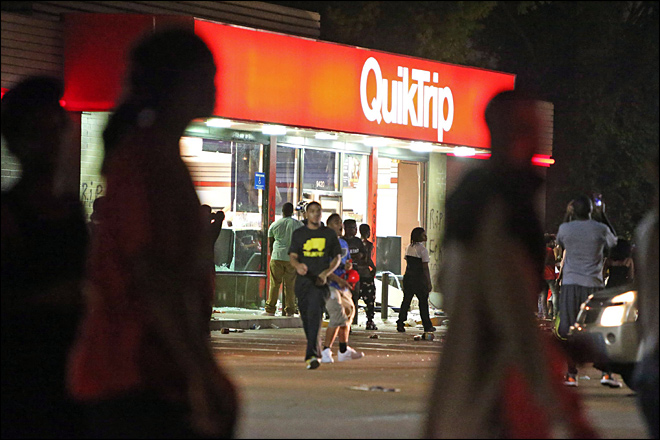
140810_ferguson_riots_04 Jordan: “I agree. But they do not have a right to loot and burn buildings. Looting and burning stores, especially in your own neighborhood, is criminal and idiotic.”
JC: “Anything else? “
Jordan: “The blame game. Residents might not be able to control behavior of police but resident can certainly control their own actions.”
JC: “OK, a few people got out of control.”
Jordan: “Who should have stopped the looting and burning…before it got out of control? Residents.”
JC: “What about police overreacting?”
Jordan: “I agree police overreacted, or at least appeared to overreact. But let’s go back and look who started the looting and burning? The police? No. Residents. My point is simple. Who started looting and burning and caused the police to come out in force?”
JC: “Point well taken. I still think police overreacted but, you’re right, the police did not cause the looting and burning.”
Jordan: “The pattern of burning one’s own house, as it were, seems to have existed in a number of black communities over the last 50 years. The lack of understanding of the consequences of that kind of behavior gives me great pause.”
JC: “What else?”
Jordan: “A bit of a sidebar but I have another example about lack of responsibility that gives me pause about the project.”
JC: “OK, what?”
122813_2140_15Education4.jpg Jordan: “The claim that kids in schools with a high-rate of poverty among parents need to be bused to schools with lower rates of poverty.”
JC: “I’m missing your point. Kids in schools with high rates of don’t do as well in school.”
Jordan: “And my response is the question, ‘why’? Why are kids not learning? And you think time on the bus will help them learn?”
JC: “Well, not really.”
Jordan: “Why did you work hard in school, JC?”
Jordan: “Same reason you did. We were motivated.”
Jordan: “And what was the source of motivation?”
JC: “Parents some. But really from within.”
Jordan: “Were you motivated because your school was new and pretty and had all kinds of neat stuff to play with?”
JC: “No, the school had been built in what the 1920’s or 1930’s, maybe earlier.”
Jordan: “Right. I’ll grant you that parents who have higher incomes might…emphasize might…provide a more encouraging environment for students to be motivated and learn. But lower income does not prevent parents from encouraging their children. If anything, the lower income should encourage them more. Motivation comes from within, not on some bus.”
JC: “Have you been watching Fox News too much lately?”
Jordan: “No. You know I don’t watch Fox News. But maybe I should present this argument to Fox and MSNBC. I think need for personal responsibility is an issue that Republicans, Democrats, Independents and Libertarians can all agree on.”
JC: “If I interpret your comments correctly, you think busing is not worth the effort.”
Jordan: “More than that. I think busing has a negative effect on education. It not only disrupts kids lives but it eliminates the bonding that comes with attending a neighborhood school, it takes money that could be spent on teachers and wastes it on diesel fuel…and worst of all, it takes away the responsibility of parents and students to be motivated. The situation is such now if students do not learn, they can always blame someone else.”
JC: “Whoa, Jordan. I need some time to let this soak in.”


#73 ‘Need to Rap? Try TAP.’ Rock Man Becomes a Painter. (Rebranding Part 4)

02 Saturday Aug 2014

Posted by Jordan Abel in Innovative Thinking: Ideas and Products, Possible Solutions, Rebranding Black Community, Societal Issues

≈ Leave a comment

(Readers: Please note the blog is constructed as a story. While not all chapters are linked, after reading a few recent entries, you might want to start at the beginning. More about the blog and about the author. )

Scene: Pizza joint with Jordan and Rock Man discussing ideas to help get blacks off the bottom rung of the economic ladder. Initial episode for this section begins #67 “Why Do Blacks Remain at the Bottom of the Economic Ladder?”

Rock Man: “Jordan, we’ve covered a lot of ground. Are we making any progress?”
Jordan: “I’m sure this conversation seems as if we’re spending too much time covering stuff you think everyone knows.”
010114_1917_19RockManCo1.png Rock Man: “Yes, it is frustrating. When do we start making some real progress?”
Jordan: “You ever painted a room before the room was prepared properly?”
Rock Man: “Haven’t we all? What a disaster. After the first coat of paint I had to go back and fix some stuff. In the end it took me twice as long to paint the room as it would have had I spent more time preparing it properly.”
Jordan: “And how did the room look after all that extra work?”
Rock Man: “Room never did look right.”
paint_and_brush_clip_art_10540 Jordan: “Alright, let’s pretend this project is like painting a room. We need to make sure we take enough time to prepare.”
Rock Man: “OK, I’ll be patient. What’s next?”
Jordan: “Where do people in the black community get information?” What’s the most credible source of info?”
Rock Man: “Good questions. I don’t know.”
Jordan: “Where do you think kids get info?”
Rock Man: “Like all kids, everyplace but their parents. Let’s see – friends, social media, school, TV, some internet sites.”
Jordan: “And who do the kids trust most?”
Rock Man: “When all said and done probably an adult they respect and trust. One thing to get info from your friends. But kids are not stupid. They know adults have more knowledge about a lot of issues.”
Jordan: “So the key to getting info to the kids is twofold: a credible source and relatively easy access.”
Rock Man: “Kids need to be willing to talk to these adults without fear of retribution.”
Jordan: “What we need to figure out is what type of person kids will listen to and talk to.”
Rock Man: “Don’t know why I thought of this but we need a “Dear Abby” for black kids.
Jordan: “…and one for adults.”
Rock Man: “Maybe there is one. That’s the kind of information you miss out on when you live outside the US for a while.”
Jordan: “Who can become the ‘Dear Abby’ in the different neighborhoods?”
Rock Man: “Let’s go back to the basics. Historically, who has been the ‘go to’ person for advice?”
Jordan: “Teachers and preachers?”
Rock Man: “We could start a program called TAP – teachers and preachers.”
Jordan: “Our theme — ‘Listen to TAP, not rap.”
Rock Man: “Kids are going to listen to rap no matter what we say. But let’s get someone to write some rap lyrics about TAP.”
Jordan: “We can change to ‘Need to rap? Try TAP.’…or something like that.”
Rock Man: “Now we have the foundation for a promotion program. I like it. ‘Need to rap? Try TAP.’”
Jordan: “As they say in advertising business, the idea has ‘legs’. Lots of potential variations. Let’s move on.”
Rock Man: “What’s next?”
Jordan: “Trying to decide. Several items we would normally discuss – production, profit, penetration.”
Rock Man: “Any of those really apply to this project?”
Jordan: “Probably not now. Let’s try another key item, then we can take a break. Passion.”
Rock Man: “Passion by whom? And passion for what?”
passion Jordan: “Passion for change. Does the black community want to make change? Without the passion to address and overcome some major barriers, this program will never be a success.”
Rock Man: “Are you saying ‘you can lead a horse to water but can’t make it drink?”
Jordan: “Exactly. Furthermore, someone in the black community needs to take the lead and start promoting the idea of real change.”
Rock Man: “Thought we weren’t ready for solutions, yet.”
Jordan: “We’re not. But we need to have some understanding whether the black community really wants to change…and is willing to make the necessary sacrifices for changes to occur.”
Rock Man: “Seems like an odd question. Why wouldn’t the black community want to change? The current situation is anything but ideal, even after the revenge revolution.”
Jordan: “I agree it seems obvious the black community would want to change. I also know reality. Some people in very difficult…even dire…circumstances resist change.”
Rock Man: “Give me an example.”
Jordan: “Look at the Palestinians in the West Bank and especially Gaza. Do you see any real effort to make change? The answer is ‘no.’”
Rock Man: “Are you saying Israel has no fault in this situation?”
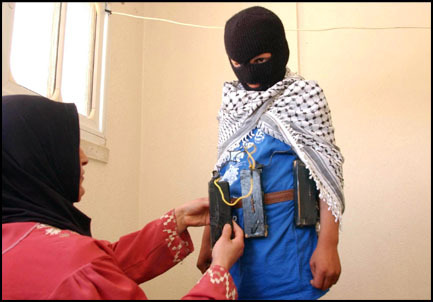
child_suicide_bomber Jordan: “You can find fault on both sides and passion on both sides. When one looks at the type of passion, the differences are dramatic. The passion of many Palestinians is about complete destruction of another society, Israel. The Palestinians are so passionate they are willing to sacrifice their own people…even its own children…to destroy the other society.”
Rock Man: “I agree that a society has a warped sense of value when parents cheer when their own children die blowing up themselves and others nearby.”
Jordan: “Passionately cheering when your children die is set of values that is not only hard to understand but eliminates the possibility of any real solution.”
Rock Man: “You’re not implying the black community is like many of the Palestinians are you?”
Jordan: “No. But the behavior of the Palestinians is one of the reasons I suggested earlier the black community is doing itself no favors by allowing so many members to convert to Islam. Have passion, yes. Have misguided passion, no. Misguided passion will make problems worse.”
Rock Man: “You’re really asking if there is enough passion…positive passion…in the black community to address problems facing the community.”
Jordan: “That’s exactly what I am saying.”
Rock Man: “Let’s go back to painting the room. We need to check the passion of the black community. Is the community willing to address problems and take the time to develop and implement proper solutions?”
Jordan: “We are talking about a program that is likely to take several generations. Lots of discipline. No shortcuts. And, like painting the room, the preparation often will be tedious, even boring at times.”
Rock Man: “We need to find out if the community is ready.”
Jordan: “Rock Man, I think you just turned into a painter.”
(To be continued)

#72 The Influence of Churches, Schools and Drug Dealers. (Rebranding Part #3)

30 Wednesday Jul 2014

Posted by Jordan Abel in Causes of the Revolution, Innovative Thinking: Ideas and Products, Rebranding Black Community, Societal Issues

≈ Leave a comment

(Readers: Please note the blog is constructed as a story. While not all chapters are linked, after reading a few recent entries, you might want to start at the beginning. More about the blog and about the author. )

Scene: Pizza joint with Jordan and Rock Man discussing ideas to help get blacks off the bottom rung of the economic ladder. Initial episode for this section begins #67 “Why Do Blacks Remain at the Bottom of the Economic Ladder?”

Rock Man: “You know I am a big believer in neighborhood schools. Kids should walk or ride a bike to school. Why are we bussing all these kids?”
Jordan: “Create equality, at least the perception of equality.”
122813_2140_15Education4.jpg Rock Man: “But it’s not working. This might sound like heresy but as blacks we need to focus on getting a quality education in our neighborhoods. Drop the busing and take the money and spend on getting more and better teachers.”
Jordan: “I agree with you. But getting widespread support for such an idea is going to take a lot of talking and convincing, just to consider the idea of neighborhood schools and less busing.”
Rock Man: “I think you might be surprised at how quickly people accept the idea, if we present it properly. And I’ll tell who can help.”
Jordan: “Who’s that?”
Jordan: “A key group we have left out of this conversation so far? Black churches. Actually all churches, or religious institutions, but really black-dominated churches.”
Jordan: “You’re right. What role do you think churches should play.”
Rock Man: “Churches have been part of the black community for a long, long time. I think blacks need to rebuild the influence of the churches.”
Jordan: “We’ve been talking about product – the product being the black community. So churches need to be a major part of the community?”
Rock Man: “Definitely. Not only as a moral compass but as a foundation for a broader education.”
chrch2Jordan: “I’m the one who always resists solutions before understanding the issues. But what about schools supported by black churches?”
Rock Man: “Why not? Catholics and Baptists have supported their own schools for years. And now with public money.”
Jordan: “Not sure of the mechanics to start a school but many states support charter schools. There must be a template the black churches can follow.”
Rock Man: “We don’t want to make religion a key part of the positioning statement but is there any better place than a church to introduce and teach core values?”
Jordan: “I agree. Please excuse me for this sidebar comment. People get all hung up on the differences between religions. How many people have you heard claim ‘I don’t trust that religion because…’ Yet, if you list the core values of most…not all…but most major religions, there’s about 90% commonality.”
Rock Man: “Never thought about it that way.”
Jordan: “And with that bit of information my follow-up question to you is, ‘If you agreed with your spouse 90% of the time, what would your relationship be like?”
Rock Man: “Fantastic. I see your point. Let’s make black churches part of the solution. And not worry whether the denomination is Baptist, Presbyterian or something else.”
Jordan: “We are going to exclude one religion from this effort. And you know which one.”
Rock Man: “I know. We have got to walk away…no run…from that group.”
Jordan: “Good. Now let’s segue to the ‘people’ section of the analysis. Rock Man, who or what type of people do you think has the most influence with the black community.”
Rock Man: “You mean, who has the most influence now or should have the most influence?”
Jordan: “Both.”
Rock Man: “Most influence now with young people – and it bothers me to say this – athletes and, yuck, drug dealers.”
Jordan: “Who should have the most influence?”
Rock Man: “Family, churches and educators.”
Jordan: “What we need to do is make sure our plan allows families, churches and educators to have more influence.”
Rock Man: “We talked about how to reduce the influence of athletes. Now, how do we get rid of drug dealers? Dealers and gangs are a major influence on younger blacks.”
Jordan: “Let’s start with why are dealers so influential?”
Rock Man: “Jordan, you are naïve. Easy, money. Kids see how much money they can make pushing drugs.”
Jordan: “What about the risk?”
Rock Man: (Laughing) “As a kid you don’t think much about the added risk. Your whole life is filled with risk. Besides what’s the alternative for making money?”
Jordan: “A job.”
McDonalds Logo Rock Man: “Where? If you’re lucky…and I mean real lucky…you get a job at some fast-food joint. And the pay?”
Jordan: “Minimum wage probably.”
Rock Man: “You got it. Let’s say the kid makes $10/hr. For 40 hours work, he makes $400 gross, maybe $325-$350 net.”
Jordan: “And what does he make selling drugs?”
Rock Man: “Probably the same amount in one night. In a year, a kid pushing drugs might make $50 grand or more. And he’s making more than anyone else in the household.”
Jordan: “And the kid working 10x longer hours at Mickey D’s is making maybe 20 grand.”
Rock Man: “Now, my friend, you understand the problem.“
To be continued.

#71 Rebranding the Black Community (Part #2)

26 Saturday Jul 2014

Posted by Jordan Abel in Causes of the Revolution, Innovative Thinking: Ideas and Products, Rebranding Black Community, Societal Issues

≈ Leave a comment

Scene: Pizza joint with Jordan and Rock Man discussing ideas to help get blacks off the bottom rung of the economic ladder. Initial episode for this section begins #67 “Why Do Blacks Remain at the Bottom of the Economic Ladder?”

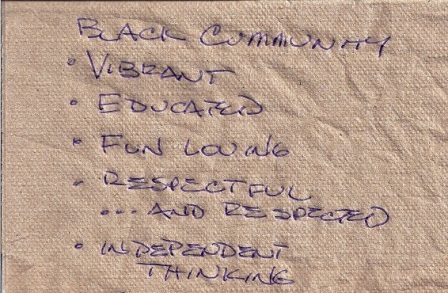
Rock Man: “OK, let me grab the napkin write down we talked about. What were the key words? Black community is ‘vibrant,’ ‘educated,’ fun loving,’ ‘respectful and respected,’ ‘independent thinking’ and ‘supportive.’”
Jordan: “What do you think about dropping ‘fun loving’? Fun loving can be part of ‘vibrant.’ I know the words are a bit different but we want to stay away from any words that might have a negative connotation.”
Black Positioning Rock Man: “I’ll buy dropping fun loving. What else?”
Jordan: “’Respectful’ is good. ‘Respected’ is what one earns.”
Rock Man: “I thought being respected is what this whole effort was about – gaining respect.”
Jordan: “Just think what you said. Respect is earned by actions. One cannot declare ‘you must respect me.’ Respect is earned…and earned over time.”
Rock Man: “I know we are early in the process but how long do you think this rebranding effort is going to take. I don’t mean the number of our sessions but how long before there is a marked changed in the perception of the black community?”
Jordan: “You mean how many generations is it going to take.”
Rock Man: “Really?”
Jordan: “Really. But what can change quickly is beginning to earn respect for trying. I think you will be surprised how many people and groups, even groups that you might consider anti black, will start supporting a well thought-out program.”
Rock Man: “Think so?”
Jordan: “Positive. But…and this is an important but…progress by the community has to be real and continuous. People understand progress will not be easy or smooth. But the black community needs to make steady progress toward achieving its positioning.”
Rock Man: “Let me just try a more structured positioning statement. ‘The black community is vibrant, educated, supportive, respectful with independent thinking.’”
Jordan: “That’ll work for now. Let’s start to drill down and begin analyzing where the community is now. Rebranding includes a number of variables. The very first step is finding out where we are today.”
010114_1917_19RockManCo1.png Rock Man: “I know where we are. Let’s start working on solutions. Besides you said you said not to drive looking though the rearview mirror.”
Jordan: “I know about the rearview mirror. However, you are about ready to change lanes. Think you should check to see if a semi-truck is barreling down in the left lane?”
Rock Man: “OK but can we make finding out ‘where are we?’ quick? I want to get to solutions.”
Jordan: “Relax. Getting ready to begin rebranding is going to take a while. As I said, at least 4-5 sessions, maybe longer. Worse, at time the questions will seem almost confrontational.”
Rock Man: “Alright. Start firing away.”
Jordan: “What do you think the perception of the black community is today?”
Rock Man: “You talking about perception among whites or among blacks?”
Jordan: “Either one. No, start with whites.”
Rock Man: “You and I might have different views.”
Jordan: “Probably so but that is one reason for these questions. You are on stage, so let’s hear it.”
Rock Man: “Based on my experience…Jordan, this is not a pleasant task.”
Jordan: “…get to the point Rock Man.”
Rock Man: “Many whites view blacks as undereducated, unmotivated with their handout for government assistance. Plus, a high percentage are criminals. That is not a pleasant description.”
Jordan: “I think the perception is fair. Notice I did not say your description was ‘reality,’ but said what the perception was.”
Rock Man: “How do blacks view the black community? Discriminated against, disadvantaged and not respected?”
Jordan: “Alright. Now at least we have two perceptions, neither of which is good. One can argue about the exact words but I think both perceptions are reasonably close.”
shovel_ready Rock Man: “So we…the black community…have dug ourselves into a hole. A very big hole.”
Jordan: “Agreed. Now let’s talk about the product.”
Rock Man: “What do you mean by ‘product’?”
Jordan: “Normally one thinks of a product as some type of hard good – clothing, automobile, electronic equipment. In this case the product is the black community. What does the black community look like?”
Rock Man: “You mean like an area of the city where the food store is black owned and the food geared toward the black community. Is that what you mean?”
Jordan: “Yes. Describe the look and feel of the neighborhood if there is a black neighborhood. There might not be one.”
Rock Man: “Let’s start with businesses because that’s easier. A variety of black-owned businesses serving the community. I mentioned the food store. Also, clothing stores, hair salons, cleaners, restaurants, gas stations, movie theaters. Something like we had growing up only more upscale and modern.”
Jordan: “Good description.”
backwards-day Rock Man: “Question. Is what I described going backwards for blacks? We don’t want to retreat to life in the 1950’s and early 1960’s, at least what I know about that life.”
Jordan: “And what part of that life was negative…and what was positive?”
Rock Man: “The negative part was being poor with rampant discrimination.”
Jordan: “What was good?”
Rock Man: “Sense of a community – family, church and lots of friends. All poor but lots of friends.”
Jordan: “What I heard you describe for blacks going forward was a community but without the poverty.”
Rock Man: “What about discrimination?”
Jordan: “You know and I know there will be some level of discrimination for decades, even generations. The level of discrimination will decline over time but some discrimination is always going to be there.”
Rock Man: “One think I left out of product – housing. Nice houses, well maintained. Some single family, some multi-family but all look nice and people are proud to be part of the neighborhood.”
Jordan: “What about subsidized housing?”
Rock Man: “We need to get rid of what people call ‘projects.’ I know we need some low-income housing but make it attractive.”
Jordan: “What about schools?”
Rock Man: “This section might take a while. I need to take a quick break.”

To be continued

#70 Beginning to Rebrand the Black Community (Part #1)

24 Thursday Jul 2014

Posted by Jordan Abel in Causes of the Revolution, Economics, Innovative Thinking: Ideas and Products, Rebranding Black Community, Societal Issues

≈ Leave a comment

Scene: Pizza joint with Jordan and Rock Man discussing ideas to help get blacks off the bottom rung of the economic ladder. Initial episode for this section begins #67 “Why Do Blacks Remain at the Bottom of the Economic Ladder?”

Rock Man: “Jordan, you’ve got me thinking. By the way, the pizza was great. Who owns this place anyway?”
Jordan: “Turns out owners are part of the family that started Buddy’s Pizza in Detroit many years ago. A colleague from my Detroit days told me about the place. Great pizza, huh?”
Rock Man: “Maybe the best I’ve ever had.”
Jordan: “Back to the task at hand. I’ve got you thinking about what?”
010114_1917_19RockManCo1.png Rock Man: “Asking me to describe the ideal black community could be the foundation for a marketing campaign.”
Jordan: “Now you are on to something.”
Rock Man: “What we are talking about doing is rebranding the black community.”
Jordan: “This might sound a bit crass but rebranding the black community is like Nike building a brand of shoes around Michael Jordan or…”
Rock Man: “I thought we were shying away from sports figures?”
Jordan: “You’re right. Then building a brand of clothing – Polo, for example. Or soda – Coke. Or Yogurt. Pick a product and there is a certain image that comes to mind when you mention the brand name. And we can use your words to describe the ideal black community. But we need to make the words describe how the brand feels.”
Rock Man: “What do you call that essence statement?”
Jordan: “Positioning statement.”
Rock Man: “That’s it. Positioning statement. But the brand has to have a product.”
Jordan: “It does have a product…the black community.”
Rock Man: “So you’re thinking of rebranding the entire black community?”
Jordan: “Changing the perception of the black community. Obviously not everyone will fit the mold but the goals is to change the overall perception of the community.”
Rock Man: “You think that’s realistic?”
Jordan: “Your question is an excellent checkpoint. And one we will use at the end of this exercise. But let me ask you, when I say…OK, Jewish community, what words or phrases come to mind?”
Rock Man: “More educated, professionals – lots of doctors, lawyers, college professors. Lots of merchants – doctor-clipart-illustration-31325Saks, Bergdorf-Goodman, Bloomingdales. And financial people – Solomon Brothers.”
Jordan: “Clearly, not every Jew falls in one of those categories. But I think that is a fair description of the perception of the Jewish community in general.”
Rock Man: “So we are trying to build a brand for the black community that fits some type of positioning statement, correct?”
Jordan: “One thing to be clear about – a substantial portion…don’t ask me what the exact number is…but a substantial percentage of blacks will need to fit the mold or the perception will never take hold. Just making a claim that the black community is like ‘X,’ ‘Y’ and ‘Z’ won’t make people change their perception.”
Rock Man: “Let’s go back and try to translate my general description into a positioning statement.”
Jordan: “Alright but just don’t get to anal right now about having a perfect positioning statement. The statements evolve over time.”
Rock Man: “Speaking of time, how long is this rebranding session going to take?”
Jordan: “Session? You mean sessions. Probably 4-5, maybe more before we complete the initial phase.”
Rock Man: “You serious? That long for the initial phase?”
elephant-clip-art Jordan: “Rock Man, the process of rebranding is like eating an elephant. There’s a lot there and you can only eat one bite at a time.”
Rock Man: “Before we get too far into this, do you think we might be covering old ground? I mean, didn’t Martin Luther King cover this issue 50-60 years ago. What’s going to make a program we come up with different?”
Jordan: “Good question. I’ve thought about the question a lot. My take is this. Dr. King had a vision about equality. And ideally that will be the result of our efforts.”
Rock Man: “So what’s different?”
Jordan: “Scholars might disagree but I think one of the reasons why MLK’s vision did not come true is blacks did not have a positioning statement.”
Rock Man: “Explain more, please.”
Jordan: “Without a positioning statement, blacks did not know what to become. There were no guideposts or guidelines. Blacks were just supposed to be equal but no real map on how to get there.”
Rock Man: “Over the years you’ve talked about how a clear, concise positioning statement helped guide a lot of activities at Buick. If I remember correctly, the positioning statement was ‘Buick is a premium American motorcar that is substantial, distinctive, powerful and mature.’”
Buick Jordan: “Very good. And when Buick followed that positioning decisions were much easier and Buick gained market share.”
Rock Man: “Then what happened? Buick had a really rough period in the late 1990’s and early 2000’s. It’s coming back now but it was rocky road for a number of years.”
Jordan: “My view? Most of the problem had nothing to do with the positioning statement. It was all in the execution.”
Rock Man: “Whadda mean?”
Michigan Jordan: “Product tastes evolve over time. I had done a lot of research at the University of Michigan Institute for Social Research. The results indicated product design that appeals to one generation will not necessarily appeal to the next generation. Just look at clothing styles for certain age groups. They seem to cycle over time.”
Rock Man: “What else?”
Jordan: “The fundamental positioning of the product can remain the same but how it’s designed needs to change. The research suggested Buick could keep all key attributes but needed to update the design to appeal to a younger generation.”
Rock Man: “So what happened?”
Jordan: “I lost the argument. My boss, who was not that much older, thought younger buyers would ‘adopt’ the same tastes as the previous generation.”
Rock Man: “So Buick makes some design changes but also keeps many of the attributes that appealed to older generations. And their market share becomes smaller and smaller since existing buyers are dying off and not being replaced by younger buyers.”
Jordan: “Exactly. The Buick look today is very similar to what we recommended years ago, although there are many more electronic features available now.”
Rock Man: “So what’s the lesson for the black community?”
Jordan: “Rock Man, that’s the $1,000,000 question. What we do know is a simple, easy to understand and credible positioning statement is a start. And we need to tighten up your words.”
Rock Man: “Let’s get started. Here’s a napkin.”
(To be continued)

#69 Setting the Stage for Getting Started: Describing an Ideal Black Community

19 Saturday Jul 2014

Posted by Jordan Abel in Innovative Thinking: Ideas and Products, Possible Solutions, Societal Issues

≈ Leave a comment

(Readers: Please note the blog about the 5th revolution in the US is constructed as a story. While not all chapters are linked, after reading a few recent entries, you might want to start at the beginning. More about the blog and about the author. )

Scene: Jordan and Rock Man at pizza joint continuing conversation about how to get blacks off the bottom rung of the economic ladder. Conversation started “#67 Why Do Blacks Remain at the Bottom Rung of the Economic Ladder?”

Rock Man: “Jordan, I hear what you’re saying about blacks being stuck on the bottom rung. I also hear some of the ideas about focusing on education and not sports. How do we pull this off?”
Jordan: “Rock Man, you and I have both been involved with projects that have been very successful and…”
010114_1941_20RockMans1.png Rock Man: “…and projects that were duds.”
Jordan: “And what was the difference between those projects…assuming that the project was not so outlandish that it had no chance of success?”
Rock Man: “For me, success projects have three key characteristics. #1 a purpose that is easy to understand; #2 timeline to accomplish; #3 ability to link one’s role to the project purpose.”
Jordan: “I agree. Clarity, timeline and link. But I’ll bet not all the projects you’ve been involved with were easy to accomplish.”
Rock Man: “No. In fact, the one’s I worked hardest on and the ones I remember the most were the most difficult…but we accomplished them.”
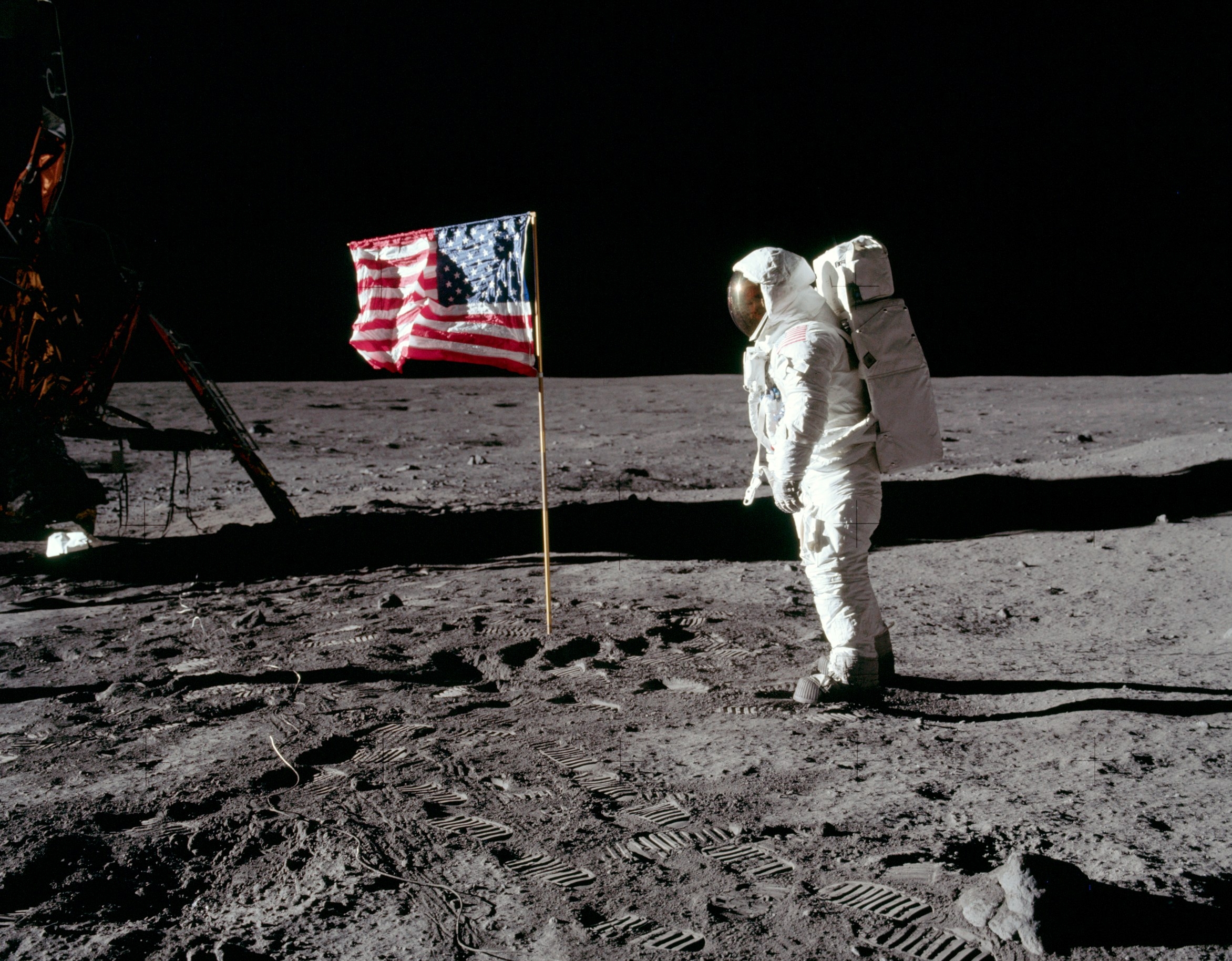
Kennedy Requests Funding for Apollo Jordan: “An old example but one that I still marvel at how it was accomplished is putting a man on the moon. President Kennedy made the announcement in 1961 and US astronauts landed on the moon in 1969.”
Rock Man: “Today, in that same 8 years, Congress…at least Congress before the revolution…couldn’t agree to support the project, let alone agree on funding.”
Jordan: “Let’s take the Apollo program…the moon shot…and bounce off your reference points. Was the mission clear?”
Rock Man: “Very clear. Put a man on the moon.”
Jordan: “Was the timing clear?”
Rock Man: “Yes. By the end of the decade – 1969.”
Jordan: “Were participants able to link tasks to the assignment.”
Moon Walk Rock Man: “It was probably very easy to decide what to do for almost all tasks. The task either contributed to getting a man on the moon or it didn’t.”
Jordan: “Now let’s use your reference points and the moon shot to guide our mission at hand.”
Rock Man: “Getting blacks off the bottom rung of the economic ladder…and let me add ‘permanently’ off the bottom. We do not need to have someone else start another program 50 years from now.”
Jordan: “Success for the Apollo program was clear. A man on the moon. Throw out some words that describe a black community that has gotten off the bottom rung.”
Rock Man: “You want words, or more description. What do you want?”
Jordan: “Throw out some words. Whatever comes to mind. We can sort ideas out later.”
Rock Man: “Here goes. A black community that is ‘vibrant.” One that is ‘educated.”
Jordan: “Good. Keep going.”
Rock Man: “Never really thought about this before.”
Jordan: “Don’t stop. More words.”
Rock Man: “’Fun loving.’ A black community that is ‘respectful’…and ‘respected’. A community that is ‘supportive of its members and others.’’’
Jordan: “Anything else?”
Rock Man: “Yeah. Community that has ‘independent thinking.’ What I’m trying to say is a community that can make it on its own…you know, that’s independent.”
Jordan: “You thinking of an independent state, or states?”
Rock Man: “No. But a community that has a lot less dependence on assistance from everyone else, including the government.”
Jordan: “Sounds like a great community. So how do we help make it happen?”

Pizza arrives. To be continued.

#68 New Ideas to Start Getting Blacks Off the Bottom Rung

16 Wednesday Jul 2014

Posted by Jordan Abel in Causes of the Revolution, Economics, Innovative Thinking: Ideas and Products, Societal Issues

≈ Leave a comment

(Readers: Please note the blog about the 5th revolution in the US is constructed as a story. While not all chapters are linked, after reading a few recent entries, you might want to start at the beginning. More about the blog and about the author. )

Scene: Jordan and Rock Man continuing conversation about how to begin getting blacks off the bottom rung of the economic ladder. First conversation. More about Rock Man.


Jordan: “OK, Rock Man, let’s get back to the topic at hand. How do we get blacks off the bottom rung of the economic ladder?”
010114_1917_19RockManCo1.pngRock Man: “Jordan, seems like we’ve had a version of this conversation before.”
Jordan: “We had it before your sabbatical. But nothing got resolved. And the need for a plan keeps gnawing at me. It should gnaw at you even more.”
Rock Man: “Maybe I’m too close to it…or maybe used to it.”
Jordan: “We need to change some thinking. It has been 150+ years since the Emancipation Proclamation. It has been 50+ years since the Civil Rights Act. 150 years is 6-7 generations.”
Rock Man: “A very long time in those terms. You have some advice?”
Jordan: “Yes, but like much of this conversation, not politically correct.”
Rock Man: “Let me guess. Blacks need to take the lead and quit following.”
Jordan: “The man did learn something on sabbatical. Seriously, that needs to happen. Blacks need to figure out a plan, spell out the key points and then, if necessary, ask for help.”
Rock Man: “Any ideas where to start? Tell me your idea Contro-man.”
Jordan: “What’s with the Contro-man? What are you talking about?”
Rock Man: “You’re bringing up a very controversial topic – why do blacks remain at the bottom of the economic ladder. You ready for all the heat when this starts to get public attention?”
Jordan: “If you think the conversation so far has been controversial, have another sip of coffee.”
Rock Man: “Keep talking Contro-man.”
Jordan: “I casually mentioned this idea before but we never really put much meat on it. One other rule when we discuss this topic.”
Rock Man: “What’s the rule?”
Jordan: “There’s always a lot of finger-pointing and blaming when this come up. Too much of government something caused something else. A lot of looking in the rearview mirror and trying to figure out who’s to blame.”
Car Rock Man: “Jordan, if there’s one thing I remember about all our conversations, it’s that you cannot drive very fast looking in the rearview mirror.”
Jordan: “I’m glad you remember that. Now, let’s start looking out the windshield and driving faster.”
Rock Man: “I’m mashing the accelerator.”
Jordan: “You’re southern roots are showing. First question, ‘In what occupations are blacks most successful?’”
Rock Man: “That’s easy, sports. Football, basketball, track and some baseball. But especially professional football and basketball – NFL, NBA.”
NFLJordan: “Right. In the NFL, what 2 of 3 players are black? NBA must be about 4 of 5 are black. Blacks are very successful in both sports.”
Rock Man: “Entertainment, also. But what’s your point?”
Jordan: “Question #2, ‘Where do you see the least number of blacks?’”
Rock Man: “At a KKK meeting…and that’s not a college fraternity.”
Jordan: “Good one smartass. Really, what professions?”
Rock Man: “Engineering. More like occupations that require lots of math and/or science.”
Jordan: “I agree.”
Rock Man: “Come to think of it, I don’t know of a highly successful software company started by blacks.”
Jordan: “I’m sure there are some but no company comes to mind.”
Rock Man: “When you were at MIT how many blacks were there?”
Jordan: “MIT was a long time ago but black students were few and far between.”
Rock Man: “OK, so Contro-man, what’s the idea?
Jordan: “We both agree that making incremental changes won’t work. Something radical is required.”
Rock Man: “Get to the idea, already.”
Jordan: “The idea is simple. Black refuse to play professional sports. No blacks enter the NFL. No blacks enter the NBA.”
Rock Man: “What about professional curling?”
Jordan: “That’s OK.”
Rock Man: “Seriously, what about college athletics.”
Jordan: “Yes, because those athletes have an opportunity for a college degree at little or no cost. And without the pressure to enter professional sports, more will student athletes will complete the degree. But, I’m talking about real, marketable degrees and not Afro-American studies.”
Rock Man: “You are pushing the envelope. You really want to deny these athletes a chance to make millions of dollars playing professional sports?”
Jordan: “In a word, ‘yes.’ Besides, what do these athletes do for the black community?”
Rock Man: “They hold sports camps and go to schools and talk about their sports.”
Jordan: “My point exactly. The athletes, many of whom…in fact I would venture to say most of whom never graduated college…are promoting the one thing at which only a handful of people excel – professional sports. Where’s the emphasis on education? Where’s the role model?”
Rock Man: “Point well taken.”
Jordan: “Rock Man, you are an excellent role model for black students. I’m always fascinated with your background. How many kids in the family?
Rock Man: “Eight.”
Jordan: “And what did your parents do?”
Cotton Rock Man: “You know what they did. Cotton farmers in eastern North Carolina.”
Jordan: “And they were high-end, wealthy cotton farmers?”
Rock Man: (Laughing) “Jordan, you know we were dirt poor. We were so poor that I literally…and I mean literally…did not have a pot to piss in.”
Jordan: “OK, so how did you go from no pot to piss in to all eight kids getting a college education and what, half the kids with a graduate degree? Was your role model some athlete?”
Rock Man: “No. The role model was my parents pushing all the kids hard to get an education. Neither of my parents graduated from high school. In fact, they barely got out of grammar school.”
Jordan: “Rock Man, now I need a break. Let’s go get a pizza.”

(Want a PDF version for Entries #1-10, #11-20, #21-30 formatted as an e-book? Entries #31-60 available when I get some time. Click links for download. America’s 5th Revolution Volume I (Entries 1-10), America’s 5th Revolution Volume II (Entries 11-20), America’s 5th Revolution Volume III (Entries 21-30)


#63 Capitalizing on Jewels…or Was that Joules?

28 Saturday Jun 2014

Posted by Jordan Abel in Innovative Thinking: Ideas and Products, Possible Solutions, Societal Issues

≈ Leave a comment

(Readers: Please note the blog about the 5th revolution in the US is constructed as a story. While not all chapters are linked, after reading a few recent entries, you might want to start at the beginning. More about the blog and about the author. )
 

Scene: Italian restaurant. Jordan and friends, Ms and daughter, Maggie. Having dessert and coffee. Dinner starts Entry #61.

Maggie: “OK, so you are working on a project to rebuild US manufacturing. I’ve got a question.”
Jordan: “Fire away.”
Margaret Maggie: “Does more US manufacturing mean more pollution?”
Ms: “Yeah, Jordan, why does it seem that increased manufacturing always means more pollution. There must be a better way. Let’s hear it smart guy.”
Jordan: “You guys are tough…and asking a good question.”
Ms: “We’re waiting for the answer.”
Jordan: “The answer is economic growth and pollution are not inextricably linked.”
Maggie: (Looking at her mother) “Does he always talk like this?”
Ms: “Usually worse. More eco-babble, please.”
Jordan: “Economic growth can occur using clean energy – solar, wind, etc.”
Womens symbolMaggie: “Solar seems OK but wind uses those large propeller things. They’re ugly, make lots of noise and kill birds. Isn’t there any type of clean energy?”
Jordan: “Yes. Thermal and kinetic energy.”
Ms: “Tell us more, please.”
Jordan: “Let me give you a couple of examples. Ms, think back to when you were a kid. Its summer time.”
Ms: “Hot and sticky in Louisiana.”
Jordan: “Was there a garden hose at your house?”
Ms: “Dark green.”
Jordan: “Did you ever get a drink out of the hose?”
Ms: Yes but the water was so hot we had to let it run for a while before we could drink it.”
Jordan: “Next example. Maggie, where do you want to pretend to be?”
Maggie: “Back in Newport Beach.”
Green Garden HoseJordan: “Alright. Now take off your sandals and walk through the parking lot to your car.”
Maggie: “I live on the beach and don’t have to walk through the parking lot.”
Jordan: “Your answers sometimes remind me of your mother.”
Ms: “Jordan, be nice to us and I’ll buy dinner.”
Jordan: “You know what I meant. And yes, I will be nice. You know I like both of you very much.”
Maggie: “Back to the example…and I will play along.”
bare-feet Jordan: “Good. Go to the store and walk across the parking lot in your bare feet.”
Maggie: “Can’t. The asphalt is too hot and my feet will burn.”
Ms: “Where are you headed with these examples? A garden hose and an asphalt parking lot.”
Jordan: “Each is an example of the effect of thermal energy.”
Maggie: “You’re saying the water and the parking lot were made hot by the sun and nothing else.”
Jordan: “Exactly. And heated for free by the sun.”
summer-smile-sun-hi Ms: “So back to your project. How can we capture thermal energy for free and replace energy from say coal or oil?”
Maggie: “Besides oil, coal…even natural gas…are expensive compared to free. Coal, oil and natural gas have lots of pollution.”
Jordan: “We’re getting better are reducing pollution from fossil fuels but zero is hard to beat.”
Ms: “What can we use thermal energy for?”
Jordan: “The most obvious is heating, especially water. Heating water takes lots of energy.”
Maggie: “How much does it cost every month to heat water?”
Jordan: “Spoken by someone who must live in Newport Beach.”
Ms: “Jordan, you are on the edge of not getting me to pay for dinner. Be nice.”
Jordan: “The comment was such an opening I could not resist. Anyway, depends on the area but to heat water costs $40-$50 per month.”
Ms: “That’s more than I realized. $50 bucks is more than 25-30% of my monthly electric bill.”
Maggie: “Can you convert thermal energy into electricity?”
Jordan: “Yes. A simple approach is making water hot enough to turn to steam. The steam then turns a generator and makes electricity. In many ways like a power plant fueled by coal but without the pollution.”
Ms: “Let’s not turn dessert and coffee into a physics lesson. I’m too old to go back to high school.”
Maggie: “You gave us two examples. Thermal and what was the other one?”
Jordan: “Kinetic energy. Easiest way to think about kinetic energy is the energy of an object in motion.”
Maggie: “Like a car or truck or motorcycle.”
Kinetic EnergyJordan: “Good examples.”
Maggie: “So the faster the car goes, the more kinetic energy?”
Ms: “And I suppose the heavier truck has more kinetic energy.”
Jordan: “I know you want to skip the physics lesson but the formula for kinetic energy, or KE, is ½ mass times velocity squared.”
Ms: “In the words of Ricky Ricardo, ‘Splain that, please.’”
Jordan: “Half the weight of the object multiplied by the square of how fast it is going.”
Maggie: “Say a rock weighs 10 pounds. And as you carry it you accidentally drop it on your foot. The KE would be ½ weight of the rock – 5 pounds – times the square of how fast the rock was going when it hit your foot – say 10 miles per hour. So KE would be 5 (pounds) times 100 (10 mph x 10 mph).
Jordan: “You got it.”
Ms: “So, if we’re in the car, KE at say 40 mph is not simply 2x KE at 20 mph but 4x KE at 20 mph. The square of 20 is 400 and the square of 40 is 1600.”
Maggie: How do they measure KE anyway? What’s miles per hour times pounds? Even I know that won’t work.”
Jordan: “The measurement is joules.”
Ms: “I like that measurement. Maggie, we could take the car and have a jewel crash. A little ding could be a ruby incident. A fender bender could be an emerald crash. And totaling the car would be a diamond crash.”
Crown Jewels Maggie: “I could tell my hubby, ‘Gee honey, I’m your queen. And he’ll ask why. Then I can tell him I had an emerald crash today in the car.’ That sounds a whole lot better than ‘I dented the front fender.’”
Jordan: “The measurement is spelled ‘j-o-u-l-e-s,’ not ‘j-e-w-e-l-s’.”
Ms: “Too bad. I thought we were on to something.”
Maggie: “OK, Jordan, other than wrecking the car, how does one capture kinetic energy?”
Jordan: “One of my favorite examples is capturing the energy of waves in the ocean. Any kind of wave, actually, but waves in the ocean have the most energy.”
Ms: “What do you do, build some device to convert waves to electricity?”
Jordan: “As a matter of fact, I’m part of a group that designed such a device. We’re not the only ones working on converting kinetic energy to electricity.”
Maggie: “But capturing KE…and thermal energy…are ways to generate electricity without any pollution. And the energy cost is free.”
Ms: “Why isn’t this country adopting more of these ideas? We seem to be fighting innovative ways of generating electricity with little or no pollution. Resisting this makes no sense to me.”
Jordan: “Unless you are in a business that’s going to be replaced.”
Maggie: “But that’s a losing battle. Otherwise we still be riding around in buggies pulled by horses.”
Jordan: “I agree, but a lot of people are fighting it. I think that attitude is changing. We have a real desire among a lot of people to make changes. People are starting to call the events the last months the beginning of the 5th US Revolution. The people also elected a new Congress and demanding Congress get something done. I’m actually hopeful.”
Ms: “Glad to hear that.”
Maggie: “Guys, the waiter is here. Let’s have some more coffee.”

(To be continued)


#60 Being Fair. Part of POTUS’ Project on Manufacturing

18 Wednesday Jun 2014

Posted by Jordan Abel in Causes of the Revolution, Innovative Thinking: Ideas and Products, Personal Stories, Possible Solutions, Societal Issues

≈ Leave a comment

(Readers: Please note the blog about the 5th revolution in the US is constructed as a story. While not all chapters are linked, after a few recent entries, you might want to start at the beginning. More about the blog and about the author. )

Scene: Jordan and Matt, Jordan’s Office

Jordan: “Matt, thanks for taking time to talk again.”

Matt: “Jordan, the least I could do. You spent a lot of time preparing for the POTUS project. My guess is these comments will be a good add.”
reporter on typewriter clipartJordan: “Hope so. Some of the ideas stem from actions by GM. Others are based on recent experience.”
Matt: “OK, let’s get started. What’s the theme? What idea…or ideas do we want to add?”
Jordan: “The idea might seem obvious or naïve or both. And it might be. I want to talk about fairness.”
Matt: “Mmmm, that is interesting. And talking about ‘fairness’ does seem appropriate. We never talked specifically about it. Implied, yes but not fairness as a specific topic.”
Jordan: “Reason I bring it up is some recent experience and a conversation with a long-time friend. I was going to say old friend but she would not like that.”
Matt: “What happened?”
Jordan: “Incidents with the cell-phone company and airlines and TSA. The conversation with my friend led to a discussion of an earlier incident with GM – not product but culture.”
Matt: “I need some details to help understand the issue.”
Jordan: “I figured you might. Rather than take your time now, I wrote several papers describing what happened.”
Matt: “Good. I’ll read those later. What was your conclusion?”
Jordan: “Simple. Fairness is a critical component for long-term success of an organization.”
Matt: “Keep going.”
Jordan: “Do you deal with people or companies that have a ‘heads I win, tails you lose’ approach?
Matt: “Not if I can help it.”
Jordan: “Everyone feels the same way. Why get the shaft in every situation?”
021214_1242_24Resultsof1.gifMatt: “So how does fairness affect POTUS’ policy on rebuilding US manufacturing?”
Jordan: “Fairness needs to be a key component. We talked a lot about how GM became a money machine and then started to focus on earnings and slid into bankruptcy. And then the turmoil over ignoring obvious safety issues.”
Matt: “You’re saying…if I hear you correctly…the overarching issue for GM’s downfall was fairness, or really lack of fairness.”
Jordan: “Fairness for customers. Fairness for employees. Fairness for suppliers. And fairness for people who sell the product.”
Matt: “What about fairness for the community?”
Jordan: “Great point. You’ll see in one of the write-ups that I think GM’s chairman in the 1980’s, Roger Smith, took revenge on Flint, Michigan.”
Matt: “Really? I’ll read the paper. Now, how do we translate fairness into some policy recommendations?”
Jordan: “Take your question about fairness to the community. Tell me why as a country do we encourage states to recruit businesses from other states?”
Matt: “Economic development, I suppose.”
Jordan: “Economic development for whom? The policy forces a winner and a loser. The state where the business moved considers itself the winner. The state where the business moved from is the loser. In fact, there is probably a net loss when add the incentives are added up. The US as a country gains nothing by the move. ”
USmapMatt: “What about competitiveness of the company moving? Lower wages will make the company more competitive.”
Jordan: “That’s often the argument but it’s not necessarily true. In fact, I’d claim it is not true far more often than true. Why not increase worker productivity enough to offset any wage differential?”
Matt: “You think companies can really increase productivity to offset wage increases?”
Jordan: “Did we talk about the company I ran in California?”
Matt: “Not sure. What’s relevant?”
Jordan: “Short story is with some changes to the manufacturing process we reduced labor cost dramatically.”
Matt: “How much?
Jordan: “We could have doubled the wages of workers in California and paid workers in China zero and still come out ahead.”
Matt: “What? You could pay workers in California twice what they were making. Then pay workers in China nothing and still have lower costs?”
Line chartJordan: “You got it. And the reason is twofold. First reason is increased productivity. By the way, we did not lay off any workers. We actually added workers.”
Matt: “You added workers and increased output? That’s un-American.”
Jordan: “I know. Counter intuitive, huh? The second reason is all the other costs associated with producing in a remote location.”
Matt: “You had a term for that. I remember now…a holistic approach to cost.”
Jordan: “Taking all costs into account.”
Matt: “Is that example a one-of-a-kind or are there more examples?”
Jordan: “An example few people know about is the coal industry.”
Matt: “Not a very popular topic, especially among environmentalists.”
Jordan: “Not a very popular topic among former coal miners either.”
Matt: “What do you mean, former coal miners? Still lots of coal being produced in the US.”
Jordan: “Actually, production is higher than during the 1970’s.”
Matt: “What about employment. You said former miners.”
Coal MinerJordan: “Productivity is way up. We need to confirm these numbers but I think employment is down from about 250,000 miners to only about 50,000 today.”
Matt: “That’s all that work in coal mining? That’s a blip on the employment radar screen. That’s it?”
Jordan: “All because of productivity.”
Matt: “Makes you wonder why some politicians claim environmental laws will destroy coal mining jobs.”
Jordan: “The coal industry destroyed the jobs through productivity.”
Matt: “That’s a good and bad example for POTUS. Good because technology can increase output. Bad because of reduced employment.”
Jordan: “We need a balanced policy in manufacturing policy. Companies should adopt technology but not just dump workers on society. They have an obligation to their employees.”
Matt: “How can that policy work? Sounds like socialism. Won’t such a policy just encourage companies to produce outside the US?”
Jordan: “Not if the policy is structured properly. We’re talking about being fair. If some people view being fair as socialistic, then so be it. But being fair does not mean being equal.”
Matt: “You’re really hammering on being fair. Few people ever talk about companies being fair.”
Jordan: “Lack of fairness is why we had a revolution. In fact, lack of fairness has been the cause of each revolution in this country…”
Matt: “…and, if you think about it, elsewhere as well.”
Jordan: “So why not make being fair part of the manufacturing policy recommendations for POTUS? Maybe fair should be part of every policy in Washington.”
Matt: “Jordan, you might be on to something. Get people to move away from hard-core ideology…”
Jordan: “…which most ideologues do not really understand…”
Matt: “…and focus on fairness. Sounds so simple.”
Jordan: “It is simple. Start addressing problems with the premise, ‘What’s fair?’ Then work out the details.”
Matt: “Listen, I gotta run. And I need to start drafting a formal paper for POTUS. But I want to make sure we include your thoughts about fairness.”
Jordan: “I’ve written a couple of papers on fairness. I should write a couple more.”
Matt: “If you want. But I’m a reporter. I’m used to working from interviews with people. If it’s OK with people you talk to, just record the interview and send me the audio or the transcript.”
Coffee CupJordan: “Alright. We each have our assignments.”
Matt: “Let’s keep in touch and meet periodically.”
Jordan: “Deal. And just to be fair, I’ll buy coffee next time.
Matt: “No, just to be fair, I’ll buy.”
Jordan: “Get out of here.”

(Want a PDF version for Entries #1-10, #11-20, #21-30 formatted as an e-book? Entries #31-40 available soon. Click links for download. America’s 5th Revolution Volume I (Entries 1-10), America’s 5th Revolution Volume II (Entries 11-20), America’s 5th Revolution Volume III (Entries 21-30)


#53 GM Lets the Batteries Drain on EV1

24 Saturday May 2014

Posted by Jordan Abel in Back Asswards Thinking, General Motors, Innovative Thinking: Ideas and Products, Stupid Is as Stupid Does

≈ Leave a comment

(Readers: Please note the blog about the 5th revolution in the US is constructed as a story. While not all chapters are linked, the story might be more meaningful by starting at the beginning.)

(Want a PDF version for Entries #1-10, #11-20, #21-30 formatted as an e-book? Entries #31-40 available soon. Click links for download. America’s 5th Revolution Volume I (Entries 1-10), America’s 5th Revolution Volume II (Entries 11-20), America’s 5th Revolution Volume III (Entries 21-30)

Scene: Jordan’s office with Matt, reporter for major publication. Matt has been asked by POTUS’ office to help write the story of GM. POTUS wants to use the information as part of a plan to help rebuild US manufacturing. Entries about GM begin #41.

Matt: “I’ve been thinking about the last session. GM was generating a lot of positive media coverage around EV1 (electric vehicle). But support for the program internally was weak so GM pulled the plug, as it were.”
Jordan: “I would call it more like letting the batteries drain. GM eventually introduced the EV1 but the program was effectively cancelled before it was ever introduced.”
reporter on typewriter clipart Matt: “So by pulling the plug on EV1 GM managed to take all the positive publicity generated and turn it into negative publicity.”
Jordan: “Probably more negative publicity generated than positive…so GM ends up losing on what was developing into a major win for GM. Another case of GM grabbing defeat from the jaws of victory.”
Matt: “Wasn’t there a movie made about GM killing the EV1?”
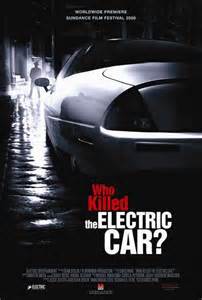
Jordan: “Yes, a so-called documentary titled ‘Who Killed the Electric Car.’”
Who KIlled the EV 2 Matt: “You were in the movie if I’m not mistaken.”
Jordan: “Yes, my one and only…at least I hope only…feature film.”
Matt: “You said ‘so-called’ documentary.’ Why the label?”
Jordan: “I think the producer left out key points in the film. Look, I understand all films take some license. Films need to tell a story.”
Matt: “But you think the whole story wasn’t told?”
Jordan: “The movie claimed, or at least implied, there was a conspiracy to kill the electric car. I laughed at that idea. We were all too naïve…I sometimes say not smart enough…to have a conspiracy. The EV1 died because of some bad decisions, not because of some conspiracy.”
Matt: “What about GM crushing all the EV1’s? Why?”
Jordan: “This is my frustration with the movie. Key points were left out. In fact, I agree that GM should have crushed the cars.”
Matt: “Huh? Seems like convoluted thinking on your part. You are frustrated that GM killed the program but agree they should have crushed the cars. Why?”
Ev1_crush5 Jordan: “GM made two big mistakes when they crushed the cars. One was they never explained why. Second was they crushed the cars too soon. GM management never understood or appreciated the value of all the positive media coverage the EV1 continued to generate.”
Matt: “You’re right, I’ve never heard why the cars were crushed. All I know is the cars, other than a few, are long gone. What’s the reason?”
Jordan: “Remember GM never sold the EV1 to anyone. All cars were leased.”
Matt: “Why not sell them?
Jordan: “Two reasons. Leasing avoids the battle with the GM financial staff over what the MSRP would be. Financial guys wanted to recover costs as quickly as possible and given the low volume, MSRP would have been outrageously high.”
Matt: “I know the timeframes are different but Tesla has a high MSRP and sells quite a few cars.”
Jordan: “You’re right. And GM might have sold as many as Tesla. The more important reason GM leased the cars was associated with providing service. EV1 was plowing new ground. There were no other electric vehicles, no hybrids and very limited knowledge on how to provide service. Working on the EV1 battery pack was not like changing your car battery.”
Matt: “You mean I could have gotten fried.”
Jordan: “In a heartbeat, or lack of a heartbeat. The battery pack had lots of volts and amps. But there was also a law…at least at the time…and I suspect something similar exists today. At the time if an auto company sold a car…transferred title…then it was obligated to provide service and parts for 10 years.”
Matt: “So if I bought an EV1 in California, where it was introduced, and then moved to say Bangor, ME, GM would be obligated to provide service in Bangor for 10 more years? Even if the car was not sold in Maine?”
Jordan: “Essentially, yes.”
Matt: “And lease cars have different rules?”
Jordan: “The person leasing the car never takes title and therefore does not trigger the service obligation. Plus, the lease can include restrictions on where the car can be driven, where serviced, etc. As a lease car, the EV1 still belongs to GM. The person leasing is really like a long-term renter.”
Matt: “Now I understand why GM leased the EV1’s. I wish the movie would have explained that.”
Jordan: “You and me both. Virtually no one is aware of the service requirement.”
Matt: “But why didn’t GM renew the lease instead of calling all EV1’s back and then crushing them?”
BeanCounter Jordan: “Matt, quit thinking like a marketing guy and start thinking like a bean counter. As a bean counter, you would view the EV1 program as a cost center and not recognize any benefit. The faster the program was shut down, the faster the cost could be eliminated.”
Matt: “I’m still having trouble understanding why the financial guys could not understand the value of EV1. It seems so obvious.”
Jordan: “I hear you. Maybe a story will help you understand. The story I’m about to tell is rarely told. One reason is so few people were involved.”
Matt: “I’m all ears.”
Jordan: (cell phone rings) “Excuse me Matt. I need to take this call. We’ll continue shortly.”

← Older posts
Newer posts →

Subscribe

  • Entries (RSS)
  • Comments (RSS)

Archives

  • August 2025
  • July 2025
  • June 2025
  • May 2025
  • April 2025
  • March 2025
  • January 2025
  • December 2024
  • November 2024
  • September 2024
  • August 2024
  • July 2024
  • June 2024
  • May 2024
  • April 2024
  • March 2024
  • February 2024
  • January 2024
  • December 2023
  • November 2023
  • October 2023
  • September 2023
  • August 2023
  • July 2023
  • June 2023
  • May 2023
  • April 2023
  • March 2023
  • February 2023
  • January 2023
  • December 2022
  • November 2022
  • October 2022
  • September 2022
  • August 2022
  • July 2022
  • June 2022
  • May 2022
  • April 2022
  • March 2022
  • February 2022
  • January 2022
  • December 2021
  • November 2021
  • October 2021
  • September 2021
  • August 2021
  • July 2021
  • June 2021
  • May 2021
  • April 2021
  • March 2021
  • February 2021
  • January 2021
  • December 2020
  • November 2020
  • October 2020
  • September 2020
  • August 2020
  • July 2020
  • June 2020
  • May 2020
  • April 2020
  • March 2020
  • February 2020
  • January 2020
  • December 2019
  • November 2019
  • October 2019
  • September 2019
  • August 2019
  • July 2019
  • June 2019
  • May 2019
  • April 2019
  • March 2019
  • February 2019
  • January 2019
  • December 2018
  • November 2018
  • October 2018
  • September 2018
  • August 2018
  • July 2018
  • June 2018
  • May 2018
  • April 2018
  • March 2018
  • February 2018
  • January 2018
  • December 2017
  • November 2017
  • October 2017
  • September 2017
  • August 2017
  • July 2017
  • June 2017
  • May 2017
  • April 2017
  • March 2017
  • February 2017
  • January 2017
  • December 2016
  • November 2016
  • October 2016
  • September 2016
  • August 2016
  • July 2016
  • June 2016
  • May 2016
  • April 2016
  • March 2016
  • February 2016
  • January 2016
  • December 2015
  • November 2015
  • October 2015
  • September 2015
  • August 2015
  • July 2015
  • June 2015
  • May 2015
  • April 2015
  • March 2015
  • February 2015
  • January 2015
  • December 2014
  • November 2014
  • October 2014
  • September 2014
  • August 2014
  • July 2014
  • June 2014
  • May 2014
  • April 2014
  • March 2014
  • February 2014
  • January 2014
  • December 2013

Categories

  • Affordable Solutions
  • Back Asswards Thinking
  • Background
  • Background Stupid Is as Stupid Does
  • Benefits of Revolution
  • Causes of the Revolution
  • Common Sense Policies
  • Corporate Policy
  • Definitions
  • Diversions
  • Economics
  • Education Issues
  • Federal Budget
  • General Motors
  • Gov't Policy
  • Infrastructure & Fixed Fuel Prices
  • Innovative Thinking: Ideas and Products
  • Lessons of Revolution
  • Personal Stories
  • Possible Solutions
  • Post Trump Presidency
  • Rebranding Black Community
  • SCOTUS
  • Sense Check
  • Societal Issues
  • Stupid Is as Stupid Does
  • Tech Tsunami
  • Trump 47
  • Uncategorized

Meta

  • Create account
  • Log in

Create a free website or blog at WordPress.com.

Privacy & Cookies: This site uses cookies. By continuing to use this website, you agree to their use.
To find out more, including how to control cookies, see here: Cookie Policy
  • Subscribe Subscribed
    • usrevolution5
    • Join 32 other subscribers
    • Already have a WordPress.com account? Log in now.
    • usrevolution5
    • Subscribe Subscribed
    • Sign up
    • Log in
    • Report this content
    • View site in Reader
    • Manage subscriptions
    • Collapse this bar
 

Loading Comments...