
(Readers: Please note this blog is constructed as a story. While not all chapters are linked, I think the story will be more meaningful by starting at the beginning.)
Scene: Jordan Abel’s Office
Voice: “Are you Jordan Abel? The staff said I could find you here.”
Jordan: “Yes, they said you were coming. They also said you were some kind of guru.”
Voice: “Well, not exactly a guru. I’m an architect.”
Jordan: “You look like a guru to me. So in this new world your name is Guru. So your shtick is architecture? What kind of architecture and why do you want to see me?”

Guru: “The United States and many other countries need affordable housing. I have designs that are attractive, innovative and affordable.”
Jordan: “Yes, this country needs lots of housing but what’s so different about your approach?”
Guru: “The approach integrates ideas from different industries. Think about when the smart phone was introduced. At the time there were already small computers and already multi-functional cell phones. The smart phone combined many of the best parts of both.”
Jordan: “I’m interested in learning more about the integration. One of my favorite examples of integration is the auto industry. Before the assembly line all cars were built one at a time – much like houses today. Lots of variability between each unit.”
Guru: “I like the analogy so far.”
Jordan: “Then a big change in how cars were built. Most everyone thinks the big change was the assembly line. But Henry Ford’s innovation was what made the assembly line possible – standardizing parts. All bodies were built the same, all engines, etc. Once that happened, then cars could be built on an assembly line.”
Guru: “You got the picture. My idea integrates components from architecture, automotive, manufacturing and some other industries.”
Jordan: “Keep going.”
Guru: “The idea is to offer custom homes built in factories. Throw away your existing ideas about modular homes and trailers. Think of those as the original cell phone. We are talking about houses that are like smart phones and today’s cars, not Henry Ford’s Model T – one color as long as it’s black.”
Jordan: “Let’s take this step by step. How are you going to make custom homes in a factory?”
Guru: “First, think ‘custom” within reason. These are really custom-fit homes. You get a wide range of choices that allows you to fit the design to your needs and tastes.”
Jordan: “The custom fit reminds me of my days in New York. I bought shirts at a place called the Custom Shop. Beautiful fabrics. They would take measurements – neck, sleeve length, whether you wore a watch, etc. Then the shirts were machine made in New Jersey using templates that were closest to the measurements. Shirts were great. In fact I got tired of the shirts before the fabric wore out.”
Guru: “Same idea as the Custom Shop. Lots of potential combinations but all the work will be completed in a controlled environment. Jordan, you came out of manufacturing. You know how much easier it is to control quality in an assembly plant.”
Jordan: “You know, I have to laugh when people say they want a hand-built car. What they want is to feel as the car was made for them – to their specifications.”
Guru: “You got it. People want to develop an emotional bond to their house and their car. The custom-fit approach allows that emotional bond to be created. Yet the approach makes the house more affordable, improves quality and makes repairs easier.”
Jordan: “You just covered a lot of territory. Let’s take this one step at a time so I make sure I understand it. By the way, want some coffee?”
Guru: “Yes, please. Regular…err, regular coffee NY style.”
Jordan: “Another quick story. The first time I ordered coffee in a deli in NY the guy asked if I wanted regular coffee. I said ‘yes.’ Where I grew up regular coffee meant black, no sugar.”

Guru: “Not in New York. Regular is cream and sugar.”
Jordan: “To this day, wherever I am, the coffee order is ‘black, no sugar.’ Enough coffee stories. Let’s break down the project into some understandable sections – exterior design, interior design, interior functions, manufacturing and assembly, serviceability, code barriers. And maybe most importantly, how do we change the perception of manufactured housing?”
Guru: “Here are some designs. These are pictures of a real house, not renderings. The ones in the picture were built in Charlotte.”
Jordan: “These are actual houses, not renderings?”
Guru: “The houses were built before the great housing crash in 2008. Let me walk you through the different designs.”
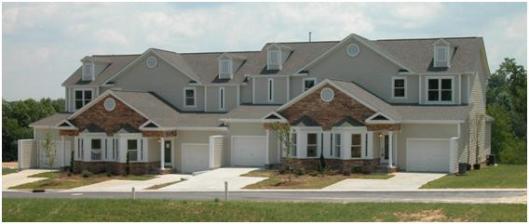

Jordan: “Great exterior. What about the interior design and features?”
Guru: “Interior design and features are even more wide open than the exterior. Pretty much whatever you want. Obviously the room shapes and sizes are influenced by the exterior but lots of flexibility.”
Jordan: “What about interior walls for support? Can one buyer have smaller rooms, more like a traditional colonial and another buyer have wide-open spaces – more modern design?”
Guru: “All within reason. Very large rooms might have to have support beams but today’s stick-built houses need support beams for larger rooms.”
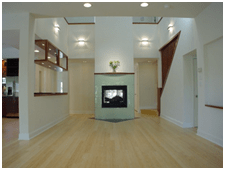

Jordan: “I like these designs a lot. You really are a guru.”
Guru: “Thanks.”
Jordan: “Well, Guru, then here’s a question that has always troubled me. How can we make the interior of the house easier to upgrade as new technology becomes available? Why should it be so difficult and costly to upgrade plumbing and electrical? Why should a 50-year old house have 50 year-old wiring? That seems crazy.”
Guru: “Good question. We’ve designed easy access to all electrical and all plumbing. I should say easy access for a licensed plumber and electrician. The homeowner can do a lot more changes than today but tasks requiring more skill need someone licensed.”
Jordan: “Give me an example of what’s different.”
Guru: “First, plumbing and electrical are easily accessible. Plumbing and electrical are inside the walls but easily accessible through decorative panels throughout the house.”
Jordan: “You mean I do not have to tear up walls to fix plumbing and electrical?”
Guru: “Easy access other than rare occasions.”
Jordan: “More control to the homeowner. What else.”
Guru: “Another example of more control is wiring. Virtually all circuits in the houses are higher voltage and higher amps – 240 volts, 30 amp – same as your electric stove.”
Jordan: “But aren’t most circuits 120 volt and 15 amp? How will computers, TV’s and lights work?”
Guru: “The receptacles also accept two types of plugs – two 120V plugs or one 240V plug. Whichever plug is used determines the voltage. Having access to 240V throughout the house alows the home owner to place higher voltage appliances – clothes dryer, for example – in different locations without having to call an electrician.”
Jordan: “Finally, someone is thinking ahead.”
Guru: “Our goal is to provide enough flexibility so the house can remain easy to update for at least the next 50 years and our target is 100 years.”
Jordan: “So you are designing a house to handle electrical and plumbing needs for 50-100 years without a major tear up?”
Guru: “The target is 100 years.”
Jordan: “I really like the designs and the goal of keeping up to date for 100 years. I want to continue this conversation but I need to leave shortly.”
Guru: “Anything I should think about?”
Jordan: “Yes, how can an owner do the following? #1, easily replace or remove damaged walls. #2, keep the house tight so it doesn’t creak and moan. #3, and this might be harder, avoid damage from floods or earthquakes. 100 years is a long time. I’m sure you will have answers. Can we meet tomorrow?”
Guru: “See you then.”
 usrevolution5