• Home
  • Booklets/Grouped Entries
  • Tech Tsunami
  • List of Entries to Date
  • About the Author

usrevolution5

~ USA Headed for a 5th Revolution! Why?

usrevolution5

Category Archives: Societal Issues

#163 VW Emissions Debacle

08 Thursday Oct 2015

Posted by Jordan Abel in Corporate Policy, General Motors, Gov't Policy, Societal Issues

≈ 1 Comment

First-time readers, this blog is set in the future (sometime after the year 2020).  Each entry assumes there has been a 5th revolution in the US — the Revenge Revolution.  More about Revenge Revolution and the author, Entry #1.  List and general description of entries to date. 

Note: most characters appear in a number of entries, with many entries building on previous conversations.  Profile of characters.  You’ll catch on quickly.  Thanks for your time and interest…and comments. 

Scene: coffee shop near office. Jordan meets Matt, a reporter for a major newspaper. Matt interviewed Jordan for an earlier series of articles.

Jordan: “Matt, been a long time. Nice to see you.”

092615_2031_Characters11.pngMatt: “Nice to see you Jordan.”

Jordan: “Tell me about the book you’re working on.”

Matt: “That’s one of the reasons I called you. Before we talk about the book, I want to ask you about an issue that still troubles me…and that you can provide some insight.”

Jordan: “What’s that?”

Matt: “The VW emissions debacle – programming the software to rig the emissions tests. And I have it on good authority that someone in POTUS’ office called you for advice when it happened.”

021214_1242_24Resultsof1.gifJordan: “You know I can’t confirm whether anyone called, even though it’s a few years later. What I can tell you is what I would have told them if they had called.”

Matt: “OK, we’ll frame the conversation as a hypothetical. I’ll pretend I’m from POTUS’ office. Now, what’s your take on what really happened at VW?”

Jordan: “I only know what I read in the papers. But if what has been reported is anywhere close to the facts, the action by VW was the most blatant violation of federal auto laws by far. Nothing else comes close.”

Matt: “I know this might sound odd but what’s so blatant? Other companies have violated safety laws. VW’s violation was only emissions.”

vwJordan: “C’mon. Emissions are a safety issue…a safety issue for society. But the real difference is VW violated the laws knowingly. And from all indications, the violations were directed by senior management.”

Matt: “You really think senior management knew?”

Jordan: “If senior management didn’t know, they all should be fired. Probably should be fired anyway. I mean, the head of US operations – Horn, Michael Horn – was told at least two years before the public announcement.”

Matt: “So one of his underlings says, ‘Houston, we have a problem.’ And the top dog responds, ‘OK.'”

TurtleneckJordan: “Allegedly, Mr. Horn – great name for a car guy – never bothers to probe. Where were such questions as, ‘What is the problem?’; ‘How severe?’; ‘What are the consequences?’; ‘How long will it take to get fixed?’; ‘Were any EPA or NHTSA rules broken?’; ‘What will the fix cost?’; and a bunch of other obvious questions you’d expect from senior management.”

Matt: “As bad as VW’s violation was, they’re not the first. What’s different about VW than say GM’s failure of the ignition switch?

Jordan: “Fair question. I think two major differences. First GM was at fault for the design. No question. But the intent to defraud, if there was one, was confined to one or two people. I am not aware of any senior managers charged with fraud.”
GM-Ignition-recall-2014Matt: “Shouldn’t GM have caught the failure in testing or at least a potential problem during a review of the specifications?”

Jordan: “Yes. My understanding is the design engineer also signed off on the changes. No having an independent review was a mistake and a flaw in GM procedures.”

Matt: “What’s the second difference?”

Jordan: “People get upset when I explain – and claim – some of the deaths linked to the ignition switch failure can be attributed to driver behavior.”

Matt: “How so. Doesn’t seem right, but how so?”

Jordan: “You know enough about cars that if the power steering and power brakes…actually power-assisted steering and brakes…fail you can still maneuver and stop the car.”

Matt: “My grandfather had an old pick-up truck that he used to let me drive. The truck had manual steering and brakes. It was a bit harder to steer but not that much.”

Jordan: “Most of the deaths attributed the ignition switch were younger people so it’s doubtful the drivers had any experience, or even knowledge, of operating a car without power steering and brakes. Plus…”

Matt: “Plus what?”

seat_belt_required_signJordan: “Some of the drivers and occupants were not wearing seatbelts. Probably one out of every 5 or 6 people, maybe more.”

Matt: “Hadn’t thought about not wearing belts. Belts are operated mechanically and work whether or not the car has any power.”

Jordan: “Like I said, not a very popular observation. I’m not saying GM’s not at fault. Just that the effort to deceive was confined to a couple of people.”

Matt: “I know we could talk about problems at Toyota, the airbag supplier Takata but let’s go back to VW. What do you think the penalty should be?”

Jordan: “You mean, what did I tell POTUS’ office had they asked?”

Matt: “Yes, had they asked.”

Jordan: “At a minimum VW needs to fix the 11,000,000 diesel cars with the emissions override program. Then for customers who are dissatisfied with lower performance, lower mpg, or whatever, VW should buy back the cars.”

Matt: “At what price?”

Jordan: “Current list price. No allowance for depreciation. And maybe even some sales tax. People have to buy another car.”

Matt: “What about people who want to keep their VW?”

Jordan: “Some compensation for reduced value of the used car.”

Matt: “What about penalties?”

Money-clip-artJordan: “The potential fine in the US is something like $18, billion. That’s 18 and nine zeros. Not sure about Europe.”

Matt: “What about the government forcing VW to cease operations? At least stop selling in the US.”

Jordan: “Doing so might make some people feel good. But doing so makes the current owners SOL, as it were. If the market forces them out of business, OK. But the government should not.”

Matt: “No easy solutions. What about the VW executives?”

PrisonerJordan: “Someone or some bodies need some jail time. There was clear intent by VW management to defraud. Defraud government, consumers and the general public. The icing on the cake is VW sought Green Seal approval. Imagine, a Green Seal for a car that spewed out 40 times allowable emissions. What gall. Anything less than jail time would not be a deterrent for others.”

Matt: “Thanks for the briefing…just in case POTUS’ office asked for your opinion. Let’s get more coffee, then back to the book.”

#162 What Is Education and How to Measure (10 of 10)

30 Wednesday Sep 2015

Posted by Jordan Abel in Education Issues, Societal Issues

≈ Leave a comment

First-time readers, this blog is set in the future (sometime after the year 2020).  Each entry assumes there has been a 5th revolution in the US — the Revenge Revolution.  More about Revenge Revolution and the author, Entry #1.  List and general description of entries to date. 

Note: most characters appear in a number of entries, with many entries building on previous conversations.  Profile of characters.  You’ll catch on quickly.  Thanks for your time and interest…and comments. 

Scene: Conversation about education starts Entry #153. Jordan and JC, a long-time friend (and frequent character) are having dinner. Time of year – just about when school starts.  Conversation from Entry #161 continues.

092615_2031_Characters1.jpgJC: “You know, the solution seems so simple.”

Jordan: “The solution is simple. People…individuals and groups with common interests…need to take responsibility for solving their own problems.”

JC: “No more help from the government? That seems cruel.”

Jordan: “Did I say no government help?”

JC: “No but it seems to be implied.”

Jordan: “Government’s role is to help. But people need to take the initiative. OK to ask for help but people, not government, need to be driving the outcome. Otherwise, the stringeffort is like pushing on a string.”

JC: “That’s a great mental picture – pushing on a string.”

Jordan: “Pushing on a string is a good way to describe many educational programs.”

JC: “You sound like a die-hard conservative.”

TurtleneckJordan: “Hardly, but I agree with conservatives that a lot of money is being wasted on certain government programs.”

JC: “Let’s go back to the list of education programs and assign a grade.”

Jordan: “Fire away.”

JC: “Busing.”

Jordan: “A grade of ‘D’ at best. Very costly, takes hours out of the day for studying or school activities. Breaks building a bond with the neighborhood school. Just a bad gradesidea.”

JC: “Magnet schools or specialized schools?”

Jordan: “I think the idea is worthwhile. I support separate schools for larger school districts – maybe districts with a population of 1,000,000 or more. Otherwise, incorporate the specialized classes in the regular school.”

JC: “What about a grade?”

Jordan: “An ‘A’ if executed properly, meaning the curriculum includes some liberal arts and sciences classes. The students still need to learn the fundamentals.”

JC: “Charter schools?”

Thumbs DownJordan: “An ‘F’. A horrible idea. Takes away tax dollars from public schools and worse, does not begin to solve the core problem.”

JC: “How do you really feel about charters?”

Jordan: “Make the grade a solid ‘F-‘. Plus charters have little, if any, accountability. Charters are a recipe for fraud.”

JC: “For-profit universities?”

Money-clip-artJordan: “Please call them what they really are. 90% of them are high-cost, poor results remedial training centers.”

JC: “What about the other 10%?”

Jordan: “You mean the alleged schools that are supposed to teach students how to become manicurists, computer techs and bunch of other stuff that should be taught at community colleges. Oh, yes, the grade? An ‘F’ for fraud.”

JC: “Private universities?”

Jordan: “OK as long as accredited by a government organization. If not accredited, then the organization should be banned from using the term ‘university’ or ‘college’…or even ‘institute.’ That rule applies to any type of institution of higher learning, secular or religious.”

JC: “What about religious high schools?”

Jordan: “Grade of ‘B’ at best. There need to be some standards for the curriculum. Otherwise, some of these schools are just brainwashing students.”

JC: “Home schooling?”

children_togetherJordan: “Some people who home school claim the regular school is not challenging enough for little Johnnie. Well, folks what about working with little Johnnie after school if he’s so smart?”

JC: “Are you implying that the social part of school is important?”

Jordan: “Of course. Social interaction is at least half the value of going to school. People do not live in caves. Individuals need to learn to get along with other people.”

JC: “What about mainstreaming kids with disabilities. Good idea or bad?”

Jordan: “That issue seems less clear. Some really smart students are cited for behavioral issues. My supervisor…”

JC: “…You mean Ms. Straight A’s?”

report-card4Jordan: “Yes, Ms. Straight A’s had a comment on a report card in grammar school about being disruptive. Seems that she was finishing her work early, then helping the other kids.”

JC: “I’ve never heard that story. That’s funny. But seriously, what about kids with real behavioral issues?”

Jordan: “Sounds harsh but the kids need to be separated. I am sympathetic and empathetic with the parents but you should not hold back 30-35 kids because of 1 or 2 other kids.”

JC: “That does seem harsh.”

Jordan: “I agree. Tell me an alternative?”

JC: “Mainstreaming treats the symptom and not the cause.”

Jordan: “Exactly. People who know a lot more about education than either one of us need to find a solution that does not disrupt the education of the other children. Mainstreaming is a politically correct answer but not a real solution.”

JC: “If I sum up your assessment of current education programs, most barely pass and some fail.”

Jordan: “Your assessment is correct. And I think this is where conservatives and liberals can agree.”

JC: “What about a solution?”

122813_2140_15Education4.jpgJordan: “The public, and especially those who feel disadvantaged by the current system, need to demand a return to quality, neighborhood schools. No charters, no busing, no solution de jour. Honest, sold neighborhood schools.”

JC: “In a very basic way it’s back to the old three R’s — reading, riting and rithmatic. But spelled correctly.”

reading-writing-arithmetic-9944699Jordan: “Simple, eh? Now people need to come together and demand government help accomplish what they want.”

———- End of section and yes, it is simple. —————

#161 What Is Education and How Should We Measure (Part 9)

26 Saturday Sep 2015

Posted by Jordan Abel in Education Issues, Possible Solutions, Societal Issues

≈ 1 Comment

First-time readers, this blog is set in the future (sometime after 2020).  Each entry assumes the Revenge Revolution has occurred.  For more about the anticipated 5th revolution in the US — the Revenge Revolution — and more about the author, Entry #1.  Note: most characters appear in a number of entries, with many entries building on previous conversations.  Profile of characters.  You’ll catch on quickly.  Thanks for your time and interest…and comments. 

Scene: Conversation about education starts Entry #153. Jordan and JC, a long-time friend (and frequent character) are having dinner. Time of year – just about when school starts.  Conversation from Entry #160 continues.

Jordan: “Over the break, I’ve been thinking.”

010414_1635_16TeachingS1.jpgJC: “You, thinking? Seriously? That’s dangerous. Thinking about what?”

Jordan: “Seems to me that we…again the collective we…need to face a simple, but difficult issue.”

JC: “An issue about education, I assume.”

Jordan: “The issue affects education, yes. And no matter how we try to improve education…and many other issues…we are not going to make progress until…”

JC: “Let me back up. You believe there is a simple, overriding issue affecting progress in education?”

BarrierJordan: “Maybe I should characterize it as a ‘barrier’ rather than an issue.”

JC: “OK, you think there is a simple barrier preventing progress.”

Jordan: “Yes, there is a barrier. But we can ignore it.”

JC: “Jordan, you have me thoroughly confused. What are you talking about? What’s the barrier?”

Jordan: “Racism.”

JC: “You’re saying racism is a major barrier to education…and other issues…but we should ignore it? How are we going to ignore racism? Maybe more important is why should we ignore racism?”

TurtleneckJordan: “Because, no matter what we do, racism is not going to go away. So just ignore it.”

JC: “Ignoring racism seems counter-intuitive. Racism is a big problem.”

Jordan: “Yes, racism is a big problems for those who let it become a barrier.”

JC: “Shouldn’t we try to eliminate racism?”

Jordan: “Good luck. Racism has existed for thousands of years. Why do you think we can eliminate it now?”

JC: “What about legislation? You know, like anti-Jim Crow laws?”

Jordan: “Why do you think such laws are going to reduce racism? Notice I did not say eliminate racism?”

JC: “I don’t know how. Give me a hint.”

Aretha-aretha-franklin-27121751-1280-1024Jordan: “Aretha Franklin.”

JC: “You mean Aretha as in ‘R-E-S-P-E-C-T’. That Aretha?”

Jordan: “Exactly. Respect. And how does someone in a group gain respect? Through legislation?”

JC: “No, they earn it.”

Jordan: “Reminds me of the tag line from an old commercial for a brokerage firm – ‘…They earned it.'”

JC: “Was the brokerage firm EF Hutton or something?”

Jordan: “I think it was Smith Barney. Anyway, it was a great tag line.”

JC: “So you have this theory that racism should be ignored and we should just plow ahead fixing education. How’s that going to work?”

Jordan: “The big change in thinking is you and I…and most other people in society…are not going to do anything.”

JC:  “Not do anything?  If we don’t, then who will?”

Jordan:  “The groups that think they are being held back by racism need to change.”

ignoreJC: “Whoa, Bubba. You want blacks to ignore racism but lead the charge for making change? You been smoking something?”

Jordan: “Recognize that racism has always existed and will always exist to some degree. So rather than focusing on racism, start building a community others can respect.”

JC: “That is a tall order. You think it can work?”

Jordan: “You name one ethnic group in this country that has not faced blatant discrimination at some point. Just one.”

JC: “I can’t think of any.”

Jordan: “And you won’t. So now ask yourself, how many of those ethnic groups still face blatant discrimination today? Emphasis on ‘blatant.'”

JC: “Blacks and I guess Muslims, but mostly blacks.”

Jordan: “What about the Irish? The Italians? The Polish, the Germans, the Jews? The Japanese, Chinese, the Indians – Asian Indians?”

JC: “Those groups seemed to have gained respect of most people.”

Jordan: “Right. And how did they gain respect?”

JC: “Like the Smith Barney commercial, they earned it.”

Jordan: “And how did they earn it?”

earn-learnJC: “They supported one another socially, in business, financially…and encouraged the kids to get an education.”

Jordan: “Right. Some groups have become more successful than others but the formula is basically the same.”

JC: “So you’re saying to blacks…actually sounds like preaching…that there is a model for gaining respect. Every other ethnic group has used the model and gained respect. So what’s your problem? Have I got it right?”

Jordan: “Yes. Forget about racism as a barrier. That’s a negative. Focus on the positive and follow the model that has worked over and over and over.”

JC: “That model takes several generations to really work.”
Emancimation ProclamationJordan: “So? It’s been 150+ years since the Emancipation Proclamation. By my count that is six generations, going on seven. Tell me, where are blacks today versus 6-7 generations ago?”

JC: “Not officially slaves but still at the bottom rung of the economic ladder. And, in that same period almost every other ethnic groups immigrated, faced discrimination, and then established themselves.”

Jordan: “In statistics we call that a trend. My question to black society is the model to gain respect has been proved repeatedly. Why aren’t you following the model?”

JC: “What if blacks follow the model? What does that mean for education?”

stop-sign-216600Jordan: “What I think it means is stop busing, stop worrying about quotas, quit blaming others and stop making excuses. Start supporting your children and their education. Yes, it might take another 50 years before there is real progress. But one thing is for certain. The current approach is not working.”

JC: “Jordan, all this seems so basic. What’s stopping progress?”

Jordan: “The artificial mental barrier called racism.”

#160 What Is Education and How Should We Measure? (Part 8)

19 Saturday Sep 2015

Posted by Jordan Abel in Education Issues, Gov't Policy, Societal Issues

≈ 2 Comments

First-time readers, this blog is set in the future (sometime after 2020).  Each entry assumes the Revenge Revolution has occurred.  For more about the anticipated 5th revolution in the US — the Revenge Revolution — and more about the author, Entry #1.  Note: most characters appear in a number of entries, with many entries building on previous conversations.  You’ll catch on quickly.  Thanks for your time and interest…and comments. 

Scene: Conversation about education starts Entry #153. Jordan and JC, a long-time friend (and frequent character) are having dinner. Time of year – just about when school starts.  End of previous entry, Jordan states, “What society can do is for kids who caught a bad break with parents, or made a stupid decision and quit school, we will help you get your education.”

010414_1635_16TeachingS1.jpgJC: How are you going to help these kids?”

Jordan: “You mean how are we going to help them.  Go back to an earlier part of this conversation — we talked about setting clear, easy-to-understand goals.”

JC: “I agree with the goal setting.  Who’s really going to set the goals, the local school board?”

Jordan:  “No.  That has been the problem.  Too much variation in quality among districts.”

JC:  “Then there has to be a national standard.  With a national standard, do local school boards decide how to achieve to the goal…at least within reason?”

TurtleneckJordan: “Exactly. As much as I am for national standards, I also realize that executing to achieve a national standard might be different in California than in Charlotte or New York. Each area has certain challenges that are unique to the area.”

JC: “OK, I’ll buy the argument for a national standard.  But why let the local districts decide how to achieve?  There will be so much variation, which seems to defeat the purpose.”

Jordan: “We need buy in to make this work.  People become more committed to a achieving a goal when they have some input. Allowing the local communities some degree of freedom is not only necessary but a smart move to get local participation and commitment.”

JC: “Will having higher-level goals help get rid of what seems to be the ‘solution de jour’ for education?”

Jordan: “I hope so.  No doubt it will take a few years.  By the way, some specific proposal come to mind as a solution de jour?”

JC: “The most recent is from your current location, Charlotte.”

newspaperJordan: “I didn’t have time to read the Charlotte Observer this morning. What’s the latest proposal?”

JC: “The school board wants each school to have a limited percentage of kids below the poverty line. I guess the school board thinks the ‘education fairy’ is going to sprinkle pixy dust and make everything better if only so many kids are below the poverty line.”

Jordan: “That’s the kind of proposal we need to get rid of.  I understand these kids have it tough. But limiting disadvantaged kids to a certain percentage is addressing the symptom, not the cause. Besides a percentage-based plan will drive more affluent kids to private school and make it nearly impossible to recruit a top-notch superintendent.”

JC: “No.  But Charlotte is supposedly a progressive city.  What’s the issue recruiting a superintendent?”

Jordan: “Charlotte has gone through school superintendents like crap through a goosegoose.”

JC: “A bit graphic don’t you think?”

Jordan: “Maybe, but true. They’ve run off two good ones in the last 3-4 years and now refuse to promote an assistant who has 30-some years’ experience.  She knows the system inside out and add the people. Seems to me the school board ought to seek stability rather than churning the system yet again.”

JC: “What about support for teachers?”

Jordan: “North Carolina legislature gives teachers a token bonus and cannot understand why teachers are unhappy and leaving the state. NC is on a race to the bottom and is now 48th or 49th in teacher pay. A few years ago it was above the down_arrow_clip_art_22552national average.”

JC: “North Carolina seems like an example of what not to do.”

Jordan: “You got that right.  Many residents, especially those who moved from the north are dumbfounded…and frustrated.”

JC: “Hate to ask this, but are some Charlotte school board members still fighting the Civil War…or Brown v. Board?”

Jordan: “Many view the Civil War and Brown v. Board as the same issue. The school board is mostly locals. Maybe it’s time to start another civil war, but this time the war will be about education and not slavery.”

JC: “A sidebar. When you read the Charlotte Observer today (September 14, 2015), make sure you read the letters to the editor.”

070715_2218_141SenseChe3.jpgJordan: “OK, what was the letter about? No, let me guess. The Civil War.”

JC: “Bingo. And the reason the South seceded was not about slavery but because of taxes. Those damn Yankees were overtaxing the southern states and they had to secede.”

Jordan: “Taxes? I’ve never heard that before. What taxes?”

JC: “Who knows? Sorry for the interruption. What about a civil war focused on education?”

Jordan: “The strategy would be to have those damn Yankees start running for school board and state house and senate. Might take 15-20 years to secure a majority vote on school boards but the effort would be worthwhile.”

meeting-clipart-board-clip-artJC: “You need to speak more southern.  The proper term is ‘might could’ take 15-20 years.”

Jordan: “OK, might could.  In addition to Yankee candidates, we need to appeal to Yankee parents with school-age kids and older people with grandchildren.”

JC: “Want my guess about how long it will take to get control?”

Jordan: “More than 15-20 years?”

JC: “No, a lot less. Once the movement gets started, the change will occur quickly. Look what happened with the LGBT movement.”

Jordan: “I am still amazed how quickly societal attitudes changes and how quickly lives changed.”

JC: “I think most people were ready for a change but needed someone to take the lead. Then they jumped on board.”

Jordan: “Well, my friend, what are we…notice the we part…going to do about starting albert-einsteinthe ‘Teach Kids to Think’ movement?”

JC: “First, let’s call it the ‘TKT Movement – teach kids to think movement, or TKT2.”

Jordan: “I like TKT2 because the ‘squared’ part forces people to think about the acronym.”

JC: “Well, while we’re thinking, I think I need a break.”

#159 What Is Education and How Should We Measure? (Part 7)

13 Sunday Sep 2015

Posted by Jordan Abel in Education Issues, Gov't Policy, Societal Issues

≈ Leave a comment

First-time readers, this blog is set in the future (sometime after 2020).  This entry assumes the Revenge Revolution has occurred.  For more about the anticipated 5th revolution in the US — the Revenge Revolution — and more about the author, Entry #1.  Note: most characters appear in a number of entries, with many entries building on previous conversations.  You’ll catch on quickly.  Thanks for your time and interest…and comments. 

Scene: Conversation about education starts Entry #153. Jordan and JC, a long-time friend (and frequent character) are having dinner. Time of year – just about when school starts.  Jordan and JC continue conversation after talking informally to some people at nearby tables.

JC: “So what do you find out? People think the idea of earning a merit 010414_1635_16TeachingS1.jpgbadge for completing certain ‘courses for dummies’ might reduce the stigma of not knowing certain topics?”

Jordan: “The people who I talked to thought the idea was interesting and intriguing. But they also suggested we run a pilot program.”

JC: “The groups I talked to had a similar reaction. The idea of eliminating the stigma of learning basic skills…topics that you should know…was well received.”

Jordan: “What about a pilot program to test the idea?”

JC: “We didn’t talk specifically about a pilot but the groups were concerned that implementing the program too quickly might backfire. They wanted to build support at the grass-roots level rather than mandate from the superintendent’s office…and certainly not from the individual states or Washington.”

TurtleneckJordan: “Why are so many people in this country against a national education program? When you go off to college or get a job there is an expectation of a certain level of learning. You can’t have 50 different standards.”

JC: “More like 500 or 5,000 different standards if you consider all the school districts.”

Jordan: “Can you imagine every auto plant having different standards for crash worthiness, turn signals, tire quality, etc. At the end of the day, like it or not, education is much like having kids go down an assembly line. In first grade, they start out at the beginning of the assembly line and assembly lineby the time they complete high school, they are a functioning chassis that can drive away.”

JC: “What about college or trade school?”

Jordan: “College and trade schools add more options and make engine performance better. But when kids graduate from high school, they should be prepared to function in the real world.”

JC: “I agree but I also know that at the end of the assembly line some cars need some repairs. What happens with these cars…kids?”

Jordan: “Let’s fix the kids. Many kids drop out of school because they have not thought through the consequences or there is some tragedy in their life. We…the proverbial societal we…have to grab these kids and make sure they get enough training to get out of high school.”

JC: “Even if they are older?”

Jordan: “Getting people who are older back through high school is even more old_woman_walkingimportant. I don’t care if someone is in their 90’s. If they want to finish high school, my vote is to have the taxpayers fund the program.”

JC: “Doesn’t that seem like a waste of money? I mean training someone who is that old?”

Jordan: “I think there is value created from two perspectives. Chances are the person who is without a high school education still pays taxes – sales tax, property tax, whatever. And they will likely pay taxes for at least 40-50 years…and maybe longer. So society owes them something in return.”

JC: “What’s the second benefit?”

Jordan: “The 90 year-old going back to school would be a great example and inspiration for a lot of younger people to complete their education. If great grandma grandmacan do it, why can’t you sonny boy or you sonny girl?”

JC: “Great grandma could become the poster child for the merit-badge program. Never too old to complete your education.”

Jordan: “Now, before we get all excited and start slobbering all over each other, we need to make sure this idea can really work. One think to talk about it in the abstract. Another to lay out a practical plan.”

JC: “Maybe we step back for a week or two. The High Holy Days are coming up. This could be on our list for the New Year.”

Jordan: “I agree that something should be done with the idea of taking away the stigma of going back to finish one’s education, no matter how old.”

JC: “You know what I like about this idea? It doesn’t point fingers at whether you are mirror-clipart_jpgpoor or rich, whether you did or did not have a supportive home life and all the other ‘symptoms’ of why someone did not do well in school. The idea holds up a mirror and says, ‘If you want to finish your education, you have to make the effort but we will help you.”

Jordan: “I agree. The school board and the public need to make sure every reasonable opportunity exists for kids to complete high school. But teachers cannot fix the kids life at home. What society can do is for kids who caught a bad break with parents, or made a stupid decision and quit school, we will help you get your education.”

JC: “I like it.”

(Continued)

#158 What Is Education and How Should We Measure? Learning Disabilities (Part 6)

05 Saturday Sep 2015

Posted by Jordan Abel in Education Issues, Societal Issues

≈ Leave a comment

First-time readers, this blog is set in the future (sometime after 2020).  This entry assumes the Revenge Revolution has occurred.  For more about the anticipated 5th revolution in the US — the Revenge Revolution — and more about the author, Entry #1.  Note: most characters appear in a number of entries, with many entries building on previous conversations.  You’ll catch on quickly.  Thanks for your time and interest…and comments. 

Scene: Conversation about education starts Entry #153. Jordan and JC, a long-time friend (and frequent character) are having dinner. Time of year – just about when school starts.

Jordan: “To me the board of education mission statements seem awfully complicated. How would you measure results?”

010414_1635_16TeachingS1.jpgJC: “What I don’t understand is why there is little, if any, emphasis on teaching kids to think. Lots of touchy-feely kinds of words that are politically correct but are hard to measure.”

Jordan: “If we are to make work the idea of ‘teaching kids to think,’ then schools will need to teach core courses and measure progress against the baseline in the core courses.”

JC: “I agree. Kids need to learn the fundamentals of math, English, social studies, history and some basic science. At the same time, society, especially parents, needs to understand not every kid is going to become highly proficient in every course. Like it or not, people have different skills.”

TurtleneckJordan: “I agree. My skills lean toward math. But I am lousy at the skilled trades. My carpentry is a joke.”

JC: “Little Jordan can’t saw straight?”

Jordan: “Ever watch ‘This Old House‘? I love the show. I also marvel at how much math and physics are used in carpentry. Tom Silva and Norm Abram use math and physics all the time to solve problems.”

JC: “Yes, I do watch it. And here’s what I fund humorous. Norm Abram may be the most famous Jewish carpenter since Jesus.”

ThisOldHouseJordan: “Funny.  So maybe we use Norm and Tom as examples why we need to teach all kids certain fundamentals, whether or not they are college bound.”

JC: “What about kids with learning disabilities? How do we teach them?”

Jordan: “We need to teach them to think. Thinking might be at a different level but we want the kids to leverage whatever skills they have.”

JC: “How are we…collective we as you say…going to teach these kids to think? You talking about mainstreaming these kids in regular classes?”

Jordan: “My view is mainstreaming is disruptive to the class. I know that sounds discriminatory but you can’t slow down 90-95% of the students for the sake of 10%, or 5%. We need 122813_2140_15Education4.jpgto think hard about how to educate kids with disabilities.”

JC: “That’s a touchy subject.”

Jordan: “May be. But parents, educators and citizens need to have an honest conversation. I am not an education expert. My expertise, at least according to the people who know me, is providing practical solutions to complex problems. Teaching kids with disabilities is a complex problem. And the current system does not appear to be working.”

JC: “You know someone knows how to teach kids with disabilities to think?”

Jordan: “Not personally.  But, there are people with lots of very practical, valuable educational experience.  My guess is the skills required for teaching kids with disabilities differ from skills required to teach other students.  Why try to mix them?”

JC: “I find it ironic we are focusing on teaching kids with learning disabilities. We all have some kind of learning disability in some subjects.”

Jordan: “Point well taken. So how do we teach me carpentry or teach me how to sing better?”

cookingJC: “I’m learning disabled when it comes to cooking. I just don’t get it.”

Jordan: “What Princess knows how to cook? Ordering in is your idea of cooking. That was too easy.”

JC: “See if I ever invite you to dinner.”

Jordan: “Where would we go, Steak & Shake? Back to topic at hand. Maybe we should take a lesson from the ‘Dummies’ books. Apply the same principle to education.”

JC: “First step might be to change the name from ‘Dummies.'”

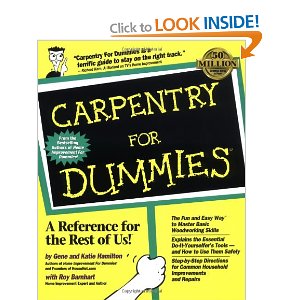
Jordan: “Think about this. What if supposedly smart people enrolled in classes for Carpentry for Dummies‘dummies’? Would that remove some of the stigma of not being proficient?”

JC: “You mean if a MIT-guy like you enrolled in a ‘Carpentry for Dummies’ class, other people might be willing to enroll in say ‘Math for Dummies’?”

Jordan: “It just might work.”

JC: “Here’s another idea. What if participants in the ‘dummies classes’ were awarded merit badges, like the Boy Scouts. Your merit badge then becomes something of a bBoy Scout sash-smalladge of honor. You know, like guys show off their trophy for winning some golf tournament.”

Jordan: “Interesting idea. Merit badges for completing a ‘dummies’ class. Eliminates the stigma…reduces it anyway…of not being proficient in a certain skill. And encourages more people to continue with their education.”

JC: “Let’s run that by some people and get their reaction.”

(Continued)

#157 What Is Education and How Should We Measure? (Part 5)

02 Wednesday Sep 2015

Posted by Jordan Abel in Education Issues, Societal Issues

≈ Leave a comment

First-time readers, this blog is set in the future (sometime after 2020).  This entry assumes the Revenge Revolution has occurred.  For more about the anticipated 5th revolution in the US — the Revenge Revolution — and more about the author, Entry #1.  Note: most characters appear in a number of entries, with many entries building on previous conversations.  You’ll catch on quickly.  Thanks for your time and interest…and comments. 

Scene: Conversation about education starts Entry #153. Jordan and JC, a long-time friend (and frequent character) are having dinner. Time of year – just about when school starts.

JC: “Using a standard of ‘teaching kids to think’ seems so simple. Do you think it can 010414_1635_16TeachingS1.jpgreally work?”

Jordan: “The seeming simplicity is what will make it work. I know that sounds odd but simplicity is the key.”

JC: “The measure is easy to understand. Plus it fits into the 10-second sound bite…with time to spare. I know it is easy to understand but is it really practical?”

Jordan: “What’s not practical about it? Think about your education. What did your English and math teachers instill in you?”

JC: “Some basic facts and methods first, then how to solve problems, which is really how to think.”

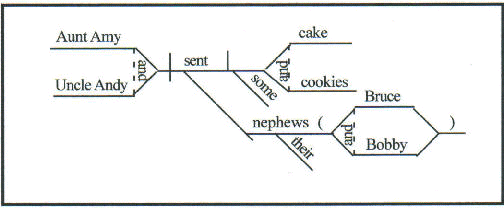
Jordan: “I agree, we can’t lose sight of learning the basics. I think everyone agrees on that. Now, in English class, what’s the value of diagramming? To have Diagramming Sentencesyou speak more clearly…and not split those infinitives?

JC: “To some degree. But diagramming really taught me how to think about sentence construction. To think about how words and phrases worked together to form a unit.”

Jordan: “What about math class? What did you learn?”

JC: “Now that I think about it, both in math and English classes…and other classes as well…I was taught how to approach a problem.”

TurtleneckJordan: “And how to solve a problem in a logical way. Gee, did learning to think help you in school and help you in addressing life’s problems?”

JC: “Helped me except for dealing with guys – like you, for example.”

Jordan: “I don’t understand women either so I guess we’re even. Seriously, the question for society today — ‘Are we teaching kids how to think?'”

JC: “Probably not teaching them very well, even with all those standardized tests.”

Jordan: “Give me an example.”

JC: “Here’s an easy one that you run into almost every day. How many young people at the cash register know how to make change?”

cash registerJordan: “Not many. Yesterday I had a bill for $4.88. I gave the clerk a $5.00 bill, one dime and three pennies because I wanted a quarter rather than more coins.”

JC: “Do you get a quarter or the deer-in-headlight look?”

Jordan: “Worse. I got back a dime and two pennies. Then I gave her back the change and asked for a quarter and still the ‘Duh’, reaction. I gave up.”

JC: “Do you think the public, you know the general public, can support the idea of ‘teaching kids to think’ as a direction for education?

122813_2140_15Education4.jpgJordan: “I hope so. Just for fun, let’s look at mission statements from 3-4 school boards. Curious to see what the boards think the mission of their school system is.”

JC: “Good idea. Look at Charlotte, NC, which you know well. Also, try Westport, CT…another one of your spots…NYC and San Francisco.”

Jordan: “Here’s Charlotte/Mecklenburg’s mission statement. ‘Foster a culture of excellence where proud students and educators become the craftsmen of a beautiful, quality work.'” (http://mcpsweb.org/?page_id=3307)

JC: “Huh? Wonder what that means? Try Westport.”

Jordan: “Their statement is a lot longer. ‘Our Mission is to prepare all students to reach their full potential as life-long learners and socially responsible contributors to our global community. We westport-logoachieve this by fostering critical and creative thinking and collaborative problem solving through a robust curriculum delivered by engaging and dedicated educators. We are committed to maintaining an environment that supports inquiry and academic excellence, emotional and physical well-being, appreciation of the arts and diverse cultures, integrity and ethical behavior.'” (http://www.westport.k12.ct.us/mission-statement/)

JC: “A mouthful but seems to make more sense. At least Westport talks about ‘critical and creative thinking.’ That seems like a step ahead.”

Jordan: “Let’s look for mission for New York City public schools, which I think is the largest district in the US.”

JC: “It is the largest. What’s the mission statement?”

Jordan: “I don’t know. I found mission statements for specific schools.  For the district, the only mission statement I found was under a tab for ‘early childhood,’ but no general statement.”

JC: “Surely you jest. Really?”

Jordan: “The childhood one seems OK as a start, ‘Every student in New York City deserves an opportunity to have the foundation of skills, knowledge, and approaches to learning needed to be ready for school and, ultimately, college and careers.'”  ( http://schools.nyc.gov/Academics/EarlyChildhood/mission)

JC: “So NY has a hidden general mission statement if they have one at all. What about San Francisco? They’re home to a lot of high-tech companies. What’s their mission statement?”

Jordan: “According to the website, the San Francisco school district initiated a community-wide program to develop a curriculum that would address the needs of the future.”  (http://www.sfusd.edu/en/assets/sfusd-staff/about-SFUSD/files/vision-2025-spreads.pdf)

JC: “Did they come up with a simple guiding principle?”

Jordan: “No. They have a booklet with a list of steps. Seems like a good start but still lots of verbiage. However, there is one statement that is very insightful.”

SFO LogoJC: “That is?”

Jordan: “Here’s the essence of quote. ‘If there was one surprise…it was the extent to which a shared vision already exists in our community and how easy it would be for diverse groups…to agree on the types of teaching and learning environments we want to build in San Francisco.'”

JC: “OK, Westport and San Francisco seem to have versions of what we’re talking about. NYC has a version of early students tat seems OK.  Charlotte’s mission is confusing. Here’s what I’m not confused about, I need a break.”

(Continued)

.

#156 What Is Education and How Should We Measure? (Part 4)

29 Saturday Aug 2015

Posted by Jordan Abel in Education Issues, Societal Issues

≈ Leave a comment

For first-time readers, this blog is set in the future (sometime after 2020).  This entry assumes the Revenge Revolution has occurred.  For more information about the anticipated 5th revolution in the US — the Revenge Revolution — and more background about the author, Entry #1.  One another note: almost all characters appear in a number of entries, with many entries building on previous conversations.  You’ll catch on quickly.  Thanks for your time and interest…and comments. 

Scene: Conversation about education starts Entry #153. Jordan and JC, a long-time friend (and frequent character) are having dinner. Time of year – just about when school starts.

Jordan: “You got that argument right. The problem with charter schools is two-fold. #1, far less accountability than public schools. And in some cases virtually no accountability.

010414_1635_16TeachingS1.jpgJC: “I’ll buy that.  What’s the second problem?”

Jordan: “#2, taxpayer dollars that are collected for use in public schools are diverted to the private sector. The money transfer further erodes the funding for public schools – teachers, buildings, and equipment. The diversion is a vicious cycle with public education suffering more and more.

JC: “Aren’t some charter schools focused on specific subjects or areas of study? That seems like a good idea. Why not let kids who are really good at say math and science go to schools where they can excel?”

Jordan: “You can accomplish the same programs…call them high-intensity study Turtleneckprograms…in the public school system. Big cities have done so for years. NY, and probably some others, have an array of special-interest high schools.”

JC: “You’re right. We went to public school and were enrolled in ‘accelerated classes.’ They probably call those classes ‘advanced placement’ now…more politically correct. I guess you and I didn’t need private schools or charter schools to get a good education.”

Jordan: “I understand the taxpayer’s frustration with cost of schools. Rather than increasing taxes, a better approach would be to reduce or eliminate money not being spent very efficiently – like busing, charter schools. Add to that waste the extra money many parents are spending for private schools.”

JC: “If I’ve heard you right tonight, you think the way to start rebuilding public schools is cutting way back on busing teacherand taking the money to create a corps of higher-caliber teachers, like Miss ‘What?’ and Mrs. D.?”

Jordan: “There are people out there who can teach like Miss What? and Mrs. D.  But they’re probably not teaching because of low pay.  We need to recruit those people to become teachers and need to pay them enough so they remain as teachers.”

JC: “Given the political support for charters, how can the rebuilding program get started? There’ll be a lot of resistance.”

Jordan: “Maybe. But the key is generating public support, at which point the politicians will fold. Remember in 2015 how quickly and effectively the Donald changed the tone of the Republicans running for president?”

JC: “Yep. His comments were straightforward, unvarnished, not diplomatic and often over the top…but he got everyone’s attention.”

Jordan: “Trump also made it OK to talk about sensitive issues without the PC-sugar Trumpcoating.”

JC: “Alright, I guess we need to find someone like the Donald…but a bit less bombastic…to talk about education.”

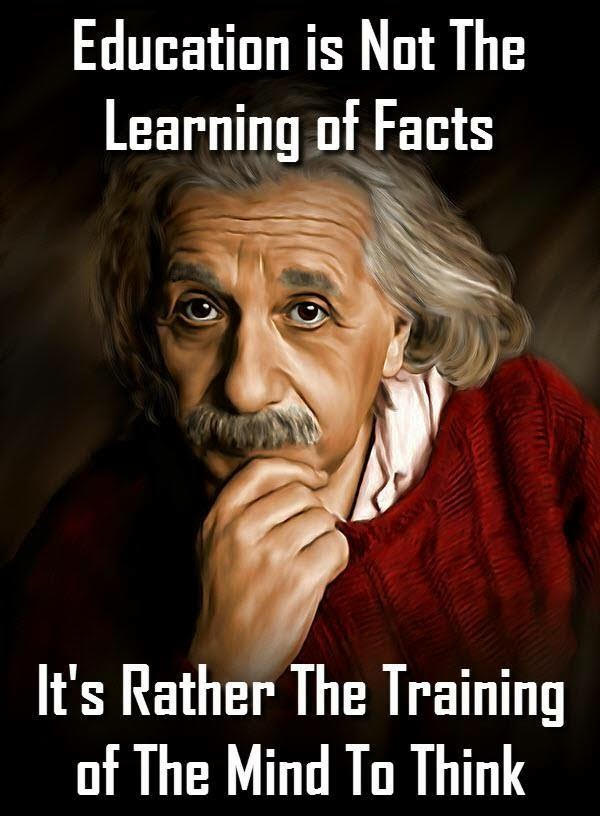
Jordan: “Let’s get someone to promote a very simple concept for education. You brought it up early in the conversation.”

JC: “You mean Einstein’s comments about education?”

Einstein EducationJordan: “Exactly. ‘Education is not the learning of facts. It’s rather the training of the mind to think.'”

JC: “Did he really say that, or is that some made-up quote on the web?”

Jordan: “Not sure it really matters. It’s a great quote and we should use it. We need to repeat it ’till we memorize it.”

JC: “You can engage your brain and memorize the quote. I’m getting a refill.”

engage-the-brain-clipartJordan: “Education is not the learning of facts. It’s rather the training of the mind to think. Education is not the learning of facts. It’s rather the training of the mind to think. Education is not the learning of facts. It’s rather the training of the mind to think.”

JC: “By the way, I checked on the quote while you were trying to memorize it. Some controversy about the exact quote and whether it was taken out of context…but, I think its close enough. The quote is easy to remember and understand. I’m voting we use it.”

(To be continued)

#155 Education What Is It and How Should We Measure? (Part 3)

26 Wednesday Aug 2015

Posted by Jordan Abel in Education Issues, Societal Issues

≈ 1 Comment

For first-time readers, this blog is set in the future (sometime after 2020).  This entry assumes the Revenge Revolution has occurred.  For more information about the anticipated 5th revolution in the US — the Revenge Revolution — and more background about the author, Entry #1.  One another note: almost all characters appear in a number of entries, with many entries building on previous conversations.  You’ll catch on quickly.  Thanks for your time and interest…and comments. 

Scene: Conversation starts Entry #153. Jordan and JC, a long-time friend (and frequent character) are having dinner. Time of year – just about when school starts.

010414_1635_16TeachingS1.jpgJC: “OK, let’s just pretend we stop discretionary busing. I know most schools will still need some buses but what really happens if we cut busing?”

Jordan: “Three things happen. #1 kids get more time for schoolwork or just to play. #2, kids get to go school in their neighborhood with their friends. They can start to build a bond with the local school and not some far off school. #3, money becomes available to pay teachers more and/or hire better teachers.”

JC: “How much more money? How much do we spend on busing?”

Jordan: “Here’s the math. For each school bus, the taxpayers buy or lease a bus, hire a driver, buy fuel and hire a mechanic for maintenance and repairs. And, just in case the one bus breaks down or needs maintenance, there is a back-up bus – not one for one Turtleneckbut some spares.”

JC: “I understand the costs but it’s not just for one kid. There’s a bunch of kids on a bus.”

Jordan: “For argument sake, let’s assume each bus averages 30 kids. Might be a bit high but reasonable.”

JC: “30 kids is about the same size as an average class.”

Jordan: “Right. So for every $1.00 spend on busing a kid, there is $1.00 less for paying teachers…unless, of course the taxpayers want to increase taxes.”

School-Bus-ClipartJC: “Never thought of the cost of busing quite like that. I wonder if taxpayers do?”

Jordan: “Now we need to figure out what each school bus costs per year.”

JC: “Before you Google that, let’s each take a guess.”

Jordan: “Alright. Write your number down and then we’ll compare estimates.”

JC: “I put down $15,000 per bus per year. So if my math is right, for 30 kids that equates to $500 per year per student.”

Jordan: “I’m going a little higher, $20,000, which works out to be $667 per student per year.”

JC: “Let’s see how we did.”

Jordan: “Here’s the DoE (Department of Education) website. Based on the trend line, it looks as if $1,000 per student per year is more accurate.”

Trash CanJC: “So we were both low. For every student, taxpayers are spending $1,000 per year to bus kids? And in some places, the number’s a lot higher. Spending that much money on busing seems like a waste.  Like throwing money in the trash can.”

Jordan: “We agree that some busing is necessary. But let’s assume that 50.0% of busing is discretionary. Might be higher but 50.0% is a reasonable estimate.”

JC: “If half the busing is discretionary, then for each bus with 30 kids, about $15,000 per year is wasted. Taxpayers, really the school board, could redirect the money to Money-clip-artpay every existing teacher $15,000 more per year. And not have to raise taxes!! Busing is even dumber than I thought.”

Jordan: “You got that right. I wonder how many parents would gladly make the following trade: stop busing your kids for more qualified teachers at the neighborhood school.”

agreement-clipart-business_handshakeJC: “Seems like a no-brainer to me. Plus the kids can spend more time at school studying, participating in extracurricular activities or just goofing off with friends.”

Jordan: “What baffles me is why kids in grammar school have to commute 30-60 or even 90 minutes a day? When I worked in Manhattan and we lived in Connecticut, my commute was not much longer.”

JC: “Plus the kids are sitting on a bus and not walking to school or riding a bike to school. So tell me again, why are we busing these kids?”

Jordan: “People who proposed busing as a solution were likely well intentioned…at Not Understandleast I think they were. But these same people neither thought through the consequences nor really understood the cause of the problem.”

JC: “You’ve said several times that the cause of low performing schools is not poverty per se.”

Jordan: “It’s not poverty per se. And yes, I agree many kids do not have good role models at home.”

JC: “Which begs the question, ‘Why bus kids to another school rather than attract better teachers to the neighborhood school?'”

Jordan: “I understand busing was done initially because schools were segregated…and schools in lower-income neighborhoods, especially black neighborhoods, were inferior.”

JC: “After busing became more widespread, did educational scores improve for kids business-free-clip-artbeing bussed?”

Jordan: “Probably, but I think only temporarily. One of the unintended consequences was busing ended up eroding confidence in and support of public schools.”

JC: “You mean because more parents sent their kids to private schools rather than being bussed?”

Jordan: “Charlotte (NC) is a good example. After busing between neighborhoods started more parents sent kids to private schools and religious schools…along with a big jump in home schooling.”

JC: “What about charter schools? Are they a good alternative?”

Charter SchoolJordan: “Another non-solution that addresses the symptoms, not the cause. Charters are a darling of many Republican politicians. Charters were promoted as better than public schools because…”

JC: “…because students attending want to learn, because charters offer better-qualified teachers…and of course, charters have no unions – the cause of most problems with public schools.”

Jordan: “You take a sour pill today? By the way, I agree with your comments. In my view, the problem with charter schools is twofold.”

JC: “Hold that thought. I need to take a break.”

—————

Links to downloads of other topics,

  • 15 05 23 Do They Really Understand Entries #121-#130 (Discuses policies in government and private industry)
  • Insight into General Motors (Multiple Entries) — (Spans many years pre and post bankruptcy)

#154 What is Education and How Should We Measure? (Part 2)

22 Saturday Aug 2015

Posted by Jordan Abel in Education Issues, Societal Issues

≈ Leave a comment

For first-time readers, this blog is set in the future (sometime after 2020).  This entry assumes the Revenge Revolution has occurred.  For more information about the anticipated 5th revolution in the US — the Revenge Revolution — and more background about the author, Entry #1.  One another note: almost all characters appear in a number of entries, with many entries building on previous conversations.  You’ll catch on quickly.  Thanks for your time and interest…and comments. 

Scene: Continuation of Entry #153. Jordan and JC, a long-time friend (and frequent character) are having dinner. Time of year – just about when school starts.

JC: “So you think the way to improve education is double teachers’ salaries and show 010414_1635_16TeachingS1.jpgrespect for the teaching profession?”

Jordan: “If forced to a 10-second sound bite, ‘yes,’ double salaries and show respect. But you and I know the solution is more complicated.”

JC: “You mean like students wanting to learn?”

Jordan: “When talking about students wanting to learn, a bunch of clichés come to mind. ‘You can lead a horse to water…’ ‘You can’t move anything by pushing on a string.’ And some others.”

JC: “Understand what you mean. But how do you intend to change these kids minds…have them want to learn?”

TurtleneckJordan: “That’s where good teachers come in. The decision to learn starts at home but…”

JC: “…but in many cases, there is no encouragement at home. Plus, some kids don’t seem to understand the importance of learning, especially how it affects them long-term.”

Jordan: “No matter what we do, there will be some kids who resist education. Teachers can be inspirational for some and reinforce the inspiration for others. But there is some percentage that will resist learning…at least publicly.”

JC: “I know we talked about this earlier but I still remember how excited I used to get Black School Teacherbefore English and math classes. I loved those classes.”

Jordan: “I hear ya. Did I ever tell you what happened in 8th grade math?”

JC: “Mrs. D your teacher?”

Jordan: “Yes. Remember the Cootie Bug game?”

JC: “Had some sort of bug-like thing, didn’t it?”

Jordan: “Right. Mrs. D had an extra-credit program called the Cootie Club. The program was designed to last the entire year. When you finished a section of extra-cootie bugcredit work, you were given part of the Cootie Bug.”

JC: “Let me guess. You finished early.”

Jordan: “Finished all the coursework and all the extra credit material by mid-October.”

JC: “The whole year’s work and extra-credit stuff by mid-October? What’d she do with you then?”

Jordan: “Made me a teaching assistant, helping other kids and grading papers.”

JC: “That’s great. But you were inspired before class even started. You loved math.”

Jordan: “True and she let me run at my own pace…as fast as I wanted. She was a true teacherinspiration for me.”

JC: “OK, but what about kids whose parents are so encouraging or who live in lower-income areas?”

Jordan: “It’s not as if my parents were wealthy. You know we had a good mix of students in that school.”

JC: “The kids were not poor by anyone’s standards.”

Jordan: “Agreed.”

JC: “Then how do we establish respect for teachers?”

Jordan: “Two steps. #1 is the president, whoever it is, needs to reinforce…and I mean reinforce constantly…the importance of teachers in educating our children. He or she should use the bully pulpit and pound in the country’s collective head why we need to support teachers.”

JC: “JFK made volunteering OK for recent college grads by promoting the Peace Corps. We still have the Peace Corps all these years later. What’s the second point?”

Jordan: “All income groups need to focus on the importance of a quality public 122813_2140_15Education4.jpgeducation. I should add all ethnic groups.”

JC: “What do we do about poor performing schools, especially in lower-income neighborhoods? Shouldn’t those kids be transferred to other schools?”

Jordan: “I know that’s a popular idea…but it’s wrong. Moving the kids to another location does not address the real problem.”

JC: “Why not?”

Jordan: “Reminds me of how some companies deal with lower-performing employees. They move the employees to another department. What’s been accomplished? Nothing.”

School-Bus-ClipartJC: “Are you saying busing the kids to a better performing school isn’t a solution?”

Jordan: “You got it. Busing the kids treats the symptom, not the cause.”

JC: “You want to teach kids in their neighborhood, even if the school is under-performing.”

UnfairJordan: “We…another societal we…need to fix the problem at the location. To shuffle kids all around town is unfair to kids being bussed. Unfair to kids who should be going to a school in their neighborhood but are being bussed. It’s also unfair to taxpayers to spend money on a solution that does not address the problem. Take the money spent on busses and diesel fuel and hire better teachers!!”

JC: “I need to think about that idea — cut way back on busing and use the money for teachers.”  (To be continued)

—————————————

Links to downloads of other topics,

  • 15 05 23 Do They Really Understand Entries #121-#130 (Discuses policies in government and private industry)
  • Insight into General Motors (Multiple Entries) — (Spans many years pre and post bankruptcy)


← Older posts
Newer posts →

Subscribe

  • Entries (RSS)
  • Comments (RSS)

Archives

  • August 2025
  • July 2025
  • June 2025
  • May 2025
  • April 2025
  • March 2025
  • January 2025
  • December 2024
  • November 2024
  • September 2024
  • August 2024
  • July 2024
  • June 2024
  • May 2024
  • April 2024
  • March 2024
  • February 2024
  • January 2024
  • December 2023
  • November 2023
  • October 2023
  • September 2023
  • August 2023
  • July 2023
  • June 2023
  • May 2023
  • April 2023
  • March 2023
  • February 2023
  • January 2023
  • December 2022
  • November 2022
  • October 2022
  • September 2022
  • August 2022
  • July 2022
  • June 2022
  • May 2022
  • April 2022
  • March 2022
  • February 2022
  • January 2022
  • December 2021
  • November 2021
  • October 2021
  • September 2021
  • August 2021
  • July 2021
  • June 2021
  • May 2021
  • April 2021
  • March 2021
  • February 2021
  • January 2021
  • December 2020
  • November 2020
  • October 2020
  • September 2020
  • August 2020
  • July 2020
  • June 2020
  • May 2020
  • April 2020
  • March 2020
  • February 2020
  • January 2020
  • December 2019
  • November 2019
  • October 2019
  • September 2019
  • August 2019
  • July 2019
  • June 2019
  • May 2019
  • April 2019
  • March 2019
  • February 2019
  • January 2019
  • December 2018
  • November 2018
  • October 2018
  • September 2018
  • August 2018
  • July 2018
  • June 2018
  • May 2018
  • April 2018
  • March 2018
  • February 2018
  • January 2018
  • December 2017
  • November 2017
  • October 2017
  • September 2017
  • August 2017
  • July 2017
  • June 2017
  • May 2017
  • April 2017
  • March 2017
  • February 2017
  • January 2017
  • December 2016
  • November 2016
  • October 2016
  • September 2016
  • August 2016
  • July 2016
  • June 2016
  • May 2016
  • April 2016
  • March 2016
  • February 2016
  • January 2016
  • December 2015
  • November 2015
  • October 2015
  • September 2015
  • August 2015
  • July 2015
  • June 2015
  • May 2015
  • April 2015
  • March 2015
  • February 2015
  • January 2015
  • December 2014
  • November 2014
  • October 2014
  • September 2014
  • August 2014
  • July 2014
  • June 2014
  • May 2014
  • April 2014
  • March 2014
  • February 2014
  • January 2014
  • December 2013

Categories

  • Affordable Solutions
  • Back Asswards Thinking
  • Background
  • Background Stupid Is as Stupid Does
  • Benefits of Revolution
  • Causes of the Revolution
  • Common Sense Policies
  • Corporate Policy
  • Definitions
  • Diversions
  • Economics
  • Education Issues
  • Federal Budget
  • General Motors
  • Gov't Policy
  • Infrastructure & Fixed Fuel Prices
  • Innovative Thinking: Ideas and Products
  • Lessons of Revolution
  • Personal Stories
  • Possible Solutions
  • Post Trump Presidency
  • Rebranding Black Community
  • SCOTUS
  • Sense Check
  • Societal Issues
  • Stupid Is as Stupid Does
  • Tech Tsunami
  • Trump 47
  • Uncategorized

Meta

  • Create account
  • Log in

Blog at WordPress.com.

Privacy & Cookies: This site uses cookies. By continuing to use this website, you agree to their use.
To find out more, including how to control cookies, see here: Cookie Policy
  • Subscribe Subscribed
    • usrevolution5
    • Join 32 other subscribers
    • Already have a WordPress.com account? Log in now.
    • usrevolution5
    • Subscribe Subscribed
    • Sign up
    • Log in
    • Report this content
    • View site in Reader
    • Manage subscriptions
    • Collapse this bar
 

Loading Comments...