• Home
  • Booklets/Grouped Entries
  • Tech Tsunami
  • List of Entries to Date
  • About the Author

usrevolution5

~ USA Headed for a 5th Revolution! Why?

usrevolution5

Category Archives: Uncategorized

#388. Donnie’s Dudes Defect to Deep State (#10 in Series)

11 Saturday Jul 2020

Posted by Jordan Abel in Post Trump Presidency, Societal Issues, Uncategorized

≈ Leave a comment

Readers: some of the dialogue in this blog is set in the future (sometime after the year 2020). Entries addressing events in the The future assume there has been a 5th revolution in the US — the Revenge Revolution. More about the Revenge Revolution, a list of earlier revolutions and the author, Entry #1.

Periodically I write a “sense check” to assess whether in the next few years, a revolution in the US is still possible or whether the entire exercise is based on a statistical aberration — i.e., a roughly 50-year cycle between major upheavals in the US.  Most recent sense check, ENTRY #387.  

Some of the entries are part of a series.  Several series are available as easy-to-read booklets for download:

  • Working with Lee Iacocca after he left Chrysler, 2019Q3 Iacocca Personal Observations. 
  • GM EV1 — behind-the-scenes events affecting development and introduction of the GM EV1, the first modern electric vehicle. 2020Q1 GM EV-1 Story Behind the Story Booklet
  • Coming technology tsunami and the implications for the US, Tech Tsunami Booklet with Supplement
  • Trump Supporters Brainwashed? A series discussing why Republics have abandoned basic principals, Are Trump Republicans Brainwashed 2020Q1
  • Who took out the Donald?  Who/what groups are most likely to “take out” Trump? Who Took Out the Donald Entries with Update
  • Revenge Revolution — description of what form the revolution might take, 20 01 07 Start of Revolution

Prelude to the current series of entries: I’ve concluded Trump is a lunatic and the administration filled with lapdogs save a couple of people at CDC.  Instead of wasting time commenting on actions by Trump, I thought it more productive to begin discussing what happens in the US once the coronavirus is more under control.  #378 began the series. At this point not sure how many entries.  Comments and suggestions welcome.

ENTRY #388: Many years ago there was a TV show with a segment called “That Was the Week that Was.”  The TV show, “Laugh In,” was the satire and a precursor to “Saturday Night Live.”

Well, this past week would have been ideal fodder for “That Was the Week that Was.” SCOTUS ruled 7-2 that POTUS was not above the law and must provide relevant information for certain legal proceedings. In the case at hand, the legal proceedings were a grand jury in the State of New York investigating possible tax fraud by Trump and/or the Trump organization.

The 7-2 majority included two justices appointed by Trump, Gorsuch and Kavanagh. When nominated and then approved by the Republican Senate, Trump had nothing but praise for the two justices.  Trump’s tune changed when the two justices joined the majority and voted to uphold a 250-year precedent that the president was not above the law. Immediately following the ruling Trump claimed the two justices were part of the “deep state” and out to get him.

I mean really Donald, can two guys who voted to uphold 250 years of precedent be part of the “deep state” (whatever that is)?  You think the law doesn’t apply to you? Apologies for the rhetorical question.

A day after the Supreme Court decision with Trump still fuming that the law doesn’t apply to him, Trump thumbed his nose at the justice system and commuted the sentence of Roger Stone.  Stone had been convicted on multiple felonies and faced at least a three-year prison sentence. Stone was also a well-documented liar, self-described “dirty trickster” and a long-time friend of the Donald.  Such nice friends the president has.

While slightly out of chronological order, the icing on the cake for the week could be the release of the manuscript of an upcoming book by Trump’s niece.  The book includes insights into many inner-workings of the Trump family.  The niece, Mary Trump, is a clinical psychologist and describes Trump’s behavior in a series of events over time. While the pettiness of the Donald’s behavior seems even more appalling in private, anyone with an ounce of gray matter has witnessed this type behavior from Trump while president.

One insight I found disturbing, but personally amusing, was Trump paying someone to take his SAT to get into undergrad. Another clear indication of a lack of confidence and lack of self-worth. Classic behavior of a ‘wanna be.”

What does always mean for the coming Revenge Revolution? As noted in last week’s entry, the 5th US Revolution seems to have started.

On the positive side for society, Trump’s personal behavior and his refusal to take meaningful action to address Covid-19, has convinced most Independent voters and many Republicans to pause and rethink whether Trump deserves a second term. Whereas some questioning Trump also are so-so toward Biden – as are many Democrats so-so – the idea of re-electing Trump is viewed as high risk to the long-term stability of the US.

Biden’s appeal could be enhanced considerably with a credible running mate — Senator Tammy Duckworth, for example.  A Biden-Duckworth victory could be the catalyst to encourage Congress and the public to come together and begin repairing damage done by Trump.

An open question is whether the Black-Lives-Matter movement will view itself as part of the effort to repair the nation or view itself as a separate movement.  Substantively addressing and solving the issues raised by the BLM movement will take time, in some cases decades.  If the movement cannot be folded into a larger effort to get the US back on track and the effort to repair the US’ reputation worldwide, then the Revenge Revolution may intensify and continue unnecessarily for years, rather than starting to diminish under a Biden administration. More to come.

#387. 5th US Revolution Possible? We’re In It!

04 Saturday Jul 2020

Posted by Jordan Abel in Post Trump Presidency, Sense Check, Societal Issues, Uncategorized

≈ 12 Comments

Readers: The focus of this blog since 2013 has been if a 5th revolution in the US would occur around 2020, give or take a few years.   The caveat was whether the time between previous revolutions, approximately 50 years, would hold again.

The previous revolutions were: #1, the American Revolution, which ended with the War of 1812; #2, the Civil War: #3, the “industrialization and migration/immigration” revolution of about 1910-1915; #4, cultural revolution from 1965-early 1970’s. (For more explanation about the revolutions, Entry #1.)

Well, no need to speculate any more about a 5th US revolution. Unless you’ve been living in a cave, the 5th US revolution has started.

One might argue that a 5th revolution, which early on I labeled as the “Revenge Revolution,” began with the election of Trump. And Trump’s election might be a fair starting point.

Clearly many people were upset and thought someone with no political experience and no credible business experience could make changes they thought necessary.  (Trump supporters if you disagree with the statement that Trump had no credible business experience, do some research with good sources. You’ll understand why the statement is true.)

Trump became president because of a fluke in the Constitution. Hillary Clinton won the popular vote by more than 3 million votes.  Nonetheless, Trump gained the White House via the Electoral College.

Whether or not the Revenge Revolution started with Trump doesn’t matter for this conversation. The Revenge Revolution has started now, and on multiple fronts – economic, social, medical, and certainly political. The fronts are interrelated, although some discreet elements exist in each.

The coronavirus scourge seems to be the catalyst for the revolution. For starters, Covid-19 has demonstrated how disjointed, dysfunctional and discriminatory the US medical system is. Even if there are underlying genetic traits that make groups more susceptible to the virus – blood type A, for example – the treatment available to those needing hospitalization for Covid-19 has varied from adequate to warlike conditions where supplies are short and treatment has to be rationed.

Attempts to control the spread of the virus have also demonstrated how certain classes of workers could be classified.  Many highly educated workers were considered “non-essential” and therefore temporarily, if not permanently expendable.  Among workers considered “essential” were many less educated, lower-paid, minorities, often from Trump’s “shit-hole” countries list.  Mmm, how did so people from those countries become “essential”?  The Trump administration forgot to explain.

Attempts to control the virus also resulted in unprecedented closings of businesses, employee layoffs, and a record decline in GDP. While a percentage of people have been rehired, the rehiring could be temporary as the rate of infections accelerates in some areas.  The pattern of a quick uptick (in this case, employment) followed by a rapid decline sometimes is referred to as the “dead-cat bounce.”

The social leg of the Revenge Revolution has been simmering for more than 100 years. What brought the simmer to a boil was the video of the Minneapolis Police killing George Floyd.  Release of the video precipitated protests and some looting, not seen in such volume and intensity since the 1960s.

Unlike like many previous social protests, which often faded rather quickly, the current protest seems to be gaining momentum.  Actions being proposed range from reducing funding of police departments to eliminating statues of Confederate generals (these generals fought against the US after all) to changing the names of certain sports teams – Washington Redskins and Cleveland Indians, e.g.

The Trump White House has taken a stand that ignores the growing Revenge Revolution. Trump claims repeatedly that the coronavirus will “just go away”; that the economy will bounce back stronger than ever; and that the protests are being led by leftist, fascist, thugs.

Donald and his supporters can think whatever they want about the revolution but the revolution will only gain momentum, which in turn will lead to even more change.  Exactly what will change is hard to predict.  No pattern has emerged other than a likely shifting of political power to Democrats following the November election.

Since today is Independence Day, I want to end on a positive note. Revolutions often result in major technological advances. After the US works through the Revenge Revolution, there could be a burst of Innovations in the industrial and medical sectors with the potential of generating significant employment gains and improvement in life span.

There’s a great opportunity ahead. We need the right people at the top to manage the transition and capitalize on the opportunity.  Stay tuned. More to come.

Other information. Some of the blog entries are part of a series.  Several series are available as easy-to-read booklets for download:

  • Working with Lee Iacocca after he left Chrysler, 2019Q3 Iacocca Personal Observations. 
  • GM EV1 — behind-the-scenes events affecting development and introduction of the GM EV1, the first modern electric vehicle. 2020Q1 GM EV-1 Story Behind the Story Booklet
  • Coming technology tsunami and the implications for the US, Tech Tsunami Booklet with Supplement
  • Trump Supporters Brainwashed? A series discussing why Republics have abandoned basic principals, Are Trump Republicans Brainwashed 2020Q1
  • Who took out the Donald?  Who/what groups are most likely to “take out” Trump? Who Took Out the Donald Entries with Update
  • Revenge Revolution — description of what form the revolution might take, 20 01 07 Start of Revolution

#386. BREAKING NEWS. Trump Resigns. Republicans in Turmoil about Candidate. (#9 in Series)

21 Sunday Jun 2020

Posted by Jordan Abel in Uncategorized

≈ Leave a comment

Readers: some of the dialogue in this blog is set in the future (sometime after the year 2020). Entries addressing events in the The future assume there has been a 5th revolution in the US — the Revenge Revolution. More about the Revenge Revolution, a list of earlier revolutions and the author, Entry #1.

Periodically I write a “sense check” to assess whether in the next few years, a revolution in the US is still possible or whether the entire exercise is based on a statistical aberration — i.e., a roughly 50-year cycle between major upheavals in the US.  Most recent sense check, Entry #365.  

Some of the entries are part of a series.  Several series are available as easy-to-read booklets for download:

  • Working with Lee Iacocca after he left Chrysler, 2019Q3 Iacocca Personal Observations. 
  • GM EV1 — behind-the-scenes events affecting development and introduction of the GM EV1, the first modern electric vehicle. 2020Q1 GM EV-1 Story Behind the Story Booklet
  • Coming technology tsunami and the implications for the US, Tech Tsunami Booklet with Supplement
  • Trump Supporters Brainwashed? A series discussing why Republics have abandoned basic principals, Are Trump Republicans Brainwashed 2020Q1
  • Who took out the Donald?  Who/what groups are most likely to “take out” Trump? Who Took Out the Donald Entries with Update
  • Revenge Revolution — description of what form the revolution might take, 20 01 07 Start of Revolution

Prelude to the current series of entries: I’ve concluded Trump is a lunatic and the administration filled with lapdogs save a couple of people at CDC.  Instead of wasting time commenting on actions by Trump, I thought it more productive to begin discussing what happens in the US once the coronavirus is more under control.  #378 began the series. At this point not sure how many entries.  Comments and suggestions welcome.

ENTRY #389 (Yes, it’s a forecast)

BREAKING NEWS.  TRUMP RESIGNS.  In the early weeks leading up to the November 2020 election, most polls, including Fox News, put Trump trailing Joe Biden, sometimes by 10 or more points. While Trump continued to hold rallies, many were sparsely attended. As has been the practice since the failed rally in Tulsa, OK in mid-June, Trump and the White House press secretary blamed the media and “leftist protesters” for sparse attendance at these rallies.

Now, just two weeks before the 2020 election, Trump announced that under doctor’s orders, he was being forced to resign.  The reason? Neither the White House press staff nor the doctor was available to elaborate.  Immediately before the cryptic press release, Trump left unannounced for Mar-a-Lago.  Upon landing he was whisked away with no interaction with the media.

Although unconfirmed at this point, there is strong evidence that Trump is suffering from some type of mental imbalance.  Over the course of his presidency, Trump has been noted for making incoherent statements, often rambling for 15-20 minutes about topics unrelated to the issue at hand. Such ramblings have become more noticeable the past year, and especially as the election date grew closer.

Since before taking office there has been speculation that Trump was suffering from early-stage Alzheimer’s, which had affected his father, Fred.  Another possible diagnosis is early-stage Parkinson’s disease.  In addition to the diminished mental acuity, Trump has displayed a growing number of physical limitations – difficulty walking and requiring two hands to drink a glass of water, for example.

However, the real reason behind Trump’s resignation remains unclear. Several staffers inside the White House indicated Trump was so fearful of losing, he begged the doctor for an excuse to resign.

Whatever the exact reason, Trump’s resignation has created chaos for Republicans.  In most states, the deadline has passed for changes to ballots for the November election, even if the designated candidate has died prior to the election.  As a result, Republicans are left with a candidate who is now ineligible to take office.  Although there is no precedent for presidential elections, it appears current VP Mike Pence becomes the Republican candidate for president with no designated VP.

The far-right has reacted by claiming the so-called “deep state” forced Trump to resign.  Fox Entertainment Network talking heads Sean Hannity and Tucker Carlson supported claims from the far right and encouraged Republicans to forcibly prevent a Democrat from occupying the White House, even if elected by voters.

While no physical clashes have occurred, many Republican and Democratic governors have put the National Guard on notice for possible duty over the next few months. Most of the same governors also have asked the US military for help if needed to quell any major disturbances.  More to come.


#385. Is a Rational Conversation about Racial Injustice Possible? (#8 re US Post COVID-19)

12 Friday Jun 2020

Posted by Jordan Abel in Gov't Policy, Personal Stories, Rebranding Black Community, Societal Issues, Uncategorized

≈ Leave a comment

Readers: this blog is set in the future (sometime after the year 2020). Each entry assumes there has been a 5th revolution in the US — the Revenge Revolution. More about the Revenge Revolution, a list of earlier revolutions and the author, Entry #1.

Periodically I write a “sense check” to assess whether in the next few years, a revolution in the US is still possible or whether the entire exercise is based on a statistical aberration — i.e., a roughly 50-year cycle between major upheavals in the US.  Most recent sense check, Entry #365.  

Some of the entries are part of a series.  Several series are available as easy-to-read booklets for download:

  • Working with Lee Iacocca after he left Chrysler, 2019Q3 Iacocca Personal Observations. 
  • GM EV1 — behind-the-scenes events affecting development and introduction of the GM EV1, the first modern electric vehicle. 2020Q1 GM EV-1 Story Behind the Story Booklet
  • Coming technology tsunami and the implications for the US, Tech Tsunami Booklet with Supplement
  • Trump Supporters Brainwashed? A series discussing why Republics have abandoned basic principals, Are Trump Republicans Brainwashed 2020Q1
  • Who took out the Donald?  Who/what groups are most likely to “take out” Trump? Who Took Out the Donald Entries with Update
  • Revenge Revolution — description of what form the revolution might take, 20 01 07 Start of Revolution

Prelude: I’ve concluded Trump is a lunatic and the administration filled with lapdogs save a couple of people at CDC.  Instead of wasting time commenting on actions by Trump, I thought it more productive to begin discussing what happens in the US once the coronavirus is more under control.  #378 began the series. At this point not sure how many entries.  Comments and suggestions welcome.

ENTRY #385: An unexpected addition to the post-COVID-19 conversation is whether widespread racism exists in the United States. While such a discussion comes to the fore periodically, the current discussion seems to be more intense and have garnered a broader audience.

As usual in this administration, comments from Trump have created frustration and anger among most blacks and many whites. The event that precipitated the current conversation was not Trump but the gross misconduct of the Minneapolis Police in the death of George Floyd.

Although Mr. Floyd had a minor rap sheet, by all accounts from bystanders, Floyd’s behavior did not justify actions taken by the police – a knee to the neck for nearly nine minutes, with the cop apparently unconcerned about a possible video from a bystander.

The protest against the police following Floyd’s death started with the release of the video.  The protests started in Minneapolis-St. Paul then spread quickly throughout the country. Protests have continued for more than two weeks, and as of today, still continue.

Actions taken by the Trump administration have created more anger and frustration. The most egregious action seemed to be when Trump, using a loophole in the law that allowed military troops deployed in Washington DC to bring protests “under control.”   Some of the protests included looting.

Last weekend (06/06-07/2020) Trump ordered Attorney General William Barr to have the military troops disperse peaceful protesters away from Lafayette Park. Protesters were met with “chemical” smoke (likely pepper spray or teargas), rubber bullets and low-hovering helicopters.

Why such drastic action? Was the White House in danger of being overrun?  Was there extensive looting?  No and no.  The protesters were cleared by military troops so Trump could walk across the street for a photo op at Saint John’s Episcopal church, often referred to as the “President’s Church.”  Trump, the paragon of Christianity, stood in front of the church holding a Bible.  What more could his hard-core base want than a picture of Trump in front of a church holding a Bible?

As the second week of protests progressed, conversations started to include demands for reducing funding for police departments, and in some cases, eliminating police departments. Other demands focused on improved healthcare, better education, improved housing and some discussions about reparations for blacks.

I’ve tried to listen and understand. Over the last week or so, I’ve also spent 4-5 hours on Skype with a long-time friend whom we met in our early days in Charlotte.  While we have great respect for one another, our ethnicity and backgrounds are vastly different. He grew up in eastern North Carolina.  His parents were sharecroppers with limited education, probably 8th grade. Interestingly, all six children of the sharecropper parents went to college.

My friend’s wife, whom he met in Charlotte. as did we, is a high-energy go-getter who’s had a very successful career in the insurance industry. One assignment was managing an insurance company’s operation in a very large developing country.  The couple has two children – one in college in California and the other finishing high school.

Our recent Skype conversations have included him describing the experiences of an educated, affluent black family with different police departments. Over the years I’ve heard bits and pieces of some of the stories.  However, until this series of calls and then when I read his detailed accounts, which I encouraged him to write, I never realized the entire story. Not pretty.

The Skype discussions also included what he viewed as ideas to address inequities between the races. Before we started that conversation, he said “Some of what I’m going to tell you will make you uncomfortable.”  He was right.

Every now and then I asked a question.  One question was, “How can some members of the black community seemingly justify looting?  How can one justify stealing, especially stealing from a neighborhood store?”  (His response paraphrased), “Whites have stolen from blacks forever. Some blacks feel the only way to get the white man’s attention is to steal from him.”  I found that rationale incredibly disturbing and still have not processed the idea.

Another suggestion was blacks should receive reparations from whites. The rationale, he explained, was if Republicans in the Senate were willing to spend $4,000,000,000,000 for a coronavirus stimulus package, they obviously didn’t care about deficits. Therefore, why not spend another $4,000,000,000,000 as reparations for blacks? Besides, he continued, the $100,000 per person (black population 45+ million so a bit high) reparation would flow back into the economy as recipients bought new cars, bought new houses, took vacations, etc.

At the end of that Skype call, the most recent, I indicated, yes some demands during the call made me feel uncomfortable. I also reminded him that I had listened carefully and didn’t challenge any of his statements. But the next call would be my turn. During that call, I might make some comments that made him uncomfortable.

What are we going to talk about the next call? First, I don’t believe the conversation about racism across the US should be viewed as a zero-sum game. If the parties involved will listen, and be willing to accept reasonable solutions, then everyone can come out ahead.  If one of the sides insists on their “solution” or none at all, then likely no progress will be made.

To me, the only issue that does not need a lot of debate is whether most organizations have some employees who are not performing appropriately and need to leave. Such organizations include police departments.  That conversation needs to include the police unions.  I understand the purpose and value of police unions. But the unions need to quit overprotecting the bad cops. Overprotecting is not good for the entire police force, not good for the union and not good for the community.

As far as the rest of the demands, I have attempted to frame the questions to allow more than one view to be discussed and evaluated.  The questions are:

  1. If every other ethnic group, many of which experienced extreme and overt discrimination, has been able to get off the bottom rung of the economic ladder and migrate toward the middle class, even though the journey often has taken several generations, then should blacks study these ethnic groups and consider a similar path? What’s preventing blacks from doing the same things as these other ethnic groups did?  While the situation for each ethnic group was somewhat different, the path followed seems somewhat similar.
  2. If there are reparations, is it fair to deduct certain amounts to compensate or repay taxpayers for the extra cost of education, the extra cost of welfare, the extra cost of incarceration, etc.?
  3. Wouldn’t money allocated for reparations be better spent on education, healthcare and housing? What happened to teaching someone to fish?
  4. If the percentage of blacks incarcerated is disproportionately high compared to the population, what percentage of crimes are committed by blacks? One can argue about the fairness of sentences for certain crimes, but that is a different issue than the percentage of crimes committed by blacks.  (And eliminate most traffic violations from the calculation.) Is there a reason beyond just “police harassment”?
  5. What percentage of businesses in predominantly black communities are owned by blacks? If the percentage is low, then why aren’t there programs by wealthy blacks to encourage and support such businesses?  Rebuilding black-owned businesses may be even more important post COVID-19.  A report by CBS News (06/12/2020) indicated that when restrictions are lifted, up to 40% of the black-owned businesses may not reopen compared to less than 20% of white-owned businesses. The higher closure rate was attributed in part to lack of available financing.
  6. Is it fair to demand quotas for white players in the NFL and the NBA? (Yes, that’s a joke.)

More to come.

#384 1967 Detroit Riots: Lessons for Cities and Trump Administration

02 Tuesday Jun 2020

Posted by Jordan Abel in Causes of the Revolution, Gov't Policy, Lessons of Revolution, Societal Issues, Uncategorized

≈ Leave a comment

Readers: this blog is set in the future (sometime after the year 2020). Each entry assumes there has been a 5th revolution in the US — the Revenge Revolution. More about the Revenge Revolution, a list of earlier revolutions and the author, Entry #1.

Periodically I write a “sense check” to assess whether in the next few years, a revolution in the US is still possible or whether the entire exercise is based on a statistical aberration — i.e., a roughly 50-year cycle between major upheavals in the US.  Most recent sense check, Entry #365.  

Some of the entries are part of a series.  Several series are available as easy-to-read booklets for download:

  • Working with Lee Iacocca after he left Chrysler, 2019Q3 Iacocca Personal Observations. 
  • GM EV1 — behind-the-scenes events affecting development and introduction of the GM EV1, the first modern electric vehicle. 2020Q1 GM EV-1 Story Behind the Story Booklet
  • Coming technology tsunami and the implications for the US, Tech Tsunami Booklet with Supplement
  • Trump Supporters Brainwashed? A series discussing why Republics have abandoned basic principals, Are Trump Republicans Brainwashed 2020Q1
  • Who took out the Donald?  Who/what groups are most likely to “take out” Trump? Who Took Out the Donald Entries with Update
  • Revenge Revolution — description of what form the revolution might take, 20 01 07 Start of Revolution

Prelude: I’ve concluded Trump is a lunatic and the administration filled with lapdogs save a couple of people at CDC.  Instead of wasting time commenting on actions by Trump, I thought it more productive to begin discussing what happens in the US once the coronavirus is more under control.  #378 began the series. At this point not sure how many entries.  Comments and suggestions welcome.

The topic of ENTRY #384 was not anticipated.  The civil unrest this past week may become more prevalent than anyone would like. Unfortunately, the unrest likely will continue well past COVID-19, and thus a topic for this series.

ENTRY #384 BEGINS:  The past week there have been rallies in numerous cities protesting the treatment of Mr. George Floyd by Minneapolis Police. More and more of these rallies have evolved into riots with extensive looting and burning of public and private property.  With Trump’s proclamation Monday evening, June 1, that maximum force, including US military personnel, could be used to quell all protests, the number and intensity may increase and the tactics more warlike.

Apparently the Donald forgot to read his history books and skipped classes as well on military strategy.  Using traditional brute force in a guerilla war, which is what is likely to evolve after the proclamation, rarely works, if ever.  The list is long of examples of brute force failing to stop guerilla warfare, including Vietnam.

Watching these riots has been painful. I can tell you from personal experience, it is quite scary to be caught in the middle of the violence itself.

In summer 1967, we were living in a suburb immediately north of Detroit. I was just months into my job at Cadillac Division of General Motors.

One Sunday afternoon our neighbor, a manager of a credit agency housed in Detroit, said he’d heard there was some disturbance downtown and wanted to go check on his office. I offered to accompany him and off we went.

What we got was a whole lot more than anticipated. When we arrived in front of the office, housed in the Fox Theater building, there were people everywhere. A liquor store next to the theater was being looted as was a TV shop next door to that.

We looked to be some of the first “outsiders” to arrive at this location because while we were still in the car, a number of police cars pulled in behind us. No, we weren’t stupid. It was time to get out of Dodge and we left.

Overnight there were more riots in selected parts of Detroit but there was no declaration of an emergency. So, Monday morning I headed to work. The main Cadillac plant was on the west side and several miles from downtown Detroit. Rioting continued as did the fires. Midday Monday a number of us stood on an enclosed walkway between the fourth floors of two different buildings. We could see parts of the city clearly burning.

Cadillac closed the offices and the assembly plant that afternoon and I headed back to the apartment using an alternate route that was even farther west and away from the activity. I returned without incident but was left with the nagging question, “Are we really safe?”

The apartment complex was just on the other side of the dividing line between Detroit and Southfield – 8-Mile Road. The apartment complex was not gated so there was nothing to stop rioters from entering. Fortunately, the rioting did not spread to our immediate area.

Rioting did continue to spread within the City of Detroit. Rioting became so extensive, Governor George Romney (Mitt’s father) asked for Federal assistance and members of the US Army’s 82nd and 101st Airborne Divisions were deployed to Detroit. In addition to light-infantry weapons, the units were supported by heavily armored tanks.

If you’ve never witnessed in real time the firepower of a .50-caliber machine gun mounted on a tank, visualize this. The machine gun is aimed at a sniper holed up in say the 5th floor of a brick building. The first few rounds from the machine gun literally blow away the brick facade and then subsequent rounds penetrate the interior of the building. That scene was fairly common in Detroit as the military attempted to control sniper fire.

Thus, in the span of a few days, much of Detroit became a war zone. The devastation is hard to describe and imagine. Some areas of Detroit have not yet recovered, more than 50+ years later. Yes, Detroit had some other problems as well but I think what tipped over the City was the 1967 riots.

What caused the riots? Was there an incident like George Floyd in Minneapolis or Rodney King in Los Angeles? On the surface, the riots were precipitated by a seemingly innocuous single incident. In the early hours of Sunday morning, the Detroit police raided and closed a blind pig in a black neighborhood (illegal bar often with some gambling as well).

While black residents were frustrated by the raid on the blind pig, residents housed a long-standing frustration with treatment by the Detroit Police Department, then mostly white. Economics was a contributing factor, but much less so than most people think. In the 1960’s, the US economy and especially Detroit’s economy were strong. Many black residents were employed at one of the many new-car/truck assembly plants or component plants in and around Detroit.

Further, all hourly employees in those plants were members of the UAW with extensive health benefits, multi-week vacation and a base wage that was sufficient for full-time workers to be classified as “middle class.” Detroit also had a relatively strong black-owned business community.

What happened to Detroit following the riots? Many whites fled the City for the suburbs. Auto companies gradually closed many of the assembly and component plants, although there were other reasons for that as well. Detroit became a shell of its former self. Only in the last decade, roughly 50 years after the riots, has Detroit started to rebound. New businesses are moving in. Housing is being rebuilt and population is gradually expanding.

What’s the lesson, or the caution, for other cities experiencing riots? While there is no simple answer, at a minimum, city leaders, public and private, need to work closely with citizens and be alert to problems with city services, whether garbage pickup, water quality (as in Flint), or unsavory or unethical actions by law enforcement. Understanding these problems, and making an effort to resolve the problems before getting out of control, will help mitigate the potential for disturbance.

An example of such an effort is the sheriff of Genesee County Michigan, north of Detroit and home to Flint, MI.  The sheriff has been working closely with residents throughout the county.  So far, there have been no unruly protests in Flint and other cities in the county.

Another issue that seems important, and one that does not get discussed enough publicly, is encouraging local residents to become business owners in their community. Maybe more black-owned businesses would prevent some of the insidious looting that occurred during recent protests. Why would you loot a store in your neighborhood that is providing critical services, and owned by one of your neighbors?

Those who loot or encourage looting neighborhood stores should not complain because few, if any, national chains open neighborhood stores. Why should these companies risk capital, if the stores are targeted for looting?

Finally, I think any honest conversation about unfair treatment, discrimination, and associated issues needs to ask the following questions. “How did other ethnic groups overcome what was often overt and brutal discrimination? What did these ethnic groups do, sometimes over several generations, to reduce discrimination and make better lives for themselves?”  The answers could provide some guidance for all sides.  Answers will also indicate solutions are never easy and never one sided.

#382 Religious Institutions: Next Big-Box Stores? (con’t) (We Gotta Get…Part 5)

16 Saturday May 2020

Posted by Jordan Abel in Economics, Innovative Thinking: Ideas and Products, Societal Issues, Uncategorized

≈ Leave a comment

Readers: this blog is set in the future (sometime after the year 2020). Each entry assumes there has been a 5th revolution in the US — the Revenge Revolution. More about the Revenge Revolution, a list of earlier revolutions and the author, Entry #1.

Periodically I write a “sense check” to assess whether in the next few years, a revolution in the US is still possible or whether the entire exercise is based on a statistical aberration — i.e., a roughly 50-year cycle between major upheavals in the US.  Most recent sense check, Entry #365.  

Some of the entries are part of a series.  Several series are available as easy-to-read booklets for download:

  • Working with Lee Iacocca after he left Chrysler, 2019Q3 Iacocca Personal Observations. 
  • GM EV1 — behind-the-scenes events affecting development and introduction of the GM EV1, the first modern electric vehicle. 2020Q1 GM EV-1 Story Behind the Story Booklet
  • Coming technology tsunami and the implications for the US, Tech Tsunami Booklet with Supplement
  • Trump Supporters Brainwashed? A series discussing why Republics have abandoned basic principals, Are Trump Republicans Brainwashed 2020Q1
  • Who took out the Donald?  Who/what groups are most likely to “take out” Trump? Who Took Out the Donald Entries with Update
  • Revenge Revolution — description of what form the revolution might take, 20 01 07 Start of Revolution

Prelude: I’ve concluded Trump is a lunatic and the administration filled with lapdogs save a couple of people at CDC.  Instead of wasting time commenting on actions by Trump, I thought it more productive to begin discussing what happens in the US once the coronavirus is more under control.  #378 began the series. At this point not sure how many entries.  Comments and suggestions welcome.

ENTRY #382 CONTINUES ENTRY #381: Technology Tsunami Impact. Efforts to address the coronavirus accelerated the implementation of technology in a wide variety of occupations. Going forward many US workers will be affected by what some of us have labeled the “technology tsunami.”

The negative effect on income over the next few years could be much greater than previously anticipated. During COVID-19 “stay-at-home” mandates, organizations realized certain workers were not necessary and other work could be completed using artificial intelligence-based software/hardware. As a result, even as the economy begins to recover, more blue-collar and white-collar workers of all ages are going to be faced with possibly accepting a lower-paying job or no job.

Will workers of different age cohorts be affected differently by the technology tsunami[1]? How will religious institutions be affected? Workers currently age 50+, even though they should have more financial resources, may be hit harder by the technology tsunami since many are less familiar with advanced technology and they have fewer years before retirement to try and recoup lost earnings.

Double-Whammy Tsunami. Another tsunami headed toward US shores is the retirement tsunami. What we as a society don’t talk about and certainly what has not been addressed at the Federal level is how unprepared white and blue-collar workers are for retirement.

The retirement tsunami has been caused in large part by employers eliminating employer-funded defined-benefit retirement programs and transferring to workers the responsibility for accumulating adequate savings for retirement. The potential impact of the tsunami has been made worse by erosion of personal income from the accelerating cost of housing, medical and college tuition. Workers have far less left over to save for retirement.

In a recent poll by Center for Retirement Research at Boston College, 75%, or 3 out of 4 people age 50-62 had jobs that fell into a “non-traditional” category — meaning, those without employer-provided retirement plans and health insurance. According to the report, workers in non-traditional jobs can expect their retirement income to be as much as 26% lower than that of people who spent their 50’s and early 60’s in positions with full benefit packages, according to the center’s findings.

The lower available income will likely affect consideration for contributions to religious institutions. (An article in the NYT 05/03/2020 described how some underfunded retirees are moving in with their children.)

What about the impact of the technology and retirement tsunamis on the finances of younger workers? Don’t they have 30-35 years to recoup lost earnings from a coronavirus economic slowdown? Unfortunately, a greater percentage of younger age cohorts are likely to be even less prepared for retirement than those currently age 50-62.

If costs for housing, medical, education and retirement continue to exceed gains in income, the cumulative effect will erode discretionary income further. Unless there is a fundamental change in funding of health care costs, retirement programs and advanced education, more and more people will be underfunded for retirement. Thus, younger cohorts, already less committed to religious institutions than previous generations at the same age, are also facing even more pressures on discretionary income.

What will make a bad situation worse is a prolonged economic slump associated with the coronavirus shutdowns. The rate at which people have been furloughed is unprecedented – in just two months, 36,000,000 filed new claims for unemployment, and more claims are likely in the next few weeks. In early May 2020 the “official” unemployment rate was 14.7%. However, the unemployment rate does not count those who are not actively looking for work.

The unprecedented increase in the number of people formerly employed has caused many to become so discouraged as to not look for work. These “discouraged” were excluded from the unemployment calculation. Had people who were recently employed but now discouraged been included, the rate would have been 21-22%, approximating the same as the height of the Great Depression in the 1930’s.

Despite proclamations from Trump, few people in business, few economists and few in the general public expect the economy to bounce back once more restrictions associated with the coronavirus are lifted. Even if employment in the manufacturing sector increases over the next 24-30 months as companies begin bringing jobs back to the US, overall economic growth will be very slow and unemployment is likely to remain at >10%.

Some portions of the service sector employment seem likely to experience a permanent loss of jobs. After “stay-at-home” restrictions are lifted, how many consumers will immediately return to restaurants, attend sporting events, go to shopping centers, travel by plane? How many members of religious institutions will be willing to risk infection by attending services, especially crowded during holidays?

Like the general public, members of religious institutions are likely to remain cautious until an effective vaccine has become widely available – on the optimistic side 18-24 months based on analysis of experienced doctors and researchers. Even with the vaccine will the public’s behavior be changed permanently?

During that 18-24 months and maybe forever, how many members of religious institutions will have their economic circumstances negatively affected? Many formerly employed in the service sector will not have employer-funded health insurance and even fewer will have an employer-funded retirement program. Where do these former employees turn for help? Their jobs are gone, or at least not coming back for some time. Finding another job will be extremely difficult since the economy will be growing slowly at best.

While many congregants will remain emotionally committed to their specific religious institution, how many will be faced with lower discretionary income? How many will be able to continue supporting their church, synagogue or mosque?

Eyeballs vs Butts in Seats – Post Coronavirus Behavior. The “stay-at-home” mandate associated with the coronavirus forced organizations to accelerate electronic communications using Zoom, Skype, FaceTime, etc. For religious institutions many people attending services in person pre-COVID-19 are now live-streaming. But what happens post-COVID-19? How many people will forego physically attending services and choose to continue live-streaming?

How many will ask, “Why go through the hassle of getting dressed, fighting traffic, when I can relax at home?” Further, how many will ask, “If I’m going to live stream, is there a service at another location that I would rather attend? I used to live in New Jersey, what about watching the service where I used to go?”

An issue for religious institutions is how to make live-streaming a reason to remain linked to a particular congregation. Live-stream services are somewhat like a media event. The target for live-streaming is capturing as many eyeballs as possible.   The trend toward live-streaming is likely to continue. Think about the difference between generations in comfort level with certain media venues.

While the risk is relatively small now, a concern with live-streaming is whether a religious institution’s service can be “competitive” with larger, more high-profile congregations. For a specific institution, if clergy and/or the Board of Directors has not done so, they should watch services from “higher-profile” congregations, especially those in major metro areas.

Religious Institutions Expense Pressure. Are religious institutions turning into under-utilized big-box stores? If fewer people attend services, whether weekly or during holidays, then do religious institutions need their current facility? Some congregations have expanded main buildings and/or other facilities based on the assumption membership would continue to grow. Part of the rationale has been that a more attractive and functional facility would help attract new members.

The downside of a larger facility is a higher burn rate for overhead, including staff. The larger facility also requires additional non-recurring expense for replacement of equipment and other critical maintenance.

A strategy sometimes employed when expenses exceed revenue is to defer maintenance expense and/or defer setting aside adequate funds for future maintenance and equipment replacement. While such a strategy might work for a year or two, kicking maintenance costs down the road increases the financial burden on future congregants, many of whom may be less prone to support the institution.

Are many religious institutions facing the same fate as many big-box stores? Unfortunately, all indications suggest the answer seems to be “yes.” Big-box stores and department stores, even high-end ones are facing severe financial pressure. The impact of actions taken to slow COVID-19 have merely hastened a trend toward fewer stores and, in many cases, bankruptcy. Well-known department stores J.C. Penny and Neiman-Marcus being a recent examples.

Possible Solutions. Some organizations – for-profit and not-for-profit – have survived major challenges by rethinking how to operate. Religious institutions face the choice – either rethink how to operate or likely disappear.

Survival for many religious institutions seems possible only by starting with a clean sheet of paper. Rethinking how to operate means more than cutting staff. Cutting staff is an incremental change and not a fundamental change. Clergy and the Board of these institutions should remember the adage, “No organization ever saved its way into prosperity.”

An organization needs to consider ideas that many congregants might view as radical. For example, holding talks with another congregation about: (i) a single back-office support staff: (ii) using one of the two buildings for weekly services. The services would be at separate times but use the same building. Holiday services could be at different times and use part of the other building, if necessary; (iii) lease out part of one of the buildings; (iv) plus other ideas.

The radical thinking should include a cash-flow forecast that incorporates such variables as:

  1. Number of existing members by age cohort
  2. Number of members by age cohort over time (some data likely exist)
  3. Distribution of contributions by age cohort – currently and ideally over time. Individual members would be assigned a random number so impossible to link contribution to a specific member
  4. Projected membership scenarios through 2030 and ideally 2050 by age cohort – would include new members and members who leave
  5. Projected revenue scenarios through 2030 and ideally 2050 by age cohort. Scenarios would reflect different attitudes by cohort toward religion and use of electronic communication. Revenue projections would include different approaches – “traditional’ approach to contributions, pay to watch live-streaming or some type of subscription model.
  6. Impact on revenue of different operating scenarios – stand-alone entity, combined facility, use of part of one facility for other purposes, etc.
  7. Expense forecast by year for:
    1. Staff and other recurring expenses as stand-alone entity and combined back-office staffs
    2. Unusual maintenance and equipment replacement – current and joint-use facility
    3. Expenses under the different operating scenarios

Constructing an Excel-type model (and the supporting math) for the financial projections is not particularly difficult.   Often the most difficult barrier is getting the “key executives” and/or committee members involved with the issue to: (i) acknowledge and appreciate the importance of getting ahead of the curve; (ii) begin to truly think innovatively; (iii) put aside excuses and biases and commit to considering practical solutions.

As with most strategic difficult issues, waiting until the problem becomes obvious is waiting too long and makes any kind of turnaround exceedingly difficult and problematic. A high-profile example is the Trump administration’s handling of COVID-19, starting with denial of early warning signs and then refusing to accept opinions of people with experience in key areas.

Over the next 24-36 months – and maybe longer – many religious institutions will face severe cash-flow shortfalls. Waiting until the cash-flow train wreck becomes obvious will result in even more dire consequences. While no guarantee, starting to discuss issues outlined herein and completing a study to assess potential consequences carries no risk. There is no downside to a study. Waiting until the problem becomes obvious has significant risk.

[1] For a more detailed discussion about the coming technology tsunami and possible solutions, download booklet I wrote titled “Technology Tsunami.”


#381: Religious Institutions Next Big Box Stores? (We Gotta…Part 4)

09 Saturday May 2020

Posted by Jordan Abel in Causes of the Revolution, Economics, Societal Issues, Uncategorized

≈ 1 Comment

Readers: this blog is set in the future (sometime after the year 2020). Each entry assumes there has been a 5th revolution in the US — the Revenge Revolution. More about the Revenge Revolution, a list of earlier revolutions and the author, Entry #1.

Periodically I write a “sense check” to assess whether in the next few years, a revolution in the US is still possible or whether the entire exercise is based on a statistical aberration — i.e., a roughly 50-year cycle between major upheavals in the US.  Most recent sense check, Entry #365.  

Some of the entries are part of a series.  Several series are available as easy-to-read booklets for download:

  • Working with Lee Iacocca after he left Chrysler, 2019Q3 Iacocca Personal Observations. 
  • GM EV1 — behind-the-scenes events affecting development and introduction of the GM EV1, the first modern electric vehicle. 2020Q1 GM EV-1 Story Behind the Story Booklet
  • Coming technology tsunami and the implications for the US, Tech Tsunami Booklet with Supplement
  • Trump Supporters Brainwashed? A series discussing why Republics have abandoned basic principals, Are Trump Republicans Brainwashed 2020Q1
  • Who took out the Donald?  Who/what groups are most likely to “take out” Trump? Who Took Out the Donald Entries with Update
  • Revenge Revolution — description of what form the revolution might take, 20 01 07 Start of Revolution

Prelude: I’ve concluded Trump is a lunatic and the administration filled with lapdogs save a couple of people at CDC.  Instead of wasting time commenting on actions by Trump, I thought it more productive to begin discussing what happens in the US once the coronavirus is more under control.  #378 began the series. At this point not sure how many entries.  Comments and suggestions welcome.

ENTRY #381: The future of religious institutions is being influenced by three factors over which the institutions have no control. These exogenous variables directly affect the near and long-term financial viability of many such institutions:

  1. Changing membership demographics, especially less favorable attitudes by younger generations toward religion
  2. Downward pressure on family discretionary income from multiple sources
  3. Migration to more electronic communication, in part because of sustained concern about large gatherings post coronavirus

The pressures will intensify in the coming years. Without some fundamental strategies to address the effects of these pressures, many religious institutions could become financially insolvent and forced to dissolve. Further the pressures are not specific to one or two religions. All religions are likely to be affected.

Demographic Pressure. There are numerous articles and studies (Pew Research, e.g.) indicating younger generations are less attracted to religions of all types. The younger generations also attend services less than previous generations at the same age.

When viewing the data, some believe that as younger generations age they will act more like their parents and grandparents, thus “adopting” much of the behavior of previous generations. By adopting attitudes and behavior of previous generations, these younger cohorts, therefore will become more favorable to religion and more supportive of religious institutions.

The clergy and the “Board of Directors” of a religious institution should not make the assumption re “adopting behavior.” One only needs to track age cohorts over time to realize younger age cohorts do not adopt the attitudes of their parents’ generation when they reach the same age.

Rather than adopting behavior, empirical evidence suggests cohorts “retain” attitudes and behaviors established in their early twenties. Some examples of “retaining” values range from attitudes of different generations toward such social issues as use of drugs, casual sex, age for marriage to preferred brands of vehicles to preferred style of house and furniture. One only has to ask “What happened to the appeal of darker-wood furniture as well as fine china and crystal with the generations under age 40″ to realize tastes and preferences are different?[1]

Pressure on the Revenue Stream.  Since roughly the mid-1960’s each succeeding age cohort has been faced with increased pressure on discretionary income[2]. Every religious institution should assume one or more of these pressures on discretionary income will continue, thereby making it more difficult for families to provide financial support. Pressures are:

  1. Medical costs increasing faster than income
  2. Housing prices (and rents) increasing faster than income
  3. College tuition increasing at a rate much faster than inflation and income
  4. Retirement savings burden being transferred to employees as employer-funded defined-benefit retirement programs have been eliminated

The economic pressures caused by each one of these factors probably could be managed by most families. However, when the increases in all factors are combined – each one has a similar pattern of costs outpacing income – the result is a significant erosion in discretionary income.  

A real-world example of the impact of these pressures was evident during a recent PBS News Hour broadcast. An ER- vehicle technician in New York City described the mental and economic pressures associated with the coronavirus. The interviewer asked the ER technician about salary – about $40,000 per year. As anyone familiar with the cost of living in any of the NY boroughs, $40k for a family is tight. Worse for the technician was that his employer, apparently a contractor to the City of New York, did not provide health insurance.

Here’s the guy taking people to the hospital to get treated for coronavirus (or some other emergency) but who does not have employer-paid health insurance. Even worse the technician can’t afford private health insurance because the Trump administration eliminated many features of Obamacare and eliminated insurance exchanges.

Housing Prices/Monthly Rental. The chart is for price increases of houses and rent compared to growth in median income, adjusted for inflation. While the data are national, people living in some metro areas have faced the problem of housing prices-HOA dues/rents and insurance rising even faster than noted on the chart.

Real estate taxes are also increasing. Although relatively low compared to NY/NJ/CT, housing costs and taxes in many areas are still high and a further erosion of discretionary income.  These costs result is less money available for contributions to a given institution.

College Costs. Since the 1960’s, early 1970’s tuition at public and private colleges has more than doubled as a percent of family income in inflation-adjusted dollars. Costs for elite universities have increased even faster. Even with some assistance, overall costs for higher education are likely twice as high as a percent of family income over the past couple of generations. The impact of the coronavirus may make the disparity worse. Tax revenue in virtually every state has fallen dramatically. To balance future budgets states may need to cut support for higher education.

End of this entry. More next week about the impact on contributions of: (i) technology replacing jobs; (ii) retirement savings shortfall; (iii) electronic “competition” from other religious institutions.

[1] For more analysis of “adoption” and “retention” please download paper I wrote at University of Michigan in 1987 titled “A Nation in Transition.” The paper addressed how differences in attitudes between pre-Boomer and Boomer cohorts could affect how America would view its role internationally. The paper included a comparison of a variety of attitudes. (87 12 08 Nation in Transition) 

[2] Discretionary income is the amount of an individual’s income left for spending after paying taxes and paying for personal necessities, such as food, shelter and clothing. Discretionary income includes money spent or allocated to luxury items, vacations and non-essential good/services, including contributions.

#380: Shopping Centers — Surplus to Stimulating (“We Gotta Get Out…” #3)

03 Sunday May 2020

Posted by Jordan Abel in Affordable Solutions, Common Sense Policies, Education Issues, Innovative Thinking: Ideas and Products, Societal Issues, Uncategorized

≈ Leave a comment

Readers: this blog is set in the future (sometime after the year 2020). Each entry assumes there has been a 5th revolution in the US — the Revenge Revolution. More about the Revenge Revolution, a list of earlier revolutions and the author, Entry #1.

Periodically I write a “sense check” to assess whether in the next few years, a revolution in the US is still possible or whether the entire exercise is based on a statistical aberration — i.e., a roughly 50-year cycle between major upheavals in the US.  Most recent sense check, Entry #365.  

Some of the entries are part of a series.  Several series are available as easy-to-read booklets for download:

  • Working with Lee Iacocca after he left Chrysler, 2019Q3 Iacocca Personal Observations. 
  • GM EV1 — behind-the-scenes events affecting development and introduction of the GM EV1, the first modern electric vehicle. 2020Q1 GM EV-1 Story Behind the Story Booklet
  • Coming technology tsunami and the implications for the US, Tech Tsunami Booklet with Supplement
  • Trump Supporters Brainwashed? A series discussing why Republics have abandoned basic principals, Are Trump Republicans Brainwashed 2020Q1
  • Who took out the Donald?  Who/what groups are most likely to “take out” Trump? Who Took Out the Donald Entries with Update
  • Revenge Revolution — description of what form the revolution might take, 20 01 07 Start of Revolution

Prelude: I’ve concluded Trump is a lunatic and the administration filled with lapdogs save a couple of people at CDC.  Instead of wasting time commenting on actions by Trump, I thought it more productive to begin discussing what happens in the US once the coronavirus is more under control.  #378 began the series. At this point not sure how many entries.  Comments and suggestions welcome.

ENTRY #380: If one believes COVID-19 will trigger some changes in societal behavior, then what behavior might be disrupted permanently after the immediate threat has dissipated? Last week’s entry discussed how the general public likely will demand more affordable or government-provided healthcare coverage.

This week’s entry addresses how shopping patterns might continue to be affected and the implications of major changes. The “stay-at-home” mandates during early months of COVID-19 accelerated the use of on-line shopping.

While some brick-and-mortar stores were able to generate on-line business for delivery or store-side pickup, many shoppers shifted to such on-line stores as Amazon. The shift affected food shopping as well. Even though most grocery stores remained open, many people ordered on line with curbside delivery at the store or home delivery.

The big unknown is whether consumer shopping behavior has been altered permanently. If it has, how will such behavioral change affect attitudes toward participating in such other large-crowd activities as football games, concerts, restaurants, even religious services? If people are satisfied to watch sporting events at home on large-screen TVs, to shop on-line, to have food delivered, to live-stream religious services on the same large-screen TV, then what happens to the physical structures supporting large-crowd activities?

For the businesses/organizations associated with these activities, what happens to the value of the real estate or the value of the franchise, whether the organization is a chain restaurant, retail outlet, or religious institution? (Interesting, the value of a sports franchise may be less affected since much of the value is not based on the number of fans attending an event but the advertising revenue associated with the media broadcast of the event.)

If the value of the real estate falls, then what should be done with the property? Let’s start with the most obvious real estate – shopping centers. As suburbs were developed following WWII, shopping centers became the de facto downtown for the suburbs. Just as the value of real estate in many downtowns declined as shopping centers proliferated, the value of shopping centers has declined as on-line shopping has proliferated.

Without having any hard data, the United States likely has at least two times the number of shopping centers needed. Some of the surplus shopping centers are large-footprint centers with multi-anchor stores and some more neighborhood centers and/or strip malls. Most larger centers also have a number of big-box stores on the periphery, which are also not needed.

What should be done with these surplus shopping centers and big-box stores? Converting the real estate to office space has been an option. However, following the coronavirus the US may end up with too many office buildings as well. As people were forced to work from home, and the implementation of technology was accelerated, many companies began to rethink requirements for (i) office space; (ii) employees on staff. The result of this rethinking is likely to be fewer office buildings and smaller staffs. (For more information about the impact on employment of the implementing more technology, download Tech Tsunami Booklet with Supplement).

If office space is not needed, then what could be done with these shopping centers? Why not address a national need and convert the shopping center to affordable housing? The coronavirus pointed out the irony that many workers deemed “essential” were also lower-paid workers. Converting shopping centers to affordable housing for these workers also would allow them to live closer to public transportation, which usually is available in larger shopping centers.

The shopping centers could be reconfigured to become true neighborhoods. Many shopping centers have large areas devoted to parking that could be converted to playgrounds, small parks, even neighborhood sports fields. Many centers are ringed with restaurants, dry cleaners, drugstores, etc., which could stay in place following redevelopment. With some creative planning, neighborhood schools could be built as part of the conversion. (School nicknames could incorporate the name of the former shopping center – the Carolinaplace Cougars or the SouthPark Sentinels. Just kidding.)

As a centerpiece of the neighborhood, the schools could be designed with classrooms for the traditional “3 R’s” education, as well as classrooms for introduction to sciences and the arts.

Neighborhood schools would reduce the need for and the inconvenience and cost of busing. Neighborhood schools would encourage children to participate in after-hours extra-curricular activities as well as be available, if needed, for remedial classes. Such here-and-now remedial classes would help students keep pace.

The proximity of the school near students’ homes would reduce the need for parents to spend money on expensive babysitting. Building design could include rooms adaptable for adult education and/or neighborhood meetings.

To help address the problem of limited access to healthcare faced by many lower-paid workers, the redeveloped shopping center could include a neighborhood clinic with office hours tied to non-working hours of neighborhood families. Clinics would serve basic needs, including physicals for children and adults and would be linked electronically to larger medical facilities. Such “preventive medicine” would reduce visits to ER.

Next week. More on post-coronavirus impact on societal behavior, including how religious institutions might be affected. Could some churches, synagogues and mosques suffer the same fate as many big-box stores?

#379: Healthcare Quagmire: We Gotta Get Out of This Place (Part 2)

25 Saturday Apr 2020

Posted by Jordan Abel in Affordable Solutions, Benefits of Revolution, Common Sense Policies, Gov't Policy, Possible Solutions, Societal Issues, Uncategorized

≈ Leave a comment

Readers: this blog is set in the future (sometime after the year 2020). Each entry assumes there has been a 5th revolution in the US — the Revenge Revolution. More about the Revenge Revolution, a list of earlier revolutions and the author, Entry #1.

Periodically I write a “sense check” to assess whether in the next few years, a revolution in the US is still possible or whether the entire exercise is based on a statistical aberration — i.e., a roughly 50-year cycle between major upheavals in the US.  Most recent sense check, Entry #365.  

Some of the entries are part of a series.  Several series are available as easy-to-read booklets for download:

  • Working with Lee Iacocca after he left Chrysler, 2019Q3 Iacocca Personal Observations. 
  • GM EV1 — behind-the-scenes events affecting development and introduction of the GM EV1, the first modern electric vehicle. 2020Q1 GM EV-1 Story Behind the Story Booklet
  • Coming technology tsunami and the implications for the US, Tech Tsunami Booklet with Supplement
  • Trump Supporters Brainwashed? A series discussing why Republics have abandoned basic principals, Are Trump Republicans Brainwashed 2020Q1
  • Who took out the Donald?  Who/what groups are most likely to “take out” Trump? Who Took Out the Donald Entries with Update
  • Revenge Revolution — description of what form the revolution might take, 20 01 07 Start of Revolution

Prelude: I’ve concluded Trump is a lunatic and the administration filled with lapdogs save a couple of people at CDC.  Instead of wasting time commenting on actions by Trump, I thought it more productive to begin discussing what happens in the US once the coronavirus is more under control.  #379 is the second entry and addresses healthcare cost. At this point not sure how many entries.  Like #378 this entry is a bit long.

ENTRY #379:  At the end of part 1 of this series (#378), I indicated suggestions to help address inequities in society would be forthcoming. Let’s start with what appears to be the closest to a practical solution, affordable health care for everyone.

The chart indicates the increase in medical care cost in the US as a percent of GDP. Since 1960, medical costs have increased from about 5% of GDP to more than 18% in 2018. These percentages include “discounts” offered to insurance companies and Medicare.

The impact of medical costs on a family vary widely. For families with health insurance partly or fully funded by an employer, the costs are relatively low. Yet, even with subsidies from employers, for most every family medical costs have increased faster than family income.

Until the Affordable Care Act passed under the Obama administration, families which did not have subsidized insurance, faced premiums that could be breathtakingly high, especially for those over age 50. In addition, many who had any one of a range of “pre-existing” condition often were unable to secure any coverage for the pre-existing condition.

The Affordable Care Act, aka Obamacare, made considerable progress in filling the “unaffordable insurance hole” in the societal safety net and for getting coverage for pre-existing conditions. While Obamacare included some coverage gaps, in part to ensure passage in Congress, the AFA did significantly reduce the number of people without medical insurance.

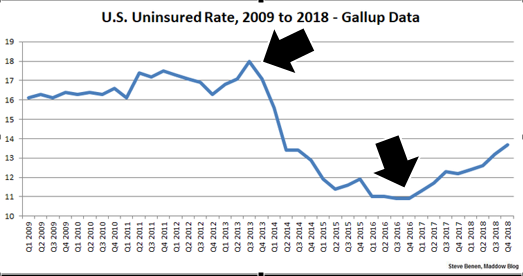
For example, immediately prior to AFA coverage taking effect, about 18% of the US population was uninsured. That percentage continued to drop through 2016:Q4. Immediately upon taking office in 2017:Q1, the Trump administration repealed many features of the AFA.

The Trump administration has continued to eliminate features, including many insurance exchanges, through which uninsured people could at least buy some coverage. The result of Trump’s policies has been a sharp uptick in the number of uninsured. While the chart stops at 2018, the latest projection for 2020 is 45-50 million people in the US will be uninsured.

Opposition to broader insurance coverage seems to focus on two issues: (i) potential elimination of the option to buy additional private insurance; (ii) additional taxpayer cost with expanded coverage for everyone. Both issues are solvable, if opponents will listen.

A Medicare-for-All (MFA) type coverage does not preclude availability of private insurance that would offer an additional level of service or benefits. In some metro areas, selected medical practices offer what is promoted as “concierge service,” ensuring quick access to physicians and more private facilities for many procedures.

While the initial cost for a MFA program could be somewhat higher as people formerly uninsured begin to address issues, longer term the cost could be less. Much of the cost savings could be from eliminating “unproductive” costs. While estimates vary because of different assumptions, overhead costs for Medicare appear to be about 50% less than overhead costs for private insurance. (NYT article)

Currently hospital costs and therefore healthcare insurance premiums include some amount for emergency room visits by the uninsured and those without financial resources. ER visits are far more expensive than office calls. In addition, people who have no insurance often wait until an illness or situation becomes extreme before visiting ER, thereby increasing the cost of treatment.

Opponents to Medicare-for-All should think about medical cost in the same way they think about maintenance on their personal vehicle. Routine maintenance, such as changing oil regularly, is much less expensive than doing no maintenance and eventually replacing the engine. In many ways, the human body operates much your car’s engine; preventive maintenance is much less expensive.

Getting Congress to agree to some form of Medicare-for-All should be much easier following the United States’ experience with the coronavirus. There has not been an event in most everyone’s lifetime that has demonstrated the importance of medical care for all citizens. Recent estimates indicate those without insurance infected with COVID-19 will face medical bills of $50,000-$75,000. Even those with insurance could face medical bills of $25,000 or more.

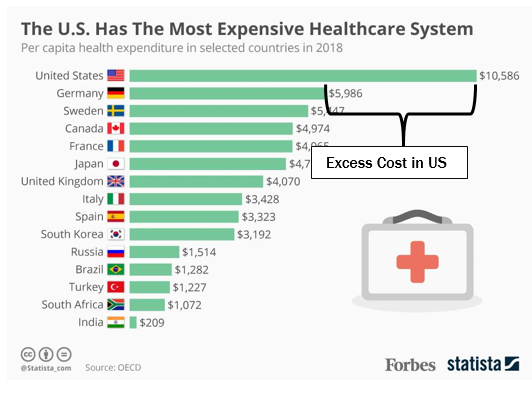
For those who still think the US cannot afford such coverage, the chart lists healthcare costs per capita by country. Note the cost per capita for highly developed countries. The cost in the US is 75% HIGHER than Germany, the next most expensive country. OK, if you’re still concerned these countries don’t offer the same level of care as the US, then buy the additional-cost option.

Addressing the Naysayers. Any effort to implement a Medicare-for-All type system will be met with vigorous opposition from the right. Following are some likely questions as well as suggested answers. I recognize no answer, however logical and supported by facts, will satisfy the hard right. But given how so many people have been affected by COVID-19 so far, and how many are likely to be affected in the coming months, the voice of the naysayers may be heard less and less, especially when facts are presented to support a Medicare-for-All type system.

Comment #1: The US has the best healthcare system in the world. Don’t mess with it! Leave it alone.

Response #1: Let’s look at the expected lifespan in the US compared to other countries. The US ranks 47th behind such countries as Sweden, Germany, China, Taiwan, France, Korea, Canada, UK, Costa Rica, French Guiana and a host of other countries and ranks just one ahead of Cuba. If the US has such a great healthcare system, why does it rank 47th?

Comment #2: Those countries don’t have as many immigrants as the US. Those immigrants are what’s causing the problem here.

Response #2: Take a look at life expectancy among whites, blacks and Hispanics. Whites have the longest life expectancy but the others are not bringing the US total down by much. You also realize that life expectancy in the US declined under the Trump administration, don’t you? The decline was the first since WWII.

Comment #3: Why should I pay for someone else’s healthcare? There are lots of slackards out there who don’t pay income taxes. Paying for their medical care is not fair to me.

Response #3: First, anyone who has worked, whether or not they pay income tax, contributes to funding Medicare. In addition, the vast majority of Medicare recipients paid while working and continue to pay a monthly premium in retirement.

Comment #4: Medicare-for-All will create another inefficient government bureaucracy. The private sector is always more efficient. Why waste my hard-earned dollars?

Response #4: The bureaucracy supporting Medicare already exists. Plus, overhead for Medicare is substantially less than for private insurance. While there are different estimates for overhead, there is almost universal agreement that overhead costs for Medicare are substantially less than for private insurance. Most estimates are savings for Medicare of 50% or more. Medicare is more efficient at administering care than private companies. Why should people have to pay 2x the administrative costs for private insurance as they do for Medicare?

Comment #5: How are the doctors going to make any money? Medicare screws them on pricing.

Response #5: One adjustment with Medicare-for-All might be to weight payment to doctors more toward prevention rather than procedures. The change should also generate cost savings. In addition, if necessary, fees to doctors could be increased. The area needs further analysis.

SUMMARY: Some form of “Medicare-for-All” with an option for additional-cost coverage seems an ideal solution to help us address “we gotta get out of this (healthcare quagmire)  place.”  Obviously there are some issues to be worked out in order to implement a Medicare-for-All type program. However, most of the issues have been solved with existing Medicare programs and the Affordable Care Act prior to the Trump administration cuts.

Enough discussion for now about a practical solution to addressing healthcare costs. Likely more later.


#378. US Societal Quagmire: “We Gotta Get Out of This Place” (Part 1)

19 Sunday Apr 2020

Posted by Jordan Abel in Causes of the Revolution, Gov't Policy, Societal Issues, Uncategorized

≈ 22 Comments

Readers: this blog is set in the future (sometime after the year 2020). Each entry assumes there has been a 5th revolution in the US — the Revenge Revolution. More about the Revenge Revolution, a list of earlier revolutions and the author, Entry #1.

Periodically I write a “sense check” to assess whether in the next few years, a revolution in the US is still possible or whether the entire exercise is based on a statistical aberration — i.e., a roughly 50-year cycle between major upheavals in the US.  Most recent sense check, Entry #365.  

Some of the entries are part of a series.  Several series are available as easy-to-read booklets for download:

  • Working with Lee Iacocca after he left Chrysler, 2019Q3 Iacocca Personal Observations. 
  • GM EV1 — behind-the-scenes events affecting development and introduction of the GM EV1, the first modern electric vehicle. 2020Q1 GM EV-1 Story Behind the Story Booklet
  • Coming technology tsunami and the implications for the US, Tech Tsunami Booklet with Supplement
  • Trump Supporters Brainwashed? A series discussing why Republics have abandoned basic principals, Are Trump Republicans Brainwashed 2020Q1
  • Who took out the Donald?  Who/what groups are most likely to “take out” Trump? Who Took Out the Donald Entries with Update
  • Revenge Revolution — description of what form the revolution might take, 20 01 07 Start of Revolution

Prelude: in a couple of preceding entries I tried to address the seemingly endless number of inconsistencies in information from the Trump administration about the spread of the coronavirus and/or actions to mitigate the spread. After some reflection, I decided that was futile.  Trump is a lunatic and the administration filled with lapdogs save a couple of people at CDC.  Instead of wasting time on Trump, I thought it more productive to begin discussing what happens in the US once the coronavirus is more under control.  At this point not sure how many entries.  The first one is a bit long.  

ENTRY #378 BEGINS: In the 1960s, there was a song by The Animals that included the lyrics, “We gotta get out of this place if it’s the last thing we ever do.”   While not written as a protest against the Vietnam War, the song was often used as a protest against the US participation in Vietnam.

Even though the song is more than 50 years old, the title seems appropriate today. The place we have to get out of is the economic and social quagmire in this country. The economic and social quagmire has been gradually getting worse with each decade. And while the Trump Administration has not been the sole cause, decisions by Trump with the support of the Republican Party have made the quagmire far worse.

Another perspective on the same situation is the US is sitting on an economic and social time bomb with the timer clock getting close to zero hour and ready to explode. What’s creating the time bomb is pressure from multiple sectors:

  1. Decades of limited earnings growth for middle and lower-income workers. The result has been greater income inequality.
  2. More medical risk. Fewer employers are providing company-paid medical insurance, thus leaving families to fund their insurance.
  3. Less job certainty. The uncertainty has been growing for some time as more organizations hire workers as contractors. Organizations are also automating an ever increasing number of functions of blue-collar and white-collar workers.
  4. More societal polarization with focus on one’s political party rather than with focus on solving problems. The shift began with the Reagan administration, when Reagan repeatedly declared, “Government is the problem, not the solution.” Trump’s public animosity toward anyone who does not support his views, however controversial, convoluted and even unconstitutional, has taken party loyalty over policy to an unprecedented level.

The four forces squeezing the US population are like hands squeezing a balloon. The coronavirus has intensified the squeeze, leaving little time before the balloon bursts. Reactions to state governors’ actions to control the spread of the coronavirus generally have been positive although some on the far right have protested. Apparently far-right Republicans think they have immunity to the virus.

The stay-at-home directives, closing of businesses and social distancing seem to have allowed the nation to pause and begin rethinking previously held assumptions. For example, prior to the coronavirus, certain jobs were considered relatively unimportant and, therefore, not worthy of much compensation. Such jobs included non-degreed healthcare workers, grocery store staff, transit workers and workers at food-processing plants.

Interestingly, the coronavirus changed those assumptions. People began to realize how important these jobs were to a functioning society. During the coronavirus those working in healthcare, grocery store and food-processing, among others, were categorized as “essential.” At the same time, many college-degreed, higher-paid white-collar jobs, including many executives, were categorized as “non-essential” and mandated to work from home.

Further, many “non-essential” businesses were ordered to close. The result was a huge spike in unemployment. Over a four-week period ending mid-April 2020, more than 22,000,000 workers in the US filed for state unemployment benefits. Over the next few weeks, the total will likely increase significantly since many unemployment offices were overwhelmed and furloughed workers unable to file.

How many of those currently furloughed will be re-employed post-coronavirus is uncertain. At a minimum, there likely will be a major disruption to the pre-virus job-status hierarchy. Many lower-paid “essential” workers could receive a pay increase and many white-collar workers deemed “non-essential” could be reclassified to lower-paid positions or jobs eliminated.

The COVID-19-related shutdown of the US economy has brought to the forefront social and economic inequities. Prior to COVID-19 these inequities often were discussed in the abstract since most of the people discussing the inequities were not affected directly. COVID-19 has reframed the conversation. Most of the public now realizes how fragile their jobs are and how the safety net for furloughed workers has a huge hole, starting with unemployment benefits and medical coverage.

Now that this “hole” in the safety net has been discovered, what steps will elected officials take to make repairs? The task of repairing the hole may be more complicated than policymakers realize. While anyone losing a job or being furloughed without pay suffers economically, the impact of that loss may be markedly different for different age groups.

Historically, as workers aged their families had been able to accumulate financial resources that could help cushion economic downturns. Thus, older workers furloughed because of COVID-19 should be in a better position economically than younger workers. But are workers today, older and younger, able to weather an economic downturn?

How do economic resources of today’s workers compare to workers at the same age say 25 years ago? Do today’s workers age 45 have the same relative assets as workers who were age 45 in 1995? What about assets of workers say age 25 in 2020 compared to those age 25 in 1995? Are workers today, older and younger, at a disadvantage economically compared to previous age cohorts? The answer is, “yes.” And that disadvantage has grown with each generation.

Over the last 50-60 years, there has a fundamental deterioration in affordability of key factors that help a family accumulate assets. Since roughly the mid-1960’s each succeeding age cohort has been faced with:

  1. Housing prices (and rents) increasing faster than income
  2. Medical costs increasing faster than income
  3. College tuition increasing at a rate much faster than inflation and income
  4. Retirement savings burden transferred to employees as employer-funded defined-benefit retirement programs have been eliminated

The economic pressures caused by each one of these factors probably could be managed by most families. For example, since 1960, when adjusted for inflation, housing prices have increased about 125%, rent about 75% and income only 25%.  However, when the increases in all factors are combined – each one has a similar curve – the result in a significant erosion in disposable personal income.

A story that hit me like a 2×4 to the forehead was an interview with a family trying to survive under the crush of these economic pressures. The interview was during the recent PBS News Hour. The subject was an ER- vehicle technician in New York.

The technician was describing the mental and economic pressures associated with the coronavirus. The ER technician earned about $40,000. As anyone familiar with cost of living in any of the NY boroughs, $40k for a family is tight. He also had a second job. What really struck me was the ER technician’s employer, apparently a contractor to the City of New York, did not provide health insurance.

Here’s the guy taking you to the hospital to get treated for coronavirus (or some other emergency) but the ER technician does not have employer-paid health insurance. Even worse he can’t afford private health insurance because the Trump administration eliminated many features of Obamacare and eliminated insurance exchanges. So, Trump and Republicans, the guy taking you to the hospital to save your life is risking his life and risking financial ruin if he contracts the virus from you. Does that seem fair?

Longer term, the impact of the coronavirus on the United States will likely end up changing permanently a number of aspects of society. The post-coronavirus United States will likely be forced to address the medical and economic inequities that have been building for the past 50-60 years. In addition, the US might begin to address the need retrain workers as more technology is integrated into the workplace.

The likely result of the coming technology tsunami? Many blue-collar and white-collar workers of all ages are going to be faced with possibly accepting a lower standard of living. (See booklet titled Technology Tsunami for more discussion and possible solutions.)

Will workers of different age cohorts be affected differently? Workers currently age 50 and older, even though they should have more resources, may be hit harder by the technology tsunami since many are less familiar with advanced technology and they have fewer years before retirement to try and recoup lost earnings.

But the technology tsunami is only one tsunami facing current workers. Another tsunami headed toward US shores is the retirement tsunami. What we as a society don’t talk about and certainly what has not been addressed at the Federal level is how unprepared for retirement workers are.

The retirement tsunami has been caused by the elimination of employer-funded health and retirement programs. The potential impact of the tsunami has been made worse by erosion of personal income from the accelerating cost of housing, medical and college tuition. Workers have nothing left over to save for retirement.

In a recent poll by Center for Retirement Research at Boston College, 75%, or 3 out of 4 people age 50-62 had jobs that fell into a “non-traditional” category — meaning, those without employer-provided retirement plans and health insurance. According to the report, workers in non-traditional jobs can expect their retirement income to be as much as 26% lower than that of people who spent their 50’s and early 60’s in positions with full benefit packages, according to the center’s findings.  (Update: NYTimes article about older workers without adequate retirement savings moving in with children, 20 05 03 NYT Underfunded Retirement Parents Moving in with Children) 

What about the impact of higher costs and the technology tsunami on younger workers? Don’t they have 30-35 years to recoup lost earnings from a coronavirus economic slowdown and the technology tsunami? Unfortunately, a greater percentage of younger age cohorts are likely to be even less prepared for retirement than those currently age 50-62.

If costs for housing, medical, education and retirement continue to exceed gains in income, the cumulative effect will further erode disposal personal income. Unless there is a fundamental change in how health care costs, retirement programs and advanced education are funded, more and more people will be underfunded for retirement.

What will make a bad situation worse is a prolonged economic slump associated with the coronavirus shutdowns. The rate at which people have been furloughed is unprecedented – 22,000,000 in four weeks and likely another 10,000,000 in the next four weeks.

Few people in business, few economists and much of the general public does not expect the economy to bounce back once the restrictions associated with the coronavirus are lifted. Even if employment in the manufacturing increases over the next 24-30 months as companies begin bringing jobs back to the US, overall economic growth will be very slow.

Some portions of the service sector employment seem likely to experience a permanent loss of jobs. After “stay-at-home” restrictions are lifted, how many consumers will immediately return to restaurants, attend sporting events, go to shopping centers or travel by plane – and especially take cruises? Consumers are likely to remain cautious until an effective vaccine has become widely available – probably as long as 18-24 months. Even with the vaccine will the public’s behavior be changed permanently?

During the next 18-24 months and maybe forever, how much of structure of service sector will change? Many formerly employed in the service sector have no employer-funded health insurance and even fewer have an employer-funded retirement program. Where do these former employees turn for help? Their jobs are gone, or at least not coming back for some time. Finding another job will be extremely difficult since the economy is growing slowly at best.

Now you see why the theme of this entry is “We gotta get out of this place if it’s the last thing we ever do.” This place is a dead end. We’ve got to find something new. The pressure to “get out of this place” seems like the spark for the Revenge Revolution.

The hardships associated with coronavirus seems to be awakening the middle class to realize how long they have been screwed by Republican policies of tax cuts for the wealthy and denying affordable medical care for all. Workers over 50 are realizing the need to return to employer-funded retirement programs and/or increased Social Security retirement benefits. Such programs are widespread in other developed countries so there is no excuse for not implementing.

When will the Revenge Revolution start? I think we’ve started. The coronavirus seems like an event that could trigger a revolution. The pace and magnitude of the job losses are unprecedented. The Revenge Revolution could spread as quickly as the coronavirus.

As more and more people realize “we gotta get out of this place” the more pressure on Washington to address the social and economic inequities. People are not going to be satisfied with Trump blaming China, the WHO or someone else for the coronavirus. People want concrete steps to fix the hole in the safety net, help train people for the coming technology tsunami, make healthcare affordable for everyone and make sure people have adequate resources for retirement. (Next few entries will offer some solutions.

← Older posts
Newer posts →

Subscribe

  • Entries (RSS)
  • Comments (RSS)

Archives

  • August 2025
  • July 2025
  • June 2025
  • May 2025
  • April 2025
  • March 2025
  • January 2025
  • December 2024
  • November 2024
  • September 2024
  • August 2024
  • July 2024
  • June 2024
  • May 2024
  • April 2024
  • March 2024
  • February 2024
  • January 2024
  • December 2023
  • November 2023
  • October 2023
  • September 2023
  • August 2023
  • July 2023
  • June 2023
  • May 2023
  • April 2023
  • March 2023
  • February 2023
  • January 2023
  • December 2022
  • November 2022
  • October 2022
  • September 2022
  • August 2022
  • July 2022
  • June 2022
  • May 2022
  • April 2022
  • March 2022
  • February 2022
  • January 2022
  • December 2021
  • November 2021
  • October 2021
  • September 2021
  • August 2021
  • July 2021
  • June 2021
  • May 2021
  • April 2021
  • March 2021
  • February 2021
  • January 2021
  • December 2020
  • November 2020
  • October 2020
  • September 2020
  • August 2020
  • July 2020
  • June 2020
  • May 2020
  • April 2020
  • March 2020
  • February 2020
  • January 2020
  • December 2019
  • November 2019
  • October 2019
  • September 2019
  • August 2019
  • July 2019
  • June 2019
  • May 2019
  • April 2019
  • March 2019
  • February 2019
  • January 2019
  • December 2018
  • November 2018
  • October 2018
  • September 2018
  • August 2018
  • July 2018
  • June 2018
  • May 2018
  • April 2018
  • March 2018
  • February 2018
  • January 2018
  • December 2017
  • November 2017
  • October 2017
  • September 2017
  • August 2017
  • July 2017
  • June 2017
  • May 2017
  • April 2017
  • March 2017
  • February 2017
  • January 2017
  • December 2016
  • November 2016
  • October 2016
  • September 2016
  • August 2016
  • July 2016
  • June 2016
  • May 2016
  • April 2016
  • March 2016
  • February 2016
  • January 2016
  • December 2015
  • November 2015
  • October 2015
  • September 2015
  • August 2015
  • July 2015
  • June 2015
  • May 2015
  • April 2015
  • March 2015
  • February 2015
  • January 2015
  • December 2014
  • November 2014
  • October 2014
  • September 2014
  • August 2014
  • July 2014
  • June 2014
  • May 2014
  • April 2014
  • March 2014
  • February 2014
  • January 2014
  • December 2013

Categories

  • Affordable Solutions
  • Back Asswards Thinking
  • Background
  • Background Stupid Is as Stupid Does
  • Benefits of Revolution
  • Causes of the Revolution
  • Common Sense Policies
  • Corporate Policy
  • Definitions
  • Diversions
  • Economics
  • Education Issues
  • Federal Budget
  • General Motors
  • Gov't Policy
  • Infrastructure & Fixed Fuel Prices
  • Innovative Thinking: Ideas and Products
  • Lessons of Revolution
  • Personal Stories
  • Possible Solutions
  • Post Trump Presidency
  • Rebranding Black Community
  • SCOTUS
  • Sense Check
  • Societal Issues
  • Stupid Is as Stupid Does
  • Tech Tsunami
  • Trump 47
  • Uncategorized

Meta

  • Create account
  • Log in

Create a free website or blog at WordPress.com.

Privacy & Cookies: This site uses cookies. By continuing to use this website, you agree to their use.
To find out more, including how to control cookies, see here: Cookie Policy
  • Subscribe Subscribed
    • usrevolution5
    • Join 32 other subscribers
    • Already have a WordPress.com account? Log in now.
    • usrevolution5
    • Subscribe Subscribed
    • Sign up
    • Log in
    • Report this content
    • View site in Reader
    • Manage subscriptions
    • Collapse this bar
 

Loading Comments...