• Home
  • Booklets/Grouped Entries
  • Tech Tsunami
  • List of Entries to Date
  • About the Author

usrevolution5

~ USA Headed for a 5th Revolution! Why?

usrevolution5

Category Archives: Uncategorized

#354 Toto Exposes the Wannabe Oz — Trump (Trump Trial 2 of 3)

13 Sunday Oct 2019

Posted by Jordan Abel in Post Trump Presidency, Uncategorized

≈ Leave a comment

Readers: this blog is set in the future (sometime after the year 2020). Each entry assumes there has been a 5th revolution in the US — the Revenge Revolution. More about the Revenge Revolution, a list of earlier revolutions and the author, Entry #1.

Periodically I write a “sense check” to assess whether in the next few years, a revolution in the US is still possible or whether the entire exercise is based on a statistical aberration — i.e., a roughly 50-year cycle between major upheavals in the US.  Most recent sense check, Entry #332.  

Entries the past several months have been an intentional diversion from the craziness in Washington. Starting with Entry #352 put us back inside the Beltway.

­­­­­­­Background detailed in Entry #353. In response to indictments charging former President Trump with fraud, tax evasion, extortion and several other crimes, Trump’s counsel suggested entering a plea of insanity. Trump told counsel to let the court know as an alternative, he would relinquish his US citizenship and relocate to either Russia or North Korea if all charges were dropped.

The presiding judge rejected any plea deal and ordered the case to proceed. Trump’s counsel then demanded a jury trial, apparently thinking it could convince a juror to hold out and secure a hung jury. Counsel believed the jury-trial strategy would allow time for Trump and counsel to attempt to sway public option in his favor and possibly avoid a second trial.

Courtroom – beginning the jury trial. Opening statement by the prosecutor. “Ladies and gentlemen of the jury, what I want you to think about during the trial is the following. I’m certain all of you have seen the movie, ‘The Wizard of Oz.’ Think back to the scene where Dorothy and Toto leave Munchkin Land and begin their trip to meet the great Oz.

One difference between the movie and this trial will be the names of the characters Dorothy meets along the way. The Scarecrow – recall who has no brain – is former vice president, Mike Pence. The Tin Man, who has no heart, is former Senate Majority Leader, Mitch McConnell. The Cowardly Lion is South Carolina Senator Lindsey Graham.

And Dorothy? Well, think of Dorothy as Nancy Pelosi. Toto represents one of those people buried in the government bureaucracy who steps forth and becomes a hero. The original whistleblower would be a good example. Think of the yellow brick road as Trump’s obsession with glitz and gold.

Skip ahead: by now Dorothy, aka Pelosi, and Toto have gone far enough toward Oz to have encountered all three of the characters. As they proceed farther, the group encounters a number of situations. With each event, Pelosi realizes that Pence is starting to think more, McConnell is developing a bit of a heart and Graham is showing some backbone.

When the group reaches the Land of Oz, they face what seems to be a formidable force protecting the fortress of the Great Oz. Think of the protection as say Trump’s fixer Michael Cohen, former lawyer Rudy Giuliani or some members of the White House staff. However, when the defense is confronted by Dorothy and her group, the protection quickly crumbles and the group is able to enter the fortress.

When the group finds Oz, they begin to ask questions. Trump, I mean Oz, responds to these questions with such inane statements as ‘I am a stable genius’ and ‘In my great and unmatched wisdom.’ Along with the inane comments, Trump verbally and viciously attacks Dorothy, the Scarecrow, the Tin Man and the Lion.

The vicious personal attacks cause each of the players to pause. The pause is broken when Toto uses his paws and pulls back the curtain, exposing the Great Oz hiding behind it.

Now exposed, the self-proclaimed master ruler is no more. Toto has exposed for all to see all of the boasts, claims and lies. The era of the Wannabe Oz is over.

Ladies and gentlemen of the jury, please keep these scenes in­­­ mind as we provide evidence supporting the grand-jury indictments of Mr. Trump for fraud, tax evasion, extortion and several other crimes. Thank you for your attention.”

The defense counsel objects to the opening argument and asks for an immediate dismissal of the case. The judge overrules and the trail begins. (Continued)

#352 Why Do Federal Reps, Senators Have No Shame? My 25¢ Analysis.

29 Sunday Sep 2019

Posted by Jordan Abel in Societal Issues, Uncategorized

≈ Leave a comment

Readers: this blog is set in the future (sometime after the year 2020). Each entry assumes there has been a 5th revolution in the US — the Revenge Revolution. More about the Revenge Revolution, a list of earlier revolutions and the author, Entry #1.

Periodically I write a “sense check” to assess whether in the next few years, a revolution in the US is still possible or whether the entire exercise is based on a statistical aberration — i.e., a roughly 50-year cycle between major upheavals in the US.  Most recent sense check, Entry #332.  

The past few blog entries have been an intentional diversion from the craziness in Washington. This entry puts us back inside the Beltway.

Ever wonder why elected Federal representatives, House and Senate, seem to have no shame? Why some individuals take one position when a Republican is in office and flip-flop when a Democrat is in office?

An extreme example of no shame is Lindsey Graham, Republican Senator of South Carolina. In 2016, when Graham and Trump were Republican presidential candidates, Graham claimed Trump was evil and untrustworthy. The criticism from Graham went far beyond what one would consider normal “campaign talk.”

Once Trump was elected, and after Graham’s guardrail John McCain died, Graham became a die-hard Trump supporter. In the most recent Trump fiasco – threating to withhold approved military aid unless Ukraine investigated a potential Democratic rival, and then trying to squash an investigation — Graham dismissed Trump’s actions as a mere phone call, not worthy of Investigation.

Graham was more than willing to overlook the abuse of power for personal gain, Trump obstructing Congress and then Trump publicly threatening anyone who put country ahead of politics. To Graham, let’s forget the oath to uphold the Constitution he took as a Senator, supporting Trump is more important. One has to wonder if Graham would have taken the same stance if those actions had been taken by a Democratic president.

Another flip-flopper is Senate Majority Leader, Mitch McConnell. McConnell has been more than willing, with no apparent remorse, to switch his position whether the Senate should have a hearing for a Supreme Court nominee if an election is upcoming within a year or so. When Obama was President, McConnell stated emphatically any hearing for a SCOTUS nominee was out of the question. While Trump has been President such a SCOTUS hearing is imperative and must be done now. Mmm, wonder what Mitch’s position will be on voting on impeachment?

Graham and McConnell are not alone. There are many examples on both sides of the aisle. In the current environment, Republicans seem to hold the edge on shamelessness. In the Trump/Ukraine debacle, among the Senators, the only one who seems to have expressed publicly any concern about Trump’s behavior is Mitt Romney. Might be a coincidence that Romney is not a lawyer but a businessman.

I’m not naive about politics and party loyalty. However I do find troubling a willingness to support party over the Constitution and frankly, what’s right for the country.

Why are these elected officials exhibiting behavior that most of us would never tolerate in the private sector? Have these officials no shame?

My $0.25 analysis? The cause of the behavior, in Yogi Berra terms, is a combination of training and lack of training.

#1 The effect of training. Most Federal Representatives and Senators are lawyers.   Lawyers are trained to be able to take multiple stances on a given issue. Successful attorneys, especially defense attorneys, may need to present different sides of an argument depending on the particular situation of and charges against their client. Further, society does not expect attorneys to agree personally with every stance taken in defense of a client. The only expectation of the attorney is to make a fair effort defending the client.

Not being expected to argue a position necessarily consistent with personal beliefs allows attorneys to shift positions back and forth without any concern about consistency in approach. For many lawyers supporting a position without regard to past support of a different position, might seem perfectly normal and part of their everyday activity. However, members of the House and Senate need to put away their lawyer training and remember their oath of office is to uphold the Constitution; not an oath to represent the president of the United States. The president is NOT their client.

#2 The lack of training. The second factor why Congressional reps show no shames could be lack of military service. For lawyers, the effect the lack of military training may be more pronounced than other occupations. For lawyers, there are generally two outcomes, win or lose. There are very few situations where a win-win is a desired outcome.

As anyone who has been in the military knows, two things become evident in basic training. The first is it matters not your background, family wealth, family connections, one’s level of education, etc. During basic training drill instructors treat every trainee exactly the same, like dirt.

The second thing that becomes evident in basic training is the necessity to work in teams. In military training at least early on, the object is not to win or lose but to build a team and learn to work closely with other teams. And you have no choice of what team you’re on. The teams are comprised of people from all different backgrounds and skill levels. Thus, to make any progress, and avoid further harassment by the DI, one needs to learn to cooperate and work with people who are radically different than normal associates.

An example I recall from my own un-storied military career was during advanced training for light infantry. Part of the training included qualifying on a wide range of weapons. The base commander put a challenge out to several larger units training at the camp. If a designated training unit could tie or break an existing scoring record when qualifying with a specific weapon, that group would receive a weekend pass beginning noon Friday. I don’t recall whether we had six or seven weapons to qualify with — pistols, assault rifles, machine guns, anti-tank weapons, etc. — but I do recall our group setting 5 or 6 post records and being able to leave Friday noon.

The records were achieved because we worked together. Most of us had not been in basic training together so there was little many of us had in common other than wanting to get through training and wanting to get a pass starting Friday noon.

Another major incentive to work together and set a base record, although not articulated by the training staff, was the fort’s location. We were stationed at Fort Ord, California, near Carmel and Monterey Bay. Getting out Friday noon would give us enough time to visit Reno, drive Big Sur to Santa Barbara, go to San Francisco and generally have a good time.

Since sending our Congressional reps to Army basic training would be fun to watch, but not really practical, what do we, societal we, do to get our elected officials to begin working more closely with one another? A solution used in private industry that might work is to have Democrats and Republicans participate in team-building exercises. Before legislators began returning to home districts on the weekends, interaction with members of the other party occurred regularly at golf courses, during poker games, and family outings. During that era many reps, spouses and children of both parties were close friends.

Like the idea of basic training, the chances of either party supporting team-building exercises is nil. I cannot imagine how loud Fox News bloviators Sean Hannity and Tucker Carlson would scream over such an idea. “Political parties working together? How dare someone suggest cooperation. An effective outcome would ruin our ratings!”

Thus, the only realistic approach seems to be the ballot box. But I think we, again societal we, need to start thinking differently about the importance of elections. To effectuate change, the primary election may be more important than the general election. If we want government to start working again, then we need to start nominating centrist candidates in both parties. We also need to be willing to switch parties if the candidate of one’s preferred party is too extreme.

If your state requires party selection to vote in the primary, then chose Republican or Democrat and vote in the primary. No one’s forcing you to vote a straight ticket in the general election.

The only way we are going to get elected representatives to Congress to start behaving with some consistency and integrity is to nominate people with positions on issues that are good for the welfare of this country, not some small slice of the population. If you look back in US history, the times when the economy was the strongest over time (constant $), when a strong middle class developed (think of “Leave It to Beaver”), when a major portion of society was able to advance in education, and when we had the most support among a wide range of countries worldwide was a time when we had a president and members of both parties working together.

The most disruptive times in US history occurred when there was a major division of the parties. I’m voting for working more closely together.

As a sidebar: One of the reasons I started writing this blog in 2013 was to alert people to what was likely to happen without some major changes in society. While I remain hopeful such changes can occur, my fear is the US will experience another revolution, the Revenge Revolution, before any meaningful change happens. Please prove me wrong.

#351 What if Trump Were…? Serious Questions about How Individually We View Presidential Behavior.

22 Sunday Sep 2019

Posted by Jordan Abel in Societal Issues, Uncategorized

≈ 3 Comments

Readers: this blog is set in the future (sometime after the year 2020). Each entry assumes there has been a 5th revolution in the US — the Revenge Revolution. More about the Revenge Revolution, a list of earlier revolutions and the author, Entry #1.

Periodically I write a “sense check” to assess whether in the next few years, a revolution in the US is still possible or whether the entire exercise is based on a statistical aberration — i.e., a roughly 50-year cycle between major upheavals in the US.  Most recent sense check, Entry #332.  

The past few blog entries have been an intentional diversion from the craziness in Washington. While this entry doesn’t address activities inside the Beltway per se, the entry does address how we view such activities.

As 2019 progresses into primary season then migrates to the general election, I thought voters should ask themselves a very simple question. In order to put the question in proper context, there’s some background information, which you should read, please.

Background Information. Trump took office as president in January 2017. Assume everything about the president and the presidency is unchanged since that point. For example assume: the same number of and content of Executive Orders; the same high turnover of cabinet members; the same number of “acting” heads of agencies; the same number of unfilled agency staff positions; the same effort to rollback all environmental programs implemented during the Obama Administration; the same denial that global warming has been accelerated by human activity; the same tax cut that transferred huge sums to corporations and the wealthy; the same tax cut that has created sharply higher federal budget deficits; the same tweets that have insulted members of Congress; the same tweets that have insulted Cabinet members; the same tweets that have insulted heads of state of long-term US allies; the same unusually friendly and secretive behavior with Vladimir Putin; the same unusual behavior with Kim Jung Un; the same refusal to disclose personal income taxes; the same effort to direct military expenditures to benefit property in Scotland; the same promise that Mexico would pay for the border wall; the same meetings with Russian diplomats, one of whom a known spy, after which notes from the meeting were destroyed; the same effort to strong-arm president of Ukraine to investigate a political rival’s family; the same repeated trashing of the US intelligence community; the same appointment of “Where’s my Roy Cohn?” as Attorney General; the same encouragement to white supremacists; the same numerous cabinet and Trump election-campaign officials who have plead guilty to felonies and are in prison or awaiting sentencing; the same number of days spent playing golf; the same repeated trashing of the judicial system; the same repeated refusal to comply with the US Constitution…and on and on and on.

I tossed a coin and the Republicans get the question asked first. The question to Democrats follow.

Republicans: none of the above information changes except one thing – Trump is a Democrat.

Question: if Trump were a Democrat, would you continue to support him as vigorously as you have and as most Republicans have?

If you answered, “Yes,” then if a Democratic president were to take all or most of the same actions, obviously you would support the Democratic president.

If you answered “No,” then why are you supporting actions taken by Trump, if you oppose the same actions if Trump were a Democrat?

The question is not some trick or “gotcha” question. Go look yourself in the mirror and answer the question as honestly as you can. Your call, not mine. If you really believe Trump, and would support him as a Democrat, OK.

If you wouldn’t support Trump’s same actions if taken by a Democratic president, then your loyalty is to the Republican Party and not to any kind of personal moral or ethical standard. Before you react to my comment, go sit down and think seriously about the question and your answer.

Democrats: none of the above information changes except one thing – Trump is a Democrat.

Question: if Trump were a Democrat, would you oppose him as vigorously as most Democrats have?

If you answered, “Yes,” then if a Democratic president were to take all or most of the same actions, obviously you would oppose the Democratic president.

If you answered “No,” then why are you opposing the actions being taken by Trump?

The question is not some trick or “gotcha” question. Go look yourself in the mirror and answer the question as honestly as you can. Your call, not mine. If you really oppose Trump, and would oppose him as a Democrat, OK.

If you wouldn’t oppose those same actions by a Democratic president, then your loyalty is to the Democratic Party and not to any kind of personal moral or ethical standard. Before you react, just sit down and think seriously about the question and your answer.

Whether these-type questions will help people pause and at least think through their positions, I don’t know. What I do know, is these-type questions need to be asked and each of us should take time and consider our answers.

Comments and questions welcome as always.

#350: GM EV-1: Story behind the Story. The Day the Music Died. (Part 5 of 5)

16 Monday Sep 2019

Posted by Jordan Abel in Corporate Policy, General Motors, Innovative Thinking: Ideas and Products, Uncategorized

≈ Leave a comment

Readers: this blog is set in the future (sometime after the year 2020). Each entry assumes there has been a 5th revolution in the US — the Revenge Revolution. More about the Revenge Revolution, a list of earlier revolutions and the author, Entry #1.

Periodically I write a “sense check” to assess whether in the next few years, a revolution in the US is still possible or whether the entire exercise is based on a statistical aberration — i.e., a roughly 50-year cycle between major upheavals in the US.  Most recent sense check, Entry #332.  

The past few entries have been a break from the craziness in Washington.  Entry #346 started discussing a project that continues to generate considerable interest — the GM EV1, the first modern electric vehicle, which was introduced more than 25 years ago.

There are two sides to the EV1 story — product and non-product.  The product side has been reasonably well documented.  In my view, the non-product side of the story is far from complete, and what’s been told so far is misleading.  The series of entries has been an attempt to provide addition insight.  If nothing else, the series has been a diversion from the madness in Washington and has provided a good lesson or two. (If you have not read Entries #346-#349, suggest you do so before reading this entry. 

if you want to read all five entries as an ebook, download 2019Q4 GM EV-1 Story Behind the Story Booklet.  Also, thanks very much to editors for these entries — my wife Pamela and Wayne Henegar, who was also on the GM EV-1 program.

This is intended to be the final entry of the series about the “inside story” of GM innovative electric vehicle, EV-1…although one never knows. The ending of the EV-1 is both sad and happy.

Sad because the EV-1 met an untimely and ugly death. Happy because many things were learned from the EV-1 program and the program has continued to this day to influence development of electric vehicles worldwide. The demand for and availability of electric vehicles has continued to grow. Even such storied brands as Porsche are introducing electric vehicles.

The EV-1 set the standard for electric vehicles, both in terms of technology innovation as well as quickly building an emotional bond with a wide swath of people. It truly bothers me to say this, but I think the auto company that so far has best captured the spirit EV-1 brought to electric vehicles has been Tesla and not General Motors.

To finish the EV-1 story, let’s start at the end and work backwards to the day the music really died. The formal death of EV-1 was in 2002. The formal death included an orderly return to GM of all EV-1’s that were on lease to customers, mostly in California.

The EV-1’s were only leased and not sold. Why only leased? Keep in mind the EV-1’s were still “experimental” by auto industry standards. Even though the EV-1’s were fully functional and met all federal safety standards, a number of items on the car had not been tested as thoroughly as most regular production models.

Leasing also allowed GM to restrict use of the cars to certain areas – initially California and later some parts of Arizona and Georgia. Leasing enabled GM to avoid what would have become a logistics nightmare. When title to a car/light-duty is transferred from the auto manufacturer to the buyer, the auto company becomes liable for providing parts and service for at least 10 years, in some states the requirement is longer.

In addition, if the owner moves from say California to Vermont, the auto company must provide service at an authorized dealership. For the EV-1 that meant possibly training dealer technicians or providing direct service to many locations throughout the country where there might be only a few EV-1’s in use.

While cancelling the EV-1 program was a strategic blunder, what GM did after the cars were returned from lease may be one of the greatest PR blunders in automotive history. After the program was canceled, remaining leases were not renewed and all EV-1’s had to be returned to GM.

So far, so good. But then what did GM do with the cars? GM crushes all but a few EV-1’s, which were donated to museums and universities but with the driveline disabled.

The giant PR mistake consisted of two components. The first mistake? With a minimal amount of effort and cost GM could have updated the cars and re-leased the EV-1’s. Doing so would have allowed GM to continue to gather customer data and maintain a positive public image about developing electric cars.

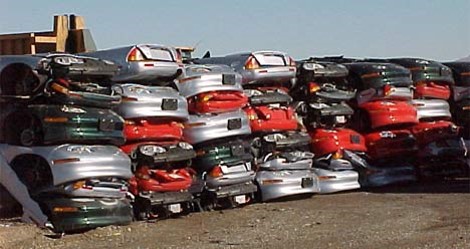
The second mistake? How the cars were disposed of.   Rather than explaining to the public why the cars needed to be crushed, GM tried to keep the crushing a secret. Hard to do with that many cars and car crushers often located in open areas with no trees or other cover.

You’d think someone in GM might have remembered a previous PR fiasco, but apparently not. In the 1960’s (many people from that era had not yet retired from GM) there was a huge public outcry against GM after disclosure GM had hired a private detective to tail Ralph Nader after he published the book, “Unsafe at Any Speed,” which was critical of the safety of the Chevrolet Corvair. I guess reviewing company history and lessons learned was not part of the discussion whether to crush EV -1’s.

What happened to GM’s image after the public found out about the crushing? Almost overnight GM’s image went from good guy trying to help the environment to bad guy. Out the window went all the positive gain in GM’s image that started when the EV-1 was introduced. In fact, GM’s image slipped from positive to negative.

The public outcry over the GM crushing EV-1’s helped spawn the movie, “Who Killed the Electric Car?” Given the seemingly esoteric topic, the movie was remarkably popular. When it premiered in Charlotte, I was invited to attend. Following the movie, there was a spirited Q&A session that lasted almost an hour. The popularity of the movie helped erode GM’s image further.

But did the EV-1 really die when the cars were crushed? Or, did the EV-1 program suffer a mortal wound sometime before, and that would lead to its death? From my perspective, the real death of the EV-1 was in late 1992, years before the public demise. In blog Entry #349, I discussed how the GM financial staff viewed the EV-1 as a cost center. Entry #349 also raised a question whether there was a conspiracy among financial executives to set up, then justify replacing Chairman Robert Stempel, who had succeeded Roger Smith. Stempel was the first chairman in some time not from the financial staff.

Financial staff executives knew whoever followed Roger Smith as chairman would be faced with a host of difficult problems created while Smith was chairman in the 1980’s. The effect of most of these problems was a cash drain and reduced ability by the operating divisions to generate additional cash. In addition, it was clear by the late 1980’s that the US economy was weakening and likely would slide into a recession. The recession would cause auto sales to slow and cash reserves to erode further.

Regardless of who was appointed chairman, no question GM needed to cut expenditures. But where to cut? The financial staff continued its drumbeat that all costs associated with the EV-1 were of no value elsewhere in the company, despite evidence to the contrary.

How was the EV-1 program affected as GM looked for cash? Here’s the scene in fall 1992. Location: General Motors Building, Detroit, conference room near the boardroom. Time, 3:00 p.m.

Attendees at the EV-1 status review meeting: on the corporate side are the chairman, president and two senior financial-staff executives. Representing EV-1 are four executives, including me.

Meeting content includes an update of engineering developments, review of marketing programs, and review of program cost. During the meeting, the chairman takes notes and asks a number of questions. The president takes no notes and does not ask a single question.

At precisely 5:00 p.m., the president stands, turns to the chairman and states, “Bob (Stempel), you can’t afford the program.” The president then excuses himself and leaves the meeting. The meeting concludes shortly thereafter.

After the internal review but before the next meeting of the Board, usually the first Monday of the month, Bob Stempel resigned as chairman and retired from GM. Soon thereafter the Board announced that Jack Smith would be promoted from president to the CEO’s role. The chairman’s role was assigned to an outside Board member.

The Board also approved a significant cutback in staff throughout the company as well as a cutback funding for certain product programs, including the GM EV-1. All the cutbacks, including funding for the EV-1, seems consistent with the idea that Stempel had been set up as the fall guy before someone from the financial staff could ride in on a white horse and save the company.

Oh, I almost forgot. What date did the Board formally approve cutting back on the EV-1 program? An action that in my opinion effectively killed the momentum of the only program which was improving GM’s image; a program which had the potential to attract to GM younger buyers who were more prone at the time to buy Imports, especially Japanese models. What date was the Board meeting that mortally wounded this program? None other than December 7th.

OK, so the Board was tone deaf to the irony of the date of their decision. Not having been privy to the discussion in the Board room, one has to wonder how objective the presentation was about the EV-1 program. Given the negative attitude toward EV-1 of the incoming CEO and his former colleagues on the financial staff, which usually coordinated presentations to the Board (a job I held for a while), I have serious doubts many of the positive aspects of the EV-1 program were presented.

But all connected with EV-1 program has not been lost. A number of positive aspects of the program seem relevant today. For me, probably the biggest takeaway has been how a small group of people with such a limited budget could build such a huge following and have such a lasting impact.   By traditional automotive standards, the size of the individual staffs, amount of the engineering budget, amount of the marketing budget and other support was tiny.

By almost any measure, we were also an eclectic group – some staff members had lots of auto experience; some had almost none. Yet, collectively we became a highly effective team that had a major positive impact on GM’s image and set the standard for a new generation of electric vehicles.

GM senior management’s failure to realize the positive benefits of the program, especially how EV-1 improved GM’s image among younger generations, was an indication then and now that GM senior management was too focused on costs and not focused on generating revenue. The concept of a company trying to cut costs and “save its way into prosperity” never works. Such an approach often is a path to bankruptcy.

The focus of senior management on cost savings and not revenue generation also alienated a number of younger, more innovative-thinking executives inside the company. Many of these innovators left GM. Their departure left GM with far fewer executives willing to take risks and try new ideas, just at the very time GM needed this kind of thinking.

The combination of focusing on cost and avoiding any kind of risk taking proved devastating. GM’s loss of market share that started in the 1980’s because of actions by then chairman Roger Smith continued throughout the 1990’s. By the time GM finally declared bankruptcy in 2008, GM’s share of cars/light-duty trucks sold in the US had fallen from about 45.0% in 1980 to less than 25.0% and was headed toward 20.0%. In say 2006, had GM maintained the share it held in 1980, GM would have sold an additional 3,500,000 cars and trucks in the US.

Could EV-1 have saved GM from bankruptcy? As a car program, no. Annual EV-1 volume was too small to offset declines in other carlines. However, the spirit, enthusiasm and innovation that was generated by the EV-1 program, both inside and outside GM, could have been the catalyst to change thinking inside the company and stop the slide in market share. Only years after the EV-1 program was cancelled, did Rick Wagoner (another financial guy), who succeeded Jack Smith as chairman, admit cancelling EV-1 was a major mistake.

Another major irony of the program?  EV-1 could have been Roger Smith’s best idea to help change GM and his legacy. Unfortunately for Smith, and GM, this great idea was preceded by actions that did irreparable harm to the company.

So, now you have another side of the GM EV-1 story. While writing these entries I was reminded of the opening words to Don McLean’s most famous ballad, “American Pie.”

“A long, long time ago
I can still remember how that music
Used to make me smile
And I knew if I had my chance
That I could make those people dance
And maybe they’d be happy for a while
But February made me shiver
With every paper I’d deliver
Bad news on the doorstep
I couldn’t take one more step
I can’t remember if I cried when I
Read about his widowed bride
But something touched me deep inside
The day the music died.”

Hope you found the series of interest. Comments welcome, as always.

#349 GM EV-1: Story Behind the Story. Inside Conspiracy? (Part 4)

08 Sunday Sep 2019

Posted by Jordan Abel in Corporate Policy, General Motors, Personal Stories, Uncategorized

≈ 1 Comment

Readers: this blog is set in the future (sometime after the year 2020). Each entry assumes there has been a 5th revolution in the US — the Revenge Revolution. More about the Revenge Revolution, a list of earlier revolutions and the author, Entry #1.

Periodically I write a “sense check” to assess whether in the next few years, a revolution in the US is still possible or whether the entire exercise is based on a statistical aberration — i.e., a roughly 50-year cycle between major upheavals in the US.  Most recent sense check, Entry #332.  

The past few entries have been a break from the craziness in Washington.  In Entries #343-#345 I included some observations about my time working with Lee Iacocca, who died July 2.  Entry #346 started discussing another project that continues to generate considerable interest — the GM EV1, the first modern electric vehicle, which was introduced more than 25 years ago.

There are two sides to the EV1 story — product and non-product.  The product side has been reasonably well documented.  In my view, the non-product side of the story is far from complete, and what’s been told so far is misleading.  The series of entries — I actually do not know how many — will attempt to provide addition insight.  The series will be a good diversion from the madness in Washington and offer a good lesson or two, I hope. (If you have not read Entries #346-#348, suggest you do so before reading this entry.)

As described in previous entries, there was a dichotomy on the GM EV-1 program. The public, the media and most government organizations were interested and viewed very positively GM’s efforts to develop and introduce an electric vehicle. Inside GM, the view was just the opposite. Many GM executives intensely disliked the EV-1 program and considered it a waste of scarce funds.

An example of the public support was the number of people who contacted the program seeking information. When the program kicked off, there was no internet. Hard to imagine now but true, no internet. The primary contact was via an 800# and some contact by snail mail. The 800# was staffed by a firm which I had used at Buick.

The firm kept a record of every contact. If you were a first-time caller, you also received a response letter written on executive stationery, which I hand signed with a fountain pen. If I knew anything about the location or something else that might be of interest to the recipient, I would write a short note in the margin.

Over roughly a two-year period, I signed about 25,000 letters. It was not uncommon to return from a week-long business trip and have a stack of 300-400 letters delivered to the house waiting for me to sign.

Did this letter writing effort have an impact? For maybe 10 years after the program, I would be introduced to someone who would say, “Oh, I know you.” I would ask how they knew me since we were just introduced. “You wrote me a letter.” Then often as not the person would reach into the desk and retrieve the letter.

Most people seemed to retain the EV-1 brochure, which was sent along with the letter. Like many efforts on the program, we broke the mold for what was considered a standard car brochure. The advertising manager on EV-1 was Amy Rader, a history major from Princeton. Amy thought we should have a different kind of brochure. She managed to convince the Robert Frost Foundation to allow EV-1 to be the first commercial use of his works. The EV-1 catalog, of course, was on recycled paper.

Contact with the EV-1 group was not limited to the United States. One day we received a package from a group of high school students in Bulgaria. Somehow they’d heard about the program (remember pre-internet) and completed a class assignment centered on the EV-1. When finished with the assignment they sent us a copy.

Unfortunately, the widespread interest in EV-1 fell on deaf ears inside GM. Part of the cause was frustration among many GM executives with 1980’s chairman Roger Smith diversion of cash from product development and marketing programs. As noted in an earlier entry, during the 1980’s Smith purchased Hughes Electronics, Electronic Data Systems, stock held by Ross Perot associated with EDS purchase. Also, Smith diverted a huge amount of cash to start Saturn. GM EV-1 was also tainted because Smith had it developed in secret by a company in California. He then held a surprise introduction at the LA Auto Show, including the statement that GM would produce EV-1.

While Roger Smith’s follies festered frustration and anger toward EV-1, some of us on the program could have done a better job trying to convey the value of EV-1 to executives inside GM. We did not spend enough time making sure our colleagues at the GM operating divisions understood how the EV-1 program could benefit GM and benefit the operating divisions.

However, even that effort might not have overcome what seems to have emerged over time as the death knell of the EV-1 program. The cause of death was the view by the financial staff that EV-1 was nothing more than a cost center. As someone who cut his teeth on the GM financial staff, I can sort of understand that view, although I do find baffling the lack of enlightenment about the non-product value that EV-1 generated for GM.

The “cost-center” view may have been a cover for at least two other actions. The first was that GM kept claiming most, if not all development cost associated with EV-1 had no other application. Yet, as EV-1 was being developed, elsewhere in GM there were efforts to incorporate many features of EV-1 into regular production vehicles. If one were to track incorporation of electronics into regular production cars/trucks, there was a huge jump after EV-1. I like to remind people that even though GM eventually cancelled EV-1, one the major benefits of the program was accelerating the use of electronics in vehicles.

The acceleration of electronics should have been fully supported by the financial staff…but it wasn’t. At the time of EV-1, many electronic features carried a price premium. Yet, the incremental cost to produce many electronic features was almost nothing. With the opportunity to use electronics to increase profit margins on most every car and truck, why was the financial staff so emphatic that EV-1 was a cost center?

The second reason for the “cost-center” claim is more sinister and one I’ve never heard discussed publicly. I reached the more sinister conclusion based on: (i) early training to be an actuary, which includes trying to find patterns out of seemingly random events; (ii) studying the history of General Motors; (iii) having worked with most of the financial executives involved.

My sinister view is the EV-1 happened to be a convenient mechanism for implementing a conspiracy by the financial staff. A conspiracy by the financial staff is unlike the conspiracy implied in the movie “Who Killed the Electric Car?” The movie suggests a conspiracy among various car companies and other organizations associated with electric vehicles. As noted in an earlier entry, I think the multi-organization conspiracy theory presented in the movie is simply not true.

Ok, then what was the conspiracy inside GM led by the financial staff? And why?

Higher-level finance executives knew that actions during Roger Smith’s reign had seriously eroded GM’s earning power. Some of this erosion had been hidden by a number of accounting changes. With that understanding, these executives knew the next chairman of GM would have a very rough time trying to stabilize the company and trying to rebuild earnings.

GM had a long tradition of the chairman coming from the financial staff and the president coming from operations. So here are my questions. Who was chosen to succeed Roger B. Smith as chairman? A financial guy? No, a guy from the operating side. Who was chosen to be president? An operating guy? No, a financial guy. Seems a bit odd, huh? Maybe a bit Machiavellian?

Robert Stempel, who was chosen as chairman to replace Roger Smith, was the quintessential engineer. Stempel had a stellar track record in operating roles at Pontiac and Chevrolet but no in-depth exposure to or understanding of finance. No surprise that Stempel was a big supporter of EV-1 since much of his career involved new product development.

The new president, Jack Smith (no relation to Roger Smith) was the quintessential finance guy with almost no experience in US operations that would help him understand how the operating divisions and the supporting dealer organization worked. An example – during a meeting I mentioned EV-1 was generating a high level of interest among teenagers. Smith replied, “15 year-olds don’t buy cars!” True, but just from a pure economic standpoint that 15 year-old will likely purchase at least 10 cars/trucks in his or her lifetime, and probably more. And who doesn’t remember which brand cars/trucks were “cool” when they were 15 years old?

So, was there really a conspiracy? Was there really a coup d’état at GM? Did the senior financial executives setup Stempel, knowing GM earnings would be rocky the first few years post Roger Smith? If Stempel demonstrated he was unable to stabilize GM, would the financial staff be justified asking the Board to replace Stempel with a traditional finance guy in order to “save” the company?

Stempel faced another problem, which was not unexpected. In the early 1990’s, the US economy slid into a recession. As GDP and personal income declined, predictably so did car sales. GM profits also fell. While Stempel continued support for the EV-1, the recession forced GM into a difficult choice. The loss of market share during Roger Smith’s reign meant fewer vehicles to cover fix cost. Plus, the diversion of cash for Smith’s various projects, especially Saturn, meant GM had no cash reserve.

GM needed to cut costs and few alternatives were available. Product programs and marketing programs at the car divisions had already been raided to fund Roger Smith’s various projects. Closing Saturn, even though it was bleeding cash, would have been a PR disaster.

What was on the table for cutting, at least from the financial staff’s perspective, was EV-1. I agree and understand that sometimes immediate needs for cash overtake future considerations, even if the long-term consequence may be negative. However, cutting EV-1 made little economic sense. The cash burn rate was not that great. Much of the development could be applied to and increase profits of other GM cars/trucks. Plus, EV-1 was GM’s only bright spot. Even with all the other problems inside the company, GM’s public image continued to improve because of EV-1.

But did that matter? Stay tuned. My apologies. In Entry #347 I promised to talk about the dynamics of the meeting the day the music died. I’ll do that in the next entry.

#348 More about EV1 (Electric Vehicles): Story Behind the Story (Part 3)

26 Monday Aug 2019

Posted by Jordan Abel in Diversions, General Motors, Personal Stories, Uncategorized

≈ Leave a comment

Readers: this blog is set in the future (sometime after the year 2020). Each entry assumes there has been a 5th revolution in the US — the Revenge Revolution. More about the Revenge Revolution, a list of earlier revolutions and the author, Entry #1.

Periodically I write a “sense check” to assess whether in the next few years, a revolution in the US is still possible or whether the entire exercise is based on a statistical aberration — i.e., a roughly 50-year cycle between major upheavals in the US.  Most recent sense check, Entry #332.  

The past few entries have been a break from the craziness in Washington.  In Entries #343-#345 I included some observations about my time working with Lee Iacocca, who died July 2.  Entry #346 started discussing another project that continues to generate considerable interest — the GM EV1, the first modern electric vehicle, which was introduced more than 25 years ago.

There are two sides to the EV1 story — product and non-product.  The product side has been reasonably well documented.  In my view, the non-product side of the story is far from complete, and what’s been told so far is misleading.  The next few entries — I actually do not know how many — will attempt to provide addition insight.  Stick around.  The series will be a good diversion from the madness in Washington and offer a good lesson or two, I hope. (If you have not read Entries #346 and #347, suggest you do so before reading this entry.)

In-house development of GM EV-1 begins. At the 1990 Los Angeles Auto Show Roger Smith, then GM chairman, introduced the first modern electric vehicle (EV-1) and proclaimed GM would produce it. As described in Entry #347, the concept car introduced in LA had been developed in secret by a company with no affiliation to GM. Formal development and production were to be inside GM.

Soon after the announcement in LA, the program kicked-off inside GM. The program manager was selected and then initial staff members recruited from different divisions. Additional staff was added as the program progressed. The EV-1 program was headquartered in the Advanced Engineering Building at the GM Tech Center. Being housed in the Advanced Engineering Building reinforced the impression, both inside and outside GM, that an Innovative product was being developed.

Another decision was to not assign the EV-1 to an operating division — Chevrolet, Oldsmobile, etc. On the plus side, not selecting the operating division helped avoid the EV1 being pushed aside by the designated division and having EV1 resources diverted for near-term marketing activities. On the negative side, not selecting a “division home” for EV1 reinforced the perception among many operating division executives that the EV-1 was part of Smith’s portfolio of projects that diverted cash from critical product development and marketing programs, which in turn, caused GM to lose market share.

One of the benefits of hindsight is the opportunity to ask, “What went wrong during the EV-1 program?” And then ask, “What did I do or not do that might have contributed to what went wrong?”

Over the past 20 years or so, I’ve been asked to discuss various aspects of the EV1 in different forums — public presentations, media interviews, guest lecturer at a university, even a movie. With each one of these “events,” I’ve tried to assess how different decisions might have affected the outcome of the program, both positively and negatively.

This series of entries, of which this is the third, attempts to analyze the “non-product” side of different activities. I have stated repeatedly in the various forums that I believe the technical limitations of the EV-1– limited range, 2-passenger seating capacity, e.g. — were not the underlying causes for GM pulling the plug on the EV1. Some of the technical limitations have been used as excuses, but were not really the causes.

What were the causes?  Before pointing fingers at others, it’s always a good idea to first look in the mirror. Most of my role at EV-1 the project was to help manage a team that focused on educating groups outside GM. The groups ranged from utilities to fire-and-rescue organizations to Federal and state-government officials to the media to the general public. While most of the efforts were in the US, we also met with officials in Europe.

The efforts of the team were incredibly successful. Even though our marketing and promotion budget was a mere fraction of the budget for the operating divisions, the team’s efforts, as measured by the amount of media coverage, resulted in a significant increase in the public’s awareness of electric vehicles and a significant increase in positive perception of General Motors.

If memory serves correctly, over a roughly three-year period, the EV-1 program generated more positive publicity for GM than the rest of the company combined. (As we’ll discuss in a future entry, all that goodwill and more was lost when GM decided to kill the program and crush all but a few EV-1’s.)

So with such a positive track record, what could have been done differently? Frankly, what did not occur to me at the time, and I don’t recall anyone else discussing this either, was the need to present to the operating divisions — Chevrolet, Buick, etc. — the same type of educational program about the EV-1 as we presented to outside groups.

While many staffers on the EV-1 program had been in the divisions that suffered because of cash diversions to fund Smith’s projects, I’m not sure any of us fully appreciated how negatively our former colleagues at the operating divisions viewed the EV-1 program. We were all enamored with the idea of an electric vehicle and assumed everyone else inside GM was equally excited.

Clearly not everyone was. An example was a return to my former division, Buick. After working many years helping position Buick for the future, I thought the EV-1 would be a perfect fit for Buick and its dealers, many of whom I knew personally. My thinking was the EV-1 could attract younger buyers to Buick, give dealers a sporty model in the showroom to attract new floor traffic and allow Buick to leverage interest in EV-1 among younger people to help build long-term brand loyalty. My rationale, however, when presented to the Buick general manager, fell on deaf ears. Buick was not interested in any association with the EV-1.

Buick and the other operating divisions were not alone in poo-pooing the EV-1. Somehow, we managed to get on the “Do Not Call List” for a number of staffs. Part of the conflict stemmed from assigned responsibilities. For example, EV-1 was the only group outside of the corporate staff whose responsibility included “government relations”. While our dealings with the government were restricted to topics associated with electric vehicles, we were allowed to approach legislators, government agencies and staff without first seeking approval of the corporate “government-relations” staff.

To me the limited scope of our government-relations activities made perfect sense. If a goal of the EV-1 program was for those in government to understand requirements for a successful introduction of electric vehicles, then the group charged with the introduction should be making contacts with various government entities. In my view we were judicious in our approach and diligent about keeping the corporate staff informed of our activities.

Were we successful? Like the group’s efforts in educating the public about electric vehicles, I think we did a good job educating legislators, legislative staff and a number of agencies. We also worked with other auto companies to ensure there was a consistent message to government about how it could help support the development and introduction of electric vehicles.

So what could go wrong? Let’s start with the relationship with the corporate government relations staff. I can state categorically there was no intent on our part to have the relationship go sideways…but it did.

Scene: Executive dining room at the GM Tech Center. Table for two. At the table are GM’s chief environmental lobbyist and me. Part way through lunch the other GM executive (I’m withholding the name intentionally) leans over the table and says, “Dabels, you’re my worst enemy.” My response, “How can that be? We work for the same company.” His retort, “You’re my worst enemy because my job is to convince Federal and state legislators there’s no demand for electric vehicles and you’re out there proving me wrong.”

The conversation continued, rather politely, but without resolution. The lack of resolution stemmed from our instructions. He was to promote a corporate policy that was in direct conflict with the policy the GM EV-1 group was to promote. We finished lunch and then left to carry out our respective instructions.

Inconsistent internal policies within GM were not uncommon. Another rift, which will be discussed in the next entry, was how the financial staff viewed the EV-1 as a cost center, and not a marketing opportunity. Focusing only on cost created an environment where the financial staff placed no value on improved corporate image, no value on increased future buyer potential, no value on brand loyalty, and no value on myriad other non-product attributes that often differentiate one brand from another and can lead to higher market share and earnings.

My view?  Supporters of the cost-center perspective ended up killing the program. The next entry will also provide some insight about what happened during the meeting the day the EV-1 music really died.

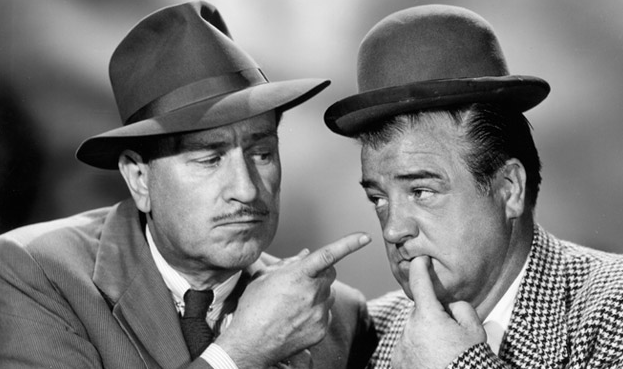
#340 Abbott Awards Costello the Presidential Medal of Freedom

23 Sunday Jun 2019

Posted by Jordan Abel in Economics, Gov't Policy, Societal Issues, Stupid Is as Stupid Does, Uncategorized

≈ Leave a comment

Readers: this blog is set in the future (sometime after the year 2020). Each entry assumes there has been a 5th revolution in the US — the Revenge Revolution. More about the Revenge Revolution, a list of earlier revolutions and the author, Entry #1.

Periodically I write a “sense check” to assess whether in the next few years, a revolution in the US is still possible or whether the entire exercise is based on a statistical aberration — i.e., a roughly 50-year cycle between major upheavals in the US.  Most recent sense check, Entry #332.  

Begin Entry #340.  Somewhat buried in this past week’s news was that Bud Abbott awarded Lou Costello the Presidential Medal of Freedom. Well, okay, it wasn’t really Abbott and Costello, but it might as well have been.

The actual players were Donald Trump and Arthur Laffer. If you don’t follow the players in the field of economics, you might not recognize the name Laffer. In the mid-1970s, Arthur Laffer, then working in the Nixon/Ford Administration, but previously a member of the faculty at University of Chicago, outlined for Messrs. Rumsfeld and Cheney (the same two as in the Bush 43 administration) a curve to illustrate the theory that government revenues could be maximized at certain marginal tax rates.

According to Laffer, too high a marginal income tax rate would be a disincentive for people to work and/or invest and tax revenues would fall. If the margin tax rate were too high, then lowering the tax rate would result in the economy expanding with overall tax revenues increasing despite the lower maximum rate.

The Laffer Theory, commonly referenced as the Laffer Curve, was cited as justification for large cuts in tax rates under Presidents Reagan, Bush 43, and Trump. In fairness to Laffer, his theory, which had been discussed earlier by other economists, could be true where a country had exceptionally high tax rates – although too high a tax rate has never been defined – and there was no compelling societal need justifying the higher rates.

Laffer’s Theory should also be considered the foundation for what is known as “trickle-down economics.” However logical Laffer’s theory and “trickle-down economics” might seem, to my knowledge there is no empirical evidence demonstrating the theory is correct.

In the 1950s, for example, maximum marginal income tax rates in the US were 70%. Yet during the 1950’s the labor-force participation rate was very high and the economy was strong. One might argue – and I think fairly – that the very high marginal tax rates were justified by a societal need. The US needed to pay down some of the enormous debt the US incurred during WWII.

More recent tests of Laffer’s theory include the Reagan, Bush 43 and Trump Administrations. What happened to government revenues when the Laffer Curve was used to justify lowering income tax rates in each of those administrations? The economy grew some but income taxes remitted to the Federal government never increased enough to offset the rate cuts. The result was a sharp increase in the Federal debt, both nominally and as a percent of GDP.

The Laffer Theory has been tried in other venues. In 2012 the Republican governor of the State of Kansas, to whom Laffer was an advisor, convinced the legislators to reduce maximum marginal tax rates. The project result, according to Governor Brownback, would be a rapidly growing economy and enough additional revenue to the state to offset the reduced tax rates.

What happened was just the opposite. Like the experience of the Federal government, tax revenues in Kansas plunged. The difference between the State of Kansas and the Federal government is a critical one. Unlike Washington, the State of Kansas is constitutionally required to balance its budget and does not have a Treasury Department that can print money. The only alternative for Kansas was to raise taxes and substantially cut expenditures in such critical areas as education and infrastructure.

Bush 41 called “trickle-down economics” that emanated from the Laffer Curve, “voodoo economics.” The voodoo economics label seems to be widely shared among most well-respected economists, with more than 95% of professional economists rejecting the Laffer Theory.

So why did Laffer receive the Presidential Medal of Freedom? The president has wide discretion in awarding the medal. A recent recipient, for example, was the golfer Tiger Woods.

What struck me as comical was the Administration’s justification for selecting Laffer. The White House press release indicated Arthur Laffer was “…one of the most influential economists in American history.” (Maybe true but “influential” does not equate necessarily to being correct.) Adding to the comedy of the press release were remarks by Trump, who claimed to have studied Arthur Laffer’s theory for many years.

Seriously? Studied for many years? Trump is anything but a student. He’s repeatedly demonstrated an appalling lack of understanding of basics taught in economics 101. While the examples are numerous, a couple of recent economic headscratchers include his claim that tariffs are paid by the country of origin – i.e., tariffs on goods shipped from China are paid by the Chinese. No, Donald, the tariffs are paid by the residents of the receiving country. The receiving country is called the United States and the tariffs are effectively a tax on consumers.

Another head-scratching idea is that world trade must be a zero-sum game; therefore, the US should work toward having a trade surplus with most all, if not all, countries. If that were true, then nearly every country worldwide would make and consume its own products. If I’m not mistaken, Trump’s theory went out millennia ago.   Maybe Trump should study more about such people as say, Marco Polo. Somehow I think Marco Polo was in the international trading business.

What about Trump’s approach to increase US GDP over the long term? Roughly 2/3 of US GDP is driven by consumer consumption. If you don’t increase the number of consumers and/or increase consumption per capita, then GDP is not going to grow and it will gradually decline. As the population ages, consumption per capita decreases and the economy can stall or start to slide — just look at what happened to the Japanese economy beginning in the 1990’s. In the US, the declining birthrate among native-born citizens will result in lower potential GDP growth unless some fundamental changes are made.

One change to help ensure sustained economic growth could be to increase the pool of younger consumers. How does the US expand the pool? The government can’t force families to have more babies. So what about more Immigrants? Wouldn’t more immigrants help offset the declining birth rate?

According to the Trump Administration, the US should not allow more immigrants, especially those entering without visas. Moreover, according to Trump, even the number of legal immigrants should be reduced sharply.

Mmm, this economics game is not so simple. Maybe Trump should have attended economics class more often. Economics seems something like a teeter-totter. Somehow the two sides need to be balanced for the system to work.

What’s the takeaway from this blog entry? Most everyone, well most everyone except Trump’s hardcore supporters, acknowledges Trump is uneducated about many subjects and his decisions are often arbitrary and conflicting.

Maybe the purpose of this entry is allowing me – and I hope some of you – to vent frustration and anger at Trump with his gang of incompetents and enablers. For many years, I’ve studied economics and had jobs where applying economic theory was a key part of a critical decision. In many of those decisions, the financial well-being of numerous families was affected. In my view, and one seemingly shared by many others, Trump’s decisions about lowering income tax rates mostly for the wealthy, efforts to influence the Federal Reserve, restructuring immigration policy could harm significantly the potential for sustained economic growth in the US.

Now, I hope I’ve made the case for why I cringed when Trump awarded the Presidential Medal of Freedom to someone like Arthur Laffer. I cringed not because of Laffer. He had no hand in this decision. I cringed at the thought of what’s going to be the next incredibly stupid decision made by Trump that will have lasting negative consequences for US citizens.

We should all be concerned, regardless of political party. As for Abbott and Costello, my apologies to them for being drawn into the discussion. Unlike the Trump Administration, even Abbott and Costello figured out who was on first.

Post Entry Update: In the week following publishing Entry #340, Eli Broad (rhymes with road), a multi-billionaire, published an Op-Ed piece in the NYT outlining why taxes on the very wealthy should be raised.  Unlike Trump, Broad views a higher-tax rate for the wealthy as necessary to help begin eliminating the growing economic inequities in the US.  Link to comments, 19 06 26 NYT Eli Broad OpEd re Asking to Raise His Taxes.

Comments welcome, as always. Thanks for your time.


#326 Changing Prisoners from Tax Users to Tax Payers

04 Monday Mar 2019

Posted by Jordan Abel in Uncategorized

≈ 1 Comment

Readers: this blog is set in the future (sometime after the year 2020). Each entry assumes there has been a 5th revolution in the US — the Revenge Revolution. More about the Revenge Revolution and author, How the 5th US Revolution Begins and About the Author.  Occasionally I do a “sense check” about the likelihood of a Revenge Revolution.  Entry #318 is the most recent “sense check.”  One more note — sometimes I write about another topic that does not quite fit the theme of the blog.  Those comments are available on the page titled “JRD Thoughts and Comments.” 

In the entry describing the coming technology tsunami (#319), I suggested a way to help mitigate the impact of the inevitable tsunami was increasing support for public education. Here’s another aspect of public education that needs more discussion.

Educating people in prison? Why? “Those people” don’t deserve it. Just another cockamamie socialist idea. Plus, there are lots of people more deserving than criminals.

All those arguments are true until one looks at the picture another way. Ask yourself these questions:

  • As a taxpayer, would you rather have someone else pay taxes or would you rather pay more taxes?
  • Would you rather have less crime or pay more taxes for prisons and law enforcement?
  • If you want more manufacturing jobs in the US, would you like to have a large pool of skilled workers?

Yes, yes, yes! But I still don’t understand why taxpayers should provide a free education to those incarcerated. Just doesn’t seem fair.

OK, some aspects might not seem fair. But how many people want to be incarcerated just to get a free education? Maybe, just maybe we…societal we…should also rethink why getting advanced technical training or a college degree is so expensive. (Let’s save that discussion for another entry.)

Why educate prisoners? Put societal benefits side and take a hard look at the financial side – return on investment, ROI. For taxpayers, it is cheaper over time to provide a college education than to incarcerate most prisoners. Keep reading. You’ll be shocked at the ROI.

What is the incremental cost to educate prisoners with a technical or college degree?

  1. Room and board? No, it’s already being paid for.
  2. Most support costs are already paid
  3. No incremental funds for sports teams, recruiting students, and the like

What remains are incremental costs for: (i) instructors who meet standards of an accredited college or university; (ii) remedial training instructors for those prisoners requiring such training; (iii) coursework material; (iv) classroom hardware, much of which could be used for other activities; (v) other miscellaneous expenses, although likely not significant.

As a gauge for comparing cost, let’s take the cost of tuition only per year at three state universities: (i) Michigan State, $14,460; (ii) NC State, $6,535: (iii) UC-Davis, $14,463. The average in-state tuition for the three is $11,819.

Now, let’s assume that 50% of the tuition is allocated to incremental costs outlined previously, On that basis, someone in prison earning a degree in say five (5) years would cost the taxpayer an additional roughly $30,000. (Annual tuition x 50% x 5)

What’s the ROI for taxpayers? That depends on several factors, including time to be served in prison. Time to be served…and therefore expense to taxpayers for each prisoner…has been increasing. While the average time varies by state, the trend is for longer sentences, with the average sentence having increased roughly five (5) years from 2000 to 2014. (Source) Five years is a reasonable estimate for a prisoner to secure additional technical training or undergraduate degree. Time required could be less since prisoners can likely devote more time to studying.  I mean, how much party time is there in prison?

By earning a degree, a prisoner could earn an early release – say one for one. And why not? Staying in prison after having acquired marketable tech skills or an undergraduate degree is not productive for the prisoner or beneficial to society. Plus, an early release avoids taxpayers footing the bill to house prisoners — national average of $30,000 per year. In some states the cost for housing prisoners exceeds $60,000 per year.

What’s the estimated ROI to taxpayers for an education program? For prisoners in their 20’s and even up to age 30, what’s the ROI for taxpayers…without any recognition of reduced cost of law enforcement, reduced court support costs, safer neighborhoods, etc.? The ROI to taxpayers is 700%. For prisoners say age 35-40, the ROI is 400%.

(I realize there are many variables and one must make numerous assumptions but the results are so striking that the idea seems worth analyzing in more detail. The ROI calculation for this entry is available on an Excel worksheet. (19 03 03 #326 Cost Avoided Educating Prisoners) Feel free to analyze the assumptions and calculations. Keep in mind, as with other entries, the purpose of this blog is to stimulate conversation and more analysis, not create another master’s thesis.)

Will some former prisoners commit crimes and return to prison? Of course. But it is hard to argue that society is worse off with fewer prisoners and lower costs for operating prisons. Plus, there would be more people paying taxes.

Will some people commit crimes just to secure a free education? Yes, but so what? This concern indicates why the US needs to restructure its education system to allow all residents an opportunity to have an affordable advanced education.

While educating prisoners might seem more like socialism to many, look at the problem of incarceration from a different angle:

  1. US has the highest incarceration rate and cost of incarceration of any developed country. Reducing incarceration rates will reduce taxpayer cost…and crime.  Some classes will need to address anger management and why the individual committed the crime(s);
  2. In order to maintain competitiveness worldwide, the US needs more skilled workers. The prison system offers a substantial pool of potential skilled workers. For technical skills, the incremental cost of training prisoners is probably less than training workers from the general populace. Prisoners can also produce products while learning. In my undergrad days, virtually all the furniture in the fraternity house was made by prisoners. The furniture wouldn’t have won any design awards but it was high quality and withstood severe use;
  3. Educating prisoners eliminates the need to build new prisons. By educating prisoners, say 30-35%, and possibly up to 50%, of the existing prisons could be eliminated. The highest cost to taxpayers is not the cost of building the prison facility. The highest cost is compensation for staff to operate the prison. Most of an organization’s overhead cost walks in every day on two feet.
  4. The net cost of educating prisoners is not really a net cost to taxpayers. Educating prisoners is really a net savings to taxpayers. With a properly structured education program, including managing the underlying cause for incarceration, a substantial portion of prisoners could become taxpayers instead of tax users.

Why don’t more members of Congress, especially Republicans, support the idea of educating people in prison? Why do many representatives in legislatures continue to believe putting more people in prison and leaving them uneducated is smart policy?

Beats me. Like many policies from trickle-down economics to denial of climate change, the idea of not supporting education for those incarcerated, especially among Republicans, seems to have no facts to support. Rather the policies seem based more “gut feel” and what plays well with hard-core supporters rather than what’s right for the country.

#276 The 2017 Year-End Sense Check: Is a Revenge Revolution Still Possible?

01 Monday Jan 2018

Posted by Jordan Abel in Uncategorized

≈ Leave a comment

Since starting publishing this blog in late 2013, I’ve periodically conducted a “sense-check” to determine if the premise of the blog is still relevant.  Admittedly it is hard to be objective about what one writes.  What I have tried to do, however, is support the claims with empirical evidence or strong anecdotal evidence.  While I’m certain there are readers who disagree with some or even many of the observations, readers should at least be comforted that the opinions and comments are not created out of thin air.

In addition, my attempt in the blog to have a “balanced approach” for assessing events or behavior does not mean that “both sides” get an equal amount of ink.  Spurious, unsubstantiated claims – alternative facts and “real” fake news – do not deserve equal time.  Just because someone makes a statement does not make the statement credible, including statements made by the president, the WH press secretary and/or officials of the administration…and some talking heads on cable channels.

With that introduction, do events in 2017 reinforce or diminish the premise of this blog – the US will experience a 5th revolution, aka the Revenge Revolution sometime after 2020?  Unfortunately, the premise seems more appropriate than ever.  The list is long of statements and/or actions by the president, the administration and/or Congress that would seem to contribute to a potential revolution.  The list continued to grow throughout the year.  Some examples include:

Repeated Lying by Trump.  While during a presidential campaign candidates can be given some license on the truth, once in office a president is expected to be honest when speaking to American citizens and other countries, especially to critical allies.  Trump seems to have overlooked the transition from campaign to governing.  The lying continued from day one.  Whereas the first major lie did not affect national security or another critical issue, it did set the tone for the presidency.  The lie demonstrated the Trump Administration was prepared to insult the intelligence of the public on even the most basic items.  Despite clear evidence to the contrary, Trump claimed the crowd at the inaugural was the largest in history.  C’mon, Donald, please, don’t waste your credibility on such meaningless matters, especially when the evidence is overwhelmingly against you.

The lying continued throughout the year.  Several real media outlets counted the lies and estimated that Trump lied in public statements at least five (5) times per day.  The lies were often repeated by the WH press secretary and/or administration officials.  The list of lies?

Trump is not the first president to misstate facts.  However, other than Nixon, lies from  modern-day presidents have been limited and often associated with such critical issues as national security.

The result of these lies?  Fewer and fewer people believe what Trump says.  If the consequences of the lying weren’t so significant, the lies by Trump and the then lies repeated by press secretary Sarah Huckabee would make great comedy.

Insulting Allies.  Bullies eventually learn, in an often painful way, that at some point, they need other people.  Trump’s behavior of continued bullying and insulting leaders of key American allies has tarnished long-standing working relationships.  Trump has made the insults worse by openly courting a long-standing enemy, Russia.

During the inevitable next international crisis that requires multi-nation support, as long as Trump is president…and possibly for many years thereafter…the US might find the list of nations willing to help to be very short.  A present day example is North Korea.  China has been unwillingness to halt shipments of oil and other critical items to North Korea.

Claiming Emperor’s Powers.  OK, we’ll cut Trump some slack.  All presidents grow in the job.  Plus, Trump has never held an elected office.  Think about when your own career included a major job change.  Virtually all of us made some mistakes early on in the new job.

But, Trump is now 11+ months into the job and does not yet seem to grasp the fundamentals.  He should at least have an 8th grader’s understanding of how government works.  Based on his comments, one wonders if he’s ever read the Constitution, let alone try to understand it.  If Trump does understand the Constitution, why in late 2017 he proclaimed in an interview with The New York Times, “I have [the] absolute right to do what I want to do with the Justice Department.”   Pardon me Donald, the president gets to nominate a candidate to head DOJ but the Senate must approve.  Plus, in case you don’t understand, the president does not control investigations conducted by DOJ.  Trying to do so is called “obstruction of justice”…and grounds for impeachment.  If there are any questions, at least watch “All the President’s Men.”

Trump’s claim about controlling DOJ implies that he views the job as president to be no different from running a family business.  In the family business, the Donald can state, “You do what I say or you’re fired.”  In the Trump family business no one dares challenge the emperor.

I make the emperor analogy based on experience.  My career has included working directly for or very closely with: (i) several CEO’s of what was the world’s largest company; (ii) former CEO of a very large international company.  The CEO was considered worldwide to be one of the best CEO’s of the 20th Century; (iii) CEO of a moderately large family-owned manufacturing and distribution business.

The impact on the organization of the CEO’s behavior was stark and consistent.  The culture of the organization was influenced greatly by the behavior of the CEO, even the culture of the very largest organization.  When the CEO was open, honest and encouraged objective assessments, the organization flourished and endured crises effectively.  When the CEO was more dictatorial and closed to criticism, the staff of the organization became disheartened, less cooperative and within a few years at most the organization began suffering financially.

Critics of my claims about the impact of behavior can rightfully argue the sample size is small.  Agreed.  But the phenomenon I experienced exists not only in organizations, but in personal relationships.  Ask yourself, who are you more willing to be around – someone who is open, honest and willing to listen…or someone who is dictatorial, lies and unwilling to share?  Not a very hard choice, huh?

Disdain for Education, Science and the (Real) Media.  Possibly what I find most disturbing about Trump and his ilk and what could become the tipping point for the Revenge Revolution is disdain for pillars that help sustain a democracy: (i) an educated public; (ii) recognition of the value of science; (iii) healthy independent media.  Without these pillars, a vibrant democracy can slide into a sham democracy.  I find the disdain by Trump and his supporters for these pillars so insulting that I can think of only one word that properly describes them – I’ll be polite and not print it.

The lack of appreciation for the value of education directly affects many other views held by Trumpsters.  One is denial of the sciences.  What is startling is claiming that global warming is a hoax and the earth’s warming has not been accelerated by the industrial revolution.  Another is continuing to promote economic policies that have been disproven repeatedly and for which there is strong empirical evidence indicating the policies do not work.  A perfect example is the so-call tax reform act passed in late 2017.  There is no empirical evidence supporting the benefits made by Republicans — plus, weren’t Trump and Republicans opposed to deficits during the Obama Administration?  There are many other examples.

The right-wing of the Republican Party, with support from Trump, has made an effort to discount the value of education.  According to Trumpsters, we as a society need to reduce the influence of people from “elite institutions,” whether those people work in government, in academia, on Wall Street or in certain private organizations.  Trumpsters claim the “elite” colleges and universities are too liberal — in fact, most academic institutions are too liberal.  The only solution to this “education problem,” therefore, is to privatize education, especially primary and secondary education.  In addition, achieving an advanced education should be more difficult.  Translated that means dumbing down society at a time when the world is attempting to provide more education to its citizens.

Look, I understand all organizations need to be tweaked periodically.  But the approach of the Trump Administration, whether toward education, health care, seeming all government functions except the military (which needs the most fixing), is to break the organization, not try to fix it, with special emphasis on privatizing.  In case Trump supporters haven’t considered the following, they should.  The primary allegiance of a for-profit educational institution is not to the students – your children or grandchildren – but to the shareholders.  The same allegiance formula holds true for companies involved in health care and any other function currently performed by the government.

While people who continue to support Trump do not seem to understand reality, fortunately the percentage of the population supporting Trump is shrinking.  As of this writing, Trump has a major accomplishment — the lowest approval rating…by far…of any president at this stage in his term – 35%.

Bizarre Behavior.  Allow me one more item that seems to make the Revenge Revolution likely – Trump’s mental state.   An increasing number of professional (as opposed to political) psychiatrists is expressing concern about Trump’s mental state.  As is the case with many issues for Trump supporters, the counter to any claim implicating Trump is “You’re speculating.  Show me the data to prove it.”   (Gee, if that same standard only applied to claims by Trump supporters as justification for the 2017 tax plan or as justification for investigating Clinton.)

Well Trump supporters, consider the value of predictions versus only acting when you have hard data.  Next time you’re driving and someone cuts in front of you or runs a red light, don’t brake or swerve.  Since predictions are not worth considering, maintain your speed and course.  When you crash into the other car, then you will have the data you want.  An extreme example?  Maybe so but I hope the point is clear.

To say Trump’s statements are coherent or consistent truly stretches the imagination.  Forget Trump’s narcissism.  Unfortunately and tragically, the Trump family has a history of mental disorders.   Don’t believe me?  Read the obituaries of his father, Fred Trump, and his brother.

Wrap Up.  OK, I agree this sense check is too lengthy. However, events in 2017 reinforced the premise that a Revenge Revolution in the US is possible…sometime after 2020.  If you disagree, please let me know and why.  As far as 2018, I am hopeful that we as a nation can reduce the likelihood of the Revenge Revolution.  As I’ve said periodically in this blog, I hope the prediction about a Revenge Revolution is wrong.  So far, I’m not optimistic.  Thanks for your time.

#261 Sense Check: Is Revenge Revolution Still Plausible?

21 Monday Aug 2017

Posted by Jordan Abel in Uncategorized

≈ Leave a comment

First-time readers, this blog is set in the future (sometime after the year 2020).  Each entry assumes there has been a 5th revolution in the US — the Revenge Revolution.  More about Revenge Revolution and author, Entry #1.  List and general description of entries to date.  

Note: most entries are formatted as conversations.  Characters appear in a number of entries, with many entries building on previous conversations.  Profile of characters.  You’ll catch on quickly.  Thanks for your time and interest…and comments.

This entry is a bit different.  A couple of times each year I step back for a “sense check” whether a Revenge Revolution in the United States sometime after 2020 is still plausible or am I blowing smoke you know where?

If there were any doubt about plausibility of a Revenge Revolution, events this past week should have erased them. The Revenge Revolution seems not only plausible, but likely. While one could make a credible argument that Revenge Revolution will begin before 2020…and may have begun already, let’s do some more analysis.

Abbott CostelloWhat’s confusing, at least for me, is trying to determine “who’s on first?” in Washington.  Is it Abbott or Costello? The political leadership in Washington and the some of the populous seem to be wandering…aimlessly. President Trump has been displaying classic symptoms of what I call “water-bug” management. Like a water bug, he operates in shallow water and darts back-and-forth, changing positions constantly but never really progressing. Describing his behavior as inconsistent and his non-scripted remarks as incoherent would be a compliment.

The lack of leadership from the president has left Congress with no clear direction. The lack of leadership has also confused the general population, creating even more splinter groups. When I first started writing this “sense check,” I assumed the splinter groups, or clusters, were based on traditional political descriptions – far right Republicans, far-left Democrats, etc. But those cluster definitions just did not seem to fit today’s situation. After some head scratching, I decided clusters described around behavior were more appropriate than political affiliations.

The clusters also seemed to beg for more descriptive names. So, here are names of clusters I thought were evolving – in no particular order of importance or influence: (i) Brainwashed; (ii) Know-Nothings; (iii) Independent Thinkers; (iv) Chicken Hawks; (v) Me Firsts. My rule is to try to limit a blog entry to no more than 1,500 words, so for this entry, write-ups about the clusters are relatively brief. In my best imitation southern vocabulary, I “might could” expand these write-ups in coming entries.

Cluster #1: “Brainwashed” – the most dominant portion of Brainwashed seems to be the Alt-right, which is promoting an America of international isolation as well as domestic racial, ethnic and religious separation. Based on purely anecdotal evidence, the cluster seems to include a surprising large percentage of college graduates. I have friends from Brainwashedmy undergraduate and graduate days who seem to have put aside all learning and become brainwashed.

The term “brainwashed” occurred to me when having breakfast with a former high-school history teacher…and a fellow Jew no less, which I mention because of the anti-Semitism of the Alt-right.  For the past 4-5 years we’ve met for breakfast every 6-8 weeks. For the past couple years, with each succeeding breakfast my colleague became more vocal about alleged problems with the Obama Administration. During the 2016 presidential campaign he started repeating false claims from Breitbart, Fox News and other sources. Refuting the claims with data had no impact on his position.

The final straw in the relationship was after I asked for a source of data supporting what I thought was a wildly outlandish claim, he jumped up, pointed a finger and accused me of calling him a liar. A liar because I asked for a data source? His behavior and behavior of some other college-educated friends could only be explained, I concluded, by some type of brainwashing. Ok, it might be a stretch…but how else do you explain it?

Cluster #2: “Know-Nothings” – there are many voters on the right and left who are not brainwashed, but, for some reason, do not seem to understand or think through Know Nothingsconsequences of their positions. Many Trump supporters fall in this category. Why else would someone vote for a candidate whose campaign platform, if implemented, would result in legislation against one’s economic best interest? Either you don’t understand what you’re voting for and/or you’ve been hoodwinked by a slick real-estate developer.

Whichever the case you have displayed that either you know nothing or chose not to think. As with the Brainwashed cluster, there seem to be a surprising number of reasonably well-educated people in this cluster. What happened to critical thinking?

Many Know-Nothings in the Republican Party, even those in Congress, seem to be intimidated by the Alt-right. Trump’s bizarre and incorrect statements following the demonstrations In Charlottesville, VA were a perfect opportunity for Republican members in this cluster to reestablish credibility. Other than a few senators – Graham, McCain, Corker, e.g. – prominent Republicans remained silent, or like Congressional leaders McConnell and Ryan, issued wishy-washy statements not directly critical of Trump. So much for leadership.

While not surprising, Know-Nothings also did not address what I consider the elephant-in-the room – the meaning of statues of Confederate soldiers, mostly generals. Folks, like it or not, those who fought with the Confederacy were traitors. Yes, I’ll say that one more time, traitors.

The southern states were not forced out of the Union but chose to leave voluntarily. The southern states betrayed the Union. Well, guess what? The traitors lost. So why should the country honor traitors with statues? And forget the false equivalency to George Washington and Thomas Jefferson being slave owners. Unlike traitors Robert E. Lee, Stonewall Jackson and Jefferson Davis, both George Washington and Thomas Jefferson fought for the creation of the United States.

The Know-Nothing cluster, whether right or left, will likely remain ineffectual, even after the Alt-right is marginalized following the Revenge Revolution. Maybe this cluster should join Dorothy, travel to the Land of Oz and ask the Wizard for a brain.

Cluster #3: “Independent Thinkers” – by definition members have no strong ties to the left or right. The group includes more moderate Republicans and more moderate Independent ThinkersDemocrats. The cluster has no clear agenda and no obvious spokesperson, other than possibly Bernie Sanders. Since the election, and especially since the events in Charlottesville, more Congressional reps and voters seem to be shifting toward the center, recognizing that the country needs some well thought-out policies. (Article written by former Trump supporter, 17 08 20 Voted for Trump and Sorely Regret It.  Source, NYT.)

At one time, this cluster included Lincoln/Dirksen/Javits Republicans and moderate Democrats. Following the Revenge Revolution, this cluster should emerge as the driving force.

Cluster #4: “Chicken Hawks” – A potentially dangerous cluster. Bush #43 suffered as Chicken Hawks Cheney, Rumsfeld and Wolfowitz pushed military involvement, despite Chicken Hawknever having served any time themselves. Trump might be Chicken Hawk supreme. Lots of bluster and bullying but no time in the military – and no, military prep school does not count. Trump seems to have no comprehension of how a military operates and the possible consequences of taking military action.

Again, without supporting data, my guess is most neo-Nazis, white supremacists and other Alt-right supporters could be classified as Chicken Hawks. With any luck, the real military people in the Administration will take control should chief Chicken Hawk give some dangerous order.

Cluster #5: “Me First” – cluster includes people with a wide range of socio-economic backgrounds and education. The primary focus for “members” of the group is me, me, Me Firstme…to the exclusion of everyone else, or at least until I’m satisfied. “Team,” “country” and similar such words are not part of their vocabulary.

The most visible members, but not the largest number, are the “1.0%’ers” and many wanna-be 1.0%’ers. For the 1.0%’ers the primary solution to all economic and many other issues is “more tax cuts.” These cuts, of course, benefit the wealthy the most but are often disguised in percentage terms to mollify the “Know Nothings.” In fairness, not all 1.0%’ers fall in this category. Some high-profile super-rich have been extremely generous sharing their wealth and have not supported additional tax breaks.

The cluster includes those opposed to most government regulation, unless the regulation favors them, of course. Few in the group seem to understand or acknowledge that their personal freedoms and other rights are the result of a…yikes, strong Federal government.

Also included in the “Me First” cluster are those seeking government handouts, whether through tax breaks or direct payments. Many supporting tax cuts are opposed to any kind of cash payments to people with lower incomes. Somehow tax breaks do not constitute real cash?

This cluster exists in part because of a mix-mash of laws and regulations. While the “Me First” cluster will continue to exist after the Revenge Revolution, the Revenge Revolution should provide the impetus to simplify the Byzantine regulations that affect taxes and various subsidy payments.

Summary: Back to the question at hand – Is a Revenge Revolution plausible sometime after 2020? Has the Revenge Revolution already begun? Based on activities during and actions by the Trump Administration, let’s stick with the answer, “yes, still plausible after 2020.” In fact, Trump and supporters have likely accelerated the timetable for the Revenge Revolution.

070715_2218_141SenseChe1.gifIronically for Trump and supporters, the outcome of the Revenge Revolution could be exactly the opposite of what they intended to accomplish. The Revenge Revolution could result in a stronger Federal government with laws that are more equitable and more regulations, especially protecting the environment. So there, Trump et al. Happy now?

← Older posts
Newer posts →

Subscribe

  • Entries (RSS)
  • Comments (RSS)

Archives

  • August 2025
  • July 2025
  • June 2025
  • May 2025
  • April 2025
  • March 2025
  • January 2025
  • December 2024
  • November 2024
  • September 2024
  • August 2024
  • July 2024
  • June 2024
  • May 2024
  • April 2024
  • March 2024
  • February 2024
  • January 2024
  • December 2023
  • November 2023
  • October 2023
  • September 2023
  • August 2023
  • July 2023
  • June 2023
  • May 2023
  • April 2023
  • March 2023
  • February 2023
  • January 2023
  • December 2022
  • November 2022
  • October 2022
  • September 2022
  • August 2022
  • July 2022
  • June 2022
  • May 2022
  • April 2022
  • March 2022
  • February 2022
  • January 2022
  • December 2021
  • November 2021
  • October 2021
  • September 2021
  • August 2021
  • July 2021
  • June 2021
  • May 2021
  • April 2021
  • March 2021
  • February 2021
  • January 2021
  • December 2020
  • November 2020
  • October 2020
  • September 2020
  • August 2020
  • July 2020
  • June 2020
  • May 2020
  • April 2020
  • March 2020
  • February 2020
  • January 2020
  • December 2019
  • November 2019
  • October 2019
  • September 2019
  • August 2019
  • July 2019
  • June 2019
  • May 2019
  • April 2019
  • March 2019
  • February 2019
  • January 2019
  • December 2018
  • November 2018
  • October 2018
  • September 2018
  • August 2018
  • July 2018
  • June 2018
  • May 2018
  • April 2018
  • March 2018
  • February 2018
  • January 2018
  • December 2017
  • November 2017
  • October 2017
  • September 2017
  • August 2017
  • July 2017
  • June 2017
  • May 2017
  • April 2017
  • March 2017
  • February 2017
  • January 2017
  • December 2016
  • November 2016
  • October 2016
  • September 2016
  • August 2016
  • July 2016
  • June 2016
  • May 2016
  • April 2016
  • March 2016
  • February 2016
  • January 2016
  • December 2015
  • November 2015
  • October 2015
  • September 2015
  • August 2015
  • July 2015
  • June 2015
  • May 2015
  • April 2015
  • March 2015
  • February 2015
  • January 2015
  • December 2014
  • November 2014
  • October 2014
  • September 2014
  • August 2014
  • July 2014
  • June 2014
  • May 2014
  • April 2014
  • March 2014
  • February 2014
  • January 2014
  • December 2013

Categories

  • Affordable Solutions
  • Back Asswards Thinking
  • Background
  • Background Stupid Is as Stupid Does
  • Benefits of Revolution
  • Causes of the Revolution
  • Common Sense Policies
  • Corporate Policy
  • Definitions
  • Diversions
  • Economics
  • Education Issues
  • Federal Budget
  • General Motors
  • Gov't Policy
  • Infrastructure & Fixed Fuel Prices
  • Innovative Thinking: Ideas and Products
  • Lessons of Revolution
  • Personal Stories
  • Possible Solutions
  • Post Trump Presidency
  • Rebranding Black Community
  • SCOTUS
  • Sense Check
  • Societal Issues
  • Stupid Is as Stupid Does
  • Tech Tsunami
  • Trump 47
  • Uncategorized

Meta

  • Create account
  • Log in

Create a free website or blog at WordPress.com.

Privacy & Cookies: This site uses cookies. By continuing to use this website, you agree to their use.
To find out more, including how to control cookies, see here: Cookie Policy
  • Subscribe Subscribed
    • usrevolution5
    • Join 32 other subscribers
    • Already have a WordPress.com account? Log in now.
    • usrevolution5
    • Subscribe Subscribed
    • Sign up
    • Log in
    • Report this content
    • View site in Reader
    • Manage subscriptions
    • Collapse this bar
 

Loading Comments...