
Readers: this blog is set in the future (sometime after the year 2020). Each entry assumes there has been a 5th revolution in the US — the Revenge Revolution. More about the Revenge Revolution and author, Entry #1. List and general description of entries to date.
Note: most entries are formatted as conversations. Characters appear in a number of entries, with many entries building on previous conversations. Profile of characters (see link at top of page). You’ll catch on quickly. Thanks for your time and interest…and comments.
Scene: Jordan’s office, Washington, DC. Conversation about “culture” starts Entry #262
Gelly: “Jordan, during the break, JC called. She’d like to stop by.”
Jordan: “She must have called from downstairs. Look who’s here.”
JC: “Hi guys. Thanks for letting me join you.”
 Gelly: “JC, I’ll get you some coffee, then I need to get back and work on a project.”
JC: “Thanks. Gelly said you’ve been talking about cultures in America. Something about how much a particular culture should blend into the US melting pot…and how much should not blend. Is that about right?”
Greenie: “Yes. We’ve talked to Wolf Man about culture of Native Americans. And no I didn’t slip and call him Two Dogs. Jordan also called Rock Man to discuss African-American culture but he hasn’t called back.”
 JC: “Greenie, is this info for your articles about the causes of the Revenge Revolution?”
Greenie: “Yep.”
JC: “I know I just walked in the door…and really have no idea what all’s been discussed…”
Jordan: “…So what else is new? That was too easy to let pass.”
JC: “As I was saying, a culture that rarely seems to get talked about other than on the surface is the US military.”
 Greenie: “Mmm, you thinking the military culture is that much different?
Jordan, you were in the military, right? Does it have a separate culture?”
Jordan: “I was in a long time ago. But I think JC’s question is a good one.”
Greenie: “What prompted you to mention the military? That’s unlike you.”
JC: “I keep hearing people still talking about how they thought the military culture got out of whack before the Revenge Revolution. Trump was enamored with the military. In his eyes, the generals could do no wrong. According to the Trumpsters, the generals were somehow super warriors.”
 Greenie: “What still gnaws at me is the behavior of John Kelly when he was chief of staff for Trump.”
JC: “You mean his lying about the Congresswoman from Florida and supporting Trump’s lies about her? What was her name?”
Greenie: “You mean what is her name…she’s still around you know. And her name is Representative Frederika Wilson.”
JC: “That’s who I mean. How stupid could Kelly have been? He lied about the contents of a press conference that he knew was on tape. Did he think he could just state her commenbts were “fake news” and everyone would salute the general and say ‘Yes, sir.’”
 Greenie: “What galls me even more is Trump’s press secretary Ms. Congeniality Susan Huckabee told the press they should not challenge a 4-star Marine general. BS Sarah.”
Jordan: “Kelly also made some babbling remarks that the military being some kind of elite organization that was superior to the rest of the population. Hitler said that about the SS troops and we know what happened there.”
JC: “Kelly’s remarks and this constant murmuring are why I asked if you’d considered looking the influence of the military culture.”
Greenie: “Actually I haven’t considered it but maybe I should. But is there any difference in the military culture today than say 25, or even 50 years ago? If the culture hasn’t changed, then why would the influence have changed?”
Jordan: “From my perspective there’s been a major change in the military culture.”
JC: “You were a major? Army or Marines? Just some payback, Jordan.”
 Jordan: “OK, we’re even. I think the military culture started to change with the elimination of the draft.”
Greenie: “From what I understand the military became much more professional when everyone volunteered compared to when people were drafted. That claim seems to counter your argument.”
Jordan: “’More professional’ in my opinion is PR hype. Eliminating the draft resulted in a military with more professional thugs.”
Greenie: “That seems awfully harsh. Why do you say more professional thugs?”
 Jordan: “With the draft there was a reasonably good cross-section of ethnic groups, backgrounds and education. Yes, some wealthier guys chickened out of the draft and bought off doctors to get an exemption…”
JC: “…You mean like ‘bone-spur Trump’? Mr. Chicken Hawk himself?”
Jordan: “Good example. But a lot of the draftees were highly educated. Case in point – the battalion in my advanced infantry training unit had a median education of…wanna guess?”
 Greenie: “I’ll go with 13 years…finished one year college.”
JC: “I’ll go with 15 years…finished three years college.”
Jordan: “You’re both low. The median education in that battalion was 15.5 years. Not bad, huh?”
Greenie: “Were these guys all…whadda call them, officer-candidate something or others?”
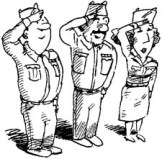 Jordan: “Nope. Just regular guys like me. I don’t recall many of us being really gung-ho, rah-rah types. We were in the Army doing our time.”
Greenie: “What’s the difference in the military now?”
Jordan: “The all-volunteer military has resulted in a mix of enlistees heavily weighted toward the rah-rah types. Some of the enlistees are truly dedicated and feel obligated to serve their country…”
JC: “…and the other enlistees like guns and want to do crazy stuff?”
Jordan: “That’s a good description for many people in today’s infantry – whether Army or Marines.”
 Greenie: “What about the SEALS and those Special Forces guys? Aren’t they really professional?”
Jordan: “They are extremely well trained…to kill. But whether they’re the right people for the military is an open question.”
JC: “Seriously? The SEALS and the special-forces guys seem so patriotic.”
Jordan: “A lot of them are patriotic. But let me tell you my experience the last few years with some members of the military. Of the three SEALS I know, one was a convicted felon – for running drugs, and not just a few drugs. The other two SEALS were brothers, who then became lawyers post military, and who then became extortionists.”
 Greenie: “Yikes. Not good. Know anyone else?”
Jordan: “The Special Forces guy stole hardware and very expensive software from a company I was consulting for…and had, what I surmise based on his comments, an illegal stash of firearms.”
JC: “Any other friends we should know about?”
Jordan: “Friends, hardly. A guy I helped fund for a business was a colonel in the Army Reserve. He got called up and low and behold sometime later I saw an article in the NY Times about a colonel in the Army being convicted of stealing at least $600,000 cash and shaking down military suppliers for cars and other goodies. Guess who it was?”
 Greenie: “Your pal? Well, your something or other. But let’s be fair. You know some other guys in the military, right? I mean your top-gun buddy and some other guys in the group that designed those jet fighters.”
Jordan: “Yes, all those guys were top-notch and highly ethical. But my point is with an all-volunteer military there is a disproportionately high percentage of people who frankly should not be in the military. Without a draft, military recruiters find it difficult to fill quotas. As a result, the military accepts recruits that often are less than ideal.”
 Greenie: “So the quality of recruits is so-so. Let’s go back and talk about the big-dog generals…specifically General John Kelly. When chief of staff for Trump, Kelly claimed that military personnel were superior and the general population should, in effect, bow down to them.”
JC: “And, Jordan, you don’t buy that argument…if nothing else based on your own experience.”
Jordan: “You got it.”
 Greenie: “So do you think to make the culture of the military more like the US population as a whole, we should reinstitute conscription?”
Jordan: “Yes. Bring back the draft to help balance the military. Not a popular idea, I know, but necessary to avoid another Revenge Revolution. And now I feel conscripted to get another coffee.”
 Greenie: “You mean about the crab barrel?”
 Greenie: “Your question might be the answer?”
 Gelly: “The tribes experienced more than just moving. If I understood Wolf Man correctly, he said the tribes on the reservations…apparently for many years…were prohibited from practicing many of the customs and ceremonies central to the respective tribes.”
 Gelly: “If they built a new culture, would they still have a tribe?”
 Jordan: “And you have an example?”
 Jordan: “But why didn’t Indians keep their traditions…the glue…that held them together.”
 Greenie: “Yes, independency is a real word. And your point is well taken. Have we…the victors in the Indian Wars…so restricted the tribes that the original culture has been lost? By our own actions, have we destroyed one culture and replaced it with a culture of dependency? That’s a depressing thought.”
 Greenie: “Not finding the right balance between what part of a culture should melt in the US melting pot and what part of a culture should not melt might have larger impact on the cause of the Revenge Revolution than I first thought.”
 Wolf Man: “Met Gelly. Chatted with Greenie but never met her.”
 Greenie: “One of the first steps is trying to understand how much of a particular culture has melted into the US melting pot…and also understand how much should not have melted. We’d like your perspective on how much culture of Native Americans has melted into the US melting pot.”
 Gelly: “And what different about the white man’s perspective?”
 Wolf Man: “Simple. The white man took the best land from the natives and then created reservations for natives on crappy land. The reservations had few resources, lots of bad water and created an environment of marginal subsistence.”
 Jordan: “So we, societal we, basically turned the tribes from being self-sustaining to being a welfare state, save a few tribes with highly profitable casinos. That analysis seems like such an exaggeration.”
 Jordan: “That’s a bold statement. Is there any way to turn this around? Might be a long process but surely something can be done.”
 Jordan: “I’m shaking my head. Wow, what a problem. Is there anything that can be done to change this attitude?”
 Greenie: “Jordan, while Gelly and I were getting coffee did you get ahold of Rock Man and Two Dogs?”
 Jordan: “Point well taken, Greenie. Lots of pressure at an early age to learn something that’s very difficult for many. The experience begins to build a foundation for a willingness to try to learn difficult subjects through one’s formal education…and for many, a lifetime of learning.”
 Jordan: “Gelly, here’s a story that illustrates the point. The scene: the inauguration of the first Jewish president. A lady turns to the president-elect’s mother and says, ‘The first Jewish president. You must be very proud of your son.’ The mother turns and says, ‘Yes, I’m very proud of him…but you should meet his brother, the doctor.’”
 Greenie: “To me, the link is an understanding by many rabbis and many Jewish families that education has been and continues to be a way to break from the past. Much like leaving Egypt was a way for Jews to break away from physical slavery, education has been a way to break away from economic slavery.”
 Gelly: “That’s interesting. So, if I interpret you correctly, understanding how to break away from adverse circumstances without completely throwing out the old culture is a key lesson. In a way the lesson is a balancing act — in the US understanding what part of the culture should melt into the melting pot and what should not melt. Being able to create such a balance might be a key lesson for other groups – blacks, Native Americans, etc.”
 Greenie: When you talk to them, could you please remind each of them we are only in the data-gathering phase? Let them know we are trying to determine if our assumption has any validity. If it does, we’ll need more guidance from them and help from some of their contacts. I just don’t want them to think the call is the end of the study. It’s just the beginning.”
 usrevolution5