• Home
  • Booklets/Grouped Entries
  • Tech Tsunami
  • List of Entries to Date
  • About the Author

usrevolution5

~ USA Headed for a 5th Revolution! Why?

usrevolution5

Category Archives: Economics

#374 Trump Incompetent’s Club Squared

08 Sunday Mar 2020

Posted by Jordan Abel in Causes of the Revolution, Economics, Societal Issues, Stupid Is as Stupid Does

≈ 1 Comment

Readers: this blog is set in the future (sometime after the year 2020). Each entry assumes there has been a 5th revolution in the US — the Revenge Revolution. More about the Revenge Revolution, a list of earlier revolutions and the author, Entry #1.

Periodically I write a “sense check” to assess whether in the next few years, a revolution in the US is still possible or whether the entire exercise is based on a statistical aberration — i.e., a roughly 50-year cycle between major upheavals in the US.  Most recent sense check, Entry #365.  

Some of the entries are part of a series.  Several series are available as easy-to-read booklets for download:

  • Working with Lee Iacocca after he left Chrysler, 2019Q3 Iacocca Personal Observations. 
  • GM EV1 — behind-the-scenes events affecting development and introduction of the GM EV1, the first modern electric vehicle. 2020Q1 GM EV-1 Story Behind the Story Booklet
  • Coming technology tsunami and the implications for the US, Tech Tsunami Booklet with Supplement
  • Trump Supporters Brainwashed? A series discussing why Republics have abandoned basic principals, Are Trump Republicans Brainwashed 2020Q1
  • Who took out the Donald?  Who/what groups are most likely to “take out” Trump? Who Took Out the Donald Entries with Update
  • Revenge Revolution — description of what form the revolution might take, 20 01 07 Start of Revolution

ENTRY #374 BEGINS: The theme of this blog is a revolution of some form in the US seems likely within a few years after 2020. In the various entries, I’ve tried to cite factors that could contribute to a revolution.

Last week’s entry was titled “Where Do We Go from Here?” and attempted to outline some of the public confusion and angst created by actions of the Trump administration in dealing with the coronavirus outbreak. But how could it get any worse?

Well, this past week the ineptness of the Trump administration ratcheted up several notches the public confusion and angst about the virus. Apparently what’s not clear to the Trump administration is no one is blaming Trump for the outbreak. What’s causing great frustration among most sectors of the population is how the Trump administration is handling efforts to diagnose and contain the spread of the virus.

And who’s the primary source of the confusion and inept management? None other than the Donald himself.

In crisis situations, people’s strengths and weaknesses tend to get magnified. One of Trump’s personality flaws is fear of being criticized. To help get around that flaw, Trump became a compulsive liar. The lying was his regular MO in the real estate business and has continued as president. He lies regularly on tv/radio and in public forums. Based on a mountain of examples, Trump seems to make erroneous statements, aka lies, whenever he needs to reinforce his own behavior or deflect potential criticism.

Specific to the coronavirus, within the past week Trump claimed 1,000,000 test kits would be available by the end of the week. He also claimed that a vaccine preventing the coronavirus would be developed and available in a couple of months.

Both those claims were intended to demonstrate to the public how actions by the Trump administration were mitigating the effects of the virus. However, both claims were patently false.

Increasing production and distribution of test kits will take weeks, if not months. Further, testing capabilities in some areas of the US is extremely limited. Arkansas, for example, has lab capacity limited to testing only 6-10 cases per day. Additional tests will need to be sent elsewhere for processing, further delaying results. As of March 6, there was no central location for labs and/or doctors to report the number of cases detected.

As far as the vaccine, a doctor at CDC noted it would be a minimum 18-24 months for development of the vaccine. In addition to development time, additional time would be required for distribution, then inoculation and finally time for the body to incorporate the vaccine. The “normal” flu vaccine, for example, takes about two weeks to become effective.

While some of the population might continue to believe Trump and the Coronavirus Czar VP Mike Pence – “You can fool some of the people all the time…” – an ever-increasing percentage of the population is becoming more concerned about the ineffectual efforts to control spread of the virus. The lying by Trump, Pence et al, further erodes confidence in the government’s capabilities. Loss of confidence in government is a major contributor to revolutions regardless of country.

The lack of honesty by the Trump Administration has created uncertainty among investors. In the past month stock process have gyrated with all major stock indexes having declined at least 10%, and more declines likely.

So what? Why would activity on Wall Street contribute to the Revenge Revolution? In today’s workforce, few people have defined benefit programs paid for by their employer. As a result, workers must rely on building their own retirement savings. A substantial portion of retirement savings is invested in stocks. When markets decline sharply, as we’ve seen the last few weeks and may see for some time, people become anxious and disenchanted.

In addition to concerns of individual investors, a problem not well understood by the public is lurking on the sidelines. The problem has been caused by the Trump administration’s fiscal policy, specifically the 2017 tax cut, and pressure on the Federal Reserve to keep interest rates low. The ballooning deficit and the already low interest rates have reduced options available to the Federal Reserve to help counter any economic slowdown.

Trump can blame anyone or any group he wants. However, when the economy declines and jobs are lost, and the population has little confidence in the government, the chances increase for some type of revolution.

With some luck, voters will replace Trump in November 2020. What we won’t know, even with a new president, is whether damage to the credibility of the government caused by Trump’s mismanagement of the coronavirus as well as mismanagement of many other situations is too extensive to repair sufficiently before a segment of the populous revolts in some way and we have a revolution – the Revenge Revolution.

#340 Abbott Awards Costello the Presidential Medal of Freedom

23 Sunday Jun 2019

Posted by Jordan Abel in Economics, Gov't Policy, Societal Issues, Stupid Is as Stupid Does, Uncategorized

≈ Leave a comment

Readers: this blog is set in the future (sometime after the year 2020). Each entry assumes there has been a 5th revolution in the US — the Revenge Revolution. More about the Revenge Revolution, a list of earlier revolutions and the author, Entry #1.

Periodically I write a “sense check” to assess whether in the next few years, a revolution in the US is still possible or whether the entire exercise is based on a statistical aberration — i.e., a roughly 50-year cycle between major upheavals in the US.  Most recent sense check, Entry #332.  

Begin Entry #340.  Somewhat buried in this past week’s news was that Bud Abbott awarded Lou Costello the Presidential Medal of Freedom. Well, okay, it wasn’t really Abbott and Costello, but it might as well have been.

The actual players were Donald Trump and Arthur Laffer. If you don’t follow the players in the field of economics, you might not recognize the name Laffer. In the mid-1970s, Arthur Laffer, then working in the Nixon/Ford Administration, but previously a member of the faculty at University of Chicago, outlined for Messrs. Rumsfeld and Cheney (the same two as in the Bush 43 administration) a curve to illustrate the theory that government revenues could be maximized at certain marginal tax rates.

According to Laffer, too high a marginal income tax rate would be a disincentive for people to work and/or invest and tax revenues would fall. If the margin tax rate were too high, then lowering the tax rate would result in the economy expanding with overall tax revenues increasing despite the lower maximum rate.

The Laffer Theory, commonly referenced as the Laffer Curve, was cited as justification for large cuts in tax rates under Presidents Reagan, Bush 43, and Trump. In fairness to Laffer, his theory, which had been discussed earlier by other economists, could be true where a country had exceptionally high tax rates – although too high a tax rate has never been defined – and there was no compelling societal need justifying the higher rates.

Laffer’s Theory should also be considered the foundation for what is known as “trickle-down economics.” However logical Laffer’s theory and “trickle-down economics” might seem, to my knowledge there is no empirical evidence demonstrating the theory is correct.

In the 1950s, for example, maximum marginal income tax rates in the US were 70%. Yet during the 1950’s the labor-force participation rate was very high and the economy was strong. One might argue – and I think fairly – that the very high marginal tax rates were justified by a societal need. The US needed to pay down some of the enormous debt the US incurred during WWII.

More recent tests of Laffer’s theory include the Reagan, Bush 43 and Trump Administrations. What happened to government revenues when the Laffer Curve was used to justify lowering income tax rates in each of those administrations? The economy grew some but income taxes remitted to the Federal government never increased enough to offset the rate cuts. The result was a sharp increase in the Federal debt, both nominally and as a percent of GDP.

The Laffer Theory has been tried in other venues. In 2012 the Republican governor of the State of Kansas, to whom Laffer was an advisor, convinced the legislators to reduce maximum marginal tax rates. The project result, according to Governor Brownback, would be a rapidly growing economy and enough additional revenue to the state to offset the reduced tax rates.

What happened was just the opposite. Like the experience of the Federal government, tax revenues in Kansas plunged. The difference between the State of Kansas and the Federal government is a critical one. Unlike Washington, the State of Kansas is constitutionally required to balance its budget and does not have a Treasury Department that can print money. The only alternative for Kansas was to raise taxes and substantially cut expenditures in such critical areas as education and infrastructure.

Bush 41 called “trickle-down economics” that emanated from the Laffer Curve, “voodoo economics.” The voodoo economics label seems to be widely shared among most well-respected economists, with more than 95% of professional economists rejecting the Laffer Theory.

So why did Laffer receive the Presidential Medal of Freedom? The president has wide discretion in awarding the medal. A recent recipient, for example, was the golfer Tiger Woods.

What struck me as comical was the Administration’s justification for selecting Laffer. The White House press release indicated Arthur Laffer was “…one of the most influential economists in American history.” (Maybe true but “influential” does not equate necessarily to being correct.) Adding to the comedy of the press release were remarks by Trump, who claimed to have studied Arthur Laffer’s theory for many years.

Seriously? Studied for many years? Trump is anything but a student. He’s repeatedly demonstrated an appalling lack of understanding of basics taught in economics 101. While the examples are numerous, a couple of recent economic headscratchers include his claim that tariffs are paid by the country of origin – i.e., tariffs on goods shipped from China are paid by the Chinese. No, Donald, the tariffs are paid by the residents of the receiving country. The receiving country is called the United States and the tariffs are effectively a tax on consumers.

Another head-scratching idea is that world trade must be a zero-sum game; therefore, the US should work toward having a trade surplus with most all, if not all, countries. If that were true, then nearly every country worldwide would make and consume its own products. If I’m not mistaken, Trump’s theory went out millennia ago.   Maybe Trump should study more about such people as say, Marco Polo. Somehow I think Marco Polo was in the international trading business.

What about Trump’s approach to increase US GDP over the long term? Roughly 2/3 of US GDP is driven by consumer consumption. If you don’t increase the number of consumers and/or increase consumption per capita, then GDP is not going to grow and it will gradually decline. As the population ages, consumption per capita decreases and the economy can stall or start to slide — just look at what happened to the Japanese economy beginning in the 1990’s. In the US, the declining birthrate among native-born citizens will result in lower potential GDP growth unless some fundamental changes are made.

One change to help ensure sustained economic growth could be to increase the pool of younger consumers. How does the US expand the pool? The government can’t force families to have more babies. So what about more Immigrants? Wouldn’t more immigrants help offset the declining birth rate?

According to the Trump Administration, the US should not allow more immigrants, especially those entering without visas. Moreover, according to Trump, even the number of legal immigrants should be reduced sharply.

Mmm, this economics game is not so simple. Maybe Trump should have attended economics class more often. Economics seems something like a teeter-totter. Somehow the two sides need to be balanced for the system to work.

What’s the takeaway from this blog entry? Most everyone, well most everyone except Trump’s hardcore supporters, acknowledges Trump is uneducated about many subjects and his decisions are often arbitrary and conflicting.

Maybe the purpose of this entry is allowing me – and I hope some of you – to vent frustration and anger at Trump with his gang of incompetents and enablers. For many years, I’ve studied economics and had jobs where applying economic theory was a key part of a critical decision. In many of those decisions, the financial well-being of numerous families was affected. In my view, and one seemingly shared by many others, Trump’s decisions about lowering income tax rates mostly for the wealthy, efforts to influence the Federal Reserve, restructuring immigration policy could harm significantly the potential for sustained economic growth in the US.

Now, I hope I’ve made the case for why I cringed when Trump awarded the Presidential Medal of Freedom to someone like Arthur Laffer. I cringed not because of Laffer. He had no hand in this decision. I cringed at the thought of what’s going to be the next incredibly stupid decision made by Trump that will have lasting negative consequences for US citizens.

We should all be concerned, regardless of political party. As for Abbott and Costello, my apologies to them for being drawn into the discussion. Unlike the Trump Administration, even Abbott and Costello figured out who was on first.

Post Entry Update: In the week following publishing Entry #340, Eli Broad (rhymes with road), a multi-billionaire, published an Op-Ed piece in the NYT outlining why taxes on the very wealthy should be raised.  Unlike Trump, Broad views a higher-tax rate for the wealthy as necessary to help begin eliminating the growing economic inequities in the US.  Link to comments, 19 06 26 NYT Eli Broad OpEd re Asking to Raise His Taxes.

Comments welcome, as always. Thanks for your time.


#336 Policies to Address Tech Tsunami. Socialism? No. National Security.

19 Sunday May 2019

Posted by Jordan Abel in Economics, Gov't Policy, Tech Tsunami

≈ Leave a comment

Readers: this blog is set in the future (sometime after the year 2020). Each entry assumes there has been a 5th revolution in the US — the Revenge Revolution. More about the Revenge Revolution, a list of earlier revolutions and the author, Entry #1.

Periodically I write a “sense check” to assess whether in the next few years, a revolution in the US is still possible or whether the entire exercise is based on a statistical aberration — i.e., a roughly 50-year cycle between major upheavals in the US.  With all that’s happened lately in Washington, I wrote a special sense check, Entry #332.

This entry is a “wrap” to the technology tsunami series, at least for a while.  The format for this entry is conversational.  The character, Sandy (comments in quotes) is an ardent Trump and NRA supporter who has appeared in previous entries.  Like virtually all the characters that appear in this blog, Sandy is patterned after someone I know with very similar characteristics. The entire technology tsunami series, including this entry is available as a eBook. (19 05 19 Tech Tsunami Booklet)

Sandy: “I don’t buy all this BS that some so-called technology tsunami could wreck the US economy. Stuff like that only happens in socialist countries. Look at what happened in Venezuela.”

True that Venezuela was the richest country in South America and then tanked economically. The reason they went into free fall was not becasue of socialism but because of bad economic policies.

“Hold on Bubba.  I’m telling you those kind of economic problems are what happens to all socialist countries. If you don’t believe me look at what happened to the economies of Cuba and to Russia. You know I’m right. Admit it.”

You are right that Cuba and Russia have suffered economically. But in the most diplomatic terms, you’re wrong about why. Let’s not confuse communism, which is more political, with socialism, which is more related to economic policy.

“Communism, socialism. They’re the same thing to me.  I know one thing for sure.  You can’t have all those socialist policies and still have a democracy.”

Like I said, let’s not confuse socialism and communism. There are many countries you might label as being socialist that are democracies. All the Nordic countries, for example, have many government-controlled social programs. Other countries in Europe, including Germany, have some degree of what you’re labeling as socialism. Even Canada. Yet, all those countries are democracies.

“Well, what about Greece? They had all those government programs and they went under. Italy almost went under. Call them what you want.  I’m telling you government programs are what causes these countries to go under.”

OK, then let’s add one more country to the list of countries that almost went under.  In fact, this country has come close to going under twice in the last hundred years. Want to guess which country?

“Probably a trick question. Who?”

The United States. We came within a hair’s breadth of the economy going into free fall in 1932 and 2008.

“I’ll tell you why. Because of the Democrats. They’re the problem. Democrats FDR and Obama were coming into office when the economy tanked. Democrats are always the problem.”

Could you please put away the Sean Hannity/Rush Limbaugh drivel and look at this issue objectively. Bad government policies under the Hoover and Bush 43 administrations created most of the problems. Notice that I said most of the problems, not all. If you want to later, we can discuss which economic policies were the primary causes. But for now, my point is without sound government policies to counteract the coming technology tsunami, the country is likely to be faced with another economic crisis.

“When you say crisis, are you suggesting unemployment could shoot up to 20 to 25% and real wages fall, just like during the Great Depression?”

Yes. If you don’t think technology can have a devastating impact, look at what’s happened to companies and employment in industries where disruptive technology was introduced.

“You mean like the coal industry? I hate to laugh but I understand even the Coal Mining Museum gets some electricity from solar panels on its roof. Anyway, technology and economics have killed the industry. Unemployment in the coal industry is what, maybe only 40-50% of what it was just 25-30 years ago?”

Now you understand why strategic planning and good government policy are so important?  I hope you also have somne appreciation of the risk associated with bad  government policy. Bad policy presents a real risk to the US economy and the country’s future as a democracy.

“Gee, I never looked at government policy quite that way. The real impact of government is not whether Democrats or Republicans are in power. The real impact is whether government makes policies that can sustain the well-being of the country.  And, you know what?  Overturning Roe v. Wade seems far less important than these other issues.”

Sandy, I’m proud of you.  If more people had your attitude, the country could start to make real progress in implementing policies to counteract the coming technology tsunami.

“I think I get it.  What you’re suggesting is not just more government intervention, but government intervention to avoid a economic catastrophe. Really, the need to address the coming tech tsunami is more a national security issue.”

Now, if only the Trump Administration and some key people in Congress would “get it” like Sandy.

#335 Curiouser and Curiouser

13 Monday May 2019

Posted by Jordan Abel in Causes of the Revolution, Economics, Education Issues, Societal Issues

≈ Leave a comment

Readers: this blog is set in the future (sometime after the year 2020). Each entry assumes there has been a 5th revolution in the US — the Revenge Revolution. More about the Revenge Revolution, a list of earlier revolutions and the author, Entry #1. 

Periodically I write a “sense check” to assess whether in the next few years, a revolution in the US is still possible or whether the entire exercise is based on a statistical aberration — i.e., a roughly 50-year cycle between major upheavals in the US.  With all that’s happened lately in Washington, I wrote a special sense check, Entry #332.

Have we, societal we, fallen down the rabbit hole? Have we lost our sense of direction? Have we lost our moral compass?

Over the last couple of months, most entries in this blog have focused on what I’ve characterized (as have others) as the coming technology tsunami. The entries describe the possible significant negative effect on the US economy of the tech tsunami and proposed solutions, the centerpiece of those solutions being more education. Education, however, not just for those currently in school but education for all age groups, even those in their 60’s. Education efforts would also include those who are, or have been unable to learn when taught using more traditional methods.

Many ideas suggested in the blog entries are not new. What’s changed is the urgency created by the oncoming technology tsunami. Like climate change, waiting until the impact is obvious to most everyone is too late. At that point the game for the US economy will be over. The fat lady will have sung…and done an encore. For the doubters, the tech tsunami is not some abstract idea or a tsunami that’s far-off shore. The water at the shoreline has started to recede and the need to take action is now.

Others share this view. Others also share the view that different approaches to education need to be tried. I was heartened by an article in the 05/12/19 New York Times  (19 05 12 NYT Teaching Math Like Football) suggesting math teachers should approach the classroom more like a football coach in the locker room. Hear, hear! Great idea. In grammar school and high-school, I was lucky enough to have a couple of “football-coach” math teachers. They challenged each student and tried to make learning math fun. The football-coach approach could be helpful to many students who do not “get math” taught using traditional approaches.

OK, what about a topic for this entry? When thinking about what to write, what kept running through my head was a simple question, “Why do educated people keep supporting a president whose actions, by US law, are clearly criminal (obstruction of justice and tax evasion are just two) and possibly treasonous?” “How can rational people overlook, let alone support such behavior?” (He even cheats at golf!)

And, the behavior is not sporadic. It’s a continuous stream. What is the latest from the Trumpland? Asking Rudy Giuliani, Trump’s personal lawyer, to go to the Ukraine and ask the Ukrainian president to try to dig up dirt on a family member of a candidate for Democratic nominee for president. Duh, Republican folks, that’s Trump asking yet another foreign country to meddle in a US election. When are Republicans going to wake up and realize where Trump’s allegiance lies? If you don’t know where to start looking, try his bank account.

Trump does not care about any Republicans, let alone members of the hardcore base. Let me repeat Trump does not care about any Republicans, let alone members of the hardcore base.

If you don’t believe me, then what about those tariffs on Chinese exports? Do you believe Trump’s tweets that the Chinese will pay the tab? Even Trump’s economic advisor won’t buy that outrageous claim. No, the tariffs per se might go to the Treasury but the prices of Chinese goods sold in the US will increase by the amount of the tariffs…and possibly more. And, yes, you get to pay for the tariff. Yet another economics class Trump skipped while in college.

“Hold on,” you say, “Chinese jobs making all those goods will come back to America. Trump is actually creating jobs. Trump is saving America! Wake up liberals.”

Okay, a few jobs might come back, but only a few. But how many more other jobs will be lost with China’s retaliatory tariffs on American exports (imports to the Chinese).

But then you say, “Didn’t Trump save thousands of jobs when he negotiated to have GM sell the Lordstown, OH plant to that other company? You know that Workhorse company?” Sorry to inform you, the answer again is “no.” Workhorse buying the Lordstown assembly plant (not a done deal as of this entry’s publication) created no net new jobs. Workhorse was merely looking for a facility to assemble a proposed electric-powered truck.

And the list of misconceptions, misunderstanding, sheer blindness by Republicans continues on and on and on. Even the Energizer Bunny is starting to get tired. The lack of a modicum of thinking by Republicans makes their behavior curiouser and curiouser. What’s the value to Republicans of supporting Trump? Trump’s in the White House for cash. What do Republicans get out of the deal?

When I hear a Republican gloat about supporting Trump, I ask a very simple question. ”Assume all the same policies, economic conditions, cabinet appointments, relationships with foreign countries, tweets, known lies, etc. Now assume Trump is not a Republican but a Democrat. Would you still be supporting Trump and/or be opposed to the investigation by the various committees in the House?” Count how many current Trump supporters say “Yes they would continue to support Trump if he were a Democrat.” If you can count more than a handful, let me know.

To be fair, you should ask some Democrats the same question. “Assume all the same policies, economic conditions, etc., would you still be so anti-Trump?” My guess is a much greater percentage of Democrats would continue to be anti-Trump and especially support the investigations in the House of Representatives.

So why do Republicans support Trump when so many of his policies are reversals of long-held Republican positions? Why have Republicans let Trump hijack their brain? As noted in several earlier blog entries, it seems that many Republicans have been brainwashed.

How can such a large group be brainwashed? If there’s one thing Trump is very good at doing, its manipulating people. Especially vulnerable are those with limited inner strength. Helping Trump with the brainwashing are the Republican talking heads – Limbaugh and Hannity in particular – who fill their air time not with questions and a discussion of possible solutions, but fill their air time with declarative statements of suggested attitudes and behavior. Kim Jung-un probably listens to “Fox News” for ideas how to brainwash North Korean citizens more effectively.

Other recent truly bizarre actions by Trump include declaring that executive privilege can apply retroactively to virtually any discussion of any action taken by anyone in the Trump Administration. Huh? Trump has also told Administration officials to ignore the law. And where are the voices of the righteous Constitutionalists Republican Senators? Save one or two, Republican Senators have contracted laryngitis while also sucking up to Trump.

The willingness to support a rogue and lawless president rather than the Constitution leaves me with only one conclusion. There needs to be a Revenge Revolution in the US in order to rid the country of the Trump cancer and bring the Republicans back to their senses. Let’s hope the 2020 election can accomplish the same thing but I’m not as hopeful.

One might not like the actions or style of certain Democratic leader, or proposed policies of certain Democrat candidates for president. Those disagreements are understandable and part of a democracy. What is not understandable is why Republicans are blaming Democrats for trying to uphold their obligations under the Constitution by investigating criminal behavior and possibly treason of the president, members of the president’s family, members/former cabinet members and people associated with the 2016 campaign.

Just in case you, and maybe Republicans in the Senate, need a reminder of the words contained in the oath for members of the House and Senate, “I do solemnly swear (or affirm) that I will support and defend the Constitution of the United States against all enemies, foreign and domestic; that I will bear true faith and allegiance to the same; that I take this obligation freely, without any mental reservation or purpose of evasion; and that I will well and faithfully discharge the duties of the office on which I am about to enter: So help me God.” (I can’t find where the oath mandates allegiance to the president, can you?)

#334 Could a Change in Semantics Break the Ideologue Logjam? More about Cost of Preparing for the Tech Tsunami.

05 Sunday May 2019

Posted by Jordan Abel in Economics, Education Issues, Gov't Policy, Societal Issues, Tech Tsunami

≈ Leave a comment

Readers: this blog is set in the future (sometime after the year 2020). Each entry assumes there has been a 5th revolution in the US — the Revenge Revolution. More about the Revenge Revolution, a list of earlier revolutions and the author, Entry #1. 

Periodically I write a “sense check” to assess whether in the next few years, a revolution in the US is still possible or whether the entire exercise is based on a statistical aberration — i.e., a roughly 50-year cycle between major upheavals in the US.  With all that’s happened lately in Washington, I wrote a special sense check, Entry #332.

This week’s Entry continues the series about preparing for the upcoming “technology tsunami” that will have a major impact on the US economy.  The series starts Entry #319. 

Arguments against society-wide programs – healthcare, education, climate change – claim that such programs are too expensive. Taxpayers cannot afford these programs.

There is a kernel of truth to that claim. Such programs have considerable start-up costs and the payback is often a few years out. Sometimes the payback is a decade or two later.

Of course, the idea of having delayed payback does not apply when the same “too expensive” group decides to make business or personal Investments. Nor does the logic apply when this group is evaluating the performance of coaches for favorite college or professional sports teams. Why coaches? Surely everyone knows it takes time to build a solid sports team. Give the coach at least five years to perform and demonstrate his or her worth.

More seriously, the question is, “Is society willing to take the risk of not investing in programs that will have a sustained, if delayed, return on investment? As an example of a similar personal-level decision is whether to delay needed maintenance on your house or car. Delaying can result in some immediate cash savings. However, the decision to delay is a two-edge sword. The repairs are needed and by waiting the severity and cost of repairs likely will be much higher. While delaying maintenance may seem to be a savings in the short-term, the decision to delay is not really savings at all, but additional cost. To paraphrase an old TV commercial, pay me now or pay me more later.

How does “pay me now or pay me more later” apply to the education of people who will be displaced by the technology tsunami? Let’s say the cost of educating those displaced averages $25,000 per person, roughly equal to 2 years cost of tuition, books and fees at a community college and even some state universities. In addition to the cost of education, let’s assume those being retrained receive a salary of about $50,000 per year. For the two years, the total cost for retraining would be about $125,000 per person.

The $125,000 cost per person seems extraordinarily high until one calculates the cost of not retraining. What is the cost not to retrain?

Assume the median age of the person being retrained is 45 years old, which means the person has 20 to 25 years left before retirement. Without retraining for the post technology-tsunami world, the person may be unemployable, and therefore, receive assistance for the next 25 years of his or her working career. In addition, the person would receive some form of assistance for another 10 to 15 years after reaching retirement age. Total time not working and receiving assistance…and not paying taxes? A total of 35-40 years.

If the person receives just $10,000 per year assistance, which is on the very low side, the cost of assistance for a person previously employed but now displaced, would be at least $400,000. Thus, the cost of not retraining is more than 3x the cost of 2-year training – tuition, fees, books and salary of $50,000 per year. Oops, we’re not finished. The person on assistance and not employed, would also not pay income taxes as well no withholding for FICA and no withholding for Medicare.

So which is smarter? Pay now to retrain the person displaced by the technology tsunami or pay more than 3x as much later (constant dollars) to have the person on assistance his or her entire life and never again paying income taxes or contributing to the cost of Social Security or Medicare?

The ROI to retrain workers is positive for workers in their 50’s and even early 60’s when all the costs are included. In addition to society saving money by retraining workers, having an employed workforce with more disposable income will increase consumer consumption, increase overall GDP and with some tweaks, to the tax structure, increase family wealth.

Despite the obvious benefits, for some reason “return on investment” does not yet seem to be part of most discussions about broad social programs, whether the discussion in Washington or in many state capitals. I am always personally baffled why Republicans focus on immediate cost and ignore “return on investment” logic for social programs, yet use the very same ROI logic for personal and/or business investment decisions. Guys, voters are not completely stupid. ROI is a concept that voters can understand.

To break the ideologue logjam, maybe such programs need to be positioned with Republicans as “business Investments” and not “social programs.” To mollify Republican critics of these programs, maybe recipients of the proposed technology-tsunami education program should be required to pay a minimum tax of say 1.0% of gross income per year for up to 10 years following completion of the retraining. The minimum tax would allow Republicans to claim assistance recipients have some “skin in the game.”

Democrats would do well to position technology-tsunami retraining, the Green New Deal, Medicare for all and other ideas, not as social programs, and especially not as “socialist programs,” but position as Investments that will help increase US GDP. Democrats should also agree that every wage-earner has to pay some income tax, even if it’s only $100 per year.

Some of the changes in positioning should be considered more semantic than substantive. However, the changes could allow Republicans and Democrats to claim some type of victory and begin to work more closely together. The changes would also thwart some of the statements by conservative talking heads implying that about half the population pays no tax. These talking heads only state “income tax” and make no mention of people paying sales tax, property taxes, fees and many other related taxes. (FYI, the percentage is remarkably flat by quartile of income paid for all types of taxes.)

Will the rhetoric change and Republicans and Democrats begin working together soon – at least agree to retrain workers to be displaced by the technology tsunami? Maybe start working together before the Revenge Revolution? As long as Trump is controlling the Republican Party, there is no hope. Republicans have demonstrated repeatedly a willingness to prostitute themselves for whatever the Donald demands, however contrary those demands are to long-held Republican principles.

Democrats, however, have a great opportunity for 2020 to begin repositioning arguments that many so-called “socialist programs” are really business Investments with positive ROI.

Should we be hopeful? Let’s see what happens. Stay tuned.


#333 Preparing for the Technology Tsunami: On-Going Education (12th in Series)

28 Sunday Apr 2019

Posted by Jordan Abel in Economics, Education Issues, Societal Issues, Tech Tsunami

≈ Leave a comment

Readers: this blog is set in the future (sometime after the year 2020). Each entry assumes there has been a 5th revolution in the US — the Revenge Revolution. More about the Revenge Revolution, a list of earlier revolutions and the author, Entry #1. 

Periodically I write a “sense check” to assess whether in the next few years, a revolution in the US is still possible or whether the entire exercise is based on a statistical aberration — i.e., a roughly 50-year cycle between major upheavals in the US.  With all that’s happened lately in Washington, I wrote a special sense check, Entry #332.

This week’s Entry continues the series about preparing for the upcoming “technology tsunami” that will have a major impact on the US economy.  The series starts Entry #319. 

The need for on-going education and training of workers is nothing new. Who’s been responsible in the past for such training? Until about the mid-1990’s or early 2000’s, the employing organization seemed to be the principal source of on-going training.

In some cases, employee training was done on the organization’s premises; in other cases, employees were encouraged to attend classes outside. Expenses for such classes usually were reimbursed by the organization. Based on my experience, mostly in manufacturing-based companies, the training seemed to focus on procedures and systems unique to that company.

What has changed within the companies in the last 20-25 years is how machines and support equipment operate. There is ever-growing integration of software programs to help manage all aspects of machine operation, movement of material and the flow of information.

While some features of the software programs might be unique to the organization, the fundamental components of a given software program, or suite of programs, are the same. Understanding the fundamentals of software programs has created two classes of workers:

  1. A group, generally younger, who are now more mobile. Because these workers understand the fundamentals of software, they can carry that knowledge to another organization and not face as steep learning curve, thereby contributing more quickly than workers in the past;
  2. A group, generally older, who were trained in the organization’s approach before many software programs were integrated into daily operations. These workers become far less mobile and, despite their experience, less valuable to the existing organization. The “reduced-value” phenomenon applies to both blue-collar and white-collar workers. Unfortunately, some of these “reduced-value” workers have 25 to 30 years remaining before retirement. This group will be the most negatively affected by the technology tsunami.

What does society do with existing “reduced-value” workers…and ideally implement plans to minimize the number of such workers in the future? Back to school! But, can you really teach an old dog, or a middle-age dog, new tricks?

The stumbling block for many of these workers seems to be never having learned basic math. While one does not need to know calculus to understand how to use computer programs effectively, one does need to know basic algebra. Programs are basically built are conditional statements – if A, then B, etc. Understanding the approach applies not only to Excel-type programs but word-processing programs as well.

What about people who just don’t “get” math, even basic addition and subtraction taught in grammar school? Obviously, not everyone learns the same way and not everyone is skilled at every subject. However, my guess is at least half the people who claim “not to get math” would “get it” if math were taught in a way more understandable to them.

Without having completed any formal research, I’ll bet there are at least three approaches used to teaching math. And one of those approaches probably will work on most people. So, for the “I-don’t-get-math” group, let’s take away the stigma of not understanding the traditional approach to teaching math, and try using the other approaches. Just visualize the smiles on faces when “I-don’t-get-math” students move to the “I-get-math” category.

Will all these students become math wizards? No, but once the basics are understood, we…societal we…might be shocked at how many in this group progress to basic algebra, and beyond.

What about people who despite different approaches to teaching, never “get” math? How do we prepare them for the tech tsunami? Or, what if someone just doesn’t want to learn?

A certain percentage of people won’t learn, and the consequences are the same whether one is unable to learn or chooses not to learn. The consequences in all likelihood will be a lower-paying service-type job. For those who try, but can’t learn, unfortunately the consequence are the same.

Any time society has been disrupted by technology — printing presses replacing scribes, machinery replacing farm hands, robots replacing assembly workers…and other examples – some people are left behind economically. While a society-funded safety net can provide some assistance, a large percentage of people in this category will fall several rungs on the economic ladder.

OK, you say, I’ll buy the argument that we should be training more workers for the tech tsunami. But who should pay for the training, much of which seems to be remedial? Why should taxpayers pay for the bill and let the companies off the hook? Shouldn’t companies that are laying off workers have an obligation to retrain these workers?

If one looks at other countries for guidance, many industrialized countries, especially in Europe, have laws that penalize, or even prevent companies from relocating or arbitrarily dismissing employees. The US has no such laws. As a result, companies are not penalized for relocating and leaving behind infrastructure installed specifically to help the company and/or leaving behind a loyal workforce with some skills that need updating.

In many states, North Carolina and South Carolina are but two examples, “economic development” is defined primarily as enticing other companies to relocate operations from the Midwest or Northeast to North Carolina or South Carolina. Incentives thrown at companies to relocate border on the ridiculous, but almost always include taxpayer-funded training for employees.

Yet the same “economic development” efforts often ignore, or even discourage, albeit possibly inadvertently, entrepreneurs from starting companies or offering no meaningful incentives to smaller company businesses trying to expand. If any incentives are offered to entrepreneurs, the “incentives” often consist of an “opportunity” to locate in some rehabbed building at a lower rent. While the reduced rent is nice public-relations strategy for politicians, most start-up businesses are starved for capital and capable key executives.

In the near-term, laws preventing companies from relocating and/or laws preventing states or cities from offering incentives for relocation are not likely to be implemented. Even if passed, there likely would be a drawn-out court challenge. A more effective approach to encourage existing companies to stay put might be to help the company analyze costs and determine if updating skills of employees and implementing other cost-reduction systems might be more effective than relocating, especially relocating operations outside the US.

Encouraging companies to stay put and retrain workers gain momentum in the next few years, especially as the technology tsunami becomes more apparent. While the US 2020 presidential election is 18 months away, many Democratic candidates seem to be discussing how to help rebuild the American middle class by leveraging new technology rather than the Trump approach of propping up industries on the decline – coal, e.g.

Programs to help update skills of existing workers could be very “hands-on,” akin to how many infrastructure projects were initiated in the 1930’s under New Deal WPA. Such national WPA-like programs are even more likely after the technology tsunami hits and/or after the country experiences the Revenge Revolution.

Programs to help mitigate the technology tsunami, programs to implement the evolving Green New Deal and other such ideas present a great opportunity for the US to create sustained economic growth. Sustained economic growth, however, can only be achieved with a high labor-force participation rate…and a high participation rate in a technology-tsunami world can be achieved only with an educated workforce.


#323 Turning Point and a Really Bad-Hair Week for the Donald

28 Monday Jan 2019

Posted by Jordan Abel in Economics, Gov't Policy, Possible Solutions, Societal Issues

≈ Leave a comment

Readers: this blog is set in the future (sometime after the year 2020). Each entry assumes there has been a 5th revolution in the US — the Revenge Revolution. More about the Revenge Revolution and author, How the 5th US Revolution Begins and About the Author.  Many entries are formatted as conversations. Occasionally I do a “sense check” about the likelihood of a Revenge Revolution.  Entry #318 is the most recent “sense check.”  One more note — sometimes I write about another topic that does not quite fit the theme of the blog.  Those comments are available on the page titled “JRD Thoughts and Comments.” 

Regular readers know I try to avoid getting hung up on daily/weekly events. The purpose of this blog is to analyze if and how long-term patterns might contribute to a post-2020 revolution in the US, aka the Revenge Revolution. However, events this past week seem to be beyond the usual “Beltway noise.” The week’s events could help change the trajectory of politics in Washington. “C’mon,” you say. “A heady week but not that heady.” I think that heady. Read on.

Key events during the week: (i) Michael Cohen, Trump’s long-time lawyer and now convicted felon, proposed delaying his volunteer testimony before the House Oversight Committee. One day after the announced delay, the House Intelligence Committee issued a summons for Cohen to appear; (ii) Roger Stone, long-time associate of Trump’s and known dirty trickster for approaching 50 years, was arrested on a number of charges related to the 2016 presidential campaign. More charges are expected; (iii) Trump and Senate Majority Leader Mitch McConnell caved and agreed to end the government shutdown of more than 35 days; (iv) Rudy Giuliani’s continued to disclose suspicious events previously denied. In addition to Rudy’s babbling, an article in the New York Times indicated one or more members of the Trump campaign met with the Russians at least 100 times before inauguration.

A fifth, less publicized event, was the appearance of Paul Manafort, Trump’s 2016 campaign chair, at a hearing to determine if an additional 10 years should be added to Manafort’ s existing prison sentence. The prosecution charged that Manafort intentionally withheld relevant information about sharing data with the Russians. The judge delayed the decision.

The events, if considered individually are interesting, but not necessarily significant. When combined the events, at least in my view, represent a major shift in power in Washington. The federal government is no longer controlled by the Bully-in-the-Oval-Office as Republicans in the House and Senate cowered. Power in Washington took a turn back toward the people.

As a result of pressure from constituents and some Republican senators, Mitch McConnell came out of hiding and convinced Trump that he should agree to reopen the government. The House and Senate then passed bills and Trump signed…with no guarantee there would be a wall at the southern border. While the agreement to open is limited to three weeks…and despite Trump’s huffing and puffing and threats to blow the house down if he doesn’t get his wall…pressure from constituents likely will prevent another shutdown

How do these events tie together? The key seems to be Republicans in the Senate are starting to show some backbone. Until a few weeks ago, Trump had free reign to do whatever he wanted. He felt immune from impeachment because of a Republican controlled House and Senate. Well, no more and no doubt this week Trump felt the noose tighten around his neck.

Start with Cohen. When testifying Cohen has nothing to lose and everything to gain by telling all. There’s a chance Mueller et al will again recommend a shorter sentence. Based on comments from several members of the committee, as much of Cohen’s testimony as possible will be made public.

Next we have Roger Stone. While defiant after his arrest and claiming loyalty to Trump, Stone may end up behaving like many of Trump associates already indicted as a result of the Muller probe – and flip. When the reality of a likely long prison sentence sets in – and for Stone it effectively could be a life sentence according to several former Federal prosecutors – Stone may drop the “never-tell-on-Trump” boast and decide saving the Donald is less important than trying to save his personal life.

The arrest of Stone leaves but a few people in Trump’s inner-circle not indicted. Steve Bannon may be next on Mueller’s list. Bannon will be quickly discredited by Trump, providing incentive for Bannon to flip – if he hasn’t already. The group remaining to be indicted is all in Trump’s family. Junior and Jared look like shoe-in’s for an indictment. And the odds for Ivana are better than 50:50.

So, who in the family might flip? If you’re a Trump family member, covering up for the Donald is high risk. When all the dust settles, especially after investigations and prosecutions by the Southern District of NY, the State of NY, and the IRS…along with a likely plethora of civil suits by condo owners, contractors, etc…there likely won’t be any money left in the Trump piggy bank.

So, if I’m a family member, let me consider my alternatives. If I refuse to cooperate with Muller, I go to jail and when a get out, I’ll probably get little or no money. Or, I can cooperate with Mueller et al and maybe avoid jail time. Mmm, which one should I choose?

As far as Trump, he’s acting like most bullies. When confronted with a tough opponent, the bluster goes away and the bully caves. And for Trump-the-Bully, his nemesis is not some physical tough guy. His nemesis is an older woman (by a few years) who’s raised five (5) kids. The past few weeks Nancy Pelosi treated Trump the same way she probably treated one of her kids, when a two-year old and throwing a tantrum. She hung tough and the kid folded.

What may be the final mental straw for Trump, however, the adoring, brain-washed base of supporters is shrinking. The 35-day government shutdown started shedding light on how Trump was willing to screw over the working class to save face over a physical wall. Many people now understand a Trump-style wall would do significant harm to the environment and offer little protection against illegal immigration and shipments of illegal drugs. Based on reports I’ve read, 85-90% of the illicit drugs enter the US through monitored ports of entry.

While the information from Mueller probe could…and probably should…lead to impeachment proceedings, Trump also faces another hurdle that seems to trump (pun intended) most presidents seeking re-election – “It’s the economy, stupid.”

The US has experienced an exceptionally long period of economic growth. The growth started under president Obama following efforts through the Federal Reserve to kick-start the economy following the financial crisis at the end of the Bush Administration. While the current economy appears strong based on certain indicators – unemployment rate and some increases in wages, e.g. – there are many soft spots.

The problem facing the Trump Administration is how to counter an economic downturn. Normally, monetary policy is the first step – the Federal Reserve lowers interest rates to stimulate borrowing and investment. This option is almost off the table since interest rates remain near historic lows. Fiscal policy follows with an increase in government spending (and the deficit) for such high-employment projects as road building/repairs. Oops, the deficit is climbing while the economy is strong so this is a limited option. Why is the deficit climbing? Because of the Trump tax cut. (I’ll save a longer discussion on the economy for another entry.)

There is a solution. While the solution is an enigma to current Trump Republicans, I have a feeling that over the next few years many of these Republicans will support the solution. What can be done? Raise taxes and redistribute income through a number of different means. And no, the approach isn’t classic socialism. The approach is called Keynesian economics. If you don’t think it works and is necessary for a stable society, then ask your parents or grandparents to tell family stories about what life was like during the Great Depression. If no one in the family has stories, then there are lots of books and movies. I’m not suggesting we’re headed for another Great Depression but there are few options left for countering a recession. (And, FYI, higher taxes did not slow growth in the 1990’s under president Clinton or in the 1950’s under Eisenhower.)

So, what does the Donald do? In the face of all the problems, he resigns to avoid being indicted. Remember, the Donald is a bully. Bullies cut and run when faced with a difficult situation. Even if he doesn’t resign, he doesn’t seek reelection…maybe because his bone spurs start to act up.

What about the Revenge Revolution? Still going to happen or will these events prevent it? Still going to happen. There’s a group that supported Trump that still feels screwed. First they felt screwed by the establishment and now screwed by Trump. If the Democrats in the House can begin to pass legislation that will help mitigate some of the inequities, real and perceived, then there will be significant pressure on the Senate to support the legislation. Such legislation will help mitigate the intensity of the Revenge Revolution.

The Revenge Revolution will be more cultural, although expect some bloodshed. For reference think of the cultural changes in the 1960’s and early 1970’s. We’re going to see another sea-change in society. Lots of issues to address – managing contributions to climate change, reducing income inequity, improving public education for all ages, implementing universal medical care, and more. To get an idea of the changes ahead, all we have to do is look at the mix of incoming members of the House. That group is more like America’s future and that group is going to force the 5th US revolution and societal changes.

#319 Technology Tsunami Headed toward US Shores

01 Tuesday Jan 2019

Posted by Jordan Abel in Causes of the Revolution, Economics, Gov't Policy, Possible Solutions, Tech Tsunami

≈ 9 Comments

Readers: this blog is set in the future (sometime after the year 2020). Each entry assumes there has been a 5th revolution in the US — the Revenge Revolution. More about the Revenge Revolution and author, How the 5th US Revolution Begins and About the Author.  Many entries are formatted as conversations. Characters appear in a number of entries, with many entries building on previous conversations.  

Occasionally I do a “sense check” about the likelihood of a Revenge Revolution.  Entry #318 is the most recent “sense check.”  One more note — sometimes I write about another topic that does not quite fit the theme of the blog.  Those comments are available on the page titled “JRD Thoughts and Comments” as well as “Tech Tsunami”, which has more articles about how technology might affect US…and add a dimension to the Revenge Revolution.

Background to Technology Tsunami Series. Thought it might be worthwhile to take a break from all the craziness in Washington and discuss other issues that likely will contribute to the Revenge Revolution. A key issue that seems to be getting less attention than it deserves….maybe because of all the noise emanating from the Trump White House…is how the implementation of technology will change the family earnings structure in the US.

We’ve seen some of the changes already, with the reduction in manufacturing jobs and the stagnation of wages for a large segment of the population. In my view the changes so far are just a small taste of what is to come. The next several blog entries…and I don’t know how many at this point…will focus on what I’m labeling the coming “technology tsunami.” The first of the entries, which follows, is a bit long but tries to set the stage.

There are already numerous early warning signs of the tsunami. An example – the announcement by General Motors in November 2018 of its intent to close five (5) plants in North America. Another warning sign is a story in the New York Times about a robotic arm playing the piano. While a robot playing a piano may seem like a bit of a novelty, think about the implications. The more dexterous robots become, the more robots can perform tasks of people who are highly skilled. Robots in warehouses and welding or painting in cars/trucks are commonplace. Those tasks are fairly straight forward compared to cooking or performing surgery or a host of other tasks.

As noted in this entry, over the centuries societies have coped with implementation of new technologies. Some societies have adopted new technologies and succeeded; others did not adopt new technologies and fell behind.  An example — in 1910, GDP per capita in Argentina was about 80% of US GDP per capita.  By 2010, 100 years later, GDP per capita in Argentina had fallen to about 30% of US GDP per capita.

Adopting successfully is very difficult. There are a couple of interesting books about adopting new technologies that we’ll discuss in a later entry. For now let’s get started. As you read, keep in mind how the disruption caused by adopting new technologies might compound societal problems currently facing the US. Numerous factors point to another revolution in the US – the technology tsunami could accelerate the Revenge Revolution and make it worse. And, yes, Mrs. Lincoln, enjoy the play.

Entry Begins

After General Motors announced plans to close five (5) plants in North America (November 2018), I was asked by several friends and colleagues for my opinion of the merits of the decision. While I had no inside information, based on my experience at GM and additional analysis, I concluded GM made the correct decision and should be congratulated.

To explain my logic in more detail, I wrote a couple of informal articles and published links on Facebook. The articles included the term “technology tsunami,” which I thought might help explain some of GM’s rationale for closing the plants…and why GM’s decision might portend what’s ahead for other companies. (GM had additional reasons for the closings. Links to articles on Tech Tsunami page.)

Reaction to the term “technology tsunami” seemed to beg for more explanation. So, here goes. I selected the term “technology tsunami” because the characteristics of a tsunami seemed to be a good proxy for how the wave of artificial intelligence (AI), increased use of robots, implementation of the blockchain, and other technologies will affect employment in the US. The effect will not be limited to the manufacturing and some service sectors but include many white-collar professionals (GM, for example, laid off more salaried  white-collar staff, than hourly manufacturing workers.)

First let’s look at the sequence of a tsunami. The start is often an earthquake or volcanic eruption deep in the ocean. The energy from that quake is transferred in the form of a series of powerful ocean waves. In the open ocean, the change in the wave pattern caused by the earthquake is not necessarily apparent. To the naked eye, tsunami waves appear relatively normal.

The strength of the waves becomes more apparent as waves move closer to shore. As the waves start to come ashore, the waves are compressed. The more gradual the slope of the shoreline, the more compression.

And there is not just one wave that is compressed and hits the shore, but a series of waves. The waves are powerful and of such height that virtually everything at or near the shoreline is completely destroyed. The waves continue inland, causing significant damage. A tsunami usually is more powerful and destructive than the surge associated with a hurricane.

An usual characteristic of a tsunami is how it affects the waterline preceding its arrival. As the tsunami gets closer to shore, the water at shore’s edge recedes. The shoreline looks as if there is an exaggerated low tide. This phenomenon might last several minutes. Then, the waterline changes quickly and drastically as repeated high and powerful waves come ashore, destroying virtually everything.

With that picture in mind, let’s examine how a technology tsunami might affect employment in the US. In my view, the earthquake has already occurred that will cause the technology tsunami. The energy from that quake has been transferred to form of a series of large and destructive waves. And those waves are headed toward the US shore. Warning signs of the tsunami are becoming more evident at the shoreline as the waterline has begun receding.

The US shoreline is filled with people. Many at the shore still work in manufacturing and service industries. However, few at the shore seem to understand the implication of the receding water line and even fewer take action to avoid the pending disaster. As the waves roll closer to shore, the beach remains filled with people.

In the next few moments – for this analysis consider next “few moments” as next “few years” – the pending disaster becomes apparent. The waterline begins moving ashore rapidly as the first of a series of giant waves becomes visible. The people at the shore – those with limited education and skills – try to escape, but it is too late and waves overwhelm them.

The powerful waves continue inland, destroying many long-standing structures, once thought invincible. Much is lost and chaos ensues for those who survive.

Am I overreacting to the potential impact of a technology tsunami? Is a technology tsunami even possible? Or, as a couple of people have suggested, am I being like “Chicken Little”?

My concern about a technology tsunami has less to do with whether AI will become smarter than humans and more to do with the potential impact on the stability of society. How many lower-skilled, semi-skilled and even skilled blue and white-collar jobs will technology replace?

Trying to stop implementation of technology is foolhardy. Depending on when such a stop-technology approach was implemented, today we might be travelling by horse and buggy and living without electricity, telephones, tv/radio, computers, internet, etc.

And yes, I agree that societies have survived major technology disruptions in the past. But transitions to new technologies have rarely, if ever, been smooth. Even worse, countries that did not transition to new technologies became also-rans.

During the technology tsunami, what is likely to happen to societal stability in the US? How will people react who are replaced by technology? As middle-class jobs continue to be eliminated…and many new jobs are at lower pay, if available at all…will people sit idly by? (When formulating your answer don’t be misled by the unemployment rates in recent months. Look at constant-dollar median incomes over time compared to GDP per capital. Income has not kept up with productivity. Also significant wealth has transferred toward the very top. The longer-term trend is a much smaller middle class with less wealth accumulation.)

If a technology tsunami seems possible, then what are we…societal we…doing to prevent a likely social upheaval that follows the tsunami? As best I can tell, we are doing nothing of substance. Policies of the Trump Administration seem to be focused on preventing adoption and even overturning technology rather than planning how to manage the transition.

In a way, the logic for why we should prepare for a technology tsunami is similar to the logic of why we should make efforts to prevent further global warming. Who’s right about the cause of accelerated global warming does not matter. If global-warming deniers are correct and man has contributed virtually nothing to global warming, the consequences are the same…and the consequences are not good. By doing something, then there’s a chance to reduce the negative effects.

Since we have a good idea of the effect of a technology tsunami, how do we start preparing? Maybe the first step should be to look at the 1930’s. In response to widespread unemployment (at least 25%), reduced net worth among most families, and no clear prospect for an economic turnaround, FDR and Congress implemented programs to create jobs. Creating jobs had a twofold effect: (i) putting money into people’s pockets so they could begin buying again; (ii) allowing families to regain self-respect.

One can argue about the efficacy of specific New Deal programs. However, there should be little argument that these programs helped bring stability back to US society.
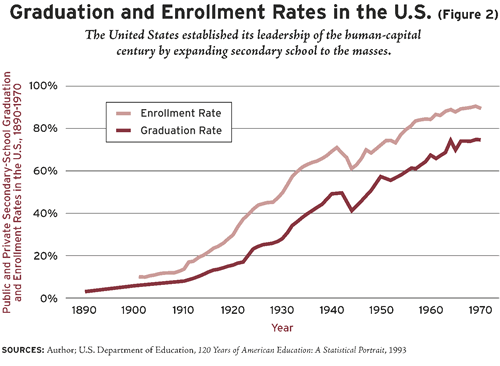
Part of the New Deal not often discussed is the effort to increase participation in public education. During the 1930’s, many grammar and high schools were built and students encouraged to complete high school.

The efforts resulted in a sharp increase in the percentage of the population graduating from high school. The increase in percent graduating from high school continued until the 1970’s when the rates plateaued.[1]

Emphasis on education continued after WWII with the GI Bill of Rights and then with availability of low-cost loans encouraging more students from lower- and middle-income families to attend college.

The lesson of these programs for today? Existing and emerging technologies require more math/analytical skills to utilize capabilities of the technologies. With the need for more math/analytic skills…and the risk of becoming an also-ran country by not adopting the technologies…what actions do we take? How does US society get more people educated, especially those on the shore unaware of the pending technology tsunami?

Following are some ideas. You’ll likely look at the list and say, “What’s so innovative about the list? I’ve heard these ideas before.” And, you’re right. The ideas are not new…but you know what? We’re not implementing them, and in some cases we seem to be regressing.

The list is intended to start the discussion:

  1. Help society understand that expenses for public education are investments, not merely costs. Investments may take time to payback but result in a benefit that spans generations.
  2. Increase pay for…and respect for teachers. Make the qualifications and salaries for teachers competitive with, and possibly slightly above, the private sector.
  3. Reinstitute more technical training in high schools. Almost everyone agrees not everyone is suited for college. Not attending college does not mean one does not have valuable skills. Far from it. The public schools should provide everyone an opportunity for training in how to use, leverage and maintain technology skills. At one time “technical training” was common in high schools. Time for it to return.
  4. Make loans for college affordable with a provision to “earn-out” the loan over a reasonable period. Unlike today, make compliance for the earn-out provision easy to understand and execute. Provide assistance to the participant – not everyone is an expert at filling out government paperwork. Encourage people to become teachers. Don’t discourage them with onerous penalties for slight mistakes in completing paperwork.
  5. Cut back, or eliminate private charter schools. Yes, all organizations need fixing over time. Public education is no exception. But charter schools are not necessary to fix problems in public education. Charter schools destroy the very foundation of public education…and operate with far less accountability. The trend toward charters needs to stop and charters eliminated.
  6. Create meaningful education programs for older workers. The claim by some that “I’m too old to learn” is an excuse, not a reason. My experience has been many older people are embarrassed to ask for help. When assistance is framed the right way, it is rare that someone turns down the opportunity to learn. We…again societal we…need to be flexible in how we approach teaching students, whether the student prospect is in grammar school or a grandparent.
  7. Implement meaningful education programs and works-skills programs in prisons. Incarceration is incredibly expensive. While different studies include different amounts for overhead and other costs, the least amount of cost per year to incarcerate someone is roughly the same as tuition, room and board at a state university. In many studies, the cost is multiples higher than tuition, room and board. Incarceration without rehabilitation is wasted money. Educating prisoners and having prisoners do meaningful work while incarcerated seems to be “common sense.”

How do we implement some of these ideas? More in the next article. Stay tuned.

[1] 120 Years of American Education: a Statistical Portrait, US Department of Education, 1993.

Links to articles re GM Plant Closings

  • JRD Reaction to GM’s Announced Plant Closings
  • GM Plant Closings Tsunami Canary

#315 How Technology-Induced Disruptions Impact Societies (#4 in Series)

23 Friday Nov 2018

Posted by Jordan Abel in Economics, Gov't Policy, Societal Issues

≈ Leave a comment

Readers: this blog is set in the future (sometime after the year 2020). Each entry assumes there has been a 5th revolution in the US — the Revenge Revolution. More about the Revenge Revolution and author, Entry #1.  Most entries are formatted as conversations. Characters appear in a number of entries, with many entries building on previous conversations.

Occasionally I do a “sense check.”  Auditing one’s own work is problematic but I try to be objective.  Entries #300 and #301 are the most recent standard “sense checks.”   Entries (#310-#313) broke from conversation format.  

Scene: Jordan’s office, Washington, DC.  Continuing conversation with Gelly, Jordan’s assistant.  Conversation began Entry #308.

Jordan: “OK, Gelly, got my coffee refill. Ready to talk more about how societies cope with technology-induced disruptions?”

Gelly: “Yes, but as a reminder, keep it simple, please. I’m just trying to understand the basics. Not trying to become a PhD candidate.”

Jordan: “Not to worry. Besides, I’m not a PhD.”

092615_2031_Characters7.gifGelly: “Maybe not but you have lots of study time…and a bunch of experience in the real world using economics stuff. Remember, KISS, okay?”

Jordan: “Let’s go back and look at how artificial intelligence (AI) is being used. Another example is your iPhone. Ask Siri a question.”

Gelly: “Siri has artificial intelligence?  And I thought she lived in my iPhone. OK, ‘Hey, Siri, what was the score of last week’s Michigan-Indiana football game?’”

MichiganJordan: “When Siri tells you Michigan beat Indiana, that’s a form of AI.”

Gelly: “I understand that part…I think. Siri hears the question, does a quick search of available databases, finds the answer, and then repeats the score. That easy enough to understand. Not saying easy to make happen, just easy to understand.”

Jordan: “You’re right, not easy to make happen. Now ask Siri to tell you a joke.”

Confused Clip ArtGelly: “How does she do that?”

Jordan: “When the question is more abstract, like ‘Tell me a joke,’ it’s the same procedure as looking for the score of the football game. However, for more abstract questions, sometimes the answer is reasonable and sometimes the answer is off the wall. Remember that AI is more effective when parameters of the task are defined. The Michigan-Indiana score is quite specific. So is picking up boxes, which we talked about earlier. Accuracy of AI also improves as more information is added to the database and algorithms refined.”

PhoneGelly: “So for Siri, Alexa and their siblings, they’re best at providing quick access to available information. At the same time, the working stiffs most affected by Siri and siblings are people employed to provide information. The example might seem a bit  dated but as a kid I remember being able to pick up the phone and have the operator get someone’s number, right?”

Jordan: “Right. Another example is society’s need for newspapers. For a couple of centuries newspapers were a primary source of information for all kinds of activities. People used to buy a paper for say just the sports section. That need has changed. Siri just told you the score of the Michigan-Indiana game. And, if you wanted, you could get real-time updates on your smart phone. Even if the game is not broadcast in your viewing area, you can ge an app on your phone to watch the highlights of the game and a bunch of other games as well.”

Legal ClerkGelly: “What about AI replacing some functions of what lawyers do, or at least law clerks do? Same with some portion of information gathered when visiting a doctor. Seems as if a lot of people could be replaced, or maybe have been replaced already by some form of Siri and siblings. What about using AI for tasks that are a lot more complicated than say picking up boxes or searching a database?”

Jordan: “You mean like people who used to paint cars or weld frames or even lay bricks being replaced by robots?”

Gelly: “Yes, but also tasks that seems even more complicated…like sewing clothes. You might not appreciate it but there are lots of steps in sewing. Lots of turning fabric and moving it back-and-forth. Making even simple clothes requires a lot of steps and precise hand-eye coordination. It’s not easy.”

Sewing MachineJordan: “Well, some clothes are already being made 100% or nearly 100% by machines. And over time, machines will make clothes that require more steps.”

Gelly: “That’s what I still don’t understand. What does happen to all those people in low-cost countries that are making clothes? If they lose their jobs, what happens? By the way, has anyone ever studies what happened to all those telephone operators, or guys that were painting cars?”

Jordan: “Your concern is spot on. What does happen? Unfortunately, the people who are most negatively affected by a disruptive technology, AI or otherwise, have little or no recourse when their job is eliminated. If they’re lucky, some get a handshake and severance pay but in developing countries, these people are SOL.”

Poor PersonGelly: “Another case of the working stiff getting screwed?”

Jordan: “The key for the country is whether the leadership begins adopting new technology and creating new jobs. If not, the country will continue to fall behind.”

Gelly: “How often do these technology disruptions happen? Seems like much faster today.”

Jordan: “Faster today…maybe. But we forget some of the objects or equipment we consider mundane today were really technology disruptions when introduced.”

Gelly: “You mean like the printing press, telegraph, the tractor and combine?”

Jordan: “Think about what was introduced between say 1850-1950. Electricity, cars, planes, trains, repeating rifles, motion pictures, radio, television…and that list doesn’t include any medical advances. So whether change is faster now is debatable. But the same problem exists – what do you do with people replaced by technology?”

Gelly: “OK, what does happen to society? I remember you talking one time about Argentina and the US having roughly the same GDP per capita in 1900. Then 100 or so years later GDP per capita in the US was almost 4x Argentina.  Argentina fell way behind.”

TurtleneckJordan: “Excellent example. I’m impressed you remembered.”

Gelly: “Thank you. Now, what happens in these countries?”

Jordan: “Remember when we first started to talk about the patterns of revolutions in the US?”

Gelly: “You found that there was a pattern of a revolution roughly every 50 years.”

Jordan: “The word ‘roughly’ is the key. Major changes in societal behavior do not follow some precise timeline. People who want to develop a more predictive model are always disappointed in how squishy the approach is.”

Gelly: “There seems to be a reasonable pattern for revolutions. Is there some kind of pattern or technology disruptions?”

Jordan: “There seems to be but the problem is trying to figure out if and how other factors affect the cycle.”

dude-with-questionGelly: “Now I’m starting to get even more confused.  What happened to KISS…keep it simple, stupid?”

Jordan: “Let me say after technology moves out of the lab and first becomes commercially viable, there’s a period of very rapid growth in companies and countries that use the technology. After a while the growth associated with the technology slows and, eventually, the technology and companies mature and decline.”

Gelly: “OK, a new technology is introduced, companies grows fast, and then decline. How long is the cycle?”

Jordan: “Without any of these other interruptions, 50 years more or less like a reasonable number. Keep in mind, if the data about revolutions are squishy, data for technology cycles are really squishy. I think there’s a pattern but the timeline for that pattern likely varies.”

Gelly: “Have you got a couple of examples. What about the auto industry? You know a lot about that? What about computers?”

Jordan: “What about another break, then we’ll talk more. I promise to try to keep it simple. As I said, the data and cycles are a bit messy.”

(Continued)

#314 What’s Artificial Intelligence? What’s Going to Happen to Working Stiffs? (#3 in Series)

11 Sunday Nov 2018

Posted by Jordan Abel in Economics, Innovative Thinking: Ideas and Products, Societal Issues

≈ Leave a comment

Readers: this blog is set in the future (sometime after the year 2020). Each entry assumes there has been a 5th revolution in the US — the Revenge Revolution. More about the Revenge Revolution and author, Entry #1.  Most entries are formatted as conversations. Characters appear in a number of entries, with many entries building on previous conversations.

Occasionally I do a “sense check.”  Auditing one’s own work is problematic but I try to be objective.  Entries #300 and #301 are the most recent standard “sense checks.”   The previous four entries (#310-#313) broke from conversation format.  Characters return with this entry.

Scene: Jordan’s office, Washington, DC.  Continuing conversation with Gelly, Jordan’s assistant.  Conversation began Entry #308.

092615_2031_Characters7.gifGelly: “The last lesson we had on economics, professor, was about how tariffs usually don’t work. As a result, when tariffs are imposed it’s often the working stiff that ends up…well, getting screwed.”

Jordan: “Where’s this conversation headed? And, please, no more of the ’professor’ stuff.”

Gelly: “Alright, no more name calling. But I would like to learn more about AI.”

Jordan: “For AI, you talking about ‘artificial intelligence’ or ‘artificial insemination’?”

Gelly: “You know which one – artificial intelligence.”

Trump DunceJordan: “You mean artificial intelligence…like Donald Trump’s intelligence — artificial?”

Gelly: “Get serious, please. A lot of people are talking about AI and I really don’t know what it means or how it works.”

Jordan: “First, I’m not an expert on AI and don’t know exactly where it’s headed. But I’m not sure anyone does. What’s even more confusing is the term ‘artificial intelligence’ gets applied to a broad range of what seem to be not overly sophisticated software applications.”

dude-with-questionGelly: “I’m also confused about what I hear people calling ‘machine learning.’ Is machine learning the same as artificial intelligence or part of artificial intelligence?”

Jordan: “Let’s try to simplify the entire category. I know some techies would probably go apoplectic if they heard this explanation but we’re not trying to prepare you to write a thesis at MIT. To get started, think about AI as using more advanced software. And there are a lot of applications. At the same time, the software is designed for…”

Gelly: “Let me try, please. Rather than software for say Excel or Word, the software for AI is a designed so some kind of machine can learn to do things?”

Jordan: “That’s a good way to think about it.”

Gelly: “But does the machine end up writing its own software program? How does it learn?”

Hammer NailJordan: “Think about how you learn to do some task. Could be learning to use a computer. Maybe something easier like hammering a nail. What’s the first step?”

Gelly: “Usually you watch somebody do it.”

Jordan: “Then what?”

Gelly: “When you first try you’re usually not very good at it.  So you have to practice and practice. If you’re lucky there’s a teacher around to help correct your mistakes. Eventually you get better and do whatever it is on your own.”

Jordan: “You just described how a machine learns.”

Boxes in WarehouseGelly: “So, if somebody shows the machine how to say pick a box off a shelf and load it on a cart, then the machine can learn to do that?”

Jordan: “Basically, yes. The person demonstrates to the machine how to find the box, pick up the box and load it on the cart. The machine records the movements — say with some kind of camera.  Then the machine tries to repeat the movements.”

Gelly: “What if the machine makes a mistake?”

albert-einsteinJordan: “Good question. That’s what different about today’s machine learning and attempts in the past.  In the past, the limitations were software and computer processing. To get the machine…a robot…to do something required a lot of very precise programming. Plus the capacity of machine ‘memory chips’ was limited…intellectually challenged…so the robot couldn’t really do much.  Today’s chips are like Albert Einstein compared to earlier chips.”

Gelly: “I know computer chips have gotten more powerful. But can a machine learn a more complicated task right away?  How would it do that?”

Jordan: “The power of the computer chips is a key.  Let’s say the machine response is not quite right.  The person can do another demonstration and the machine can correct itself.  But let’s say the task is a lot more complicated.  The demonstration can be broken into smaller steps.  The machine then learns each step.”

SuccessGelly: “If I understand correctly, by learning a set of small steps, the machine can adapt  if some part of the task changes.  For example, if the first box is small and the next box is larger, the machine could pick-up either size box and load on the cart.  I understand there’s some range of sizes but, as long as the machine has been taught to pick up a bunch of different size boxes, the machine can pick up any size box within that range.  Right?”

Jordan: “You got it.”

Gelly: “What else can these machines be taught to do?”

drone-manJordan: “That’s the question that seems to be scaring a lot of people. As computer chips continue to be more powerful, the capabilities of the machines will continue to increase.”

Gelly: “Guess the machines are like children. As they get older, they can learn to do more things. But people seem to reach a limit as to what they can learn and do. What about machines? Will they reach a limit or will they keep on learning…and maybe outsmart humans?”

Jordan: “No one knows for sure. When I hear that question, I go back to a fundamental of learning, whether learning for humans or machines, but especially machines.”

Gelly: “You mean GIGO – garbage in, garbage out?”

Jordan: “Exactly. People need to think about what machines are being trained to do. And then think about what happens if the machines turn against the trainers.”

Gelly: “If we go back to machines picking boxes in a warehouse, what kind of bad things can the little robot do? At most, some people lose their jobs. Not nice for the people but not a societal crisis. If we talk about some sort of robot war machine that seems like a lot more risk.”

TurtleneckJordan: “That’s the point. War machines are a different story. While it seems like a bit of science fiction, very sophisticated war robots could decide to turn around and attack.”

Gelly: “Now, that does seem scary.”

Jordan: “A rogue war robot…or even worse an army of rogue robots…is still an abstract idea. Because the idea of a rogue war machine is still abstract and not yet a reality is why we need to start thinking through what we’re training machines to do…and start now.”

Gelly: “Back to the more mundane. Seems as if machines can replace lots of people, even some who are considered highly skilled.”

Jordan: “Yes these robots can and probably should replace some of these people.”

Gelly: “What does society do with all the people who end up losing their jobs to machines? If a bunch of people lose jobs, won’t that negatively affect the economy?”

Steam Engine Old RenderingJordan: “Yes, but countries having to manage the transition from an existing to a disruptive technology is not something new. Countries worldwide have faced this very problem for centuries — what about the introduction of steam engines, planes, cars, telephones, internet…and the list goes on. Some countries have managed the transitions well, other not so well.”

Gelly: “Seems to me the United States has managed well so far. But I’m not so sure going forward. Trump’s whole theme seemed to be attracting people who had been or likely to be negatively affected by new technology. Then after Trump, we had another upheaval with the Revenge Revolution. How do we manage going forward? Now, I’m getting nervous.”

Jordan: “Hold on, Gelly. Let me go get a coffee refill, then we’ll talk. Or maybe that coffee robot could get a coffee refill for me.”

Gelly: “Funny, Jordan. But I really am concerned.”


← Older posts
Newer posts →

Subscribe

  • Entries (RSS)
  • Comments (RSS)

Archives

  • August 2025
  • July 2025
  • June 2025
  • May 2025
  • April 2025
  • March 2025
  • January 2025
  • December 2024
  • November 2024
  • September 2024
  • August 2024
  • July 2024
  • June 2024
  • May 2024
  • April 2024
  • March 2024
  • February 2024
  • January 2024
  • December 2023
  • November 2023
  • October 2023
  • September 2023
  • August 2023
  • July 2023
  • June 2023
  • May 2023
  • April 2023
  • March 2023
  • February 2023
  • January 2023
  • December 2022
  • November 2022
  • October 2022
  • September 2022
  • August 2022
  • July 2022
  • June 2022
  • May 2022
  • April 2022
  • March 2022
  • February 2022
  • January 2022
  • December 2021
  • November 2021
  • October 2021
  • September 2021
  • August 2021
  • July 2021
  • June 2021
  • May 2021
  • April 2021
  • March 2021
  • February 2021
  • January 2021
  • December 2020
  • November 2020
  • October 2020
  • September 2020
  • August 2020
  • July 2020
  • June 2020
  • May 2020
  • April 2020
  • March 2020
  • February 2020
  • January 2020
  • December 2019
  • November 2019
  • October 2019
  • September 2019
  • August 2019
  • July 2019
  • June 2019
  • May 2019
  • April 2019
  • March 2019
  • February 2019
  • January 2019
  • December 2018
  • November 2018
  • October 2018
  • September 2018
  • August 2018
  • July 2018
  • June 2018
  • May 2018
  • April 2018
  • March 2018
  • February 2018
  • January 2018
  • December 2017
  • November 2017
  • October 2017
  • September 2017
  • August 2017
  • July 2017
  • June 2017
  • May 2017
  • April 2017
  • March 2017
  • February 2017
  • January 2017
  • December 2016
  • November 2016
  • October 2016
  • September 2016
  • August 2016
  • July 2016
  • June 2016
  • May 2016
  • April 2016
  • March 2016
  • February 2016
  • January 2016
  • December 2015
  • November 2015
  • October 2015
  • September 2015
  • August 2015
  • July 2015
  • June 2015
  • May 2015
  • April 2015
  • March 2015
  • February 2015
  • January 2015
  • December 2014
  • November 2014
  • October 2014
  • September 2014
  • August 2014
  • July 2014
  • June 2014
  • May 2014
  • April 2014
  • March 2014
  • February 2014
  • January 2014
  • December 2013

Categories

  • Affordable Solutions
  • Back Asswards Thinking
  • Background
  • Background Stupid Is as Stupid Does
  • Benefits of Revolution
  • Causes of the Revolution
  • Common Sense Policies
  • Corporate Policy
  • Definitions
  • Diversions
  • Economics
  • Education Issues
  • Federal Budget
  • General Motors
  • Gov't Policy
  • Infrastructure & Fixed Fuel Prices
  • Innovative Thinking: Ideas and Products
  • Lessons of Revolution
  • Personal Stories
  • Possible Solutions
  • Post Trump Presidency
  • Rebranding Black Community
  • SCOTUS
  • Sense Check
  • Societal Issues
  • Stupid Is as Stupid Does
  • Tech Tsunami
  • Trump 47
  • Uncategorized

Meta

  • Create account
  • Log in

Create a free website or blog at WordPress.com.

Privacy & Cookies: This site uses cookies. By continuing to use this website, you agree to their use.
To find out more, including how to control cookies, see here: Cookie Policy
  • Subscribe Subscribed
    • usrevolution5
    • Join 32 other subscribers
    • Already have a WordPress.com account? Log in now.
    • usrevolution5
    • Subscribe Subscribed
    • Sign up
    • Log in
    • Report this content
    • View site in Reader
    • Manage subscriptions
    • Collapse this bar
 

Loading Comments...