• Home
  • Booklets/Grouped Entries
  • Tech Tsunami
  • List of Entries to Date
  • About the Author

usrevolution5

~ USA Headed for a 5th Revolution! Why?

usrevolution5

Category Archives: Economics

#309 Can We Talk Economics? Do Tariffs Really Work…or Does the Working Stiff Get Screwed Again? (#2 in Series)

06 Saturday Oct 2018

Posted by Jordan Abel in Economics, Education Issues, Gov't Policy

≈ Leave a comment

Readers: this blog is set in the future (sometime after the year 2020). Each entry assumes there has been a 5th revolution in the US — the Revenge Revolution. More about the Revenge Revolution and author, Entry #1.  Most entries are formatted as conversations. Characters appear in a number of entries, with many entries building on previous conversations.

Occasionally I break from the normal formatting and do a “sense check.”  Auditing one’s own work is problematic but I try to be objective.  Entries #300 and #301 are the most recent “sense checks.”  Your thoughts are welcomed and appreciated.  Thanks for your time and interest…and comments, please.

Scene: Jordan’s office, Washington, DC, start of workday.  “Can We Talk about Economics” conversation began Entry #308.

092615_2031_Characters7.gif

Gelly: “Professor Jordan, now that you’ve had a break, ready to explain more economics?”

Jordan: “Professor, hardly, but yes, let’s continue. Any topic in particular?”

Gelly: “I’d like to know more about tariffs. I think I understand the concept but not sure how effective tariffs really are, especially for worker bees.”

Jordan: “OK, tell me your understanding of tariffs. Why would a country implement a tariff?”

Shaking HandsGelly: “First, let me make sure I understand the idea of trade between two countries. I get the part where one country might have stuff the other country needs, or makes some product more efficiently than the other country. That all seems logical. What also seems logical is that trade should be fair. Maybe I’m being naïve but shouldn’t trade between countries be like what we were all supposed to learn as kids…you know, treat your neighbor as you want to be treated?”

Jordan: “Gelly, how do you boil complex issues down to such basic ideas? You’re right, trade should be fair to both sides.”

Gelly: “Like most any relationship, sometimes trade probably gets out of whack and one country has an advantage that needs to be adjusted. Is that what tariffs are supposed to do? Provide a balance? Or maybe protect some industry or set of products?”

Jordan: “Yes, that’s the theory. However, for trade to work long-term, the industries being protected should be considered ‘critical’ for some legiimate strategic reason.”

Coffee Bean GuyGelly: “Critical such as growing and exporting coffee beans might be critical to the economy and welfare of the people of say Costa Rica? Coffee’s probably a big deal to Costa Rica but hardly of any importance to the US…other than maybe Hawaii.”

Jordan: “Right.  Because coffee has such a major impact on its economy, Costa Rica could add tariffs to any coffee imported from say Brazil or Columbia in order to protect its economy.”

Gelly: “I get that part.  Then what impact would a tariff have on exports from Costa Rica? People in Costa Rica can’t drink all the coffee grown there. If Costa Rica added tariffs to products imported from other countries…and those countries then added tariffs to Costa Rican coffee…wouldn’t that hurt exports? Tariffs seem like a two-edged sword to me.”

Poker PlayersJordan: “For countries with only a few products to export and where those products do not have much competition, tariffs might work. But, for most countries, tariffs are a high-risk poker game. While coffee can’t be grown in every country, in can be grown in many countries. Unless your country is a real big dog for that product or commodity, the country adding tariffs runs the risk of losing exports.”

Gelly: “For countries with lots of different kinds of products – Germany, Canada, China, the US – tariffs seem a lot more complicated.”

Jordan: “I said earlier you were becoming an economist. Keep talking.”

Gelly: “Isn’t trade between countries also affected by currency rates?”

Jordan: “Yes, but put currency rates aside for a few minutes. We’ll cover that later.”

Gelly: “OK, so if the US say claimed China was selling steel at too low a price, the US might put a tariff on steel made in China or goods produced with steel made in China. But what really happens after the tariff is implemented?”

CornJordan: “Well, for one thing, China can then decide to add tariffs to some goods imported in China from the US – say corn or soybeans, which is exactly what they did after Trump put tariffs on Chinese steel.”

Gelly: “Those tit-for-tat tariffs can go on for a long time. And what do they accomplish?”

Jordan: “Good question.  To answer your questions let’s look at what happened after Trump put tariffs on raw steel and aluminum from China…and Canada, of all places.”

Gelly: “Did the price of Chinese steel increase after the tariffs?”

Jordan: “Yes.”

Gelly: “Did American companies start selling more steel?”

Price IncreaseJordan: “Some but the US steel companies did what often happens in the US when tariffs are implemented – the US companies immediately raised prices.”

Gelly: “C’mon, how much could that increase really cost a company? Couldn’t have been that much, could it?”

Jordan: “Soon after the tariffs were announced, Ford said tariffs on steel and aluminum would increase their cost at least $1,000,000,000 per year. And that’s the cost to just one company.”

Gelly: “This might sound dumb but if a company’s costs keep going up, wouldn’t the company raise prices? For Ford, they would have to increase prices of cars and trucks, right?”

Jordan: “You got it.”

ScrewedGelly: “Then, unless I’m missing something, the tariffs really end up being a tax on consumers. The government might collect revenue from the tariffs but the consumer – the working stiffs – are the ones who gets screwed.”

Jordan: “Now, remember what happened to the corn and soybean farmer after Trump put tariffs on Chinese steel and then China retaliated?”

Gelly: “The Chinese didn’t stop consuming corn and soybeans…but the Chinese began buying corn and soybeans from other countries. So the tariffs caused US farmers to lose exports to a major market…and the same farmers ended up paying more for their tractor and pick-up truck. So why do tariffs like the ones Trump imposed seem so stupid?”

Confused Clip ArtJordan: “A lot Trump’s tariffs were head scratchers. In fairness, sometimes trade between countries does get out of whack. And tariffs can help resolve the issue. But tariffs are like a Band-Aid, for small wounds and to help only temporarily. There’s a better way to solve issues when trade gets out of whack…and a better way to manage trade.”

Gelly: “You mean like trade agreements? Agreements such as Nafta or whatever Trump tried to rename it?”

TurtleneckJordan: “Yes, trade agreements. The agreements usually include what you might call a trade court.  That court helps revolve issues and avoids tariffs.”

Gelly: “I’m interested in learning more but need to put this conversation on hold, please. I’ve got a conference call in a few minutes and need to get ready. Let’s continue later, OK?”

Jordan: “Deal.”

(Continued)

#308 Can We Talk? What Economic Policies Should the Federal Gov’t Really Implement, Please?

24 Monday Sep 2018

Posted by Jordan Abel in Economics, Lessons of Revolution, Societal Issues

≈ 5 Comments

Readers: this blog is set in the future (sometime after the year 2020). Each entry assumes there has been a 5th revolution in the US — the Revenge Revolution. More about the Revenge Revolution and author, Entry #1.  Most entries are formatted as conversations. Characters appear in a number of entries, with many entries building on previous conversations.

Occasionally I break from the normal formatting and do a “sense check.”  Auditing one’s own work is problematic but I try to be objective.  Entries #300 and #301 are the most recent “sense checks.”  Your thoughts are welcomed and appreciated.  Thanks for your time and interest…and comments, please.

Scene: Jordan’s office, Washington, DC, start of workday

092615_2031_Characters7.gifGelly:  “Good morning, Jordan.  Sorry I didn’t make it back from the conference yesterday.  Long day.  How was your visit with Walt?”

Jordan:  “Visit was great.  His thinking seems to have returned to normal.”

Gelly:  “So his ‘de-brainwashing’ of Trumpism really helped.  The whole idea of brainwashing someone or some group seems a bit odd to me but it must have worked.”

BrainwashedJordan:  “Worked on Walt and millions of hard-core Trump supporters.  Say, what’s with the sling on your left arm?”

Gelly:  “That’s why it was a long day yesterday.  On the way out of the conference, I slipped on something and landed on my left elbow.”

Jordan:  “Yikes that must have hurt?  Go to ER?”

Gelly:  “Yes, it did hurt.  Fortunately my doctor’s office is close to where I fell.  Went to the office and got an X-ray.  PA said my elbow was fractured.  Then I got this cast.  Well, not really a cast but keeps me from moving my elbow.”

TurtleneckJordan:  “Any idea how long in the sling?”

Gelly:  “Apparently 6-8 weeks.”

Jordan:  “Can you work at all?  Seems as if we should get someone in here to help…at least for a couple of months.”

Gelly:  “Some help would be great.  As far as work?  I can hold a cup of coffee in my left hand but not much else.  Serious typing, trying to file or even moving anything is out for a while.”

Jordan:  “OK, then let’s get somebody in here no later than tomorrow morning.”

Gelly:  “Now, back to business.   At the conference there was a lot of discussion about the effect of government economic policies.”

Jordan:  “Such policies as…?”

Gelly:  “The topic for one of the sessions was Federal government economic policies following the Revenge Revolution.  A couple of speakers kept touting that Trump’s economic policies in the first two years in office were highly effective and should be the basis for future government economic growth.”

Tear PaperJordan:  “You mean such policies as tax cuts for the wealthy, tearing up trade agreements with other countries that the US drafted after WWII, efforts to severely restrict immigration and then allow only people with money to get green cards and finally citizenship.  Those kinds of policies?”

Gelly:  “Yes, but the speakers seemed so convincing.  In the past I’ve heard you debunk those policies.   What I’d like to learn is a simple, but meaningful way to decide which government economic policies are appropriate for certain conditions.  Can you help me?”

Know NothingsJordan:  “Of course.  I have three guidelines – really basic questions that might help you.  The first question is about tax policy.  Ready?”

Gelly:  “Yes, have on my thinking cap.”

Jordan:  “If the Federal government is going to use personal income and taxes to help spur economic growth, to what kind of people should it direct most of the effort?  Who, for example, is likely to spend say $1,000?  A person or family making $35,000 per year with little savings or a person making say $235,000 with a decent stock portfolio?”

Gelly:  “The person or family making $35,000.  That person probably has 5-10 things the money could be used for.  The person making $235,000 will likely never notice the $1,000 and just leave the money in the bank.”

Unemployment2Jordan:  “Question #2.  If the Federal government wants to stimulate employment, which policy would be more effective – trying to create even more new jobs when unemployment is already low or trying to create new jobs when unemployment is high and a lot of people ae looking for work?”

Gelly:  “Why would the government try to create more jobs when unemployment rate is already low?  That makes no sense to me.  Create more jobs when unemployment is high.”

Jordan:  “Question #3.  If you’re the Federal government, when is a better time to save money and pay down the Federal debt?  When Federal tax revenues are high and maybe likely to grow or when federal tax revenues are falling and likely to fall more?”

Money BagsGelly:  “When tax revenue is high.  That’s when government should pay down debt and save for a rainy day.  When the economy starts to get bad is when the government should start spending more money and create more jobs.”

Jordan:  “Gelly, you are on your way to becoming an economist.”

Gelly:  “Those questions and answers seem so basic.  But the left-over Trump supporters kept spouting exactly the opposite of what we just discussed.  They kept taking about more tax cuts for the highest income people. Their argument was if the government doesn’t reduce taxes for people with the most money, they won’t invest, build new plants and create more jobs.  A lot of people seemed to buy in to that argument.”

Jordan:  “Here’s another question.  Say you own a business and the government just reduced income taxes…but mostly for very wealthy people.  And let’s say your factory produces chocolate candy bars.  Are you going to increase production of candy bars in hopes that people will eat more chocolate?”

StupidGelly:  “No, that would be stupid.  Sounds like a waste of money.”

Jordan:  “When would you add production capacity and hire more workers?”

Gelly:  “When I kept having to produce candy bars on overtime and it was hard to keep up with demand.”

Jordan:  “You’re right.  The idea of ‘build it and they will come’ works only in the movies.”

Gelly:  “Then why did Trump promote all those economic policies that seem illogical?  And, even worse, why did the Republicans in Congress pass the legislation?”

Me FirstJordan:  “Short answer is greed.  The Donald was never, ever for anyone but the Donald.  He did not care how economic policies affected the country as long as he and his family could make more money.”

Gelly:  “What about the Republicans in Congress?  Could they have been brain-washed like Walt was?”

Jordan:  “Some maybe.  I think the old adage about ‘power corrupts and absolute power corrupts absolutely’ applies to Mitch McConnell, Paul Ryan and some of the committee chairs.”

McConnellGelly:  “When you mentioned McConnell you know what popped in my head?  The scene from ‘The Graduate’ where Elaine is in Benjamin’s rented room near Berkeley, she’s just screamed and the landlord is headed toward the room and turns to Benjamin.  The landlord says to Benjamin, ‘You are scum.’  Seems to fit Trump, McConnell and some others.”

Jordan:  “I’ll buy that.”

Gelly:  “Have you got time to explain more economics to me, please?”

Jordan:  “Of course.  Keep in mind not all economics is as basic as we just discussed.  And some parts are counter-intuitive.  We can talk more about fundamentals…after I refill my coffee.”

Gelly: “OK and I’ll call the temp agency.”


#280 Trump Gets Annual Checkup with Board of Directors (Part 2)

28 Sunday Jan 2018

Posted by Jordan Abel in Causes of the Revolution, Economics, Stupid Is as Stupid Does

≈ Leave a comment

Readers: this blog is set in the future (sometime after the year 2020). Each entry assumes there has been a 5th revolution in the US — the Revenge Revolution. More about the Revenge Revolution and author, Entry #1. List and general description of entries to date.

Note: most entries are formatted as conversations. Characters appear in a number of entries, with many entries building on previous conversations. Profile of characters (see link at top of page). You’ll catch on quickly. Thanks for your time and interest…and comments.

Scene: Jordan’s office in Washington, DC. Conversation begins Entry #279

Board of DirectorsBoard Member:  “Mr. Trump, during the break did you think about your managers’ concerns?  What about their concerns was so unreasonable that you allowed the company to effectively shut down?”

Trump:  “You guys seem to exaggerate everything.  The company only closed for a few days.  You know, like a long holiday weekend.  What’s your problem?”

Board Member:  “Have the concerns of the managers been addressed properly?  Or is the company going to limp along from one shut-down crisis to another?”

trump-scowlTrump:  “You keep pointing the finger at me.  I haven’t done anything.”

Board Member:  “That’s the point…you haven’t done anything meaningful.  Might the Board remind you yet again, the CEO is in charge…”

Trump:  “…But I want…”

Temper TantrumBoard Member:  “…Excuse me but I wasn’t finished speaking.  Let’s see if you understand this.  ‘Little Donnie, quit whining like a brat, and be quiet until the adults in the room tell you it’s ok to speak.  Understand?’”

Trump:  “I feel like I’m in grammar school again.”

Board Member:  “The Board thinks you act as if you’re in grammar school.  As I was about to say, are you familiar with the sign President Truman kept on his desk?”

Harry Truman's The Buck Stops Here SignTrump:  “You mean ‘The Buck Stops Here’ sign?”

Board Member:  “Well, well, he does know some history.  Yes, that’s the sign.  And since you’re CEO, the buck stops where in this company?”

Trump:  “With me…I guess.  Is that what you want me to say?”

Board Member:  “Brilliant analysis on your part.  You’re a genius.”

Trump:  “Glad you think so.  I know a lot of other people think I’m a genius.  Now tell me where this conversation is headed.”

Board Member:  “Another insightful question from the genius.  What the Board wants to know is your plan to take the company forward.”

Golf Bet 1Trump:  “But I told you before about the plan to make the company great again.  Step #1 is to change the compensation structure.  The 1.0% management team needs more money.  The peons who work for the company don’t really deserve any more money but we can throw them a few crumbs for a while…then gradually take it back.  They’re too stupid to understand what’s really going on.  Step #2 is…”

Board Member:  “Hold on, Mr. Trump.  How will the company pay for all the extra money you’re going to give to the 1.0% management team?  And how much extra cash are you planning to take home?”

Trump:  “Don’t worry about my compensation.  I deserve every penny.  In fact, I deserve much more.  To pay for the well-deserved extra compensation for the 1.0% team, the company is going to borrow the money.”

Board Member:  “Really?  Borrow all that money?  Who will lend the company that much money?”

Trump:  “You forget, I’m the world’s best negotiator.  I’ll get my friends at Deutsche Bank to lend the money.  They’ve laundered money for me…I mean lent money to me before.”

PutinBoard Member:  “But what about their connections to shady Russian oligarchs, let alone Putin?  Associating with the Russians will compromise the company.”

Trump:  “You keep worrying about the wrong things.  The Russians are here to help.  Besides all the extra money paid to the 1.0% group will allow the 1.0%er’s to spend even more on luxury goods, yachts, country clubs…you know stuff that really matters.  And eventually, some of that money will find its way to those people…you know, the workers.  At that point the company will sell more product and we will pay back the loan.  See a perfect plan…pure genius.”

Board Member:  “The approach sounds like trickle-down economics.”

Trump:  “Same concept.  Did you know that Arthur Laffer and Ronald Reagan stole the idea of trickle-down economics from me?  Aren’t I a genius?”

013114_2302_21VoodooEco3.jpgBoard Member:  “Mr. Trump, the trickle-down approach, which president George H.W. Bush called voodoo economics, has never worked.  He was right.  Trickle down has never worked in the US or anyplace in the world.  The trickle-down approach slows economic growth, not accelerate it.  You know that don’t you?”

Trump:  “Fake news.  I know it works.  Trust me.”

Board Member:  “And what if it doesn’t work?”

Trump:  “We’ll cut the worker bees’ compensation.  We can reduce their medical benefits and cut their retirement benefits.  Those peons aren’t entitled to those benefits anyway.”

ScrewedBoard Member:  “You realize, of course, the workers contributed to their medical plan and their retirement plan.  And they’ve done so for a long time.  Your plan will basically screw them.”

Trump:  “Not my problem.  They didn’t contribute enough.  I deserve the money and they don’t.”

Board Member:  “Workers contributed what the company asked them to contribute.  You set the amount that was to be withheld from their paycheck.”

Trump:  “I don’t care.  They should have paid more.”

Board Member:  “So you want to harm the workers for your inept management of the medical and retirement programs?”

Trump:  “Don’t blame me.  You need to blame the guys that came before me.”

Board Member:  “One more time.  What did the sign on President Truman’s desk say?”

Trump:  “’The Buck Stops here.’”

Board Member:  “So, let’s talk in more detail about your performance this past year and how you’re going to lead the Witch Huntcompany going forward.”

Trump:  “Why is the Board questioning me?  Seems like a witch hunt.  The biggest one in history.  You want to find something wrong so you can get me out of office.  I haven’t done anything wrong.  Trust me.  I’ve accomplished more than any CEO of this company…ever.”

(Continued)

#243 Primer Cha 8: “What’s Good for General Motors is Good for the Country.” Still True?

04 Tuesday Apr 2017

Posted by Jordan Abel in Economics, Gov't Policy

≈ Leave a comment

First-time readers, the dialogue in this blog is set in the future (sometime after the year 2020).  Each entry assumes there has been a 5th revolution in the US — the Revenge Revolution.  More about Revenge Revolution and author, Entry #1.  List and general description of entries to date.  Annual assessment if Revolution plausible.

Note: most characters appear in a number of entries, with many entries building on previous conversations.  Profile of characters.  You’ll catch on quickly.  Thanks for your time and interest…and comments.

Scene: Gelly, Jordan’s assistant, has been editing and updating a primer Jordan wrote about 2011.  Section starts Entry #235.  (Primer will be available as PDF in another week or so.  Then the primer download will be updated regularly.) 

Gelly: “Jordan, I have a request.  You know I’ve been trying to edit the Primer on 092615_2031_Characters7.gifEconomics and do my regular job.  Well…”

Jordan: “Well, you’re having a tough time, right?”

Gelly: “Yes.  With all the upheaval in Washington and all the calls you’re getting after the Revenge Revolution, finding extra time has been very difficult, ya’ know?”

Jordan: “Look, I understand.  We’ve both been incredibly busy lately.  Why don’t you edit the primer as time permits and we’ll just add it to the primer website page.  By the way, Turtleneckis the primer page on the site?”

Gelly: “Actually, no.  But give me a few more days, OK?”

Jordan: “You’ve got a deal.  Now, please let me read the chapter on why a strong domestic auto industry is important.  That’s near-and-dear to my heart.”

—————– Text of Primer Chapter 8 ——————

(Written originally: June 2009, as the US was mired in a deep recession) In the last few months, a number of ordinary citizens, government officials and media pundits have Rantranted and raved, asking, “Why should we use government money to bail out Chrysler and General Motors?” The comments continue, “Management at these companies has made bad decisions, UAW wages are too high and no one wants to buy their cars. Besides, Toyota, Honda, Nissan, Hyundai and Mercedes all make vehicles in the United States.”

The question about validity of government bailouts is valid…but the conclusion is not correct. The U.S. needs a healthy domestic auto industry but for reasons that many people may not have considered.

Why write an article defending the domestic auto industry?  I’m writing because a number of people asked me to do so. Once I explained my views on a strong domestic auto industry, most people responded with something similar to, “I never realized how important it is to have strong domestic auto companies.”

goofy006What makes me an expert? My comments are based on some fundamental laws of economics and 40+ years in the auto business.  The auto experience includes being inside a large auto company as well as starting several companies offering hybrid-electric or 100%-electric drive systems. I’ve been in technology centers, on factory floors, in boardrooms, in design centers and in dealership showrooms and service bays. I’ve been involved with some good, some bad and some ugly projects.

So why is a successful domestic auto industry so important? Three fundamental reasons: (i) ensuring advanced technology is readily available inside the country to auto and other industries; (ii) stimulating growth in other industries (iii) helping ensure national security.

ComplicatedWhat makes the auto industry different from most other industries is a combination of large-scale, complex manufacturing and demands for extremely high levels of reliability and durability, especially compared to other products. Everyone I have ever met who entered the auto industry after time in another industry makes the same comment after 2-3 weeks, “The auto business is much more complicated than I realized.” And the comment usually includes several expletives.

The degree of complexity does not mean “outsiders” should not enter the industry. Far from it. But outsiders need to be cautious about ignoring staff who have toiled inside the companies for many years. Institutional knowledge is very valuable and should not be taken lightly. Clean the water and be careful not to throw out the babies. (If you think the comments about complexity do not apply to such companies as Tesla, think again, and read more about how Tesla saved itself from bankruptcy.)    

ENSURING AVAILABILITY OF ADVANCED TECHNOLOGY.  What does the auto industry do that cannot be done by the defense or aircraft industry? The answer is volume. High volume drives down cost and lower cost makes products affordable for many more consumers. While much new technology is developed in defense and aerospace industries, neither industry generates the volume necessary to drive down cost significantly.

Think about the number of military and civilian aircraft built each year. The total number built for the entire year is equal to about one day’s production at one auto plant. And there are more than 20 auto assembly plants in the US. Auto companies produce 15-17,000,000 new cars and trucks in every year, just for the U.S. market.

down chartThus, for technology to be introduced in cars and trucks – even very expensive vehicles – cost must drop 1 to 2 orders of magnitude, or more than 90%, from cost acceptable for a defense or aerospace application.

Further, parts on cars must function with essentially no maintenance. Think about how little you maintain your car or truck vs. the number of hours you drive. Yes, you may refuel every few days, or every few hours, but how often do you change oil, have a tune-up or overhaul the engine compared to hours driven? Would you fly on a commercial airplane with the same minimal maintenance schedule as you have for your car? Of course not.

Despite the limited maintenance schedule, cars and trucks are expected to operate and last 15-20 years, or more. What other major piece of equipment so widely used in so many different environments lasts that long?

?????????????????????????????????????????????????????????????????????????????????Well, you say, “I still don’t understand why we need to bail out GM and Chrysler. Seems like the government is pouring money down a hole.”  As a point of clarification, when I talk about the auto industry, I mean more than just assembly plants.  The core of the auto industry is primarily component design and manufacturing. The assembly plants get all the glamour but industry guts are in components – electronics, robots, batteries, wheels, frames, tires, steering, foundries for engines and brakes and many other components.

Manufacturing of components creates value.  In addition, knowledge gained in manufacturing can be transferred to other industries. As a country we often overlook the need to remain competitive in producing components. The US does not need to produce all components for all cars assembled in the US. But is does need to maintain the capability of producing a high percentage of each key component.

STIMULATING OTHER INDUSTRIES.  The technology used in autos is directly applicable to many other industries. The demands of the auto industry for lower cost and high reliability force many suppliers to improve their technology and quality processes. A strong domestic auto industry increases the likelihood, although does not ensure, the U.S. is creating, receiving and utilizing the latest technology.

Will foreign auto companies with U.S. assembly plants transfer the latest technology to the U.S.? No, just as the U.S.-companies do not export their latest technology to other countries. If there is any question about countries keeping technology at home first, one should study technology available on cars sold by Toyota and Nissan in Japan compared to technology available in the US. Frequently the technology is not available in the US for 2-3 years after being introduced in Japan.

EV1Further, some technology breakthroughs have a long-lasting impact. An example is the effort by GM in the early 1990’s to develop and introduce an electric vehicle, known as the GM EV1. While GM was praised for introducing the car, and skewered when stopping production, the advances in technology developed for the EV1 program became the foundation for many of the electronics available in cars and trucks today, 20 years after the EV1 concept car was introduced at the Los Angeles auto show.

Yes, GM deserves criticism for canceling the program. But GM deserves praise for advancing automotive electronics, which in turn led to the use of advanced electronics in many non-automotive applications. The strong domestic auto industry creates advancements in technology that benefit the auto industry and all segments of industry and everyday consumers.

Advanced technology applied in non-auto industries keeps US companies competitive worldwide. Exports create jobs. If you think transportation-driven technology is not important to other industries, think about productivity in agriculture, raw materials, manufacturing, distribution and other industries. Most of the productivity gains were greatly influenced by demands first met in the auto industry. Without such productivity, the US output and incomes would fall toward lesser developed nations.

Yes, I know, Silicon Valley is great. But the country needs to translate the ideas to generate wealth for US society. Manufacturing generates wealth, services do not. Knowledge without manufacturing does not create wealth.

NATIONAL SECURITY.  Since foreign-based auto companies do not transfer the latest technology – and why should they – without a strong domestic auto industry, the U.S. will fall behind in technology development for everyday products and manufacturing efficiencies. This in turn will lower potential GDP growth and personal incomes.

More importantly, however, without a higher-volume domestic auto industry to spread cost, will the country be able to afford the cost for developing new technology used primarily for defense and aerospace applications? Probably not unless we raise taxes and lower incomes.

WWII AircraftFinally, and let’s hope this never occurs again, but what happens if the U.S. needs manufacturing capacity for a large-scale ground war? A domestic auto industry, both assembly and component manufacturers will be critical for rapid conversion from automotive production to defense materiel. Having only assembly plants without domestically sourced components – engines, transmissions, axles, electronics, and so forth – offers no benefit for national security. (For insight into how the auto industry contributed to production of war materiel in WWII, visit Auto Industry in WWII. One of many websites.)

SMART INVESTMENT.  Taxpayer dollars to ensure a vibrant domestic auto assembly and component manufacturing industry are dollars well spent – a smart investment. What would the hue and cry be from these same critics of the GM and Chrysler bailout if the defense and aerospace industries began outsourcing critical defense weapons systems to such countries as India, China and Japan?

Charles_Wilson_official_DoD_photoIf you still have doubts, name one country worldwide that has sustained growth in GDP and real growth in consumer incomes without a strong manufacturing base built around a strong automobile industry? Call me when you can name one.

Supporting a strong domestic automobile industry is smart economics. Charles E. Wilson was correct, when he said many years ago, “What is good for General Motors is good for the country and vice versa.”

#241 Primer Cha 6: Creating Societal Wealth: Manufacturing

12 Sunday Mar 2017

Posted by Jordan Abel in Economics, Gov't Policy, Societal Issues

≈ Leave a comment

First-time readers, the dialogue in this blog is set in the future (sometime after the year 2020).  Each entry assumes there has been a 5th revolution in the US — the Revenge Revolution.  More about Revenge Revolution and author, Entry #1.  List and general description of entries to date.  Annual assessment if Revolution plausible.

Note: most characters appear in a number of entries, with many entries building on previous conversations.  Profile of characters.  You’ll catch on quickly.  Thanks for your time and interest…and comments.

Scene: Gelly, Jordan’s assistant, has been editing and updating a primer Jordan wrote about 2011.  Section starts Entry #235.  (Primer will be available as PDF in more traditional format after Chapter 5 or 6.  Then the primer download will be updated regularly.) 

092615_2031_Characters7.gif

Gelly:  “Jordan, do you really think I’m a pick-pocket?”

Jordan:  “What are you talking about, Gelly?”

Gelly:  “In the primer chapter on creating wealth, you said people in service industries were like pick-pockets.”

Jordan:  “I think you’re wording is a bit of a stretch…but I get the gist of what you’re saying.”

TurtleneckGelly:  “Actually, I liked the analogy.  It helped me understand how wealth is created for a society rather than just an individual.”

———- TEXT of PRIMER ———- 

During summer 2009, which was still early on in the Great Recession, Congress was considering whether to bail out Chrysler and General Motors.  Many people stated that auto companies and auto production did not need to be in the US. In fact, some argued US consumers would be better off if auto manufacturing was done in lower-cost countries outside the US.

dude-with-questionI’m not sure where these people took Economics 101 but all the economics I have studied indicates manufacturing has a direct and positive impact on wealth creation for a country. Wealth for a society is created one way — taking materials and processing them so the end-product is more valuable to buyers than the individual components.

The concept of creating societal wealth through manufacturing is apolitical. Whether your political beliefs are left or right, whether you are a fervent capitalist or fervent socialist, creating wealth for society works the same way – manufacturing.

Printing money can create wealth in the short term. So can mining and selling natural resources. But those resources often finite and are of value only, and only, if processed into another product.

Oil RigFor example, crude oil per se, has no value. Oil is feed stock for plastic and has value to companies manufacturing plastic products. Oil, when refined, has great value today for use in transportation, heating homes and generating some electricity. Oil would have much less value if more electricity and transportation were powered by non-fossil fuels.

Gold has no inherent value.  Gold becomes valuable when it is processed into jewelry, part of electronics components or other products.  Gold’s use as currency is arbitrary.  A society’s currency could be based on certain types of rocks…or even paper, as it is in most countries today.

Understanding how manufacturing creates societal wealth is not difficult.  For example, think of the manufacturing process as starting with iron ore – a bunch of rocks.  Through various steps the rocks are formed into steel.  Through another series Rocksof steps, the raw steel is turned into hoods and fenders for cars/trucks or support beams for industrial buildings. Each step in the manufacturing process adds value to what was originally a pile of rocks with no inherent value.

Farming, in a broad sense, is also manufacturing. Farmers take seeds and through various steps turn the seeds into corn or soybeans. The farmer then sells the corn to others who process it again, Tractorturning the corn into cereal or bio–fuel for cars/trucks. Each time the end product becomes more valuable.

Each step in the manufacturing also creates jobs. At each step, part of the “added value created” is distributed to workers through wages and owners through wages and dividends.

What about companies that offer services?  Do these companies create wealth?  Answer: No.

Service-related companies do not create wealth.  These companies/organizations merely transfer money from one person’s pocket to another person’s pocket. Yes, some individuals may make more money in the transaction but others lose an equal amount. Thus, with services there is no net gain in wealth for society…unless the service makes the manufacturing sector more productive.

taxpayerMedical care, for example, is a service that does not create societal wealth.   The doctor and medical staff may be economically better off after some procedure, but the patient, the insurance company and other taxpayers have transferred funds to the medical staff.   Unlike manufacturing, the doctor, nurse and others involved with patient care, created no wealth for society – they merely picked the other person’s pocket. 

Before you become enraged, just think about medical care.  For a society, the cost of medical care is, in many ways, like a tax. The cost of medical care transfers wealth from one pocket to another but does not create wealth overall.  However, like some taxes (note the term “some taxes”, not “all taxes”), medical care is necessary to sustain a vibrant and productive society.

newspaperRetailing is also a service that creates no societal wealth. The primary benefit of retailing is a convenient venue to purchase manufactured goods. While most people think of retail stores, the “stores” can be physical structures, internet sites, business-to-business sales representatives or even door–to-door sales people.

The contribution retail “stores” make to local economic growth is not well understood. Retail stores, Amazon-like warehouses and other such facilities do not create jobs.  I am always amazed when a new store or Amazon-like warehouse comes to an area where many retail stores exist. The news report often is, “X Brand New Store/Warehouse Coming to Town, 200 New Jobs Created.”

A new store does not create new jobs unless the market is under–represented with retailers. A new store does not cause people to spend more money, but merely reallocates the money being spent among other retailers.

walmart_logoThe reallocation is particularly true for such retailers as Wal–Mart/Sam’s Club, Amazon et al. Wal–Mart/Sam’s Club draws customers from other stores and often pays lower wages than other stores. Further, most of the merchandise in Wal–Mart is manufactured outside the US.

Shoppers at Wal-Mart create a double negative impact on wealth creation by (i) supporting lower–paying jobs that replace higher paying jobs at existing local retailers and (ii) sourcing products outside the US at the expense of manufacturing jobs in the US.

The example should not be construed as anti–Wal-Mart. However, Wal-Mart is no patron saint. If the true economic impact of such stores as Wal–Mart were analyzed, the outcome would likely be negative, not positive.  Amazon has become the ”new Wal-Mart,” with even more erosion of higher-paying jobs and US-manufactured goods.

As a society, we need to understand what economic policies create wealth and what economic policies merely transfer wealth between people‘s pockets.  In many ways, the emphasis on service companies – banks, medical, retail – are like taxes, which transfer wealth between segments of society but create no overall societal wealth.

Trump Administration and Manufacturing.  The promise by Trump during the campaign to bring back former high-labor-content manufacturing jobs is folly.  Yes, manufacturing is critical to create societal wealth but Trumptechnology has replaced much of the labor content in manufacturing.  And the use of technology to replace workers will only continue. 
If there is any doubt about the trend, merely look at agriculture.  The implementation of technology has resulted in enormous gains in output with far fewer workers.   The key for sustaining US manufacturing is not trying to create retro-manufacturing jobs but training workers help support technology for future manufacturing growth.      


#239 Cha 4: Unemployment Rate: A Lagging Indicator

19 Sunday Feb 2017

Posted by Jordan Abel in Economics, Gov't Policy

≈ 1 Comment

First-time readers, the dialogue in this blog is set in the future (sometime after the year 2020).  Each entry assumes there has been a 5th revolution in the US — the Revenge Revolution.  More about Revenge Revolution and author, Entry #1.  List and general description of entries to date.  Annual assessment if Revolution plausible.

Note: most characters appear in a number of entries, with many entries building on previous conversations.  Profile of characters.  You’ll catch on quickly.  Thanks for your time and interest…and comments.

Scene: Gelly, Jordan’s assistant, has been editing and updating a primer Jordan wrote about 2011.  Section starts Entry #235.  (Primer will be available as PDF in more traditional format after the first few entries.  The download will be updated regularly.) 

092615_2031_Characters7.gifGelly:  “Jordan, I finished another section.”

Jordan: “Good.  Which one?”

Gelly: “Unemployment rate.  Several things I didn’t know.”

Jordan: “Such as…?”

Gelly: “The unemployment rate lags behind economic growth.  Until I read your example, I never thought about why changes in the unemployment rate follow other activity.  I also didn’t realize how the rate was calculated.  The idea that the rate can go up as the economy is improving just didn’t seem right at first.”

TurtleneckJordan: “Understand it now?”

Gelly: “I think so.  Here’s the write-up.  I need to make one chart a little more clear.  We should also update some of the information for the Trump Administration.  But everyone should get the idea for now.”

Jordan: “OK, Gelly.  Thanks.”

——————- TEXT of CHAPTER —————

When Obama was president, most Republican politicians and conservative talking heads continually criticized the Administration for not creating more jobs. During president Obama’s first term, a typical comment from the right would be, “There has been no sharp decrease in the unemployment rate.  Therefore the stimulus package and deficit spending has not worked.”

On the surface, the comment seems fair. But what is the unemployment rate and how should we interpret changes in the rate?

How Would You Behave?  Situation: You own a business.  Sales and profits are down.  Lately there has been some uptick in sales but you’re not sure if it will last.  Question: Would you start hiring people the minute sales started to pick up or would you wait to be certain sales were going to continue at a higher level? Answer: Most all business owners wait…and the behavior is logical.

With this behavior in mind, let’s think about the unemployment rate.  If businesses wait to hire more people until they are certain the economy is getting stronger, how should the unemployment rate be characterized – as a “leading” economic indicator or a “lagging” economic indicator?

The unemployment rate is a “lagging” economic indicator – the unemployment rate does not decline until the economy is already weaker and the unemployment rate does not fall until the economy is already improving.  Thus, gains in employment will come after the economy has started to improve.

The chart depicts monthly changes in employment.  The data points above the “zero” line indicate increases in employment compared to the previous month.  Data points below the “zero” line indicate losses.  As you review the chart, keep in mind that employment is a “lagging” economic indicator so changes in overall economic activity occur before the changes in employment.   

17-02-18-total-employment-2007-2010

The economic decline that turned into the “Great Recession” started during Bush43’s second term and the decline accelerated sharply as Obama was taking office.  Early in the Obama Administration, Congress passed an economic stimulus package.  These type packages, whether implemented by Republican or Democratic administrations, take time to have an effect on the economy and an even longer time to have an effect on employment. 

Note that beginning October 2008, about 7-8 months after the stimulus package was passed, monthly job losses stabilized and the monthly losses decreased until the beginning of 2010.  Because the unemployment rate is a “lagging” economic indicator, the economy was actually starting to improve even though people were continuing to lose jobs and the unemployment rate continued to increase. 

While it makes for great political theater, those claiming that the economic recovery program implemented by the Obama Administration was a failure, conveniently failed to provide an accurate representation.  The recession of 2007-2008 was labeled the Great Recession because the economy almost sank into a depression.

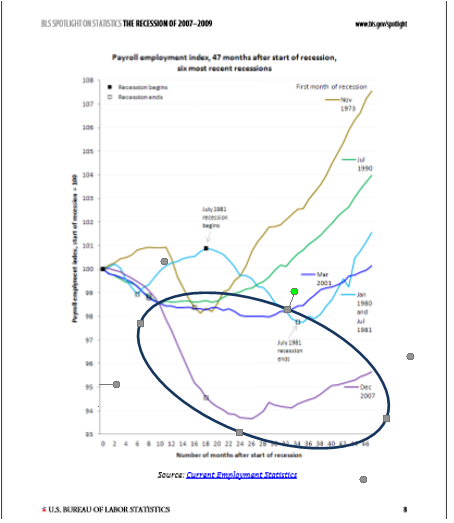
Just how bad were job loss been compared to previous recessions? Much worse. The job losses were much sharper and more severe than in any other post-WWII recession.  The area within the ellipse reflects the losses in 2007-2008.  Notice how much steeper and deeper the losses are compared to other recessions.  (I’m working on a chart that is easier to read.)

17-02-19-bls-job-losses-recent-recessions-with-highlight


        So, if the job losses were significantly worse than previous recessions, wouldn’t you think any economic recovery should take longer?  Not if you’re a politician of the opposing party.  For all those criticized the Obama Administration for not creating more jobs, the critics should remember who was president when the recession started – and why the recession started.

Explaining the Unemployment Rate

Enough politics. Just what is the unemployment rate?   The unemployment rate is total number of people looking for work but unable to find work divided by the total work force.  The result is “unemployment rate” or percent of the workforce considered unemployed.

Part of the confusion lies in the definition of the “total work force.”  Total work force is the sum of people looking for work and people currently employed. If people are unemployed and have given up looking for work, they are not considered part of the workforce. Huh? Really? Yes, really. Here’s an example.

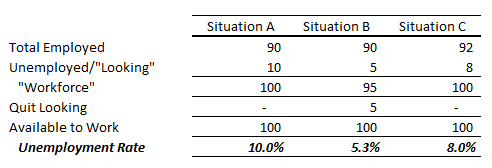
Situation A. 100 people are available to work – 90 are employed and 10 are unemployed and all 10 are actively looking for work.  Thus, the workforce is 90+10, or 100.  The unemployment rate is 10.0% (1-90/100).

17-02-18-unemployment-table


Situation B. Same 100 people as Situation A. However, after several months, 5 out of the 10 people unemployed cannot find work, become frustrated and quit looking for a job. What happens to the unemployment rate? It goes down. Yes, down, even though the total number of people stays the same.

The unemployment rate decreases from 10.0% (10 unemployed out of 100 in the workforce) to 5.3% (5 unemployed out of 95 in the workforce.) The unemployment rate decreases even though the number of people without work stays the same.

Even more confusing is when the economy improves, those who previously quit looking begin looking for jobs.  What happens to the unemployment rate?  The rate may actually increase even though the economy is improving.

Situation C.  Start with Situation B where 10 people were unemployed but 5 of the 10 quit looking for work. Now the economy starts to improve and the five people who quit looking start looking again. Only 2 of the 5 who quit previously find jobs right away but everyone who was not employed is again looking for work.

Situation C now has 92 employed, 8 unemployed.  What happens to the unemployment rate?  The rate jumps from 5.3% in Situation B to 8.0% in Situation C, even though the total number of people employed increased from 90 to 92.  Why?  Because the total workforce – the number of people employed and number looking for work increased from 95 to 100.  (Unemployment rate calculation, (1-92/100=8.0%)

Another problem interpreting the data is the unemployment rate includes workers who have jobs but are working less than full-time. These people are counted as “employed.” Using the same 100 people, if 15 are working say 30 hours per week instead of 40 hours per week, the 15 would be counted as “fully employed,” even if weekly income has been reduced.

While these calculations are not hard to understand, the method used to calculate the unemployment rate is not often explained, especially the effect of “under-employed” or “quit looking for work.” Understanding the methodology will help you explain to others why results of programs to reduce unemployment always lag economic growth.

(Reference material: Bureau of Labor Statistics website has vast array of information about employment, unemployment and how to interpret. http://www.bls.gov)


#238 Primer Cha 3: Is the Federal Debt Too High? Well, Not Really.

12 Sunday Feb 2017

Posted by Jordan Abel in Common Sense Policies, Economics, Federal Budget

≈ Leave a comment

First-time readers, the dialogue in this blog is set in the future (sometime after the year 2020).  Each entry assumes there has been a 5th revolution in the US — the Revenge Revolution.  More about Revenge Revolution and author, Entry #1.  List and general description of entries to date.  Annual assessment if Revolution plausible.

Note: most characters appear in a number of entries, with many entries building on previous conversations.  Profile of characters.  You’ll catch on quickly.  Thanks for your time and interest…and comments.

Scene: Gelly, Jordan’s assistant, has been editing and updating a primer Jordan wrote about 2011.  Section starts Entry #235.  (Primer will be available as PDF in more traditional format after the first few entries.  The download will be updated regularly.) 

092615_2031_Characters7.gifGelly:  “Jordan, can you clarify something for me, please?  Is the Federal debt too high?”

Jordan: “Interesting question.  Why do you ask?”

Gelly: “Some people I know and some of the talk-radio bloviators keep saying…or at least they used to say when Obama was president…that the Federal government’s debt is too high.”

Jordan: “Then let me guess.  The follow-on comment, ‘The country needs to return to the fiscal-conservative days of the Reagan Administration.'”

parrothead_tnsGelly: “Exactly right.”

Jordan: “I find it interesting the claim about Reagan as a fiscal conservative…but what are the facts?  Here’s the question: ‘Since the 1960’s, under which president has the Federal debt as a percent of GDP (gross domestic product) increased the most?  (Note: In the early decades following WWII, Federal debt as a percent of GDP declined sharply.)

Gelly: “First, just what is the Federal debt?”

TurtleneckJordan: “Grab a cup of coffee and I’ll walk you through some of the basics.”

Gelly: “Good.  That should help me understand the rest of the primer.”

Jordan: “For non-economists, the Federal debt is essentially what you think it is…the amount of money the US government owes creditors. The Federal debt is similar in many ways to the debt you owe – mortgage on the house, outstanding car loan, student loan and credit cards.

One major difference. The US government can print money to pay-off its debt; you cannot print money…at least legally.

Is the Federal debt too high? Depends.

CashTo help answer whether Federal debt is too high, first let’s start by roughly adding up all your debt – mortgage on the house, loan on the car(s), outstanding balance on credit cards, etc. Let’s say your debt totals $250,000. If your income is $50,000 per year, your debt of $250,000 is too high. If you make $100,000 per year, your debt is reasonable. If you make $250,000 or more per year, you’re probably in very good shape.

So how do the examples of personal debt compare to the debt of the Federal government? Surprisingly, personal debt is generally higher, often 2-3 times more than household annual income. When you bought your first house, for example, how much higher was your mortgage (with interest) than your annual income?

If you were comfortable getting that big a loan for your house, then relax about the Federal debt.  The Federal debt is much lower proportionately than your personal debt.

Was Reagan a Fiscal Conservative?

The chart indicates debt as a percent of GDP from the 1960’s through early 2017. Most people who view the chart are surprised to learn that debt did not decline under Reagan/Bush.  In fact, under Reagan/Bush 41 debt as a percent of GDP just about doubled — from about 30% of GDP to almost 60% of GDP.  Based on the metrics used by many Republican to claim debt under the Obama Administration was “out of control,” Reagan should have been branded as a president leading the country toward bankruptcy.

17-02-12-gdp-growth-1950-2016

Republicans who brand Democrats as “tax-and-spend” need to be reminded that under the Clinton Administration that followed Reagan/Bush 41, the Federal government ran a surplus and total debt as a percent of GDP declined.  Yes, I understand the sarcasm in what’s supposed to be an apolitical primer.  However, without some prodding and poking, the “alternative facts” crowd will continue to make erroneous claims that Reagan was a fiscal conservative.

Federal debt as a percent of GDP climbed sharply under Bush 43 (2001-2009) Administration from about 55% of GDP to about 80% of GDP.  The primary causes were implementing a major tax cut, which decreased Federal revenues at the same time increasing spending for wars in Iraq and Afghanistan.

Under Obama, Federal debt as a percent of GDP increased sharply at the beginning.  The cause was primarily efforts to overcome a severe recession.  During the recession, which started toward the end of Bush 43, Federal government tax revenues fell sharply and Federal government spending increased sharply to help stimulate the economy.  In the latter years of the Obama Administration, annual Federal deficit declined as did the rate of increase Federal debt as a percent of GDP.

(For those thinking the government should cut back on spending in recessions, there will be a separate entry to explain why, in a recession, fiscal actions for the Federal government and individual households should be exactly the opposite.)  

Under the Trump Administration, debt as a percent of GDP is likely to increase. Trump voodoo-2015958and Republicans are pushing for a major tax cut, similar in many respects to the “trickle-down” tax cuts by Reagan and Bush 43.  “Trickle-down” economics is what Bush 41 famously labeled as “voodoo economics” in the campaign against Reagan.

In addition, Trump Administration has proposed a major infrastructure rebuilding program.  An equally ambitious infrastructure rebuilding program proposed under the Obama Administration was deemed “too expensive” by Republicans.  Apparently, the cost of such a program and the dramatic increase to the Federal deficit are no longer issues.  Mmm, wonder what changed the Republicans thinking?

Trump claims the additional expenses associated with government spending will be offset by additional revenues from accelerated economic growth.  Annual growth in GDP will somehow magically increase to an average 4.0%.  While 4.0% growth in GDP has been achieved periodically since WWII, such a high rate has not been sustained.  Further, the rate is often the result of the stimulus associated with large fiscal deficits.

17-02-12-gdp-growth-1950-2016

Given all the “don’t worry about the deficit because it will magically disappear” rhetoric now that Trump is in the White House, the next time a Republican claims policies of Democrats have crippled the country with debt, note that Reagan and Bush 43 administrations increased debt far more than any other administration since WWII…and Trump is likely to set another record for increasing the debt.  So much for being a “fiscal conservative.”

OK, What Really Caused the Debt to Increase?

  1. Republican-led tax cuts that did not translate into sustained economic growth, thereby creating more debt.
  2. Allowing taxes for Social Security and Medicare to be counted as “general revenues” and effectively used for other purposes. Such “baloney” accounting has allowed both parties in Congress to justify not raising taxes to pay for other programs.
  3. Belief by most Republicans that tax cuts for the wealthy will “trickle down” to middle and lower incomes.  There is no credible evidence to support such claims.
  4. Allowing, and even encouraging companies to relocate manufacturing outside the US, thereby reducing wealth creation and ability to collect tax on payroll and income.

Proposed Simple Changes to Policy.  Following are some simple changes to government policy that would have an immediate and positive impact on US economic growth. Some of these have been proposed previously and some are under consideration by the Trump Administration.  Serious consideration should be given to:

  1. Stop counting tax revenues for Social Security and Medicare as “general revenue.” It is OK to run a Federal deficit. Just make certain the amount of the deficit is understood and not understated by phony-baloney accounting.
  2. Recognizing that people who are unemployed do not need lower taxes.  Unemployed people likely pay no income taxes. Unemployed people need cash.
  3. Recognizing that people who are unemployed/under-employed spend a higher percentage of income than those employed, especially those with higher incomes
  4. Recognizing that people who work have more self-esteem than those who take handouts. Put the unemployed to work, even if the task is ”beneath their skill level.” There are many worthwhile projects that need to be completed.  If you don’t like this idea, then read some accounts of how government programs during the 1930’s New Deal programs positively affected lives of all income strata.  And check your own family history to see who benefitted.”

Gelly: “Thanks for the summary Jordan.  Seems to me for the president and Congressional leaders, maybe the most important guide about proposing changes to government economic policy is use some common sense.  Think before you act…or react to an idea. Thinking before you act was good advice from our parents when we were teenagers. Still relevant today.”


#237 Primer Cha2: Basic Economics and Common Sense Test

05 Sunday Feb 2017

Posted by Jordan Abel in Economics, Societal Issues

≈ Leave a comment

First-time readers, the dialogue in this blog is set in the future (sometime after the year 2020).  Each entry assumes there has been a 5th revolution in the US — the Revenge Revolution.  More about Revenge Revolution and author, Entry #1.  List and general description of entries to date.  Annual assessment if Revolution plausible.

Note: most characters appear in a number of entries, with many entries building on previous conversations.  Profile of characters.  You’ll catch on quickly.  Thanks for your time and interest…and comments.

Scene: Gelly, Jordan’s assistant, has been editing and updating a primer Jordan wrote about 2011.  Section starts Entry #235.  (Primer will be available as PDF in more traditional format after the first few entries.  The download will be updated regularly.) 

092615_2031_Characters7.gifGelly:  “Jordan, are you a dismal guy?”

Jordan: “What are you talking about?  Dismal?  Do I look that bad?”

Gelly:  In your write-up, you said economics has been called a dismal science.  And I know you love economics.  Seriously, I am not sure why it’s called ‘dismal’ since economic-based decisions can have such a profound impact on society.”

TurtleneckJordan: “As you said, I find economics quite exciting. After editing the primer, I hope you don’t think I’m so dismal.”

Chapter 2.  Basic Economics and a Common Sense Test. 

There are some basics of economics that we all need to understand. The “economics wonks” already know the basics…but the wonks aren’t the concern.  The concern is politicians who choose to ignore the data or cherry-pick the data and claim a result that the data do not support.  So, if you’re not an “economics wonk,” the primer is designed to help you understand some terms and statistics that are cited frequently but that you might not understand completely.

drone-manOne of these problems is data are not displayed in easy-to-understand charts. (Pardon me for using a plural verb with data but…OK, so I’m old school.)   In addition, the data are often cited without reference to previous data points or without the proper context. One of the goals of this primer is to explain some economic terms in language for non-economists.

Three comments about the primer before proceeding:

  1. If you want to learn more about a series of data or an economic indicator, start with the Federal government websites.  Bureau of Labor Statistics has an excellent data base and reasonably understandable explanations.  (www.bls.gov)  (Let’s hope the Trump Administration honors the history and integrity of the government’s economic data.  If BLS data are compromised or access denied by the Trump Administration, then check some academic websites – start with MIT, Harvard and Chicago, which all have a long history of Nobel Prize winners in economics.)
  2. The list of databases and examples is not comprehensive but selected to be relevant to discussions.
  3. Not everyone will agree with the items listed and/or the definitions. The primer is just that, a primer, and not a college textbook on economics. Please read it accordingly.

Much of my academic and professional life has included using economic indicators to forecast demand, primarily for sales of cars and trucks. The forecasts have been used to decide: (i) if new assembly plants required; (ii) how many cars and trucks to produce: (iii) what type marketing programs needed: (iv) how many workers required.  These-type decisions can affect the lives and incomes of thousands of people.

Some key lessons learned from many years of forecasting:

  1. Forecasts are always wrong!
  2. Goal should be to minimize the forecasting error for critical variables.  If the forecast is for an item where there is little credible historical data, the default position I use is start at the mid-point of what you think are reasonable high and low estimates. By starting at the mid-point, the worst is the forecast is 50% wrong…and virtually all the time, the error is far less.
  3. Math-based forecasting models are very helpful. The model, however, needs to be easy to understand. If you cannot explain the basics of the model to a non-economist colleague, the model is too complicated

Common Sense Test – Like Some Real Basic Stuff

goofy006Situation #1: A family has no money because no one can find work. Then a family member is employed by the government to complete a task – say building a road or building a school.

Question #1: Is society better off with the person working and being productive or doing nothing…and likely receiving some form of assistance?

Situation #2: “A person has no money and can find work only in minimum-wage jobs.”

Question #2:  Will a person with a minimum-wage job benefit from a tax cut?”

Tax Cuts for the Unemployed?  

When the Bush 43 Administration was faced with declining employment and decreasing real personal income, the answer was not to implement programs similar to the New Deal but to implement tax cuts. I realize parties have platforms and some people are fundamentally opposed to any government programs. But, c’mon, use some common sense. If you were unemployed, would you want a tax cut, which is of no value since you pay little, if any, income tax… or would you want a job that provided cash to buy food, pay the mortgage and utilities? This is not a complicated question.  (Trump Administration – are you listening?  In another segment, we’ll address the societal benefit of “trickle-down” economics.)

Laws of Economics Are Like the Laws of Sciences

The laws of economics are much like the fundamental laws of physics and chemistry. formula-scienceFrom time to time someone claims to have invented a perpetual motion machine that defies the fundamental laws of physics or to have invented a battery that will last forever. And usually sooner rather than later the claims are proved false.

The same seems to apply to some who want to defy the fundamentals of economics. Despite claims to the contrary, wealth for society cannot be created by transferring money between individuals, selling services, offering more medical care or a plethora of other activities.  The only way to create wealth over the long-term is manufacturing.

money-in-pocketTransferring money between pockets helps individuals but offers no benefit to society. Stop and think about it. If you go to the doctor for a problem, where is the value add to society? If you go to a restaurant, where is the value add for society? Money has changed hands but there is no more wealth in society than before.

New-Age Economy Is Horse Pucky

The belief that a new-age “service” economy adds wealth to the country is horse pucky. Yes, certain services may make individuals more productive but at the end of the day, it is manufacturing that creates wealth.

The Chinese get it. I’m afraid many decision-makers in the US don’t get it — whether manufacturing-production-operations-jobsin Congress or in the board room. Unless the US changes policy toward retaining manufacturing and changes the system of rewarding executives for transferring wealth by relocating operations outside the country, the US is headed for a sustained decline in wealth and standard of living.  (In other entries, we’ll discuss: (i) international trade as a critical component of economic growth.  And, no, trade can’t be just one way; (ii) what activities constitute “manufacturing.”  Do economists…and policy makers…need to rethink the definition of “manufacturing”? )

 No country can sustain itself by just providing services and transferring money between pockets. The US needs a healthy manufacturing sector to survive.

(Trump Administration Policies re Manufacturing.  The Trump Administration is right to emphasize the need for manufacturing in the US.  The claim that the US manufacturing base has been completed eroded is false.  The claim that Trump Administration’s policies will bring back manufacturing jobs to industries that formerly included many semi-skilled workers – automotive, e.g. – is sheer folly.  Many semi-Coal Minerskilled and some skilled jobs have been eliminated by technology.  The idea of numerous jobs in “clean coal” is even more ridiculous.  An even greater proportion of mining jobs have been replaced by technology and electricity production is shifting away from coal.  More about these issues in a later entry.)

#236 Primer Cha 1: You Can’t Drive Very Fast Only Looking in the Rearview Mirror

29 Sunday Jan 2017

Posted by Jordan Abel in Common Sense Policies, Economics, Possible Solutions

≈ Leave a comment

First-time readers, the dialogue in this blog is set in the future (sometime after the year 2020).  Each entry assumes there has been a 5th revolution in the US — the Revenge Revolution.  More about Revenge Revolution and author, Entry #1.  List and general description of entries to date.  Annual assessment whether Revolution plausible.

Note: most characters appear in a number of entries, with many entries building on previous conversations.  Profile of characters.  You’ll catch on quickly.  Thanks for your time and interest…and comments.

092615_2031_Characters7.gifGelly: “Jordan, I’ve finished editing the first few chapters.”

Jordan:  “Good.  Make any changes?”

Gelly: “I tried to make the text more current by including excerpts from papers you wrote later, especially during the early days of the Trump Administration.  Hope adding the more recent information was OK.”

Jordan: Glad you added the updates.  Thanks.  Let me take a look.”

(Chapter 1 of Primer.  PDF Download will be available after a few more entries.  Text of download will be formatted in columns.)

windshield-screenImagine this: You need to get someplace quickly. You jump in the driver’s seat and start the car. But the windshield is covered by one of those sun screens. You can only see by using the rearview mirror.

Question: How fast can you drive when you can only see out of the rearview mirror? Not very fast and not very safely.

Where do we start? By removing the sun screen blocking the window. Start looking forward instead of only looking to the past. Duh, the future is different from the past. Yes, learning from the past is important so check the rearview mirror periodically, but spend more time looking ahead than looking behind.

fork-in-the-roadYes, like all countries, the United States needs to update its approach to economic development.  However, the US is facing a major fork…maybe forks…in the road.  The combination of a bifurcated economy, concern about our competitive position worldwide and a polarized Congress makes prospects for long–term growth problematic.  Without a change in approach the US could fall behind global competitors.

Think it can’t happen?  Roughly 100 years ago GDP/capita in Argentina was about 80% of the US GDP/capita.  Today, GDP/capita in Argentina is a little over 30% of US GDP/capita.  Argentina made some bad strategic economic decisions.

But what about decision–makers in the US? Why are most people in public positions, elected officials and many CEO’s, seemingly reluctant to take a stand on issues outside what is perceived as “mainstream” – thus the analogy of not driving fast while looking only through the rearview mirror?

rearview-mirror-with-diceAnd why, in 2017, is President Trump’s solution to “Make America Great Again” based on ideas that might have worked when kids hung dice on the rearview mirrors?  The ideas are great for nostalgia but they have no basis in today’s economic world, no recognition how technology has affected manufacturing employment and no recognition of the impact on jobs of emerging technologies. 

donald-duck-wishing-wellAnd, no Donald, merely claiming that GDP will increase 4.0% or more each year will not make it happen, nor will claiming “clean coal” bring jobs to back to West Virginia, nor will tweets or tariffs.  Nor will pillorying anyone, even well-respected office holders, who question the logic of these retro positions.

So, What Are They Thinking?  Given that kind of back-asswards thinking, it is no wonder that many of us get so frustrated with some government policy decisions. Is it no wonder we get angry when a CEO gets a large bonus after laying off workers? It is no wonder we get angry when tax policy encourages companies to send jobs overseas?

dude-with-questionAmong voters left, right and middle, many decisions by government and business seem to make no sense. In fact, many decisions by government and business seem to be exactly opposite of the best interest of the United States and its citizens.

Does Back-Asswards Have Negative Consequences?  Yes, most emphatically yes.  In searching for answers to what seem to me to be counter-intuitive decisions, three situations came to mind: (i) the town where I was raised and received my primary and secondary education has been devastated by job losses; (ii) my first post-college employer and a company which was the heart of US manufacturing for decades, General Motors, filed for bankruptcy (in 2011); (iii) thinking and analysis have been replaced by babble spouting talking–head entertainers.

tweetyRather than “pouting and shouting” or even worse, “tweeting” about these frustrations, I decided my therapy was to write a primer outlining how using basic economic principles, business principals and more practical, affordable solutions to help address some policy issues facing the US public and private sectors.

A few years ago I wrote a short paper titled “Why a Healthy Domestic Auto Is Important.” After distributing to a few friends and colleagues, I was surprised by how many commented they had not heard such rationale, agreed it made sense and as such changed their mind about whether the US government should have supported bailing out General Motors and Chrysler.  (The paper is included in this primer.)  

With that encouragement I drafted other essays, which will be part of the primer. My hope is at least a few people read some or all of the primer and begin to think more broadly and take action on those thoughts.

bookletThe primer is designed to be apolitical. The ideas are not exclusively left or exclusively right. Quite honestly, the ideas are so common sense and so basic that at times I am embarrassed to publish them. You would think everyone knew these fundamentals. But apparently not since many are not applied, not understood or lost in political rhetoric.

The primer is also designed to help describe what I consider the cause of the deterioration in the ability of US companies to compete effectively worldwide. Some essays are purely educational; others propose solutions.

open-mindAs you read these essays, please (i) keep an open mind about the analysis and proposed solutions; (ii) consider how you can implement part or all of the idea, whether you are a member of Congress, a CEO, employee or citizen; (ill) discuss ideas with friends, family and colleagues. The early entries are intended to offer an understanding of some common economic principles and terms. Other entries include common questions, claims and arguments for/against a particular government policy or action.

When you listen to others make claims about what government policy needs to change, or make such claims yourself, then think about the context of the argument and if some additional data or analysis would change your position.

The primer is work in progress. The intent is to add chapters regularly as topics arise. I will update existing chapters for new information and any necessary corrections.

professor4The primer is not a source authority on economics.  I would never be so presumptuous.  So, if you are schooled on these subjects, please scan the chapters. If nothing else, you can offer ideas on how to improve them.

I hope you find the primer thought provoking, entertaining at times and educational. Please send ideas other topics as well. This primer is the beginning of a journey. I need some guidance on where to go next. Thank you for your time.

For Your Information: If you are curious about my background, raised in Danville, IL, then a town of almost 50,000 (now closer to 30,000). Danville is about 120 miles south of Chicago. Like many Midwest towns in my formative years, Danville was a mix of industrial plants surrounded by farms.  Danville offered a good mix of ethnic groups and religions. The public school system was well respected, producing more than its share of successful entertainers, astronauts, educators, doctors and corporate executives.

  • Education: Drake University (Des Moines, IA); Massachusetts Institute of Technology.
  • Job locations: Detroit area (twice), New York, Boston, San Francisco, Los Angeles, Charlotte (currently).
  • Politics: Fervent independent. Have voted for wide range of Republicans and Democrats. Some in the south consider me a liberal. I remind them of the history of the Republican Party…and that the Civil War ended 150+ years ago, ending with a gentle reminder to “get over it.”  I skip “you lost.”


#235 The Set-Up. Primer from “Practical, Affordable Policies Institute” (Part 1)

22 Sunday Jan 2017

Posted by Jordan Abel in Common Sense Policies, Economics, Gov't Policy, Innovative Thinking: Ideas and Products

≈ 7 Comments

First-time readers, the dialogue in this blog is set in the future (sometime after the year 2020).  Each entry assumes there has been a 5th revolution in the US — the Revenge Revolution.  More about Revenge Revolution and author, Entry #1.  List and general description of entries to date.  Annual assessment whether Revolution plausible.

Note: most characters appear in a number of entries, with many entries building on previous conversations.  Profile of characters.  You’ll catch on quickly.  Thanks for your time and interest…and comments.

Scene: Jordan’s office in Washington, DC

Gelly:  “At the beginning of each year, I clean out some file drawers.  Look what I ran across.”

Jordan:  “I’d forgotten about these.  I must have drafted some of these in about 2010-2011, but never published them.”

092615_2031_Characters7.gifGelly:  “What were they for?”

Jordan:  “Each article was to be a chapter in a primer about how to develop practical, affordable government policies to address key issues.  The primer would be the foundation for an organization I thought of creating – the working name was the Practical, Affordable Policies Institute, as known as…”

Gelly:  “PAPI.  I like that name.  My ‘pappy’ always had good, practical advice for our family.  So you wanted to become Washington’s ‘PAPI’, right?”

fatherly-adviceJordan:  “You know better than that.”

Gelly:  “Well, someone must have wanted your advice, at least some idea about what was in the primer.”

Jordan:  “Not that many people knew about the primer.  As a sense check, I circulated the articles within a fairly small group inside the Beltway.  Wanted to get reactions and ideas how to improve.” 

Gelly:  “That explains the phone call in the early days of the Trump telephoneAdministration.  A couple of staffers asked for copies of the primer.  I wasn’t sure what they were talking about.  Remember when I asked you about it?”

Jordan:  “Yes and I was out of town…somewhere.  I emailed the staffers a copy but you and I never talked about the primer when I got back.  The staffers that called probably were part of the review group.”   

Gelly:  “Now the rest of the conversation with the staffers makes sense.  They were concerned that senior officials in the Trump Administration had no clear policy for addressing many aspects of the economy.”

toss-out-iconJordan:  “You mean they didn’t consider Trump’s tweets and ‘toss out whatever Obama did’ as real policy?”

Gelly:  “I still shudder when I think about Trump’s approach early on.  Do you think these articles actually helped turn things around?”

Jordan:  “In Washington, as you know, a good idea has many fathers.  But, I presume the staffers did distribute the primer to some people in the Trump Administration…very discreetly, of course.”

Gelly:  “As I flipped through the pages, some of the articles seemed to be more about approach than actual policy.”

donald-duck-wishing-wellJordan:  “True.  I thought the articles about approach might be helpful since to make something happen – accelerate economic growth, for example – you can’t simply wish it to be true and expect results.”

Gelly:  “So, to implement a policy and make it work you really do need a plan and a disciplined approach to implementation.”

Jordan:  “Yes, and the statement seems so incredibly obvious.  I remember some people finished an article and asked…and I think rightfully so…’what’s the value here?  What’s being discussed is just common sense.’”

Gelly:  “Funny, I thought the same thing about some topics.  But I agree that common sense seems to get lost on some people when they’re inside the Beltway.”

Jordan:  “Let’s hope it doesn’t get lost for us.”

Gelly:  “Another question.  Do you think if all the ideas in the primer were implemented, the country could have avoided the Revenge Revolution?”

TurtleneckJordan:  “That’s a real stretch.  What I do know is if the Trump Administration had considered more carefully the essence of what was outlined in the primer, then the likelihood of a Revenge Revolution would have diminished.  At a minimum the Revenge Revolution would have been later and less disruptive.”

Gelly:  “You ever going to publish these?”

Jordan:  “Should I?  Whadda think?”

Gelly:  “My vote is ‘yes’ you should publish.”

Jordan:  “I’m not sure what all the topics were.  You have a list?”

Gelly:  “Here’s a list so far.  I think there are a few more.”

  1. You Can’t Drive Fast Looking through the Rearview Mirror
  2. Basic Economics and Common Sense
  3. National Debt Is Too High.  Well, Not Really.
  4. Unemployment: Always a Lagging Indicator
  5. Seasonal Adjustments and Trend Lines
  6. Manufacturing Creates Wealth
  7. Impact of Losing the US Manufacturing Base
  8. Eliminating the Incentive to Pillage
  9. Recruiting New Plants or Overseas Manufacturing
  10. Practical Policies to Rebuild US Manufacturing
  11. Why a Healthy Domestic Auto Industry Is Important
  12. Securing Equity Capital for Start-Ups, Emerging Companies
  13. Capitalizing on Global Warming

Jordan:  “I’d forgotten about a few of those.  Gelly, here’s an idea. I’ll consider publishing the primer…rather we’ll consider publishing the primer…after you edit the various entries.”

bookletGelly:  “You want me to edit?”

Jordan:  “I know some of the data needs to be updated, which I can help with.  But having you edit will make sure the papers are understandable to the average reader.  I tried to make the language simple but not sure I always succeeded.”

Gelly:  “How quickly do you want the editing finished?”

Jordan:  “Weave the editing into your normal schedule.  Finish at least one per week and try to get two finished.  And, then we’ll publish as you finish, OK?”

Gelly:  “We’ll publish?  But these are your papers.”

Jordan:  “No.  They’ll be our papers and we will publish.”

(Entries for the primer will be published at one or two per week.  Entries published to date will be available for download on the “Policy Primer” page of the blog.  Format will be double columns.)  

← Older posts
Newer posts →

Subscribe

  • Entries (RSS)
  • Comments (RSS)

Archives

  • August 2025
  • July 2025
  • June 2025
  • May 2025
  • April 2025
  • March 2025
  • January 2025
  • December 2024
  • November 2024
  • September 2024
  • August 2024
  • July 2024
  • June 2024
  • May 2024
  • April 2024
  • March 2024
  • February 2024
  • January 2024
  • December 2023
  • November 2023
  • October 2023
  • September 2023
  • August 2023
  • July 2023
  • June 2023
  • May 2023
  • April 2023
  • March 2023
  • February 2023
  • January 2023
  • December 2022
  • November 2022
  • October 2022
  • September 2022
  • August 2022
  • July 2022
  • June 2022
  • May 2022
  • April 2022
  • March 2022
  • February 2022
  • January 2022
  • December 2021
  • November 2021
  • October 2021
  • September 2021
  • August 2021
  • July 2021
  • June 2021
  • May 2021
  • April 2021
  • March 2021
  • February 2021
  • January 2021
  • December 2020
  • November 2020
  • October 2020
  • September 2020
  • August 2020
  • July 2020
  • June 2020
  • May 2020
  • April 2020
  • March 2020
  • February 2020
  • January 2020
  • December 2019
  • November 2019
  • October 2019
  • September 2019
  • August 2019
  • July 2019
  • June 2019
  • May 2019
  • April 2019
  • March 2019
  • February 2019
  • January 2019
  • December 2018
  • November 2018
  • October 2018
  • September 2018
  • August 2018
  • July 2018
  • June 2018
  • May 2018
  • April 2018
  • March 2018
  • February 2018
  • January 2018
  • December 2017
  • November 2017
  • October 2017
  • September 2017
  • August 2017
  • July 2017
  • June 2017
  • May 2017
  • April 2017
  • March 2017
  • February 2017
  • January 2017
  • December 2016
  • November 2016
  • October 2016
  • September 2016
  • August 2016
  • July 2016
  • June 2016
  • May 2016
  • April 2016
  • March 2016
  • February 2016
  • January 2016
  • December 2015
  • November 2015
  • October 2015
  • September 2015
  • August 2015
  • July 2015
  • June 2015
  • May 2015
  • April 2015
  • March 2015
  • February 2015
  • January 2015
  • December 2014
  • November 2014
  • October 2014
  • September 2014
  • August 2014
  • July 2014
  • June 2014
  • May 2014
  • April 2014
  • March 2014
  • February 2014
  • January 2014
  • December 2013

Categories

  • Affordable Solutions
  • Back Asswards Thinking
  • Background
  • Background Stupid Is as Stupid Does
  • Benefits of Revolution
  • Causes of the Revolution
  • Common Sense Policies
  • Corporate Policy
  • Definitions
  • Diversions
  • Economics
  • Education Issues
  • Federal Budget
  • General Motors
  • Gov't Policy
  • Infrastructure & Fixed Fuel Prices
  • Innovative Thinking: Ideas and Products
  • Lessons of Revolution
  • Personal Stories
  • Possible Solutions
  • Post Trump Presidency
  • Rebranding Black Community
  • SCOTUS
  • Sense Check
  • Societal Issues
  • Stupid Is as Stupid Does
  • Tech Tsunami
  • Trump 47
  • Uncategorized

Meta

  • Create account
  • Log in

Create a free website or blog at WordPress.com.

Privacy & Cookies: This site uses cookies. By continuing to use this website, you agree to their use.
To find out more, including how to control cookies, see here: Cookie Policy
  • Subscribe Subscribed
    • usrevolution5
    • Join 32 other subscribers
    • Already have a WordPress.com account? Log in now.
    • usrevolution5
    • Subscribe Subscribed
    • Sign up
    • Log in
    • Report this content
    • View site in Reader
    • Manage subscriptions
    • Collapse this bar
 

Loading Comments...