• Home
  • Booklets/Grouped Entries
  • Tech Tsunami
  • List of Entries to Date
  • About the Author

usrevolution5

~ USA Headed for a 5th Revolution! Why?

usrevolution5

Category Archives: Education Issues

#159 What Is Education and How Should We Measure? (Part 7)

13 Sunday Sep 2015

Posted by Jordan Abel in Education Issues, Gov't Policy, Societal Issues

≈ Leave a comment

First-time readers, this blog is set in the future (sometime after 2020).  This entry assumes the Revenge Revolution has occurred.  For more about the anticipated 5th revolution in the US — the Revenge Revolution — and more about the author, Entry #1.  Note: most characters appear in a number of entries, with many entries building on previous conversations.  You’ll catch on quickly.  Thanks for your time and interest…and comments. 

Scene: Conversation about education starts Entry #153. Jordan and JC, a long-time friend (and frequent character) are having dinner. Time of year – just about when school starts.  Jordan and JC continue conversation after talking informally to some people at nearby tables.

JC: “So what do you find out? People think the idea of earning a merit 010414_1635_16TeachingS1.jpgbadge for completing certain ‘courses for dummies’ might reduce the stigma of not knowing certain topics?”

Jordan: “The people who I talked to thought the idea was interesting and intriguing. But they also suggested we run a pilot program.”

JC: “The groups I talked to had a similar reaction. The idea of eliminating the stigma of learning basic skills…topics that you should know…was well received.”

Jordan: “What about a pilot program to test the idea?”

JC: “We didn’t talk specifically about a pilot but the groups were concerned that implementing the program too quickly might backfire. They wanted to build support at the grass-roots level rather than mandate from the superintendent’s office…and certainly not from the individual states or Washington.”

TurtleneckJordan: “Why are so many people in this country against a national education program? When you go off to college or get a job there is an expectation of a certain level of learning. You can’t have 50 different standards.”

JC: “More like 500 or 5,000 different standards if you consider all the school districts.”

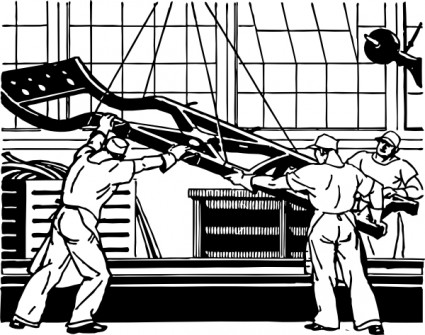
Jordan: “Can you imagine every auto plant having different standards for crash worthiness, turn signals, tire quality, etc. At the end of the day, like it or not, education is much like having kids go down an assembly line. In first grade, they start out at the beginning of the assembly line and assembly lineby the time they complete high school, they are a functioning chassis that can drive away.”
JC: “What about college or trade school?”

Jordan: “College and trade schools add more options and make engine performance better. But when kids graduate from high school, they should be prepared to function in the real world.”

JC: “I agree but I also know that at the end of the assembly line some cars need some repairs. What happens with these cars…kids?”

Jordan: “Let’s fix the kids. Many kids drop out of school because they have not thought through the consequences or there is some tragedy in their life. We…the proverbial societal we…have to grab these kids and make sure they get enough training to get out of high school.”

JC: “Even if they are older?”

Jordan: “Getting people who are older back through high school is even more old_woman_walkingimportant. I don’t care if someone is in their 90’s. If they want to finish high school, my vote is to have the taxpayers fund the program.”

JC: “Doesn’t that seem like a waste of money? I mean training someone who is that old?”

Jordan: “I think there is value created from two perspectives. Chances are the person who is without a high school education still pays taxes – sales tax, property tax, whatever. And they will likely pay taxes for at least 40-50 years…and maybe longer. So society owes them something in return.”

JC: “What’s the second benefit?”

Jordan: “The 90 year-old going back to school would be a great example and inspiration for a lot of younger people to complete their education. If great grandma grandmacan do it, why can’t you sonny boy or you sonny girl?”

JC: “Great grandma could become the poster child for the merit-badge program. Never too old to complete your education.”

Jordan: “Now, before we get all excited and start slobbering all over each other, we need to make sure this idea can really work. One think to talk about it in the abstract. Another to lay out a practical plan.”

JC: “Maybe we step back for a week or two. The High Holy Days are coming up. This could be on our list for the New Year.”

Jordan: “I agree that something should be done with the idea of taking away the stigma of going back to finish one’s education, no matter how old.”

JC: “You know what I like about this idea? It doesn’t point fingers at whether you are mirror-clipart_jpgpoor or rich, whether you did or did not have a supportive home life and all the other ‘symptoms’ of why someone did not do well in school. The idea holds up a mirror and says, ‘If you want to finish your education, you have to make the effort but we will help you.”

Jordan: “I agree. The school board and the public need to make sure every reasonable opportunity exists for kids to complete high school. But teachers cannot fix the kids life at home. What society can do is for kids who caught a bad break with parents, or made a stupid decision and quit school, we will help you get your education.”

JC: “I like it.”

(Continued)

#158 What Is Education and How Should We Measure? Learning Disabilities (Part 6)

05 Saturday Sep 2015

Posted by Jordan Abel in Education Issues, Societal Issues

≈ Leave a comment

First-time readers, this blog is set in the future (sometime after 2020).  This entry assumes the Revenge Revolution has occurred.  For more about the anticipated 5th revolution in the US — the Revenge Revolution — and more about the author, Entry #1.  Note: most characters appear in a number of entries, with many entries building on previous conversations.  You’ll catch on quickly.  Thanks for your time and interest…and comments. 

Scene: Conversation about education starts Entry #153. Jordan and JC, a long-time friend (and frequent character) are having dinner. Time of year – just about when school starts.

Jordan: “To me the board of education mission statements seem awfully complicated. How would you measure results?”

010414_1635_16TeachingS1.jpgJC: “What I don’t understand is why there is little, if any, emphasis on teaching kids to think. Lots of touchy-feely kinds of words that are politically correct but are hard to measure.”

Jordan: “If we are to make work the idea of ‘teaching kids to think,’ then schools will need to teach core courses and measure progress against the baseline in the core courses.”

JC: “I agree. Kids need to learn the fundamentals of math, English, social studies, history and some basic science. At the same time, society, especially parents, needs to understand not every kid is going to become highly proficient in every course. Like it or not, people have different skills.”

TurtleneckJordan: “I agree. My skills lean toward math. But I am lousy at the skilled trades. My carpentry is a joke.”

JC: “Little Jordan can’t saw straight?”

Jordan: “Ever watch ‘This Old House‘? I love the show. I also marvel at how much math and physics are used in carpentry. Tom Silva and Norm Abram use math and physics all the time to solve problems.”

JC: “Yes, I do watch it. And here’s what I fund humorous. Norm Abram may be the most famous Jewish carpenter since Jesus.”

ThisOldHouseJordan: “Funny.  So maybe we use Norm and Tom as examples why we need to teach all kids certain fundamentals, whether or not they are college bound.”

JC: “What about kids with learning disabilities? How do we teach them?”

Jordan: “We need to teach them to think. Thinking might be at a different level but we want the kids to leverage whatever skills they have.”

JC: “How are we…collective we as you say…going to teach these kids to think? You talking about mainstreaming these kids in regular classes?”

Jordan: “My view is mainstreaming is disruptive to the class. I know that sounds discriminatory but you can’t slow down 90-95% of the students for the sake of 10%, or 5%. We need 122813_2140_15Education4.jpgto think hard about how to educate kids with disabilities.”

JC: “That’s a touchy subject.”

Jordan: “May be. But parents, educators and citizens need to have an honest conversation. I am not an education expert. My expertise, at least according to the people who know me, is providing practical solutions to complex problems. Teaching kids with disabilities is a complex problem. And the current system does not appear to be working.”

JC: “You know someone knows how to teach kids with disabilities to think?”

Jordan: “Not personally.  But, there are people with lots of very practical, valuable educational experience.  My guess is the skills required for teaching kids with disabilities differ from skills required to teach other students.  Why try to mix them?”

JC: “I find it ironic we are focusing on teaching kids with learning disabilities. We all have some kind of learning disability in some subjects.”

Jordan: “Point well taken. So how do we teach me carpentry or teach me how to sing better?”

cookingJC: “I’m learning disabled when it comes to cooking. I just don’t get it.”

Jordan: “What Princess knows how to cook? Ordering in is your idea of cooking. That was too easy.”

JC: “See if I ever invite you to dinner.”

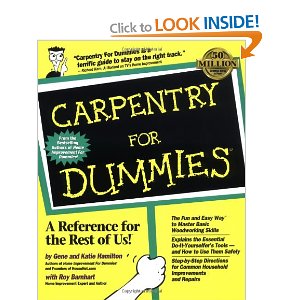
Jordan: “Where would we go, Steak & Shake? Back to topic at hand. Maybe we should take a lesson from the ‘Dummies’ books. Apply the same principle to education.”

JC: “First step might be to change the name from ‘Dummies.'”

Jordan: “Think about this. What if supposedly smart people enrolled in classes for Carpentry for Dummies‘dummies’? Would that remove some of the stigma of not being proficient?”

JC: “You mean if a MIT-guy like you enrolled in a ‘Carpentry for Dummies’ class, other people might be willing to enroll in say ‘Math for Dummies’?”

Jordan: “It just might work.”

JC: “Here’s another idea. What if participants in the ‘dummies classes’ were awarded merit badges, like the Boy Scouts. Your merit badge then becomes something of a bBoy Scout sash-smalladge of honor. You know, like guys show off their trophy for winning some golf tournament.”

Jordan: “Interesting idea. Merit badges for completing a ‘dummies’ class. Eliminates the stigma…reduces it anyway…of not being proficient in a certain skill. And encourages more people to continue with their education.”

JC: “Let’s run that by some people and get their reaction.”

(Continued)

#157 What Is Education and How Should We Measure? (Part 5)

02 Wednesday Sep 2015

Posted by Jordan Abel in Education Issues, Societal Issues

≈ Leave a comment

First-time readers, this blog is set in the future (sometime after 2020).  This entry assumes the Revenge Revolution has occurred.  For more about the anticipated 5th revolution in the US — the Revenge Revolution — and more about the author, Entry #1.  Note: most characters appear in a number of entries, with many entries building on previous conversations.  You’ll catch on quickly.  Thanks for your time and interest…and comments. 

Scene: Conversation about education starts Entry #153. Jordan and JC, a long-time friend (and frequent character) are having dinner. Time of year – just about when school starts.

JC: “Using a standard of ‘teaching kids to think’ seems so simple. Do you think it can 010414_1635_16TeachingS1.jpgreally work?”

Jordan: “The seeming simplicity is what will make it work. I know that sounds odd but simplicity is the key.”

JC: “The measure is easy to understand. Plus it fits into the 10-second sound bite…with time to spare. I know it is easy to understand but is it really practical?”

Jordan: “What’s not practical about it? Think about your education. What did your English and math teachers instill in you?”

JC: “Some basic facts and methods first, then how to solve problems, which is really how to think.”

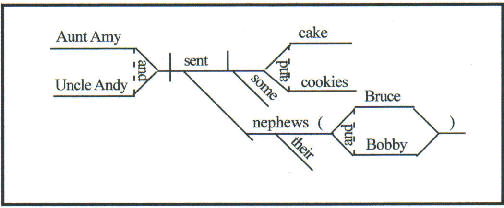
Jordan: “I agree, we can’t lose sight of learning the basics. I think everyone agrees on that. Now, in English class, what’s the value of diagramming? To have Diagramming Sentencesyou speak more clearly…and not split those infinitives?

JC: “To some degree. But diagramming really taught me how to think about sentence construction. To think about how words and phrases worked together to form a unit.”

Jordan: “What about math class? What did you learn?”

JC: “Now that I think about it, both in math and English classes…and other classes as well…I was taught how to approach a problem.”

TurtleneckJordan: “And how to solve a problem in a logical way. Gee, did learning to think help you in school and help you in addressing life’s problems?”

JC: “Helped me except for dealing with guys – like you, for example.”

Jordan: “I don’t understand women either so I guess we’re even. Seriously, the question for society today — ‘Are we teaching kids how to think?'”

JC: “Probably not teaching them very well, even with all those standardized tests.”

Jordan: “Give me an example.”

JC: “Here’s an easy one that you run into almost every day. How many young people at the cash register know how to make change?”

cash registerJordan: “Not many. Yesterday I had a bill for $4.88. I gave the clerk a $5.00 bill, one dime and three pennies because I wanted a quarter rather than more coins.”

JC: “Do you get a quarter or the deer-in-headlight look?”

Jordan: “Worse. I got back a dime and two pennies. Then I gave her back the change and asked for a quarter and still the ‘Duh’, reaction. I gave up.”

JC: “Do you think the public, you know the general public, can support the idea of ‘teaching kids to think’ as a direction for education?

122813_2140_15Education4.jpgJordan: “I hope so. Just for fun, let’s look at mission statements from 3-4 school boards. Curious to see what the boards think the mission of their school system is.”

JC: “Good idea. Look at Charlotte, NC, which you know well. Also, try Westport, CT…another one of your spots…NYC and San Francisco.”

Jordan: “Here’s Charlotte/Mecklenburg’s mission statement. ‘Foster a culture of excellence where proud students and educators become the craftsmen of a beautiful, quality work.'” (http://mcpsweb.org/?page_id=3307)

JC: “Huh? Wonder what that means? Try Westport.”

Jordan: “Their statement is a lot longer. ‘Our Mission is to prepare all students to reach their full potential as life-long learners and socially responsible contributors to our global community. We westport-logoachieve this by fostering critical and creative thinking and collaborative problem solving through a robust curriculum delivered by engaging and dedicated educators. We are committed to maintaining an environment that supports inquiry and academic excellence, emotional and physical well-being, appreciation of the arts and diverse cultures, integrity and ethical behavior.'” (http://www.westport.k12.ct.us/mission-statement/)

JC: “A mouthful but seems to make more sense. At least Westport talks about ‘critical and creative thinking.’ That seems like a step ahead.”

Jordan: “Let’s look for mission for New York City public schools, which I think is the largest district in the US.”

JC: “It is the largest. What’s the mission statement?”

Jordan: “I don’t know. I found mission statements for specific schools.  For the district, the only mission statement I found was under a tab for ‘early childhood,’ but no general statement.”

JC: “Surely you jest. Really?”

Jordan: “The childhood one seems OK as a start, ‘Every student in New York City deserves an opportunity to have the foundation of skills, knowledge, and approaches to learning needed to be ready for school and, ultimately, college and careers.'”  ( http://schools.nyc.gov/Academics/EarlyChildhood/mission)

JC: “So NY has a hidden general mission statement if they have one at all. What about San Francisco? They’re home to a lot of high-tech companies. What’s their mission statement?”

Jordan: “According to the website, the San Francisco school district initiated a community-wide program to develop a curriculum that would address the needs of the future.”  (http://www.sfusd.edu/en/assets/sfusd-staff/about-SFUSD/files/vision-2025-spreads.pdf)

JC: “Did they come up with a simple guiding principle?”

Jordan: “No. They have a booklet with a list of steps. Seems like a good start but still lots of verbiage. However, there is one statement that is very insightful.”

SFO LogoJC: “That is?”

Jordan: “Here’s the essence of quote. ‘If there was one surprise…it was the extent to which a shared vision already exists in our community and how easy it would be for diverse groups…to agree on the types of teaching and learning environments we want to build in San Francisco.'”

JC: “OK, Westport and San Francisco seem to have versions of what we’re talking about. NYC has a version of early students tat seems OK.  Charlotte’s mission is confusing. Here’s what I’m not confused about, I need a break.”

(Continued)

.

#156 What Is Education and How Should We Measure? (Part 4)

29 Saturday Aug 2015

Posted by Jordan Abel in Education Issues, Societal Issues

≈ Leave a comment

For first-time readers, this blog is set in the future (sometime after 2020).  This entry assumes the Revenge Revolution has occurred.  For more information about the anticipated 5th revolution in the US — the Revenge Revolution — and more background about the author, Entry #1.  One another note: almost all characters appear in a number of entries, with many entries building on previous conversations.  You’ll catch on quickly.  Thanks for your time and interest…and comments. 

Scene: Conversation about education starts Entry #153. Jordan and JC, a long-time friend (and frequent character) are having dinner. Time of year – just about when school starts.

Jordan: “You got that argument right. The problem with charter schools is two-fold. #1, far less accountability than public schools. And in some cases virtually no accountability.

010414_1635_16TeachingS1.jpgJC: “I’ll buy that.  What’s the second problem?”

Jordan: “#2, taxpayer dollars that are collected for use in public schools are diverted to the private sector. The money transfer further erodes the funding for public schools – teachers, buildings, and equipment. The diversion is a vicious cycle with public education suffering more and more.

JC: “Aren’t some charter schools focused on specific subjects or areas of study? That seems like a good idea. Why not let kids who are really good at say math and science go to schools where they can excel?”

Jordan: “You can accomplish the same programs…call them high-intensity study Turtleneckprograms…in the public school system. Big cities have done so for years. NY, and probably some others, have an array of special-interest high schools.”

JC: “You’re right. We went to public school and were enrolled in ‘accelerated classes.’ They probably call those classes ‘advanced placement’ now…more politically correct. I guess you and I didn’t need private schools or charter schools to get a good education.”

Jordan: “I understand the taxpayer’s frustration with cost of schools. Rather than increasing taxes, a better approach would be to reduce or eliminate money not being spent very efficiently – like busing, charter schools. Add to that waste the extra money many parents are spending for private schools.”

JC: “If I’ve heard you right tonight, you think the way to start rebuilding public schools is cutting way back on busing teacherand taking the money to create a corps of higher-caliber teachers, like Miss ‘What?’ and Mrs. D.?”

Jordan: “There are people out there who can teach like Miss What? and Mrs. D.  But they’re probably not teaching because of low pay.  We need to recruit those people to become teachers and need to pay them enough so they remain as teachers.”

JC: “Given the political support for charters, how can the rebuilding program get started? There’ll be a lot of resistance.”

Jordan: “Maybe. But the key is generating public support, at which point the politicians will fold. Remember in 2015 how quickly and effectively the Donald changed the tone of the Republicans running for president?”

JC: “Yep. His comments were straightforward, unvarnished, not diplomatic and often over the top…but he got everyone’s attention.”

Jordan: “Trump also made it OK to talk about sensitive issues without the PC-sugar Trumpcoating.”

JC: “Alright, I guess we need to find someone like the Donald…but a bit less bombastic…to talk about education.”

Jordan: “Let’s get someone to promote a very simple concept for education. You brought it up early in the conversation.”

JC: “You mean Einstein’s comments about education?”

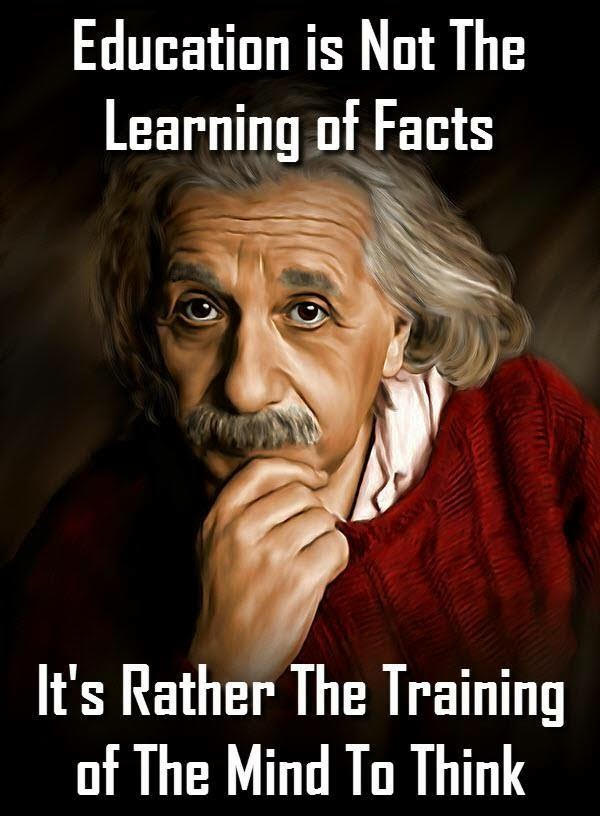
Einstein EducationJordan: “Exactly. ‘Education is not the learning of facts. It’s rather the training of the mind to think.'”

JC: “Did he really say that, or is that some made-up quote on the web?”

Jordan: “Not sure it really matters. It’s a great quote and we should use it. We need to repeat it ’till we memorize it.”

JC: “You can engage your brain and memorize the quote. I’m getting a refill.”

engage-the-brain-clipartJordan: “Education is not the learning of facts. It’s rather the training of the mind to think. Education is not the learning of facts. It’s rather the training of the mind to think. Education is not the learning of facts. It’s rather the training of the mind to think.”

JC: “By the way, I checked on the quote while you were trying to memorize it. Some controversy about the exact quote and whether it was taken out of context…but, I think its close enough. The quote is easy to remember and understand. I’m voting we use it.”

(To be continued)

#155 Education What Is It and How Should We Measure? (Part 3)

26 Wednesday Aug 2015

Posted by Jordan Abel in Education Issues, Societal Issues

≈ 1 Comment

For first-time readers, this blog is set in the future (sometime after 2020).  This entry assumes the Revenge Revolution has occurred.  For more information about the anticipated 5th revolution in the US — the Revenge Revolution — and more background about the author, Entry #1.  One another note: almost all characters appear in a number of entries, with many entries building on previous conversations.  You’ll catch on quickly.  Thanks for your time and interest…and comments. 

Scene: Conversation starts Entry #153. Jordan and JC, a long-time friend (and frequent character) are having dinner. Time of year – just about when school starts.

010414_1635_16TeachingS1.jpgJC: “OK, let’s just pretend we stop discretionary busing. I know most schools will still need some buses but what really happens if we cut busing?”

Jordan: “Three things happen. #1 kids get more time for schoolwork or just to play. #2, kids get to go school in their neighborhood with their friends. They can start to build a bond with the local school and not some far off school. #3, money becomes available to pay teachers more and/or hire better teachers.”

JC: “How much more money? How much do we spend on busing?”

Jordan: “Here’s the math. For each school bus, the taxpayers buy or lease a bus, hire a driver, buy fuel and hire a mechanic for maintenance and repairs. And, just in case the one bus breaks down or needs maintenance, there is a back-up bus – not one for one Turtleneckbut some spares.”

JC: “I understand the costs but it’s not just for one kid. There’s a bunch of kids on a bus.”

Jordan: “For argument sake, let’s assume each bus averages 30 kids. Might be a bit high but reasonable.”

JC: “30 kids is about the same size as an average class.”

Jordan: “Right. So for every $1.00 spend on busing a kid, there is $1.00 less for paying teachers…unless, of course the taxpayers want to increase taxes.”

School-Bus-ClipartJC: “Never thought of the cost of busing quite like that. I wonder if taxpayers do?”

Jordan: “Now we need to figure out what each school bus costs per year.”

JC: “Before you Google that, let’s each take a guess.”

Jordan: “Alright. Write your number down and then we’ll compare estimates.”

JC: “I put down $15,000 per bus per year. So if my math is right, for 30 kids that equates to $500 per year per student.”

Jordan: “I’m going a little higher, $20,000, which works out to be $667 per student per year.”

JC: “Let’s see how we did.”

Jordan: “Here’s the DoE (Department of Education) website. Based on the trend line, it looks as if $1,000 per student per year is more accurate.”

Trash CanJC: “So we were both low. For every student, taxpayers are spending $1,000 per year to bus kids? And in some places, the number’s a lot higher. Spending that much money on busing seems like a waste.  Like throwing money in the trash can.”

Jordan: “We agree that some busing is necessary. But let’s assume that 50.0% of busing is discretionary. Might be higher but 50.0% is a reasonable estimate.”

JC: “If half the busing is discretionary, then for each bus with 30 kids, about $15,000 per year is wasted. Taxpayers, really the school board, could redirect the money to Money-clip-artpay every existing teacher $15,000 more per year. And not have to raise taxes!! Busing is even dumber than I thought.”

Jordan: “You got that right. I wonder how many parents would gladly make the following trade: stop busing your kids for more qualified teachers at the neighborhood school.”

agreement-clipart-business_handshakeJC: “Seems like a no-brainer to me. Plus the kids can spend more time at school studying, participating in extracurricular activities or just goofing off with friends.”

Jordan: “What baffles me is why kids in grammar school have to commute 30-60 or even 90 minutes a day? When I worked in Manhattan and we lived in Connecticut, my commute was not much longer.”

JC: “Plus the kids are sitting on a bus and not walking to school or riding a bike to school. So tell me again, why are we busing these kids?”

Jordan: “People who proposed busing as a solution were likely well intentioned…at Not Understandleast I think they were. But these same people neither thought through the consequences nor really understood the cause of the problem.”

JC: “You’ve said several times that the cause of low performing schools is not poverty per se.”

Jordan: “It’s not poverty per se. And yes, I agree many kids do not have good role models at home.”

JC: “Which begs the question, ‘Why bus kids to another school rather than attract better teachers to the neighborhood school?'”

Jordan: “I understand busing was done initially because schools were segregated…and schools in lower-income neighborhoods, especially black neighborhoods, were inferior.”

JC: “After busing became more widespread, did educational scores improve for kids business-free-clip-artbeing bussed?”

Jordan: “Probably, but I think only temporarily. One of the unintended consequences was busing ended up eroding confidence in and support of public schools.”

JC: “You mean because more parents sent their kids to private schools rather than being bussed?”

Jordan: “Charlotte (NC) is a good example. After busing between neighborhoods started more parents sent kids to private schools and religious schools…along with a big jump in home schooling.”

JC: “What about charter schools? Are they a good alternative?”

Charter SchoolJordan: “Another non-solution that addresses the symptoms, not the cause. Charters are a darling of many Republican politicians. Charters were promoted as better than public schools because…”

JC: “…because students attending want to learn, because charters offer better-qualified teachers…and of course, charters have no unions – the cause of most problems with public schools.”

Jordan: “You take a sour pill today? By the way, I agree with your comments. In my view, the problem with charter schools is twofold.”

JC: “Hold that thought. I need to take a break.”

—————

Links to downloads of other topics,

  • 15 05 23 Do They Really Understand Entries #121-#130 (Discuses policies in government and private industry)
  • Insight into General Motors (Multiple Entries) — (Spans many years pre and post bankruptcy)

#154 What is Education and How Should We Measure? (Part 2)

22 Saturday Aug 2015

Posted by Jordan Abel in Education Issues, Societal Issues

≈ Leave a comment

For first-time readers, this blog is set in the future (sometime after 2020).  This entry assumes the Revenge Revolution has occurred.  For more information about the anticipated 5th revolution in the US — the Revenge Revolution — and more background about the author, Entry #1.  One another note: almost all characters appear in a number of entries, with many entries building on previous conversations.  You’ll catch on quickly.  Thanks for your time and interest…and comments. 

Scene: Continuation of Entry #153. Jordan and JC, a long-time friend (and frequent character) are having dinner. Time of year – just about when school starts.

JC: “So you think the way to improve education is double teachers’ salaries and show 010414_1635_16TeachingS1.jpgrespect for the teaching profession?”

Jordan: “If forced to a 10-second sound bite, ‘yes,’ double salaries and show respect. But you and I know the solution is more complicated.”

JC: “You mean like students wanting to learn?”

Jordan: “When talking about students wanting to learn, a bunch of clichés come to mind. ‘You can lead a horse to water…’ ‘You can’t move anything by pushing on a string.’ And some others.”

JC: “Understand what you mean. But how do you intend to change these kids minds…have them want to learn?”

TurtleneckJordan: “That’s where good teachers come in. The decision to learn starts at home but…”

JC: “…but in many cases, there is no encouragement at home. Plus, some kids don’t seem to understand the importance of learning, especially how it affects them long-term.”

Jordan: “No matter what we do, there will be some kids who resist education. Teachers can be inspirational for some and reinforce the inspiration for others. But there is some percentage that will resist learning…at least publicly.”

JC: “I know we talked about this earlier but I still remember how excited I used to get Black School Teacherbefore English and math classes. I loved those classes.”

Jordan: “I hear ya. Did I ever tell you what happened in 8th grade math?”

JC: “Mrs. D your teacher?”

Jordan: “Yes. Remember the Cootie Bug game?”

JC: “Had some sort of bug-like thing, didn’t it?”

Jordan: “Right. Mrs. D had an extra-credit program called the Cootie Club. The program was designed to last the entire year. When you finished a section of extra-cootie bugcredit work, you were given part of the Cootie Bug.”

JC: “Let me guess. You finished early.”

Jordan: “Finished all the coursework and all the extra credit material by mid-October.”

JC: “The whole year’s work and extra-credit stuff by mid-October? What’d she do with you then?”

Jordan: “Made me a teaching assistant, helping other kids and grading papers.”

JC: “That’s great. But you were inspired before class even started. You loved math.”

Jordan: “True and she let me run at my own pace…as fast as I wanted. She was a true teacherinspiration for me.”

JC: “OK, but what about kids whose parents are so encouraging or who live in lower-income areas?”

Jordan: “It’s not as if my parents were wealthy. You know we had a good mix of students in that school.”

JC: “The kids were not poor by anyone’s standards.”

Jordan: “Agreed.”

JC: “Then how do we establish respect for teachers?”

Jordan: “Two steps. #1 is the president, whoever it is, needs to reinforce…and I mean reinforce constantly…the importance of teachers in educating our children. He or she should use the bully pulpit and pound in the country’s collective head why we need to support teachers.”

JC: “JFK made volunteering OK for recent college grads by promoting the Peace Corps. We still have the Peace Corps all these years later. What’s the second point?”

Jordan: “All income groups need to focus on the importance of a quality public 122813_2140_15Education4.jpgeducation. I should add all ethnic groups.”

JC: “What do we do about poor performing schools, especially in lower-income neighborhoods? Shouldn’t those kids be transferred to other schools?”

Jordan: “I know that’s a popular idea…but it’s wrong. Moving the kids to another location does not address the real problem.”

JC: “Why not?”

Jordan: “Reminds me of how some companies deal with lower-performing employees. They move the employees to another department. What’s been accomplished? Nothing.”

School-Bus-ClipartJC: “Are you saying busing the kids to a better performing school isn’t a solution?”

Jordan: “You got it. Busing the kids treats the symptom, not the cause.”

JC: “You want to teach kids in their neighborhood, even if the school is under-performing.”

UnfairJordan: “We…another societal we…need to fix the problem at the location. To shuffle kids all around town is unfair to kids being bussed. Unfair to kids who should be going to a school in their neighborhood but are being bussed. It’s also unfair to taxpayers to spend money on a solution that does not address the problem. Take the money spent on busses and diesel fuel and hire better teachers!!”

JC: “I need to think about that idea — cut way back on busing and use the money for teachers.”  (To be continued)

—————————————

Links to downloads of other topics,

  • 15 05 23 Do They Really Understand Entries #121-#130 (Discuses policies in government and private industry)
  • Insight into General Motors (Multiple Entries) — (Spans many years pre and post bankruptcy)


#153 What Is Education and How Should We Measure?

19 Wednesday Aug 2015

Posted by Jordan Abel in Causes of the Revolution, Education Issues

≈ 9 Comments

For first-time readers, this blog is set in the future (sometime after 2020).  This entry assumes the Revenge Revolution has occurred.  For more information about the anticipated 5th revolution in the US — the Revenge Revolution — and more background about the author, Entry #1.  One another note: almost all characters appear in a number of entries, with many entries building on previous conversations.  You’ll catch on quickly.  Thanks for your time and interest…and comments. 

Scene: Jordan and JC, a long-time friend (and frequent character) are having dinner. Time of year – just about when school starts.

JC: “Here’s a toast to an enjoyable evening.”

122913_1337_14BringingU2.pngJordan: “Hear, hear. Nice to see you, JC.”

JC: “Nice to see you, Jordan. I’d ask what you’ve been up to but Greenie filled me in the other day.” (See Entry #151)

Jordan: “She and I had a fun time talking taxes.”

JC: “She enjoyed it. Now here’s my topic for the evening – what is education?”

122913_1337_14BringingU1.jpgJordan: “You should know. You were a better student than I was…plus you taught middle school for a while.”

JC: “Well, you taught also…and at some big-name university.”

Jordan: “OK, so what’s the issue with education?”

JC: “The issue is the education system seems to be focused on the wrong measure.”

Jordan: “Whadda mean, wrong measure?”

Einstein EducationJC: “Einstein said it best. ‘Education is not learning of facts. It’s rather the training of the mind to think.'”

Jordan: “Great way to frame education.”

JC: “Think about your own education. Did you memorize a bunch of facts for some test? Or did you get trained how to think?”

Jordan: “You need to know certain facts and rules, especially in math, science and any language.”

JC: “Agreed, but the key is how do you use those facts to solve problems?”

Jordan: “You know what teacher I think of who made us learn some facts and then taught us how to think?”

math_clipartJC: “Our mutual math teacher, Miss ‘What?'”

Jordan: “She’d grind you down with her ‘what?’ questions. Then one day you understood and started to think.”

JC: “You were much better at math than I was but she was one of the best teachers I ever had, from grammar school to grad school.”

Jordan: “I wonder how she would be rated today.”

JC: “Probably get points off because she was so demanding…at least in our group.”

TurtleneckJordan: “What other teachers come to mind?”

JC: “Remember Frances…”

Jordan: “…English?”

JC: “Yes. She was right up there with Miss ‘What?’.”

Jordan: “What do you remember most about her English class?”

Sentence diagramJC: “Diagramming sentences. Some of those sentences were incredibly difficult to diagram properly.”

Jordan: “I hope you didn’t split any infinitives or leave your participle dangling.”

JC: “You need to worry about your participle dangling, I don’t.”

Jordan: “Funny, JC. Seriously, though, you learned the basic rules then applied them to the problem at hand, just like Einstein said.”

JC: “OK, we agree we got a good education…”

Jordan: “…in public schools.”

JC: “Yes, public schools. But how do we translate that experience to today?”

Jordan: “The first step is to attract more qualified teachers.”

JC: “Easier said than done. More pay?”

Money-clip-artJordan: “Yes, a lot more pay. Probably at least 50% more pay, maybe even double salaries.”

JC: “Wow that will cost a lot.”

Jordan: “Equally important to pay is showing respect. We…societal we…need to make teaching a highly respected profession, again. I said again because at one time it was.”

122813_2140_15Education4.jpgJC: “Good idea, but who is going to pay for all this?”

Jordan: “The current system is very expensive. It’s just that the cost is located in different buckets.”

JC: “I don’t follow you.”

Jordan: “An inferior education system…”

JC: “Excuse me Jordan, you think our system is inferior?”

Jordan: “Yes and getting worse every year. An inferior education system adds direct costs for lower worker productivity, which makes US business less competitive worldwide. The lower wages then reduce taxes paid by individuals. But a major money_bucketindirect cost is additional crime. The cost to incarcerate a person for one year is the same as tuition at a major university. I know people get all exorcised about the idea but I would rather pay someone to go to college than have them sit in prison and not be productive.”

JC: “No one wants to talk about the indirect costs. Politicians claim it is confusing for voters.”

Jordan: “Well, many of those politicians got voted out of office after the Revenge Revolution. Maybe it’s time to take a new approach to discussing problems — frankness and honesty”

JC: “You know what politician comes to mind – at least for the frankness part.”

TrumpJordan: “The Donald?”

Jordan: “He’s not my ideal role model but I have to give him credit. He changed the dynamic of running for president.”

Jordan: “Let’s not forget Bernie Sanders. He wasn’t as bombastic as the Donald but he got issues out on the table.”

JC: “Alright, we need an honest discussion about the value of teachers…and about the cost of not getting better teachers. Where do we start?”

Jordan: “Remember how we began to measure the appropriateness of policies for government and business?”

JC: “You mean, ‘treat thy neighbor as thyself?’ You want to apply that standard to teachers?”

Jordan: “Why not? Seems simple and straightforward. Ask parents, grandparents, Parent Meetingfamilies, business leaders, other educators what they want from a teacher?”

JC: “And I’ll bet its more than teaching kids to memorize facts for a test. They’ll want the teacher to teach the kid to think.”

Jordan: “Seems like a simple way to start measuring what we should do.”

JC: “Speaking of measuring. A critical storage tank of mine is full. Let’s take a break for a couple of minutes.”

#132 Education Policy: Separate but Equal an Improvement?

30 Saturday May 2015

Posted by Jordan Abel in Education Issues, Gov't Policy, Societal Issues

≈ Leave a comment

Scene: Continuation of conversation between Jordan and JC.  Conversation centers on themes for government policies following Revenge Revolution.  Jordan and JC have agreed to a deadline of this evening to complete the work.  When finished, Jordan will attempt to review with POTUS.  Conversation begins Entry #131.

Background: JC and Jordan have concluded that the standard measure for future government policies should be ‘treat thy neighbor as thyself.’  The first ‘test’ of the standard is education policy.

Jordan:  “First criteria for education policy should be a quality education opportunity for all students.”

010414_1635_16TeachingS1.jpgJC:  “Public or private education?”

Jordan:  “Public education.  The country needs to make a quality education available to everyone.  Otherwise the country is not treating citizens fairly.”

JC:  “Does fair mean no private education?”

Jordan:  “No, fair allows private education as long as public education meets acceptable quality standards.”

JC:  “You just implied that separate but equal is OK.  You really mean that?”

Jordan:  “Yes, separate but equal is OK.”

supreme_court_buildingJC:  “That takes the country back to Plessy v. Ferguson and overturns Brown v. Board of Education.”

Jordan:  “Think about this.  We’re more than 100 years after Plessy v. Ferguson and more than 50 years after Brown v. Board of Education.  And what’s changed?  The US does not have even separate but equal public education.”

JC:  “Whoa, Bubba.  You really think so?”

Jordan:  “Pick a city.  Any city.”

JC:  “Alright.  Let’s take Charlotte, NC.  You used to live there.”

TurtleneckJordan:  “Still do when I’m not trapped in Washington.”

JC:  “Charlotte claims it is a world-class city and a leader in all that new south stuff.”

Jordan:  “And what does Charlotte have?  A very strong private school base and a public school system with widely divergent quality and test scores.”

JC:  “Maybe Charlotte should balance out the public schools…with you know, more bussing.”

Jordan:  “Mandated bussing is what caused the boom in private schools.  Charter School-Bus-Clipartschools and vouchers made the problem even worse.”

JC:  “What’s the problem with charter schools?  I thought they were the answer to weak public schools.”

Jordan:  “Charter schools…and vouchers…use public money to fund schools that are privately run with little accountability.  Why should my tax dollars…or anyone’s tax dollars…support someone’s religious brainwashing…excuse me education.”

JC:  “The term ‘brainwashing’ is probably correct.  Many religious-based private schools seem to ban critical thinking.  The schools might as well build robots the kids are so programmed.”

Jordan:  “You asked me whether I supported separate but equal education.  My answer is ‘yes.’”

JC:  “How are you…we, the country…going to manage ‘separate but equal?’?”

Jordan:  “Let’s start with the kids first.  And back to the reference point, ‘treat thy neighbor as thyself.’”

122813_2140_15Education4.jpgJC:  “I agree that kids should have a neighborhood school.  Having a school one can attach to…sort of bond with emotionally…is important.  If possible, the kids should walk or ride a bike to school.  And go to class with other kids from the neighborhood.”

Jordan:  “So what do the kids get with bussing?”

JC:  “Kids get to spend a lot of time on the bus and don’t necessarily know the other kids in the neighborhood.”

Jordan:  “Exactly.  And had we been bussed in grammar school, you and I likely never would have met.  And no comment whether that would have been better.”

JC:  “I’m all for bussing.  Just kidding, Jordan.  I agree with you.  But how do you enforce consistent quality in the different schools?”

Jordan:  “A lot of decisions need to be made at the local level.  But the very first standard for all decisions needs to be ‘treat thy neighbor as thyself.’”

JC:  “I guess that’s what Plessy v. Ferguson was trying to do…but without really enforcing the standard.”

Jordan:  “No one said setting new government policies would be easy.  But a clear standard allows real discussion to take place, especially at the local level.”

JC:  “So the measurement standard for education is ‘treat thy neighbor as thyself?’  That’s it?”

Jordan:  “Well, yes, and why not?”

JC:  “The standard does not seem very clear.”

Jordan:  “Au contraire, I think the standard is very clear.  The standard forces the community into equal educational opportunity for all.”

meeting-clipart-board-clip-artJC:  “You’re counting on the local community to enforce the standard?”

Jordan:  “Who better to enforce it?  Right now, those groups that want unequal educational opportunity find all kinds of ways around supporting public education – private schools, private religious schools, vouchers, charter schools, home schools.  Everything but equal-opportunity public education.”

JC:  “Your logic seems to be the more specific the standard or rule, the more time and creativity some groups will spend on finding a way around it.”

Jordan:  “You got it.  Keep the policy standard simple and easy to understand.”

JC:  “I get it.  The government can then force those who don’t support the standard to justify why.”

Jordan:  “The federal government has been perceived as the bad guy in education, at Constitution-Dayleast by many Republicans.  Let’s turn that image around.  The federal government should set an easy to understand standard that is consistent with the US Constitution…equal justice for all…and consistent with virtually every religion.”

JC:  “Hard to argue with such a standard.”

Jordan:  “Besides, the entire country needs to crank up the focus on education.  The US is way behind much of the developed world in quality of education.”

JC:  “Mmmm.  The ‘treat thy neighbor as thyself’ seems to work with education policy.  What about say health care policy?”

Jordan:  “Let’s tackle that one after a break.”

JC:  “Don’t take too long.  Remember you’ve got a mock broadcast from the Oval Office at 9:00pm tonight.”

(To be continued)

Previous entries: #121-#130, Issues related to Federal budget.  Download in e-book format, 15 05 23 Do They Really Understand Entries #121-#130.

#131 How Treating Others Affects Gov’t Policy: Overview (Part 1)

27 Wednesday May 2015

Posted by Jordan Abel in Education Issues, Gov't Policy

≈ 9 Comments

Scene: Jordan’s office.  (More about the blog’s origin and the author.)

Gelly (Jordan’s assistant): Mr. Abel, you have an unexpected visitor, JC.  You have no woman_parentappointments for the next hour if you want to see her.”

Jordan:  “Sure.  Send her in.”

JC:  “Thanks, Gelly.  Well, well, Mr. Bigshot.  I feel honored to be able to see you.”

Jordan:  “C’mon, JC, cut the BS.  Come over here and let me give you a hug.”

JC:  “Careful, that might be considered sexual harassment and get you fired.”

Jordan:  “I wish.  Please report me.”

010414_1635_16TeachingS1.jpgJC:  “What’s the matter?  Things not going well for little Jordie?  Wanna talk to mama?”

“JC, you have a way of humbling most anyone.  Yes, let’s talk.”

JC:  “Gelly was nice enough to get coffee for me.  You need another cup?  I’ll get it.”

Jordan:  “Yes, please.  Thanks.”

JC:  “Well, he still has manners.  And, yes, I know, black, no sugar.  Now, what’s the issue?”

Jordan:  “Not one overriding issue.  Just frustrated that progress after the Revenge Revolution seems so slow.”

JC:  “What did you expect?”

TurtleneckJordan:  “Thought the country would turn around more quickly.  Get on a track where we were making real progress.”

JC:  “Progress toward what?”

Jordan:  “More effective government.”

JC:  “What went wrong?  Something happen to put things sideways?”

Jordan:  “Nothing in particular.  I think people did not have a clear vision of what they wanted after the Revenge Revolution.”

JC:  “People knew what they didn’t want – the old way of governing will all the inequities.”

Jordan:  “In retrospect, the Revenge Revolution was the easy part.  The hard part is what to do afterwards.”

dogchasingcar_1JC:  “I suppose like the dog chasing the car.  What’s he do after he catches it and sinks his teeth into the tire?”

Jordan:  “Good analogy.  It’s like war.  If the enemy is clear, then war is easy…well the strategy is easy.  War is always painful.”

JC:  “So pretend you’re king.  OK, pretend you’re POTUS.  What’s your plan?  The people and government need some direction.”

Jordan:  “You’re making this tough.”

JC:  “I’m making it real.  For too long people in Washington functioned by being against something…whatever something was.”

Jordan:  “Then the populous revolted.”

021214_1242_24Resultsof1.gifJC:  “And said, we don’t want you to be against something.  We want you to stand for something.  So, OK, great swami…I mean POTUS…whadda stand for?”

Jordan:  “How much time do I have to decide?”

JC:  “Assume you have a nationwide broadcast from the Oval Office at 9:00PM eastern tonight.  You better be ready.”

Jordan:  “I know this is just an exercise…at least for now.  But I think we should finish it and then consider presenting to POTUS…soon.  Real soon.”

JC:  “Now he understands.”

Jordan:  “Gelly, if no major conflicts, could you, please reschedule appointments for the rest of the day?  Thanks.”

Gelly: “No major conflicts.  I’ll reschedule.  And I’ll order in lunch.  Tuna sandwiches OK.”

JC:  “Great.  Thanks.”

checklistJordan:  “Alright, let’s list the topics we need to address.”

JC:  “In no particular order, tax rate, national defense, trade policy, infrastructure, election funding…”

Jordan:  “Whoa, you’re covering a lot of ground.”

JC:  “You need to cover a lot of ground.  The list is really made up of sub-topics.  But we need to put these topics on the list before we develop a broader strategy.  The grand plan, as it were.”

Jordan:  “You’ve got my head spinning.”

JC:  “Don’t worry, the big picture will become clear in a few minutes.  Let’s keep going on the list.”

Jordan:  “Social Security, health care, education, social issues…what else?”

JC:  “Energy policy, foreign policy, economic policy…”

Jordan:  “Yikes!!  Enough, already.”

stupid Resized clipart-illustration-443616JC:  “OK, the list is long enough.  If you had to pick a few words to describe how each of these issues should be addressed, what would the words be?”

Jordan:  “You are tough.”

JC:  “Quit stalling.”

Jordan:  “I’m thinking.”

JC:  “OK, let me give you an idea that might help.”

Jordan:  “When you think of how personal relationships should be handled, what words come to mind?”

Jordan:  “Something very basic…and something most of us learned a long time ago.”

JC:  “And that is?”

Jordan:  “Treat your neighbor as thyself.”

JC:  “Well, well, well, Mr. Religion himself.  You working on becoming a rabbi soon?  torahClipSuch insight.”

Jordan:  “Well, it’s true…and, no I’m not working on going to rabbinic school.  My Hebrew is not that good.”

JC:  “But you picked out the foundation for many religions?  Why not apply the same standard to government policy?”

Jordan:  “Separation of church and state.”

JC:  “You’re not promoting a specific religion.  You’re promoting a philosophy.  Let’s try it as a reference for policy.”

122813_2140_15Education4.jpgJordan:  “Alright, let’s try education policy.  The measurement is ‘treat thy neighbor as thyself.’”

JC:  “Now, what does education policy look like?”


(To be continued)

Previous entries: #121-#130, Issues related to Federal budget.  Download in e-book format, 15 05 23 Do They Really Understand Entries #121-#130.

#125 Do They Really Understand? Federal Deficit con’t (Part 5)

23 Thursday Apr 2015

Posted by Jordan Abel in Economics, Education Issues, Societal Issues

≈ Leave a comment

Scene: Jordan and Sandy, a former business colleague, are having coffee.  The discussion begins Entry #121,.  This segment is a continuation of Jordan’s description to Sandy of a conversation with the Speaker of the House and the Senate Majority Leader, which begins Entry #123.

Jordan:  “Feel better, John Boy?”

man_with_speechJohn Boy:  “Much.  Now, now back to the debt to income discussion.”

Mackey:  “OK, so we agree Bill Gates can take on a lot more debt than any one of us because his income is much higher.  What does that mean for the Federal debt?”

Jordan:  “John Boy, you want to explain this to Mackey or you want me to?”

John Boy:  “Let me try.  The simple answer is we should link the amount of Federal debt to Federal income.  The more income the country has, the more debt it can have.”

occupations_lawyerMackey:  “Alright, I understand the concept but what makes up Federal income?”

Jordan:  “Two approaches.  One measure is revenue collected through taxes.  The other measure is gross domestic product, or GDP.  Most measures of debt are against GDP because that represents the income of the country rather than just taxes collected.”

Mackey:  “John Boy, you think GDP is a fair measure.  You can’t trust these liberals to tell you the truth.”

John Boy:  “Relax, both measures have their plusses and minuses but yes, I think debt as percent of GDP is fair.  From what I’ve read, the ratio is used by a wide range of economists, including some of our own.  Let’s stick with debt as a percent of GDP.”

TurtleneckJordan:  “Here’s a question for both of you.  Did debt as a percent of GDP increase more during Bush 43 or Obama?”

Mackey:  “That’s a stupid question.  Obama, of course.  Hands down.”

Jordan:  “John Boy, what do you think – Bush or Obama?”

John Boy:  “I’m afraid to answer because it seems like a trick question.”

Jordan:  “OK, here’s another.  Did the Federal deficit as a percent of GDP increase Reaganmore under FDR – up until WWII – or under Ronald Reagan?”

Mackey:  “I’d like to say another stupid question but now I’m not so sure.”

Jordan:  “We seem to be making progress.”

Mackey:  “You know, Republicans hold up Ronald Reagan as the paragon for fiscal conservatism.  What’s wrong with that assumption?”

Jordan:  “Lots wrong.  One final question for now.  When’s the last time debt as a percent of GDP declined?”

Mackey:  “Under a Republican, of course.”

John Boy:  “Mackey, I think we are in for a rude awakening.”

Jordan:  “Look at my iPad.  Here’s a chart to get us started.  It’s from the BLS (Bureau of Labor Statistics).”

Jipad-clipart-ipad-user-01ohn Boy:  “Another liberal organization – should be named BS, not BLS.  Just kidding.  I know BLS has been a credible source of data for decades.”

Jordan:  “Look at this chart.  Federal debt as a percent of GDP beginning in 1800.”

Mackey:  “Now we’re talking.  That’s when the US was really a great country – no debt and lots of growth.”

John Boy:  “Mackey, you need to take a close look at this chart.”

Mackey:  “Whoa.  That can’t be right.”

(To be continued)

← Older posts
Newer posts →

Subscribe

  • Entries (RSS)
  • Comments (RSS)

Archives

  • August 2025
  • July 2025
  • June 2025
  • May 2025
  • April 2025
  • March 2025
  • January 2025
  • December 2024
  • November 2024
  • September 2024
  • August 2024
  • July 2024
  • June 2024
  • May 2024
  • April 2024
  • March 2024
  • February 2024
  • January 2024
  • December 2023
  • November 2023
  • October 2023
  • September 2023
  • August 2023
  • July 2023
  • June 2023
  • May 2023
  • April 2023
  • March 2023
  • February 2023
  • January 2023
  • December 2022
  • November 2022
  • October 2022
  • September 2022
  • August 2022
  • July 2022
  • June 2022
  • May 2022
  • April 2022
  • March 2022
  • February 2022
  • January 2022
  • December 2021
  • November 2021
  • October 2021
  • September 2021
  • August 2021
  • July 2021
  • June 2021
  • May 2021
  • April 2021
  • March 2021
  • February 2021
  • January 2021
  • December 2020
  • November 2020
  • October 2020
  • September 2020
  • August 2020
  • July 2020
  • June 2020
  • May 2020
  • April 2020
  • March 2020
  • February 2020
  • January 2020
  • December 2019
  • November 2019
  • October 2019
  • September 2019
  • August 2019
  • July 2019
  • June 2019
  • May 2019
  • April 2019
  • March 2019
  • February 2019
  • January 2019
  • December 2018
  • November 2018
  • October 2018
  • September 2018
  • August 2018
  • July 2018
  • June 2018
  • May 2018
  • April 2018
  • March 2018
  • February 2018
  • January 2018
  • December 2017
  • November 2017
  • October 2017
  • September 2017
  • August 2017
  • July 2017
  • June 2017
  • May 2017
  • April 2017
  • March 2017
  • February 2017
  • January 2017
  • December 2016
  • November 2016
  • October 2016
  • September 2016
  • August 2016
  • July 2016
  • June 2016
  • May 2016
  • April 2016
  • March 2016
  • February 2016
  • January 2016
  • December 2015
  • November 2015
  • October 2015
  • September 2015
  • August 2015
  • July 2015
  • June 2015
  • May 2015
  • April 2015
  • March 2015
  • February 2015
  • January 2015
  • December 2014
  • November 2014
  • October 2014
  • September 2014
  • August 2014
  • July 2014
  • June 2014
  • May 2014
  • April 2014
  • March 2014
  • February 2014
  • January 2014
  • December 2013

Categories

  • Affordable Solutions
  • Back Asswards Thinking
  • Background
  • Background Stupid Is as Stupid Does
  • Benefits of Revolution
  • Causes of the Revolution
  • Common Sense Policies
  • Corporate Policy
  • Definitions
  • Diversions
  • Economics
  • Education Issues
  • Federal Budget
  • General Motors
  • Gov't Policy
  • Infrastructure & Fixed Fuel Prices
  • Innovative Thinking: Ideas and Products
  • Lessons of Revolution
  • Personal Stories
  • Possible Solutions
  • Post Trump Presidency
  • Rebranding Black Community
  • SCOTUS
  • Sense Check
  • Societal Issues
  • Stupid Is as Stupid Does
  • Tech Tsunami
  • Trump 47
  • Uncategorized

Meta

  • Create account
  • Log in

Blog at WordPress.com.

Privacy & Cookies: This site uses cookies. By continuing to use this website, you agree to their use.
To find out more, including how to control cookies, see here: Cookie Policy
  • Subscribe Subscribed
    • usrevolution5
    • Join 32 other subscribers
    • Already have a WordPress.com account? Log in now.
    • usrevolution5
    • Subscribe Subscribed
    • Sign up
    • Log in
    • Report this content
    • View site in Reader
    • Manage subscriptions
    • Collapse this bar
 

Loading Comments...