
Readers: this blog is set in the future (sometime after the year 2020). Each entry assumes there has been a 5th revolution in the US — the Revenge Revolution. More about the Revenge Revolution and author, How the 5th US Revolution Begins and About the Author. Many entries are formatted as conversations. Characters appear in a number of entries, with many entries building on previous conversations.
Occasionally I do a “sense check” about the likelihood of a Revenge Revolution. Entry #318 is the most recent “sense check.” One more note — sometimes I write about another topic that does not quite fit the theme of the blog. Those comments are available on the page titled “JRD Thoughts and Comments” as well as “Tech Tsunami”, which has more articles about how technology might affect US…and add a dimension to the Revenge Revolution.
Background to Technology Tsunami Series. Thought it might be worthwhile to take a break from all the craziness in Washington and discuss other issues that likely will contribute to the Revenge Revolution. A key issue that seems to be getting less attention than it deserves….maybe because of all the noise emanating from the Trump White House…is how the implementation of technology will change the family earnings structure in the US.
We’ve seen some of the changes already, with the reduction in manufacturing jobs and the stagnation of wages for a large segment of the population. In my view the changes so far are just a small taste of what is to come. The next several blog entries…and I don’t know how many at this point…will focus on what I’m labeling the coming “technology tsunami.” The first of the entries, which follows, is a bit long but tries to set the stage.
There are already numerous early warning signs of the tsunami. An example – the announcement by General Motors in November 2018 of its intent to close five (5) plants in North America. Another warning sign is a story in the New York Times about a robotic arm playing the piano. While a robot playing a piano may seem like a bit of a  novelty, think about the implications. The more dexterous robots become, the more robots can perform tasks of people who are highly skilled. Robots in warehouses and welding or painting in cars/trucks are commonplace. Those tasks are fairly straight forward compared to cooking or performing surgery or a host of other tasks.
As noted in this entry, over the centuries societies have coped with implementation of new technologies. Some societies have adopted new technologies and succeeded; others did not adopt new technologies and fell behind. An example — in 1910, GDP per capita in Argentina was about 80% of US GDP per capita. By 2010, 100 years later, GDP per capita in Argentina had fallen to about 30% of US GDP per capita.
Adopting successfully is very difficult. There are a couple of interesting books about adopting new technologies that we’ll discuss in a later entry. For now let’s get started. As you read, keep in mind how the disruption caused by adopting new technologies might compound societal problems currently facing the US. Numerous factors point to another revolution in the US – the technology tsunami could accelerate the Revenge Revolution and make it worse. And, yes, Mrs. Lincoln, enjoy the play.
Entry Begins
After General Motors announced plans to close five (5) plants in North America (November 2018), I was asked by several friends and colleagues for my opinion of the merits of the decision. While I had no inside information, based on my experience at GM and additional analysis, I concluded GM made the correct decision and should be congratulated.
To explain my logic in more detail, I wrote a couple of informal articles and published links on Facebook. The articles included the term “technology tsunami,” which I thought might help explain some of GM’s rationale for closing the plants…and why GM’s decision might portend what’s ahead for other companies. (GM had additional reasons for the closings. Links to articles on Tech Tsunami page.)
Reaction to the term “technology tsunami” seemed to beg for more explanation. So, here goes. I selected the term “technology tsunami” because the characteristics of a tsunami seemed to be a good proxy for how the wave of artificial intelligence (AI), increased use of robots, implementation of the blockchain, and other technologies will affect employment in the US. The effect will not be limited to the manufacturing and some service sectors but include many white-collar professionals (GM, for example, laid off more salaried white-collar staff, than hourly manufacturing workers.)
First let’s look at the sequence of a tsunami. The start is often an earthquake or volcanic eruption deep in the ocean. The energy from that quake is transferred in the form of a series of powerful ocean waves. In the open ocean, the change in the wave pattern caused by the earthquake is not necessarily apparent. To the naked eye, tsunami waves appear relatively normal.
The strength of the waves becomes more apparent as waves move closer to shore. As the waves start to come ashore, the waves are compressed. The more gradual the slope of the shoreline, the more compression.
And there is not just one wave that is compressed and hits the shore, but a series of waves. The waves are powerful and of such height that virtually everything at or near the shoreline is completely destroyed. The waves continue inland, causing significant damage. A tsunami usually is more powerful and destructive than the surge associated with a hurricane.
An usual characteristic of a tsunami is how it affects the waterline preceding its arrival. As the tsunami gets closer to shore, the water at shore’s edge recedes. The shoreline looks as if there is an exaggerated low tide. This phenomenon might last several minutes. Then, the waterline changes quickly and drastically as repeated high and powerful waves come ashore, destroying virtually everything.
With that picture in mind, let’s examine how a technology tsunami might affect employment in the US. In my view, the earthquake has already occurred that will cause the technology tsunami. The energy from that quake has been transferred to form of a series of large and destructive waves. And those waves are headed toward the US shore. Warning signs of the tsunami are becoming more evident at the shoreline as the waterline has begun receding.
The US shoreline is filled with people. Many at the shore still work in manufacturing and service industries. However, few at the shore seem to understand the implication of the receding water line and even fewer take action to avoid the pending disaster. As the waves roll closer to shore, the beach remains filled with people.
In the next few moments – for this analysis consider next “few moments” as next “few years” – the pending disaster becomes apparent. The waterline begins moving ashore rapidly as the first of a series of giant waves becomes visible. The people at the shore – those with limited education and skills – try to escape, but it is too late and waves overwhelm them.
The powerful waves continue inland, destroying many long-standing structures, once thought invincible. Much is lost and chaos ensues for those who survive.
Am I overreacting to the potential impact of a technology tsunami? Is a technology tsunami even possible? Or, as a couple of people have suggested, am I being like “Chicken Little”?
 My concern about a technology tsunami has less to do with whether AI will become smarter than humans and more to do with the potential impact on the stability of society. How many lower-skilled, semi-skilled and even skilled blue and white-collar jobs will technology replace?
Trying to stop implementation of technology is foolhardy. Depending on when such a stop-technology approach was implemented, today we might be travelling by horse and buggy and living without electricity, telephones, tv/radio, computers, internet, etc.
And yes, I agree that societies have survived major technology disruptions in the past. But transitions to new technologies have rarely, if ever, been smooth. Even worse, countries that did not transition to new technologies became also-rans.
During the technology tsunami, what is likely to happen to societal stability in the US? How will people react who are replaced by technology? As middle-class jobs continue to be eliminated…and many new jobs are at lower pay, if available at all…will people sit idly by? (When formulating your answer don’t be misled by the unemployment rates in recent months. Look at constant-dollar median incomes over time compared to GDP per capital. Income has not kept up with productivity. Also significant wealth has transferred toward the very top. The longer-term trend is a much smaller middle class with less wealth accumulation.)
If a technology tsunami seems possible, then what are we…societal we…doing to prevent a likely social upheaval that follows the tsunami? As best I can tell, we are doing nothing of substance. Policies of the Trump Administration seem to be focused on preventing adoption and even overturning technology rather than planning how to manage the transition.
In a way, the logic for why we should prepare for a technology tsunami is similar to the logic of why we should make efforts to prevent further global warming. Who’s right about the cause of accelerated global warming does not matter. If global-warming deniers are correct and man has contributed virtually nothing to global warming, the consequences are the same…and the consequences are not good. By doing something, then there’s a chance to reduce the negative effects.
 Since we have a good idea of the effect of a technology tsunami, how do we start preparing? Maybe the first step should be to look at the 1930’s. In response to widespread unemployment (at least 25%), reduced net worth among most families, and no clear prospect for an economic turnaround, FDR and Congress implemented programs to create jobs. Creating jobs had a twofold effect: (i) putting money into people’s pockets so they could begin buying again; (ii) allowing families to regain self-respect.
One can argue about the efficacy of specific New Deal programs. However, there should be little argument that these programs helped bring stability back to US society.
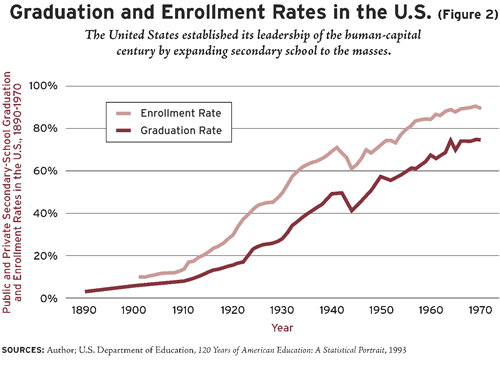 Part of the New Deal not often discussed is the effort to increase participation in public education. During the 1930’s, many grammar and high schools were built and students encouraged to complete high school.
The efforts resulted in a sharp increase in the percentage of the population graduating from high school. The increase in percent graduating from high school continued until the 1970’s when the rates plateaued.[1]
Emphasis on education continued after WWII with the GI Bill of Rights and then with availability of low-cost loans encouraging more students from lower- and middle-income families to attend college.
The lesson of these programs for today? Existing and emerging technologies require more math/analytical skills to utilize capabilities of the technologies. With the need for more math/analytic skills…and the risk of becoming an also-ran country by not adopting the technologies…what actions do we take? How does US society get more people educated, especially those on the shore unaware of the pending technology tsunami?
Following are some ideas. You’ll likely look at the list and say, “What’s so innovative about the list? I’ve heard these ideas before.” And, you’re right. The ideas are not new…but you know what? We’re not implementing them, and in some cases we seem to be regressing.
The list is intended to start the discussion:
- Help society understand that expenses for public education are investments, not merely costs. Investments may take time to payback but result in a benefit that spans generations.
- Increase pay for…and respect for teachers. Make the qualifications and salaries for teachers competitive with, and possibly slightly above, the private sector.
- Reinstitute more technical training in high schools. Almost everyone agrees not everyone is suited for college. Not attending college does not mean one does not have valuable skills. Far from it. The public schools should provide everyone an opportunity for training in how to use, leverage and maintain technology skills. At one time “technical training” was common in high schools. Time for it to return.
- Make loans for college affordable with a provision to “earn-out” the loan over a reasonable period. Unlike today, make compliance for the earn-out provision easy to understand and execute. Provide assistance to the participant – not everyone is an expert at filling out government paperwork. Encourage people to become teachers. Don’t discourage them with onerous penalties for slight mistakes in completing paperwork.
- Cut back, or eliminate private charter schools. Yes, all organizations need fixing over time. Public education is no exception. But charter schools are not necessary to fix problems in public education. Charter schools destroy the very foundation of public education…and operate with far less accountability. The trend toward charters needs to stop and charters eliminated.
- Create meaningful education programs for older workers. The claim by some that “I’m too old to learn” is an excuse, not a reason. My experience has been many older people are embarrassed to ask for help. When assistance is framed the right way, it is rare that someone turns down the opportunity to learn. We…again societal we…need to be flexible in how we approach teaching students, whether the student prospect is in grammar school or a grandparent.
- Implement meaningful education programs and works-skills programs in prisons. Incarceration is incredibly expensive. While different studies include different amounts for overhead and other costs, the least amount of cost per year to incarcerate someone is roughly the same as tuition, room and board at a state university. In many studies, the cost is multiples higher than tuition, room and board. Incarceration without rehabilitation is wasted money. Educating prisoners and having prisoners do meaningful work while incarcerated seems to be “common sense.”
How do we implement some of these ideas? More in the next article. Stay tuned.
[1] 120 Years of American Education: a Statistical Portrait, US Department of Education, 1993.
Links to articles re GM Plant Closings
 JC: “Look, I like the idea of ‘treat thy neighbor as thyself’ as the standard for behavior. But let’s not be naïve. What do we do about those people who don’t follow the rules?”
 Greenie: “Until Trump. Then he and his gang basically gave the finger to everyone. He even trashed people in his cabinet who supported him from the get go. Some display of appreciation and loyalty, huh?”
 Greenie: “A start would be to reinstate the 60-vote rule in the Senate for approving appointments, whether for the agencies or the courts. A 60-vote rule would force the White House to offer nominees toward the middle politically…not the extremes.”
 Jordan: “On the Judicial side, even with the 60-vote rule, what about limiting tenure of Senate-approved judges? Right now these judges have lifetime appointments.”
 Jordan: “Re-upping.”
 Greenie: “I don’t know if the limit should be at the court level or in total. For now, let’s assume the limit applies to a specific level. Otherwise someone might get to SCOTUS with only 6-7 years left out of the 30-year limit. That doesn’t seem fair.”
 Greenie: “OK, Jordan, any ideas how to stop such behavior? And what about all the obvious ethics violations by Trump, the Trump family and some cabinet officials? How do we stop that going forward?”
 JC: “More teeth and more transparency. I realize there’s some information cannot be disclosed. But, and this should be a big but…no comments, please about personal appearance…the baseline should be to make the public as aware as possible of the shenanigans and unethical behavior by people inside the government, especially members of Congress and high-ranking agency personnel. The disclosures might force some people to stop.”
 Greenie: “Make it in addition to impeachment. Some of the behavior will be illegal. Why shouldn’t that behavior get punished like the rest of us are subject to?”
 Greenie: “Since neither JC nor I play golf, we have no idea what you’re talking about.”
 Greenie: “Are you serious? The individual golfer is supposed to penalize herself or himself for some rules infraction? I agree, that does seem weird.”
 JC: “I guess I never appreciated all the hullabaloo about Trump, when he was president, driving his cart on the putting green at Mar-a-Lago and that place in New Jersey he used to play.”
 Jordan: “As far as hurting or killing the grass on the green, you’re right. Driving on the green one time is no big deal. But, in terms of golf etiquette, I can’t think of anything more egregious. In the rules of golf etiquette, you’re not supposed to walk on the green in an area where someone else is going to putt…aka, the putting line.”
 Jordan: “I’ve tested this theory over many rounds. If you are playing golf with someone you don’t know, by the 4th hole you will have a very good idea of their personality and their ethics.”
 Greenie: “Your theory is, if the person readily admits a mistake, or takes the penalty or apologies for breaking some etiquette rule, then that’s a reflection of their true personality. Same if they don’t acknowledge the mistake, right?”
 Greenie: “What was the title of that book? ‘All I Really Need to Know I Learned in Kindergarten.’”
 Greenie: “I shouldn’t even smile at that one…but it was pretty good. Now, JC, stop the puns and tell us your idea.”
 JC: “Two prongs. (i) Reconfigure existing roads into smarter roads. Smarter roads can carry more traffic with a lot less congestion; (ii) rebuild and expand the rail system to handle more passenger trains and freight traffic.”
 Jordan: “Commuting by rail in metro areas is easier, more pleasant, less expensive and faster. Plus, you can work on the train.”
 Jordan: “High-speed rail needs to be defined given the barriers that exist. High-speed in the Northeast corridor is not going to be like a bullet-train in Japan. Making that happen would be outrageously expensive and disruptive.”
 Jordan: “Don’t know exactly but I’ll bet you’re pushing 85-90%.”
 JC: “This sounds great but what about resolving the conflict between freight and passenger traffic? The little that I know about rail, the freight railroads seem to keep resisting any efforts to add passenger traffic to certain rail lines…in fact, most rail lines.”
 Jordan: “Other than difference in speed between freight trains and passenger trains, I don’t know of a technical reason the two can’t share the tracks.”
 Jordan: “The article was in the Harvard Business Review and written by Theodore Levitt. The title was ‘Marketing Myopia.’ An example of the myopia was the railroads viewing themselves as being in railroad business and turning thumbs down to considering being in the transportation business. As a result, the railroads lost a huge share of the logistics business to the trucking industry.”
 Greenie: “Before the break, I said I thought at first Jordan’s idea of reinstating conscription was stupid. Then I came around and supported it.”
 JC: “What’s your logic? Something wrong with charter schools?”
 JC: “Not that I disagree with you but why do you think charter schools are a band-aide?”
 JC: “We need to get more specific about the issues. Besides we know that merely throwing money at schools does not necessarily make schools better.”
 JC: “I agree that many were top-notch, especially those teaching math and English. To think we were so motivated we used to diagram sentences for fun!”
 Jordan: “What about teacher pay?”
 Jordan: “OK, I’ll be the bad guy. Why do we need free public education? What percent of the public thinks education should be privately provided and not publicly provided…forget who pays for it?”
 Greenie: “…an educated populous. And how did the US populous become educated? Not just an education for the elite but an education for everyone, including immigrants, many of whom arrived here illiterate. They were educated through a free public education.”
 JC: “While we’re throwing out ideas about education, what about banning busing? Busing seems like a waste of time and money.”
 Greenie: “Tell me how a politician is going to campaign against free, quality public education for all? That type campaign, especially in this post-Revenge Revolution environment would be suicide.”
 eenie: “Ready for another idea how to really make America great again?”
 Jordan: “You mean like Trump, Limbaugh, Hannady, and the former right-wing truthsayer, Bill O’Reilly.”
 enie: “Jordan, pulleeeze. Be a bit more diplomatic, will you?”
 Jordan: “For now, we’ll include both men and women.”
 Jordan: “Eligible at 18 but must begin service by say age 26. A person could get a deferment to attend trade school or college but would need to start by age 26.”
 Jordan: “Federal agencies that have operations in most parts of the country. Agencies that serve people locally or work with the states to service people locally.”
 Jordan: “Same with EPA. There are lots of areas where an ‘EPA corps’ as it were, could help gather data or fix an issue before it becomes difficult and costly to solve. Just like that old commercial, ‘pay me now or pay me later.’ But later is almost always much more expensive.”
 JC: “I can hear it now. Some people are going to claim what we’re proposing will be taking away jobs from others. Or worse yet, conscription will interrupt little Johnnie’s or little Susie’s career that mommy and daddy paid so much to prepare them for. How are we going to counter that argument?”
 JC: “…Let me try. #4, forced diversity. Exposure to a wide range of people and backgrounds never hurt anyone. Maybe we, that is societal we, could become a bit more civil if we understood others’ perspectives. Brilliant statement, huh?”
 JC: “You know, the time might be right to reinstitute conscription. Since the Revenge Revolution people seem more willing to explore old and new ways of trying to solve problems.”
 Greenie: “Jordan, that’s quite a list of ideas about how to make America great again. We’ve got to call this project something else but let’s not spend time on that now. Which item on the list seems like a good place to start?”
 JC: “Let’s say there’s no major legal issue. Then how should Federal funds be allocated to the candidates?”
 Jordan: “Good points. Try this. Presidential elections get the full $10/head funding. Off-year elections get $5/head allocated.”
 JC: “Let me try the math. If I remember Ester’s Algebra class, that would be 200X+435X=$1,700,000,000. Using my hand-dandy phone, x equals almost $2.7 million. So Senate races get about $5.4 million and House races about $2.7 million.”
 JC: “3rd-party candidates?”
 Greenie: “Now, JC, I mean really. What’s a few billion in a trillion-dollar Federal budget – a rounding error? I agree the approach seems expensive until you begin to add up all the hidden costs with today’s approach to funding elections…and all the backroom deals connected to the funding.”
 Greenie: “Because funds will be limited, the approach will likely also force candidates to get out on the campaign trail and meet the voters. Maybe we’ll get fewer negative ad blitzes and more time on the campaign trail.”
 Greenie: “Oh, you mean like South Carolina’s Mick Mulvaney? What chutzpah. He bragged to a group of bankers that before he became part of the Trump Administration, he only talked to lobbyists who paid him. Wonder if he stopped the practice when he became director of OMB and consumer protection bureau for Trump? Pardon me — that seems like a rhetorical question.”
 Greenie: “He retired from the House. I guess you call it retired if not seeking in November 2018 qualifies as retiring.”
 JC: “C’mon, you love it. Now what’s the idea?”
 Greenie: “Let’s keep in mind the past does provide some guidance to the future. You do agree with that, don’t you, Jordan?”
 Jordan: “For one, Greenie’s articles about the Revenge Revolution. We might have more understanding about the causes of the Revenge Revolution than anyone in Congress, especially incoming members or staffers.”
 (Following is the list from the brainstorming session about how to really make America great again. Over the coming blog entries, a number of these ideas will be discussed in more detail.)
 First, it appears more and more people are realizing what the military and gun enthusiasts have known for some time – the AR-15 is not a sport rifle, is not a hunting rifle but is an assault weapon designed for killing as many people as possible in as short a time as possible.
 Why such a harsh recommendation? First and foremost, these type weapons are not needed outside the military. For those who insist on firearms to protect self and/or property, hunting rifles, shotguns and pistols are more than adequate. For hunters, using AR-15’s is hardly sport, even if hunting elephants, lions, tigers or bears, which you shouldn’t be doing anyway.
 Banning assault weapons is not unprecedented. Beginning in 1994 Federal law banned the sales of newly manufactured assault weapons. Former presidents Gerald Ford, Jimmy Carter, and Ronald Reagan, wrote to the U.S. House of Representatives in support of banning “semi-automatic assault guns”. The law passed with bi-partisan support. Congress let the law expire in 2004.
 ll not be infringed.”
 In that context, the Second Amendment seems perfectly logical. Guys, get it? The regular citizens of the country made up the military when the Constitution was written. And, if you’re a strict “Constitutionalist” and interpret the Constitution as originally written, the weapons were single-shot flint locks, not AR-15’s.
 Get serious conservatives. If you understood government, you might realize that you already live in a country where the government allows you basic rights. That piece of property you think you own? Your right to ownership is a function of government. The freedom to travel? That freedom is a function of government. Hate to burst your conservative bubble, but the freedoms that you have are because the government lets you have those freedoms.
 I hope these students ask their grandparents to coach them about how the grandparent protested the Vietnam War. Then the kids can go to Washington, march in front of the White House and chant, “Hey, hey, Donald J! How many kids did you kill today?”
 Wolf Man: “Met Gelly. Chatted with Greenie but never met her.”
 Greenie: “One of the first steps is trying to understand how much of a particular culture has melted into the US melting pot…and also understand how much should not have melted. We’d like your perspective on how much culture of Native Americans has melted into the US melting pot.”
 Gelly: “And what different about the white man’s perspective?”
 Wolf Man: “Simple. The white man took the best land from the natives and then created reservations for natives on crappy land. The reservations had few resources, lots of bad water and created an environment of marginal subsistence.”
 Jordan: “So we, societal we, basically turned the tribes from being self-sustaining to being a welfare state, save a few tribes with highly profitable casinos. That analysis seems like such an exaggeration.”
 Jordan: “That’s a bold statement. Is there any way to turn this around? Might be a long process but surely something can be done.”
 Wolf Man: “No crab barrels off the reservation.”
 Jordan: “I’m shaking my head. Wow, what a problem. Is there anything that can be done to change this attitude?”
 usrevolution5