• Home
  • Booklets/Grouped Entries
  • Tech Tsunami
  • List of Entries to Date
  • About the Author

usrevolution5

~ USA Headed for a 5th Revolution! Why?

usrevolution5

Category Archives: Societal Issues

#382 Religious Institutions: Next Big-Box Stores? (con’t) (We Gotta Get…Part 5)

16 Saturday May 2020

Posted by Jordan Abel in Economics, Innovative Thinking: Ideas and Products, Societal Issues, Uncategorized

≈ Leave a comment

Readers: this blog is set in the future (sometime after the year 2020). Each entry assumes there has been a 5th revolution in the US — the Revenge Revolution. More about the Revenge Revolution, a list of earlier revolutions and the author, Entry #1.

Periodically I write a “sense check” to assess whether in the next few years, a revolution in the US is still possible or whether the entire exercise is based on a statistical aberration — i.e., a roughly 50-year cycle between major upheavals in the US.  Most recent sense check, Entry #365.  

Some of the entries are part of a series.  Several series are available as easy-to-read booklets for download:

  • Working with Lee Iacocca after he left Chrysler, 2019Q3 Iacocca Personal Observations. 
  • GM EV1 — behind-the-scenes events affecting development and introduction of the GM EV1, the first modern electric vehicle. 2020Q1 GM EV-1 Story Behind the Story Booklet
  • Coming technology tsunami and the implications for the US, Tech Tsunami Booklet with Supplement
  • Trump Supporters Brainwashed? A series discussing why Republics have abandoned basic principals, Are Trump Republicans Brainwashed 2020Q1
  • Who took out the Donald?  Who/what groups are most likely to “take out” Trump? Who Took Out the Donald Entries with Update
  • Revenge Revolution — description of what form the revolution might take, 20 01 07 Start of Revolution

Prelude: I’ve concluded Trump is a lunatic and the administration filled with lapdogs save a couple of people at CDC.  Instead of wasting time commenting on actions by Trump, I thought it more productive to begin discussing what happens in the US once the coronavirus is more under control.  #378 began the series. At this point not sure how many entries.  Comments and suggestions welcome.

ENTRY #382 CONTINUES ENTRY #381: Technology Tsunami Impact. Efforts to address the coronavirus accelerated the implementation of technology in a wide variety of occupations. Going forward many US workers will be affected by what some of us have labeled the “technology tsunami.”

The negative effect on income over the next few years could be much greater than previously anticipated. During COVID-19 “stay-at-home” mandates, organizations realized certain workers were not necessary and other work could be completed using artificial intelligence-based software/hardware. As a result, even as the economy begins to recover, more blue-collar and white-collar workers of all ages are going to be faced with possibly accepting a lower-paying job or no job.

Will workers of different age cohorts be affected differently by the technology tsunami[1]? How will religious institutions be affected? Workers currently age 50+, even though they should have more financial resources, may be hit harder by the technology tsunami since many are less familiar with advanced technology and they have fewer years before retirement to try and recoup lost earnings.

Double-Whammy Tsunami. Another tsunami headed toward US shores is the retirement tsunami. What we as a society don’t talk about and certainly what has not been addressed at the Federal level is how unprepared white and blue-collar workers are for retirement.

The retirement tsunami has been caused in large part by employers eliminating employer-funded defined-benefit retirement programs and transferring to workers the responsibility for accumulating adequate savings for retirement. The potential impact of the tsunami has been made worse by erosion of personal income from the accelerating cost of housing, medical and college tuition. Workers have far less left over to save for retirement.

In a recent poll by Center for Retirement Research at Boston College, 75%, or 3 out of 4 people age 50-62 had jobs that fell into a “non-traditional” category — meaning, those without employer-provided retirement plans and health insurance. According to the report, workers in non-traditional jobs can expect their retirement income to be as much as 26% lower than that of people who spent their 50’s and early 60’s in positions with full benefit packages, according to the center’s findings.

The lower available income will likely affect consideration for contributions to religious institutions. (An article in the NYT 05/03/2020 described how some underfunded retirees are moving in with their children.)

What about the impact of the technology and retirement tsunamis on the finances of younger workers? Don’t they have 30-35 years to recoup lost earnings from a coronavirus economic slowdown? Unfortunately, a greater percentage of younger age cohorts are likely to be even less prepared for retirement than those currently age 50-62.

If costs for housing, medical, education and retirement continue to exceed gains in income, the cumulative effect will erode discretionary income further. Unless there is a fundamental change in funding of health care costs, retirement programs and advanced education, more and more people will be underfunded for retirement. Thus, younger cohorts, already less committed to religious institutions than previous generations at the same age, are also facing even more pressures on discretionary income.

What will make a bad situation worse is a prolonged economic slump associated with the coronavirus shutdowns. The rate at which people have been furloughed is unprecedented – in just two months, 36,000,000 filed new claims for unemployment, and more claims are likely in the next few weeks. In early May 2020 the “official” unemployment rate was 14.7%. However, the unemployment rate does not count those who are not actively looking for work.

The unprecedented increase in the number of people formerly employed has caused many to become so discouraged as to not look for work. These “discouraged” were excluded from the unemployment calculation. Had people who were recently employed but now discouraged been included, the rate would have been 21-22%, approximating the same as the height of the Great Depression in the 1930’s.

Despite proclamations from Trump, few people in business, few economists and few in the general public expect the economy to bounce back once more restrictions associated with the coronavirus are lifted. Even if employment in the manufacturing sector increases over the next 24-30 months as companies begin bringing jobs back to the US, overall economic growth will be very slow and unemployment is likely to remain at >10%.

Some portions of the service sector employment seem likely to experience a permanent loss of jobs. After “stay-at-home” restrictions are lifted, how many consumers will immediately return to restaurants, attend sporting events, go to shopping centers, travel by plane? How many members of religious institutions will be willing to risk infection by attending services, especially crowded during holidays?

Like the general public, members of religious institutions are likely to remain cautious until an effective vaccine has become widely available – on the optimistic side 18-24 months based on analysis of experienced doctors and researchers. Even with the vaccine will the public’s behavior be changed permanently?

During that 18-24 months and maybe forever, how many members of religious institutions will have their economic circumstances negatively affected? Many formerly employed in the service sector will not have employer-funded health insurance and even fewer will have an employer-funded retirement program. Where do these former employees turn for help? Their jobs are gone, or at least not coming back for some time. Finding another job will be extremely difficult since the economy will be growing slowly at best.

While many congregants will remain emotionally committed to their specific religious institution, how many will be faced with lower discretionary income? How many will be able to continue supporting their church, synagogue or mosque?

Eyeballs vs Butts in Seats – Post Coronavirus Behavior. The “stay-at-home” mandate associated with the coronavirus forced organizations to accelerate electronic communications using Zoom, Skype, FaceTime, etc. For religious institutions many people attending services in person pre-COVID-19 are now live-streaming. But what happens post-COVID-19? How many people will forego physically attending services and choose to continue live-streaming?

How many will ask, “Why go through the hassle of getting dressed, fighting traffic, when I can relax at home?” Further, how many will ask, “If I’m going to live stream, is there a service at another location that I would rather attend? I used to live in New Jersey, what about watching the service where I used to go?”

An issue for religious institutions is how to make live-streaming a reason to remain linked to a particular congregation. Live-stream services are somewhat like a media event. The target for live-streaming is capturing as many eyeballs as possible.   The trend toward live-streaming is likely to continue. Think about the difference between generations in comfort level with certain media venues.

While the risk is relatively small now, a concern with live-streaming is whether a religious institution’s service can be “competitive” with larger, more high-profile congregations. For a specific institution, if clergy and/or the Board of Directors has not done so, they should watch services from “higher-profile” congregations, especially those in major metro areas.

Religious Institutions Expense Pressure. Are religious institutions turning into under-utilized big-box stores? If fewer people attend services, whether weekly or during holidays, then do religious institutions need their current facility? Some congregations have expanded main buildings and/or other facilities based on the assumption membership would continue to grow. Part of the rationale has been that a more attractive and functional facility would help attract new members.

The downside of a larger facility is a higher burn rate for overhead, including staff. The larger facility also requires additional non-recurring expense for replacement of equipment and other critical maintenance.

A strategy sometimes employed when expenses exceed revenue is to defer maintenance expense and/or defer setting aside adequate funds for future maintenance and equipment replacement. While such a strategy might work for a year or two, kicking maintenance costs down the road increases the financial burden on future congregants, many of whom may be less prone to support the institution.

Are many religious institutions facing the same fate as many big-box stores? Unfortunately, all indications suggest the answer seems to be “yes.” Big-box stores and department stores, even high-end ones are facing severe financial pressure. The impact of actions taken to slow COVID-19 have merely hastened a trend toward fewer stores and, in many cases, bankruptcy. Well-known department stores J.C. Penny and Neiman-Marcus being a recent examples.

Possible Solutions. Some organizations – for-profit and not-for-profit – have survived major challenges by rethinking how to operate. Religious institutions face the choice – either rethink how to operate or likely disappear.

Survival for many religious institutions seems possible only by starting with a clean sheet of paper. Rethinking how to operate means more than cutting staff. Cutting staff is an incremental change and not a fundamental change. Clergy and the Board of these institutions should remember the adage, “No organization ever saved its way into prosperity.”

An organization needs to consider ideas that many congregants might view as radical. For example, holding talks with another congregation about: (i) a single back-office support staff: (ii) using one of the two buildings for weekly services. The services would be at separate times but use the same building. Holiday services could be at different times and use part of the other building, if necessary; (iii) lease out part of one of the buildings; (iv) plus other ideas.

The radical thinking should include a cash-flow forecast that incorporates such variables as:

  1. Number of existing members by age cohort
  2. Number of members by age cohort over time (some data likely exist)
  3. Distribution of contributions by age cohort – currently and ideally over time. Individual members would be assigned a random number so impossible to link contribution to a specific member
  4. Projected membership scenarios through 2030 and ideally 2050 by age cohort – would include new members and members who leave
  5. Projected revenue scenarios through 2030 and ideally 2050 by age cohort. Scenarios would reflect different attitudes by cohort toward religion and use of electronic communication. Revenue projections would include different approaches – “traditional’ approach to contributions, pay to watch live-streaming or some type of subscription model.
  6. Impact on revenue of different operating scenarios – stand-alone entity, combined facility, use of part of one facility for other purposes, etc.
  7. Expense forecast by year for:
    1. Staff and other recurring expenses as stand-alone entity and combined back-office staffs
    2. Unusual maintenance and equipment replacement – current and joint-use facility
    3. Expenses under the different operating scenarios

Constructing an Excel-type model (and the supporting math) for the financial projections is not particularly difficult.   Often the most difficult barrier is getting the “key executives” and/or committee members involved with the issue to: (i) acknowledge and appreciate the importance of getting ahead of the curve; (ii) begin to truly think innovatively; (iii) put aside excuses and biases and commit to considering practical solutions.

As with most strategic difficult issues, waiting until the problem becomes obvious is waiting too long and makes any kind of turnaround exceedingly difficult and problematic. A high-profile example is the Trump administration’s handling of COVID-19, starting with denial of early warning signs and then refusing to accept opinions of people with experience in key areas.

Over the next 24-36 months – and maybe longer – many religious institutions will face severe cash-flow shortfalls. Waiting until the cash-flow train wreck becomes obvious will result in even more dire consequences. While no guarantee, starting to discuss issues outlined herein and completing a study to assess potential consequences carries no risk. There is no downside to a study. Waiting until the problem becomes obvious has significant risk.

[1] For a more detailed discussion about the coming technology tsunami and possible solutions, download booklet I wrote titled “Technology Tsunami.”


#381: Religious Institutions Next Big Box Stores? (We Gotta…Part 4)

09 Saturday May 2020

Posted by Jordan Abel in Causes of the Revolution, Economics, Societal Issues, Uncategorized

≈ 1 Comment

Readers: this blog is set in the future (sometime after the year 2020). Each entry assumes there has been a 5th revolution in the US — the Revenge Revolution. More about the Revenge Revolution, a list of earlier revolutions and the author, Entry #1.

Periodically I write a “sense check” to assess whether in the next few years, a revolution in the US is still possible or whether the entire exercise is based on a statistical aberration — i.e., a roughly 50-year cycle between major upheavals in the US.  Most recent sense check, Entry #365.  

Some of the entries are part of a series.  Several series are available as easy-to-read booklets for download:

  • Working with Lee Iacocca after he left Chrysler, 2019Q3 Iacocca Personal Observations. 
  • GM EV1 — behind-the-scenes events affecting development and introduction of the GM EV1, the first modern electric vehicle. 2020Q1 GM EV-1 Story Behind the Story Booklet
  • Coming technology tsunami and the implications for the US, Tech Tsunami Booklet with Supplement
  • Trump Supporters Brainwashed? A series discussing why Republics have abandoned basic principals, Are Trump Republicans Brainwashed 2020Q1
  • Who took out the Donald?  Who/what groups are most likely to “take out” Trump? Who Took Out the Donald Entries with Update
  • Revenge Revolution — description of what form the revolution might take, 20 01 07 Start of Revolution

Prelude: I’ve concluded Trump is a lunatic and the administration filled with lapdogs save a couple of people at CDC.  Instead of wasting time commenting on actions by Trump, I thought it more productive to begin discussing what happens in the US once the coronavirus is more under control.  #378 began the series. At this point not sure how many entries.  Comments and suggestions welcome.

ENTRY #381: The future of religious institutions is being influenced by three factors over which the institutions have no control. These exogenous variables directly affect the near and long-term financial viability of many such institutions:

  1. Changing membership demographics, especially less favorable attitudes by younger generations toward religion
  2. Downward pressure on family discretionary income from multiple sources
  3. Migration to more electronic communication, in part because of sustained concern about large gatherings post coronavirus

The pressures will intensify in the coming years. Without some fundamental strategies to address the effects of these pressures, many religious institutions could become financially insolvent and forced to dissolve. Further the pressures are not specific to one or two religions. All religions are likely to be affected.

Demographic Pressure. There are numerous articles and studies (Pew Research, e.g.) indicating younger generations are less attracted to religions of all types. The younger generations also attend services less than previous generations at the same age.

When viewing the data, some believe that as younger generations age they will act more like their parents and grandparents, thus “adopting” much of the behavior of previous generations. By adopting attitudes and behavior of previous generations, these younger cohorts, therefore will become more favorable to religion and more supportive of religious institutions.

The clergy and the “Board of Directors” of a religious institution should not make the assumption re “adopting behavior.” One only needs to track age cohorts over time to realize younger age cohorts do not adopt the attitudes of their parents’ generation when they reach the same age.

Rather than adopting behavior, empirical evidence suggests cohorts “retain” attitudes and behaviors established in their early twenties. Some examples of “retaining” values range from attitudes of different generations toward such social issues as use of drugs, casual sex, age for marriage to preferred brands of vehicles to preferred style of house and furniture. One only has to ask “What happened to the appeal of darker-wood furniture as well as fine china and crystal with the generations under age 40″ to realize tastes and preferences are different?[1]

Pressure on the Revenue Stream.  Since roughly the mid-1960’s each succeeding age cohort has been faced with increased pressure on discretionary income[2]. Every religious institution should assume one or more of these pressures on discretionary income will continue, thereby making it more difficult for families to provide financial support. Pressures are:

  1. Medical costs increasing faster than income
  2. Housing prices (and rents) increasing faster than income
  3. College tuition increasing at a rate much faster than inflation and income
  4. Retirement savings burden being transferred to employees as employer-funded defined-benefit retirement programs have been eliminated

The economic pressures caused by each one of these factors probably could be managed by most families. However, when the increases in all factors are combined – each one has a similar pattern of costs outpacing income – the result is a significant erosion in discretionary income.  

A real-world example of the impact of these pressures was evident during a recent PBS News Hour broadcast. An ER- vehicle technician in New York City described the mental and economic pressures associated with the coronavirus. The interviewer asked the ER technician about salary – about $40,000 per year. As anyone familiar with the cost of living in any of the NY boroughs, $40k for a family is tight. Worse for the technician was that his employer, apparently a contractor to the City of New York, did not provide health insurance.

Here’s the guy taking people to the hospital to get treated for coronavirus (or some other emergency) but who does not have employer-paid health insurance. Even worse the technician can’t afford private health insurance because the Trump administration eliminated many features of Obamacare and eliminated insurance exchanges.

Housing Prices/Monthly Rental. The chart is for price increases of houses and rent compared to growth in median income, adjusted for inflation. While the data are national, people living in some metro areas have faced the problem of housing prices-HOA dues/rents and insurance rising even faster than noted on the chart.

Real estate taxes are also increasing. Although relatively low compared to NY/NJ/CT, housing costs and taxes in many areas are still high and a further erosion of discretionary income.  These costs result is less money available for contributions to a given institution.

College Costs. Since the 1960’s, early 1970’s tuition at public and private colleges has more than doubled as a percent of family income in inflation-adjusted dollars. Costs for elite universities have increased even faster. Even with some assistance, overall costs for higher education are likely twice as high as a percent of family income over the past couple of generations. The impact of the coronavirus may make the disparity worse. Tax revenue in virtually every state has fallen dramatically. To balance future budgets states may need to cut support for higher education.

End of this entry. More next week about the impact on contributions of: (i) technology replacing jobs; (ii) retirement savings shortfall; (iii) electronic “competition” from other religious institutions.

[1] For more analysis of “adoption” and “retention” please download paper I wrote at University of Michigan in 1987 titled “A Nation in Transition.” The paper addressed how differences in attitudes between pre-Boomer and Boomer cohorts could affect how America would view its role internationally. The paper included a comparison of a variety of attitudes. (87 12 08 Nation in Transition) 

[2] Discretionary income is the amount of an individual’s income left for spending after paying taxes and paying for personal necessities, such as food, shelter and clothing. Discretionary income includes money spent or allocated to luxury items, vacations and non-essential good/services, including contributions.

#380: Shopping Centers — Surplus to Stimulating (“We Gotta Get Out…” #3)

03 Sunday May 2020

Posted by Jordan Abel in Affordable Solutions, Common Sense Policies, Education Issues, Innovative Thinking: Ideas and Products, Societal Issues, Uncategorized

≈ Leave a comment

Readers: this blog is set in the future (sometime after the year 2020). Each entry assumes there has been a 5th revolution in the US — the Revenge Revolution. More about the Revenge Revolution, a list of earlier revolutions and the author, Entry #1.

Periodically I write a “sense check” to assess whether in the next few years, a revolution in the US is still possible or whether the entire exercise is based on a statistical aberration — i.e., a roughly 50-year cycle between major upheavals in the US.  Most recent sense check, Entry #365.  

Some of the entries are part of a series.  Several series are available as easy-to-read booklets for download:

  • Working with Lee Iacocca after he left Chrysler, 2019Q3 Iacocca Personal Observations. 
  • GM EV1 — behind-the-scenes events affecting development and introduction of the GM EV1, the first modern electric vehicle. 2020Q1 GM EV-1 Story Behind the Story Booklet
  • Coming technology tsunami and the implications for the US, Tech Tsunami Booklet with Supplement
  • Trump Supporters Brainwashed? A series discussing why Republics have abandoned basic principals, Are Trump Republicans Brainwashed 2020Q1
  • Who took out the Donald?  Who/what groups are most likely to “take out” Trump? Who Took Out the Donald Entries with Update
  • Revenge Revolution — description of what form the revolution might take, 20 01 07 Start of Revolution

Prelude: I’ve concluded Trump is a lunatic and the administration filled with lapdogs save a couple of people at CDC.  Instead of wasting time commenting on actions by Trump, I thought it more productive to begin discussing what happens in the US once the coronavirus is more under control.  #378 began the series. At this point not sure how many entries.  Comments and suggestions welcome.

ENTRY #380: If one believes COVID-19 will trigger some changes in societal behavior, then what behavior might be disrupted permanently after the immediate threat has dissipated? Last week’s entry discussed how the general public likely will demand more affordable or government-provided healthcare coverage.

This week’s entry addresses how shopping patterns might continue to be affected and the implications of major changes. The “stay-at-home” mandates during early months of COVID-19 accelerated the use of on-line shopping.

While some brick-and-mortar stores were able to generate on-line business for delivery or store-side pickup, many shoppers shifted to such on-line stores as Amazon. The shift affected food shopping as well. Even though most grocery stores remained open, many people ordered on line with curbside delivery at the store or home delivery.

The big unknown is whether consumer shopping behavior has been altered permanently. If it has, how will such behavioral change affect attitudes toward participating in such other large-crowd activities as football games, concerts, restaurants, even religious services? If people are satisfied to watch sporting events at home on large-screen TVs, to shop on-line, to have food delivered, to live-stream religious services on the same large-screen TV, then what happens to the physical structures supporting large-crowd activities?

For the businesses/organizations associated with these activities, what happens to the value of the real estate or the value of the franchise, whether the organization is a chain restaurant, retail outlet, or religious institution? (Interesting, the value of a sports franchise may be less affected since much of the value is not based on the number of fans attending an event but the advertising revenue associated with the media broadcast of the event.)

If the value of the real estate falls, then what should be done with the property? Let’s start with the most obvious real estate – shopping centers. As suburbs were developed following WWII, shopping centers became the de facto downtown for the suburbs. Just as the value of real estate in many downtowns declined as shopping centers proliferated, the value of shopping centers has declined as on-line shopping has proliferated.

Without having any hard data, the United States likely has at least two times the number of shopping centers needed. Some of the surplus shopping centers are large-footprint centers with multi-anchor stores and some more neighborhood centers and/or strip malls. Most larger centers also have a number of big-box stores on the periphery, which are also not needed.

What should be done with these surplus shopping centers and big-box stores? Converting the real estate to office space has been an option. However, following the coronavirus the US may end up with too many office buildings as well. As people were forced to work from home, and the implementation of technology was accelerated, many companies began to rethink requirements for (i) office space; (ii) employees on staff. The result of this rethinking is likely to be fewer office buildings and smaller staffs. (For more information about the impact on employment of the implementing more technology, download Tech Tsunami Booklet with Supplement).

If office space is not needed, then what could be done with these shopping centers? Why not address a national need and convert the shopping center to affordable housing? The coronavirus pointed out the irony that many workers deemed “essential” were also lower-paid workers. Converting shopping centers to affordable housing for these workers also would allow them to live closer to public transportation, which usually is available in larger shopping centers.

The shopping centers could be reconfigured to become true neighborhoods. Many shopping centers have large areas devoted to parking that could be converted to playgrounds, small parks, even neighborhood sports fields. Many centers are ringed with restaurants, dry cleaners, drugstores, etc., which could stay in place following redevelopment. With some creative planning, neighborhood schools could be built as part of the conversion. (School nicknames could incorporate the name of the former shopping center – the Carolinaplace Cougars or the SouthPark Sentinels. Just kidding.)

As a centerpiece of the neighborhood, the schools could be designed with classrooms for the traditional “3 R’s” education, as well as classrooms for introduction to sciences and the arts.

Neighborhood schools would reduce the need for and the inconvenience and cost of busing. Neighborhood schools would encourage children to participate in after-hours extra-curricular activities as well as be available, if needed, for remedial classes. Such here-and-now remedial classes would help students keep pace.

The proximity of the school near students’ homes would reduce the need for parents to spend money on expensive babysitting. Building design could include rooms adaptable for adult education and/or neighborhood meetings.

To help address the problem of limited access to healthcare faced by many lower-paid workers, the redeveloped shopping center could include a neighborhood clinic with office hours tied to non-working hours of neighborhood families. Clinics would serve basic needs, including physicals for children and adults and would be linked electronically to larger medical facilities. Such “preventive medicine” would reduce visits to ER.

Next week. More on post-coronavirus impact on societal behavior, including how religious institutions might be affected. Could some churches, synagogues and mosques suffer the same fate as many big-box stores?

#379: Healthcare Quagmire: We Gotta Get Out of This Place (Part 2)

25 Saturday Apr 2020

Posted by Jordan Abel in Affordable Solutions, Benefits of Revolution, Common Sense Policies, Gov't Policy, Possible Solutions, Societal Issues, Uncategorized

≈ Leave a comment

Readers: this blog is set in the future (sometime after the year 2020). Each entry assumes there has been a 5th revolution in the US — the Revenge Revolution. More about the Revenge Revolution, a list of earlier revolutions and the author, Entry #1.

Periodically I write a “sense check” to assess whether in the next few years, a revolution in the US is still possible or whether the entire exercise is based on a statistical aberration — i.e., a roughly 50-year cycle between major upheavals in the US.  Most recent sense check, Entry #365.  

Some of the entries are part of a series.  Several series are available as easy-to-read booklets for download:

  • Working with Lee Iacocca after he left Chrysler, 2019Q3 Iacocca Personal Observations. 
  • GM EV1 — behind-the-scenes events affecting development and introduction of the GM EV1, the first modern electric vehicle. 2020Q1 GM EV-1 Story Behind the Story Booklet
  • Coming technology tsunami and the implications for the US, Tech Tsunami Booklet with Supplement
  • Trump Supporters Brainwashed? A series discussing why Republics have abandoned basic principals, Are Trump Republicans Brainwashed 2020Q1
  • Who took out the Donald?  Who/what groups are most likely to “take out” Trump? Who Took Out the Donald Entries with Update
  • Revenge Revolution — description of what form the revolution might take, 20 01 07 Start of Revolution

Prelude: I’ve concluded Trump is a lunatic and the administration filled with lapdogs save a couple of people at CDC.  Instead of wasting time commenting on actions by Trump, I thought it more productive to begin discussing what happens in the US once the coronavirus is more under control.  #379 is the second entry and addresses healthcare cost. At this point not sure how many entries.  Like #378 this entry is a bit long.

ENTRY #379:  At the end of part 1 of this series (#378), I indicated suggestions to help address inequities in society would be forthcoming. Let’s start with what appears to be the closest to a practical solution, affordable health care for everyone.

The chart indicates the increase in medical care cost in the US as a percent of GDP. Since 1960, medical costs have increased from about 5% of GDP to more than 18% in 2018. These percentages include “discounts” offered to insurance companies and Medicare.

The impact of medical costs on a family vary widely. For families with health insurance partly or fully funded by an employer, the costs are relatively low. Yet, even with subsidies from employers, for most every family medical costs have increased faster than family income.

Until the Affordable Care Act passed under the Obama administration, families which did not have subsidized insurance, faced premiums that could be breathtakingly high, especially for those over age 50. In addition, many who had any one of a range of “pre-existing” condition often were unable to secure any coverage for the pre-existing condition.

The Affordable Care Act, aka Obamacare, made considerable progress in filling the “unaffordable insurance hole” in the societal safety net and for getting coverage for pre-existing conditions. While Obamacare included some coverage gaps, in part to ensure passage in Congress, the AFA did significantly reduce the number of people without medical insurance.

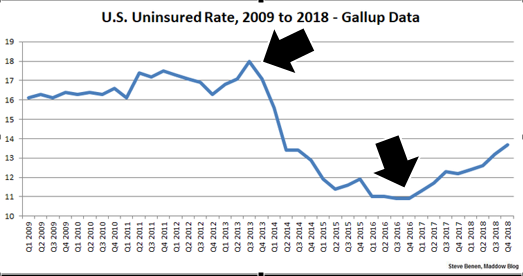
For example, immediately prior to AFA coverage taking effect, about 18% of the US population was uninsured. That percentage continued to drop through 2016:Q4. Immediately upon taking office in 2017:Q1, the Trump administration repealed many features of the AFA.

The Trump administration has continued to eliminate features, including many insurance exchanges, through which uninsured people could at least buy some coverage. The result of Trump’s policies has been a sharp uptick in the number of uninsured. While the chart stops at 2018, the latest projection for 2020 is 45-50 million people in the US will be uninsured.

Opposition to broader insurance coverage seems to focus on two issues: (i) potential elimination of the option to buy additional private insurance; (ii) additional taxpayer cost with expanded coverage for everyone. Both issues are solvable, if opponents will listen.

A Medicare-for-All (MFA) type coverage does not preclude availability of private insurance that would offer an additional level of service or benefits. In some metro areas, selected medical practices offer what is promoted as “concierge service,” ensuring quick access to physicians and more private facilities for many procedures.

While the initial cost for a MFA program could be somewhat higher as people formerly uninsured begin to address issues, longer term the cost could be less. Much of the cost savings could be from eliminating “unproductive” costs. While estimates vary because of different assumptions, overhead costs for Medicare appear to be about 50% less than overhead costs for private insurance. (NYT article)

Currently hospital costs and therefore healthcare insurance premiums include some amount for emergency room visits by the uninsured and those without financial resources. ER visits are far more expensive than office calls. In addition, people who have no insurance often wait until an illness or situation becomes extreme before visiting ER, thereby increasing the cost of treatment.

Opponents to Medicare-for-All should think about medical cost in the same way they think about maintenance on their personal vehicle. Routine maintenance, such as changing oil regularly, is much less expensive than doing no maintenance and eventually replacing the engine. In many ways, the human body operates much your car’s engine; preventive maintenance is much less expensive.

Getting Congress to agree to some form of Medicare-for-All should be much easier following the United States’ experience with the coronavirus. There has not been an event in most everyone’s lifetime that has demonstrated the importance of medical care for all citizens. Recent estimates indicate those without insurance infected with COVID-19 will face medical bills of $50,000-$75,000. Even those with insurance could face medical bills of $25,000 or more.

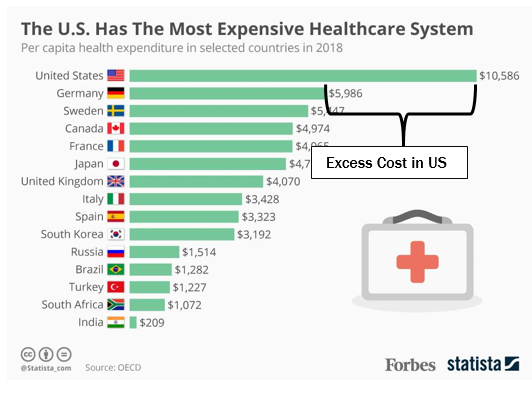
For those who still think the US cannot afford such coverage, the chart lists healthcare costs per capita by country. Note the cost per capita for highly developed countries. The cost in the US is 75% HIGHER than Germany, the next most expensive country. OK, if you’re still concerned these countries don’t offer the same level of care as the US, then buy the additional-cost option.

Addressing the Naysayers. Any effort to implement a Medicare-for-All type system will be met with vigorous opposition from the right. Following are some likely questions as well as suggested answers. I recognize no answer, however logical and supported by facts, will satisfy the hard right. But given how so many people have been affected by COVID-19 so far, and how many are likely to be affected in the coming months, the voice of the naysayers may be heard less and less, especially when facts are presented to support a Medicare-for-All type system.

Comment #1: The US has the best healthcare system in the world. Don’t mess with it! Leave it alone.

Response #1: Let’s look at the expected lifespan in the US compared to other countries. The US ranks 47th behind such countries as Sweden, Germany, China, Taiwan, France, Korea, Canada, UK, Costa Rica, French Guiana and a host of other countries and ranks just one ahead of Cuba. If the US has such a great healthcare system, why does it rank 47th?

Comment #2: Those countries don’t have as many immigrants as the US. Those immigrants are what’s causing the problem here.

Response #2: Take a look at life expectancy among whites, blacks and Hispanics. Whites have the longest life expectancy but the others are not bringing the US total down by much. You also realize that life expectancy in the US declined under the Trump administration, don’t you? The decline was the first since WWII.

Comment #3: Why should I pay for someone else’s healthcare? There are lots of slackards out there who don’t pay income taxes. Paying for their medical care is not fair to me.

Response #3: First, anyone who has worked, whether or not they pay income tax, contributes to funding Medicare. In addition, the vast majority of Medicare recipients paid while working and continue to pay a monthly premium in retirement.

Comment #4: Medicare-for-All will create another inefficient government bureaucracy. The private sector is always more efficient. Why waste my hard-earned dollars?

Response #4: The bureaucracy supporting Medicare already exists. Plus, overhead for Medicare is substantially less than for private insurance. While there are different estimates for overhead, there is almost universal agreement that overhead costs for Medicare are substantially less than for private insurance. Most estimates are savings for Medicare of 50% or more. Medicare is more efficient at administering care than private companies. Why should people have to pay 2x the administrative costs for private insurance as they do for Medicare?

Comment #5: How are the doctors going to make any money? Medicare screws them on pricing.

Response #5: One adjustment with Medicare-for-All might be to weight payment to doctors more toward prevention rather than procedures. The change should also generate cost savings. In addition, if necessary, fees to doctors could be increased. The area needs further analysis.

SUMMARY: Some form of “Medicare-for-All” with an option for additional-cost coverage seems an ideal solution to help us address “we gotta get out of this (healthcare quagmire)  place.”  Obviously there are some issues to be worked out in order to implement a Medicare-for-All type program. However, most of the issues have been solved with existing Medicare programs and the Affordable Care Act prior to the Trump administration cuts.

Enough discussion for now about a practical solution to addressing healthcare costs. Likely more later.


#378. US Societal Quagmire: “We Gotta Get Out of This Place” (Part 1)

19 Sunday Apr 2020

Posted by Jordan Abel in Causes of the Revolution, Gov't Policy, Societal Issues, Uncategorized

≈ 22 Comments

Readers: this blog is set in the future (sometime after the year 2020). Each entry assumes there has been a 5th revolution in the US — the Revenge Revolution. More about the Revenge Revolution, a list of earlier revolutions and the author, Entry #1.

Periodically I write a “sense check” to assess whether in the next few years, a revolution in the US is still possible or whether the entire exercise is based on a statistical aberration — i.e., a roughly 50-year cycle between major upheavals in the US.  Most recent sense check, Entry #365.  

Some of the entries are part of a series.  Several series are available as easy-to-read booklets for download:

  • Working with Lee Iacocca after he left Chrysler, 2019Q3 Iacocca Personal Observations. 
  • GM EV1 — behind-the-scenes events affecting development and introduction of the GM EV1, the first modern electric vehicle. 2020Q1 GM EV-1 Story Behind the Story Booklet
  • Coming technology tsunami and the implications for the US, Tech Tsunami Booklet with Supplement
  • Trump Supporters Brainwashed? A series discussing why Republics have abandoned basic principals, Are Trump Republicans Brainwashed 2020Q1
  • Who took out the Donald?  Who/what groups are most likely to “take out” Trump? Who Took Out the Donald Entries with Update
  • Revenge Revolution — description of what form the revolution might take, 20 01 07 Start of Revolution

Prelude: in a couple of preceding entries I tried to address the seemingly endless number of inconsistencies in information from the Trump administration about the spread of the coronavirus and/or actions to mitigate the spread. After some reflection, I decided that was futile.  Trump is a lunatic and the administration filled with lapdogs save a couple of people at CDC.  Instead of wasting time on Trump, I thought it more productive to begin discussing what happens in the US once the coronavirus is more under control.  At this point not sure how many entries.  The first one is a bit long.  

ENTRY #378 BEGINS: In the 1960s, there was a song by The Animals that included the lyrics, “We gotta get out of this place if it’s the last thing we ever do.”   While not written as a protest against the Vietnam War, the song was often used as a protest against the US participation in Vietnam.

Even though the song is more than 50 years old, the title seems appropriate today. The place we have to get out of is the economic and social quagmire in this country. The economic and social quagmire has been gradually getting worse with each decade. And while the Trump Administration has not been the sole cause, decisions by Trump with the support of the Republican Party have made the quagmire far worse.

Another perspective on the same situation is the US is sitting on an economic and social time bomb with the timer clock getting close to zero hour and ready to explode. What’s creating the time bomb is pressure from multiple sectors:

  1. Decades of limited earnings growth for middle and lower-income workers. The result has been greater income inequality.
  2. More medical risk. Fewer employers are providing company-paid medical insurance, thus leaving families to fund their insurance.
  3. Less job certainty. The uncertainty has been growing for some time as more organizations hire workers as contractors. Organizations are also automating an ever increasing number of functions of blue-collar and white-collar workers.
  4. More societal polarization with focus on one’s political party rather than with focus on solving problems. The shift began with the Reagan administration, when Reagan repeatedly declared, “Government is the problem, not the solution.” Trump’s public animosity toward anyone who does not support his views, however controversial, convoluted and even unconstitutional, has taken party loyalty over policy to an unprecedented level.

The four forces squeezing the US population are like hands squeezing a balloon. The coronavirus has intensified the squeeze, leaving little time before the balloon bursts. Reactions to state governors’ actions to control the spread of the coronavirus generally have been positive although some on the far right have protested. Apparently far-right Republicans think they have immunity to the virus.

The stay-at-home directives, closing of businesses and social distancing seem to have allowed the nation to pause and begin rethinking previously held assumptions. For example, prior to the coronavirus, certain jobs were considered relatively unimportant and, therefore, not worthy of much compensation. Such jobs included non-degreed healthcare workers, grocery store staff, transit workers and workers at food-processing plants.

Interestingly, the coronavirus changed those assumptions. People began to realize how important these jobs were to a functioning society. During the coronavirus those working in healthcare, grocery store and food-processing, among others, were categorized as “essential.” At the same time, many college-degreed, higher-paid white-collar jobs, including many executives, were categorized as “non-essential” and mandated to work from home.

Further, many “non-essential” businesses were ordered to close. The result was a huge spike in unemployment. Over a four-week period ending mid-April 2020, more than 22,000,000 workers in the US filed for state unemployment benefits. Over the next few weeks, the total will likely increase significantly since many unemployment offices were overwhelmed and furloughed workers unable to file.

How many of those currently furloughed will be re-employed post-coronavirus is uncertain. At a minimum, there likely will be a major disruption to the pre-virus job-status hierarchy. Many lower-paid “essential” workers could receive a pay increase and many white-collar workers deemed “non-essential” could be reclassified to lower-paid positions or jobs eliminated.

The COVID-19-related shutdown of the US economy has brought to the forefront social and economic inequities. Prior to COVID-19 these inequities often were discussed in the abstract since most of the people discussing the inequities were not affected directly. COVID-19 has reframed the conversation. Most of the public now realizes how fragile their jobs are and how the safety net for furloughed workers has a huge hole, starting with unemployment benefits and medical coverage.

Now that this “hole” in the safety net has been discovered, what steps will elected officials take to make repairs? The task of repairing the hole may be more complicated than policymakers realize. While anyone losing a job or being furloughed without pay suffers economically, the impact of that loss may be markedly different for different age groups.

Historically, as workers aged their families had been able to accumulate financial resources that could help cushion economic downturns. Thus, older workers furloughed because of COVID-19 should be in a better position economically than younger workers. But are workers today, older and younger, able to weather an economic downturn?

How do economic resources of today’s workers compare to workers at the same age say 25 years ago? Do today’s workers age 45 have the same relative assets as workers who were age 45 in 1995? What about assets of workers say age 25 in 2020 compared to those age 25 in 1995? Are workers today, older and younger, at a disadvantage economically compared to previous age cohorts? The answer is, “yes.” And that disadvantage has grown with each generation.

Over the last 50-60 years, there has a fundamental deterioration in affordability of key factors that help a family accumulate assets. Since roughly the mid-1960’s each succeeding age cohort has been faced with:

  1. Housing prices (and rents) increasing faster than income
  2. Medical costs increasing faster than income
  3. College tuition increasing at a rate much faster than inflation and income
  4. Retirement savings burden transferred to employees as employer-funded defined-benefit retirement programs have been eliminated

The economic pressures caused by each one of these factors probably could be managed by most families. For example, since 1960, when adjusted for inflation, housing prices have increased about 125%, rent about 75% and income only 25%.  However, when the increases in all factors are combined – each one has a similar curve – the result in a significant erosion in disposable personal income.

A story that hit me like a 2×4 to the forehead was an interview with a family trying to survive under the crush of these economic pressures. The interview was during the recent PBS News Hour. The subject was an ER- vehicle technician in New York.

The technician was describing the mental and economic pressures associated with the coronavirus. The ER technician earned about $40,000. As anyone familiar with cost of living in any of the NY boroughs, $40k for a family is tight. He also had a second job. What really struck me was the ER technician’s employer, apparently a contractor to the City of New York, did not provide health insurance.

Here’s the guy taking you to the hospital to get treated for coronavirus (or some other emergency) but the ER technician does not have employer-paid health insurance. Even worse he can’t afford private health insurance because the Trump administration eliminated many features of Obamacare and eliminated insurance exchanges. So, Trump and Republicans, the guy taking you to the hospital to save your life is risking his life and risking financial ruin if he contracts the virus from you. Does that seem fair?

Longer term, the impact of the coronavirus on the United States will likely end up changing permanently a number of aspects of society. The post-coronavirus United States will likely be forced to address the medical and economic inequities that have been building for the past 50-60 years. In addition, the US might begin to address the need retrain workers as more technology is integrated into the workplace.

The likely result of the coming technology tsunami? Many blue-collar and white-collar workers of all ages are going to be faced with possibly accepting a lower standard of living. (See booklet titled Technology Tsunami for more discussion and possible solutions.)

Will workers of different age cohorts be affected differently? Workers currently age 50 and older, even though they should have more resources, may be hit harder by the technology tsunami since many are less familiar with advanced technology and they have fewer years before retirement to try and recoup lost earnings.

But the technology tsunami is only one tsunami facing current workers. Another tsunami headed toward US shores is the retirement tsunami. What we as a society don’t talk about and certainly what has not been addressed at the Federal level is how unprepared for retirement workers are.

The retirement tsunami has been caused by the elimination of employer-funded health and retirement programs. The potential impact of the tsunami has been made worse by erosion of personal income from the accelerating cost of housing, medical and college tuition. Workers have nothing left over to save for retirement.

In a recent poll by Center for Retirement Research at Boston College, 75%, or 3 out of 4 people age 50-62 had jobs that fell into a “non-traditional” category — meaning, those without employer-provided retirement plans and health insurance. According to the report, workers in non-traditional jobs can expect their retirement income to be as much as 26% lower than that of people who spent their 50’s and early 60’s in positions with full benefit packages, according to the center’s findings.  (Update: NYTimes article about older workers without adequate retirement savings moving in with children, 20 05 03 NYT Underfunded Retirement Parents Moving in with Children) 

What about the impact of higher costs and the technology tsunami on younger workers? Don’t they have 30-35 years to recoup lost earnings from a coronavirus economic slowdown and the technology tsunami? Unfortunately, a greater percentage of younger age cohorts are likely to be even less prepared for retirement than those currently age 50-62.

If costs for housing, medical, education and retirement continue to exceed gains in income, the cumulative effect will further erode disposal personal income. Unless there is a fundamental change in how health care costs, retirement programs and advanced education are funded, more and more people will be underfunded for retirement.

What will make a bad situation worse is a prolonged economic slump associated with the coronavirus shutdowns. The rate at which people have been furloughed is unprecedented – 22,000,000 in four weeks and likely another 10,000,000 in the next four weeks.

Few people in business, few economists and much of the general public does not expect the economy to bounce back once the restrictions associated with the coronavirus are lifted. Even if employment in the manufacturing increases over the next 24-30 months as companies begin bringing jobs back to the US, overall economic growth will be very slow.

Some portions of the service sector employment seem likely to experience a permanent loss of jobs. After “stay-at-home” restrictions are lifted, how many consumers will immediately return to restaurants, attend sporting events, go to shopping centers or travel by plane – and especially take cruises? Consumers are likely to remain cautious until an effective vaccine has become widely available – probably as long as 18-24 months. Even with the vaccine will the public’s behavior be changed permanently?

During the next 18-24 months and maybe forever, how much of structure of service sector will change? Many formerly employed in the service sector have no employer-funded health insurance and even fewer have an employer-funded retirement program. Where do these former employees turn for help? Their jobs are gone, or at least not coming back for some time. Finding another job will be extremely difficult since the economy is growing slowly at best.

Now you see why the theme of this entry is “We gotta get out of this place if it’s the last thing we ever do.” This place is a dead end. We’ve got to find something new. The pressure to “get out of this place” seems like the spark for the Revenge Revolution.

The hardships associated with coronavirus seems to be awakening the middle class to realize how long they have been screwed by Republican policies of tax cuts for the wealthy and denying affordable medical care for all. Workers over 50 are realizing the need to return to employer-funded retirement programs and/or increased Social Security retirement benefits. Such programs are widespread in other developed countries so there is no excuse for not implementing.

When will the Revenge Revolution start? I think we’ve started. The coronavirus seems like an event that could trigger a revolution. The pace and magnitude of the job losses are unprecedented. The Revenge Revolution could spread as quickly as the coronavirus.

As more and more people realize “we gotta get out of this place” the more pressure on Washington to address the social and economic inequities. People are not going to be satisfied with Trump blaming China, the WHO or someone else for the coronavirus. People want concrete steps to fix the hole in the safety net, help train people for the coming technology tsunami, make healthcare affordable for everyone and make sure people have adequate resources for retirement. (Next few entries will offer some solutions.

#376. Trump’s Stupidity May Help Save the Country

29 Sunday Mar 2020

Posted by Jordan Abel in Benefits of Revolution, General Motors, Post Trump Presidency, Societal Issues, Stupid Is as Stupid Does, Uncategorized

≈ Leave a comment

Readers: this blog is set in the future (sometime after the year 2020). Each entry assumes there has been a 5th revolution in the US — the Revenge Revolution. More about the Revenge Revolution, a list of earlier revolutions and the author, Entry #1.

Periodically I write a “sense check” to assess whether in the next few years, a revolution in the US is still possible or whether the entire exercise is based on a statistical aberration — i.e., a roughly 50-year cycle between major upheavals in the US.  Most recent sense check, Entry #365.  

Some of the entries are part of a series.  Several series are available as easy-to-read booklets for download:

  • Working with Lee Iacocca after he left Chrysler, 2019Q3 Iacocca Personal Observations. 
  • GM EV1 — behind-the-scenes events affecting development and introduction of the GM EV1, the first modern electric vehicle. 2020Q1 GM EV-1 Story Behind the Story Booklet
  • Coming technology tsunami and the implications for the US, Tech Tsunami Booklet with Supplement
  • Trump Supporters Brainwashed? A series discussing why Republics have abandoned basic principals, Are Trump Republicans Brainwashed 2020Q1
  • Who took out the Donald?  Who/what groups are most likely to “take out” Trump? Who Took Out the Donald Entries with Update
  • Revenge Revolution — description of what form the revolution might take, 20 01 07 Start of Revolution

Prelude: there is an endless number of inconsistencies in information from the Trump administration about the spread of the coronavirus and/or actions to mitigate the spread. For recent blog entries I’ve selected a few that are representative but not necessarily the most egregious.

ENTRY #376 BEGINS:  When it became clear the coronavirus had turned into a pandemic, the White House dropped claims the virus was a hoax and established a task force to help coordinate something, although no one was quite sure what.  The task force began a daily press conference to provide the public with updates on the spread of the virus, actions being contemplated – emphasis on contemplated – to help mitigate the spread and guidance from CDC doctors about steps to the public could take to avoid getting infected or infecting others.

Once Trump realized the task force’s press conference was being viewed widely, he insisted on VP Pence playing second fiddle and Trump becoming the lead spokesperson. Since joining the daily briefings, frequently Trump has spoken for 45-60 minutes, often rambling incoherently about a wide range of unrelated and irrelevant topics. The rambling regularly includes an incredible number of lies and totally fabricated stories and claims. 

Even in a crisis, Trump cannot tell anything resembling the truth.  Since the beginning of his term, the frequency and magnitude of the lies has increased dramatically, even by Trump standards.  The daily press conferences seem to be two, sometimes three different events. 

  1. Press conference featuring Trump’s incoherent rambling and lies.  The remarks almost always include pointing fingers at someone else, claiming the other person/group is at fault, and not Trump.  An example is Trump claiming the Governor of New York should have known that the Federal government had stored ventilators in New Jersey.  Even though the Federal government didn’t know, Governor Cuomo of NY should have known the ventilators were in New Jersey!  Seems logical to me.
  2. Press conference updating info from the task force.  Lots of claims of progress and projections but very little hard data.  During the press conference the contrast is shocking between statements from Pence, who constantly praises Trump, and live reports from doctors and nurses in hospitals in say Brooklyn or Queens.  While Pence has fewer gross misstatements than Trump, Pence has not been a credible source of information.
  3. Press conference with doctors from CDC, especially Anthony Fauci, a 79-year-old, Brooklyn-born straight shooter with extensive experience in communicable diseases.  Fauci has become a trusted “voice of reason” in this crisis.  Fauci also frequently, but diplomatically, corrects Trump’s claims.  The contrast between Trump and Fauci is striking, both in stature and credibility.  The little guy Fauci is a credible giant.

Unfortunately, for Trump’s hard-core supporters, none of Trump’s behavior seems to matter.  For them Trump can never be wrong, no matter how egregious the claim or no matter how much data support the truth.  Trumpsters have made it a habit of never checking the facts.  Why should they when they have “alternative facts” to support their position?  If one is able to hold something akin to a conversation with a Trumpster, the least bit of a challenge to one of Trump’s claims will result in the Trumpster making irrelevant and usually disproved claims, usually about Obama or Hillary Clinton. 

Trump’s lies, and the refusal within the Trump Administration to address real problems – recall as late as March 3 Trump claimed the coronavirus was a hoax – has made it even more difficult to address the many logistical and medical equipment availability problems associated with the coronavirus.

An example is limited availability of ventilators.  While the percentage is small of people contracting the coronavirus who need a ventilator, the vast number of people who have or will contract the virus results in the need for ventilators far in excess of existing capacity.

Increasing production of ventilators is it good example of how, in the Trump administration, no good deed goes unpunished. When projections indicated that demand for ventilators would far exceed installed capacity, General Motors offered to work with Ventec Life Systems, a ventilator company based in Bothell, WA and help the company increase production.

That proposed relationship was announced March 20, although likely most of the agreement had already been reached. Under the agreement GM was to help the company increase production from about 150 per month to 1,000 per month and then 10,000 per month with total production up to 200,000 ventilators.

Within a few days of the announcement that GM would help, which received decent press coverage, there was another announcement published in the technical press.  That release received very little coverage.  The “technical” press release indicated details about the ventilator design. Knowing the details presented a completely different picture of the problems GM faced in increasing production than the supposed problems claimed by Trump.

If you were not familiar with manufacturing, the details in following paragraphs might not seem to be so important. If you are familiar with manufacturing, your jaw might drop and hit the table.

For reference, think of a ventilator as a somewhat more elaborate HVAC system that’s in your car or truck. Both the ventilator and HVAC have a pump, tubes to push the air, vents that open and close and sensors to monitor air flow and other conditions. The ventilator also includes a facemask to help concentrate the airflow for the user. Otherwise the ventilator and the HVAC system are roughly the same.  Since GM makes millions of cars and trucks every year, all with some form of HVAC, one would think that GM should be able to take the ventilator company’s design and ramp up production within a few days.

Alas, the unforeseen problem. I don’t know the exact percentage, but I’ll bet 90% of the key components are the same for every HVAC system installed in GM cars and trucks. Yes, between body styles the tubes might be a different length and the mounting brackets might be different, and the pump on a big truck will be larger than a small car, but fundamentally the components are all about the same.

Well, manufacturing experts, the ventilator design would not pass DFM 101 (design for manufacturing). The report I saw in the tech press indicated there are 1,400 specific parts. That sounds outrageously high so let’s cut that by 75% and say there are 350 specific parts. The tech press also indicated the parts were sourced in at least 10 different countries.

Thus, what GM encountered was not a manufacturing problem which it could solve simply and quickly, but a supply chain problem, which can take much longer to solve. No one, and I mean no one, who understands one iota about manufacturing would allow such a crazy design to go into production. For GM, the problem then became how to find parts, including parts in a number of countries also inflicted with the coronavirus. Nonetheless, GM apparently found enough parts to be ready to begin ventilator production at a plant in Kokomo, IN that is outfitted for “clean production.”

What did Trump do to help alleviate the ventilator shortage? Trump, who knows absolutely nothing about manufacturing and apparently is either too lazy or too stupid to learn, likely both, blames GM for not meeting a Trump-set production goal, even though GM was ready to begin production and waiting for Federal government approval. In addition, rather than approving the request to begin, Trump said GM should begin production at a Lordstown, OH assembly plant that GM no longer owns.  (Bloomberg article.)

OK Donald, let’s not take responsibility for not preparing the country for a likely pandemic – your administration was informed formally by China January 3 and then later you claimed you always knew it was a pandemic.  No, instead of taking responsibility, let’s blame the Good Samaritan GM for stepping up and trying to help.

In addition to chastising General Motors for not meeting a nearly impossible production schedules, Trump claimed GM was charging too much for the project. Of course, Trump had no data points to support his claim. In a widely-watched interview, Governor Cuomo of New York stated that each ventilator cost the State of New York roughly $25,000.

Trump told GM to build a minimum 40,000 ventilators asap.  Gee, the last I looked 40,000*$25,000 = $1,000,000,000.  Where’s the premium you claim GM is charging?  There appears to be little, if any reimbursement to GM for engineering hours, travel expenses and assembly time.  What’s being charged is the transfer price from the existing company.

There’s an old saying, “When the going gets tough, the tough get going.”  Well, Trump’s refusal to lead and to take responsibility for delaying any type of Federal action to help thwart the effects of the coronavirus is a perfect example of someone who talks tough but isn’t. 

Ironically, Trump’s lame, narcissistic, stupid behavior may somehow allow the US to avoid a more serious 5th revolution.  The Revenge Revolution will still occur but the outcome, if patterns continue, will be positive.  People are starting to understand and appreciate the importance of sharing and sacrifice, the importance of being honest and helpful, the importance of duty, honor, country.  Trump has none of these characteristics.  In a very obtuse way, his negligence and ineptness has forced the country to reassess its behavior.

I’m optimistic the US will be a better country once we get through this phase of the coronavirus.  It’s truly unfortunate so many people had to die prematurely because of Trump’s behavior.


When it became clear the coronavirus had turned into a pandemic, the White House dropped claims the virus was a hoax and established a task force to help coordinate something, although no one was quite sure what.  The task force began a daily press conference to provide the public with updates on the spread of the virus, actions being contemplated – emphasis on contemplated – to help mitigate the spread and guidance from CDC doctors about steps to the public could take to avoid getting infected or infecting others.

Once Trump realized the task force’s press conference was being viewed widely, he insisted on VP Pence playing second fiddle and Trump becoming the lead spokesperson. Since joining the daily briefings, frequently Trump has spoken for 45-60 minutes, often rambling incoherently about a wide range of unrelated and irrelevant topics. The rambling regularly includes an incredible number of lies and totally fabricated stories and claims. 

Even in a crisis, Trump cannot tell anything resembling the truth.  Since the beginning of his term, the frequency and magnitude of the lies has increased dramatically, even by Trump standards.  The daily press conferences seem to be two, sometimes three different events.  #1 event is Trump’s incoherent rambling and lies.  The remarks almost always include pointing fingers at someone else, claiming the other person/group is at fault, and not Trump.  An example is Trump claiming the Governor of New York should have known that the Federal government has stored ventilators in New Jersey.  Even though the Federal government didn’t know, Governor Cuomo of NY should have known the ventilators were in New Jersey!  Seems logical to me.

#2 press conference is the task force report.  Lots of claims of progress and projections but very little hard data.  During the press conference the contrast is shocking between statements from Pence, who constantly praises Trump, and live reports from doctors and nurses in hospitals in say Brooklyn or Queens.  While Pence has fewer gross misstatements than Trump, Pence has not been a credible source of information. 

#3 press conference is the doctors from CDC, especially Anthony Fauci, a 79-year-old, Brooklyn-born straight shooter with extensive experience in communicable diseases.  Fauci has become a trusted “voice of reason” in this crisis.  Fauci also frequently, but diplomatically, corrects Trump’s claims.  The contrast between Trump and Fauci is striking, both in stature and credibility.  The little guy Fauci is a credible giant.

Unfortunately, for Trump’s hard-core supporters, none of Trump’s behavior seems to matter.  For them Trump can never be wrong, no matter how egregious the claim or no matter how much data support the truth.  Trumpsters have made it a habit of never checking the facts.  Why should they when they have “alternative facts” to support their position?  If one is able to hold something akin to a conversation with a Trumpster, the least bit of a challenge to one of Trump’s claims will result in the Trumpster making irrelevant and usually disproved claims, usually about Obama or Hillary Clinton. 

Trump’s lies, and the refusal within the Trump Administration to address real problems – recall as late as March 3 Trump claimed the coronavirus was a hoax – has divided the country further and made it even more difficult to address the many logistical and medical equipment availability problems associated with the coronavirus.

An example is limited availability of ventilators.  While the percentage is small of people contracting the coronavirus who need a ventilator, the vast number of people who have or will contract the virus results in the need for ventilators far in excess of existing capacity.

Increasing production of ventilators is it good example of how, in the Trump administration, no good deed goes unpunished. When projections indicated that demand for ventilators would far exceed installed capacity, General Motors offered to work with Ventec Life Systems, a ventilator company based in Bothell, WA and help the company increase production.

That proposed relationship was announced March 20, although likely most of the agreement had already been reached. Under the agreement GM was to help the company increase production from about 150 per month to 1,000 per month and then 10,000 per month up to 200,000 ventilators.

Within a few days of the announcement that GM would help, which received decent press coverage, there was another announcement published in the technical press.  That release received very little coverage.  The “technical” press release indicated details about the ventilator design. Knowing the details presented a completely different picture of the problems GM faced in increasing than the supposed problems claimed by Trump.

If you were not familiar with manufacturing, the details in following paragraphs might not seem to be so important. If you are familiar with manufacturing, your jaw made drop and hit the table.

For reference, think of a ventilator as a somewhat more elaborate HVAC system that’s in your car or truck. Both the ventilator and HVAC have a pump, tubes to push the air, vents that open and close and sensors to monitor air flow and other conditions. The ventilator also includes a facemask to help concentrate the airflow for the user. Otherwise the ventilator and the HVAC system are roughly the same.  Since GM makes millions of cars and trucks every year, all with some form of HVAC, one would think that GM should be able to take the ventilator company’s design and ramp up production within a few days.

Alas, the unforeseen problem. I don’t know the exact percentage, but I’ll bet 90% of the key components are the same for every HVAC system installed in GM cars and trucks. Yes, between body styles the tubes might be a different length and the mounting brackets might be different, and the pump on a big truck will be larger than a small car, but fundamentally the components are all about the same.

Well, manufacturing experts, the ventilator design would not pass DFM 101 (design for manufacturing). The report I saw in the tech press indicated there are 1,400 specific parts. That sounds outrageously high so let’s cut that by 75% and say there are 350 specific parts. The tech press also indicated the parts were sourced in at least 10 different countries.

Thus, what GM encountered was not a manufacturing problem which it could solve quickly, but a supply chain problem, which can take much longer to solve. No one, and I mean no one, who understands one iota about manufacturing would allow such a crazy design to go into production. For GM, the problem then became how to find parts, including parts in a number of countries also inflicted with the coronavirus. Nonetheless, GM apparently found enough parts to be ready to begin production at a plant in Kokomo, IN that is outfitted for “clean production.”

What did Trump do to help alleviate the problem? Trump, who knows absolutely nothing about manufacturing and apparently is either too lazy or too stupid to learn, likely both, blames GM for not meeting a Trump-set production goal, even though GM was ready to begin production and waiting for Federal government approval. In addition, rather than approving the request to begin, Trump said GM should begin production at a Lordstown, OH assembly plant that GM no longer owns.  (Bloomberg article.)

OK Donald, let’s not take responsibility for not preparing the country for a likely pandemic – your administration was informed formally by China January 3 and then later you claimed you always knew it was a pandemic.  No, instead of taking responsibility, let’s blame the Good Samaritan GM for stepping up and trying to help.

In addition to chastising General Motors for not meeting nearly impossible production schedules, Trump claimed GM was charging too much for the project. Of course, Trump had no data points to support his claim. In a widely-watched interview, Governor Cuomo of New York stated that each ventilator cost the State of New York roughly $25,000. Trump told GM to build a minimum 40,000 ventilators asap.  Gee, the last I looked 40,000*$25,000 = $1,000,000,000.  Where’s the premium you claim GM is charging?  There appears to be little, if any reimbursement to GM for engineering hours, travel expenses and assembly time.  What’s being charged is the transfer price from the existing company.

There’s an old saying, “When the going gets tough, the tough get going.”  Well, Trump’s refusal to lead and to take responsibility for delaying any type of Federal action to help thwart the effects of the coronavirus is a perfect example of someone who talks tough but isn’t. 

Ironically, Trump’s lame, narcissistic behavior may have actually allowed the US to avoid a more serious 5th revolution.  The Revenge Revolution will occur and the outcome, if patterns continue, will be positive.  People are starting to understand and appreciate the importance of sharing and sacrifice, the importance of being honest and helpful, the importance of duty, honor, country.  Trump has none of those characteristics.  In a very obtuse way, his negligence and ineptness has forced the country to reassess its behavior.

I’m optimistic the US will be a better country once we get through this phase of the coronavirus.  It’s truly unfortunate so many people had to die prematurely because of Trump. 

#374 Trump Incompetent’s Club Squared

08 Sunday Mar 2020

Posted by Jordan Abel in Causes of the Revolution, Economics, Societal Issues, Stupid Is as Stupid Does

≈ 1 Comment

Readers: this blog is set in the future (sometime after the year 2020). Each entry assumes there has been a 5th revolution in the US — the Revenge Revolution. More about the Revenge Revolution, a list of earlier revolutions and the author, Entry #1.

Periodically I write a “sense check” to assess whether in the next few years, a revolution in the US is still possible or whether the entire exercise is based on a statistical aberration — i.e., a roughly 50-year cycle between major upheavals in the US.  Most recent sense check, Entry #365.  

Some of the entries are part of a series.  Several series are available as easy-to-read booklets for download:

  • Working with Lee Iacocca after he left Chrysler, 2019Q3 Iacocca Personal Observations. 
  • GM EV1 — behind-the-scenes events affecting development and introduction of the GM EV1, the first modern electric vehicle. 2020Q1 GM EV-1 Story Behind the Story Booklet
  • Coming technology tsunami and the implications for the US, Tech Tsunami Booklet with Supplement
  • Trump Supporters Brainwashed? A series discussing why Republics have abandoned basic principals, Are Trump Republicans Brainwashed 2020Q1
  • Who took out the Donald?  Who/what groups are most likely to “take out” Trump? Who Took Out the Donald Entries with Update
  • Revenge Revolution — description of what form the revolution might take, 20 01 07 Start of Revolution

ENTRY #374 BEGINS: The theme of this blog is a revolution of some form in the US seems likely within a few years after 2020. In the various entries, I’ve tried to cite factors that could contribute to a revolution.

Last week’s entry was titled “Where Do We Go from Here?” and attempted to outline some of the public confusion and angst created by actions of the Trump administration in dealing with the coronavirus outbreak. But how could it get any worse?

Well, this past week the ineptness of the Trump administration ratcheted up several notches the public confusion and angst about the virus. Apparently what’s not clear to the Trump administration is no one is blaming Trump for the outbreak. What’s causing great frustration among most sectors of the population is how the Trump administration is handling efforts to diagnose and contain the spread of the virus.

And who’s the primary source of the confusion and inept management? None other than the Donald himself.

In crisis situations, people’s strengths and weaknesses tend to get magnified. One of Trump’s personality flaws is fear of being criticized. To help get around that flaw, Trump became a compulsive liar. The lying was his regular MO in the real estate business and has continued as president. He lies regularly on tv/radio and in public forums. Based on a mountain of examples, Trump seems to make erroneous statements, aka lies, whenever he needs to reinforce his own behavior or deflect potential criticism.

Specific to the coronavirus, within the past week Trump claimed 1,000,000 test kits would be available by the end of the week. He also claimed that a vaccine preventing the coronavirus would be developed and available in a couple of months.

Both those claims were intended to demonstrate to the public how actions by the Trump administration were mitigating the effects of the virus. However, both claims were patently false.

Increasing production and distribution of test kits will take weeks, if not months. Further, testing capabilities in some areas of the US is extremely limited. Arkansas, for example, has lab capacity limited to testing only 6-10 cases per day. Additional tests will need to be sent elsewhere for processing, further delaying results. As of March 6, there was no central location for labs and/or doctors to report the number of cases detected.

As far as the vaccine, a doctor at CDC noted it would be a minimum 18-24 months for development of the vaccine. In addition to development time, additional time would be required for distribution, then inoculation and finally time for the body to incorporate the vaccine. The “normal” flu vaccine, for example, takes about two weeks to become effective.

While some of the population might continue to believe Trump and the Coronavirus Czar VP Mike Pence – “You can fool some of the people all the time…” – an ever-increasing percentage of the population is becoming more concerned about the ineffectual efforts to control spread of the virus. The lying by Trump, Pence et al, further erodes confidence in the government’s capabilities. Loss of confidence in government is a major contributor to revolutions regardless of country.

The lack of honesty by the Trump Administration has created uncertainty among investors. In the past month stock process have gyrated with all major stock indexes having declined at least 10%, and more declines likely.

So what? Why would activity on Wall Street contribute to the Revenge Revolution? In today’s workforce, few people have defined benefit programs paid for by their employer. As a result, workers must rely on building their own retirement savings. A substantial portion of retirement savings is invested in stocks. When markets decline sharply, as we’ve seen the last few weeks and may see for some time, people become anxious and disenchanted.

In addition to concerns of individual investors, a problem not well understood by the public is lurking on the sidelines. The problem has been caused by the Trump administration’s fiscal policy, specifically the 2017 tax cut, and pressure on the Federal Reserve to keep interest rates low. The ballooning deficit and the already low interest rates have reduced options available to the Federal Reserve to help counter any economic slowdown.

Trump can blame anyone or any group he wants. However, when the economy declines and jobs are lost, and the population has little confidence in the government, the chances increase for some type of revolution.

With some luck, voters will replace Trump in November 2020. What we won’t know, even with a new president, is whether damage to the credibility of the government caused by Trump’s mismanagement of the coronavirus as well as mismanagement of many other situations is too extensive to repair sufficiently before a segment of the populous revolts in some way and we have a revolution – the Revenge Revolution.

#372. Sticks and Stones Will Break My Bones, but Words Will Never Hurt Me.

23 Sunday Feb 2020

Posted by Jordan Abel in Societal Issues, Stupid Is as Stupid Does, Uncategorized

≈ Leave a comment

Readers: this blog is set in the future (sometime after the year 2020). Each entry assumes there has been a 5th revolution in the US — the Revenge Revolution. More about the Revenge Revolution, a list of earlier revolutions and the author, Entry #1.

Periodically I write a “sense check” to assess whether in the next few years, a revolution in the US is still possible or whether the entire exercise is based on a statistical aberration — i.e., a roughly 50-year cycle between major upheavals in the US.  Most recent sense check, Entry #365.  

Some of the entries are part of a series.  Several series are available as easy-to-read booklets for download:

  • Working with Lee Iacocca after he left Chrysler, 2019Q3 Iacocca Personal Observations. 
  • GM EV1 — behind-the-scenes events affecting development and introduction of the GM EV1, the first modern electric vehicle. 2020Q1 GM EV-1 Story Behind the Story Booklet
  • Coming technology tsunami and the implications for the US, Tech Tsunami Booklet with Supplement
  • Trump Supporters Brainwashed? A series discussing why Republics have abandoned basic principals, Are Trump Republicans Brainwashed 2020Q1
  • Who took out the Donald?  Who/what groups are most likely to “take out” Trump? Who Took Out the Donald Entries with Update
  • Revenge Revolution — description of what form the revolution might take, 20 01 07 Start of Revolution

ENTRY #372 BEGINS.  As a kid, most of us were told, “Sticks and stones will break my bones but words will never hurt me.” The lesson of this little saying was not to let schoolyard bullies and others intimidate you with their words.”

Well, Republicans in Congress, and Republican Senators in particular, did your parents not teach you that saying or have you forgotten it? All Republican Senators but Mitt Romney apparently have forgotten the lesson and continue to kowtow to Trump.  What’s worse, even as Trump’s behavior has spiraled out of control since the Republican Senators refused to vote to impeach, these brave Republican Senators have remained quiet.

Republican Senators, what’s bad-boy Donnie really going to do to you? Send a few nasty tweets? Mock you at a rally? Come on, where’s your sense of dignity?

Trump is a classic bully. And my experience with every bully I’ve ever met has been the same – deep-seated inferiority complex on top of being a coward. Standing up to a bully usually causes the bully to turn tail and run.

Trump appears no different than those other bullies. For certain, he’s a coward.  The most visible display of his cowardice being the alleged bone spur, which somehow rendered him 4F for the military and therefore ineligible to be drafted during Vietnam.

For those who don’t play golf, having a 4F-scale bone spur would make playing golf incredibly painful. Maybe Trump plays so much golf to demonstrate how tough he really is because he plays through all that pain.  And, if you believe that, you’ll believe there’s a bridge between Brooklyn and Manhattan that’s for sale.

On a more critical level for the country, Trump has repeatedly demonstrated his cowardice by refusing to discuss with anyone or debate with anyone substantive issues. If you think the 2016 debates for the Republican nomination and then presidential election were really debates, take a look at the reruns. Trump never offered a substantive, well-documented argument. Trump’s response to any issue was more akin to what one would characterize as schoolyard “trash talk.”

Since being awarded the presidency by the Electoral College, Trump has continued the trash talk and ratcheted up the trash talk and bullying since the acquittal.  And where have the Republican Senators been during this period of even crazier behavior?  Showing their mettle by acting like a bunch of scared little kids, cowering at the side of the school yard, hoping the bully Trump doesn’t try to steal their lunch money.

What’s worse is the Republican Senators won’t even admit he’s been stealing their lunch money for the last three years.  The stealing has not been confined to Republican Senators.  Trump’s been stealing every taxpayer’s money. If you’re a Trump supporter, take some time and do real research about how your tax dollars are flowing into Trump’s pockets. Forget putting Fox News, Breitbart and other Trump outlets on the list of credible sources.

If you don’t like to read, then at least listen to a series of podcasts titled “Trump, Inc.”  The podcast content is well-researched and describes in some detail about how Trump and family have been funneling significant amounts of taxpayer money to their pockets and/or funneling foreign money to their pockets. Just listen and learn.

Do you really think a small cottage on the grounds of Bedminster Country Club should rent for $17,000 per month?  Yes, that’s $17,000 per month, or $204,000 per year for a small cottage.  That’s what Trump charges the Secret Service.  What does Trump charge the government for rooms at Mar-a-Lago for Secret Service?  Only $650 per night.  And the $650/night rate is after Donald, Jr. claimed the charge to Federal government at any Trump facility would be direct cost of housekeeping – about $50/room.

After you finish listening to the podcasts, please Trumpsters, no false comparisons to some fictitious claim about some Democrat.  The issue is how Trump as president is raping taxpayers.  Understand?

In addition to intimidating, bullies are good at breaking things, like 2-year olds.  Do you know anyone who’s ever hired a bully to build something?  Trump’s ability to break things might warrant his only grade of A+, ever.

There has never been a president who has made such an intense effort to destroy the very fabric that sets the US apart from every other country, including other democracies.  Since the first day in office, actually before the first day in office, Trump has been bent on destroying the FBI, CIA, the federal judiciary, and it seems even destroying the military. Republican Senators, have you ever wondered why he wants to destroy these organizations?  And, why he keeps denying that Russia might have helped him get elected?  And why he keeps trashing Robert Muller?

Yes, every organization needs to make a course correction now and then. But a course correction to address problems that need to be fixed doesn’t mean destroying the entire organization.  Do you blow up the house when the toilet is leaking?

Republican Senators, have you ever wondered why Bill Barr, whom you approved as Trump’s attorney general, acts more like Roy Cohn or a mob attorney than a real AG? Republican Senators, you do understand you can impeach the AG?  Republican Senators, have you no concern when Trump routinely appoints lap dogs to key positions in the justice department and national security agencies?  In case you haven’t noticed, Trump’s gigantic inferiority complex shines brightly when he appoints only people to key positions who will not challenge him.

Well, Republican Senators, where is your courage? Where’s your sense of duty, of honor, of country? Have you forgotten the lesson that “words will never hurt me?”  Why don’t you, Republican Senators, stand up and challenge the bully in the White House? What are you afraid of?  Cat got your tongue?


#371. Putin Praises Puppet President. Mandates Moscow Mitch Merits Medal.

16 Sunday Feb 2020

Posted by Jordan Abel in Causes of the Revolution, Societal Issues

≈ Leave a comment

Readers: this blog is set in the future (sometime after the year 2020). Each entry assumes there has been a 5th revolution in the US — the Revenge Revolution. More about the Revenge Revolution, a list of earlier revolutions and the author, Entry #1.

Periodically I write a “sense check” to assess whether in the next few years, a revolution in the US is still possible or whether the entire exercise is based on a statistical aberration — i.e., a roughly 50-year cycle between major upheavals in the US.  Most recent sense check, Entry #365.  

Some of the entries are part of a series.  Several series are available as easy-to-read booklets for download:

  • Working with Lee Iacocca after he left Chrysler, 2019Q3 Iacocca Personal Observations. 
  • GM EV1 — behind-the-scenes events affecting development and introduction of the GM EV1, the first modern electric vehicle. 2020Q1 GM EV-1 Story Behind the Story Booklet
  • Coming technology tsunami and the implications for the US, Tech Tsunami Booklet with Supplement
  • Trump Supporters Brainwashed? A series discussing why Republics have abandoned basic principals, Are Trump Republicans Brainwashed 2020Q1
  • Who took out the Donald?  Who/what groups are most likely to “take out” Trump? Who Took Out the Donald Entries with Update
  • Revenge Revolution — description of what form the revolution might take, 20 01 07 Start of Revolution

ENTRY #371 BEGINS.  During a private, off-the-record meeting that was secretly recorded, Vladimir Putin gushed over how obedient Trump has been at following orders. Putin noted that Trump’s performance in wrecking long-held democratic standards in the United States had far exceeded his expectations.

Putin was heard on the recording stating, “In three years Trump has done more to destroy the fabric of US democracy than Russia has been able to accomplish in 75 years. And he’s got his supporters believing Ukraine meddled in the 2016 election and not us. What more could we ask for?” Putin continued, “The only problem is his paranoia is far worse than we realized.  Who knows what Trump will do next? He’s become like a mad dog.”

An unidentified attendee reminded the group that just last week during a ceremony at the White House honoring service dogs, Trump flew into a rage and actually bit a former service dog when he found out the dog was now owned by the Obamas. When being taken away, the speaker noted, “Trump yelled that Obama’s dog should be impeached and kicked out the service dog corps.”

The comment drew uproarious laughter by the group, after which Putin added the real surprise in the Trump era has been Mitch McConnell. Putin noted, “While Trump has created a lot of noise, McConnell – I like the nickname Moscow Mitch – has wielded a true wrecking ball to the legislative process.

Under any other Senate Majority Leader, Trump would have been impeached. But good ol’ Moscow Mitch managed to bring a vote to the floor without allowing any evidence or witnesses. And only one Republican senator objected. Now that’s how dictators operate. Whatta guy.”

Following an order to the waiter to bring another round of drinks, Putin declared, “I think Trump and Moscow Mitch deserve a medal. They’ve kowtowed to our requests and helped Russia more than we ever expected. And both of them have been so cheap to buy. What does the group think about a medal for each?”

Someone then rather loudly proclaimed, “A toast and a medal to the puppet president and to Moscow Mitch. Since Trump and Moscow Mitch have been so good at kowtowing, let’s give them a medal shaped like a cow’s udder.” In unison, the group was heard moaning, then laughing, which was followed by a loud, “Hear, hear!” End of recording.


#369 Climate Change. Who’s Right about the Cause? Doesn’t Matter.

02 Sunday Feb 2020

Posted by Jordan Abel in Common Sense Policies, Gov't Policy, Societal Issues, Uncategorized

≈ Leave a comment

Readers: this blog is set in the future (sometime after the year 2020). Each entry assumes there has been a 5th revolution in the US — the Revenge Revolution. More about the Revenge Revolution, a list of earlier revolutions and the author, Entry #1.

Periodically I write a “sense check” to assess whether in the next few years, a revolution in the US is still possible or whether the entire exercise is based on a statistical aberration — i.e., a roughly 50-year cycle between major upheavals in the US.  Most recent sense check, Entry #365.  

Some of the entries are part of a series.  Several series are available as easy-to-read booklets for download:

  • Working with Lee Iacocca after he left Chrysler, 2019Q3 Iacocca Personal Observations. 
  • GM EV1 — behind-the-scenes events affecting development and introduction of the GM EV1, the first modern electric vehicle. 2020Q1 GM EV-1 Story Behind the Story Booklet
  • Coming technology tsunami and the implications for the US, Tech Tsunami Booklet with Supplement
  • Trump Supporters Brainwashed? A series discussing why Republics have abandoned basic principals, Are Trump Republicans Brainwashed 2020Q1
  • Who took out the Donald?  Who/what groups are most likely to “take out” Trump? Who Took Out the Donald Entries with Update
  • Revenge Revolution — description of what form the revolution might take, 20 01 07 Start of Revolution

ENTRY #369 BEGINS.  Recently, a longtime colleague sent an article from a local paper about a series of speeches he’s been giving focused on electric transportation and climate change. The article noted his position about the increase in the earth’s average temperature was due to natural causes, and not due to actions by humans, such as burning fossil fuels or deforestation.

In the speeches, he argued because the change in temperature was due to natural causes, society should continue to burn coal, gasoline, natural gas, etc. He stated the CO2 generated from the burning would not be harmful to the environment and, in fact, could be could be helpful – e.g., more CO2 could increase agricultural production.

While I agree that the average temperature of the earth and CO2 ppm have varied over time due to natural causes, the changes have occurred very, very slowly, often taking hundreds if not thousands or even tens of thousands of years. In addition, in periods with very high concentration of CO2, all evidence suggests that humans didn’t exist.

I’m a big supporter of science-based decisions. However, the science doesn’t matter about the cause of climate change. What matters is how to mitigate the potential damage associated with the rapid increase in the earth’s temperature.

You don’t need to have a degree in climate science to know that if the earth’s average temperature continues to rise more polar ice will melt. Actually, a 3rd grader can understand the problem. What happens when all the ice melts? Oceans will rise. (Much of the ice is on land.)

Let’s say the ocean level increases 12-18” inches over the next 50-100 years, which is not an unreasonable estimate. Well, that amount of increase in ocean levels would be goodbye to much of Florida as well as goodbye to many coastal cities in the US and around the world.

In addition to the rising seas and the millions of people displaced, we are likely to see oceans as a less productive food source. There would also be a major disruption to agricultural production since many crops would not grow in the current location. The transition in agriculture could result in major shortages of food for years, possibly decades.

Regardless of the cause of climate change, the risk of doing nothing could be catastrophic. So let’s not get our panties in a wad about who’s right or wrong.  Instead, let’s figure out what it takes to mitigate the effects of higher temperatures and capitalize on any opportunities.

An obvious action that can start now is to accelerate the elimination of fossil fuels. And why not? Why not add solar panels to roofs? Add solar panels even in areas where the sun shines say only 50% of the days per year. While the electricity generated in the 50% areas won’t match electricity generated in Arizona, the cumulative effect of all houses in the 50%-sunny area would be an enormous amount of electricity over time.

Why not reduce the number of animals raised for meat? Cows are great for hamburger but they’re also a methane machine. Increased use of plant-based “meats” would have a positive impact.

My colleague was trained as a nuclear engineer. Despite his belief the increase in earth’s temperature is the result of natural causes, he is an advocate of migrating from using fossil fuels to nuclear power to generate electricity.

I’ll not argue the burn-fossil-fuel-and-switch-to-nuclear logic and agree with using more nuclear fuel as long as the industry chooses the least damaging and easiest to manage nuclear fuel. Based on very limited research I think that thorium would be a better choice than uranium, although I’m not a hundred percent sure.

Many other changes can be made to reduce CO2 emissions. As many of us are experiencing in the auto industry’s migration to electric-powered vehicles, the change can be challenging but also exciting fun. The changes are very likely to spawn a plethora of new technologies and create many new jobs.

The first step in this journey, however, is to have both sides quit pointing fingers about who’s right and who’s wrong. Folks, it does not matter. The consequences of continuing to do nothing are bad and worse. Consequences are the issue. Forget about who’s correct about the cause.

And, oh, what if the average temperature starts to fall in the future because of natural causes? Mmm, what has been lost by all the efforts to reduce CO2 ppm?? Absolutely nothing, nada, zero. In fact, the earth will be have cleaner air, more productive citizens and some new jobs. Not a bad thing to have happen.

So, to all the so-called “climate-change deniers” and to all the so-called “climate-change extremists”, let’s shake hands, go grab a coffee and start working on solutions, together. Something productive might get accomplished.

← Older posts
Newer posts →

Subscribe

  • Entries (RSS)
  • Comments (RSS)

Archives

  • August 2025
  • July 2025
  • June 2025
  • May 2025
  • April 2025
  • March 2025
  • January 2025
  • December 2024
  • November 2024
  • September 2024
  • August 2024
  • July 2024
  • June 2024
  • May 2024
  • April 2024
  • March 2024
  • February 2024
  • January 2024
  • December 2023
  • November 2023
  • October 2023
  • September 2023
  • August 2023
  • July 2023
  • June 2023
  • May 2023
  • April 2023
  • March 2023
  • February 2023
  • January 2023
  • December 2022
  • November 2022
  • October 2022
  • September 2022
  • August 2022
  • July 2022
  • June 2022
  • May 2022
  • April 2022
  • March 2022
  • February 2022
  • January 2022
  • December 2021
  • November 2021
  • October 2021
  • September 2021
  • August 2021
  • July 2021
  • June 2021
  • May 2021
  • April 2021
  • March 2021
  • February 2021
  • January 2021
  • December 2020
  • November 2020
  • October 2020
  • September 2020
  • August 2020
  • July 2020
  • June 2020
  • May 2020
  • April 2020
  • March 2020
  • February 2020
  • January 2020
  • December 2019
  • November 2019
  • October 2019
  • September 2019
  • August 2019
  • July 2019
  • June 2019
  • May 2019
  • April 2019
  • March 2019
  • February 2019
  • January 2019
  • December 2018
  • November 2018
  • October 2018
  • September 2018
  • August 2018
  • July 2018
  • June 2018
  • May 2018
  • April 2018
  • March 2018
  • February 2018
  • January 2018
  • December 2017
  • November 2017
  • October 2017
  • September 2017
  • August 2017
  • July 2017
  • June 2017
  • May 2017
  • April 2017
  • March 2017
  • February 2017
  • January 2017
  • December 2016
  • November 2016
  • October 2016
  • September 2016
  • August 2016
  • July 2016
  • June 2016
  • May 2016
  • April 2016
  • March 2016
  • February 2016
  • January 2016
  • December 2015
  • November 2015
  • October 2015
  • September 2015
  • August 2015
  • July 2015
  • June 2015
  • May 2015
  • April 2015
  • March 2015
  • February 2015
  • January 2015
  • December 2014
  • November 2014
  • October 2014
  • September 2014
  • August 2014
  • July 2014
  • June 2014
  • May 2014
  • April 2014
  • March 2014
  • February 2014
  • January 2014
  • December 2013

Categories

  • Affordable Solutions
  • Back Asswards Thinking
  • Background
  • Background Stupid Is as Stupid Does
  • Benefits of Revolution
  • Causes of the Revolution
  • Common Sense Policies
  • Corporate Policy
  • Definitions
  • Diversions
  • Economics
  • Education Issues
  • Federal Budget
  • General Motors
  • Gov't Policy
  • Infrastructure & Fixed Fuel Prices
  • Innovative Thinking: Ideas and Products
  • Lessons of Revolution
  • Personal Stories
  • Possible Solutions
  • Post Trump Presidency
  • Rebranding Black Community
  • SCOTUS
  • Sense Check
  • Societal Issues
  • Stupid Is as Stupid Does
  • Tech Tsunami
  • Trump 47
  • Uncategorized

Meta

  • Create account
  • Log in

Create a free website or blog at WordPress.com.

Privacy & Cookies: This site uses cookies. By continuing to use this website, you agree to their use.
To find out more, including how to control cookies, see here: Cookie Policy
  • Subscribe Subscribed
    • usrevolution5
    • Join 32 other subscribers
    • Already have a WordPress.com account? Log in now.
    • usrevolution5
    • Subscribe Subscribed
    • Sign up
    • Log in
    • Report this content
    • View site in Reader
    • Manage subscriptions
    • Collapse this bar
 

Loading Comments...