
Readers: this blog is set in the future (sometime after the year 2020). Each entry assumes there has been a 5th revolution in the US — the Revenge Revolution. More about the Revenge Revolution and author, Entry #1. Many entries are formatted as conversations. Characters appear in a number of entries, with many entries building on previous conversations.
Occasionally I do a “sense check” about the likelihood of a Revenge Revolution. Entry #318 is a “sense check.” One more note — sometimes I write about another topic that does not quite fit the theme of the blog. Those comments are in the page titled “JRD Thoughts and Comments.“
When I started this blog more than five (5) years ago, two guidelines I set were key: (i) avoid spending too much time on political or economic events occurring in the previous week or two; (ii) avoid overreacting to such events. Throughout writing the blog I’ve tried to keep such events in proper perspective and also tried to frame the events in the context of the underlying premise of the blog – sometime after 2020 the US would experience a 5th revolution, which I labeled the “Revenge Revolution.”
Trying to avoid overreacting is borne out by history. Revolutions seem to be caused by events over time. However, a few events during a short period of time, or even one event, can tip the scales, triggering the populace to say, “Enough, already. Throw the bum(s) out. Time for a change!”
Although we rarely think about it, such trigger points happen in our everyday lives. A simple example is one day you look at your fingernails and think they’re too long. And with that realization, most of us feel an urgent need to take action and file the nails. Obviously the fingernails didn’t grow all at once. The fingernails grew a little bit every day and then, suddenly, the fingernails seemed too long.
This phenomenon is described by the Theory of Just Noticeable Difference, (JND). While JND is usually applied to more physical measures – e.g., length of fingernails – the theory seems to apply to less tangible measures as well. For many people, Trump’s behavior the past couple of weeks has been akin to a “fingernails-too-long” moment.
Just why would people think that way? Let’s take a quick review of events of the past couple of weeks. The list is not necessarily in chronological order.
- Michael Cohen, long-time Trump lawyer and “fixer” of problems, was sentenced to three (3) years in prison for what the judge called a “veritable smorgasbord of criminal conduct.” Earlier in 2018 Cohen’s offices were raided by the FBI. Cohen eventually became a cooperating witness against Trump in investigations by Mueller and the Southern District of NY. A partial list of crimes by Cohen has been disclosed. One crime of public interest, although one that eventually might prove to be a “lesser” crime, was for payments made immediately preceding the election to two women with whom Trump had affairs. The payments were a violation of campaign laws.
- National Enquirer, owned by American Media, Inc. CEO, David Pecker, admitted working with Cohen to help squash negative news about Trump immediately preceding the election. AMI was funneling money to cover a payment to at least one of the women. AMI’s involvement violated campaign finance laws.
- Michael Flynn, former Marine Corps general and former National Security Advisor to Trump, was anticipating no jail time at his sentencing. The judge chose to ignore the recommendations of the Special Counsel and dressed down the general in the court proceeding, indicating Flynn would be smart to ask for a delay in sentencing and agree to continue cooperating with Special Counsel for the next six (6) months. Even then the judge told Flynn he was subject to incarceration. Flynn was selected by Trump over widespread objections of the intelligence community.
- Matthew Whittaker, Acting Attorney General, refused to recuse himself from any involvement in the Mueller probe. Whittaker, who had been a regular on Fox News criticizing the investigation before being appointed by Trump, was strongly encouraged by the Ethics Office to recuse himself. Whittaker ignored the advice. In addition, there is some question whether his appointment was legal and whether certain actions taken by Justice Department under his appointment would be legal. The nominee to become the permanent head of Justice has been equally critical of the Mueller investigation and appears to have been chosen for that reason.
- Ryan Zinke, head of Dep’t of Interior, resigned. Zinke is subject of at least five ongoing investigations for various crimes.
- Trump Foundation agreed to dissolve after a lawsuit by the State of New York Attorney General claiming “…shocking pattern of illegality.” Based on claims presented by the State AG, it appears Trump and several members of the Trump family could face significant civil fines and possible criminal indictments.
- John Kelly, Trump’s chief of staff and former Marine Corps general, was fired by Trump. Kelly’s replacement – Mick Mulvaney. Mulvaney, a former representative from South Carolina, is currently Director of Office of Management and Budget. Mulvaney supposedly will function as chief of staff and run OMB. The practical effect is Trump has no chief of staff to manage schedules or try to coordinate legislation with Congress. How long will Mulvaney last? Mulvaney once called Trump’s views on a border wall and immigration “simplistic” and “absurd and almost childish.” Mulvaney added a physical barrier would not stop undocumented immigrants from crossing the Mexican border and ranchers at the border say they don’t need a fence.
- James Mattis, former Marine Corps 4-star, resigned as head of Dep’t of Defense. For Mattis the “fingernails-too-long” moment was Trump not seeking advice of the military and intelligence community before announcing, via Twitter, that the US would withdraw troops from Syria and probably withdraw half the forces from Afghanistan. The arbitrary decision on Syria shocked people in the US military, Congress and US allies. Since DOD was established in 1947, Mattis is the first head to resign in protest. If you have not read the letter of resignation, please do so. 18 12 21 Mattis Letter of Resignation NYT
- Trump Administration lifted sanctions on a Russian oligarch, Oleg V. Deripaska, who has close ties to Putin and Manafort.
- Putin publically praised Trump for his decisions re Syria and lifting sanctions on the Russian oligarch. (Sort of makes you wonder whose camp Trump is in, doesn’t it?)
- Trump, in a highly unusual public meeting in the White House, attempted to negotiate with Senator Charles Schumer of NY (top Democrat in Senate) and Representative Nancy Pelosi (incoming Speaker of the House) about a budget resolution that would continue to fund the Federal government. During the negotiations, Trump demanded that $5.0 billion be included for part of Trump’s Mexican border wall. If the $5.0 billion were not included, Trump declared in front of rolling cameras that he would be “”proud to shut down the government for border security.” The Senate passed a bill that included additional funding for border security but not a wall. The House, still under Paul Ryan, passed a bill that included funding for a wall. The House bill then forced the bill back to the Senate which refused to fund the wall. Trump then flip-flopped and tried to blame Democrats for the subsequent shutdown what he claimed he would be “proud” to do.
- Trump, after claiming that he was responsible for gains in the stock market, then blamed the Federal Reserve chairman for causing the largest percentage loss in value in any December since 1931. To “correct the problem,” Trump indicated he would fire Federal Reserve Chairman Jerome Powell, whom Trump appointed earlier in 2018 after firing Janet Yeltin.
There are probably more events but these are the ones that came to mind…with no further research. Yikes!! Any one of these events would have been a major scandal in a “normal” administration.
What do these events mean for the likelihood of a Revenge Revolution? If we were living during the era of the Wild West, I’d say, “Add another notch to your gun.”
I’ve not conducted a survey that would be considered scientifically valid. However, after listening to a number of people on the left, center and right, I get the sense that many have reached a “fingernails-too-long” moment…and some corrective action needs to be taken. Interesting, even some on the far right seem frustrated, but maybe for a different reason. They might sense that adults could start taking back Washington.
One far-right person that I deal with (data points of one are dangerous except in Washington), suggested he would use armed force to defend his property against any government action. I had limited time and did not dig deeper into what he considered intrusive government action. Nor did I take time to remind him the only reason he can claim ownership of property is…well, because of the legal structure established by the government. I’ll explain that role of government to him on another day.
So where are we? Many people seem to think Trump is so out of control that he needs to be removed from office. And what does that attitude mean for the likelihood of a Revenge Revolution? When I started the blog in 2013, the chances of a Revenge Revolution by the early 2020’s were at the very most 50 (yes):50 (no). Over time the odds seemed to have increased gradually. Now the odds have increased to 75 (yes): 25 (no) – at a minimum. And, without much effort, I could be talked into raising the odds to 90 (yes): 10 (no). It is truly a scary time.
If you’d like to read more about how a Revenge Revolution might get started, take a look at Entries #1-#8. (E-book version of the entries, How the 5th US Revolution Begins and About the Author). These were my initial blog entries. I recently reread and the entries seem OK. If you are interested in how Trump might be “taken out” – impeached or physically removed from office – try Entries #244-#257. For a PDF e-book, DOWNLOAD Who Took Out the Donald #244-#257. These entries were written in summer 2017. The general content still seems plausible.
Thanks for your time. Comments welcome.
 Gelly: “Seems to me we have two open topics – (i) if the invention of the automobile changed society; (ii) to what extent do product life cycles influence societal change. But I need to get out of the office soon, so no blabbering on, please.”
 Gelly: “Your analysis surprised me before the break and still surprises me. I always thought the iPhone was some big invention. Invention or not, what does the iPhone have to do with the automobile?”
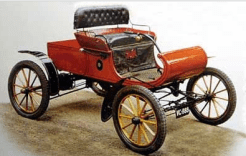 Gelly: “Horseless carriage, right?”
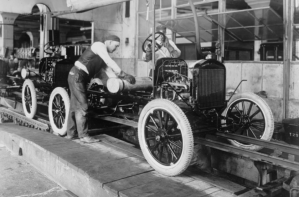 Gelly: “What about the assembly line. Didn’t Henry Ford invent that?”
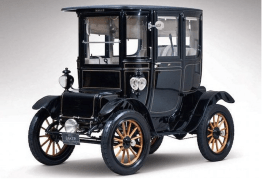 performance, emissions, creature comforts – the fundamental technology in cars and trucks is the same as the early 1900’s. I know that might sound odd, but it’s true. Most people forget there were steam-powered cars and battery-powered electric cars in 1910. See that picture on my desk. That’s a Baker Electric.”
 Jordan: “So has the automobile life cycle affected societal behavior? Yes, but has society been affected by the life-cycle of the automobile manufacturers?”
 Jordan: “Yes. Very good. Then between about 1920 and the mid-1960’s, the number of manufacturers dropped from 20 to 4-5, depends on the timing. However, did the decline in the number of manufacturers affect how societal behavior was affected by the automobile?”
 Jordan: “You’ve made your point. There are at least 10 different auto companies with assembly plants in North America. They got here, in part, because in the late 1960’s and 1970’s and even in the 1980’s, the US companies were slow to respond to changing consumer tastes and the increased demand for more fuel-efficient cars. Even if the Big 3 auto companies had responded more quickly, they probably could not have stopped all the imports.”
 Jordan: “The foreign-based manufacturers built plants in North America to save money and respond to market demands more quickly. What Trump seemed to overlook…more likely never understood…is the real cost and the long lead-times involved with building overseas and then shipping to the country where the cars are sold. What he also probably never understood was that before 1920, the US auto companies set up assembly plants in a number of foreign countries for the very same reasons the foreign companies built assembly plants in the US.”
 shorter life-cycle product might still be around but the period of influence – its life cycle – is over. I think I understand…but the answer seems so messy.”
 Gelly: “Just looking at your coffee cup, I suspect the introduction of a paper coffee cup was a major disruption to the pottery coffee-cup makers. However, it’s hard to imagine the paper coffee cup had a major societal impact. Is that what you mean?”
 Jordan: “In the 1960’s when IBM introduced what were called mainframe computers. Granted, by today’s standards, the mainframes were big and slow. There were special air-conditioned rooms to handle all the extra heat from the computers. Plus, for a lot of applications, you had to transfer information to punch cards before you could use the computer. While those computers were clunky and dumb by today’s standards, the machines were breakthroughs for the time — offering at least a couple of orders of magnitude better data management and analysis.”
 Jordan: “Each order of magnitude represents a tenfold increase. One order of magnitude would be 10x higher than the previous number. Two orders would be 100x higher – 10x the previous number which also was 10x higher. Three orders would be 10x10x10 or 1,000x higher. Look at this chart and then imagine the line going up faster than what’s shown.”
 Gelly: “Did IBM just one day decide to invent the computer or was something else invented that allowed the mainframe to be developed?”
 Jordan: “What changed to allow IBM…and a few others…to make practical mainframes was a way to eliminate vacuum tubes. The invention was the semi-conductor. Think of a semi-conductor as a computer chip or the SIM card in your phone. The early chips were not nearly as powerful as today.”
 Gelly: “If I understand correctly, the invention of the semi-conductor did not cause societal change per se. The societal change occurred only after products were developed using the semi-conductor. So, in deciding how a society adapts or manages technology-induced disruption, does it really matter whether the invention is the driver or the catalyst for the change? Deciding which might be a good academic exercise but does anyone else care?”
 Gelly: “Jordan, are we looking at the issue from the wrong end? We’re trying to find the cause of the societal disruptions. Would a better approach be to ignore the cause and analyze how the technology disrupted society…and, if so, what kind of disruption?”
 Jordan: “Take a look at sales after WWII and the hand-drawn blue line. The company had positive sales growth virtually every year from right after WWII to almost 1990 – 45 years.”
 Jordan: “What IBM missed was the shift to the personal computer – desktops first, then laptops. Even though the PC was not as powerful as the mainframe, it was easier to use.”
 Gelly: “Near the end of the movie ‘Miracle on 34th Street’ when they’re driving down some the suburban street, Natalie Wood shouts something. Remember what she shouted”
 usrevolution5