
Readers: this blog is set in the future (sometime after the year 2020). Each entry assumes there has been a 5th revolution in the US — the Revenge Revolution. More about the Revenge Revolution, a list of earlier revolutions and the author, Entry #1.
Periodically I write a “sense check” to assess whether in the next few years, a revolution in the US is still possible or whether the entire exercise is based on a statistical aberration — i.e., a roughly 50-year cycle between major upheavals in the US. Most recent sense check, Entry #365.
Some of the entries are part of a series. Several series are available as easy-to-read booklets for download:
- Working with Lee Iacocca after he left Chrysler, 2019Q3 Iacocca Personal Observations.
- GM EV1 — behind-the-scenes events affecting development and introduction of the GM EV1, the first modern electric vehicle. 2020Q1 GM EV-1 Story Behind the Story Booklet
- Coming technology tsunami and the implications for the US, Tech Tsunami Booklet with Supplement
- Trump Supporters Brainwashed? A series discussing why Republics have abandoned basic principals, Are Trump Republicans Brainwashed 2020Q1
- Who took out the Donald? Who/what groups are most likely to “take out” Trump? Who Took Out the Donald Entries with Update
- Revenge Revolution — description of what form the revolution might take, 20 01 07 Start of Revolution
Prelude: I’ve concluded Trump is a lunatic and the administration filled with lapdogs save a couple of people at CDC. Instead of wasting time commenting on actions by Trump, I thought it more productive to begin discussing what happens in the US once the coronavirus is more under control. #379 is the second entry and addresses healthcare cost. At this point not sure how many entries. Like #378 this entry is a bit long.
ENTRY #379: At the end of part 1 of this series (#378), I indicated suggestions to help address inequities in society would be forthcoming. Let’s start with what appears to be the closest to a practical solution, affordable health care for everyone.
The chart indicates the increase in medical care cost in the US as a percent of GDP. Since 1960, medical costs have increased from about 5% of GDP to more than 18% in 2018. These percentages include “discounts” offered to insurance companies and Medicare.

The impact of medical costs on a family vary widely. For families with health insurance partly or fully funded by an employer, the costs are relatively low. Yet, even with subsidies from employers, for most every family medical costs have increased faster than family income.
Until the Affordable Care Act passed under the Obama administration, families which did not have subsidized insurance, faced premiums that could be breathtakingly high, especially for those over age 50. In addition, many who had any one of a range of “pre-existing” condition often were unable to secure any coverage for the pre-existing condition.
The Affordable Care Act, aka Obamacare, made considerable progress in filling the “unaffordable insurance hole” in the societal safety net and for getting coverage for pre-existing conditions. While Obamacare included some coverage gaps, in part to ensure passage in Congress, the AFA did significantly reduce the number of people without medical insurance.
For example, immediately prior to AFA coverage taking effect, about 18% of the US population was uninsured. That percentage continued to drop through 2016:Q4. Immediately upon taking office in 2017:Q1, the Trump administration repealed many features of the AFA.
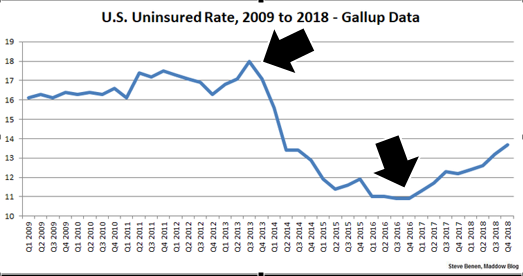
The Trump administration has continued to eliminate features, including many insurance exchanges, through which uninsured people could at least buy some coverage. The result of Trump’s policies has been a sharp uptick in the number of uninsured. While the chart stops at 2018, the latest projection for 2020 is 45-50 million people in the US will be uninsured.
Opposition to broader insurance coverage seems to focus on two issues: (i) potential elimination of the option to buy additional private insurance; (ii) additional taxpayer cost with expanded coverage for everyone. Both issues are solvable, if opponents will listen.
A Medicare-for-All (MFA) type coverage does not preclude availability of private insurance that would offer an additional level of service or benefits. In some metro areas, selected medical practices offer what is promoted as “concierge service,” ensuring quick access to physicians and more private facilities for many procedures.
While the initial cost for a MFA program could be somewhat higher as people formerly uninsured begin to address issues, longer term the cost could be less. Much of the cost savings could be from eliminating “unproductive” costs. While estimates vary because of different assumptions, overhead costs for Medicare appear to be about 50% less than overhead costs for private insurance. (NYT article)
Currently hospital costs and therefore healthcare insurance premiums include some amount for emergency room visits by the uninsured and those without financial resources. ER visits are far more expensive than office calls. In addition, people who have no insurance often wait until an illness or situation becomes extreme before visiting ER, thereby increasing the cost of treatment.
Opponents to Medicare-for-All should think about medical cost in the same way they think about maintenance on their personal vehicle. Routine maintenance, such as changing oil regularly, is much less expensive than doing no maintenance and eventually replacing the engine. In many ways, the human body operates much your car’s engine; preventive maintenance is much less expensive.
Getting Congress to agree to some form of Medicare-for-All should be much easier following the United States’ experience with the coronavirus. There has not been an event in most everyone’s lifetime that has demonstrated the importance of medical care for all citizens. Recent estimates indicate those without insurance infected with COVID-19 will face medical bills of $50,000-$75,000. Even those with insurance could face medical bills of $25,000 or more.
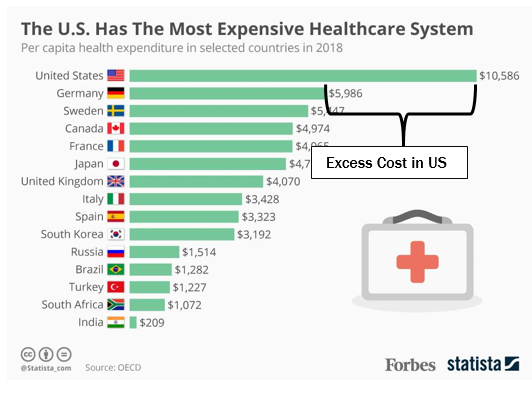
For those who still think the US cannot afford such coverage, the chart lists healthcare costs per capita by country. Note the cost per capita for highly developed countries. The cost in the US is 75% HIGHER than Germany, the next most expensive country. OK, if you’re still concerned these countries don’t offer the same level of care as the US, then buy the additional-cost option.
Addressing the Naysayers. Any effort to implement a Medicare-for-All type system will be met with vigorous opposition from the right. Following are some likely questions as well as suggested answers. I recognize no answer, however logical and supported by facts, will satisfy the hard right. But given how so many people have been affected by COVID-19 so far, and how many are likely to be affected in the coming months, the voice of the naysayers may be heard less and less, especially when facts are presented to support a Medicare-for-All type system.
 Comment #1: The US has the best healthcare system in the world. Don’t mess with it! Leave it alone.
Response #1: Let’s look at the expected lifespan in the US compared to other countries. The US ranks 47th behind such countries as Sweden, Germany, China, Taiwan, France, Korea, Canada, UK, Costa Rica, French Guiana and a host of other countries and ranks just one ahead of Cuba. If the US has such a great healthcare system, why does it rank 47th?
Comment #2: Those countries don’t have as many immigrants as the US. Those immigrants are what’s causing the problem here.
Response #2: Take a look at life expectancy among whites, blacks and Hispanics. Whites have the longest life expectancy but the others are not bringing the US total down by much. You also realize that life expectancy in the US declined under the Trump administration, don’t you? The decline was the first since WWII.
Comment #3: Why should I pay for someone else’s healthcare? There are lots of slackards out there who don’t pay income taxes. Paying for their medical care is not fair to me.
Response #3: First, anyone who has worked, whether or not they pay income tax, contributes to funding Medicare. In addition, the vast majority of Medicare recipients paid while working and continue to pay a monthly premium in retirement.
Comment #4: Medicare-for-All will create another inefficient government bureaucracy. The private sector is always more efficient. Why waste my hard-earned dollars?
Response #4: The bureaucracy supporting Medicare already exists. Plus, overhead for Medicare is substantially less than for private insurance. While there are different estimates for overhead, there is almost universal agreement that overhead costs for Medicare are substantially less than for private insurance. Most estimates are savings for Medicare of 50% or more. Medicare is more efficient at administering care than private companies. Why should people have to pay 2x the administrative costs for private insurance as they do for Medicare?
Comment #5: How are the doctors going to make any money? Medicare screws them on pricing.
Response #5: One adjustment with Medicare-for-All might be to weight payment to doctors more toward prevention rather than procedures. The change should also generate cost savings. In addition, if necessary, fees to doctors could be increased. The area needs further analysis.
SUMMARY: Some form of “Medicare-for-All” with an option for additional-cost coverage seems an ideal solution to help us address “we gotta get out of this (healthcare quagmire) place.” Obviously there are some issues to be worked out in order to implement a Medicare-for-All type program. However, most of the issues have been solved with existing Medicare programs and the Affordable Care Act prior to the Trump administration cuts.
Enough discussion for now about a practical solution to addressing healthcare costs. Likely more later.
 Walt: “I’ll tell you another event that penetrated the brainwashing cap. In fact, I still shake my head when thinking about it.”
 Walt: “That’s it. Todd looked more dumbfounded than a deer in headlights. Then he tried to let Giuliani correct his mistake. But Giuliani in true Trump fashion, refused to admit an error and proceeded to straight-jacket himself.”
 Walt: “Hadn’t thought of it exactly like you phrased it but Giuliani’s comment was so stupid an alarm bell went off in my head.”
 Walt: “Probably. But I’m still embarrassed to talk about my brainwashed state. I mean, when I was brainwashed, Kellyanne Conway’s claim about ‘alternative facts’ never caused me to pause.”
 Walt: “I asked him if he was calling me a liar. He asked again for the source of information. I repeated my claim he was calling me a liar…then I left.”
 Walt: “Nothing. What still makes me smile was when the owner of the National Enquirer was granted immunity.”
 Walt: “Once the brainwashing cap got penetrated, I started to look at the flood of Trump’s tweets a lot more critically. What I noticed was that virtually every tweet laid the blame for a problem on someone else or on some Federal agency. Trump seemed to forget he was in charge.”
 Jordan: “OK, now we’re in a new era. Trump is gone and the country has gone through the Revenge Revolution. And you’re more open to crossing party lines. What about other former Trumpsters?”
 Greenie: “Before the break, I said I thought at first Jordan’s idea of reinstating conscription was stupid. Then I came around and supported it.”
 JC: “What’s your logic? Something wrong with charter schools?”
 JC: “Not that I disagree with you but why do you think charter schools are a band-aide?”
 JC: “We need to get more specific about the issues. Besides we know that merely throwing money at schools does not necessarily make schools better.”
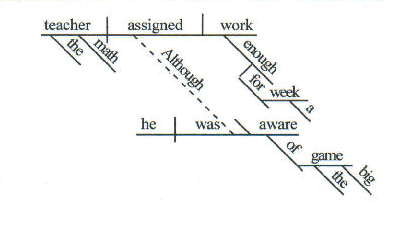 JC: “I agree that many were top-notch, especially those teaching math and English. To think we were so motivated we used to diagram sentences for fun!”
 Jordan: “What about teacher pay?”
 Jordan: “OK, I’ll be the bad guy. Why do we need free public education? What percent of the public thinks education should be privately provided and not publicly provided…forget who pays for it?”
 Greenie: “…an educated populous. And how did the US populous become educated? Not just an education for the elite but an education for everyone, including immigrants, many of whom arrived here illiterate. They were educated through a free public education.”
 JC: “While we’re throwing out ideas about education, what about banning busing? Busing seems like a waste of time and money.”
 Greenie: “Tell me how a politician is going to campaign against free, quality public education for all? That type campaign, especially in this post-Revenge Revolution environment would be suicide.”
 enie: “Jordan, pulleeeze. Be a bit more diplomatic, will you?”
 Jordan: “Eligible at 18 but must begin service by say age 26. A person could get a deferment to attend trade school or college but would need to start by age 26.”
 Jordan: “Federal agencies that have operations in most parts of the country. Agencies that serve people locally or work with the states to service people locally.”
 Jordan: “Same with EPA. There are lots of areas where an ‘EPA corps’ as it were, could help gather data or fix an issue before it becomes difficult and costly to solve. Just like that old commercial, ‘pay me now or pay me later.’ But later is almost always much more expensive.”
 JC: “I can hear it now. Some people are going to claim what we’re proposing will be taking away jobs from others. Or worse yet, conscription will interrupt little Johnnie’s or little Susie’s career that mommy and daddy paid so much to prepare them for. How are we going to counter that argument?”
 JC: “…Let me try. #4, forced diversity. Exposure to a wide range of people and backgrounds never hurt anyone. Maybe we, that is societal we, could become a bit more civil if we understood others’ perspectives. Brilliant statement, huh?”
 JC: “You know, the time might be right to reinstitute conscription. Since the Revenge Revolution people seem more willing to explore old and new ways of trying to solve problems.”
 Gelly: “Jordan, you have a call from a guy named Willie. Want to take it or should I…”
 Willie: “Your voice mail said you wanted to talk about crypto-currency.”
 Jordan: “In a way, the crypto-currencies remind me of the US prior to the creation of the Federal Reserve. Lots of variation in value and no one quite sure who’s in charge?”
 Willie: “Another good question. A lot of the so-called crypto-currencies vanished early on. Some never got any momentum and some were never issued even after investor funds were taken.”
 Willie: “A couple of crypto-currencies were backed by some assets. One was even backed by gold, but most were backed by nothing.”
 Jordan: “Over the years you’ve dealt with the Federal Reserve. How did they view crypto-currency?”
 Willie: “Most people did not fully appreciate how crypto-currencies forced the Fed’s hand. Crypto-currencies took a bigger and bigger slide out of the Fed’s monetary pie. In order to achieve the same result as before crypto-currencies, the Fed was forced to exaggerate changes in interest rates, both up and down. The exaggeration also affected Wall Street. As a result, the Fed was unhappy, Wall Street was unhappy, many investors were unhappy and the general public was unhappy.”
 Willie: “Federal revenue. While the Fed is not responsible for collecting taxes, in order to manage monetary policy, the Fed needs to have a good idea of sources and uses of Federal funds.”







 usrevolution5