• Home
  • Booklets/Grouped Entries
  • Tech Tsunami
  • List of Entries to Date
  • About the Author

usrevolution5

~ USA Headed for a 5th Revolution! Why?

usrevolution5

Category Archives: Causes of the Revolution

Discussion of what might have contributed to the revolution. Includes information about current events and some historical events.

#341 SCOTUS Puts another Arrow in Revenge Revolution’s Quiver

30 Sunday Jun 2019

Posted by Jordan Abel in Back Asswards Thinking, Causes of the Revolution, Societal Issues, Stupid Is as Stupid Does

≈ Leave a comment

Readers: this blog is set in the future (sometime after the year 2020). Each entry assumes there has been a 5th revolution in the US — the Revenge Revolution. More about the Revenge Revolution, a list of earlier revolutions and the author, Entry #1.

Periodically I write a “sense check” to assess whether in the next few years, a revolution in the US is still possible or whether the entire exercise is based on a statistical aberration — i.e., a roughly 50-year cycle between major upheavals in the US.  Most recent sense check, Entry #332.  

The original entry for this week was a diversion from politics, culture and the potential for a Revenge Revolution sometime after 2020. The topic was ideas about the Big Bang Theory and the formation of the universe. (I’ll publish the Big Bang entry sometime in the next few weeks.)

Maybe discussing the idea of the Big Bang was fortuitous. A big bang seemed to be the thinking of the Supreme Court this past week. The decision regarding legality of extremely partisan gerrymandering — Rucho vs. Common Cause — may go down as one of the most illogical SCOTUS decisions of the last 100-150 years. Use Plessy vs Ferguson as a reference point for being illogical.

The majority opinion, led by Chief Justice John Roberts, claimed SCOTUS was not entitled to second-guess state legislatures’ decisions re gerrymandering, even if the result was extreme disproportionate representation. Really? The majority of SCOTUS’ justices claimed the Constitution did not provide authority for the Supreme Court to address such state issues as gerrymandering, and besides, the framers envisioned that politics would influence the drawing of legislative districts.

Duh, Roberts, put aside the legal mumbo-jumbo and try to figure out what’s right and wrong for the country. The case, which involved extreme gerrymandering in North Carolina, demonstrated clearly that Republican legislators intended to discriminate against certain voters, i.e., Democrats, the Party which happens to include most black and Hispanic voters.

The consultant, hired by the Republican-controlled NC legislature, publicly stated disappointment that he could ensure Republicans only 10, not 11, of 13 the seats in the US Hose of Representative despite the percentage of voters in North Carolina being split about evenly between Democrats and Republicans, and slightly favoring Democrats.

Gee, Roberts, using your logic, it’s OK if Democratic votes in North Carolina count less than 1/2 of what Republicans votes count. (Of the 13 districts, based on the number of Republicans and Democrats, at least six (6) should be represented by Democrats. With the gerrymandered districts, Democrats hold only three (3), or less than 50%.) If the SCOTUS justices keep referencing the Constitution as the basis for the gerrymandering decision, at least have Democratic votes count 3/5 of a Republican vote, which is what the Constitution noted that slaves counted.

When citing laws and legal precedent, ever think about considering the 14th Amendment? What about considering the Voting Rights Act? What about Brown vs. Board of Education? Okay, I understand your logic. None of these decisions had been made when the Constitution was written and, therefore, should not be considered.

But wait. What about the Citizen’s United case?  In Citizens United the majority, of which you were a member, claimed that when it came to campaign financing a corporation was really a person and should be treated as such. I’ve looked at my copy of the Constitution and I can’t find where corporations are mentioned, let alone being considered “people.” Your logic must be to reference the Constitution when convenient but to disregard the Constitution when you want a different outcome.

A second Supreme Court ruling this past week was well-publicized, but frankly a bunch of meaningless noise. The second decision prohibited the Bureau of Census from including a question about citizenship during the 2020 census. Roberts, in an apparent Fox-News attempt to be “fair and balanced,” sided with the Democrats on prohibiting the citizenship question.

But Roberts’s position is a ruse. The SCOTUS decision does not prevent future census from including a citizenship question. Moreover, with all the publicity around the case, Roberts and Republicans already have convinced many immigrants, even legals, not to respond to the census. And who can blame them? As long as Trump is in office, immigrants will be targets for deportation, regardless of status, and the Trump administration has demonstrated repeatedly a willingness to ignore restrictions on misusing and/or sharing confidential information.

How should the Supreme Court decisions be interpreted? In the months and years ahead, the US will experience more partisanship, and as hard as it might be to believe, even more extreme positions by politicians. With the gerrymandering decision in place, politicians must now consider all members of the other party as the enemy if a politician is to survive in the primaries in the gerrymandered districts. Compromise and civility will be surefire paths to losing a primary, which has become the defacto general election.

The gerrymandering decision piled on top of the Citizens United case, should be viewed as the Supreme Court putting another arrow in the Revenge Revolution’s quiver. Given the stupid-is-as-stupid does approach of the Supreme Court combined with the abdication by the McConnell-led Senate Republicans to thwart any illicit and illegal actions by Trump, the only solution to steer this country back to the middle where a government can work for all people seems to be a revolution.

Comments, welcome, as always.  Any, yes, have a happy 4th of July.  Wasn’t there a revolution sometime around then?

#339 Still Supporting Trump? Quit Claiming to be a Republican.

16 Sunday Jun 2019

Posted by Jordan Abel in Causes of the Revolution, Societal Issues

≈ Leave a comment

Readers: this blog is set in the future (sometime after the year 2020). Each entry assumes there has been a 5th revolution in the US — the Revenge Revolution. More about the Revenge Revolution, a list of earlier revolutions and the author, Entry #1.

Periodically I write a “sense check” to assess whether in the next few years, a revolution in the US is still possible or whether the entire exercise is based on a statistical aberration — i.e., a roughly 50-year cycle between major upheavals in the US.  Most recent sense check, Entry #332.  

Current entry — the reason I skipped the blog entry last week was to take time and try to make some kind of sense of actions by Trump and actions, or lack thereof, by Republicans in Congress and elsewhere. By any measure, Trump’s behavior is illogical, inconsistent and illegal.

In fairness to Trump, he’s exhibited this same behavior for many years. While being president has inflated his ego and allowed him to exhibit behavior dangerous to the country, his approach to decision-making and working with others – now as head of government rather than just head of a real estate company – has remained the same as it was in New York. Noting that Trump has not changed his behavior as president does not condone his behavior. Trump continues as he has been for decades – a scumbag crook.

What has changed is the behavior of all but a few Republicans. Proposals and/or actions undertaken during the Obama and Clinton Administrations that Republicans labeled as illegal or even treasonous, are now considered by Republicans as perfectly acceptable under the Trump Administration.

Recall when Trump wanted to lock up Hillary Clinton for a having a personal email server, even though no evidence was found that classified information was compromised? Now the same Republicans who chanted “Lock her up!” think it’s okay when Trump indicates publicly he’d take information on a candidate provided by a foreign entity, even if an enemy of the US. If offered such information, he would not call the FBI. Just in case you’re wondering such behavior is illegal and possibly treasonous. And no, his insincere recant of his statement doesn’t count.

While the list of egregious behavior by Trump, his family and/or members of the Trump Administration is almost endless, what has me the most confused – baffled might be a better term – is why so-called Republicans have been so quick to join Trump and discard long-held positions on free trade, fiscal responsibility, and individual rights. What happened to the Republicans who supported those long-held beliefs?

As noted periodically in this blog, I think many so-called Republicans have been brainwashed by watching too much Fox News and/or listening frequently to Rush Limbaugh. However, if 75% of the former Republicans have been brainwashed, that still leaves 25% who should be able to think. So where is this 25% group that’s not been brainwashed? Who knows because other than a handful, no high-profile Republican seems to be speaking out against Trump.

The malleability of Republicans is dangerous. Putting Trump aside, the US needs two viable political parties to function correctly. Right now we have one party that’s functioning as a party – the Democrats. Then we have a bunch of people supporting a wannabe autocrat, but not functioning as a political party – so-called Republicans.

Let’s consider this comparison. You say, “Look at all of what Trump has done. It’s been great. So don’t get so hung up on his behavior.” If that’s your logic, then ask yourself, “If I were in Germany in the 1930s, would I support Hitler? After all, Hitler helped improve the economy. Forget that he got rid of a few million of those pesky ‘undesirables.’ Overall, things were better for Germany and we should support Hitler.” The question might be a bit of a stretch but many Republicans appear to be as malleable and spineless as many Germans in the 1930s.

Here’s a more straightforward question for people who support Trump and claim to be Republican. Are you a person who believes in long-term Republican values — free trade, fiscal responsibility, individual rights, etc.? Are you willing to discard those core values and support someone who has no ethics, shows no loyalty to others and even shows no loyalty to the United States? If you decide to continue to support Trump, obviously it’s your choice. But if you continue, please stop claiming to be a Republican.

One more item to consider. Please take time to read and think about the meaning of the oath taken by the president of the United States. “I do solemnly swear (or affirm) that I will faithfully execute the office of President of the United States, and will to the best of my ability, preserve, protect, and defend the Constitution of the United States.” Now, go look in the mirror and ask yourself, “Has Trump made every effort to preserve, protect and defend the Constitution of the United States?”


#338 The Human Toll of the Coming Technology Tsunami – Example, Lordstown, OH Plant

01 Saturday Jun 2019

Posted by Jordan Abel in Causes of the Revolution, Education Issues, Societal Issues, Tech Tsunami

≈ Leave a comment

Readers: this blog is set in the future (sometime after the year 2020). Each entry assumes there has been a 5th revolution in the US — the Revenge Revolution. More about the Revenge Revolution, a list of earlier revolutions and the author, Entry #1.

Periodically I write a “sense check” to assess whether in the next few years, a revolution in the US is still possible or whether the entire exercise is based on a statistical aberration — i.e., a roughly 50-year cycle between major upheavals in the US.  With all that’s happened lately in Washington, I wrote a special sense check, Entry #332.  

One of the contributing factors to the Revenge Revolution will be a technology tsunami, which I believe is rapidly headed toward US shores.  Fifteen recent entries addressed various aspects how the tech tsunami might: (i) affect the US economy and family incomes; (ii) be mitigated by taking certain actions.  The series of entries is available as an eBook. This entry is an supplement to the booklet and now included with the booklet.  (Download: 19 06 01 Tech Tsunami Booklet with Supplement)

The impact of the technology tsunami can easily be viewed as an abstract concept, especially if one is not affected directly. For example, you read an article about technology replacing someone’s job. Then the person replaced finds another job, which is fairly easy in today’s labor market. Reader thinks, “What’s the net effect on the person whose original job was replaced by technology? Zero. What’s the net effect on the unemployment rate? Zero. Time to move on to the next article.”

But, hold on, there’s more to this story. What prompted this blog entry was an article in the New York Times about a family whose members had worked at the GM Lordstown, OH plant almost from the opening day of the facility.

The Lordstown plant was built in the mid-1960s, but over the years GM continued to invest and upgrade the facility. What resulted from investments in Lordstown and other plants throughout North America was increased potential capacity with lower labor content per car/truck produced. Thus, more output with fewer employees. (As I wrote in late 2018, although I had no first-hand information, based on my experience inside GM, closing Lordstown, and other plants in North America, seemed justified.)

What happens to workers when a GM plant closes? Depending upon an individual’s seniority and the number of jobs available at other facilities, some laid-off employees might be eligible to transfer to another GM plant. Some laid-off workers at Lordstown met the criteria and have transferred.

What about workers who aren’t eligible to transfer or who don’t want to transfer, which often involves relocation? Some training is available for other types of jobs, which are usually non-automotive and often at lower pay. In addition, some laid-off workers, again depending upon seniority, receive from GM supplemental unemployment benefits for a limited period.

Back to the family featured in the NYT article. If you haven’t read the article, it’s worth a read. (19 05 28 NYT Lordstown Shutdown Employee Impact Examples ) The short version is the father gets out of the military, goes to work at the Lordstown plant soon after it opens. Over time the father becomes a representative of the union. The son, born after the father starts at Lordstown, doesn’t study much in school but is confident he will get a job at the plant, primarily because of his father‘s position with the union.

After completing high school, the son is hired and one of his jobs is prepping cars before final painting. Painting is an areas where the auto industry has installed as much technology as possible over the years to improve the quality and consistency of the finish. The implementation of technology in the paint shop has dramatically reduced employment. At Lordstown plant the number of employees declined from 38 to 4, a decrease of almost 90%. While the decrease in employment in the paint shop is at the high-end, substantial declines in employment from technology have affected body welding, engine machining and other high-precision areas with high labor content.

At the time of closing, the son had worked at Lordstown for 25 years. While no specific age was cited in the article, the son is probably in his mid to late 40s. With his years of service, he’ll be eligible for a modest pension from GM. However, he has at least 20-25 years left before being eligible for Social Security and Medicare.

Where does the son find another middle-class paying job given his limited education and skill level? Another job in the auto industry unless he relocates to another GM plant. Even if he finds an auto job, he runs a high risk of losing it given the continuous implementation of labor-saving technology by the auto companies and suppliers.

The extent of how many jobs in the auto industries (and other industries) are being eliminated by technology goes far beyond the assembly plant, which most people think of. In an earlier blog entry I mentioned an auto supplier in Fort Wayne, IN that bends tubing to make exhaust systems for cars and trucks for many auto OEM’s. If you don’t think there are lots of twists and turns in your vehicle’s exhaust system, next time you see a car or truck up on a service rack, go take a look underneath.

The process of bending tubing might seem straightforward (no pun intended) until one thinks about what happens when a tube is bent. The metal on the “outside” of the bend becomes thinner and the metal on the “inside” of the bend wants to “crinkle.” Bending tubing can be much more complicated than it first appears.

The company that bends the tubes is a perfect example of the impact on employment of the coming technology tsunami. The company incorporates an extraordinary amount of high technology, with a plethora of very sophisticated machines…and very few people staffing those machines. The parking lot of the company is the tell-tale sign of the technology tsunami. The company operates 24×7 with significant daily output, yet has a small parking lot that even during the day when office staff is working, has plenty of empty parking spaces for visitors.

Is this just a story about how one family was affected by a GM plant closing or are there broader implications? If the attitude of the now unemployed son is at all representative, then US society has a growing problem. While the son apparently has not yet come to grips with the long-term implications of the layoff, he is searching for answers to “Why is this happening to me?” “Why, after 25 years of working at this facility, am I getting screwed?”

He’s very frustrated and believes that people in Washington “just don’t get it.” The frustration includes Trump, whom he voted for in 2016, and members of both parties. He’s also frustrated with large corporations, which he thinks suffer no penalty for shuttering plants and relocating operations to say Mexico.

The frustration and anger of the son is understandable. While from a business perspective I think GM is more than justified in closing the Lordstown plant, especially given some of labor problems over the years, the business justification does not eliminate the economic and social issues facing the laid-off workers.

We, as I keep suggesting is the proverbial societal we, need to help this family transition from pissed-off members of society to being productive workers in an ever-increasing technology-laden workplace. As it stands now, even with a small pension and some additional benefits, the son is the kind of guy who is ripe to be part of a Revenge Revolution. For those not familiar with northern Ohio, almost guaranteed he’s got a deer rifle or two and a bunch of ammo. Now, he’s out of a job, has shrinking income, thinks politicians don’t understand the problem, and thinks large corporations are exploiting people and communities. Not a good combination.  (The son is much like the character “Sandy” who appears periodically in the blog entries.)

Without some serious societal effort, the ranks of this group are going to grow. Making America great again does not involve trying to reintroduce high-labor content products or industries from decades past. The implementation of technology to replace humans is going to continue. All types of jobs and skill levels will be affected, from manufacturing to legal to medical. Without a national plan to begin lifetime education for people of all ages, from 6 to 66 (and older), the US is going to face a growing segment of the population which is extremely angry and poses a growing threat to a stable democracy.

Reminder: For more about how the technology tsunami might affect the US economy and culture, and ideas to help mitigate the effects, there’s a free ebook waiting for your download. The book is a compilation of this entry and 15 earlier blog entries about the technology tsunami. Comments welcome. (Download, 19 06 01 Tech Tsunami Booklet with Supplement)

#337 Compartmentalizing Irrational Behavior. Fiction Trumps Truth.

27 Monday May 2019

Posted by Jordan Abel in Back Asswards Thinking, Causes of the Revolution, Societal Issues

≈ Leave a comment

Readers: this blog is set in the future (sometime after the year 2020). Each entry assumes there has been a 5th revolution in the US — the Revenge Revolution. More about the Revenge Revolution, a list of earlier revolutions and the author, Entry #1.

Periodically I write a “sense check” to assess whether in the next few years, a revolution in the US is still possible or whether the entire exercise is based on a statistical aberration — i.e., a roughly 50-year cycle between major upheavals in the US.  With all that’s happened lately in Washington, I wrote a special sense check, Entry #332.  

One of the contributing factors to the Revenge Revolution will be a technology tsunami, which I believe is rapidly headed toward US shores.  Fifteen recent entries addressed various aspects how the tech tsunami might: (i) affect the US economy and family incomes; (ii) be mitigated by taking certain actions.  The series of entries is available as an eBook.  (19 05 19 Tech Tsunami Booklet)

The first draft of this blog entry was an attempt to convince Trumpsters to ask themselves why they continued to support behavior that if exhibited by a Democrat would have caused them to be apoplectic. With each passing month I have become more perplexed why and how Republican thinking switched 180 degrees from categorizing certain behavior as unacceptable in pre-Trump to categorizing the same behavior as acceptable under Trump. What caused the definition of “acceptable behavior” to change? Formerly unacceptable behavior has become the norm with only a whimper of protest from a few Republicans. Why?

The blog entry got delayed because of activities surrounding Memorial Day weekend…fortunately. Why fortunately? There was a fascinating opinion piece in the “Review” section of the 05/26/2019 NY Times, titled, “Why Fiction Trumps Truth” that seemed to explain how some people willingly allow clearly untrue assertions to affect some of their behavior, yet act rationally much of the other time. The article noted that people who compartmentalize seem to accept more readily claims that are truly bizarre and outlandish.

Whether the author’s analysis is completely accurate, I don’t know. I am not a trained psychologist, psychiatrist, psychoanalyst. Some people think I’m just psycho. However, the writer’s premise and support seems plausible and helps me understand what can best be described only as irrational behavior. In previous blog entries, I’ve suggested the cause of such “compartmentalized” behavior by Trump supporters was some form of brainwashing.

Part of the brainwashing could be attributed to such talking heads as Sean Hannity and Rush Limbaugh who fill their airtime not with questions and analysis but with declarative statements and claims unsupported by facts. An even more influential source for the brainwashing is Trump, who if nothing else, is a master of making and repeating false statements, offering no context or support for his claims. After a while, people here the lie often enough, they get brainwashed and believe the lie.

While Republicans under Trump seem to have taken the compartmentalizing phenomenon to the extreme, the phenomenon is not unique to Trump supporters or the Republican Party. We are all probably guilty of some degree of “compartmentalizing” irrational behavior, even if such behavior applies only to a favorite sports team.

Please read the opinion piece using the link above. Given the degree of compartmentalization, the question now seems to be, “How does US society get out of this mess?” Other than a catastrophic event, such as a revolution, is there any to convince “compartmentalized” voters, left and right, to come out of the closet, err compartment?

While both parties have voters in such compartments, the degree to which Republicans have begun accepting as normal, behavior that for decades had been considered “highly unacceptable,” is startling and hard to explain. Why do Republicans without any protest whatsoever allow Trump to enable the Attorney General, if he so chooses, to disclose publicly any and all sources of intelligence information, domestic and foreign?

Whether the Attorney General ever discloses the sources doesn’t matter. The damage is already done. The fear by the source of being “outed” will cause most every source to no longer provide information. In many countries, any type of disclosure for a source has a severe negative consequence – imprisonment, torture and possibly death. Trump’s action, which was done purely for political reasons, is a direct threat to national security. And where were protests from Republicans, who claim to be the party of national security? No response!!!!!

Where are all the Republicans who clamored for putting Hillary Clinton in jail for using a non-government server? Where’s the protest Representative Jim Jordan Ohio? Guess you’re not such a tough guy wrestler after all. Trump seems to have you in a choke hold. Where are protests from Mitch McConnell, Senate Majority Leader? Cat got your tongue? Where are Republican supporters of the military when Trump tweets that Russia and North Korea are not really threats?

I’ll tell you where Republicans are. Clamoring for an investigation of the people in the FBI and CIA who found out people in the Trump Campaign were dealing with the Russians before the election. And, no, Trump supporters, there was no attempted coup. First, Trump and supporters should thank James Comey for handing Trump the election with the press conference chastising Hillary Clinton.

But, no, in Trump world everything is backwards. Good is bad and bad is good. Next, go read the Muller Report, not Trump’s or Barr’s misinterpretation. If you still need convincing that Trump just might be acting in violation of US law, look at all the financial information from Trump’s tax returns, phony foundation, money laundering through Deutsche Bank and elsewhere.

Despite overwhelming evidence, Republicans in a classic flip flop compared to demands for say Clinton, insist any financial information not be disclosed. Why? The information would be used for political purposes. Republicans would never do such a thing but Democrats always do. Well then, let’s use this argument. The law requires the IRS to turn over tax returns to specified members of Congress. Using a standard Republican argument about complying with the law, if Trump’s done nothing wrong and has nothing to hide, why not let people view the information who are charged in the Constitution with oversight of the Executive Branch? If you have questions about the House’s authority, please read Article I of the Constitution.

OK, I’ve ranted enough and probably not changed a single Republican’s mind. I do hope, however, that everyone reading the blog (Republicans and Democrats) will at least read the opinion piece in the NYT and step back and ask, “What irrational behavior (fiction) am I ‘compartmentalizing’ and allowing to influence my behavior that I would otherwise consider unacceptable?” Also ask, “How can each of us change behavior to avoid what seems to be the inevitable road to the Revenge Revolution?”

Comments and suggestions welcome. Thanks for your time.


#335 Curiouser and Curiouser

13 Monday May 2019

Posted by Jordan Abel in Causes of the Revolution, Economics, Education Issues, Societal Issues

≈ Leave a comment

Readers: this blog is set in the future (sometime after the year 2020). Each entry assumes there has been a 5th revolution in the US — the Revenge Revolution. More about the Revenge Revolution, a list of earlier revolutions and the author, Entry #1. 

Periodically I write a “sense check” to assess whether in the next few years, a revolution in the US is still possible or whether the entire exercise is based on a statistical aberration — i.e., a roughly 50-year cycle between major upheavals in the US.  With all that’s happened lately in Washington, I wrote a special sense check, Entry #332.

Have we, societal we, fallen down the rabbit hole? Have we lost our sense of direction? Have we lost our moral compass?

Over the last couple of months, most entries in this blog have focused on what I’ve characterized (as have others) as the coming technology tsunami. The entries describe the possible significant negative effect on the US economy of the tech tsunami and proposed solutions, the centerpiece of those solutions being more education. Education, however, not just for those currently in school but education for all age groups, even those in their 60’s. Education efforts would also include those who are, or have been unable to learn when taught using more traditional methods.

Many ideas suggested in the blog entries are not new. What’s changed is the urgency created by the oncoming technology tsunami. Like climate change, waiting until the impact is obvious to most everyone is too late. At that point the game for the US economy will be over. The fat lady will have sung…and done an encore. For the doubters, the tech tsunami is not some abstract idea or a tsunami that’s far-off shore. The water at the shoreline has started to recede and the need to take action is now.

Others share this view. Others also share the view that different approaches to education need to be tried. I was heartened by an article in the 05/12/19 New York Times  (19 05 12 NYT Teaching Math Like Football) suggesting math teachers should approach the classroom more like a football coach in the locker room. Hear, hear! Great idea. In grammar school and high-school, I was lucky enough to have a couple of “football-coach” math teachers. They challenged each student and tried to make learning math fun. The football-coach approach could be helpful to many students who do not “get math” taught using traditional approaches.

OK, what about a topic for this entry? When thinking about what to write, what kept running through my head was a simple question, “Why do educated people keep supporting a president whose actions, by US law, are clearly criminal (obstruction of justice and tax evasion are just two) and possibly treasonous?” “How can rational people overlook, let alone support such behavior?” (He even cheats at golf!)

And, the behavior is not sporadic. It’s a continuous stream. What is the latest from the Trumpland? Asking Rudy Giuliani, Trump’s personal lawyer, to go to the Ukraine and ask the Ukrainian president to try to dig up dirt on a family member of a candidate for Democratic nominee for president. Duh, Republican folks, that’s Trump asking yet another foreign country to meddle in a US election. When are Republicans going to wake up and realize where Trump’s allegiance lies? If you don’t know where to start looking, try his bank account.

Trump does not care about any Republicans, let alone members of the hardcore base. Let me repeat Trump does not care about any Republicans, let alone members of the hardcore base.

If you don’t believe me, then what about those tariffs on Chinese exports? Do you believe Trump’s tweets that the Chinese will pay the tab? Even Trump’s economic advisor won’t buy that outrageous claim. No, the tariffs per se might go to the Treasury but the prices of Chinese goods sold in the US will increase by the amount of the tariffs…and possibly more. And, yes, you get to pay for the tariff. Yet another economics class Trump skipped while in college.

“Hold on,” you say, “Chinese jobs making all those goods will come back to America. Trump is actually creating jobs. Trump is saving America! Wake up liberals.”

Okay, a few jobs might come back, but only a few. But how many more other jobs will be lost with China’s retaliatory tariffs on American exports (imports to the Chinese).

But then you say, “Didn’t Trump save thousands of jobs when he negotiated to have GM sell the Lordstown, OH plant to that other company? You know that Workhorse company?” Sorry to inform you, the answer again is “no.” Workhorse buying the Lordstown assembly plant (not a done deal as of this entry’s publication) created no net new jobs. Workhorse was merely looking for a facility to assemble a proposed electric-powered truck.

And the list of misconceptions, misunderstanding, sheer blindness by Republicans continues on and on and on. Even the Energizer Bunny is starting to get tired. The lack of a modicum of thinking by Republicans makes their behavior curiouser and curiouser. What’s the value to Republicans of supporting Trump? Trump’s in the White House for cash. What do Republicans get out of the deal?

When I hear a Republican gloat about supporting Trump, I ask a very simple question. ”Assume all the same policies, economic conditions, cabinet appointments, relationships with foreign countries, tweets, known lies, etc. Now assume Trump is not a Republican but a Democrat. Would you still be supporting Trump and/or be opposed to the investigation by the various committees in the House?” Count how many current Trump supporters say “Yes they would continue to support Trump if he were a Democrat.” If you can count more than a handful, let me know.

To be fair, you should ask some Democrats the same question. “Assume all the same policies, economic conditions, etc., would you still be so anti-Trump?” My guess is a much greater percentage of Democrats would continue to be anti-Trump and especially support the investigations in the House of Representatives.

So why do Republicans support Trump when so many of his policies are reversals of long-held Republican positions? Why have Republicans let Trump hijack their brain? As noted in several earlier blog entries, it seems that many Republicans have been brainwashed.

How can such a large group be brainwashed? If there’s one thing Trump is very good at doing, its manipulating people. Especially vulnerable are those with limited inner strength. Helping Trump with the brainwashing are the Republican talking heads – Limbaugh and Hannity in particular – who fill their air time not with questions and a discussion of possible solutions, but fill their air time with declarative statements of suggested attitudes and behavior. Kim Jung-un probably listens to “Fox News” for ideas how to brainwash North Korean citizens more effectively.

Other recent truly bizarre actions by Trump include declaring that executive privilege can apply retroactively to virtually any discussion of any action taken by anyone in the Trump Administration. Huh? Trump has also told Administration officials to ignore the law. And where are the voices of the righteous Constitutionalists Republican Senators? Save one or two, Republican Senators have contracted laryngitis while also sucking up to Trump.

The willingness to support a rogue and lawless president rather than the Constitution leaves me with only one conclusion. There needs to be a Revenge Revolution in the US in order to rid the country of the Trump cancer and bring the Republicans back to their senses. Let’s hope the 2020 election can accomplish the same thing but I’m not as hopeful.

One might not like the actions or style of certain Democratic leader, or proposed policies of certain Democrat candidates for president. Those disagreements are understandable and part of a democracy. What is not understandable is why Republicans are blaming Democrats for trying to uphold their obligations under the Constitution by investigating criminal behavior and possibly treason of the president, members of the president’s family, members/former cabinet members and people associated with the 2016 campaign.

Just in case you, and maybe Republicans in the Senate, need a reminder of the words contained in the oath for members of the House and Senate, “I do solemnly swear (or affirm) that I will support and defend the Constitution of the United States against all enemies, foreign and domestic; that I will bear true faith and allegiance to the same; that I take this obligation freely, without any mental reservation or purpose of evasion; and that I will well and faithfully discharge the duties of the office on which I am about to enter: So help me God.” (I can’t find where the oath mandates allegiance to the president, can you?)

#321 Using AI for Profiling – Birds of a Feather Flock Together

13 Sunday Jan 2019

Posted by Jordan Abel in Causes of the Revolution, Societal Issues, Tech Tsunami

≈ 1 Comment

Readers: this blog is set in the future (sometime after the year 2020). Each entry assumes there has been a 5th revolution in the US — the Revenge Revolution. More about the Revenge Revolution and author, How the 5th US Revolution Begins and About the Author.  Many entries are formatted as conversations. Characters appear in a number of entries, with many entries building on previous conversations.  

Occasionally I do a “sense check” about the likelihood of a Revenge Revolution.  Entry #318 is the most recent “sense check.”  One more note — sometimes I write about another topic that does not quite fit the theme of the blog.  Those comments are available on the page titled “JRD Thoughts and Comments.” 

This series is about the coming “Technology Tsunami.”  The series addresses what might be involved and some suggestions for mitigating and even capitalizing on the opportunity.  Entries #321 and #322 are intended to describe AI in more understandable terms, using personal experiences as examples.  

A widespread use of AI today is what is called “profiling.” Ever notice after you’ve searched something on Google, an ad appears for the product? How does the computer know?

This entry discusses how AI was used to create “profiles” and how those profiles were used in a commercial application. The examples in this entry and the next (Entry #322) are “early stage” and intentionally selected to demonstrate: (i) applications that are easy to understand: (ii) AI-based applications have been around for a number of years; (iii) how AI can be used to increase the effectiveness of “gut-feel” profiling.

The concept of profiling is simple. Profiles are based on the assumption that “birds of a feather flock together.” That is, people with similar profiles have similar behavior.

Of course, not everyone in the flock, or profile group, behaves the same way.   But to the user, profiling is not about individuals but about probabilities of member in the group. What percentage of the people in the profile group will behave a certain way? The goal is to create a group, or profile, where there is a high likelihood that members will have a specific desired behavior.

Profiling is not a new idea. Profiles existed for eons before being formalized with computer programs. Further, virtually everyone creates profiles. Most all of us put strangers into categories based on such factors as geographic location, appearance – skin color, hair color, hair style, clothing, etc. – age, education and a host of other criteria. Think back to someone you met, then after you got to know the person much better, said to yourself, “Gee, that person is a lot different from I first imagined.”

As for this entry, the first example seems rather crude by today’s standards. At the time the profiling technique described was considered “state-of-the-art.” Remember an abacus was considered state-of-the-art when introduced.

The time period for this entry is the mid-1980’s, at Buick Motor Division of General Motors, where I’m director of marketing. As described previously, Buick has used AI-programs to improve the accuracy of its sales forecast and to start allowing dealers more discretion when ordering cars. (Reading Entry #320 will provide more context.)

The next logical step to try to continue building market share was helping dealers refine how to order the appropriate number and mix/models of cars. For example, dealers in the Northeast knew smaller cars were preferred, but which ones were likely to sell more rapidly in a dealer’s particular sales area? Same problem with dealers throughout the country.

I do not remember who or how the introduction was made – could have been one of the “crazy phone calls” the staff often accused me of taking – but Buick was introduced to a company called Claritas. At the time Claritas had combined zip code and general demographic data. The results were “clustered” into 40 groups, or profiles. Each profile had general buying information for products ranging from food to wine to vehicles to many other items. Claritas also assigned a descriptive and memorable to each group. Some examples of names of group – “Pools & Patios,” “Furs & Station Wagons,” “Hard Scrabble,” “Down-Home Gentry,” “Blue Blood Estates,” etc.

As I recall Buick was the first auto company to use the Claritas profiling. We introduced the concept at the annual dealer announcement meeting. And then not much happened for several months. Finally I got a call from a dealer who purchased a store in Florida that had gone bankrupt and was in the process of converting to a Buick store.

The call went something like this, “You remember that program you told us about at the announcement meeting? I’ve forgotten the name of the program but do you think it might help me order the cars more effectively for this new store?” We asked for the zip codes he thought most likely to consider shopping buy at his store. Based on the zip codes we suggested a mix of cars he should consider ordering.

About six months later, my wife and I were hosts on an incentive trip for dealers. During cocktail hour one night, the dealer said, “I owe you a drink. You’ve made me a ton of money.” As he told the story, the profiling program had been a major contributor to helping him turn what had been an unprofitable dealership into one that was very profitable. And, yes, I let him buy me a drink…even though drinks were already paid for.

He told his success story to many other Buick dealers and the use of the program became more widespread. What seems like standard marketing procedure now was anything but standard then.

Within a couple of years starting to work with Claritas, Buick developed a variation of an existing car that designed to appeal to a very small audience. Because introducing such a “niche” car in the traditional way would be too expensive – major national tv and print campaign that could eat all the potential profits – we decided on a targeted campaign using the information from Claritas. What was the result of promoting the niche car to selected profiles – “Pools & Patios,” “Blue Blood Estates” and a few others? A very successful, and profitable, introduction.

What’s the status of profiling today? Profiling has migrated from projecting buying patterns based on zip code (5 digit) to neighborhood profiles (9-digit zip codes) to profiles by families to profiles for individuals within the same household. The same philosophy applies – birds of a feather flock together. However, the flock is no longer defined by geography but by attitudes and behavior gathered from information on search engines, websites, on-line purchases and social media platforms. Profiling is still about probabilities – and not individuals – even though the clusters can include specific information about individuals within the group.

What does this migration portend for the future? One of the unintended consequences of profiling seems to be the diminished value of small geographic social groups. When one had more face-to-face interaction with neighbors, it was difficult to simply walk away from people with different opinions. While you might not always agree with your neighbor, one at least tried to be civil because that neighbor would be there the next morning and you might need to rely on him or her for something.   Amazon, on-line buying, delivery services, etc. have reduced the reliance for many activities. No longer does longer does one even need to talk face-to-face with neighbors. One can replace face-to-face chats by going on-line and finding a chat room of like-minded people, thereby avoiding having to listen to the neighbor with whom one might disagree.

In the future are we going to continue only to seek others in our profile and therefore become more isolated? Maybe for a few more years…then I’m hopeful the tide will turn. The underlying premise of my blog (www.usrevolution5.com): the US is headed for a 5th revolution sometime after 2020. I’ve labeled revolution as the Revenge Revolution. One societal change that I think will result is a return to neighborhoods. Some groups and communities have maintained active neighborhoods, but far too few. What I’m hoping evolves from the Revenge Revolution is a sense of cohesion among neighbors.

Yes, post Revenge Revolution you’ll still be able to use your smart phone and order on-line. At the same time, people will become more aware of and concerned about others, especially those in their neighborhoods. Maybe naively, this awareness will help neighborhoods begin to have the feel more like the 1950’s – not quite like Wally and the Beaver but a lot closer than today. And, no, in my view fences do not make good neighbors.

(In the next entry, a discussion about how AI-developed personality profiles can be extremely useful in dealing with others. Of course, women have used this approach for centuries. Men are still in the learning phase.)

#319 Technology Tsunami Headed toward US Shores

01 Tuesday Jan 2019

Posted by Jordan Abel in Causes of the Revolution, Economics, Gov't Policy, Possible Solutions, Tech Tsunami

≈ 9 Comments

Readers: this blog is set in the future (sometime after the year 2020). Each entry assumes there has been a 5th revolution in the US — the Revenge Revolution. More about the Revenge Revolution and author, How the 5th US Revolution Begins and About the Author.  Many entries are formatted as conversations. Characters appear in a number of entries, with many entries building on previous conversations.  

Occasionally I do a “sense check” about the likelihood of a Revenge Revolution.  Entry #318 is the most recent “sense check.”  One more note — sometimes I write about another topic that does not quite fit the theme of the blog.  Those comments are available on the page titled “JRD Thoughts and Comments” as well as “Tech Tsunami”, which has more articles about how technology might affect US…and add a dimension to the Revenge Revolution.

Background to Technology Tsunami Series. Thought it might be worthwhile to take a break from all the craziness in Washington and discuss other issues that likely will contribute to the Revenge Revolution. A key issue that seems to be getting less attention than it deserves….maybe because of all the noise emanating from the Trump White House…is how the implementation of technology will change the family earnings structure in the US.

We’ve seen some of the changes already, with the reduction in manufacturing jobs and the stagnation of wages for a large segment of the population. In my view the changes so far are just a small taste of what is to come. The next several blog entries…and I don’t know how many at this point…will focus on what I’m labeling the coming “technology tsunami.” The first of the entries, which follows, is a bit long but tries to set the stage.

There are already numerous early warning signs of the tsunami. An example – the announcement by General Motors in November 2018 of its intent to close five (5) plants in North America. Another warning sign is a story in the New York Times about a robotic arm playing the piano. While a robot playing a piano may seem like a bit of a novelty, think about the implications. The more dexterous robots become, the more robots can perform tasks of people who are highly skilled. Robots in warehouses and welding or painting in cars/trucks are commonplace. Those tasks are fairly straight forward compared to cooking or performing surgery or a host of other tasks.

As noted in this entry, over the centuries societies have coped with implementation of new technologies. Some societies have adopted new technologies and succeeded; others did not adopt new technologies and fell behind.  An example — in 1910, GDP per capita in Argentina was about 80% of US GDP per capita.  By 2010, 100 years later, GDP per capita in Argentina had fallen to about 30% of US GDP per capita.

Adopting successfully is very difficult. There are a couple of interesting books about adopting new technologies that we’ll discuss in a later entry. For now let’s get started. As you read, keep in mind how the disruption caused by adopting new technologies might compound societal problems currently facing the US. Numerous factors point to another revolution in the US – the technology tsunami could accelerate the Revenge Revolution and make it worse. And, yes, Mrs. Lincoln, enjoy the play.

Entry Begins

After General Motors announced plans to close five (5) plants in North America (November 2018), I was asked by several friends and colleagues for my opinion of the merits of the decision. While I had no inside information, based on my experience at GM and additional analysis, I concluded GM made the correct decision and should be congratulated.

To explain my logic in more detail, I wrote a couple of informal articles and published links on Facebook. The articles included the term “technology tsunami,” which I thought might help explain some of GM’s rationale for closing the plants…and why GM’s decision might portend what’s ahead for other companies. (GM had additional reasons for the closings. Links to articles on Tech Tsunami page.)

Reaction to the term “technology tsunami” seemed to beg for more explanation. So, here goes. I selected the term “technology tsunami” because the characteristics of a tsunami seemed to be a good proxy for how the wave of artificial intelligence (AI), increased use of robots, implementation of the blockchain, and other technologies will affect employment in the US. The effect will not be limited to the manufacturing and some service sectors but include many white-collar professionals (GM, for example, laid off more salaried  white-collar staff, than hourly manufacturing workers.)

First let’s look at the sequence of a tsunami. The start is often an earthquake or volcanic eruption deep in the ocean. The energy from that quake is transferred in the form of a series of powerful ocean waves. In the open ocean, the change in the wave pattern caused by the earthquake is not necessarily apparent. To the naked eye, tsunami waves appear relatively normal.

The strength of the waves becomes more apparent as waves move closer to shore. As the waves start to come ashore, the waves are compressed. The more gradual the slope of the shoreline, the more compression.

And there is not just one wave that is compressed and hits the shore, but a series of waves. The waves are powerful and of such height that virtually everything at or near the shoreline is completely destroyed. The waves continue inland, causing significant damage. A tsunami usually is more powerful and destructive than the surge associated with a hurricane.

An usual characteristic of a tsunami is how it affects the waterline preceding its arrival. As the tsunami gets closer to shore, the water at shore’s edge recedes. The shoreline looks as if there is an exaggerated low tide. This phenomenon might last several minutes. Then, the waterline changes quickly and drastically as repeated high and powerful waves come ashore, destroying virtually everything.

With that picture in mind, let’s examine how a technology tsunami might affect employment in the US. In my view, the earthquake has already occurred that will cause the technology tsunami. The energy from that quake has been transferred to form of a series of large and destructive waves. And those waves are headed toward the US shore. Warning signs of the tsunami are becoming more evident at the shoreline as the waterline has begun receding.

The US shoreline is filled with people. Many at the shore still work in manufacturing and service industries. However, few at the shore seem to understand the implication of the receding water line and even fewer take action to avoid the pending disaster. As the waves roll closer to shore, the beach remains filled with people.

In the next few moments – for this analysis consider next “few moments” as next “few years” – the pending disaster becomes apparent. The waterline begins moving ashore rapidly as the first of a series of giant waves becomes visible. The people at the shore – those with limited education and skills – try to escape, but it is too late and waves overwhelm them.

The powerful waves continue inland, destroying many long-standing structures, once thought invincible. Much is lost and chaos ensues for those who survive.

Am I overreacting to the potential impact of a technology tsunami? Is a technology tsunami even possible? Or, as a couple of people have suggested, am I being like “Chicken Little”?

My concern about a technology tsunami has less to do with whether AI will become smarter than humans and more to do with the potential impact on the stability of society. How many lower-skilled, semi-skilled and even skilled blue and white-collar jobs will technology replace?

Trying to stop implementation of technology is foolhardy. Depending on when such a stop-technology approach was implemented, today we might be travelling by horse and buggy and living without electricity, telephones, tv/radio, computers, internet, etc.

And yes, I agree that societies have survived major technology disruptions in the past. But transitions to new technologies have rarely, if ever, been smooth. Even worse, countries that did not transition to new technologies became also-rans.

During the technology tsunami, what is likely to happen to societal stability in the US? How will people react who are replaced by technology? As middle-class jobs continue to be eliminated…and many new jobs are at lower pay, if available at all…will people sit idly by? (When formulating your answer don’t be misled by the unemployment rates in recent months. Look at constant-dollar median incomes over time compared to GDP per capital. Income has not kept up with productivity. Also significant wealth has transferred toward the very top. The longer-term trend is a much smaller middle class with less wealth accumulation.)

If a technology tsunami seems possible, then what are we…societal we…doing to prevent a likely social upheaval that follows the tsunami? As best I can tell, we are doing nothing of substance. Policies of the Trump Administration seem to be focused on preventing adoption and even overturning technology rather than planning how to manage the transition.

In a way, the logic for why we should prepare for a technology tsunami is similar to the logic of why we should make efforts to prevent further global warming. Who’s right about the cause of accelerated global warming does not matter. If global-warming deniers are correct and man has contributed virtually nothing to global warming, the consequences are the same…and the consequences are not good. By doing something, then there’s a chance to reduce the negative effects.

Since we have a good idea of the effect of a technology tsunami, how do we start preparing? Maybe the first step should be to look at the 1930’s. In response to widespread unemployment (at least 25%), reduced net worth among most families, and no clear prospect for an economic turnaround, FDR and Congress implemented programs to create jobs. Creating jobs had a twofold effect: (i) putting money into people’s pockets so they could begin buying again; (ii) allowing families to regain self-respect.

One can argue about the efficacy of specific New Deal programs. However, there should be little argument that these programs helped bring stability back to US society.

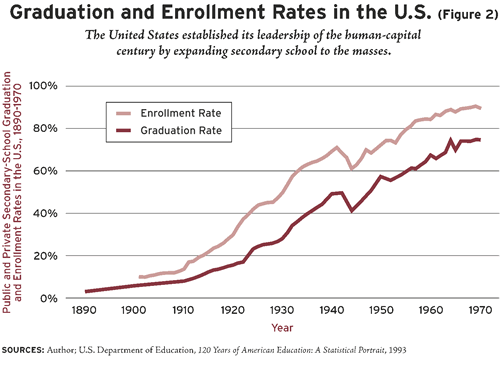
Part of the New Deal not often discussed is the effort to increase participation in public education. During the 1930’s, many grammar and high schools were built and students encouraged to complete high school.

The efforts resulted in a sharp increase in the percentage of the population graduating from high school. The increase in percent graduating from high school continued until the 1970’s when the rates plateaued.[1]

Emphasis on education continued after WWII with the GI Bill of Rights and then with availability of low-cost loans encouraging more students from lower- and middle-income families to attend college.

The lesson of these programs for today? Existing and emerging technologies require more math/analytical skills to utilize capabilities of the technologies. With the need for more math/analytic skills…and the risk of becoming an also-ran country by not adopting the technologies…what actions do we take? How does US society get more people educated, especially those on the shore unaware of the pending technology tsunami?

Following are some ideas. You’ll likely look at the list and say, “What’s so innovative about the list? I’ve heard these ideas before.” And, you’re right. The ideas are not new…but you know what? We’re not implementing them, and in some cases we seem to be regressing.

The list is intended to start the discussion:

  1. Help society understand that expenses for public education are investments, not merely costs. Investments may take time to payback but result in a benefit that spans generations.
  2. Increase pay for…and respect for teachers. Make the qualifications and salaries for teachers competitive with, and possibly slightly above, the private sector.
  3. Reinstitute more technical training in high schools. Almost everyone agrees not everyone is suited for college. Not attending college does not mean one does not have valuable skills. Far from it. The public schools should provide everyone an opportunity for training in how to use, leverage and maintain technology skills. At one time “technical training” was common in high schools. Time for it to return.
  4. Make loans for college affordable with a provision to “earn-out” the loan over a reasonable period. Unlike today, make compliance for the earn-out provision easy to understand and execute. Provide assistance to the participant – not everyone is an expert at filling out government paperwork. Encourage people to become teachers. Don’t discourage them with onerous penalties for slight mistakes in completing paperwork.
  5. Cut back, or eliminate private charter schools. Yes, all organizations need fixing over time. Public education is no exception. But charter schools are not necessary to fix problems in public education. Charter schools destroy the very foundation of public education…and operate with far less accountability. The trend toward charters needs to stop and charters eliminated.
  6. Create meaningful education programs for older workers. The claim by some that “I’m too old to learn” is an excuse, not a reason. My experience has been many older people are embarrassed to ask for help. When assistance is framed the right way, it is rare that someone turns down the opportunity to learn. We…again societal we…need to be flexible in how we approach teaching students, whether the student prospect is in grammar school or a grandparent.
  7. Implement meaningful education programs and works-skills programs in prisons. Incarceration is incredibly expensive. While different studies include different amounts for overhead and other costs, the least amount of cost per year to incarcerate someone is roughly the same as tuition, room and board at a state university. In many studies, the cost is multiples higher than tuition, room and board. Incarceration without rehabilitation is wasted money. Educating prisoners and having prisoners do meaningful work while incarcerated seems to be “common sense.”

How do we implement some of these ideas? More in the next article. Stay tuned.

[1] 120 Years of American Education: a Statistical Portrait, US Department of Education, 1993.

Links to articles re GM Plant Closings

  • JRD Reaction to GM’s Announced Plant Closings
  • GM Plant Closings Tsunami Canary

#318 Tipping Point on the Donald: Fingernails Are Too Long

23 Sunday Dec 2018

Posted by Jordan Abel in Causes of the Revolution, Gov't Policy, Sense Check

≈ 14 Comments

Readers: this blog is set in the future (sometime after the year 2020). Each entry assumes there has been a 5th revolution in the US — the Revenge Revolution. More about the Revenge Revolution and author, Entry #1.  Many entries are formatted as conversations. Characters appear in a number of entries, with many entries building on previous conversations.  

Occasionally I do a “sense check” about the likelihood of a Revenge Revolution.  Entry #318 is a “sense check.”  One more note — sometimes I write about another topic that does not quite fit the theme of the blog.  Those comments are in the page titled “JRD Thoughts and Comments.“

When I started this blog more than five (5) years ago, two guidelines I set were key: (i) avoid spending too much time on political or economic events occurring in the previous week or two; (ii) avoid overreacting to such events. Throughout writing the blog I’ve tried to keep such events in proper perspective and also tried to frame the events in the context of the underlying premise of the blog – sometime after 2020 the US would experience a 5th revolution, which I labeled the “Revenge Revolution.”

Trying to avoid overreacting is borne out by history. Revolutions seem to be caused by events over time. However, a few events during a short period of time, or even one event, can tip the scales, triggering the populace to say, “Enough, already. Throw the bum(s) out. Time for a change!”

Although we rarely think about it, such trigger points happen in our everyday lives. A simple example is one day you look at your fingernails and think they’re too long. And with that realization, most of us feel an urgent need to take action and file the nails. Obviously the fingernails didn’t grow all at once. The fingernails grew a little bit every day and then, suddenly, the fingernails seemed too long.

This phenomenon is described by the Theory of Just Noticeable Difference, (JND). While JND is usually applied to more physical measures – e.g., length of fingernails – the theory seems to apply to less tangible measures as well. For many people, Trump’s behavior the past couple of weeks has been akin to a “fingernails-too-long” moment.

Just why would people think that way? Let’s take a quick review of events of the past couple of weeks. The list is not necessarily in chronological order.

  1. Michael Cohen, long-time Trump lawyer and “fixer” of problems, was sentenced to three (3) years in prison for what the judge called a “veritable smorgasbord of criminal conduct.” Earlier in 2018 Cohen’s offices were raided by the FBI. Cohen eventually became a cooperating witness against Trump in investigations by Mueller and the Southern District of NY. A partial list of crimes by Cohen has been disclosed. One crime of public interest, although one that eventually might prove to be a “lesser” crime, was for payments made immediately preceding the election to two women with whom Trump had affairs. The payments were a violation of campaign laws.
  2. National Enquirer, owned by American Media, Inc. CEO, David Pecker, admitted working with Cohen to help squash negative news about Trump immediately preceding the election. AMI was funneling money to cover a payment to at least one of the women. AMI’s involvement violated campaign finance laws.
  3. Michael Flynn, former Marine Corps general and former National Security Advisor to Trump, was anticipating no jail time at his sentencing. The judge chose to ignore the recommendations of the Special Counsel and dressed down the general in the court proceeding, indicating Flynn would be smart to ask for a delay in sentencing and agree to continue cooperating with Special Counsel for the next six (6) months. Even then the judge told Flynn he was subject to incarceration. Flynn was selected by Trump over widespread objections of the intelligence community.
  4. Matthew Whittaker, Acting Attorney General, refused to recuse himself from any involvement in the Mueller probe. Whittaker, who had been a regular on Fox News criticizing the investigation before being appointed by Trump, was strongly encouraged by the Ethics Office to recuse himself. Whittaker ignored the advice. In addition, there is some question whether his appointment was legal and whether certain actions taken by Justice Department under his appointment would be legal. The nominee to become the permanent head of Justice has been equally critical of the Mueller investigation and appears to have been chosen for that reason.
  5. Ryan Zinke, head of Dep’t of Interior, resigned. Zinke is subject of at least five ongoing investigations for various crimes.
  6. Trump Foundation agreed to dissolve after a lawsuit by the State of New York Attorney General claiming “…shocking pattern of illegality.” Based on claims presented by the State AG, it appears Trump and several members of the Trump family could face significant civil fines and possible criminal indictments.
  7. John Kelly, Trump’s chief of staff and former Marine Corps general, was fired by Trump. Kelly’s replacement – Mick Mulvaney. Mulvaney, a former representative from South Carolina, is currently Director of Office of Management and Budget. Mulvaney supposedly will function as chief of staff and run OMB. The practical effect is Trump has no chief of staff to manage schedules or try to coordinate legislation with Congress. How long will Mulvaney last? Mulvaney once called Trump’s views on a border wall and immigration “simplistic” and “absurd and almost childish.” Mulvaney added a physical barrier would not stop undocumented immigrants from crossing the Mexican border and ranchers at the border say they don’t need a fence.
  8. James Mattis, former Marine Corps 4-star, resigned as head of Dep’t of Defense. For Mattis the “fingernails-too-long” moment was Trump not seeking advice of the military and intelligence community before announcing, via Twitter, that the US would withdraw troops from Syria and probably withdraw half the forces from Afghanistan. The arbitrary decision on Syria shocked people in the US military, Congress and US allies. Since DOD was established in 1947, Mattis is the first head to resign in protest. If you have not read the letter of resignation, please do so.     18 12 21 Mattis Letter of Resignation NYT
  9. Trump Administration lifted sanctions on a Russian oligarch, Oleg V. Deripaska, who has close ties to Putin and Manafort.
  10. Putin publically praised Trump for his decisions re Syria and lifting sanctions on the Russian oligarch. (Sort of makes you wonder whose camp Trump is in, doesn’t it?)
  11. Trump, in a highly unusual public meeting in the White House, attempted to negotiate with Senator Charles Schumer of NY (top Democrat in Senate) and Representative Nancy Pelosi (incoming Speaker of the House) about a budget resolution that would continue to fund the Federal government. During the negotiations, Trump demanded that $5.0 billion be included for part of Trump’s Mexican border wall. If the $5.0 billion were not included, Trump declared in front of rolling cameras that he would be “”proud to shut down the government for border security.” The Senate passed a bill that included additional funding for border security but not a wall. The House, still under Paul Ryan, passed a bill that included funding for a wall. The House bill then forced the bill back to the Senate which refused to fund the wall. Trump then flip-flopped and tried to blame Democrats for the subsequent shutdown what he claimed he would be “proud” to do.
  12. Trump, after claiming that he was responsible for gains in the stock market, then blamed the Federal Reserve chairman for causing the largest percentage loss in value in any December since 1931. To “correct the problem,” Trump indicated he would fire Federal Reserve Chairman Jerome Powell, whom Trump appointed earlier in 2018 after firing Janet Yeltin.

There are probably more events but these are the ones that came to mind…with no further research. Yikes!! Any one of these events would have been a major scandal in a “normal” administration.

What do these events mean for the likelihood of a Revenge Revolution? If we were living during the era of the Wild West, I’d say, “Add another notch to your gun.”

I’ve not conducted a survey that would be considered scientifically valid. However, after listening to a number of people on the left, center and right, I get the sense that many have reached a “fingernails-too-long” moment…and some corrective action needs to be taken. Interesting, even some on the far right seem frustrated, but maybe for a different reason. They might sense that adults could start taking back Washington.

One far-right person that I deal with (data points of one are dangerous except in Washington), suggested he would use armed force to defend his property against any government action. I had limited time and did not dig deeper into what he considered intrusive government action. Nor did I take time to remind him the only reason he can claim ownership of property is…well, because of the legal structure established by the government. I’ll explain that role of government to him on another day.

So where are we? Many people seem to think Trump is so out of control that he needs to be removed from office. And what does that attitude mean for the likelihood of a Revenge Revolution? When I started the blog in 2013, the chances of a Revenge Revolution by the early 2020’s were at the very most 50 (yes):50 (no). Over time the odds seemed to have increased gradually. Now the odds have increased to 75 (yes): 25 (no) – at a minimum. And, without much effort, I could be talked into raising the odds to 90 (yes): 10 (no). It is truly a scary time.

If you’d like to read more about how a Revenge Revolution might get started, take a look at Entries #1-#8. (E-book version of the entries, How the 5th US Revolution Begins and About the Author).  These were my initial blog entries. I recently reread and the entries seem OK. If you are interested in how Trump might be “taken out” – impeached or physically removed from office – try Entries #244-#257. For a PDF e-book, DOWNLOAD Who Took Out the Donald #244-#257. These entries were written in summer 2017. The general content still seems plausible.

Thanks for your time. Comments welcome.


#317 How Technology-Induced Disruptions Impact Societies (#6 of 6)

09 Sunday Dec 2018

Posted by Jordan Abel in Causes of the Revolution, Societal Issues

≈ Leave a comment

Readers: this blog is set in the future (sometime after the year 2020). Each entry assumes there has been a 5th revolution in the US — the Revenge Revolution. More about the Revenge Revolution and author, Entry #1.  Most entries are formatted as conversations. Characters appear in a number of entries, with many entries building on previous conversations.  

Occasionally I do a “sense check.”  Auditing one’s own work is problematic but I try to be objective.  Entries #300 and #301 are the most recent standard “sense checks.”   Entries (#310-#313) broke from conversation format.  One more note — sometimes I write about another topic that does not quite fit the theme of the blog.  Those comments are in the page titled “JRD Thoughts and Comments.”   

Scene: Jordan’s office, Washington, DC.  Continuing conversation with Gelly, Jordan’s assistant.  Conversation began Entry #308.

092615_2031_Characters7.gifGelly:  “Seems to me we have two open topics – (i) if the invention of the automobile changed society; (ii) to what extent do product life cycles influence societal change.  But I need to get out of the office soon, so no blabbering on, please.”

Jordan:  “So diplomatic.  OK, I’ll try to keep it short…”

Gelly:  “…and simple.”

Jordan:  “Let’s start with autos.  Recall I said the iPhone…really the smartphone…seemed to be more integration of existing components than an invention.  Without question, since introduction the iPhone has had a major impact on societies worldwide.  But, to me the iPhone should not be categorized as a major technology breakthrough.”

iPhone3Gelly:  “Your analysis surprised me before the break and still surprises me.  I always thought the iPhone was some big invention.  Invention or not, what does the iPhone have to do with the automobile?”
Jordan:  “The introduction of the automobile, in many ways, fits in the same category as the iPhone – more integration than invention.”

Gelly:  “Your comment just seems to counter-intuitive.  Why do you say the automobile was more integration?”

Jordan:  “What was the nickname that most people called early automobiles?”

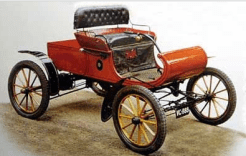
1903 OldsGelly:  “Horseless carriage, right?”

Jordan:  “Yes.  And what did the early automobiles look like?”

Gelly:  “A carriage without horses.”

Jordan:  “Now, think about the key components of an early automobile.  Obviously horse-carriage components were around.  If fact, for the early years, automobiles used wooden frames and wooden wheels – wheels, not tires.  The engine for the automobile had been around for a while, too.  Both the steam engines and the gas engine had been used in farm tractors.”

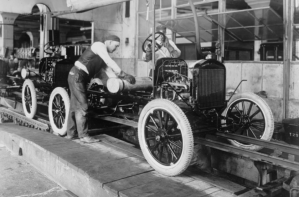
Model T AssemblyGelly:  “What about the assembly line.  Didn’t Henry Ford invent that?”

Jordan:  “Not really.  An assembly line required parts to be standardized so each part fit the same way on every car.  While Ford was probably the first auto company to use an assembly line, rifle manufacturers had been making standardized parts for decades.  Ford was smart and adopted the same assembly-line technique to increase production and reduce cost of the Model A.”

Gelly:  “Gee, I always thought automobiles were a technological breakthrough.  Now you’re saying autos were more like an iPhone.”

Jordan:  “True, but I also have a confession.  Always knew that Henry Ford borrowed the idea of an assembly line but until this conversation, I never really thought about the development of the automobile as being more integration than invention.”

Gelly:  “Well, well.  Jordan makes a confession.  Now, next topic – how do product life cycles affect societal change?”

Jordan:  “Stick with autos to start.  The automobile life cycle has been very long…and still going strong.  While lots of things on cars have changed – design, interior, engine Baker Electricperformance, emissions, creature comforts – the fundamental technology in cars and trucks is the same as the early 1900’s.  I know that might sound odd, but it’s true.  Most people forget there were steam-powered cars and battery-powered electric cars in 1910.  See that picture on my desk.  That’s a Baker Electric.”

Gelly:  “You mean Elon Musk didn’t invent the electric car?  Yikes!  What will all those Millennials think?”

Jordan:  “Now, now, be nice.”

Gelly:  “I know what you mean.  If you see a car that was built around 1910, even earlier, everyone still knows it’s a car.  That’s not true for some major products from 40-50 years ago, or even 25-30 years ago.”

WhyJordan:  “So has the automobile life cycle affected societal behavior?  Yes, but has society been affected by the life-cycle of the automobile manufacturers?”

Gelly:  “Not sure what you mean.”

Jordan:  “The answer is no, society has not.  Let me tell you why.  And give me some leeway on the numbers.  They’re about right.  In the US in 1910 there were 200 or more companies making cars.  By 1920 that number had dropped to about 20.”

Gelly:  “Is that drop like one of those order-of-magnitudes you were talking about before the break?”

Declining ChartJordan:  “Yes.  Very good.  Then between about 1920 and the mid-1960’s, the number of manufacturers dropped from 20 to 4-5, depends on the timing.  However, did the decline in the number of manufacturers affect how societal behavior was affected by the automobile?”

Gelly:  “No.  Car sales kept increasing.  So the relative short life-cycle of most of the early manufacturers had no affect at all on the number of cars being produced.  In fact, even though the number of car manufacturers declined sharply, the number of cars sold increased sharply.”

Jordan:  “So now we’ve separated the influence of the technology from the influence of individual companies involved with the technology.”

Gelly:  “The number of auto companies in the US declined but then it increased again.  Right now there are a bunch of foreign companies selling cars in the US.  And many of those companies have assembly plants here.  Let’s see, there’s Toyota, Honda, Mazda, Mercedes, BMW…let me think some more.”

TurtleneckJordan:  “You’ve made your point.  There are at least 10 different auto companies with assembly plants in North America. They got here, in part, because in the late 1960’s and 1970’s and even in the 1980’s, the US companies were slow to respond to changing consumer tastes and the increased demand for more fuel-efficient cars.  Even if the Big 3 auto companies had responded more quickly, they probably could not have stopped all the imports.”

Gelly:  “So in the 1970’s the foreign-based companies start selling in the US…and have taken a big chunk of the US market.  But what I don’t understand is why did they build assembly plants in the US?  If Trump’s MAGA claim – Make America Great Again – had any validity, then why wouldn’t the various foreign manufacturers take the same approach?  Just build cars in say Germany or Japan and ship to the US.  Why not?

Trump DunceJordan:  “The foreign-based manufacturers built plants in North America to save money and respond to market demands more quickly.  What Trump seemed to overlook…more likely never understood…is the real cost and the long lead-times involved with building overseas and then shipping to the country where the cars are sold.  What he also probably never understood was that before 1920, the US auto companies set up assembly plants in a number of foreign countries for the very same reasons the foreign companies built assembly plants in the US.”

Gelly:  “Another example of dodo-bird reasoning in the Trump Oval Office.  Boy, am I glad Trump’s gone.”

Jordan:  “Speaking of gone, before you leave let me try to wrap us what we’ve been talking about.”

Gelly:  “Let me try instead, please.  Societies may experience major changes in behavior as a result of a new product.  There does not seem to be consistent pattern whether the product that precipitated the change was an invention, a spin-off of an invention or an integration of other products, like the iPhone or the automobile.  We also concluded it doesn’t really matter…other than to maybe a few academics…whether the primary product was the invention, a spin-off or some integration.”

Jordan:  “OK so far.”

Gelly:  “In addition, although we didn’t talk about it a lot, some products have a very long life cycle that continues to affect societal behavior – automobiles, for example.  Other products have shorter cycles that affect societal behavior – mainframe computers, for example.  Some version of the Question Animatedshorter life-cycle product might still be around but the period of influence – its life cycle – is over.  I think I understand…but the answer seems so messy.”

Jordan:  “Agreed.  There doesn’t seem to be a clear-cut answer whether a technology per se, products based on that technology, or some product which integrated that technology precipitated societal change…let alone did the societal change contribute to a societal revolution.”

Gelly:  “One thing is clear, I need to get out of here.  Good-bye, Jordan.”

Jordan:  “Good-bye, Gelly.”

(Topic over for now.  Will likely revisit reasonably soon.)

#316 How Technology-Induced Disruptions Impact Societies (#5 in Series)

02 Sunday Dec 2018

Posted by Jordan Abel in Causes of the Revolution, Innovative Thinking: Ideas and Products, Societal Issues

≈ Leave a comment

Readers: this blog is set in the future (sometime after the year 2020). Each entry assumes there has been a 5th revolution in the US — the Revenge Revolution. More about the Revenge Revolution and author, Entry #1.  Most entries are formatted as conversations. Characters appear in a number of entries, with many entries building on previous conversations.  

Occasionally I do a “sense check.”  Auditing one’s own work is problematic but I try to be objective.  Entries #300 and #301 are the most recent standard “sense checks.”   Entries (#310-#313) broke from conversation format.  One more note — sometimes I write about another topic that does not quite fit the theme of the blog.  Those comments are in the page titled “JRD Thoughts and Comments.”   

Scene: Jordan’s office, Washington, DC.  Continuing conversation with Gelly, Jordan’s assistant.  Conversation began Entry #308.

Jordan: “OK, Gelly, I’m back. On the break I thought more how to keep this discussion simple.”

Gelly: “Good. So where do we start?”

Jordan: “First step is to decide what’s a disruptive technology for society compared to a disruptive technology for a company or industry.”

Coffee cup StarbucksGelly: “Just looking at your coffee cup, I suspect the introduction of a paper coffee cup was a major disruption to the pottery coffee-cup makers.  However, it’s hard to imagine the paper coffee cup had a major societal impact. Is that what you mean?”

Jordan: “Exactly. Same logic applies to causes of the various revolutions in the US. The Great Depression in the 1930’s caused a major economic disruption for much of the population but there was no societal upheaval as there was with the other revolutions.  In fact, one might argue that during the Great Depression most of the US population came closer together rather growing than farther apart.”

Gelly: “Think I understand the difference. Now, how about looking at some technologies. Before the break I asked if computers and automobiles were technologies that caused disruptions to society.”

Jordan: “Computers seem to be easier to analyze…but be prepared because the discussion might get a bit messy.”

Gelly: “OK. If computers really started to change society, then when did the change start?”

IBM MainframeJordan: “In the 1960’s when IBM introduced what were called mainframe computers. Granted, by today’s standards, the mainframes were big and slow. There were special air-conditioned rooms to handle all the extra heat from the computers. Plus, for a lot of applications, you had to transfer information to punch cards before you could use the computer. While those computers were clunky and dumb by today’s standards, the machines were breakthroughs for the time — offering at least a couple of orders of magnitude better data management and analysis.”

Gelly: “I said to keep the discussion simple, please. What’s an order of magnitude?”

Chart RisingJordan: “Each order of magnitude represents a tenfold increase. One order of magnitude would be 10x higher than the previous number. Two orders would be 100x higher – 10x the previous number which also was 10x higher. Three orders would be 10x10x10 or 1,000x higher.  Look at this chart and then imagine the line going up faster than what’s shown.”

Gelly: “So you think the computer increased data management and analysis by say 100 times, maybe 1,000 times? Wow.”

Jordan: “Wow is right. The gains didn’t apply to everything but they did to a lot of analysis. However…and this problem still exists today…you had to make sure input data was good. Otherwise, it was GIGO — garbage in, garbage out.”

092615_2031_Characters7.gifGelly: “Did IBM just one day decide to invent the computer or was something else invented that allowed the mainframe to be developed?”

Jordan: “Very perceptive question. The first so-called computers were even larger than the ones I described. The early computers used vacuum tubes and were not very practical. Have you ever seen a vacuum tube?”

Gelly: “Think so.  My grandmother kept a radio from her childhood. She took the back off one time and all I saw was a bunch of tubes. What I remember most is one time I touched a tube and it was really hot.”

Semi-ConductorJordan: “What changed to allow IBM…and a few others…to make practical mainframes was a way to eliminate vacuum tubes. The invention was the semi-conductor. Think of a semi-conductor as a computer chip or the SIM card in your phone. The early chips were not nearly as powerful as today.”

Gelly: “So getting rid of vacuum tubes was the breakthrough?”

Jordan: “Yes along with being able to store data on magnetic tape.”

Gelly: “With semi-conductors, IBM could make machines more powerful but smaller and cheaper, right?”

Jordan: “Yes. And now back to the question, ‘Does a certain technology become the driving force for societal change or merely a catalyst for societal change?’”

Know NothingsGelly: “If I understand correctly, the invention of the semi-conductor did not cause societal change per se. The societal change occurred only after products were developed using the semi-conductor. So, in deciding how a society adapts or manages technology-induced disruption, does it really matter whether the invention is the driver or the catalyst for the change? Deciding which might be a good academic exercise but does anyone else care?”

Jordan: “You’re right, it probably does not matter whether the technology is the driver or the catalyst. The semi-conductor could have been invented but then put on the shelf and never used. That’s happened to who knows how many inventions.  And some of those shelf sitters might be as important for society as the semi-conductor.”

HorseGelly: “Jordan, are we looking at the issue from the wrong end? We’re trying to find the cause of the societal disruptions. Would a better approach be to ignore the cause and analyze how the  technology disrupted society…and, if so, what kind of disruption?”

Jordan: “Mmm, you might be on to something. Keep talking.”

Gelly: “Say if some company like IBM had not used the semi-conductor, we might not have laptops, internet, or smartphones.”

Jordan: “Good point. Let’s not get hung up on who or what technology caused the disruption. Let’s look at the change that resulted.”

Gelly: “Go back to IBM. My uncle used to work there. If family stories are anywhere near correct, IBM quickly became a behemoth company, making lots money for many people, including my uncle.”

Jordan: “So how long do you think the IBM growth spurt was? Just for fun, let me do a quick download of IBM sales over time.”

Gelly: “OK.”

18 11 24 IBM Growth Yr-to-Yr 1007214-13999302201478128-Peter-E--Greulich_origin_LIJordan: “Take a look at sales after WWII and the hand-drawn blue line.  The company had positive sales growth virtually every year from right after WWII to almost 1990 – 45 years.”

Gelly: “Some of those year-to-year gains don’t look like much.”

Jordan: “Take another look at the scale on the left side. There were a lot of years when sales increased 15% or more over the prior year. That kind of gain for one year is good. To achieve that kind of gain year after year after year is phenomenal.”

Gelly: “So what happened in the early 1990’s? Sales declined for several years…and doesn’t look like they’ve really bounced back since.”

Laptop 1990Jordan: “What IBM missed was the shift to the personal computer – desktops first, then laptops. Even though the PC was not as powerful as the mainframe, it was easier to use.”

Gelly: “I’m beginning to appreciate what you mean by the analysis being complicated. The semi-conductor gets invented, then voila, a bunch of new electronic products are introduced – mainframe computers to portable radios – and society begins to change behavior.”

Jordan: “As semi-conductors become more powerful, more products are introduced – personal computers, e.g. – and a new set of players dominates the scene – Apple, Microsoft and Dell. IBM’s still around but no longer the really big dog.”

Gelly: “Then the internet comes along and we have another set of players. By the way, wasn’t the internet some kind of Defense Department project?”

Jordan: “It was.  DoD worked with a small number of universities to set up a commutations network to make it easier to exchange data between computers. I’ll bet that in their wildest dreams these guys never thought how the internet would grow and be used today. Who could have imagined the likes of Google, Facebook and Amazon?”

Gelly: “So, if I step back and try to decide if society was changed by electronic products…and the answer is ‘yes’…then the base technology that allowed the change as the semi-conductor. But without products that used the semi-conductor – mainframes, laptops, portable radios, cell phones…and who knows what else – the semi-conductor would not have been a game changer.”

TurtleneckJordan: “Now you can see why trying to figure out how much society was changed by a specific technology is a messy exercise. Some products that influence societal behavior, at least in my estimation, don’t even qualify as technology breakthroughs. Others are breakthroughs but don’t get credit.”

Gelly:  “OK, Jordan, cut the gibberish and tell me what you mean.”

Jordan:  “Some so-called breakthrough products are really integration of existing components, albeit very sophisticated component integration but still integration.”

Gelly: “By integration you mean like picking and choosing parts from other products and then creating a new product? Sorta like Italian food. Spaghetti, linguine, angel hair have essentially the same base ingredients but are configured differently.”

iPhone3Jordan: “That’s a different way of looking at it but a good example. Let me give you one of my favorites. Not sure everyone on the original development team would agree, but I think the iPhone was a very clever and sophisticated integration of components from cell phones and laptops.”

Gelly: “Alright, but even if some products are integrations, so what? Can’t these products change society?”

Jordan: “Absolutely. And there’s another yet aspect of how a technology can change societal behavior – that is the life cycle of a product.

Gelly: “We can talk about life cycle.  But before we do I have a question for you.”

Jordan: “Which is?”

Miracle on 34th StreetGelly: “Near the end of the movie ‘Miracle on 34th Street’ when they’re driving down some the suburban street, Natalie Wood shouts something. Remember what she shouted”

Jordan: “You mean, ‘Stop Uncle Fred, stop!’”

Gelly: “That’s what we’re going to do now – stop.”

(Continued)

← Older posts
Newer posts →

Subscribe

  • Entries (RSS)
  • Comments (RSS)

Archives

  • August 2025
  • July 2025
  • June 2025
  • May 2025
  • April 2025
  • March 2025
  • January 2025
  • December 2024
  • November 2024
  • September 2024
  • August 2024
  • July 2024
  • June 2024
  • May 2024
  • April 2024
  • March 2024
  • February 2024
  • January 2024
  • December 2023
  • November 2023
  • October 2023
  • September 2023
  • August 2023
  • July 2023
  • June 2023
  • May 2023
  • April 2023
  • March 2023
  • February 2023
  • January 2023
  • December 2022
  • November 2022
  • October 2022
  • September 2022
  • August 2022
  • July 2022
  • June 2022
  • May 2022
  • April 2022
  • March 2022
  • February 2022
  • January 2022
  • December 2021
  • November 2021
  • October 2021
  • September 2021
  • August 2021
  • July 2021
  • June 2021
  • May 2021
  • April 2021
  • March 2021
  • February 2021
  • January 2021
  • December 2020
  • November 2020
  • October 2020
  • September 2020
  • August 2020
  • July 2020
  • June 2020
  • May 2020
  • April 2020
  • March 2020
  • February 2020
  • January 2020
  • December 2019
  • November 2019
  • October 2019
  • September 2019
  • August 2019
  • July 2019
  • June 2019
  • May 2019
  • April 2019
  • March 2019
  • February 2019
  • January 2019
  • December 2018
  • November 2018
  • October 2018
  • September 2018
  • August 2018
  • July 2018
  • June 2018
  • May 2018
  • April 2018
  • March 2018
  • February 2018
  • January 2018
  • December 2017
  • November 2017
  • October 2017
  • September 2017
  • August 2017
  • July 2017
  • June 2017
  • May 2017
  • April 2017
  • March 2017
  • February 2017
  • January 2017
  • December 2016
  • November 2016
  • October 2016
  • September 2016
  • August 2016
  • July 2016
  • June 2016
  • May 2016
  • April 2016
  • March 2016
  • February 2016
  • January 2016
  • December 2015
  • November 2015
  • October 2015
  • September 2015
  • August 2015
  • July 2015
  • June 2015
  • May 2015
  • April 2015
  • March 2015
  • February 2015
  • January 2015
  • December 2014
  • November 2014
  • October 2014
  • September 2014
  • August 2014
  • July 2014
  • June 2014
  • May 2014
  • April 2014
  • March 2014
  • February 2014
  • January 2014
  • December 2013

Categories

  • Affordable Solutions
  • Back Asswards Thinking
  • Background
  • Background Stupid Is as Stupid Does
  • Benefits of Revolution
  • Causes of the Revolution
  • Common Sense Policies
  • Corporate Policy
  • Definitions
  • Diversions
  • Economics
  • Education Issues
  • Federal Budget
  • General Motors
  • Gov't Policy
  • Infrastructure & Fixed Fuel Prices
  • Innovative Thinking: Ideas and Products
  • Lessons of Revolution
  • Personal Stories
  • Possible Solutions
  • Post Trump Presidency
  • Rebranding Black Community
  • SCOTUS
  • Sense Check
  • Societal Issues
  • Stupid Is as Stupid Does
  • Tech Tsunami
  • Trump 47
  • Uncategorized

Meta

  • Create account
  • Log in

Create a free website or blog at WordPress.com.

Privacy & Cookies: This site uses cookies. By continuing to use this website, you agree to their use.
To find out more, including how to control cookies, see here: Cookie Policy
  • Subscribe Subscribed
    • usrevolution5
    • Join 32 other subscribers
    • Already have a WordPress.com account? Log in now.
    • usrevolution5
    • Subscribe Subscribed
    • Sign up
    • Log in
    • Report this content
    • View site in Reader
    • Manage subscriptions
    • Collapse this bar
 

Loading Comments...