• Home
  • Booklets/Grouped Entries
  • Tech Tsunami
  • List of Entries to Date
  • About the Author

usrevolution5

~ USA Headed for a 5th Revolution! Why?

usrevolution5

Category Archives: Economics

#148 European Economic Amnesia (Part 3 of 3)

01 Saturday Aug 2015

Posted by Jordan Abel in Causes of the Revolution, Economics, Gov't Policy, Societal Issues

≈ Leave a comment

Scene: Jordan and former colleague, whose views lean far right, are at dinner. Conversation started Entry 146. (More about author and the general content of the Blog, Entry #1.)

Jordan: “Wow, this is a great dessert. We should skip the entrée and go straight for dessert.”

science_rocksSteve: “Not a chance. We’ve spent too much time training the staff on how to customize the salad.”

Jordan: “Alright, back to the topic at hand.”

Steve: “You agreed that government and households could have the same economic behavior…but then said the timing for the behavior was 180 degrees apart. Tell me why.”

TurtleneckJordan: “Use Greece as an example. Germany clamped down on spending by the Greek government.”

Steve: “As they should have. Spending was out of control.”

Jordan: “Hold on. Think about the restrictions that were forced on Greece. Banking. No withdrawals…well, very limited withdrawals.”

Steve: “So, why is that a problem?”

Jordan: “Where was the money going to come from to help grow the economy? People had no money. Even if they have savings, they could not access the account because of the banking restrictions. Businesses that exported could not buy goods from other countries so their export business dried up…and Greece needed foreign currency.”

Steve: “So government can’t spend any more because they were to pay down the debt. I’m beginning to see the box they were in. There’s no money and no way to start the economy.”

Jordan: “You’ve got it. Not so hard to understand, is it?”

Steve: “But no one…and I mean not one of the people I listen to or read has put the situation in such understandable terms. Why?”

Jordan: “You’re a good example why we all need to get news from multiple sources. RantWhy haven’t your sources explained it? Ideology and politics. Lots of credible economists have made the point that someone has to spend for the economy to grow.”

Steve: “What you said earlier. Your spending is my income, right? As much as it troubles me to say this, I see why government has to spend more in a recession…and especially a depression. This really pains me but I even understand the extra spending might increase the deficit.”

Jordan: “I’m loving this conversation.”

Steve: “Don’t slobber all over yourself yet. What about savings? You said the government should act like a household. When does the government save?”

Line chartJordan: “When the economy is stronger. If the economy is in a growth mode…and has been for a while…it’s OK to raise taxes a bit and start to pay down the deficit.”

Steve: “I knew there was a trick. Raising taxes. We need to cut taxes…except for Greece, where they needed to raise taxes. Those slackards weren’t paying.”

Jordan: “Ok, what side do you want to take? Raise taxes and lower the deficit or…”

Steve: “Cut taxes and lower the deficit. That’s the only fair way.”

Jordan: “What Kool-Aid have you been drinking? Or maybe just too much wine.”

Steve: “You better hope it’s not the wine. I’m driving, remember? What’s wrong with lower taxes and reducing the deficit? That’s good economic policy.”

voodoo-2015958Jordan: “The math just doesn’t work is what’s wrong.  Voodoo economics.”

Steve: “The tax rate is too high. It’s a disincentive to work.”

Jordan: “I admit that at some point the tax rate becomes a disincentive.”

Steve: “I knew I was right.”

Jordan: “A maximum marginal tax rate of say 50% or more might be a disincentive to the very wealthy. A maximum rate of 75% would expand the field. But I’m talking about a marginal rate of much less than 50%.”

Steve: “Your argument is weak. We need a tax cut.”

Jordan: “We’ve gotten somewhat sidetracked. But I want you to do one thing. Find some empirical evidence where a significant cut to a reasonable maximum marginal tax rate reduced the deficit.”

Steve: “That’s not a fair request.”

Jordan: “You’re right. It’s not a fair request.”

Steve: “See another trick.”

Jordan: “No trick. But the request is not fair because you cannot find any credible data. You need to put your political ideology aside and solve the problem.”

Steve: “Are you saying there is only one solution…yours or whoever you believe in?”

Jordan: “What I’m saying is if you want to solve an economic problem – Greece, for example – you need to understand what drives the economy.”

Steve: “And you think it’s not just politics.”

Jordan: “It’s the same problem you face when trying to find oil and gas reserves. You need to understand what rocks and what formations are most likely to hold oil and gas.”

carnacSteve: “You meaning wishing for oil and gas won’t do?”

Jordan: “I’m glad you haven’t lost your sense of humor. No wishing won’t do.  No Great Carnac, whether exploring for oil or fixing the economy.”

Steve: “Back to Greece. Why do you think Germany…I mean the EC…put such harsh restrictions on Greece? Didn’t they understand what was likely to happen?”

Jordan: “You were right when you said Germany. Greece was not acting the way bossy-motherMother Merkel thought Greece should act. You must behave like mother says. Down two, over four. Be good and Mother Merkel will give you a little treat.”

Jordan: “But the kid said, ‘You know what Mother Merkel? I’m not like you.”

Steve: “And then the people of Greece told Mother Merkel to shove it and started a revolution. You think the revolution in Greece motivated the Revenge Revolution in the US?”

Jordan: “The revolution in Greece certainly opened eyes, especially to the younger crowd. But I think the US was headed for a revolution anyway.”

Steve: “Without Greece? Why’s that?”

Jordan: “People in the US were faced with the same underlying cause of all revolutions – inequality.”

waiterWaiter: “Gentlemen, may I get you anything else?”

Steve: “No thanks. The salad and dessert were great…and so was the wine. I’ve just had my fill of economics for the evening. No more.”

Jordan: “I’ll take the check.”

Ebook format of recent series of entries on Federal Budget.  15 05 23 Do They Really Understand Entries #121-#130

#147 European Economic Amnesia (2 of 3)

30 Thursday Jul 2015

Posted by Jordan Abel in Causes of the Revolution, Economics, Gov't Policy

≈ Leave a comment

Scene: Jordan and former colleague, whose views lean far right, are at dinner. Conversation started Entry 146. (More about author and the general content of the Blog, Entry #1.)

Steve: “You asked how much I really understand about economics.”

Jordan: “That’s the question.”

science_rocksSteve: “What’s there to understand? You cannot spend more than you earn…at least not for very long. I mean, what else is there to know?”

Jordan: “Let’s see Mr. Geophysicist. Oil and gas are stored in the ground someplace. Some rocks are more likely than other rocks to hold oil and gas. If I want to drill for oil, I go find someplace with a bunch of rocks.  What else do I need to know?

Steve: “Alright, point well taken. Truth be known I had one economics class in undergrad…and I don’t remember if it was micro or macro-economics.”

TurtleneckJordan: “But I watch Fox News, therefore…”

Steve: “C’mon, that’s not a fair-and-balanced comment. But really, how complicated is economics?”

Jordan: “Real economics…not political economics…is a science with lots of empirical data and structured analysis, just like any science.”

Steve: “But it’s a dismal science.”

Jordan: “I don’t view it that way at all. In fact, I think economics is quite exciting. Some of the fundamentals are not well understood…or worse, ignored, especially politicians and ideologues.”

Steve: “Well, then tell me what you think was wrong with the EEC demanding Greece repay its debts. The demand to repay seems very logical to me. And logical to a lot of other people as well.”

Piggy BankJordan: “I am not advocating shirking financial responsibility. However, let me ask you a question. Who do you think has a better chance of repaying debts – someone who is working or someone who is not working?”

Steve: “That’s a really dumb question.”

Jordan: “No it isn’t. That’s the question that should have been asked as Germany was imposing penalties on Greece.”

Steve: “You mean the EEC, don’t you?”

Jordan: “No, I mean Germany. From everything I’ve read about the agreement, Germany drove the decision.”

Steve: “So you think the loan restrictions are too harsh…were too harsh?”

SpiralJordan: “Absolutely. The restrictions effectively limited Greece’s ability to grow its economy and generate enough income to pay down the debt. The restrictions created a death spiral and effectively killed Greece’s economy.”

Steve: “How so?”

Jordan: “By forcing everyone, not just the very wealthy, to take a large portion of income for taxes and debt repayment.”

Steve: “You mean tax rates matter after all?”

Jordan: “Of course tax rates matter. And it’s not just Republicans who say that. Even your hated John Maynard Keynes said tax rates matter…and that was many decades ago.”

down chartSteve: “You think the loan restrictions precipitated the revolution in Greece?”

Jordan: “Yes. And here’s what’s so amazing to me. After WWI, the Allies imposed harsh repayment penalties on Germany. What happened? The economy collapsed, Germany had no income so it printed scads of money, which was followed by hyper-inflation.”

Steve: “I always knew printing money would cause inflation.”

Jordan: “Be careful. Here’s where you need to study economics. The two are not always so directly linked. In Germany’s case, the amount of money was excessive for the good available. Plus some other factors. But, then what happened in Germany?”

swastikaSteve: “German people rebelled and elected Hitler…and then we had WWII.”

Jordan: “You’d think the Germans might remember their history. But no, Merkel seemed more focused on extracting revenge on Greece for what she thought was ‘fiscal irresponsibility.’ Rather than allowing Greece’s economy to grow and repay debt over time, she put the screws to it. And Germany claimed forcing harsh terms on Greece was really a lesson in fiscal management.”

Steve: “Pardon me for what might seem like an obvious statement…in order to repay the debt, a country…in this case Greece…needs to grow the economy and generate Line chartincome, just like a person needs income to repay debt.”

Jordan: “He’s starting to understand.”

Steve: “And for the program to work, people need to retain a decent percent of income. A country or individual cannot save their way into prosperity. You have to earn the money and then spend most of the money for the economy to grow. My expenses are your income, right?”

Jordan: “By George, I think he’s got it. The rain in Spain…”

Steve: “Tell me one more thing. Should families and government take the same financial actions?”

122913_1337_14BringingU2.pngJordan: “Basically, yes. But they take those actions at exactly opposite times. And the Germans either didn’t understand or refused to acknowledge that. I’ll tell you why over another glass of wine and desert.”

(Conversation to be continued next entry.)

Ebook format of recent series of entries on Federal Budget.  15 05 23 Do They Really Understand Entries #121-#130


#146 European Economic Amnesia (Part 1)

25 Saturday Jul 2015

Posted by Jordan Abel in Causes of the Revolution, Economics, Gov't Policy, Societal Issues

≈ 2 Comments

Scene: Jordan and former colleague, whose views lean far right, are planning to go to dinner.  (More about author and the general content of the Blog, Entry #1.)

Jordan: “Steve, glad you called. What brings you to Washington?”

science_rocksSteve: “Conference plus I need to check some files at the National Archives…old mining stuff.”

Jordan: “Let’s talk more over dinner.”

Steve: “The usual spot?”

Jordan: “Absolutely. I’m sure they’ve missed us.” (Walk to restaurant.)

Waiter: “Gentlemen, good evening. May I get you something to drink?”

Steve: “Yes, please bring a bottle of a Sonoma County cab.”

waiterWaiter: “Silver Palm or the Mondavi Special Reserve.”

Steve: “Mondovi, please. Thanks.”

Jordan: “And we know what we want to eat.”

Waiter: “Yes, sir.”

Jordan: “We will each have a Caesar salad with salmon. And could you…”

Waiter: “…Pardon me, sir. Are you the gentlemen the manager told us about?”

Steve: “All positive, I assume.”

Waiter: “Yes, he said the way you want the salmon prepared is not on the menu but we should accept the order anyway.”

TurtleneckJordan: “Yes, we’re the ones. Didn’t know we were so famous. And thank you for accepting the order. We really appreciate it.”

Steve: “No need to rush the salad. We want to catch up over some wine.”

Waiter: “Yes, sir. I’ll bring the wine right out.”

Jordan: “So, Mr. Mining Expert, what shall we talk about this evening?”

Steve: “You get all the inside dope in Washington. Why do you think there was a revolution in Greece…and did that precipitate the revolution in the US?”

Jordan: “Good questions. My take on the revolutions — the underlying cause is the same for Greece, the US…in fact most any revolution.”

Steve: “Which is?”

Jordan: “Inequality. Really economic inequality.”

Steve: “The opposite of economic inequality is economic equality, which sounds very socialist to me…and I don’t like socialism and neither should you. It’s un-American.”

UnfairJordan: “By economic inequality, I really mean unfair economic opportunity, not that everyone makes the same income.”

Steve: “Still sounds like socialism to me.”

Jordan: “You’re a religious guy, right?”

Steve: “You already know the answer to that. Of course I am. That’s why I’m a conservative.”

Jordan: “If you were to state one tenant of your religion that could be a guide for everyone’s behavior, what would that tenant be?”

Bible GenericSteve: “Probably, ‘love thy neighbor as thyself.'”

Jordan: “I’d say that tenant sums up most religions. So let’s take that tenant and apply it to economic policy.”

Steve: “Seriously?”

Jordan: “Seriously. If we have a policy of being fair…treat thy neighbor as thyself…what kind of economic policy would we implement?”

politicsSteve: “I’ve never heard anyone address economic policy quite that way. If they have, there’s so much shouting that basic question gets overlooked.”

Jordan: “Sometime in the next few weeks, you’ll hear POTUS discuss a new way to measure government policy – treat thy neighbor as thyself.”

Steve: “That still sounds like socialism.”

Jordan: “Maybe your religion is socialist.”

Steve: “I’ll ignore that.”

Jordan: “More like you don’t want to think about it.”

Steve: “Put your measurement in practical terms. How would have a ‘treat thy neighbor as thyself’ economic policy prevented say the revolution in Greece?”

Jordan: “This is no profound statement but economic situations in Greece, the US…in fact most any country… are not pure black and white. Most of the time there’s a big gray area. But a gray area does not prevent or preclude a well-thought-out policy.”

Steve: “Tell me more.”

Jordan: “In my view Greece was affected…actually affected negatively…by three major factors.”

Clipart - running from debtSteve: “The biggest one to me was that the country was filled…maybe still filled…with a bunch of slackards. Those people just don’t want to work.  They want to run away from debt.”

Jordan: “You are so Republican. When did they brainwash you? Alright, the country had a less well-honed economic infrastructure than other European countries or the US.”

Steve: “What’s #2?”

Jordan: “The way the EEC (European Economic Community) was configured. Once a country agreed to use the Euro as their currency, they were stuck.”

Steve: “But I thought the Euro was a good thing.”

Jordan: “Definitely helped break down trade barriers between the countries. But if a country gets into economic trouble, like Greece, devaluing the currency to increase competitiveness is no longer an option.”

Steve: “I need to come back to that later. What’s the third issue?”

Jordan: “Germany.”

Steve: “What do you mean, Germany?”

Mickey-Mouse-fingerJordan: “What I mean is Germany gave Greece the royal finger.”

Steve: “How can you criticize Germany? They’re the economic engine of Europe. Other countries should follow the model. What was so bad about insisting Greece become fiscally responsible and pay all its debts? Seems logical to me.”

Jordan: (Pouring another glass of wine) “Oh, how quickly we forget.  Steve. Let me ask you something. First, I admit I am not a geologist, a geophysicist, a petrophysicist or whatever other kind of ‘ist’ plays with rocks. I’m not sure I know enough about rocks to even be dangerous.”

Steve: “You and I definitely agree on something. Now what’s your question?”

Jordan: “How much do you really understand about economics and the impact of economic policies on world events?”

(Conversation to be continued next entry.)

Ebook format of recent series of entries on Federal Budget.  15 05 23 Do They Really Understand Entries #121-#130


#130 Do They Really Understand? Flat Tax Fallacy. (Part 10)

22 Friday May 2015

Posted by Jordan Abel in Economics, Federal Budget, Societal Issues

≈ Leave a comment

Scene: Jordan and Sandy, a former business colleague, are having coffee.  The discussion begins Entry #121,.  This is the final segment of a series that includes Jordan’s description of a conversation with the Speaker of the House and the Senate Majority Leader, which begins Entry #123

Sandy:  “That conversation with the Speaker of the House and the Senate Majority hunterLeader sounds fascinating.  How often do you get private time with those guys?”

Jordan:  “First time in my career.”

Sandy:  “Maybe the three of you should play golf more often.”

Jordan:  “Not sure they need to be around me very often but your point is well taken.  They need to be around some people who can really help them understand the issues.”

Sandy:  “From what my parents tell me, Washington used to be more like what you guys did.  Sort of informal where people actually talked to one another.”

CongressJordan:  “Your parents are right.  Guys from both parties…it was mostly men then…used to play golf, play poker and whatever.  The families used to socialize and the kids knew one another.”

Sandy:  “You mean they acted like real people?”

Jordan:  “Good way to put it.  Yes, they acted like real people.  And, frankly, a lot more got done in Washington then, too.”

Sandy:  “You think the Revenge Revolution will bring back the old Washington?  How can we make that happen?”

Jordan:  “Shorter political campaigns and public funding of campaigns would be a good start.”

Sandy:  “You mean no more PAC’s (Political Action Committees)?”

TurtleneckJordan:  “No more PAC’s.  Every candidate gets so many dollars for his or her campaign…and that’s it.  No transferring money to other candidates.  No money for personal expenses.”

Sandy:  “How would that really work?”

Jordan:  “Sandy, let’s save that conversation for another day.  Before the break you said you had a couple of questions.  What were they?”

Sandy:  “One big question really.  Why doesn’t Congress implement a flat income tax?”

Jordan:  “What’s the appeal of the flat tax?”

Sandy:  “Two reasons.  One, a flat tax would be much easier to calculate.  Two, and more important, everyone would then pay taxes.”

taxpayerJordan:  “I agree a flat tax would be much easier to calculate.  But when you say everyone would pay taxes, exactly what do you mean?”

Sandy:  “A lot of people pay no tax.  And that’s not fair.  They’re free-loaders.”

Jordan:  “You mean some people don’t pay any income tax or not pay any kind of tax?”

Sandy:  “Never really thought about taxes other than income.  I guess I mean pay no income taxes.”

Jordan:  “And you think it’s not fair that some people don’t pay income taxes.  Right?”

Sandy:  “It’s not fair.  Those of us who work hard pay all the taxes.”

Jordan:  “You mean, pay all the income taxes.”

UnfairSandy:  “What’s the difference?  If someone doesn’t pay income tax, that’s not fair.  Period.”

Jordan:  “First, let’s talk about different type of taxes.  Name a few taxes.”

Sandy:  “Income tax, sales tax, property tax.”

Jordan:  “What about FICA?”

Sandy:  “You mean Social Security…and Medicare?”

Jordan:  “Yes, Social Security and Medicare.  While not a big amount, another one is excise tax?  Check your phone bill every month and see what you pay.”

Sandy:  “OK, there are lots of different taxes.  What’s your point?”

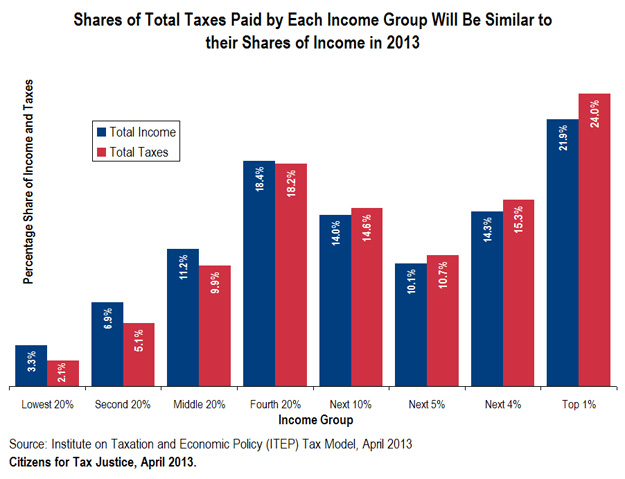
Jordan:  “If I showed you credible data that people who do not pay income tax still pay 15-20% of their income in taxes, would you stop calling these people free-loaders?”

Sandy:  “Yes…but I don’t believe you.”


total-tax-bill by income

Sandy:  “I never knew this.  Why don’t people look at the tax burden this way?

Jordan:  “The same reason people don’t look at debt as a percent of GDP.  They either do not understand percentages…or more likely, the data destroys their argument.”

Sandy:  “The data makes the case for a flat tax almost moot.  While the tax burden is not flat across the board, it’s a lot flatter than I thought.  But what about the argument that higher income people pay all the taxes…and lower income people don’t?  That still seems like a fair argument.”

Jordan:  “I agree higher income people pay a lot more tax.  But, Sandy, higher income people also make a whole lot more money.”

Sandy:  “That seems so obvious when you say it like that.”

Jordan:  “OK, here’s a chart that shows the percentage of income by group and the percentage of taxes paid by group.  See much difference?”

Share of Taxes by Income

Sandy:  “Not really.  The lowest 20% income group pays a little less tax than their share of income and the highest income group pays a little more tax.  But, overall income and taxes look pretty balanced to me.”

Jordan:  “So I ask you.  Would you rather be in the highest income group and pay a little more tax or the lowest income group and pay a little less tax?

Sandy:  “Another one of those trick questions?  Put me in the highest income group any day.  I’ll gladly pay a little more tax.”

Jordan:  “Feel better that the tax burden is spread evenly among all groups?  Think we need a flat tax?”

Sandy:  “No we don’t need a flat tax.  We have one already.  We need a simpler tax code but we don’t need a flat tax.  Just baffled why no one really talks about the tax burden this way.”

fife-drum%201Jordan:  “Welcome to Washington, the land where objective and fair arguments have been gobbled up by self-interest and greed.”

Sandy:  “Let’s hope the revenge Revolution changes that.  Jordan, you’ve converted me.  I’ll help tell the story.”

Jordan:  “Great.  Really enjoyed seeing you again.”


#129 Do They Really Understand? Federal Debt con’t (Part 9)

16 Saturday May 2015

Posted by Jordan Abel in Economics, Federal Budget

≈ 1 Comment

Scene: Jordan and Sandy, a former business colleague, are having coffee.  The discussion begins Entry #121,.  This segment is a continuation of Jordan’s description to Sandy of a conversation with the Speaker of the House and the Senate Majority Leader, which begins Entry #123

Mackey:  “Alright, I agree that the Federal debt as a percent of GDP (Gross Domestic occupations_lawyerProduct) was up less under Obama than Bush 43 but…”

Jordan:  “We’re making real progress.”

Mackey:  “Jordan, please, let me finish.  The debt percentage was less under Obama because Republicans forced him to cut back on his ridiculous expenditures.”

John Boy:  “That’s right.  And Republicans deserve all the credit for the economic recovery.”

Jordan:  “I must say, you guys have real chutzpah.”

Mackey:  “Jordan, just what is chutzpah?”

Jordan:  “For the average Joe, I would say, having a set of you know what…kahunas.  But ‘chutzpah’ is Yiddish and is best described with a story.”

man_with_speechJohn Boy:  “This should be interesting, but just don’t take too long.”

Jordan:  “The short version is this.  A hoodlum kills his mother and father, then begs for forgiveness from the court because he is an orphan.  That’s chutzpah.”

Mackey:  “The kid was disingenuous to say the least.”

Jordan:  “That’s why I said you guys had chutzpah.”

John Boy:  “You think we’re being disingenuous?”

Jordan:  “Look, Republicans tried to block nearly every program Obama proposed to stimulate the economy.  The Republicans mantra was ‘we need to save our way into prosperity.’  And, by the way, John Boy, how many times did the House vote to overturn the Affordable Care Act, aka Obamacare?”

Jordan:  “I quit counting after 50.”

Mackey:  “But Obama’s stimulus programs would have raised the debt?”

man_with_piggy_bank_2Jordan:  “True, but raised it only temporarily.  Mackey, if you’ve learned nothing else from this little session in the club house, I hope you’ve learned that one cannot save their way into prosperity.”

John Boy:  “Are you saying if I don’t spend money – or if someone doesn’t spend money – then demand will not increase?”

Jordan:  “Yes…and?”

John Boy:  “And without consumer demand there will be no additional jobs and no additional income…maybe no income for me, or most anyone.”

Jordan:  “And no income means no tax revenue from those unemployed.”

Mackey:  “But why doesn’t business spend more?”

down chartJordan:  “If you owned a business and demand for your product was flat to down, would you hire more people?

Mackey:  “No, of course not.”

Jordan:  “Which leaves government to get the economy started again.”

Mackey:  “If I hear you correctly, in a recession since business is not spending, government needs to spend more money.  If government cuts back also, it makes the economy worse.  Kinda creates a spiral downward.”

SpiralJordan: “You’re on a roll, Mackey.”

Mackey:  “But what about paying back the debt?”

Jordan:  “Pay it down when the economy is stronger.  Then you can raise taxes.”

John Boy:  “You’re giving me apoplexy.  Raise taxes?  That’ll kill everything!”

taxpayerJordan:  “OK, Mr. No-Tax-Increase-Ever, what was the maximum marginal tax rate at the end of the Reagan Administration?”

John Boy:  “25%…and that was still too high.”

Jordan:  “Mackey, want to guess?”

Mackey:  “25% seems low but I’ll stick with it.”

Jordan:  “How ‘bout the maximum tax rate under Clinton?”

John Boy:  “Clinton got lucky.  Reagan and Bush created the environment and he benefitted.  Clinton probably raised it to 35%.  I really don’t remember.”

Mackey:  “Agreed.”

Jordan:  “Good guesses.  Reagan was 28% and Clinton was 35%.  But the 28% was short-lived.  The max rate was raised to 31% under Bush 41.”

John Boy:  “That’s why the economy went in the tank and he didn’t get reelected.  Taxes went up.  Proves my point.”

Jordan:  “Just what is your point?”

John Boy:  “Like I said earlier, Reagan deserves all the credit for the economic recovery.”

voodoo-2015958Jordan:  “And what about all the deficits under Reagan and the voodoo economics?  And, oh yes, when was the last time there was a budget surplus?  C’mon, John Boy, take a guess.”

John Boy:  “OK, you made your point.  There was a budget surplus under Clinton, not Reagan.  We went through that a few minutes ago.”

Jordan:  “At least one of the lessons stuck.  John Boy…and you, too Mackey…if someone offered you $1.00 but said that you had to pay $0.35 tax, you would turn down the $1.00 and have nothing or pay the tax and have $0.65 left?”

John Boy:  “No, I’d take the $1.00 and pay my $0.35 tax.”

Jordan:  “What if the deal was you could keep $0.61.  Would you still take it?”

Mackey:  “Of course, take the $1.00.”

John Boy:  “Mackey, be careful.  Jordan is setting up another one of those intellectual traps.”

TurtleneckJordan:  “Look, I agree there is some point at which you would not take the $1.00.  You might reject it because of the risk involved, the amount of money you already make, the time involved…whatever.  But for most everyone except the very wealthy, would take the $1.00.  Taxes would need to be higher than 35% before they stopped seeking the extra $1.00.”

Mackey:  “Are you saying we should raise taxes?”

Jordan:  “I’m saying it is OK to raise taxes when the economy is strong, maybe even raise them a bit while the economy is starting to recover.  Then use the extra taxes to pay down the debt.  But people need to have income in order to generate tax revenue.”

bomb-hiJohn Boy:  “Jordan, why do you keep making such logical statements?”

Jordan:  “Comes with the territory.  I just wish we…collective we…would spend more time thinking through and talking through issues rather than throwing ideologue bombs at one another.”

Mackey:  “Listen, we need to get out of here.  But I want to make one final comment.  You know I can never admit to this publicly, but I very much appreciate the lessons in economics.”

122913_1337_14BringingU2.pngJohn Boy:  “Hear, hear.  A toast to our host, Jordan Abel.”

Jordan:  “Thanks.  Glad I could be of help.”

Waiter:  “Mr. Abel, the check.”

(Back to the conversation with Sandy.)

Sandy:  “Wow, Jordan that was quite a story.  Have you got a few more minutes?  hunterHave a couple of questions.”

Jordan:  “Yes, Sandy, but let’s take a break first.”

(To be continued.)   


#128 Do They Really Understand? Federal Debt con’t (Part 8)

10 Sunday May 2015

Posted by Jordan Abel in Economics, Federal Budget

≈ 1 Comment


Scene: Jordan and Sandy, a former business colleague, are having coffee.  The discussion begins Entry #121,.  This segment is a continuation of Jordan’s description to Sandy of a conversation with the Speaker of the House and the Senate Majority Leader, which begins Entry #123

man_with_speechJohn Boy:  “Let me repeat the questions.  ‘What was wrong with tax cuts under Bush 43?”

Mackey:  “Yes, Jordan, what was wrong with them?”

Jordan:  “Two fold.  First, Bush 43’s economic policy created huge deficits.  Remember CBO (Congressional Budget Office) had predicted budget surpluses for a number of years into the future.  Rather than reducing Federal debt…as many Republicans are wont to do…the tax cuts make the debt much worse.”

occupations_lawyerMackey:  “And what was the second reason?”

Jordan:  “Let me add to the first.  Remember guys the US was at war with Iraq so military expenditures are starting to soar…and we’re cutting taxes.  Doesn’t seem very Republican-like to me.”

John Boy:  “OK, Jordan, what was the second reason?”

Jordan:  “You guys always interrupt someone when they are speaking?”

John Boy:  “Yes, just finish and quit evading the question.”

Tilted-scale-hiJordan:  “The tax cuts were weighted heavily toward upper income.”

John Boy:  “Everyone…well most everyone…got a tax cut.  So the middle class benefitted.  Why are you always so worried about the middle class?  The wealthy pay way more than their fair share of taxes.”

Mackey:  “Right.  What’s your problem?”

Jordan:  “Just how short is your collective memory?  We just talked people needing money to buy things.  No money, no purchases, no demand and no new jobs. And, therefore less income for the wealthy. Remember?”

Mackey:  “You keep trying to convince us the Republicans economic theory…”

Jordan:  “…Trickle-Down theory.  And pardon me for interrupting.”

waterfall-clipart-dTrMkL7XcMackey:  “Trying to convince us the Trickle Down theory doesn’t work.  You know, like a waterfall, those at the bottom benefit from the work done at the top.  You know, workers at the top of the income scale and moochers at the bottom.”

Jordan:  “I’ll ignore your last comment.  You guys are old enough to remember the 1980 presidential campaign.”

John Boy:  “Unfortunately, we are old enough.  And so are you.”

Jordan:  “George Herbert Walker Bush, eventually #41, was running against Ronald Reagan to be the Republican presidential nominee.  And what label did Bush put on his fellow Republican’s economic policy?  The Trickle Down theory.”

Mackey:  “He called it ‘voodoo economics’ or something like that.”

Jvoodoo-2015958ordan:  “Voodoo economics…and truer words were never spoken.”

John Boy:  “The voodoo economics label was campaign talk.’

Jordan:  “Spoken during the campaign, yes.  But merely ‘campaign talk’ as you claim, no.  The label was spot on.”

Mackey:  “But the economy expanded under Reagan.  Proves he was right.”

Jordan:  “One more time, let’s look at the Federal debt as a percent of GDP.  Under Reagan what happened?”

John Boy:  “I know, I know.  Under Mr. Conservative, Ronald Reagan, the Federal debt ronald_reagannearly doubled as a percent of GDP.  That’s still hard for me to believe.”

Mackey:  “Seems as if someone is cooking the books.”

Jordan:  “Forget the conspiracy theories about distorting the data.  Remember the data were gathered when Reagan was president.”

Mackey: “But all those liberal bureaucrats in Washington hated Reagan and they fudged the data to make him look bad.”

Jordan:  Guys, whether you like it or not, economic growth under Reagan was a case of Keynesian economics at its best.  Reagan, the great communicator, roped you in to believing it was Trickle-Down economics.”

Mackey:  “Why doesn’t Trickle-Down work.  Seems as if it should.”

service jobJordan:  “Let’s go back to basics.  Add $1,000 to the income of someone making say $20,000-$30,000 per year.  What will they do with the money?”

John Boy:  “Spend it all.”

Jordan:  “What about $1,000 to people who make say $100,000 per year?”

Mackey:  “Might spend some of it.  Same with people making more than $100k.  But most over $100k won’t even notice.”

John Boy:  “Mackey, we keep falling into Jordan’s traps.”

TurtleneckJordan:  “John Boy, these aren’t traps.  Just facts.”

John Boy:  “I know but your approach is frustrating.”

Jordan:  “Truth is sometimes frustrating.”

John Boy:  “You know it is, especially since we’ve been preaching the opposite for so long.”

Mackey: “Preaching what?”

John Boy: “That Keynesian economics does not work and the most effective way for economic growth in a recession is to cut back on Federal spending, not increase it.”

Jordan:  “Maybe it’s time to put away the ideologue rhetoric and start focusing on solutions.  The US had a Revenge Revolution and then threw out many sitting members of Congress.  The public said it was time to rethink policies like tax cut that benefit the wealthy and don’t create good jobs.”

FiascoJohn Boy:  “Alright, we can make some policy changes.  But…and I emphasize but…we don’t want another Obama Administration fiasco.”

Jordan:  “What was the alleged fiasco?”

Mackey:  “Alleged?  The fiasco was huge deficits.  Wild spending on health care.  The Administration was absolutely out of control.  Obama ruined the country.  He caused the Revenge Revolution.”

John Boy:  “Mackey, raise your right hand and repeat after me.  ‘Beginning now and henceforth I will think before making what are really outrageous political statements.”

US Debt Percent GDPMackey:  “OK, no more statements without thinking first.  What’s the issue in telling the truth about Obama?  His fiscal deficits made Bush look like a piker.”

John Boy:  “Mackey, Mackey.  Look at Jordan’s charts.  Then get ready to eat some crow.”


crow-clip-art-COLOR_CROW(To be continued.  Included on the dinner menu, crow.)

#127 Do They Really Understand? Federal Deficit con’t (Part 7)

05 Tuesday May 2015

Posted by Jordan Abel in Economics, Federal Budget, Possible Solutions, Societal Issues

≈ 1 Comment

Scene: Jordan and Sandy, a former business colleague, are having coffee.  The discussion begins Entry #121,.  This segment is a continuation of Jordan’s description to Sandy of a conversation with the Speaker of the House and the Senate Majority Leader, which begins Entry #123

John Boy:  “Your point about companies replacing debt with stock…equity…is something I never really thought about.”

occupations_lawyerMackey:  “Me either.  Wonder what would happen if the US Government issued stock instead of debt?”

Jordan:  “Interesting questions but obviously lots of barriers to make it happen.”

John Boy:  “And highly unlikely…no impossible…given the attitude of many Republicans.

Mackey:  “John Boy, I agree the chance of passage is slim to none.  But we should bring it up for discussion.  Doing so would at least make people think.”

Jordan:  “Think?  Ideologues actually think?  Surely you jest.”

man_with_speechJohn Boy:  “Alright you guys let’s get back to the issue at hand – debt as a percent of GDP.  How ‘bout looking at the 230th Century?”

Jordan:  “OK.  Debt jumps in the Civil War…”

Mackey:  “Excuse me, the War of Northern Aggression.”

John Boy:  “Mackey, put that idea to rest.  The war was more than 150 years ago.  And which side wanted to secede?”

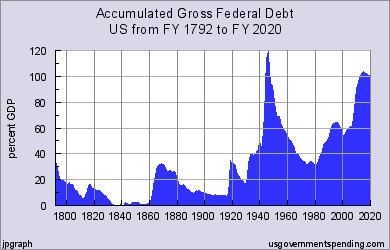
US Debt Percent GDPJordan:  “Children, no bickering.  Debt as percent of GDP (gross domestic product) jumps during the Civil War, then declines, jumps again in WWI, then declines until the Great Depression.”

Mackey:  “Yes, and the crazy public elects that socialist, Mr. ‘spend-at-all-costs’ himself, Franklin Delano Roosevelt.”

John Boy:  “Right.  Just look at how much debt jumped under FDR.  Mackey’s right.  What a socialist!”

fdr_~FdrJordan:  “And just what happened to the economy?”

Mackey:  “The economy recovered…sort of.”

Jordan:  “Sort of?”

Mackey:  “Sort of.  The country didn’t need all those socialist program.  The country could have saved its way out of the Depression.”

John Boy:  “You’re right again, Mackey.”

Jordan:  “And just what do you think drives the economy?”

John Boy:  “Tax cuts.  Incentives to invest.”

TurtleneckJordan:  “Here’s a simple question.  For someone out of work…through no fault of their own…what good is a tax cut?”

Mackey:  “An incentive to work.  Go find a job.”

Jordan:  “And just who is going to hire that unemployed worker?”

John Boy:  “Create your own job.”

Jordan:  “Let’s put politics aside and think this through.”

(John Boy and Mackey both sigh.)

Jordan:  “You own a business.  Why would you hire someone?  Just because the person needs a job?”

Mackey:  “Of course not.  Jordan, where do you come up with these stupid questions?”

John Boy:  “Mackey, I think we’re about ready to have another ‘ah ha’ moment.”

Mackey:  “Whadda mean?”

John Boy:  “As much as I hate to admit it, Jordan’s right.  Why would you hire someone?”

Mackey:  “Because you were busy and needed more help.”

John Boy:  “You got the right answer – because you need more help.”

Mackey:  “Simple isn’t it.  People want to buy your product, eat at your restaurant, whatever.  You need help.  What’s wrong with you guys?”

John Boy:  “And where did the tax breaks fit into that decision?”

Mackey:  “The tax breaks didn’t.  Oops.  What made the difference was demand.”

Jordan:  “Waiter, may we have some more snacks and another round?  Time to celebrate.”

Mackey:  “What are we celebrating?”

mr_know-it-allJohn Boy:  “Our enlightenment…at least enlightenment according to Jordan.  OK Mr. Know-It-All, what’s next?”

Jordan:  “Look, all I’m trying to do is present some basic economic principles.  Not left, not right, just basic economics.”

Mackey:  “So you’re claiming…”

Jordan:  “I’m not claiming anything.  I’m just stating.”

Mackey:  “OK, since you’re buying…you’re stating.  And you’re stating the only real way out of a recession is to stimulate demand.”

Jordan:  “Yes, that’s exactly what I am stating.  Talk about all the other theories you want.  When you do, you have to go back to one basic question?  Is a company going to hire another employee…or even retain existing employees…if enough people are not buying the company’s products?”

John Boy:  “Why do you make economics so simple?”

Jordan:  “The fundamentals of economics are simple…but not always intuitive.”

John Boy:  “Next you are going to tell Mackey and me that if the private sector is not hiring people…or laying off people…then the government needs to stimulate the economy.”

Jordan:  “You’re on a roll.  I told you most of economics was simple.”

OppositeMackey:  “Wait, you’re saying the government should do the exact opposite of what a household should do?  I mean, rather than cut back on spending when times are tough like real people do, the government should spend more?”

Jordan:  “See how easy this lesson is?”

John Boy:  “I don’t believe it.  If it’s bad for business it’s bad for government.”

Jordan:  “I’m going to show you why business benefits and makes more money by supporting a Federal deficit when in a recession.”

(To be continued)

#126 Do They Really Understand. Federal Deficit con’t (Part 6)

01 Friday May 2015

Posted by Jordan Abel in Economics, Federal Budget

≈ Leave a comment

Scene: Jordan and Sandy, a former business colleague, are having coffee.  The discussion begins Entry #121,.  This segment is a continuation of Jordan’s description to Sandy of a conversation with the Speaker of the House and the Senate Majority Leader, which begins Entry #123.

Jordan:  “A little surprised, Mackey?”

occupations_lawyerMackey:  “Absolutely.  I had no idea.  John Boy, did you know about this?”

John Boy:  “I’ve heard Democrats talk about it but never really believed them.”

Mackey:  “Jordan, could you walk us through this chart?  I want to make sure I understand it.”

Jordan:  “Gladly.  Let’s start with what is displayed.”

man_with_speechJohn Boy:  “Federal debt as a percent of GDP, right?”

Jordan:  “Yes, debt as a percent of gross domestic product.  Not the absolute level of debt, just the percent.”

Mackey:  “So the chart really is more like what we talked about re Bill Gates.  He can afford to take on a lot more debt than any one of us because he makes a lot more money than any one of us.”

Jordan:  “True.  But we also need to consider wealth in addition to income.  A lot of people make a lot of money every year but spend most of it…and therefore really haven’t accumulated a lot of wealth.”

bill_gatesMackey:  “But Gates has income and wealth.  In fact, a whole lot more wealth than his annual income.”

John Boy:  “As simple as that sounds, talking about the combination of income and wealth really helps me understand.  The United States has a lot of assets, really accumulated wealth, which could be used to back-up the debt.  What do they call that back-up?”

Mackey:  “Collateral.  The back-up is like what they do for your mortgage.  The bank uses your house as security or back-up for the loan.”

John Boy:  “Jordan, you sure no one is recording this discussion?  I’d really be house_on_hill_scene_color_2embarrassed if someone heard us asking these questions.”

Jordan:  “No one is recording the conversation.  And I think you hit on a good point.”

Mackey:  “You mean that a lot of people, including many of our legislative colleagues, do not understand the basics of finance.  And especially how the Federal government is financed.   From what you’ve said, financing the government is similar in some ways to your household finances, but there are some key differences.”

John Boy:  “Let’s get started with the chart, please.”

Jordan:  “What most people don’t realize, is the US has been in debt since the Revolutionary War.”

John Boy:  “What?  Debt since the Revolutionary War?  That seems hard to believe.”

Jordan:  “Think about it.  During the Revolution, the US was really like a start-up Mickey-Mouse-fingercompany…but really a country.  With the Revolution we gave the finger to our biggest trading partner – call it our biggest customer, mother England.”

Mackey:  “Now what do we do for money?  And where do we get some key supplies to fight the motherland?”

John Boy:  “We’ve got to import goods.”

Jordan:  “Goods cost money, which we don’t have.  But…”

Mackey:  “But like Bill Gates, we have lots of assets that other countries can use.”

John Boy:  “So now some countries, notably France, lend us money and also buy some of our products.”

Jordan:  “A new country going into debt is not unusual.  Really no different than a start-up company going into debt.”

Mackey:  “OK, the US has lots of debt but the economy starts to grow.”

US Debt Percent GDPJohn Boy:  “Yeah and according to the chart by 1835 or so we paid off the debt.  Who was president then?”

Jordan:  “Andrew Jackson.”

John Boy:  “What happened?  We were debt free and then we go back into debt again.  Seems stupid to me.”

Jordan:  “Try the Civil War for starters but let’s move beyond that.  Think of the US as a fast-growing company.  Give me some license in this comparison but I think you’ll get the point.”

John Boy:  “Many companies have no debt.  So why shouldn’t the US operate that way?”

Jordan:  “Here’s something I’ll bet you’ve never thought about.  Do you own stock in any companies?”

John Boy:  “Of course.”

TurtleneckJordan:  “Mackey, how about you?  Own stock?”

Mackey:  “Absolutely.”

Jordan:  “Many of those larger companies replaced their debts…loans…by issuing stock.”

Mackey:  “What a minute.  Are you saying the people who bought the stock are really financing the company…just like the bank?  They’re really loaning it money?”

Jordan:  “Yes, but with one difference.  The company never needs to pay off the loan.”

John Boy:  “Aren’t stockholders protected?  The company has all the assets.”

Jordan:  “Stockholders can benefit by having the value of the stock increase and/or by receiving dividends…at least some companies pay dividends.  But there is no guarantee of anything.  If the company goes bankrupt, stockholders are at the back of the line and hold what is probably a worthless stock certificate.”

printing_dollar_billsMackey:  “If there’s no guarantee or no backing to the stock certificate, isn’t the company effectively printing money?  All they have to do to get more money is issue more stock, rather than going to the bank and getting a loan.”

John Boy:  “Mackey, we get all exorcised because the government issues money without backing it up with gold or silver.  When you stop and think about it, the companies that sell stock are, in essence, doing the same thing – printing money.

Jordan:  “A real eye opener, eh?  But let’s hold the conversation about printing money.  Back to the chart and more about when debt as a percent of GDP went up and then came down.”

(To be continued)

#125 Do They Really Understand? Federal Deficit con’t (Part 5)

23 Thursday Apr 2015

Posted by Jordan Abel in Economics, Education Issues, Societal Issues

≈ Leave a comment

Scene: Jordan and Sandy, a former business colleague, are having coffee.  The discussion begins Entry #121,.  This segment is a continuation of Jordan’s description to Sandy of a conversation with the Speaker of the House and the Senate Majority Leader, which begins Entry #123.

Jordan:  “Feel better, John Boy?”

man_with_speechJohn Boy:  “Much.  Now, now back to the debt to income discussion.”

Mackey:  “OK, so we agree Bill Gates can take on a lot more debt than any one of us because his income is much higher.  What does that mean for the Federal debt?”

Jordan:  “John Boy, you want to explain this to Mackey or you want me to?”

John Boy:  “Let me try.  The simple answer is we should link the amount of Federal debt to Federal income.  The more income the country has, the more debt it can have.”

occupations_lawyerMackey:  “Alright, I understand the concept but what makes up Federal income?”

Jordan:  “Two approaches.  One measure is revenue collected through taxes.  The other measure is gross domestic product, or GDP.  Most measures of debt are against GDP because that represents the income of the country rather than just taxes collected.”

Mackey:  “John Boy, you think GDP is a fair measure.  You can’t trust these liberals to tell you the truth.”

John Boy:  “Relax, both measures have their plusses and minuses but yes, I think debt as percent of GDP is fair.  From what I’ve read, the ratio is used by a wide range of economists, including some of our own.  Let’s stick with debt as a percent of GDP.”

TurtleneckJordan:  “Here’s a question for both of you.  Did debt as a percent of GDP increase more during Bush 43 or Obama?”

Mackey:  “That’s a stupid question.  Obama, of course.  Hands down.”

Jordan:  “John Boy, what do you think – Bush or Obama?”

John Boy:  “I’m afraid to answer because it seems like a trick question.”

Jordan:  “OK, here’s another.  Did the Federal deficit as a percent of GDP increase Reaganmore under FDR – up until WWII – or under Ronald Reagan?”

Mackey:  “I’d like to say another stupid question but now I’m not so sure.”

Jordan:  “We seem to be making progress.”

Mackey:  “You know, Republicans hold up Ronald Reagan as the paragon for fiscal conservatism.  What’s wrong with that assumption?”

Jordan:  “Lots wrong.  One final question for now.  When’s the last time debt as a percent of GDP declined?”

Mackey:  “Under a Republican, of course.”

John Boy:  “Mackey, I think we are in for a rude awakening.”

Jordan:  “Look at my iPad.  Here’s a chart to get us started.  It’s from the BLS (Bureau of Labor Statistics).”

Jipad-clipart-ipad-user-01ohn Boy:  “Another liberal organization – should be named BS, not BLS.  Just kidding.  I know BLS has been a credible source of data for decades.”

Jordan:  “Look at this chart.  Federal debt as a percent of GDP beginning in 1800.”

Mackey:  “Now we’re talking.  That’s when the US was really a great country – no debt and lots of growth.”

John Boy:  “Mackey, you need to take a close look at this chart.”

Mackey:  “Whoa.  That can’t be right.”

(To be continued)

#124 Do They Really Understand? Federal Deficit. (Part 4)

19 Sunday Apr 2015

Posted by Jordan Abel in Economics, Education Issues, Societal Issues

≈ Leave a comment

Scene: Jordan and Sandy, a former business colleague, are having coffee.  The discussion begins Entry #121,.  This segment is a continuation of Jordan’s description to Sandy of a conversation with the Speaker of the House and the Senate Majority Leader, which begins Entry #123.

Jordan:  “Waiter, we’d like another round, please.”

Waiter:  “And whose tab should I put this on?”

Jordan:  “Mine, unfortunately.”

man_with_speechJohn Boy:  “Jordan, you have no idea how good this drink tastes since you’re paying for it.”

Mackey:  “You’re not going to charge this to taxpayers, are you?”

Jordan:  “No, Mackey.  Not to worry.  My own money.”

Mackey:  “Now, explain all this accounting stuff.  What does it really mean?”

Jordan:  “Let me ask you.  When you were first married did you buy a house?

Mackey:  “Of course…and proud of it.”

Jordan:  “And did you pay cash for the house?”

occupations_lawyerMackey:  “Are you kidding?  I borrowed all the money I could.”

Jordan:  “What if you were forced to pay cash for the house rather than borrowing?”

Mackey:  “Never could have afforded it.  In fact, we’d probably still be renting.”

John Boy:  “I think I see where you’re headed with this.”

Mackey:  “I don’t see.  Where is this headed?”

Piggy BankJohn Boy:  “Since the government uses ‘piggy bank’ accounting, it appears there is a big deficit when some of the funds are used to buy an asset…something that lasts a long time, like a new house.”

Mackey:  “I still don’t understand what you guys are talking about.”

John Boy:  “Why did the bank lend you money?”

Mackey:  “Because I had a steady income.”

John Boy:  “Did the house you bought cost more than your annual income?”

Mackey:  “Of course…4-5 times more than my income.  What’s wrong with that?”

TurtleneckJordan:  “Nothing wrong.  What if you had to make as much money every year as the house cost?”

Mackey:  “Already told you.  I couldn’t afford the house and probably still be renting.”

John Boy:  “Well, Mackey, old buddy, I can see we have a problem.”

Mackey:  “The problem is the federal budget deficit.”

John Boy:  “It’s not the deficit.  It’s the way we calculate it.  If your personal household used the same accounting method as the government, you would be in a big hole when you bought the house, or even a new car.  If there were a Constitutional ?????????????????????????????????????????????????????????????????????????????????Amendment forcing a balanced budget, you never would have bought your house, or even that new car.”

Jordan:  “And most businesses would never have gotten started.”

Mackey:  “I think I’m getting this.  And boy, am I glad we are off camera.  We are off camera, aren’t we Jordan?”

Jordan:  “No recording, no notes, no record, just an informal chat.”

Mackey:  “Quite honestly, I just never appreciated…really never understood…the difference in accounting methods.  By the way, what’s the other accounting method called?”

Jordan:  “For the record, accrual accounting.  And ‘piggy bank’ accounting is really man_with_piggy_bank_2called ‘cash’ accounting but piggy bank is easier to understand.”

John Boy:  “Jordan, at some point you have to pay off your debts.  We paid off the loans on our house.”

Jordan:  “Are you completely out of debt?  I mean debt other than credit cards.”

John Boy:  “No, not really.”

Mackey:  “And neither am I.”

Jordan:  “You’re not alone.  Most people, even those who’ve paid off their house, are in the same boat.  So, some debt seems OK?”

John Boy and Mackey (in unison):  “Of course.”

Jordan:  “What about the amount of debt?  Does that matter?”

Mackey:  “All depends on income.”

bill_gatesJordan:  “So you think Bill Gates could take on more debt than say I could.”

Mackey:  “That seems like another stupid question.  Of course Gates could handle more debt than you.  What’s your point?”

John Boy:  “His point, if I understand correctly, is the amount of debt should be measured against income or wealth, not just the amount of debt per se.”

Mackey:  “So $100 million of debt for you Jordan, might seem like a lot…”

Jordan:  “Excuse me Mackey?  Me with $100 million debt?  That’s a dream.  A debt of $1.0 million or even less would seem like a big deal.”

Money-clip-artMackey:  “As I was saying, $100 million debt might seem like a lot of debt to Jordan but not to Bill Gates.  Is that your point?”

Jordan:  “Exactly my point.  The measurement should be the amount of debt relative to income or wealth, not just the amount of debt.”

John Boy:  “Jordan, the way this discussion is headed you might make meaning less the argument that the federal debt is too high.”

Jordan:  “I wouldn’t say ‘meaningless’ but certainly citing the amount of debt as a scream-1-1024scare tactic becomes a lot less impactful or rational…if people understand.”

John Boy:  “Mackey, why did we agree to talk to this guy?  He’s starting to ruin my day…even more than my golf game.  But, I really want to learn more about the relationship of debt to income…after a break.  Be right back.”

(To be continued.)

← Older posts
Newer posts →

Subscribe

  • Entries (RSS)
  • Comments (RSS)

Archives

  • August 2025
  • July 2025
  • June 2025
  • May 2025
  • April 2025
  • March 2025
  • January 2025
  • December 2024
  • November 2024
  • September 2024
  • August 2024
  • July 2024
  • June 2024
  • May 2024
  • April 2024
  • March 2024
  • February 2024
  • January 2024
  • December 2023
  • November 2023
  • October 2023
  • September 2023
  • August 2023
  • July 2023
  • June 2023
  • May 2023
  • April 2023
  • March 2023
  • February 2023
  • January 2023
  • December 2022
  • November 2022
  • October 2022
  • September 2022
  • August 2022
  • July 2022
  • June 2022
  • May 2022
  • April 2022
  • March 2022
  • February 2022
  • January 2022
  • December 2021
  • November 2021
  • October 2021
  • September 2021
  • August 2021
  • July 2021
  • June 2021
  • May 2021
  • April 2021
  • March 2021
  • February 2021
  • January 2021
  • December 2020
  • November 2020
  • October 2020
  • September 2020
  • August 2020
  • July 2020
  • June 2020
  • May 2020
  • April 2020
  • March 2020
  • February 2020
  • January 2020
  • December 2019
  • November 2019
  • October 2019
  • September 2019
  • August 2019
  • July 2019
  • June 2019
  • May 2019
  • April 2019
  • March 2019
  • February 2019
  • January 2019
  • December 2018
  • November 2018
  • October 2018
  • September 2018
  • August 2018
  • July 2018
  • June 2018
  • May 2018
  • April 2018
  • March 2018
  • February 2018
  • January 2018
  • December 2017
  • November 2017
  • October 2017
  • September 2017
  • August 2017
  • July 2017
  • June 2017
  • May 2017
  • April 2017
  • March 2017
  • February 2017
  • January 2017
  • December 2016
  • November 2016
  • October 2016
  • September 2016
  • August 2016
  • July 2016
  • June 2016
  • May 2016
  • April 2016
  • March 2016
  • February 2016
  • January 2016
  • December 2015
  • November 2015
  • October 2015
  • September 2015
  • August 2015
  • July 2015
  • June 2015
  • May 2015
  • April 2015
  • March 2015
  • February 2015
  • January 2015
  • December 2014
  • November 2014
  • October 2014
  • September 2014
  • August 2014
  • July 2014
  • June 2014
  • May 2014
  • April 2014
  • March 2014
  • February 2014
  • January 2014
  • December 2013

Categories

  • Affordable Solutions
  • Back Asswards Thinking
  • Background
  • Background Stupid Is as Stupid Does
  • Benefits of Revolution
  • Causes of the Revolution
  • Common Sense Policies
  • Corporate Policy
  • Definitions
  • Diversions
  • Economics
  • Education Issues
  • Federal Budget
  • General Motors
  • Gov't Policy
  • Infrastructure & Fixed Fuel Prices
  • Innovative Thinking: Ideas and Products
  • Lessons of Revolution
  • Personal Stories
  • Possible Solutions
  • Post Trump Presidency
  • Rebranding Black Community
  • SCOTUS
  • Sense Check
  • Societal Issues
  • Stupid Is as Stupid Does
  • Tech Tsunami
  • Trump 47
  • Uncategorized

Meta

  • Create account
  • Log in

Blog at WordPress.com.

Privacy & Cookies: This site uses cookies. By continuing to use this website, you agree to their use.
To find out more, including how to control cookies, see here: Cookie Policy
  • Subscribe Subscribed
    • usrevolution5
    • Join 32 other subscribers
    • Already have a WordPress.com account? Log in now.
    • usrevolution5
    • Subscribe Subscribed
    • Sign up
    • Log in
    • Report this content
    • View site in Reader
    • Manage subscriptions
    • Collapse this bar
 

Loading Comments...