• Home
  • Booklets/Grouped Entries
  • Tech Tsunami
  • List of Entries to Date
  • About the Author

usrevolution5

~ USA Headed for a 5th Revolution! Why?

usrevolution5

Category Archives: Possible Solutions

Range of ideas to consider for helping the US transition from revolution to a more stable environment.

#179 POTUS Calls re Rebuilding US Manufacturing Base, Middle Class (Part #3)

10 Sunday Jan 2016

Posted by Jordan Abel in Corporate Policy, Economics, Education Issues, Gov't Policy, Possible Solutions, Societal Issues

≈ 8 Comments

First-time readers, this blog is set in the future (sometime after the year 2020).  Each entry assumes there has been a 5th revolution in the US — the Revenge Revolution.  More about Revenge Revolution and author, Entry #1.  List and general description of entries to date.  Annual assessment whether Revolution plausible.

Note: most characters appear in a number of entries, with many entries building on previous conversations.  Profile of characters.  You’ll catch on quickly.  Thanks for your time and interest…and comments. 

Scene: Jordan’s office. Regular work day.

Gelly (Jordan’s assistant): “Jordan, sorry to interrupt you but I think you might want 092615_2031_Characters7.gifto take this call.”

Jordan: “Anyone important?”

Gelly: “Try POTUS. He’s calling you personally.”

Jordan: “Oops. Thanks. (Picking up phone.) Good morning, Mr. President.”

POTUS: “Morning, Jordan. Hope all is well with you. Have a nice holiday break?”

Jordan: “Yes, thank you. Had a chance to visit my wife’s family.”

021214_1242_24Resultsof1.gifPOTUS: “That’s what I understand. And don’t ask how I know.”

Jordan: “I know better than to ask.”

POTUS: “Calling to see what you learned on the trip. I can’t really get out and visit with people like you can. What’s up out in the heartland?”

PilotLogoJordan: “One of our stops…really one of my stops…was a truck stop in Central Illinois. Had an interesting chat with a fellow diner.”

POTUS: “Was it productive or the usual politics?”

Jordan: “Very insightful. The guy…his nickname is Doughman…talked about companies Pillsbury-Doughboymoving manufacturing jobs out of the US and relocating in Mexico or China. He just could not understand why we would want to gut the middle class in this country by shipping jobs elsewhere.”

POTUS: “What’d you tell him?”

Jordan: “I could not tell him much he didn’t already know.”

POTUS: “You mean like crazy tax laws that benefit CEO’s and other executives by moving jobs outside the US? And those laws really transfer wealth of the middle class to the executives and to the other country.”

TurtleneckJordan: “Tax laws are part of it. So are the negative perceptions of unions and a few other issues. But…”

POTUS: “…but what? Have you got a solution?”

Jordan: “The solution, at least to me, seems to be more education about why manufacturing in the US can be as profitable, if not more profitable, than manufacturing overseas.”

POTUS: “What about fixing the tax laws, increasing training for workers…ideas like that.”

factory_07Jordan: “Tax laws are out of whack and need to get fixed. But the real problem, I think, is American companies do not understand total costs…or maybe don’t know how to calculate total costs. As a result, they focus on individual components…like wages…and miss the big picture.”

POTUS: “Sort of like some of these yahoo politicians focusing on one part of the problem in the Middle East and pretending the related problems don’t matter. So, OK Swami, what are we going to do about rebuilding the manufacturing base…and rebuilding the middle class?”

swamiJordan: “First step is to find some examples of companies that have expanded US-based operations rather than shipping jobs overseas. We can have them talk about what issues they considered in the decision.”

POTUS: “OK, then what?”

Jordan: “We need to reach out to other CEO’s and CFO’s (chief financial officers) and educate them why it can be cheaper to manufacture in the US. The conversation needs teacherto focus on all costs, not just labor costs.”

POTUS: “That’s a big job. Who are going to get to be the spokesperson? Might need several people.”

Jordan: “The most credible would be CEO’s and CFO’s of companies that have either expanded in the US or brought operations back.”

POTUS: “What about some consumers? Some folks really prefer to buy US-made product.”

Jordan: “Good idea. And maybe you can use the bully pulpit to help persuade some companies to focus more on US manufacturing.”

walmart_logoPOTUS: “You mean like Wal-Mart. Sam Walton must be turning over in his grave. Wal-Mart went from US-made products to “Made in China” for just about everything.”

Jordan: “Wal-Mart might be more receptive than we think about returning to US-made products. They’re struggling.”

POTUS: “Any bully pulpit effort needs to be very quiet and behind the scenes. Can’t give countries the impression I don’t support free trade.”

Jordan: “The naysayers are going to argue that China offers lower costs and therefore that helps the middle class.”

POTUS: “You sound like some politician.”

Jordan: “Should I wave my arms and raise my voice as well? Actually the argument might be true for some items. But when the people who used to buy your goods are out of a job and have no money, what does a lower price do for them? They still can’t afford it.”

POTUS: “Hasn’t much of the price decline for a lot of products been due to technology and not labor cost per se?”

bingo-607633Jordan: “Bingo. And that’s the core argument with the CEO’s and CFO’s. Cheap labor doesn’t matter for many products. Technology has reduced labor content to a much smaller percent of total cost.”

POTUS: “Not sure this is the right example, but your old stomping ground – the auto industry – has reduced labor costs, right?”

Jordan: “Yes. Over the last say 25 years, labor hours per car have decreased dramatically.”

POTUS: “Just thought of another point we need to emphasize. If labor costs in the US are so high, why have so many of the foreign car manufacturers set up assembly plants here?”

Jordan: “Duh. Think those companies might understand the value of manufacturing in the US better than many US companies do?”

questions_answers_5POTUS: “OK, so we’ve identified a problem – the middle class is shrinking; and we’ve identified a partial solution – rebuild US manufacturing base; and we’ve identified a way to get started – educating CEO’s and CFO’s about how to calculate total cost….”

Jordan: “…and educating the public.”

POTUS: “Jordan, I buy the argument and the base solution. We’ve had the Revenge Revolution, which should make people more receptive.  Now, how do we really get started?”

Jordan:  “Want to talk now?”

POTUS:  “Can’t.  Have a cabinet meeting.  I’ll get back to you.”

(Continued)

#168 Black Women as Change Agents

07 Saturday Nov 2015

Posted by Jordan Abel in Possible Solutions, Rebranding Black Community, Societal Issues

≈ Leave a comment

First-time readers, this blog is set in the future (sometime after the year 2020).  Each entry assumes there has been a 5th revolution in the US — the Revenge Revolution.  More about Revenge Revolution and author, Entry #1.  List and general description of entries to date.

Note: most characters appear in a number of entries, with many entries building on previous conversations.  Profile of characters.  You’ll catch on quickly.  Thanks for your time and interest…and comments. 

Scene: coffee shop near Jordan’s office.  Matt, a reporter for a major newspaper, had interviewed Jordan for an earlier series of articles. Jordan and Matt having a conversation about Matt’s upcoming book, the causes of the Revenge Revolution.  This general conversation starts Entry #165.

092615_2031_Characters11.pngMatt: “I understand your argument about taking personal responsibility, but…”

Jordan: “…but what?”

Matt: “Blacks came to this country as slaves. Other ethnic groups volunteered. There’s a big difference.”

Jordan: “Matt, I’ve heard that argument before. Now, let’s analyze it.”

TurtleneckMatt: “Doesn’t involuntary servitude make blacks different?”

Jordan: “Why do you think other ethnic groups came to this country?”

Matt: “Opportunity for a better life.”

Jordan: “And what was wrong with their life that they needed to seek a better opportunity?”

Matt: “Probably because life was bad in the old country.”

Jordan: “Bad like famine, war, genocide, and overt discrimination – de facto slavery. Lots of reasons for leaving – and none positive.”

Matt: “But those people left voluntarily. Blacks didn’t leave voluntarily. No other ethnic group has been enslaved.”

chinese-railroad-workersJordan: “Excuse me? What about the railroad workers from China in the mid-19th century. You think they came voluntarily? What about people facing death threats in their own country?  Do they qualify as coming here voluntarily?”

Matt: “Well, no. Guess, I never considered why other people came to the US.”

Jordan: “Alright, so we agree that blacks are not the only ethnic group that came to the US under extremely adverse circumstances and faced discrimination for many years. Have all those other groups remained at the bottom of the economic ladder?”

Matt: “No. Your examples sort of take away the argument that blacks faced special circumstances.”

Jordan: “Look, I’m not trying to beat up on blacks. I look at data. When say 9 out of 10 groups arrive under crappy circumstances and manage to improve their lot, you have to ask, why can’t #10?”

Matt: “One more issue that makes blacks different. The tribal culture of Africa.”

African tribal chiefJordan: “Huh?”

Matt: “In some tribes the chief had multiple wives.”

Jordan: “Were these tribal chiefs Mormons? I couldn’t resist. But so what if the chief had multiple wives. What am I missing?”

Matt: “Having multiple wives helps explain why there are so many black families where one mother has children from multiple fathers.”

Jordan: “You’ve lost me. Blacks have fewer single-father households because of some tribal custom?”

Matt: “That’s what I’ve been told.”

Jordan: “Then why in say 1960 was the percentage of black families with two parents two times what it is today?”

Matt: “Can’t answer that but refutes the argument about the tribal influence.”

Jordan: “I’ll tell you a simple fact that refutes all the reasons…really excuses…why blacks remain at the bottom of the economic ladder.”

Matt: “The fact is?”

Emancimation ProclamationJordan: “The fact is the Emancipation Proclamation was more than 150 years and 7+ generations ago. Seven generations. Give me one valid reason why a group can’t change in 150 years?”

Matt: “What about profiling? It’s biased against blacks?”

Jordan: “Really? How?”

Matt: “Because statistics show blacks are arrested more than whites.”

Jordan: “Do you hear black leaders or politicians ever asking why blacks might be arrested more frequently?”

Matt: “They claim the statistics and profiling are proof of discrimination.”

nba-logoJordan: “Using those kind of logic, does it mean the NBA is discriminating against white guys? What about the NFL? Blacks are disproportionately represented in both leagues.”

Matt: “You know what I mean.”

Jordan: “I know what you mean. First, let’s agree on what profiling is.”

Matt: “Behavior that is predicted based statistical patterns.”

Jordan: “Very good. Profiling targets groups of people based on previous patterns of behavior.”

Matt: “You mean like those ads that appear on my browser after I do a search on Google.”

Math formulaJordan: “Exactly. The politically correct explanation is ‘Based on algorithms, we believe you would be interested in…whatever.’ In reality, the ads are based on profiling.”

Matt: “In your former life, did you ever profile prospective buyers?”

Jordan: “In my marketing job, I was an early adopter of profiling. We used a combination of geography and demographics to predict interest in certain models of cars. We even introduced a specialty car based on ‘profiling.'”

Matt: “Was the launch successful?”

Jordan: “Sales exceeded our expectations…and was very profitable for the company.”

Matt: “So companies use profiling all the time. Why does profiling have such a bad name?”

blameJordan: “Claims of profiling are an easy excuse to blame someone else. Blame profiling rather than taking personal responsibility.”

Matt: “Don’t blacks still have an argument about being the subject of profiling…really negative profiling?”

Jordan: “If data indicated the black population committed less crime, do you think police would spend as much time profiling blacks?”

PoliceMatt: “Probably a lot less. I understand profiling is used to increase productivity. Why would police spend time with a certain group if the likelihood is low that someone is breaking the law.”

Jordan: “Why do you think police don’t profile older drivers as drug runners?”

Matt: “Because not many grannies are drug runners.”

Jordan: “Success. He understands.”

Matt: “Is that why you keep harping on personal responsibility if blacks want to succeed?”

Jordan: “Personal responsibility for individuals and personal responsibility for the black mirror-clipart_jpgcommunity. Both need to look in the mirror.”

Matt: “How long will the change take?”

Jordan: “Most every other ethnic group has realized major change in 2 generations — 3 generations at the most.”

Matt: “Who needs to lead the charge?”

Jordan: “My recommendation might seem counter-intuitive. I used to think a black man. I’ve changed my mind. I think a middle-aged black woman…but no media star.”

Matt: “Interesting idea. Why?”

Jordan: “Chances are the black woman has experienced some real challenges and woman-clipart-zyikqxpcEhardships in her life. She can relate to other black women. And I think the change needs to be led by black women, not black men.”

Matt: “What about black churches?”

Jordan: “Black women can encourage the ministers.”

Matt: “Won’t black men resent that a woman, really women, are taking the lead?”

Jordan: “Might. I also know with younger black men, the mother rules the roost.”

Matt: “So no one like Oprah or some black woman who’s been a star in government?”

Jordan: “From my perspective, the most effective change agent will be a middle-aged black woman. Exactly who I do not know but I know she’s out there.”

Matt: “I need to leave. Thanks for taking the time to help me with the book on the Revenge Revolution. Remember, one of these days you’re going to teach me how you approach solving problems.”

Jordan: “You have a deal. I enjoyed the conversation Matt. Good luck with the book.”

#165 Republican Taliban

17 Saturday Oct 2015

Posted by Jordan Abel in Causes of the Revolution, Gov't Policy, Possible Solutions, Societal Issues

≈ 2 Comments

First-time readers, this blog is set in the future (sometime after the year 2020).  Each entry assumes there has been a 5th revolution in the US — the Revenge Revolution.  More about Revenge Revolution and the author, Entry #1.  List and general description of entries to date. 

Note: most characters appear in a number of entries, with many entries building on previous conversations.  Profile of characters.  You’ll catch on quickly.  Thanks for your time and interest…and comments. 

Scene: coffee shop near office. Jordan meets Matt, a reporter for a major newspaper. Matt interviewed Jordan for an earlier series of articles. Jordan and Matt have finished side conversation about VW. Returning to conversation about Matt’s upcoming book.

Jordan: “Alright, Matt. Let’s talk about your book. What’s the title?”

092615_2031_Characters11.pngMatt: “No title yet but the theme is whether the behavior of fundamentalists contributed to the Revenge Revolution in the US.”

Jordan: “You mean fundamentalists like we consider the Taliban to be fundamentalists?”

Matt: “Yes, but the groups I’m focusing on are in the US, so really no Taliban.”

TurtleneckJordan: “What about Republican fundamentalists who refused to compromise and govern. Would they qualify?”

Matt: “If you think so. What I’m looking for is individual’s opinion on what groups and/or events they consider precipitated the Revenge Revolution.”

Jordan: “As you know, revolutions don’t just happen. Over time the populous gets frustrated and angry about a series of events.”

Matt: “Then one day, an event – even a seemingly small event – puts them over the top and voila, a revolution.”

Jordan: “I tell you what would help me – picking a point in time where events really began to change my thinking.”

ScaleMatt: “When I talk to people about such events, most mention 2015 as a tipping point. A tipping point not for the revolution but for them beginning to think differently.”

Jordan: “Any particular event in 2015 mentioned more frequently?”

Matt: “No. People just remember the year when they scratched their head and asked, ‘What is this or that group doing?”

question.jpgJordan: “I agree. 2015 was a year of childish actions by some people who should have been acting like adults. Nothing catastrophic like a president being assassinated. Just a lot of events that really started to gnaw at me.”

Matt: “OK. What events are on your list?”

Jordan: “Three come to mind right away. #1 the so-called conservative Republicans forcing out John Boehner as Speaker of the House, and then having no plans to govern. #2 Refusal by the NRA and many of the same Republicans to consider some type of gun regulation, even after a number of mass killings. #3, which didn’t get much publicity but an example of people not taking responsibility. The gathering in Washington of blacks to mark the 2Oth anniversary of the Million Man March.”

Matt: “I’d like to hear more about each one. Take them in order.”

RantJordan: “The behavior of the Republicans…more like Republicants or even Republirants…baffles me and apparently many other people.”

Matt: “I think I know but what behavior was so troubling?”

Jordan: “Refusal to listen to, let alone accept, another opinion. From the perspective of those Republicants, there’s one view of the world – theirs.”

Matt: “Just like the Taliban?”

Jordan: “A good name for the group is the Taliban Republicans.”

Matt: “I’m certain they would prefer the label conservative Republicans.”

Jordan: “Probably so but the group is anything but conservative. Despite claims to the contrary, Republicans’ fiscal policies have increased the national debt significantly. debtReagan and Bush 43 added far more to the national debt than Clinton and much more than Obama, despite Obamacare and bailing out the banks. Plus, the republicans absolutely opposed any effort to reduce carbon footprint. ”

Matt: “Aren’t most of the members religious conservatives – fundamentalist Christians?”

Jordan: “Guess that group forgot to read the Bible. There are repeated references and mitzvot – commandments – to save the earth.”

Matt: “What else about the Taliban Republicans?”

Jordan: “Refusal to govern. At least the real Taliban makes an attempt to govern. The Taliban Republicans seemed to have forgotten, they were elected to run the country, not shut it down. The US population is 350+ million. Not everyone thinks the same way.”

Matt: “But the Taliban Republicans…I guess I shouldn’t use that term…believe the majority of people who elected them support their Taliban-like behavior.”

Jordan: “That might be true for some districts. And you asked what I thought caused bossy-motherthe Revenge Revolution. Well, a major contributor is people who act and think that their way is the only right way. No consideration for a different views and no compromising because compromising would tarnish their principles. Just like the Taliban.”

Matt: “You mentioned forcing out John Boehner as a key event. Why?”

Jordan: “The Taliban Republicans focused on forcing him out with no plan to govern afterwards. It is one thing to disagree. But if you disagree you need an alternative solution. Anyone who’s run an organization knows practical alternatives are critical…and one needs to be willing to work with others to develop alternatives. Just saying no is not a realistic solution.”

Matt: “Why do you think the Taliban Republicans didn’t propose some practical alternatives…or at least be willing to compromise?”

Jordan: “Really want to know why?”

Matt: “Yes, please.”

Jordan: “Because virtually all of them, maybe all of them, are lawyers. And for many lawyers, events involving people who have a different view are a zero-sum game – a winner and a loser. Most lawyers have never run organizations where you have to compromise. You just can’t walk out of a courtroom and say gee, lost that one. When you run an organization, all involved live with the decision.”

Matt: “But aren’t most members of Congress lawyers?”

open-mindedJordan: “Yes. And listen to members of Congress who’ve been around a while. Those members talk about when a light bulb when on in their head.  They started to get things done when they learned the art of compromising.”

Matt: “Compromise is a word not in the lexicon of Taliban Republicans.”

Jordan: “That’s my point. Let’s take a break, then address the other examples.”

#161 What Is Education and How Should We Measure (Part 9)

26 Saturday Sep 2015

Posted by Jordan Abel in Education Issues, Possible Solutions, Societal Issues

≈ 1 Comment

First-time readers, this blog is set in the future (sometime after 2020).  Each entry assumes the Revenge Revolution has occurred.  For more about the anticipated 5th revolution in the US — the Revenge Revolution — and more about the author, Entry #1.  Note: most characters appear in a number of entries, with many entries building on previous conversations.  Profile of characters.  You’ll catch on quickly.  Thanks for your time and interest…and comments. 

Scene: Conversation about education starts Entry #153. Jordan and JC, a long-time friend (and frequent character) are having dinner. Time of year – just about when school starts.  Conversation from Entry #160 continues.

Jordan: “Over the break, I’ve been thinking.”

010414_1635_16TeachingS1.jpgJC: “You, thinking? Seriously? That’s dangerous. Thinking about what?”

Jordan: “Seems to me that we…again the collective we…need to face a simple, but difficult issue.”

JC: “An issue about education, I assume.”

Jordan: “The issue affects education, yes. And no matter how we try to improve education…and many other issues…we are not going to make progress until…”

JC: “Let me back up. You believe there is a simple, overriding issue affecting progress in education?”

BarrierJordan: “Maybe I should characterize it as a ‘barrier’ rather than an issue.”

JC: “OK, you think there is a simple barrier preventing progress.”

Jordan: “Yes, there is a barrier. But we can ignore it.”

JC: “Jordan, you have me thoroughly confused. What are you talking about? What’s the barrier?”

Jordan: “Racism.”

JC: “You’re saying racism is a major barrier to education…and other issues…but we should ignore it? How are we going to ignore racism? Maybe more important is why should we ignore racism?”

TurtleneckJordan: “Because, no matter what we do, racism is not going to go away. So just ignore it.”

JC: “Ignoring racism seems counter-intuitive. Racism is a big problem.”

Jordan: “Yes, racism is a big problems for those who let it become a barrier.”

JC: “Shouldn’t we try to eliminate racism?”

Jordan: “Good luck. Racism has existed for thousands of years. Why do you think we can eliminate it now?”

JC: “What about legislation? You know, like anti-Jim Crow laws?”

Jordan: “Why do you think such laws are going to reduce racism? Notice I did not say eliminate racism?”

JC: “I don’t know how. Give me a hint.”

Aretha-aretha-franklin-27121751-1280-1024Jordan: “Aretha Franklin.”

JC: “You mean Aretha as in ‘R-E-S-P-E-C-T’. That Aretha?”

Jordan: “Exactly. Respect. And how does someone in a group gain respect? Through legislation?”

JC: “No, they earn it.”

Jordan: “Reminds me of the tag line from an old commercial for a brokerage firm – ‘…They earned it.'”

JC: “Was the brokerage firm EF Hutton or something?”

Jordan: “I think it was Smith Barney. Anyway, it was a great tag line.”

JC: “So you have this theory that racism should be ignored and we should just plow ahead fixing education. How’s that going to work?”

Jordan: “The big change in thinking is you and I…and most other people in society…are not going to do anything.”

JC:  “Not do anything?  If we don’t, then who will?”

Jordan:  “The groups that think they are being held back by racism need to change.”

ignoreJC: “Whoa, Bubba. You want blacks to ignore racism but lead the charge for making change? You been smoking something?”

Jordan: “Recognize that racism has always existed and will always exist to some degree. So rather than focusing on racism, start building a community others can respect.”

JC: “That is a tall order. You think it can work?”

Jordan: “You name one ethnic group in this country that has not faced blatant discrimination at some point. Just one.”

JC: “I can’t think of any.”

Jordan: “And you won’t. So now ask yourself, how many of those ethnic groups still face blatant discrimination today? Emphasis on ‘blatant.'”

JC: “Blacks and I guess Muslims, but mostly blacks.”

Jordan: “What about the Irish? The Italians? The Polish, the Germans, the Jews? The Japanese, Chinese, the Indians – Asian Indians?”

JC: “Those groups seemed to have gained respect of most people.”

Jordan: “Right. And how did they gain respect?”

JC: “Like the Smith Barney commercial, they earned it.”

Jordan: “And how did they earn it?”

earn-learnJC: “They supported one another socially, in business, financially…and encouraged the kids to get an education.”

Jordan: “Right. Some groups have become more successful than others but the formula is basically the same.”

JC: “So you’re saying to blacks…actually sounds like preaching…that there is a model for gaining respect. Every other ethnic group has used the model and gained respect. So what’s your problem? Have I got it right?”

Jordan: “Yes. Forget about racism as a barrier. That’s a negative. Focus on the positive and follow the model that has worked over and over and over.”

JC: “That model takes several generations to really work.”

Emancimation ProclamationJordan: “So? It’s been 150+ years since the Emancipation Proclamation. By my count that is six generations, going on seven. Tell me, where are blacks today versus 6-7 generations ago?”

JC: “Not officially slaves but still at the bottom rung of the economic ladder. And, in that same period almost every other ethnic groups immigrated, faced discrimination, and then established themselves.”

Jordan: “In statistics we call that a trend. My question to black society is the model to gain respect has been proved repeatedly. Why aren’t you following the model?”

JC: “What if blacks follow the model? What does that mean for education?”

stop-sign-216600Jordan: “What I think it means is stop busing, stop worrying about quotas, quit blaming others and stop making excuses. Start supporting your children and their education. Yes, it might take another 50 years before there is real progress. But one thing is for certain. The current approach is not working.”

JC: “Jordan, all this seems so basic. What’s stopping progress?”

Jordan: “The artificial mental barrier called racism.”

#133 Gov’t Policy for Healthcare (Part 3)

03 Wednesday Jun 2015

Posted by Jordan Abel in Gov't Policy, Innovative Thinking: Ideas and Products, Possible Solutions, Societal Issues

≈ Leave a comment

Scene: Continuation of conversation between Jordan and JC.  Conversation centers on themes for government policies following Revenge Revolution.  Jordan and JC have agreed to a deadline of this evening to complete the work.  When finished, Jordan will schedule a review with POTUS.  Conversation begins Entry #131.

Background: JC and Jordan have concluded that the standard measure for future government policies should be ‘treat thy neighbor as thyself.’  This entry uses the policy to address healthcare.

JC:  “OK, Jordan, ready to talk about healthcare?”

010414_1635_16TeachingS1.jpgJordan:  “A good way to start will be having everyone repeat after me, the standard for all government policies is “treat thy neighbor as thyself.”

JC:  “Alright old wise one, now how do we link the mantra to healthcare policy?”

Jordan:  “Ideally the US adopts to a national healthcare program with the option…emphasis on option…for individuals and families to buy additional coverage.”

JC:  “The optional service — you talking about concierge-type healthcare service?  Ya know, where someone can visit the doctor pretty much whenever they want?  Most of the time little or no waiting.  Like having doctors on call.”

doctor-clipart-illustration-31325Jordan:  “That’s what I’m talking about.  For those who insist national healthcare cannot be good enough for them, and they have the money, let them buy the concierge option.”

JC:  “But wouldn’t the basic national healthcare system cover everyone?”

Jordan:  “Yes, covers everyone.  One point that really needs to be emphasized.  The basic system, as you call it, will be comprehensive, covering virtually all situations.  See how simple the approach is.”

JC:  “But the plan won’t work.”

Jordan:  “Why not?”

RantJC:  “Republicans are opposed to any program the government runs.  For Republicans, private industry can always do a better job…and supposedly at less cost.”

Jordan:  “What healthcare program have the Republicans proposed that meets the standard of ‘treat thy neighbor as thyself’?”

JC:  “None.  But still they have no policy other than ‘national healthcare can’t work’.”

Jordan:  “Much of the time Republicans in Congress…and I’ve said before…ought to be called  ‘Republicants’.  Congressional Republicans and the general public need to be reminded about how their policy of ‘no, never, nada’ has consequences.”

JC:  “This story I assume you’re about to tell me — for real or one of those stories with 10% fact and 90% fiction?”

Jordan:  “No the story is for real.  When it happened, there was a lot of coverage locally and then the story went viral.”

JC:  “You talking about that guy in Charlotte, NC?”

Jordan:  “Yes.  Actually near Charlotte just over the border in South Carolina.”

JC:  “Tell me again what happened.”

Jordan:  “The short version is this.  The guy has his own business as a handyman.  Some of the customers are banks which have foreclosed on homes that need repair.  He does do not buy any private insurance and also Mickey-Mouse-fingerrefuses to buy insurance offered through the Affordable Care Act.  And, just to add another dimension to the story, he’s a good right-wing Republican.”

JC:  “Yeah, I remember, then he gets sick, like real sick.”

Jordan:  “Actually, without an operation he will lose eyesight, at least in one eye.  The condition, which I do not remember, was caused in part by diabetes.  He also continued to smoke, which I’m certain didn’t help.”

JC:  “I remember.  Now he needs insurance to pay for the operation and begins complaining because he can’t get coverage, even under Obamacare.”  (One of many articles about the situation.)

Jordan:  “Alleges he was rejected by Obamacare but the reasons for being rejected kept changing, and he never did get very specific.  One time the reason was he kept getting transferred after calling an 800 number.  Another time he claimed Obamacare was too complicated.  Another time he claimed he did not qualify because he had no income.  BTW, at the time he lived in a house valued at $300k…and he still might live there.”

JC:  “Didn’t his wife make some claim also?”

Jordan:  “She thought he should go to the head of the line for medical treatment, bypassing other people who were, as she implied, less worthy.”

Affordable-Care-ActJC:  “I get it.  Refuse to buy insurance.  Blame Obamacare for being too complicated and also blame all those other people who paid for coverage as being less worthy.  Neither the husband nor wife seems like the brightest crayon in the box.  But, in fairness to them, wasn’t a major provision of Obamacare that pre-existing conditions were covered?”

Jordan:  “Pre-existing conditions are covered under the Affordable Care Act…unlike private insurance.  But to participate in Obamacare you must buy insurance during the enrollment period, which lasts several months a year.”

JC:  “He didn’t follow the rules and enroll during the period, but still wanted the Spiralbenefits.  Reminds of some Republican governors and Congressman who complain about Federal government overreach until there’s a flood, tornado or hurricane in their area.  Then ask for government help.”

Jordan:  “And have the gall to complain the government didn’t respond quickly enough.”

JC:  “Of course, those Congressional reps complaining loudest conveniently forget to mention the budget cuts they forced on the government agencies responsible for responding to disasters.  So enough pointing fingers, already.  Where does that leave us?”

TurtleneckJordan:  “I think a way to address health care is to use the guy and his wife as an example.”

JC:  “What was the guy’s name anyway?

Jordan:  “Something like Lois Lane.  But I think his name is Luis Lang.”

JC:  “Sounds right.  By the way, what happened to him?”

Jordan:  “He begged for money.  And some hard-core Democrats contributed to a fund for the operation.”

Money-clip-artJC:  “How ironic.  He’s helped by the some of the very people he despised.  While his behavior smells, I guess using him as an example would help draw attention to why we need national healthcare.”

Jordan:  “I agree we need to drop scolding him for stupid behavior.  But it seems fair to talk about how one’s actions have consequences.”

JC:  “So rather than blame old Luis Lang…I love the link to Lois Lane…we should focus on how national health care would prevent such tragedies.”

Jordan:  “That’s why I keep thinking the benchmark of ‘treat thy neighbor as thyself’ will force more meaningful discussion and action.”

JC:  “But isn’t national health care a case of what Republicans would characterize as classic government overreach?”

Jordan:  “What’s the alternative?”

JC:  “There is no alternative so I guess the Republicans would let Mr. Lang go blind.”

Used Car royalty-free-car-salesman-clipart-illustration-443283Jordan:  “Would a Republican congressman in that situation want his neighbor or family member to go blind?  If they do, then they can vote to reject national health care.  But I don’t think many will.”

JC:  “It’s easy to reject national healthcare as a concept.  It’s much more difficult to reject national healthcare when rejecting it has such negative, specific and identifiable consequences.”

Jordan:  “National healthcare is not without problems, and no doubt a few people will fall through the cracks.”

JC:  “But as you’re suggesting…and I agree…when issue of healthcare is framed in the context of ‘treat thy neighbor as thyself,’ then national healthcare becomes a very obvious and practical solution.”

CongressJordan:  “Obamacare is a great start.  We need to put public pressure on Republicans to support the Affordable Care Act and support filling in the gaps.”

JC:  “By doing so we’ll have far fewer situations like Luis Lang.”

Jordan:  “Exactly.”

JC:  “Good story for tonight’s mock broadcast from the Oval Office.  What’s the next government policy topic?

Jordan:  “Corporate behavior.”

(To be continued)

More about the origination of the blog and the author, Entry #1.

Ebook format of recent series of entries on Federal Budget.  15 05 23 Do They Really Understand Entries #121-#130

#127 Do They Really Understand? Federal Deficit con’t (Part 7)

05 Tuesday May 2015

Posted by Jordan Abel in Economics, Federal Budget, Possible Solutions, Societal Issues

≈ 1 Comment

Scene: Jordan and Sandy, a former business colleague, are having coffee.  The discussion begins Entry #121,.  This segment is a continuation of Jordan’s description to Sandy of a conversation with the Speaker of the House and the Senate Majority Leader, which begins Entry #123

John Boy:  “Your point about companies replacing debt with stock…equity…is something I never really thought about.”

occupations_lawyerMackey:  “Me either.  Wonder what would happen if the US Government issued stock instead of debt?”

Jordan:  “Interesting questions but obviously lots of barriers to make it happen.”

John Boy:  “And highly unlikely…no impossible…given the attitude of many Republicans.

Mackey:  “John Boy, I agree the chance of passage is slim to none.  But we should bring it up for discussion.  Doing so would at least make people think.”

Jordan:  “Think?  Ideologues actually think?  Surely you jest.”

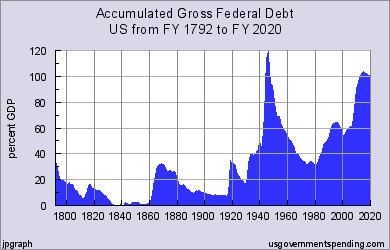
man_with_speechJohn Boy:  “Alright you guys let’s get back to the issue at hand – debt as a percent of GDP.  How ‘bout looking at the 230th Century?”

Jordan:  “OK.  Debt jumps in the Civil War…”

Mackey:  “Excuse me, the War of Northern Aggression.”

John Boy:  “Mackey, put that idea to rest.  The war was more than 150 years ago.  And which side wanted to secede?”

US Debt Percent GDPJordan:  “Children, no bickering.  Debt as percent of GDP (gross domestic product) jumps during the Civil War, then declines, jumps again in WWI, then declines until the Great Depression.”

Mackey:  “Yes, and the crazy public elects that socialist, Mr. ‘spend-at-all-costs’ himself, Franklin Delano Roosevelt.”

John Boy:  “Right.  Just look at how much debt jumped under FDR.  Mackey’s right.  What a socialist!”

fdr_~FdrJordan:  “And just what happened to the economy?”

Mackey:  “The economy recovered…sort of.”

Jordan:  “Sort of?”

Mackey:  “Sort of.  The country didn’t need all those socialist program.  The country could have saved its way out of the Depression.”

John Boy:  “You’re right again, Mackey.”

Jordan:  “And just what do you think drives the economy?”

John Boy:  “Tax cuts.  Incentives to invest.”

TurtleneckJordan:  “Here’s a simple question.  For someone out of work…through no fault of their own…what good is a tax cut?”

Mackey:  “An incentive to work.  Go find a job.”

Jordan:  “And just who is going to hire that unemployed worker?”

John Boy:  “Create your own job.”

Jordan:  “Let’s put politics aside and think this through.”

(John Boy and Mackey both sigh.)

Jordan:  “You own a business.  Why would you hire someone?  Just because the person needs a job?”

Mackey:  “Of course not.  Jordan, where do you come up with these stupid questions?”

John Boy:  “Mackey, I think we’re about ready to have another ‘ah ha’ moment.”

Mackey:  “Whadda mean?”

John Boy:  “As much as I hate to admit it, Jordan’s right.  Why would you hire someone?”

Mackey:  “Because you were busy and needed more help.”

John Boy:  “You got the right answer – because you need more help.”

Mackey:  “Simple isn’t it.  People want to buy your product, eat at your restaurant, whatever.  You need help.  What’s wrong with you guys?”

John Boy:  “And where did the tax breaks fit into that decision?”

Mackey:  “The tax breaks didn’t.  Oops.  What made the difference was demand.”

Jordan:  “Waiter, may we have some more snacks and another round?  Time to celebrate.”

Mackey:  “What are we celebrating?”

mr_know-it-allJohn Boy:  “Our enlightenment…at least enlightenment according to Jordan.  OK Mr. Know-It-All, what’s next?”

Jordan:  “Look, all I’m trying to do is present some basic economic principles.  Not left, not right, just basic economics.”

Mackey:  “So you’re claiming…”

Jordan:  “I’m not claiming anything.  I’m just stating.”

Mackey:  “OK, since you’re buying…you’re stating.  And you’re stating the only real way out of a recession is to stimulate demand.”

Jordan:  “Yes, that’s exactly what I am stating.  Talk about all the other theories you want.  When you do, you have to go back to one basic question?  Is a company going to hire another employee…or even retain existing employees…if enough people are not buying the company’s products?”

John Boy:  “Why do you make economics so simple?”

Jordan:  “The fundamentals of economics are simple…but not always intuitive.”

John Boy:  “Next you are going to tell Mackey and me that if the private sector is not hiring people…or laying off people…then the government needs to stimulate the economy.”

Jordan:  “You’re on a roll.  I told you most of economics was simple.”

OppositeMackey:  “Wait, you’re saying the government should do the exact opposite of what a household should do?  I mean, rather than cut back on spending when times are tough like real people do, the government should spend more?”

Jordan:  “See how easy this lesson is?”

John Boy:  “I don’t believe it.  If it’s bad for business it’s bad for government.”

Jordan:  “I’m going to show you why business benefits and makes more money by supporting a Federal deficit when in a recession.”

(To be continued)

#123 Do They Really Understand? The Impact of Accounting on Federal Deficit. (Part 3)

16 Thursday Apr 2015

Posted by Jordan Abel in Economics, Education Issues, Possible Solutions

≈ 7 Comments

Scene: Jordan and Sandy, a former business colleague, are having coffee.  The discussion, which began Entry #121, has centered on Sandy’s frustration with Federal government policies and Jordan’s attempt to explain the rationale and benefit of certain policies – politely, why Sandy’s thinking is incorrect.

Sandy:  “OK, Jordan, we’ve had our break.  Now let’s get back to the federal budget.  Why can’t we have an amendment to make sure it’s balanced every year?”

hunterJordan:  “You sound like some Tea Party Republican.”

Sandy:  “Well, that’s what I am.  So why not?”

Jordan:  “In an attempt to answer your question, I’m going to tell you a story.”

Sandy:  “Typical bureaucrat.  Never…and I mean never…gets to the point.  OK, I’ll be nice and listen.  What’s little Jordan’s story?”

Jordan:  “You would have enjoyed what happened to me the other day.  I was playing golf…”

Sandy:  “Excuse me, playing golf is a waste of time.  It’s the only game I know where people who play less are happier than those who play more.  You’d think if you were spending all that money for a round of golf, you’d want to hit the ball more times, not less.  Yes, I’ll be quiet.  What’s the story?”

TurtleneckJordan:  “I was playing in a charity tournament and lo and behold, whom do I meet in the locker room afterwards but two of your favorite people.”

Sandy:  “I cannot imagine since the people I like would be at the shooting range, not the golf course.  Who?”

Jordan:  “The Speaker of the House and Senate Majority Leader.”

Sandy:  “You’re kidding.  You guys pal around with each other?”

Jordan:  “Hardly.  Remember, I said this was a charity golf tournament.”

Sandy:  “That is interesting.  What happened?”

Jordan:  “Finally, he’s willing to listen.  I’ll tell the story as best I remember it.  Here goes.”

The following is Jordan’s dialogue explaining the encounter.  Scene: in the locker room after the tournament.

CongressJordan:  (Addressing the Speaker of the House and the Senate Majority Leader) “Gentlemen, what a pleasant surprise.”

Speaker of the House (aka, John Boy):  “Well, well, well, if it isn’t one of POTUS’ lackeys, Jordan Abel.”

Jordan:  “Thanks for the compliment, John Boy.  Glad you are so supportive of people who try to help.”

Senate Majority Leader (aka, Mackey): Forgive him Jordan, he had a bad round of golf.  I’m glad to see you…well, sort of.”

Jordan:  “By the way, what I have ever done to you guys?”

John Boy:  “It’s not you, Jordan.  Your boss is the problem.”

Jordan:  “OK, what’s the issue?”

Mackey:  “Where do we start?  The list if issues is very long.”

man_with_speechJohn Boy:  “First of all, why won’t he cooperate?  He’s like a rock.”

Jordan:  “What do you mean?  Give me an example.”

Mackey:  “You buy us a drink and we’ll talk.  Deal?”

Jordan:  “Deal.  (Order drinks.)  OK, give me a couple of issues.”

Mackey:  “Environmental stuff.  POTUS keeps pushing to reduce coal consumption.  Why?  We need more coal, not less.”

Jordan:  “You mean your constituents like coal because they think it means jobs.”

Mackey:  “Coal equals jobs.”

Jordan:  “Mackey, you and I both know that the coal industry has far fewer jobs per ton mined than it used to.”

Mackey:  “But we can’t lose those jobs that are left.  And POTUS is a major threat to those jobs.  What’s wrong with him?”

Jordan:  “What if there were a way to create jobs and reduce coal production?”

Mackey:  “Sounds like some liberal gibberish.  We need coal.”

Jordan:  “What about emissions from coal?  What about scarring the land?””

occupations_lawyerMackey:  “More liberal gibberish, Jordan.  You just don’t understand.  Quit being so rigid and uncompromising.”

Jordan:  “Think I’ll probably have another drink.  John Boy, what’s your issue?”

John Boy:  “Budget.  We need a balanced budget.  In fact, we should have a Constitutional Amendment requiring a balanced budget.”

Mackey:  “I agree.  The country is going to run out of money.”

Jordan:  “Excuse me?  Run out of money?  How?”

John Boy:  “You know what I mean.  The country cannot afford all this debt.”

Jordan:  “Tell me why not.”

John Boy:  “The private sector pays its debts.  Why shouldn’t the government?”

debtJordan:  “You really think the private sector pays its debt?”

Mackey:  “Of course it does.”

Jordan:  “Mackey, you’ve been inhaling too much coal dust.  Most private debt debt…commercial anyway…is rolled over and new debt issued.”

John Boy:  “C’mon, Jordan.  Stop the BS.”

Jordan:  “Really, think about this.  Do financial institutions ever…and I mean ever…pay off their debt?  No.  They merely issue new bonds.”

John Boy:  “But the private sector has collateral backing their debt and the government.  So another liberal lie.”

Jordan:  “So you’re claiming the government has no assets?  What about all the land, buildings and equipment it owns?  You don’t think those are assets?”

John Boy:  “I’ll be honest with you since we are off camera – I never thought about government debt being backed by collateral.”

Mackey:  “Frankly, I hadn’t either.  Wonder why no one explains the debt structure the way you just did?”

Piggy BankJordan:  “Part of it is the problem is the approach to accounting – and I’m not talking about counting beans.  Unlike private industry, the government is forced to use what I call “piggy bank” accounting.  Piggy bank accounting is just like it sounds – how much cash goes in the piggy bank and how much is taken out.  Does not matter that the money went to buy something that will last say 50 years?  You have to account for it all right now.”

John Boy:  “Accounting.  I almost failed that and I only had one semester.”

Jordan:  “Remember debits on the window side and credits on the chalkboard side.”

John Boy:  “How’d you know?”

BeanCounterMackey:  “OK, while we’re confessing, I don’t understand accounting either.  But what real difference does some accounting system make?  A bunch of bean counter stuff.  The government should not run a deficit.”

John Boy:  “You know, I never thought I would say this but Mackey, let the man explain.  We might learn something.”

(To be continued)

#120 Lessons from Einstein and Aretha (Part 3 of 3)

26 Thursday Mar 2015

Posted by Jordan Abel in Education Issues, Innovative Thinking: Ideas and Products, Possible Solutions, Societal Issues

≈ Leave a comment

(Readers: The blog centers around the author’s prediction that the US will experience a 5th revolution by 2020-2025.  Some early vignettes precede the revolution; later vignettes follow the revolution.  Many characters appear regularly.  More about the blog and the author.)

Scene: Jordan and Gelly continue conversation about why “race” is not the issue.  Conversation starts segment #118.)

Gelly:  “Asking blacks to focus on showing respect for others seems counter-intuitive, woman_parentalmost insulting.”

Jordan:  “I know.  Had exactly the same reaction when Carnac suggested I start respecting Mr. E.S. Cue.”

Gelly:  “You thought he was the problem, not you, and he should respect you.”

Jordan:  “Exactly how I felt.  I knew he was the problem.”

Gelly:  “Why did you change?  Why did you start respecting him?”

Jordan:  “Two reasons: One, I had some experience with Carnac.  Not a lot but enough so I knew most of her advice was sound.”

carnacGelly:  “So Carnac had some credibility with you.  What was the second reason?”

Jordan:  “There was no risk on my part.  What was the downside?”

Gelly:  “Nothing really.  If the current approach wasn’t working, then what’s the risk of a new approach?”

Jordan:  “What’s the adage, which many attribute to Einstein…”

Gelly:  “… the definition of insanity is doing the same thing over and over and albert-einsteinexpecting a different outcome.”

Jordan:  “With Mr. Cue, I wasn’t voting for insanity, at least not voluntary insanity, so I needed to change the approach.”

Gelly:  “But why not get Mr. Cue to change?  From what you’ve said, and knowing you as I do, your assessment of his behavior was probably correct.”

Jordan:  “Correct or not, what was his incentive to change?  He had none.  I’m not his boss…plus most of the consequences of what I considered bad decisions were in the future, which I’m not certain he really understood.”

Gelly:  “So as obvious as this seems, people who have no incentive to change are highly unlikely to change.”

blameJordan:  “You got it.   It is obvious when you think about it.  And that’s why the other person needs to change, even if the person thinks they are not at fault.”

Gelly:  “Mmmm.  That idea might be a tough sell.”

Jordan:  “Like I said, what’s the risk?  For the black community, what has really changed in the last 50 years?”

Gelly:  “A few laws and more protection…but I see your point.  Have attitudes changed much?”

Jordan:  “Some attitudes for certain, but there is an underlying frustration within US laddersociety about why blacks can’t get off the bottom of the economic ladder.”

Gelly:  “Is that attitude among just Republicans?”

Jordan:  “Not really.  You’ve meet Greenie, right?”

Gelly:  “She’s a friend of JC’s.  And the same hometown as you.”

Jordan:  “Same grammar school.  Anyway, one is hard pressed to find someone more liberal than Greenie.”

010414_1635_16TeachingS2.jpgGelly:  “And her attitude toward blacks has changed?”

Jordan:  “One day we were talking and she made a very perceptive comment.”

Gelly:  “Which was?”

Jordan:  “Greenie said, ‘I fear all the civil rights legislation and social support programs have inadvertently created a dependency among blacks.’  She wasn’t being critical as much as making what I think was a very astute observation.”

Gelly:  “That’s really disturbing.  She really thinks the programs have created a dependency?”

Jordan:  “Yes.  Like I said, she wasn’t being critical, merely observing.  And I agree with her.  While the civil rights legislation and social programs were needed and well intentioned, the perception of dependency is clearly an unintended consequence.”

Gelly:  “Does Greenie’s observation mean the Republicans are right – we should abolish the social safety net?”

occupations_lawyerJordan:  “Gelly, remember the Revenge Revolution was caused, in part, by Republicans trying to slash spending for social programs, including Social Security and Medicare, both of which are really insurance programs.”

Gelly:  “So, what’s the solution?”

Jordan:  “I think the solution gets back to the people most affected.”

Gelly:  “Taxpayers?”

Jordan:  “Sometimes I think you’ve been around JC too much.  You both have that biting sense of humor.”

Gelly:  “OK, then who…or whom…whatever.”

Jordan:  “The black community needs to take the lead the charge.  They need to put people in charge who are willing to look their colleagues straight in the eye and discuss the facts.”

mirror-clipart_jpgGelly:  “You mean no more blaming someone else or trying to force someone else to change?”

Jordan:  “That’s exactly what I mean.  Has anyone ever been able to force you to change your opinion?  They might have tried but did they force you?”

Gelly:  “No, of course not.  In fact, when someone tries to force me to change, I did in my heels.”

Jordan:  “Have you ever changed your beliefs about someone?”

Gelly:  “Yes.”

Jordan:  “And what made you change?”

Gelly:  “Their behavior toward me.  When I thought they were sincere in an effort to change, then I changed my attitude toward them.”

Jordan:  “So what we’re talking about is the base for any kind of long-term relationship – treating others with respect.”

Aretha-aretha-franklin-27121751-1280-1024Gelly:  “Maybe the black community needs to make Aretha Franklin their spokesperson.”

Jordan:  “I know that was intended as a tongue-in-cheek comment but it is an interesting idea.”

Gelly:  “At least her music could be the foundation for beginning to make the change.  R-E-S-P-E-C-T.”

Jordan:  “I think that would be a great start.”

#109 Privatizing Functions of Gov’t: the Fallacy (Part #5)

20 Tuesday Jan 2015

Posted by Jordan Abel in Economics, Infrastructure & Fixed Fuel Prices, Innovative Thinking: Ideas and Products, Possible Solutions

≈ Leave a comment

Scene: Jordan alone in office late working on the paper for POTUS.  Earlier POTUS asked Jordan for ideas how to convince politicians and the public that it would be a good idea to fund rebuilding US infrastructure by fixing the price for gas and diesel fuel.  The paper is overdue, POTUS is frustrated and Jordan struggling to finish because of a series of interruptions.  Original conversation with POTUS Entries #104, #105.

(Jordan talking to himself.)  Getting support from Republicans for $5.00 gasoline is Turtleneckgoing to be tough, even those elected after the Revenge Revolution.  They seems obsessed with privatizing a whole range of functions of government, including infrastructure.

Claiming societal benefits by privatizing many government functions is a fallacy.  Look, government is not the most efficient organization at many tasks, but…and this is what many people fail to grasp – Republicans and some Democrats…government is a system that works most efficiently when tasks are grouped or integrated.

Any one task might be completed more efficiently by private business.  But “outsourcing” these tasks results in even more inefficient government.  I can hear the RantRepublicans screaming now.

Many Republicans congressman and many business leaders seem to forget a key lesson from private enterprise.  The lesson?  Companies that are more vertically integrated make the most money.

Historical examples.  General Motors, when it was the most vertically integrated might as well have printed money it was so profitable.  More recently, Apple, has become hugely profitable because it controls the integration of apple logohardware and software.

Vertical integration – I wonder if the lawyers in Congress really understand what it means and the potential benefits vertical integration offers.  Probably not.  OK, I’ll need to include a definition for POTUS.   The Wikipedia definition is a good overview.  http://en.wikipedia.org/wiki/Vertical_integration

POTUS will have to link the discussion of vertical integration to why many functions of the Federal government should be vertically integrated and how vertical integration applies to rebuilding US infrastructure.

Maybe we start the conversation with a discussion of roads.  During the Obama Administration Republicans kept pushing to privatize rebuilding the infrastructure.  Many Republicans said the government should have private enterprise provide the capital to rebuild roads, bridges, water treatment facilities…and a bunch of other stuff.  But, with the private capital came one caveat – the companies could charge the public tollfor using the privately funded infrastructure.

What a dumb-ass idea.  It basically turns control of the public infrastructure to the private sector.  Why?  Because some Republicans were opposed to any function run by government?  I dislike the idea intently…and I hope POTUS opposes strongly.

What if the company decides profits are more important and neglects maintenance and repair of infrastructure?  What if the company decides to increase fees or tolls?  The company could also decide the terms of the contract are onerous and then declares bankruptcy.  And what is the public left with?  The tab for repairing the infrastructure.  Meanwhile the company has reaped profits…maybe raped the public is more appropriate.

The idea of private water and sewage treatment is even more risky.  A failure by the company could have a huge negative impact on the public with virtually no accountability by the company.  I need to have POTUS remind people of the financial Prisonercrisis of 2008.  Let’s see, how many executives from the banks and Wall Street firms went to jail?  Goose egg, nada.  There was no accountability then.  The only difference today is the Revenge Revolution and people are fed up with executives and corporations not being held accountable.

The public might not understand effective oversight of private companies requires government staff.  Republicans, of course, will claim “market forces” will keep the companies competitive.

Excuse me…but the last I looked roads, bridges and water treatment facilities were all monopolies, not free-market enterprises.  Monopolies do not have a natural check-and-balance system.

Since we’ve had the Revenge Revolution I think there’s a better chance people will understand why infrastructure should be funded and managed by government.  Using private companies to help rebuild infrastructure is OK and keeps government out of certain businesses.  But government needs to manage the process.

Once POTUS makes this argument, he’ll need to talk about why $5.00 gas is necessary.  Avoid getting into too much detail about cost during the early sessions.  021214_1242_24Resultsof1.gifIt’s an easy way to get sidetracked.  But he needs to make the case that $5.00/gallon gasoline will make enough funds available to fund rebuilding infrastructure.

Maybe he should mention the Apollo program of the 1960’s.  When President Kennedy said the US would put a man on the moon in less than a decade, I think the budget was 3-4% of GDP.  Need to confirm but seems right.  That program was highly successful with vast spin-off benefits.  Rebuilding could have the same benefits.

OK, I think this section is OK for now.  I’ll need to polish and make sure it flows smoothly.  But POTUS needs to make the strong argument that government, not private companies, needs to fund and manage rebuilding infrastructure.

(To be continued)
#107 Selling the Idea of a Fixed Fuel Price (Part #3)

28 Sunday Dec 2014

Posted by Jordan Abel in Economics, Infrastructure & Fixed Fuel Prices, Innovative Thinking: Ideas and Products, Possible Solutions, Societal Issues

≈ Leave a comment

Scene: Jordan calling JC about meeting to review a communications proposal.  POTUS asked Jordan for ideas how to convince politicians and the public that it would be a good idea to fund rebuilding US infrastructure by fixing the price for gas and diesel fuel.  Original conversation with POTUS Entries #104, #105.

Jordan:  “JC, are you ready to review the communications proposal for POTUS?”

010414_1635_16TeachingS1.jpgJC:  “Jordan, send me what you have and let me look at it first.  You know I like to spend time reviewing ideas before making comments.  Besides, I have some errands to run.”

Jordan:  “Alright, I’ll send an email later today with some of the ideas.  When I get another section drafted, I’ll send that.  You review.  Then can we talk, please?”

JC:  “I know we can talk but yes we may talk.  You are finally beginning to understand how to work with other people.  It’s taken a while but I guess old guys can learn.”

Jordan:  “Old.  If I’m old, then what are you?”

JC:  “Younger than you.  I’ve always been younger than you…and probably always will be, don’t ya think?”

Jordan:  “OK, you win.  I’ll email a draft of some ideas later today.”

JC:  “OK, bye.”

Scene: Jordan begins drafting marketing-like plan for POTUS.    

(Jordan finds talking to himself helpful.) “I think most people understand that infrastructure needs to be rebuilt.  But will they understand why it makes sense to fund the rebuilding using mirror-clipart_jpga fixed price for fuel?  Fixed prices, especially ones set by government, are such a foreign idea to most US citizens.  Maybe the best approach is to pretend we are launching a new product or service.  Then use the ‘15 P’s’ approach.  The 15 P’s approach has worked well in the past.  Think I’ll try that.

Now, Jordan, listen.  Take your time and follow the steps in 15 P’s procedure.  Otherwise, you’ll get ahead of yourself.  You know it’s easy to take shortcuts.  And when you do, problems inevitably occur.  Remember the time you painted the room before you prepared it properly?  What a mess, and it took forever to fix.  Slow down Jordan and take your time.

Also, don’t worry about making all the wording perfect.  Remember, Jordan, this is a draft-stamp-hidraft.  A draft…not the final presentation.  Make some notes for yourself.  OK, got it.

What’s the purpose of the project?  “Create a fund for rebuilding infrastructure throughout the United States – rebuild and/or expand roads, bridges, rail lines (especially for public transit), water treatment facilities, airports and communications infrastructure.”

How will you position the project with the public?  Why is the project necessary?   “Rebuilding infrastructure will help increase US competitiveness in the world economy and help increase the standard of living for all US citizens.”   (Note: good concept that probably needs some more explanation, but not right now.  Work on that later.)

Where will the projects be located?  Projects will penetrate all 50 states.  All states have a need to rebuild infrastructure although the mix of what’s needed varies by state.  For example, more populated areas need to improve or build new public transit, while more rural areas need to improve roads and communications infrastructure.  (Note: water and sewage treatment a major issue in all states.  Might be separate section.  Also, need to emphasize reusing water rather than just processing.)

How will we pay for the infrastructure projects?  Create a fund based on the difference money_24077_lgbetween what the price of gasoline and diesel would have been in the open market and a pre-determined price.  Fuel prices will be fixed beginning a certain date.  The difference between a ‘free-market” price and the “fixed” price will be sent to a fund to pay for rebuilding infrastructure.  (Notes: (i) if there is a phase-in period for increased fuel prices, make sure it is very difficult to delay the increase.  Otherwise a constant political battle. (ii) Think about delaying the proposed fixed prices for gas and diesel until we can lay out clearly the extent of the problem.  If people understand, $5.00 per gallon gasoline might seem more than justified.)

How will the fund be protected against other uses?  Look what happened to Social Security Trust Fund?  Fund for infrastructure needs to be separated and protected from politicians diverting it for other uses…and not just some paper wall of protection as with Social Security.  The Highway Trust Fund seems reasonably well metro_north_logoprotected (Note: need to confirm.)  However, infrastructure extends well beyond highways and in some cases projects might appear to conflict with highway construction.  (Note: need to really make solid argument for public transit, especially rail, which is the most efficient in populated areas.)

How will the project be approved given the politics in Washington?  First step will be to conduct assessment of current state of infrastructure.  Second step will be to politicsdetermine what is required to make the US and a particular geographic area more competitive.  Focus the project initially on assessing “Where is the United States today with respect to how inferior infrastructure is slowing economic growth and costing US jobs?  Make the assessment as objective and credible as possible.  Also make sure the public understands that the investment in infrastructure is a way to accelerate economic growth and create jobs.  (Note: consider measuring using ROI.  Doing so will address Republican concerns about ‘tax-and-spend.’)

What people should be involved in the project?  Mmmm, good question.  Maybe I should create a list of the types of people affected negatively by inferior infrastructure.  Just jot them down as they come to mind.  You can sort the list later.  OK, here goes:

  • People who use public transportation, especially to get to/from work, medical appointments, school, etc.
  • Businesses which rely on cost-effective and timely transportation for inbound and outbound freight
  • People who use electronic means to communicate and/or order products
  • Transportation companies that deliver products – FedEx, UPS, USPS, freight companies, railroads, etc.
  • People who commute to work using private transportation. (Note: discourage more private use where possible.)
  • Schools that use the Internet for some instruction, data gathering
  • Homeland security, local police, fire, emergency services, etc.
  • Farmers getting crops to market

OK, it’s a big list already and you’ve only scratched the surface.  In fact most everyone in the US is affected.  So now, how do we put a group together that is representative and not mired in all the politics?  The project seems as if it’s such an apolitical issue…and it might be since we’ve had the Revenge Revolution…but I am always amazed at how Washington gets bogged down in politics.  (Note: Be careful and watch out for chat-roomsanimals wounded in the Revolution – they can lash out.)

Promoting the idea.  Maybe we should create a giant “chat room” and let people tell their own stories how inferior infrastructure affects them.  Let people sell themselves and each other on the idea.

OK, stop for now.  I need to send what I have to JC — I’m already a day late.  Make sure she knows it’s a draft and encourage her to comment on it.  Then I’m going to get a coffee refill and work on this some more.  Remember, Jordan, this is a draft and not the final document.

(To be continued)

(Readers: The assumed chronological date for most of the entries in this blog is after the expected 5th revolution in the US.  For more background about  the expected revolution – labeled the Revenge Revolution – and author, please view entry #01.) 

← Older posts
Newer posts →

Subscribe

  • Entries (RSS)
  • Comments (RSS)

Archives

  • August 2025
  • July 2025
  • June 2025
  • May 2025
  • April 2025
  • March 2025
  • January 2025
  • December 2024
  • November 2024
  • September 2024
  • August 2024
  • July 2024
  • June 2024
  • May 2024
  • April 2024
  • March 2024
  • February 2024
  • January 2024
  • December 2023
  • November 2023
  • October 2023
  • September 2023
  • August 2023
  • July 2023
  • June 2023
  • May 2023
  • April 2023
  • March 2023
  • February 2023
  • January 2023
  • December 2022
  • November 2022
  • October 2022
  • September 2022
  • August 2022
  • July 2022
  • June 2022
  • May 2022
  • April 2022
  • March 2022
  • February 2022
  • January 2022
  • December 2021
  • November 2021
  • October 2021
  • September 2021
  • August 2021
  • July 2021
  • June 2021
  • May 2021
  • April 2021
  • March 2021
  • February 2021
  • January 2021
  • December 2020
  • November 2020
  • October 2020
  • September 2020
  • August 2020
  • July 2020
  • June 2020
  • May 2020
  • April 2020
  • March 2020
  • February 2020
  • January 2020
  • December 2019
  • November 2019
  • October 2019
  • September 2019
  • August 2019
  • July 2019
  • June 2019
  • May 2019
  • April 2019
  • March 2019
  • February 2019
  • January 2019
  • December 2018
  • November 2018
  • October 2018
  • September 2018
  • August 2018
  • July 2018
  • June 2018
  • May 2018
  • April 2018
  • March 2018
  • February 2018
  • January 2018
  • December 2017
  • November 2017
  • October 2017
  • September 2017
  • August 2017
  • July 2017
  • June 2017
  • May 2017
  • April 2017
  • March 2017
  • February 2017
  • January 2017
  • December 2016
  • November 2016
  • October 2016
  • September 2016
  • August 2016
  • July 2016
  • June 2016
  • May 2016
  • April 2016
  • March 2016
  • February 2016
  • January 2016
  • December 2015
  • November 2015
  • October 2015
  • September 2015
  • August 2015
  • July 2015
  • June 2015
  • May 2015
  • April 2015
  • March 2015
  • February 2015
  • January 2015
  • December 2014
  • November 2014
  • October 2014
  • September 2014
  • August 2014
  • July 2014
  • June 2014
  • May 2014
  • April 2014
  • March 2014
  • February 2014
  • January 2014
  • December 2013

Categories

  • Affordable Solutions
  • Back Asswards Thinking
  • Background
  • Background Stupid Is as Stupid Does
  • Benefits of Revolution
  • Causes of the Revolution
  • Common Sense Policies
  • Corporate Policy
  • Definitions
  • Diversions
  • Economics
  • Education Issues
  • Federal Budget
  • General Motors
  • Gov't Policy
  • Infrastructure & Fixed Fuel Prices
  • Innovative Thinking: Ideas and Products
  • Lessons of Revolution
  • Personal Stories
  • Possible Solutions
  • Post Trump Presidency
  • Rebranding Black Community
  • SCOTUS
  • Sense Check
  • Societal Issues
  • Stupid Is as Stupid Does
  • Tech Tsunami
  • Trump 47
  • Uncategorized

Meta

  • Create account
  • Log in

Create a free website or blog at WordPress.com.

Privacy & Cookies: This site uses cookies. By continuing to use this website, you agree to their use.
To find out more, including how to control cookies, see here: Cookie Policy
  • Subscribe Subscribed
    • usrevolution5
    • Join 32 other subscribers
    • Already have a WordPress.com account? Log in now.
    • usrevolution5
    • Subscribe Subscribed
    • Sign up
    • Log in
    • Report this content
    • View site in Reader
    • Manage subscriptions
    • Collapse this bar
 

Loading Comments...