• Home
  • Booklets/Grouped Entries
  • Tech Tsunami
  • List of Entries to Date
  • About the Author

usrevolution5

~ USA Headed for a 5th Revolution! Why?

usrevolution5

Author Archives: Jordan Abel

#240 Primer: Cha 5 — Trends and Seasonally Adjusted Rates

06 Monday Mar 2017

Posted by Jordan Abel in Uncategorized

≈ Leave a comment

First-time readers, the dialogue in this blog is set in the future (sometime after the year 2020).  Each entry assumes there has been a 5th revolution in the US — the Revenge Revolution.  More about Revenge Revolution and author, Entry #1.  List and general description of entries to date.  Annual assessment if Revolution plausible.

Note: most characters appear in a number of entries, with many entries building on previous conversations.  Profile of characters.  You’ll catch on quickly.  Thanks for your time and interest…and comments.

Scene: Gelly, Jordan’s assistant, has been editing and updating a primer Jordan wrote about 2011.  Section starts Entry #235.  (Primer will be available as PDF in more traditional format after Chapter 5 or 6.  Then the primer download will be updated regularly.) 

Gelly: “Jordan, my apologies.  I’ve fallen behind on editing the primer.  I’m working on catching up but it might be another week or so .”

woman_parentJordan: “No apologies necessary. We both took a week off from the business.  And, yes, I’m behind on some of my work as well.  What’s the topic of the next chapter?”

Gelly: “Seasonally adjusted annual rates and trends.  I confess, it was not a topic that gave me goosebumps.  However… ”

Jordan: “I take the ‘however’ to mean it wasn’t so boring.”

TurtleneckGelly:  “Actually, it was interesting.  Now, I think I understand what it’s all about.”

Jordan: “Good, let’s see what you think we should publish.”

———— CHAPTER 5 ————-

If you thought Chapter 4, the write-up on unemployment was confusing, go grab a coffee. The concept of seasonal adjustments is widely used…and also widely misunderstood.

dude-with-questionEconomic data are frequently reported as being “seasonally adjusted” and equal to an “annual rate.”  Just what does that mean?  A “seasonally adjusted annual rate” (aka, SAAR) is an attempt to predict what sales would be for an entire year, recognizing that sales for many products vary month to month and are not simply 1/12 of the total for the year.

Two examples:

  1. Sales of gift items are higher at certain times of the year – Valentine’s Day, Mother’s Day and especially leading up to Christmas. Sales of these-type items might be very strong one month and fall-off sharply the next month, or months because of the “pull-ahead” effect. The term “Black Friday” originated in the retail business because the Friday after Thanksgiving is when retailers usually began making money for the entire year, or as accounts say “going in the black.”  These monthly swings in sales make it very hard to gauge whether sales are headed up or down.  Without some sort of “seasonal adjustment,” a manufacturer or retailer might view lower sales in January vs. December as negative when in fact the sales pattern might be improving.  The seasonal adjustment attempts to “normalize” sales for the month.
  2. Sales of cars and trucks in the US are lower in the winter months as people spend money on Christmas gifts and delay buying new cars/trucks during inclement weather. Thus, sales of cars and trucks in the winter – and then the spring – need to be “seasonally adjusted” to help gauge whether sales are trending up, down or staying about the same.

Seasonal adjustments are often based on averages of actual data over a given period – say 5-10 years.  Because of changing economic conditions, sales activity in any given year probably will be somewhat different from the “average” sales pattern.  Adjusting the data for individual months or quarters can help determine sales trends.

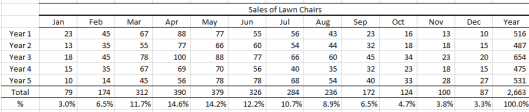
Calculating Seasonal Adjustments.  While there are some sophisticated techniques to calculating how each month should be adjusted, the reality is for many users there are no Black School Teacherpublished seasonal adjustments.  To create your own seasonal adjustment, start by making a table with at least five (5) years of sales data by month.  If you have 10 years, great.  More than 10 years, stick with 10 years for now.

Begin by adding up sales for all the January’s, then the February’s and each month of the year.  After you have totaled 5 (or 10) years of sales, then divide total January sales by total sales for all five years.  If you’re in the lawn chair business, the “seasonal adjustment” percentage for sales of chairs in January should be less than 8.33% (1÷12).  Sales of lawn chairs in June should be well above 8.33%.
Lawn Chairs Table

To calculate the “seasonally adjusted annual rate for this year’s sales in January, simply divide sales by the January percentage (%).  If January sales in Year 6 were 50 lawn chairs and the “seasonal adjustment” percent was 3.0% (well below average), the seasonally adjusted annual rate of sales would be 1,667 lawn chairs.  If sales of lawn chairs in June were 125 (75 units higher than January) and the June adjustment percent was 12.2% (above average), the annual rate would be 1,000 units – a significant decline from the seasonally adjusted annual rate in January and an indicator that sales might be trending downward.

What Are Trends?  Would you believe someone who claimed the weather last June 12 was an indicator of what the weather would likely be for the next 12 months? In fact, most people would laugh at such an assertion. Yet, many of the same people believe a politician or talking head when single economic data-point is used to justify a claim that a particular program is working or not working.

The period for determining trends can vary.  Depending on the subject matter, reports of activity are issued weekly, monthly, quarterly and some annually. When viewing data, it is important to consider the type of data and how frequently a change becomes meaningful.

Weather ForecastData for weather may be the most extreme example.  Weather conditions and temperatures change daily, even hourly.  However, what constitutes a change in weather “trend”?  An early frost or a late snowfall might simply be an aberration.  But a pattern of increasing temperatures year after year after year indicates a change in the trend.

But what about trends in economic data or a company’s sales data?  How does one calculate a trend?  Are sales of lawn chairs headed up or down…or staying about the same?

Calculating a trend line can be as simple as plotting data on a chart and then taking a ruler and adjusting it so ½ the data points are above the ruler and ½ are below the ruler.  This “eyeball” method is not a bad place to start.

Lawn Chairs

In this chart of lawn chair sales, the “linear” trend line — i.e., ½ the data points are above the trend line and ½ below the trend line — suggests that:

  • Monthly sales bounce around…a lot
  • Overall, sales are improving…maybe
  • Using data for any single month is not an accurate predictor of other months

OwlA more sophisticated method to fit the data is called “exponential fitting” (think of compound interest rates on your savings). For many sets of data, using an “exponential” trend line provides a more accurate picture of the results. Using an exponential fit, the trend line indicates sales of lawn chairs are flat to falling compared to rising sales using a simpler liner trend line.

While the differences between the linear and exponential lines may not seem significant, if you were in charge of manufacturing for the lawn-chair company, the difference could change your decision. If you looked only at the data using a linear trend, you might add to the production schedule, assuming that sales were likely to increase. However, if you looked the data fitted exponentially, you would not add to the production schedule and might even consider reducing the schedule.

There are several credible methods to calculate trend lines. If you use Excel or a similar program, most have formulae built into the program. Sometime you will also hear these methods referred to as “regressions.” If you decide to use more sophisticated regression techniques to calculate trend lines or “fit the data,” and have not completed college-level statistics – or do not remember – I suggest you read at least two articles on the plusses and minuses of the best approach for a particular task.

MIT LogoTrend lines, aka regressions, can be extremely useful when looking for patterns. When I was a grad student at MIT, there was an oft repeated saying among the professors, “When in doubt run a regression.”

The “when-in-doubt” advice was sound and has served me well over many years in many different jobs and in addressing many different problems. Regressions and trend lines help you create some order out of chaos.

The seasonally adjusted annual rates and the trend lines described in this section can help reduce the risk of making a terribly wrong decision. Try both approaches individually, and then in combination.  I think you will find the approaches very useful.  Just do not make the analysis too complicated.

 

#239 Cha 4: Unemployment Rate: A Lagging Indicator

19 Sunday Feb 2017

Posted by Jordan Abel in Economics, Gov't Policy

≈ 1 Comment

First-time readers, the dialogue in this blog is set in the future (sometime after the year 2020).  Each entry assumes there has been a 5th revolution in the US — the Revenge Revolution.  More about Revenge Revolution and author, Entry #1.  List and general description of entries to date.  Annual assessment if Revolution plausible.

Note: most characters appear in a number of entries, with many entries building on previous conversations.  Profile of characters.  You’ll catch on quickly.  Thanks for your time and interest…and comments.

Scene: Gelly, Jordan’s assistant, has been editing and updating a primer Jordan wrote about 2011.  Section starts Entry #235.  (Primer will be available as PDF in more traditional format after the first few entries.  The download will be updated regularly.) 

092615_2031_Characters7.gifGelly:  “Jordan, I finished another section.”

Jordan: “Good.  Which one?”

Gelly: “Unemployment rate.  Several things I didn’t know.”

Jordan: “Such as…?”

Gelly: “The unemployment rate lags behind economic growth.  Until I read your example, I never thought about why changes in the unemployment rate follow other activity.  I also didn’t realize how the rate was calculated.  The idea that the rate can go up as the economy is improving just didn’t seem right at first.”

TurtleneckJordan: “Understand it now?”

Gelly: “I think so.  Here’s the write-up.  I need to make one chart a little more clear.  We should also update some of the information for the Trump Administration.  But everyone should get the idea for now.”

Jordan: “OK, Gelly.  Thanks.”

——————- TEXT of CHAPTER —————

When Obama was president, most Republican politicians and conservative talking heads continually criticized the Administration for not creating more jobs. During president Obama’s first term, a typical comment from the right would be, “There has been no sharp decrease in the unemployment rate.  Therefore the stimulus package and deficit spending has not worked.”

On the surface, the comment seems fair. But what is the unemployment rate and how should we interpret changes in the rate?

How Would You Behave?  Situation: You own a business.  Sales and profits are down.  Lately there has been some uptick in sales but you’re not sure if it will last.  Question: Would you start hiring people the minute sales started to pick up or would you wait to be certain sales were going to continue at a higher level? Answer: Most all business owners wait…and the behavior is logical.

With this behavior in mind, let’s think about the unemployment rate.  If businesses wait to hire more people until they are certain the economy is getting stronger, how should the unemployment rate be characterized – as a “leading” economic indicator or a “lagging” economic indicator?

The unemployment rate is a “lagging” economic indicator – the unemployment rate does not decline until the economy is already weaker and the unemployment rate does not fall until the economy is already improving.  Thus, gains in employment will come after the economy has started to improve.

The chart depicts monthly changes in employment.  The data points above the “zero” line indicate increases in employment compared to the previous month.  Data points below the “zero” line indicate losses.  As you review the chart, keep in mind that employment is a “lagging” economic indicator so changes in overall economic activity occur before the changes in employment.   

17-02-18-total-employment-2007-2010

The economic decline that turned into the “Great Recession” started during Bush43’s second term and the decline accelerated sharply as Obama was taking office.  Early in the Obama Administration, Congress passed an economic stimulus package.  These type packages, whether implemented by Republican or Democratic administrations, take time to have an effect on the economy and an even longer time to have an effect on employment. 

Note that beginning October 2008, about 7-8 months after the stimulus package was passed, monthly job losses stabilized and the monthly losses decreased until the beginning of 2010.  Because the unemployment rate is a “lagging” economic indicator, the economy was actually starting to improve even though people were continuing to lose jobs and the unemployment rate continued to increase. 

While it makes for great political theater, those claiming that the economic recovery program implemented by the Obama Administration was a failure, conveniently failed to provide an accurate representation.  The recession of 2007-2008 was labeled the Great Recession because the economy almost sank into a depression.

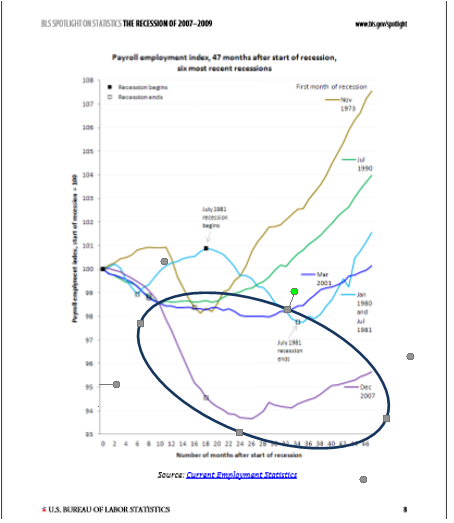
Just how bad were job loss been compared to previous recessions? Much worse. The job losses were much sharper and more severe than in any other post-WWII recession.  The area within the ellipse reflects the losses in 2007-2008.  Notice how much steeper and deeper the losses are compared to other recessions.  (I’m working on a chart that is easier to read.)

17-02-19-bls-job-losses-recent-recessions-with-highlight


        So, if the job losses were significantly worse than previous recessions, wouldn’t you think any economic recovery should take longer?  Not if you’re a politician of the opposing party.  For all those criticized the Obama Administration for not creating more jobs, the critics should remember who was president when the recession started – and why the recession started.

Explaining the Unemployment Rate

Enough politics. Just what is the unemployment rate?   The unemployment rate is total number of people looking for work but unable to find work divided by the total work force.  The result is “unemployment rate” or percent of the workforce considered unemployed.

Part of the confusion lies in the definition of the “total work force.”  Total work force is the sum of people looking for work and people currently employed. If people are unemployed and have given up looking for work, they are not considered part of the workforce. Huh? Really? Yes, really. Here’s an example.

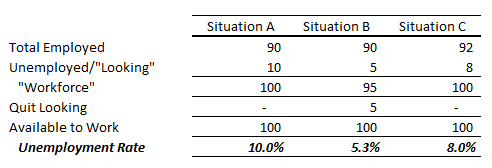
Situation A. 100 people are available to work – 90 are employed and 10 are unemployed and all 10 are actively looking for work.  Thus, the workforce is 90+10, or 100.  The unemployment rate is 10.0% (1-90/100).

17-02-18-unemployment-table


Situation B. Same 100 people as Situation A. However, after several months, 5 out of the 10 people unemployed cannot find work, become frustrated and quit looking for a job. What happens to the unemployment rate? It goes down. Yes, down, even though the total number of people stays the same.

The unemployment rate decreases from 10.0% (10 unemployed out of 100 in the workforce) to 5.3% (5 unemployed out of 95 in the workforce.) The unemployment rate decreases even though the number of people without work stays the same.

Even more confusing is when the economy improves, those who previously quit looking begin looking for jobs.  What happens to the unemployment rate?  The rate may actually increase even though the economy is improving.

Situation C.  Start with Situation B where 10 people were unemployed but 5 of the 10 quit looking for work. Now the economy starts to improve and the five people who quit looking start looking again. Only 2 of the 5 who quit previously find jobs right away but everyone who was not employed is again looking for work.

Situation C now has 92 employed, 8 unemployed.  What happens to the unemployment rate?  The rate jumps from 5.3% in Situation B to 8.0% in Situation C, even though the total number of people employed increased from 90 to 92.  Why?  Because the total workforce – the number of people employed and number looking for work increased from 95 to 100.  (Unemployment rate calculation, (1-92/100=8.0%)

Another problem interpreting the data is the unemployment rate includes workers who have jobs but are working less than full-time. These people are counted as “employed.” Using the same 100 people, if 15 are working say 30 hours per week instead of 40 hours per week, the 15 would be counted as “fully employed,” even if weekly income has been reduced.

While these calculations are not hard to understand, the method used to calculate the unemployment rate is not often explained, especially the effect of “under-employed” or “quit looking for work.” Understanding the methodology will help you explain to others why results of programs to reduce unemployment always lag economic growth.

(Reference material: Bureau of Labor Statistics website has vast array of information about employment, unemployment and how to interpret. http://www.bls.gov)


#238 Primer Cha 3: Is the Federal Debt Too High? Well, Not Really.

12 Sunday Feb 2017

Posted by Jordan Abel in Common Sense Policies, Economics, Federal Budget

≈ Leave a comment

First-time readers, the dialogue in this blog is set in the future (sometime after the year 2020).  Each entry assumes there has been a 5th revolution in the US — the Revenge Revolution.  More about Revenge Revolution and author, Entry #1.  List and general description of entries to date.  Annual assessment if Revolution plausible.

Note: most characters appear in a number of entries, with many entries building on previous conversations.  Profile of characters.  You’ll catch on quickly.  Thanks for your time and interest…and comments.

Scene: Gelly, Jordan’s assistant, has been editing and updating a primer Jordan wrote about 2011.  Section starts Entry #235.  (Primer will be available as PDF in more traditional format after the first few entries.  The download will be updated regularly.) 

092615_2031_Characters7.gifGelly:  “Jordan, can you clarify something for me, please?  Is the Federal debt too high?”

Jordan: “Interesting question.  Why do you ask?”

Gelly: “Some people I know and some of the talk-radio bloviators keep saying…or at least they used to say when Obama was president…that the Federal government’s debt is too high.”

Jordan: “Then let me guess.  The follow-on comment, ‘The country needs to return to the fiscal-conservative days of the Reagan Administration.'”

parrothead_tnsGelly: “Exactly right.”

Jordan: “I find it interesting the claim about Reagan as a fiscal conservative…but what are the facts?  Here’s the question: ‘Since the 1960’s, under which president has the Federal debt as a percent of GDP (gross domestic product) increased the most?  (Note: In the early decades following WWII, Federal debt as a percent of GDP declined sharply.)

Gelly: “First, just what is the Federal debt?”

TurtleneckJordan: “Grab a cup of coffee and I’ll walk you through some of the basics.”

Gelly: “Good.  That should help me understand the rest of the primer.”

Jordan: “For non-economists, the Federal debt is essentially what you think it is…the amount of money the US government owes creditors. The Federal debt is similar in many ways to the debt you owe – mortgage on the house, outstanding car loan, student loan and credit cards.

One major difference. The US government can print money to pay-off its debt; you cannot print money…at least legally.

Is the Federal debt too high? Depends.

CashTo help answer whether Federal debt is too high, first let’s start by roughly adding up all your debt – mortgage on the house, loan on the car(s), outstanding balance on credit cards, etc. Let’s say your debt totals $250,000. If your income is $50,000 per year, your debt of $250,000 is too high. If you make $100,000 per year, your debt is reasonable. If you make $250,000 or more per year, you’re probably in very good shape.

So how do the examples of personal debt compare to the debt of the Federal government? Surprisingly, personal debt is generally higher, often 2-3 times more than household annual income. When you bought your first house, for example, how much higher was your mortgage (with interest) than your annual income?

If you were comfortable getting that big a loan for your house, then relax about the Federal debt.  The Federal debt is much lower proportionately than your personal debt.

Was Reagan a Fiscal Conservative?

The chart indicates debt as a percent of GDP from the 1960’s through early 2017. Most people who view the chart are surprised to learn that debt did not decline under Reagan/Bush.  In fact, under Reagan/Bush 41 debt as a percent of GDP just about doubled — from about 30% of GDP to almost 60% of GDP.  Based on the metrics used by many Republican to claim debt under the Obama Administration was “out of control,” Reagan should have been branded as a president leading the country toward bankruptcy.

17-02-12-gdp-growth-1950-2016

Republicans who brand Democrats as “tax-and-spend” need to be reminded that under the Clinton Administration that followed Reagan/Bush 41, the Federal government ran a surplus and total debt as a percent of GDP declined.  Yes, I understand the sarcasm in what’s supposed to be an apolitical primer.  However, without some prodding and poking, the “alternative facts” crowd will continue to make erroneous claims that Reagan was a fiscal conservative.

Federal debt as a percent of GDP climbed sharply under Bush 43 (2001-2009) Administration from about 55% of GDP to about 80% of GDP.  The primary causes were implementing a major tax cut, which decreased Federal revenues at the same time increasing spending for wars in Iraq and Afghanistan.

Under Obama, Federal debt as a percent of GDP increased sharply at the beginning.  The cause was primarily efforts to overcome a severe recession.  During the recession, which started toward the end of Bush 43, Federal government tax revenues fell sharply and Federal government spending increased sharply to help stimulate the economy.  In the latter years of the Obama Administration, annual Federal deficit declined as did the rate of increase Federal debt as a percent of GDP.

(For those thinking the government should cut back on spending in recessions, there will be a separate entry to explain why, in a recession, fiscal actions for the Federal government and individual households should be exactly the opposite.)  

Under the Trump Administration, debt as a percent of GDP is likely to increase. Trump voodoo-2015958and Republicans are pushing for a major tax cut, similar in many respects to the “trickle-down” tax cuts by Reagan and Bush 43.  “Trickle-down” economics is what Bush 41 famously labeled as “voodoo economics” in the campaign against Reagan.

In addition, Trump Administration has proposed a major infrastructure rebuilding program.  An equally ambitious infrastructure rebuilding program proposed under the Obama Administration was deemed “too expensive” by Republicans.  Apparently, the cost of such a program and the dramatic increase to the Federal deficit are no longer issues.  Mmm, wonder what changed the Republicans thinking?

Trump claims the additional expenses associated with government spending will be offset by additional revenues from accelerated economic growth.  Annual growth in GDP will somehow magically increase to an average 4.0%.  While 4.0% growth in GDP has been achieved periodically since WWII, such a high rate has not been sustained.  Further, the rate is often the result of the stimulus associated with large fiscal deficits.

17-02-12-gdp-growth-1950-2016

Given all the “don’t worry about the deficit because it will magically disappear” rhetoric now that Trump is in the White House, the next time a Republican claims policies of Democrats have crippled the country with debt, note that Reagan and Bush 43 administrations increased debt far more than any other administration since WWII…and Trump is likely to set another record for increasing the debt.  So much for being a “fiscal conservative.”

OK, What Really Caused the Debt to Increase?

  1. Republican-led tax cuts that did not translate into sustained economic growth, thereby creating more debt.
  2. Allowing taxes for Social Security and Medicare to be counted as “general revenues” and effectively used for other purposes. Such “baloney” accounting has allowed both parties in Congress to justify not raising taxes to pay for other programs.
  3. Belief by most Republicans that tax cuts for the wealthy will “trickle down” to middle and lower incomes.  There is no credible evidence to support such claims.
  4. Allowing, and even encouraging companies to relocate manufacturing outside the US, thereby reducing wealth creation and ability to collect tax on payroll and income.

Proposed Simple Changes to Policy.  Following are some simple changes to government policy that would have an immediate and positive impact on US economic growth. Some of these have been proposed previously and some are under consideration by the Trump Administration.  Serious consideration should be given to:

  1. Stop counting tax revenues for Social Security and Medicare as “general revenue.” It is OK to run a Federal deficit. Just make certain the amount of the deficit is understood and not understated by phony-baloney accounting.
  2. Recognizing that people who are unemployed do not need lower taxes.  Unemployed people likely pay no income taxes. Unemployed people need cash.
  3. Recognizing that people who are unemployed/under-employed spend a higher percentage of income than those employed, especially those with higher incomes
  4. Recognizing that people who work have more self-esteem than those who take handouts. Put the unemployed to work, even if the task is ”beneath their skill level.” There are many worthwhile projects that need to be completed.  If you don’t like this idea, then read some accounts of how government programs during the 1930’s New Deal programs positively affected lives of all income strata.  And check your own family history to see who benefitted.”

Gelly: “Thanks for the summary Jordan.  Seems to me for the president and Congressional leaders, maybe the most important guide about proposing changes to government economic policy is use some common sense.  Think before you act…or react to an idea. Thinking before you act was good advice from our parents when we were teenagers. Still relevant today.”


#237 Primer Cha2: Basic Economics and Common Sense Test

05 Sunday Feb 2017

Posted by Jordan Abel in Economics, Societal Issues

≈ Leave a comment

First-time readers, the dialogue in this blog is set in the future (sometime after the year 2020).  Each entry assumes there has been a 5th revolution in the US — the Revenge Revolution.  More about Revenge Revolution and author, Entry #1.  List and general description of entries to date.  Annual assessment if Revolution plausible.

Note: most characters appear in a number of entries, with many entries building on previous conversations.  Profile of characters.  You’ll catch on quickly.  Thanks for your time and interest…and comments.

Scene: Gelly, Jordan’s assistant, has been editing and updating a primer Jordan wrote about 2011.  Section starts Entry #235.  (Primer will be available as PDF in more traditional format after the first few entries.  The download will be updated regularly.) 

092615_2031_Characters7.gifGelly:  “Jordan, are you a dismal guy?”

Jordan: “What are you talking about?  Dismal?  Do I look that bad?”

Gelly:  In your write-up, you said economics has been called a dismal science.  And I know you love economics.  Seriously, I am not sure why it’s called ‘dismal’ since economic-based decisions can have such a profound impact on society.”

TurtleneckJordan: “As you said, I find economics quite exciting. After editing the primer, I hope you don’t think I’m so dismal.”

Chapter 2.  Basic Economics and a Common Sense Test. 

There are some basics of economics that we all need to understand. The “economics wonks” already know the basics…but the wonks aren’t the concern.  The concern is politicians who choose to ignore the data or cherry-pick the data and claim a result that the data do not support.  So, if you’re not an “economics wonk,” the primer is designed to help you understand some terms and statistics that are cited frequently but that you might not understand completely.

drone-manOne of these problems is data are not displayed in easy-to-understand charts. (Pardon me for using a plural verb with data but…OK, so I’m old school.)   In addition, the data are often cited without reference to previous data points or without the proper context. One of the goals of this primer is to explain some economic terms in language for non-economists.

Three comments about the primer before proceeding:

  1. If you want to learn more about a series of data or an economic indicator, start with the Federal government websites.  Bureau of Labor Statistics has an excellent data base and reasonably understandable explanations.  (www.bls.gov)  (Let’s hope the Trump Administration honors the history and integrity of the government’s economic data.  If BLS data are compromised or access denied by the Trump Administration, then check some academic websites – start with MIT, Harvard and Chicago, which all have a long history of Nobel Prize winners in economics.)
  2. The list of databases and examples is not comprehensive but selected to be relevant to discussions.
  3. Not everyone will agree with the items listed and/or the definitions. The primer is just that, a primer, and not a college textbook on economics. Please read it accordingly.

Much of my academic and professional life has included using economic indicators to forecast demand, primarily for sales of cars and trucks. The forecasts have been used to decide: (i) if new assembly plants required; (ii) how many cars and trucks to produce: (iii) what type marketing programs needed: (iv) how many workers required.  These-type decisions can affect the lives and incomes of thousands of people.

Some key lessons learned from many years of forecasting:

  1. Forecasts are always wrong!
  2. Goal should be to minimize the forecasting error for critical variables.  If the forecast is for an item where there is little credible historical data, the default position I use is start at the mid-point of what you think are reasonable high and low estimates. By starting at the mid-point, the worst is the forecast is 50% wrong…and virtually all the time, the error is far less.
  3. Math-based forecasting models are very helpful. The model, however, needs to be easy to understand. If you cannot explain the basics of the model to a non-economist colleague, the model is too complicated

Common Sense Test – Like Some Real Basic Stuff

goofy006Situation #1: A family has no money because no one can find work. Then a family member is employed by the government to complete a task – say building a road or building a school.

Question #1: Is society better off with the person working and being productive or doing nothing…and likely receiving some form of assistance?

Situation #2: “A person has no money and can find work only in minimum-wage jobs.”

Question #2:  Will a person with a minimum-wage job benefit from a tax cut?”

Tax Cuts for the Unemployed?  

When the Bush 43 Administration was faced with declining employment and decreasing real personal income, the answer was not to implement programs similar to the New Deal but to implement tax cuts. I realize parties have platforms and some people are fundamentally opposed to any government programs. But, c’mon, use some common sense. If you were unemployed, would you want a tax cut, which is of no value since you pay little, if any, income tax… or would you want a job that provided cash to buy food, pay the mortgage and utilities? This is not a complicated question.  (Trump Administration – are you listening?  In another segment, we’ll address the societal benefit of “trickle-down” economics.)

Laws of Economics Are Like the Laws of Sciences

The laws of economics are much like the fundamental laws of physics and chemistry. formula-scienceFrom time to time someone claims to have invented a perpetual motion machine that defies the fundamental laws of physics or to have invented a battery that will last forever. And usually sooner rather than later the claims are proved false.

The same seems to apply to some who want to defy the fundamentals of economics. Despite claims to the contrary, wealth for society cannot be created by transferring money between individuals, selling services, offering more medical care or a plethora of other activities.  The only way to create wealth over the long-term is manufacturing.

money-in-pocketTransferring money between pockets helps individuals but offers no benefit to society. Stop and think about it. If you go to the doctor for a problem, where is the value add to society? If you go to a restaurant, where is the value add for society? Money has changed hands but there is no more wealth in society than before.

New-Age Economy Is Horse Pucky

The belief that a new-age “service” economy adds wealth to the country is horse pucky. Yes, certain services may make individuals more productive but at the end of the day, it is manufacturing that creates wealth.

The Chinese get it. I’m afraid many decision-makers in the US don’t get it — whether manufacturing-production-operations-jobsin Congress or in the board room. Unless the US changes policy toward retaining manufacturing and changes the system of rewarding executives for transferring wealth by relocating operations outside the country, the US is headed for a sustained decline in wealth and standard of living.  (In other entries, we’ll discuss: (i) international trade as a critical component of economic growth.  And, no, trade can’t be just one way; (ii) what activities constitute “manufacturing.”  Do economists…and policy makers…need to rethink the definition of “manufacturing”? )

 No country can sustain itself by just providing services and transferring money between pockets. The US needs a healthy manufacturing sector to survive.

(Trump Administration Policies re Manufacturing.  The Trump Administration is right to emphasize the need for manufacturing in the US.  The claim that the US manufacturing base has been completed eroded is false.  The claim that Trump Administration’s policies will bring back manufacturing jobs to industries that formerly included many semi-skilled workers – automotive, e.g. – is sheer folly.  Many semi-Coal Minerskilled and some skilled jobs have been eliminated by technology.  The idea of numerous jobs in “clean coal” is even more ridiculous.  An even greater proportion of mining jobs have been replaced by technology and electricity production is shifting away from coal.  More about these issues in a later entry.)

#236 Primer Cha 1: You Can’t Drive Very Fast Only Looking in the Rearview Mirror

29 Sunday Jan 2017

Posted by Jordan Abel in Common Sense Policies, Economics, Possible Solutions

≈ Leave a comment

First-time readers, the dialogue in this blog is set in the future (sometime after the year 2020).  Each entry assumes there has been a 5th revolution in the US — the Revenge Revolution.  More about Revenge Revolution and author, Entry #1.  List and general description of entries to date.  Annual assessment whether Revolution plausible.

Note: most characters appear in a number of entries, with many entries building on previous conversations.  Profile of characters.  You’ll catch on quickly.  Thanks for your time and interest…and comments.

092615_2031_Characters7.gifGelly: “Jordan, I’ve finished editing the first few chapters.”

Jordan:  “Good.  Make any changes?”

Gelly: “I tried to make the text more current by including excerpts from papers you wrote later, especially during the early days of the Trump Administration.  Hope adding the more recent information was OK.”

Jordan: Glad you added the updates.  Thanks.  Let me take a look.”

(Chapter 1 of Primer.  PDF Download will be available after a few more entries.  Text of download will be formatted in columns.)

windshield-screenImagine this: You need to get someplace quickly. You jump in the driver’s seat and start the car. But the windshield is covered by one of those sun screens. You can only see by using the rearview mirror.

Question: How fast can you drive when you can only see out of the rearview mirror? Not very fast and not very safely.

Where do we start? By removing the sun screen blocking the window. Start looking forward instead of only looking to the past. Duh, the future is different from the past. Yes, learning from the past is important so check the rearview mirror periodically, but spend more time looking ahead than looking behind.

fork-in-the-roadYes, like all countries, the United States needs to update its approach to economic development.  However, the US is facing a major fork…maybe forks…in the road.  The combination of a bifurcated economy, concern about our competitive position worldwide and a polarized Congress makes prospects for long–term growth problematic.  Without a change in approach the US could fall behind global competitors.

Think it can’t happen?  Roughly 100 years ago GDP/capita in Argentina was about 80% of the US GDP/capita.  Today, GDP/capita in Argentina is a little over 30% of US GDP/capita.  Argentina made some bad strategic economic decisions.

But what about decision–makers in the US? Why are most people in public positions, elected officials and many CEO’s, seemingly reluctant to take a stand on issues outside what is perceived as “mainstream” – thus the analogy of not driving fast while looking only through the rearview mirror?

rearview-mirror-with-diceAnd why, in 2017, is President Trump’s solution to “Make America Great Again” based on ideas that might have worked when kids hung dice on the rearview mirrors?  The ideas are great for nostalgia but they have no basis in today’s economic world, no recognition how technology has affected manufacturing employment and no recognition of the impact on jobs of emerging technologies. 

donald-duck-wishing-wellAnd, no Donald, merely claiming that GDP will increase 4.0% or more each year will not make it happen, nor will claiming “clean coal” bring jobs to back to West Virginia, nor will tweets or tariffs.  Nor will pillorying anyone, even well-respected office holders, who question the logic of these retro positions.

So, What Are They Thinking?  Given that kind of back-asswards thinking, it is no wonder that many of us get so frustrated with some government policy decisions. Is it no wonder we get angry when a CEO gets a large bonus after laying off workers? It is no wonder we get angry when tax policy encourages companies to send jobs overseas?

dude-with-questionAmong voters left, right and middle, many decisions by government and business seem to make no sense. In fact, many decisions by government and business seem to be exactly opposite of the best interest of the United States and its citizens.

Does Back-Asswards Have Negative Consequences?  Yes, most emphatically yes.  In searching for answers to what seem to me to be counter-intuitive decisions, three situations came to mind: (i) the town where I was raised and received my primary and secondary education has been devastated by job losses; (ii) my first post-college employer and a company which was the heart of US manufacturing for decades, General Motors, filed for bankruptcy (in 2011); (iii) thinking and analysis have been replaced by babble spouting talking–head entertainers.

tweetyRather than “pouting and shouting” or even worse, “tweeting” about these frustrations, I decided my therapy was to write a primer outlining how using basic economic principles, business principals and more practical, affordable solutions to help address some policy issues facing the US public and private sectors.

A few years ago I wrote a short paper titled “Why a Healthy Domestic Auto Is Important.” After distributing to a few friends and colleagues, I was surprised by how many commented they had not heard such rationale, agreed it made sense and as such changed their mind about whether the US government should have supported bailing out General Motors and Chrysler.  (The paper is included in this primer.)  

With that encouragement I drafted other essays, which will be part of the primer. My hope is at least a few people read some or all of the primer and begin to think more broadly and take action on those thoughts.

bookletThe primer is designed to be apolitical. The ideas are not exclusively left or exclusively right. Quite honestly, the ideas are so common sense and so basic that at times I am embarrassed to publish them. You would think everyone knew these fundamentals. But apparently not since many are not applied, not understood or lost in political rhetoric.

The primer is also designed to help describe what I consider the cause of the deterioration in the ability of US companies to compete effectively worldwide. Some essays are purely educational; others propose solutions.

open-mindAs you read these essays, please (i) keep an open mind about the analysis and proposed solutions; (ii) consider how you can implement part or all of the idea, whether you are a member of Congress, a CEO, employee or citizen; (ill) discuss ideas with friends, family and colleagues. The early entries are intended to offer an understanding of some common economic principles and terms. Other entries include common questions, claims and arguments for/against a particular government policy or action.

When you listen to others make claims about what government policy needs to change, or make such claims yourself, then think about the context of the argument and if some additional data or analysis would change your position.

The primer is work in progress. The intent is to add chapters regularly as topics arise. I will update existing chapters for new information and any necessary corrections.

professor4The primer is not a source authority on economics.  I would never be so presumptuous.  So, if you are schooled on these subjects, please scan the chapters. If nothing else, you can offer ideas on how to improve them.

I hope you find the primer thought provoking, entertaining at times and educational. Please send ideas other topics as well. This primer is the beginning of a journey. I need some guidance on where to go next. Thank you for your time.

For Your Information: If you are curious about my background, raised in Danville, IL, then a town of almost 50,000 (now closer to 30,000). Danville is about 120 miles south of Chicago. Like many Midwest towns in my formative years, Danville was a mix of industrial plants surrounded by farms.  Danville offered a good mix of ethnic groups and religions. The public school system was well respected, producing more than its share of successful entertainers, astronauts, educators, doctors and corporate executives.

  • Education: Drake University (Des Moines, IA); Massachusetts Institute of Technology.
  • Job locations: Detroit area (twice), New York, Boston, San Francisco, Los Angeles, Charlotte (currently).
  • Politics: Fervent independent. Have voted for wide range of Republicans and Democrats. Some in the south consider me a liberal. I remind them of the history of the Republican Party…and that the Civil War ended 150+ years ago, ending with a gentle reminder to “get over it.”  I skip “you lost.”


#235 The Set-Up. Primer from “Practical, Affordable Policies Institute” (Part 1)

22 Sunday Jan 2017

Posted by Jordan Abel in Common Sense Policies, Economics, Gov't Policy, Innovative Thinking: Ideas and Products

≈ 7 Comments

First-time readers, the dialogue in this blog is set in the future (sometime after the year 2020).  Each entry assumes there has been a 5th revolution in the US — the Revenge Revolution.  More about Revenge Revolution and author, Entry #1.  List and general description of entries to date.  Annual assessment whether Revolution plausible.

Note: most characters appear in a number of entries, with many entries building on previous conversations.  Profile of characters.  You’ll catch on quickly.  Thanks for your time and interest…and comments.

Scene: Jordan’s office in Washington, DC

Gelly:  “At the beginning of each year, I clean out some file drawers.  Look what I ran across.”

Jordan:  “I’d forgotten about these.  I must have drafted some of these in about 2010-2011, but never published them.”

092615_2031_Characters7.gifGelly:  “What were they for?”

Jordan:  “Each article was to be a chapter in a primer about how to develop practical, affordable government policies to address key issues.  The primer would be the foundation for an organization I thought of creating – the working name was the Practical, Affordable Policies Institute, as known as…”

Gelly:  “PAPI.  I like that name.  My ‘pappy’ always had good, practical advice for our family.  So you wanted to become Washington’s ‘PAPI’, right?”

fatherly-adviceJordan:  “You know better than that.”

Gelly:  “Well, someone must have wanted your advice, at least some idea about what was in the primer.”

Jordan:  “Not that many people knew about the primer.  As a sense check, I circulated the articles within a fairly small group inside the Beltway.  Wanted to get reactions and ideas how to improve.” 

Gelly:  “That explains the phone call in the early days of the Trump telephoneAdministration.  A couple of staffers asked for copies of the primer.  I wasn’t sure what they were talking about.  Remember when I asked you about it?”

Jordan:  “Yes and I was out of town…somewhere.  I emailed the staffers a copy but you and I never talked about the primer when I got back.  The staffers that called probably were part of the review group.”   

Gelly:  “Now the rest of the conversation with the staffers makes sense.  They were concerned that senior officials in the Trump Administration had no clear policy for addressing many aspects of the economy.”

toss-out-iconJordan:  “You mean they didn’t consider Trump’s tweets and ‘toss out whatever Obama did’ as real policy?”

Gelly:  “I still shudder when I think about Trump’s approach early on.  Do you think these articles actually helped turn things around?”

Jordan:  “In Washington, as you know, a good idea has many fathers.  But, I presume the staffers did distribute the primer to some people in the Trump Administration…very discreetly, of course.”

Gelly:  “As I flipped through the pages, some of the articles seemed to be more about approach than actual policy.”

donald-duck-wishing-wellJordan:  “True.  I thought the articles about approach might be helpful since to make something happen – accelerate economic growth, for example – you can’t simply wish it to be true and expect results.”

Gelly:  “So, to implement a policy and make it work you really do need a plan and a disciplined approach to implementation.”

Jordan:  “Yes, and the statement seems so incredibly obvious.  I remember some people finished an article and asked…and I think rightfully so…’what’s the value here?  What’s being discussed is just common sense.’”

Gelly:  “Funny, I thought the same thing about some topics.  But I agree that common sense seems to get lost on some people when they’re inside the Beltway.”

Jordan:  “Let’s hope it doesn’t get lost for us.”

Gelly:  “Another question.  Do you think if all the ideas in the primer were implemented, the country could have avoided the Revenge Revolution?”

TurtleneckJordan:  “That’s a real stretch.  What I do know is if the Trump Administration had considered more carefully the essence of what was outlined in the primer, then the likelihood of a Revenge Revolution would have diminished.  At a minimum the Revenge Revolution would have been later and less disruptive.”

Gelly:  “You ever going to publish these?”

Jordan:  “Should I?  Whadda think?”

Gelly:  “My vote is ‘yes’ you should publish.”

Jordan:  “I’m not sure what all the topics were.  You have a list?”

Gelly:  “Here’s a list so far.  I think there are a few more.”

  1. You Can’t Drive Fast Looking through the Rearview Mirror
  2. Basic Economics and Common Sense
  3. National Debt Is Too High.  Well, Not Really.
  4. Unemployment: Always a Lagging Indicator
  5. Seasonal Adjustments and Trend Lines
  6. Manufacturing Creates Wealth
  7. Impact of Losing the US Manufacturing Base
  8. Eliminating the Incentive to Pillage
  9. Recruiting New Plants or Overseas Manufacturing
  10. Practical Policies to Rebuild US Manufacturing
  11. Why a Healthy Domestic Auto Industry Is Important
  12. Securing Equity Capital for Start-Ups, Emerging Companies
  13. Capitalizing on Global Warming

Jordan:  “I’d forgotten about a few of those.  Gelly, here’s an idea. I’ll consider publishing the primer…rather we’ll consider publishing the primer…after you edit the various entries.”

bookletGelly:  “You want me to edit?”

Jordan:  “I know some of the data needs to be updated, which I can help with.  But having you edit will make sure the papers are understandable to the average reader.  I tried to make the language simple but not sure I always succeeded.”

Gelly:  “How quickly do you want the editing finished?”

Jordan:  “Weave the editing into your normal schedule.  Finish at least one per week and try to get two finished.  And, then we’ll publish as you finish, OK?”

Gelly:  “We’ll publish?  But these are your papers.”

Jordan:  “No.  They’ll be our papers and we will publish.”

(Entries for the primer will be published at one or two per week.  Entries published to date will be available for download on the “Policy Primer” page of the blog.  Format will be double columns.)  

#234 The Bet: How Long before Trump Leaves Office?

17 Tuesday Jan 2017

Posted by Jordan Abel in Causes of the Revolution, Gov't Policy, Stupid Is as Stupid Does

≈ Leave a comment

First-time readers, the dialogue in this blog is set in the future (sometime after the year 2020).  Each entry assumes there has been a 5th revolution in the US — the Revenge Revolution.  More about Revenge Revolution and author, Entry #1.  List and general description of entries to date.  Annual assessment whether Revolution plausible.

Note: most characters appear in a number of entries, with many entries building on previous conversations.  Profile of characters.  You’ll catch on quickly.  Thanks for your time and interest…and comments.

Scene: Jordan’s office Washington, DC

092615_2031_Characters7.gifGelly:  “We have an unexpected visitor.”

JC:  “Hi Jordan.  Glad to see me?”

Jordan:  “Of course, JC.  I’m always glad to see you.  And you’re in town because…?”

JC:  “Greenie is adding a few chapters to her book about the causes of the Revenge Revolution.  She wants me to research if and how the tone of the transition after the election and the tone of the Inaugural speech might have influenced the effectiveness of the administration.”

092615_2031_Characters1.jpgJordan:  “Interesting topic.  So, if the transition was smooth, the incoming might be more effective, right?”

JC:  “Exactly…and vice versa.”

Jordan:  “Speaking of inaugurations, do you remember our conversation in 2017, just before Trump was sworn in?”

JC:  “Of course.  And the loser, or winner depending on one’s perspective, never paid off the dinner bet.  Whadda say we have the payoff this evening?”

TurtleneckJordan:  “Gelly, am I free this evening, please?  And, if so, would you like to join us for dinner?”

Gelly:  “Yes, you’re available and I would love to join you guys.  But I don’t know all the background about the bet, just bits and pieces.”

JC:  “Here’s the short version.  Remember I stopped by the office a few days before Trump’s inauguration?”

Gelly:  “Yes, but just after you got here I had to leave for a meeting.”

(Conversation from January 17, 2017)     

Jordan:  “JC, you must be in town for the inauguration.”

JC:  “You’re right about the inauguration but not here for the swearing-in.”

Jordan:  “Listen, if you need tickets, I can get you a couple.  Lots of members of Congress are not attending.”

tweetyJC:  “Not on your life would I attend.  I’m in town to join a protest march against Tweety Bird.”

Jordan:  “Now, now, you should show the incoming president some respect.”

JC:  “Why?  He never showed any respect to president Obama.”

Jordan:  “But still.”

JC:  “The Republicans never showed any respect for Obama either, especially old Mitchie McConnell.  What a hypocrite.”

Jordan:  “Some people think McConnell was just doing his job…and quite effectively.”

RantJC:  “Now we’re headed into an era where the Republicans…more appropriately called the Republicants and Republirants…actually have to do something other than say ‘no.’  And we’ve got an incoming president who thinks an oligarch is a hero and people with education and experience are trash.”

Jordan:  “The oligarch – you mean POTUS’ love for Putin?”

JC:  “Please, the Trumpster is not yet POTUS and, yes his love for Putin.  I mean really, Jordan, aren’t you upset?  The man is crazy!”

Jordan:  “You are a bit pumped.  Why do you say he’s crazy?”

JC:  “Look at his behavior.  Remarks during the campaign were bad…and frequently way out of line for a presidential candidate.  But his behavior and remarks since the election have been worse.”

Jordan:  “Such as…?”

trump-scowlJC:  “The list of ‘stupid is as stupid does’ is almost endless and keep growing daily.  Let’s start with trashing Representative John Lewis.  Trump tweets that Lewis is ‘all talk and no action.’  Really, Donald?  Lewis no action?  Every read any history?  Of course not.  And Donald what have you done that merits noteworthy ‘action’?”

Jordan:  “You consider that the attack on Lewis classifies him as crazy?  Maybe it was just a bad tweet.”

JC:  “You know my degree…my degrees are in psychology.  Diagnosing from afar is a bit risky.  But his behavior is so blatant and so consistently outside the norm that I goofy006think there’s a rock-solid case to label him as delusional.  He has exhibited no reasoning skills whatsoever.  In fact I’m not sure he can differentiate between what’s true and what’s not true.”

Jordan:  “Could his behavior be an early sign of Alzheimer’s?  Although when first diagnosed I think he was older than the Donald, Fred Trump was afflicted with Alzheimer’s.”

JC:  “I didn’t realize his father had Alzheimer’s.  Wouldn’t wish that on anybody.  Early-stage Alzheimer’s really hard to separate from some other mental illnesses and even dementia caused by say a chemical imbalance.”

Jordan:  “No way to really know?”

JC:  “If we take his brain out we’ll know for sure.  I know, I know.”

Jordan:  “So what’s the solution?  Your protests aren’t going to change his behavior.  He’s so thinned-skinned he’ll probably double down and bully even more people.”

gangster-cartoon-clip-art-540pxJC:  “The only solution I know of is to take him out.  Where’s the mafia when you need them?”

Jordan:  “You serious?  Take him out?  Really?”

JC:  “Tell me how else to control the guy?  He shows no sign of understanding the complexities of many domestic and international issues, let alone how to solve problems.  Tweeting does not constitute well thought-out policy.  He’s simply dangerous to the country.”

Jordan:  “I agree he doesn’t come across as the brightest bulb around but many presidents have not been the smartest guy in the room.”

JC:  “But no president that I’m aware of exhibited such irrational behavior.  On the Trump scale of behavior, Nixon look almost normal.”

Jordan:  “If he’s so bad, then how long do you think he’ll last?”

JC:  “Want my honest opinion?”

Jordan:  “Yes, please.”

JC:  “He’ll be taken out after a year…OK, I’ll give him two years.”

kick-in-the-pantsJordan:  “You really mean taken out…or just booted out, like impeached?”

JC:  “He will not be president in two years.  And I’ll bet you a dinner and drinks I’m right.”

(End of earlier conversation.)

Gelly:  “So now I have the whole story.  And I’m invited to the payoff this evening.”

(Entry to be concluded sometime.)

#233 Is Revenge Revolution Still Likely? Yes, Outlook Worse. (Part 2 of 2)

07 Saturday Jan 2017

Posted by Jordan Abel in Causes of the Revolution, Gov't Policy, Lessons of Revolution, Stupid Is as Stupid Does

≈ Leave a comment

First-time readers, the blog is usually constructed as a dialogue between characters.  The dialogue is set in the future (sometime after the year 2020) and assumes there has been a 5th revolution in the US — the Revenge Revolution.  More about Revenge Revolution and author, Entry #1.  List and general description of entries to date.  Annual assessment whether Revolution plausible.

Note: most characters appear in a number of entries, with many entries building on previous conversations.  Profile of characters.  You’ll catch on quickly.  Thanks for your time and interest…and comments.

Normally, I allocate one entry every six months or so as a “sense check” sense-checkwhether the 5th US revolution, aka Revenge Revolution, seems plausible by say 2020-2025.  Given developments since the election of Donald Trump, and especially given recent actions and statements by the president-elect, I felt compelled to expand “sense-check” entry #232.

If you want to read no farther, my conclusion is this.  A Revenge Revolution is not just a possibility, but is quickly moving to the category of “highly likely.”  In addition, the US is likely to experience another president being assassinated, or at a minimum removed from office.  OK, now the rationale.

Believe what you want…and I don’t care if you voted for Clinton or Trump or a 3rd party…Trump continues to exhibit behavior that most politely can be described Howdy-Doodyas bizarre and more realistically described as Howdy-Doody like, reacting as would a puppet when various inexperienced people pull the strings.  There is no consistent pattern of behavior, just jerky, random motions. 

Trump’s campaign promised he would effectively “drain the swamp.”  Well, if you want to change the way an organization behaves, rational people know you  cannot simply “blowup” the infrastructure of the organization and expect it to remain standing and operate effectively.     

If you want to lead an organization through the change, you have to 092615_2031_Characters12.gifdemonstrate leadership qualities yourself.  The person trying to initiate the change cannot simply give staff members the finger, belittling the organization they work for and then expect staff members to follow proposed changes enthusiastically.  Plus, if one is going to make change, then there must be a plan to follow that leads away from the current way of operating to a new way of operating.  Change without a clear plan is a sure recipe for chaos. 

So far, Trump has not disclosed anything remotely resembling a plan.   And worse, Trump continues to demonstrate an apparent inability to develop a cohesive plan.  Sending tweets does not constitute a plan.  OK, so you want to questioncancel Obamacare.  What is the replacement?  The approach is not like tearing down a building before you’ve decided on plans for the new building and converting the land to a parking lot while building plans are crafted.  Such an approach won’t work for making changes to health care, or EPA, or Education or any other agency. 

Assessing the structure and efficiency of the CIA seems a fair goal.  But if you expect support for such an assessment, why on earth would you claim that Julian Assange and WikiLeaks provide more credible information than the CIA?  Such Self-Destruct-Buttonremarks not only fall in the category of “stupid is as stupid does,” but self-destructive.  Such remarks can affect national security and beg for some covert operator(s) to take out “the problem”, i.e., the Donald.  If you think such an idea is impossible in the US, then you’re being incredibly naïve or smoking way too much weed.

If you want the support of the military, it won’t result from merely appointing a couple of generals to your staff.  If you want support of the military, would you military-clip-art--military-clipart-8claim to know more about field operations than generals in Iraq, Afghanistan and elsewhere? 

If the wacko rhetoric had stopped at the end of the campaign, then many in the affected agencies might have sighed and agreed to move on.  But, no, the wacko behavior has not stopped.  The wacko behavior continues unabated and, if anything seems to have ratcheted up.  Before being briefed by the CIA, the Donald claimed to know “what no one else knows” about potential Russian hacking.  Well, Donald, that means one of two things – either you’re wired to Putin or you’re stupid.

I have a friend who claims Trump is a great negotiator and incredibly smart.  Trump might know how to negotiate a real estate deal, although the track record laughing-manis anything but stellar.  But Trump incredibly smart?  That’s one of the funniest statements I’ve heard in years.  The man cannot put a coherent paragraph together.  I realize many Trump supporters might not care what he says, but a lot of high-powered people worldwide do. 

If his words and tweets have to be interpreted by staff…as they are now…then how do critical messages get communicated to government agencies, the public and other world leaders?  Why not go ahead and tell the military to launch nuclear-explosionnuclear missiles…and then sometime later have a staffer clarify the remarks by claiming that’s not what he really meant to say.  Oh well, nuclear war means more new buildings are needed…and the Trump organization can build them. 

Maybe flaunting social norms, ignoring the press, disregarding protocol and thumbing your nose at possible conflicts of interest feeds the Donald’s ego and makes him feel important.  But, Mr. President-elect, you are setting up yourself and the country for failure.  Your behavior is  Richard Nixon on steroids.  Nixon was able to resign.  You are likely not to have that option.

092615_2031_Characters8.gifDictators in other countries might be able to bully the masses and stay in power.  What’s different about the US is the number of arms held by citizens.  Remember the 2nd Amendment?  And, in case you’ve forgotten, thanks to the NRA many of the arms owned by the citizens are military style and military caliber.  Oops.    

Some icing on the cake.  Discussion of and/or Congressional attempts to overthrow the basic operations of the Federal government, including Social Security, Medicare and some form of health insurance, will add fuel to an environment that is ripe for a revolution.  I find it interesting that soon after the election, I received an email from an ardent Trump supporter, asking me to sign a petition to ensure Medicare is not Connecting Dotschanged.  Some Trump supporters are starting to connect the dots and apparently are not very happy.  Think about this situation – if a segment of the population starts to rebel using firearms, even a small segment of the population, the local police and military will find it nearly impossible to maintain control.

As for Trump himself, while the Secret Service might be able to protect the president, Trump’s primary NY residence, Trump Tower, and other residences and properties associated with Trump will be easy targets.  Even for Trump Tower, the Secret Service cannot shutdown commerce on 5th Avenue just because Trump or some of his family is in residence.  Even more challenging is how the Secret Service will prevent IED-drones from being launched from near-by Central Park or even from New Jersey.  OK, so a single drone won’t bring down Trump Tower, and maybe five drones won’t…but five drones with high explosives can cause serious damage and a major fire.

american-revolution-728714Once it starts, the Revenge Revolution will not stop with taking out one key figure in government.   Unfortunately, if Trump is assassinated then it is likely vice-president Pence will be taken out as well.  Additional targets could be those in the Cabinet and Congress who are perceived to be destroying basic rights.

Do I hope I’m wrong with this prediction?  Yes, I hope I am wrong.  The segment has not been fun to write, believe me.  But like it or not, what we’ve not seen in the behavior of the president-elect is any indication he understands the gravity of the job as president.  Further, none of his remarks, tweets and other actions Turtleneckindicate a level of maturity, or even intellect, required to be the US president.  A couple of days ago Vice-President Joseph Biden was quoted as telling the president-elect to “grow up.”  Joe, you comment is spot on.  Unfortunately, for the US, and the world, the president-elect seems incapable of growing up.  And aside from that Mrs. Lincoln, how was the play?


#232 Year-End Review. Is a Revenge Revolution Still Likely? (Part 1 of 2)

26 Monday Dec 2016

Posted by Jordan Abel in Uncategorized

≈ 3 Comments

First-time readers, the blog is usually constructed as a dialogue between characters.  The dialogue is set in the future (sometime after the year 2020) and assumes there has been a 5th revolution in the US — the Revenge Revolution.  More about Revenge Revolution and author, Entry #1.  List and general description of entries to date.  Annual assessment whether Revolution plausible.

Note: most characters appear in a number of entries, with many entries building on previous conversations.  Profile of characters.  You’ll catch on quickly.  Thanks for your time and interest…and comments.

Special 2016 Year-End Review.  Is the premise of this blog realistic?  Is the US headed for a 5th revolution sometime after 2020 – the Revenge Revolution? Or is the premise more like “fake news,” which became so prevalent leading up to the election and continues today?  The blog about a 5th US revolution, the Revenge Revolution, was first published in late 2013 – before the campaign for the 2016 presidential election heated up and certainly before anyone took a Trump presidential bid seriously, including Donald Trump. 

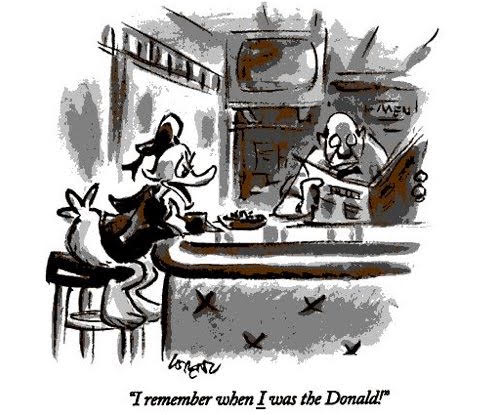
donald-duck-and-the-donaldOne can legitimately argue that the Revenge Revolution has already begun — with the election of Donald Trump.  Who would have thunk  Donald Trump would replace an older, more famous Donald, let alone become president?

Yet, a large percentage of the population voted for a candidate with no prior political experience, no experience running a large organization (the Trump organization despite claims to the contrary is quite small with only about 150 staff members, including family), no demonstrated understanding of macro and micro-economics, no demonstrated understanding of international relations, no demonstrated desire to learn…and a very long record of behavior that many people characterize as unethical and even immoral.

pants-on-fireFurther, the claims by Trump during the campaign were so outlandish and contrary to facts, that by historical standards, he should have not progressed past one or two primaries.  Despite these flaws, Trump gained sufficient votes to win a majority of the Electoral College and become the president elect.  I note the Electoral College because Hillary Clinton received about three million more popular votes than Donald Trump.

From my perspective and what I find ironic, is many of the people who voted for Trump seem the most likely to initiate the Revenge Revolution.  Why?  Because the promise to those voters about returning America to the days of widespread manufacturing and mining jobs for those with limited technical skills is impossible to keep.

As discussed in this blog, I agree some of the manufacturing jobs lost in the US have been shipped to countries with lower labor costs.  But the jobs shipped elsewhere are going to suffer the same fate as many manufacturing jobs in the US – being replaced by technology. 

For Trumpsters, the reason you have a cell phone, flat-screen TV, iPad, fast internet speed and a car with a bunch of electronic do-dads, is the same reason there are robots doing many of the jobs in the  manufacturing and mining sectors (and other sectors as well) formerly done by semi-skilled and even some horse-and-carriageskilled labor.  As unpleasant as this might be for Trumpsters, your vote does not count whether your job is replaced by a robot.  You have about as much influence on the fate of your job as 100 years ago when horses couldn’t vote whether families bought a horseless carriage.

In addition, while waiting for the non-existent manufacturing jobs to return, the Trump Administration will likely attempt to dismantle or restructure the basic financial foundation for many retirees – Social Security and Medicare. Although efforts to radically change Social Security and Medicare seem unlikely to succeed, the mere attempt will create widespread anger among today’s Trumpsters.

A few more reasons of a long list why the Trumpsters…and others…will become increasingly incensed.

·         Cabinet appointees.  Many appointees have no experience running a large organization, public or private.  Further, many appointees were selected because of intense opposition to the purpose of the agency – Education, HUD, HHS, EPA, Budget, Interior, etc. 

·         Financial conflicts of interest.  Several cabinet appointees as well as Donald money-in-pocketTrump/Trump family are likely to be charged with significant financial conflicts of interest.  Many of the people who voted for Trump because of alleged financial conflicts of interest by Hillary Clinton and the Clinton Foundation, will eventually tire of the claims that (i) the president cannot have conflicts of interest and (ii) charges of conflicts by cabinet members are being fabricated by Democrats and the media.   The conflicts in the Trump Administration are likely to be so blatant that even the most ardent supporters will be angered.

·         Irrational behavior by the president on a number of fronts – nuclear weapons, trade agreements, economic policy are part of a long list.  The nuclear-explosionchallenge to other countries of trying to outmatch the US with nuclear arms will be the turning point for many older Trumpsters.  These Trumpsters remember as children there was widespread fear in the US of a nuclear holocaust. 

·         Unbecoming boorish behavior by the president, his direct staff and some cabinet members.  The public and even the Republican members of Congress will tire of tirades by the president and staff over even the most minor criticism.   The American people want the president and staff to be role models and act like adults, rather than petulant bully-clip-art4-year olds…or even worse, neighborhood bullies.

One final thought…and I’m unsure if the event will have any effect on the likelihood of a Revenge Revolution.  To me it is unlikely Trump will finish a 4-year term, whether the term ends because he is forced from office or incapacitated, physically or mentally.  If Trump leaves and Mike Pence assumes office, there will be little calming of the unrest among the populous since many voters consider Pence more radical than Trump.  Even if Pence is more moderate than Trump in the attempt to restructure agencies and programs — Social Security, Medicare, etc. — his policies will be unable to fulfill many of the campaign promises made to Trumpsters, especially bringing back manufacturing jobs.

fife-drum%201Throughout history revolutions have been caused by extreme frustration among the populous.  Repeatedly over-promising and under-delivering, especially to ardent supporters, is a sure recipe for creating extreme frustration…and the Revenge Revolution.          

Note: after this segment was written, I decided to write another segment about a possible Revenge Revolution.  The segments are not continuous but complementary.             

#231 Lessons from Revenge Revolution: Trump’s ‘Incompetents Club’ Cabinet (Part 7 of 7)

18 Sunday Dec 2016

Posted by Jordan Abel in Federal Budget, Gov't Policy, Lessons of Revolution

≈ Leave a comment

First-time readers, the dialogue in this blog is set in the future (sometime after the year 2020).  Each entry assumes there has been a 5th revolution in the US — the Revenge Revolution.  More about Revenge Revolution and author, Entry #1.  List and general description of entries to date.  Annual assessment whether Revolution plausible.

Note: most characters appear in a number of entries, with many entries building on previous conversations.  Profile of characters.  You’ll catch on quickly.  Thanks for your time and interest…and comments.  This conversation begins Entry #225.

Gelly:  “Drone Man, nice to see you again.  I thought you were headed back to your 092615_2031_Characters7.gifgranddaughter’s tour group.”

Drone Man:  “Just as I got off the elevator in your lobby she called and said there’d been a delay of an hour or so.  So, Gelly, if it’s OK, I’ll take that cup of coffee you offered a few minutes ago.”

Gelly:  “Of course.  Come on in.  Jordan and I were just taking a short break.”

Jordan:  “Welcome back, Drone Man.  So we have you for another hour or so, eh?”

Drone Man:  “If you can put up with me.”

Jordan:  “It’s tough but we’ll try.”

(Gelly brings Drone Man coffee.)

Drone Man:  “Thanks for the coffee Gelly.  And since I interrupted you guys, I have another favor.”

Jordan:  “Which is…?”

Drone Man:  “In discussing lessons learned from the Revenge Revolution, I’ve not heard much about the Trump Administration…other than some lessons about what not goofy006to do for economic and tax policies.”

Jordan:  “You have a specific topic in mind?”

Drone Man:  “What about the lessons learned from Trump’s selection of various cabinet positions and heads of agencies?”

Jordan:  “You mean Trump’s appointments to the ‘Incompetents Club?’”

Drone Man:  “C’mon.  You really don’t mean the appointees were incompetent, do you?  Lots of smart people.”

Gelly:  “Jordan, Drone Man makes an interesting point.  These were smart people.  What do you mean?”

Jordan:  “Would either of you hire me to manage your brain surgery?”

Drone Man:  “Of course not.  That would be stupid.  What do you know about brain surgery?”

Brain deadJordan:  “Then stupid is as stupid does.. Why nominate a brain surgeon to be head of HUD (Housing and Urban Development).  Just because he lived in public housing as a kid, doesn’t mean he knows how to manage the agency.  The same applies to any number of Trump’s appointments – EPA, DOE, Interior…and the list goes on.  Zero knowledge of the agency they were to manage.”

Drone Man:  “Look, Trump was trying to ‘drain the swamp.’  He needed to appoint people who were not connected to the agency.”

Jordan:  “If you’re going to drain the swamp, don’t you think you should put someone who knows something about swamps?”

aligator-clip-artGelly:  “But didn’t Trump claim that people who knew the swamp were the problem?  Therefore, why appoint them?”

Drone Man:  “Keep poking him, Gelly.”

Jordan:  “My view is Trump was focused on the wrong target.”

Gelly:  “Well, then who’s to blame for the swamp if it’s not the bureaucrats at the agencies?”

Jordan:  “A group that few people really think about as a core problem – Congress.  CongressOh, yes, people think some members of Congress are too self-centered and non-responsive.”

Gelly:  “What about voters?  People keep electing the same congressional rep.  There’s very little turnover.”

Jordan:  “I agree voters share part of the blame.  But, unlike legislators in Congress, voters can’t make laws.  Voters cannot determine what money the Federal government will spend.  And that fact seems to be where Trump completely missed the boat.  The Federal agencies do not authorize their budget.  All spending bills are initiated in the House, not by the agency.”

Gelly:  “So you’re saying the agencies really manage the money that Congress authorizes, right?”

ConstitutionJordan:  “Exactly.  If you listened to Trump, who apparently had never read the Constitution and sleep-walked through his 8th-grade civics class, you’d think EPA, Defense, Education, Interior, Transportation and all the other agencies just ran around printing money willy-nilly.  Someone forgot to tell the Donald, if you want to change what goes on in Washington, you better start with the place that approves the spending…Congress.”

Gelly:  “I must missing something.  If the heads of agencies are really just managers, why were the Trump appointments so bad?  I mean most of his appointments were business people and former military generals.  Don’t these guys know how to manage?”

Drone Man:  “She’s spot on, Jordan.  What’s the issue with my man’s appointments…I mean Trump’s appointments?”

Jordan:  “Like I said earlier, if you’re going to manage a complex task…like brain surgery…you should know something about the subject matter.”

Gelly:  “This discussion all seems abstract to me.  You have a specific example?”

Jordan:  “Yes, Trump put ideologues in management positions.  Few of the appointees had real-world experience in the field they were supposed to manage…and some had no management experience whatsoever.  That same approach…ideologues managing areas where they had little experience…is what ruined one of the world’s best companies.”

GM,_logoDrone Man:  “Based on you past, you must be talking about another general…General Motors?”

Jordan:  “In the early 1980’s when Roger B. Smith took over as chairman, he too claimed he wanted to ‘drain the swamp,’ although he used different words.  Like Trump he focused on cost, cost, and cost.  He chose to pursue seemingly easy, high-profile targets, including shafting some long-time vendors.”

Gelly:  “But isn’t that just the way good businesses operate?”

Jordan:  “Not really.  Trump’s record as a businessman is not very good.  Why GM was so remarkably successful for so many decades was not because it focused primarily on cost.”

Drone Man:  “What did Smith do that was so wrong?  I still don’t understand.”

BeanCounterJordan:  “His approach to generating profits was wrong.  Smith put a bunch of bean counters in staff positions that had nothing to do with finance.  Their job was to generate more profits, primarily by cutting cost and then cutting more cost.”

Gelly:  “That sounds like the approach Trump and heads of agencies took.  Keep cutting cost.”

Drone Man:  “What’s wrong with cutting cost?  All large organizations have fat, especially the government.  You sound like some screaming liberal…or even worse fat-personsome academic.”

Jordan:  “And you sound like Trump with his immature tweets.”

Gelly:  “Now children, let’s behave.”

Jordan:  “Yes, mother.  Anyway, in Smith’s obsession with profits, he forgot one thing…sustained profits are not generated from cutting costs.  Sustained profits, and not just for GM but for any company, are generated from selling more product, whether cars and trucks or computers or shirts and sweaters.  No organization can sustain itself without generating revenue.”

Gelly:  “So what really happened at General Motors when Roger Smith was chairman?  Is that the person who people called ‘Squeaky’?”

Jordan:  “During Squeaky’s reign…I mean Smith’s reign in the 1980’s, GM lost 10 points of market share.  Let put that in perspective.  If annual car and truck sales are say 15 million units, then GM no longer produced and sold 1,500,000 sales units every single year.”

money-down-the-drainDrone Man:  “Each year?  That seems like a huge number…and lots of money down the drain.”

Jordan:  “At the time it was the equivalent of about six (6) large assembly plants with thousands and thousands of people and suppliers.  1.5 million is more cars and truck than sold in the US by Chrysler, Honda, Toyota at the time and bunch of other manufacturers.”

Gelly:  “Well, if GM lost those sales in the 1980’s, did the slide continue in the 1990’s?”

Jordan:  “That’s the problem, once a slide like that starts, it’s very hard to stop.  GM eventually declared bankruptcy.  Before it started to rebound in about 2014, GM share was only about 1/3 of what it was just before Smith took over.”

Drone Man:  “That’s amazing.  They lost 2/3 of their market share?”

Jordan:  “Just about 2/3, yes.”

Drone Man:  “So, if sales and revenue decline, all those cuts in expenses mean man-fallingnothing.  If the revenue falls, then profit also falls and the organization does not come out ahead…and in the end can be worse off.”

Jordan:  “Interesting dilemma, huh?  I’m not saying you shouldn’t look for ways to cut cost, but people need to understand what generates revenue…and it’s not from cutting cost.”

Gelly:  “For the government, revenue is from taxes.  So, if the economy continues to stall or even sink, or people are not as productive and make less money, then the long-term effects are like what happened to GM.  That doesn’t seem very appealing.”

Drone Man:  “I’d never really connected the dots between the skills of the cabinet members and the possible effect on the country.  It’s really important to have the right people in the right job.”

TurtleneckJordan:  “As I asked earlier, would you hire me to manage your brain surgery?”

Drone Man:  “When I think about Trump’s picks for cabinet posts, most of them were ideologues opposed to the fundamental purpose of the agency.  No wonder there were so many problems.”

Jordan:  “No different from Roger Smith chosing people in GM who were focused on cutting cost and not generating revenue.  As most of Trump’s cabinet didn’t understand government, most of Smith’s picks didn’t really understand the car business.”

Gelly:  “And Trump selected people who were focused on destroying the very agency they were supposed to lead.  Rather than making the agency better, they wanted to destroy it.”

Drone Man:  “Unfortunately, the result for the country was about the same as GM…except rather than going bankrupt the US had the Revenge Revolution.”

three-stoogesJordan:  “Now you see why I called Trump’s cabinet the ‘Incompetent’s Club.’  They might have been smart in one field but they were like Larry, Moe and Curly in their government jobs.”

Drone Man:  “And with that bit of wisdom, I need to disappear…this time for good.  Gelly, Jordan, it’s been swell.”

← Older posts
Newer posts →

Subscribe

  • Entries (RSS)
  • Comments (RSS)

Archives

  • August 2025
  • July 2025
  • June 2025
  • May 2025
  • April 2025
  • March 2025
  • January 2025
  • December 2024
  • November 2024
  • September 2024
  • August 2024
  • July 2024
  • June 2024
  • May 2024
  • April 2024
  • March 2024
  • February 2024
  • January 2024
  • December 2023
  • November 2023
  • October 2023
  • September 2023
  • August 2023
  • July 2023
  • June 2023
  • May 2023
  • April 2023
  • March 2023
  • February 2023
  • January 2023
  • December 2022
  • November 2022
  • October 2022
  • September 2022
  • August 2022
  • July 2022
  • June 2022
  • May 2022
  • April 2022
  • March 2022
  • February 2022
  • January 2022
  • December 2021
  • November 2021
  • October 2021
  • September 2021
  • August 2021
  • July 2021
  • June 2021
  • May 2021
  • April 2021
  • March 2021
  • February 2021
  • January 2021
  • December 2020
  • November 2020
  • October 2020
  • September 2020
  • August 2020
  • July 2020
  • June 2020
  • May 2020
  • April 2020
  • March 2020
  • February 2020
  • January 2020
  • December 2019
  • November 2019
  • October 2019
  • September 2019
  • August 2019
  • July 2019
  • June 2019
  • May 2019
  • April 2019
  • March 2019
  • February 2019
  • January 2019
  • December 2018
  • November 2018
  • October 2018
  • September 2018
  • August 2018
  • July 2018
  • June 2018
  • May 2018
  • April 2018
  • March 2018
  • February 2018
  • January 2018
  • December 2017
  • November 2017
  • October 2017
  • September 2017
  • August 2017
  • July 2017
  • June 2017
  • May 2017
  • April 2017
  • March 2017
  • February 2017
  • January 2017
  • December 2016
  • November 2016
  • October 2016
  • September 2016
  • August 2016
  • July 2016
  • June 2016
  • May 2016
  • April 2016
  • March 2016
  • February 2016
  • January 2016
  • December 2015
  • November 2015
  • October 2015
  • September 2015
  • August 2015
  • July 2015
  • June 2015
  • May 2015
  • April 2015
  • March 2015
  • February 2015
  • January 2015
  • December 2014
  • November 2014
  • October 2014
  • September 2014
  • August 2014
  • July 2014
  • June 2014
  • May 2014
  • April 2014
  • March 2014
  • February 2014
  • January 2014
  • December 2013

Categories

  • Affordable Solutions
  • Back Asswards Thinking
  • Background
  • Background Stupid Is as Stupid Does
  • Benefits of Revolution
  • Causes of the Revolution
  • Common Sense Policies
  • Corporate Policy
  • Definitions
  • Diversions
  • Economics
  • Education Issues
  • Federal Budget
  • General Motors
  • Gov't Policy
  • Infrastructure & Fixed Fuel Prices
  • Innovative Thinking: Ideas and Products
  • Lessons of Revolution
  • Personal Stories
  • Possible Solutions
  • Post Trump Presidency
  • Rebranding Black Community
  • SCOTUS
  • Sense Check
  • Societal Issues
  • Stupid Is as Stupid Does
  • Tech Tsunami
  • Trump 47
  • Uncategorized

Meta

  • Create account
  • Log in

Blog at WordPress.com.

Privacy & Cookies: This site uses cookies. By continuing to use this website, you agree to their use.
To find out more, including how to control cookies, see here: Cookie Policy
  • Subscribe Subscribed
    • usrevolution5
    • Join 32 other subscribers
    • Already have a WordPress.com account? Log in now.
    • usrevolution5
    • Subscribe Subscribed
    • Sign up
    • Log in
    • Report this content
    • View site in Reader
    • Manage subscriptions
    • Collapse this bar
 

Loading Comments...