• Home
  • Booklets/Grouped Entries
  • Tech Tsunami
  • List of Entries to Date
  • About the Author

usrevolution5

~ USA Headed for a 5th Revolution! Why?

usrevolution5

Category Archives: Gov’t Policy

#285 Why Is Banning Assault Weapons a 2nd Amendment Issue?

04 Sunday Mar 2018

Posted by Jordan Abel in Common Sense Policies, Gov't Policy, Societal Issues

≈ Leave a comment

Readers: this blog is set in the future (sometime after the year 2020). Each entry assumes there has been a 5th revolution in the US — the Revenge Revolution. More about the Revenge Revolution and author, Entry #1. List and general description of entries to date.

Note: most entries are formatted as conversations. Characters appear in a number of entries, with many entries building on previous conversations. Profile of characters (see link at top of page). You’ll catch on quickly. Thanks for your time and interest…and comments.

Scene: JC and Jordan ordering coffee at shop near Jordan’s office in Washington.

Clerk to Jordan: “Hi Bubbles, the usual?”

Jordan:  “Yes, please.  And JC, what do you want?”

092615_2031_Characters1.jpgJC:  “Grande, medium roast.”

——– Have coffee and find table —————-

JC:  “OK, you’ve got to tell me.  Where’d the name ‘Bubbles’ come from?  You leading some kind of secret life none of us know about?”

Jordan:  “Nothing that exciting.  When I started coming here regularly, I asked them to top off the coffee…since I don’t take cream.  One day when they put on the lid, some bubbles oozed out of the drink hole and onto the lid.”

Coffee cup and lidJC:  “And, so what?”

Jordan:  “That’s what I said, ‘So what?’  But apparently some customers are very picky and ask for a new lid if any bubbles ooze out.”

JC:  “So you, poking fun at those who take themselves too seriously, begin asking for bubbles, right?”

Jordan:  “And, voila, I became known as ‘Bubbles.’”

JC:  “Well, Bubbles, I think we’re going to have company.  An old friend of yours.”

Jordan:  “Hi, Sandy.  Long time, no see.  Have a seat, if you want.”

092615_2031_Characters8.gifSandy:  “Hi, Jordan.  If I recall, it’s JC, right?”

JC:  “Yes.”

Sandy:  “I really shouldn’t sit with you, Jordan.  I’m still mad at you.”

Jordan:  “For what?”

Sandy:  “Your efforts to overturn the 2nd Amendment and take away all our guns.”

Jordan:  “C’mon, Sandy, I never supported overturning the 2nd Amendment.”

AR-15Sandy:  “Sure you did.  You wanted to ban the sale of all assault weapons…and even make owning one illegal.”

JC:  “Excuse me, but you please help me understand something?”

Sandy:  “What would you like to understand?”

JC:  “How a ban on owning an assault weapon affecst rights under the 2nd Amendment?  I’m missing the link.”

Sandy:  “Because the ban was the first step toward a total ban on owning any weapons…and another major step toward a socialist state.”

JC:  “Sandy, let’s be serious, please.  No more NRA hype.  Remember there’s been a Revenge Revolution and the US political landscape is different now.”

Sandy:  “But you don’t understand.”

ComplicatedJC:  “You’re right.  I don’t understand.  The assault ban still allowed ownership of all kinds of hunting rifles, shotguns, pistols.  I’m not a hunter but why would you need an assault rifle to kill a deer?  Where’s the sport in that?  Maybe we should arm the deer.  That would make it more fun.”

Jordan:  “She’s right…well, maybe not about giving guns to the deer.  From your perspective, what was the real issue?  No civilian needs an AR-15.”

Sandy:  “Need assault rifles for protection.  That was the issue.”

Jordan:  “Protection from what?  You and I both know there’s no ad hoc civilian group, no matter how well armed, that has any chance against the military.  So really, what’s the heartache over the ban?”

School

Sandy:  “Well, you didn’t support protecting schools by arming teachers either.  Don’t you like kids?”

JC:  “Oh, Sandy, Sandy, please.  You don’t need to pretend to be a talking head on Fox or a politician who changes the subject and tries to blame someone else when he can’t answer the question.  What was the real issue?”

Jordan:  “Let’s take your comment about wanting to arm teachers…and even putting barricades around schools.”

Sandy:  “Good.  Now you’re talking some sense.”

Jordan:  “Tell me, what would either arming teachers or fortifying schools prevent?”

Sandy:  “Mass killings at schools.  Protecting our kids.  Why don’t you like kids?”

JC:  “He likes kids.  I need to understand what’s going to stop a shooter from hiding across the street from the school?  Or even sitting in the car and then shooting a bunch of kids when school lets out?”

Jordan:  “The shooter could also just fire a few rounds, blow out a window and then have a whole classroom of targets.”

JC:  “Jordan, that’s gross.”

Jordan:  “Gross, yes, but anyone with some infantry training in the military…and Sandy has more experience than I have…knows how to take out a bunch of people quickly, especially with an assault rifle.”

Sandy:  “Are you saying there’s no way to protect these school kids?”

Jordan:  “What I’m saying is a mass killing is much easier with an assault weapon.  And that’s the reason I opposed any ownership of assault weapons outside the military.”

Sandy:  “The ban won’t stop killing.”

JC:  “Oh boys.  Sandy, I think everyone agrees that the ban is not a silver bullet, as it were.  Some mass killings will continue to happen as long as there are so many guns around.”

Seat beltsSandy:  “So why have a ban on owning assault weapons?”

JC:  “To help reduce the number of killings.  Here’s a comparison.  Mandating seat belts and air bags in cars and trucks didn’t eliminate some people dying in wrecks.  But as a result of the mandate, there have been far fewer deaths.  Got it?”

#283 Creating Clarity from Chaos (Part 2)

25 Sunday Feb 2018

Posted by Jordan Abel in Causes of the Revolution, Common Sense Policies, Gov't Policy, Possible Solutions, Societal Issues

≈ Leave a comment

Readers: this blog is set in the future (sometime after the year 2020). Each entry assumes there has been a 5th revolution in the US — the Revenge Revolution. More about the Revenge Revolution and author, Entry #1. List and general description of entries to date.

Commentary: The last two week’s entries are a bit different — a personal dialogue.  No characters.  No scenes in coffee shops or in the office.  Just personal dialogue.

At the end of Entry #282, I gave no hint about a recommendation for reducing gun violence in America.  The vagueness was intentional, in part, because I wanted to: (i) think through my ideas; (ii) recognize possible meaningful actions at the state or Federal level during the then upcoming week.

Yes, I know one week does not a trend make.  But this past week helped solidify, at least for me, what action needs to be taken.

AR-15First, it appears more and more people are realizing what the military and gun enthusiasts have known for some time – the AR-15 is not a sport rifle, is not a hunting rifle but is an assault weapon designed for killing as many people as possible in as short a time as possible.

My conclusion and recommendation: sale and ownership of AR-15’s and similar military-grade weapons need to be banned.  The ban would apply to new sales through dealers or between private individuals.  Further ownership of any AR-15 (and other designated weapons) would be banned.  No grandfathering.

Weapons currently in private hands would be returned to authorities for disposal.  Owners would receive some compensation for turning in the weapons.  Those not turning in designated weapons would be subject to a felony conviction and losses of rights associated with such a conviction.

The only sales of AR-15’s and other designated weapons would be to the military.  An attempted sale of such weapons to any other individual or entity would carry an automatic felony conviction and void any compensation for turning in the weapon.

ComplicatedWhy such a harsh recommendation?  First and foremost, these type weapons are not needed outside the military.  For those who insist on firearms to protect self and/or property, hunting rifles, shotguns and pistols are more than adequate.  For hunters, using AR-15’s is hardly sport, even if hunting elephants, lions, tigers or bears, which you shouldn’t be doing anyway.

Aside from the lack of need for these type weapons, I am recommending the approach because compromise will not begin to solve the underlying problem of ownership of military weapons in civilian hands.  This baby cannot be cut in half.

The NRA and the hard right have such a warped sense of reality on this issue that a compromise would only migrate efforts to reduce gun violence from outlandishly unworkable to extremely unworkable.  The NRA’s approach to any effort to address the problem is to offer No Rational Alternative.

ReaganBanning assault weapons is not unprecedented.  Beginning in 1994 Federal law banned the sales of newly manufactured assault weapons.  Former presidents Gerald Ford, Jimmy Carter, and Ronald Reagan, wrote to the U.S. House of Representatives in support of banning “semi-automatic assault guns”. The law passed with bi-partisan support.  Congress let the law expire in 2004.

The law had many loopholes, which reduced potential effectiveness.  Part of the justification for not renewing the ban in 2004 was the lack of clear evidence that crime had been reduced.  Well, I’ll tell you what.  Put enough loopholes in any kind of regulation and people will find a way around the regulation, thereby negating its intended purpose.   The justufucation for not renewing the ban seems as ill-conceived as using a sieve for a drinking cup and wondering why you can’t get much water.

The NRA and hard right, as both are prone to do, have created alternative universes to help justify their position.  The interpretation of the Second Amendment is a good example of an alternative universe.

What is the wording of the Second Amendment?    “A well regulated Militia, being necessary to the security of a free State, the right of the people to keep and bear Arms, shaConstitutionll not be infringed.”

Why was the Second Amendment added to the Constitution?  At the time the US had a very small standing Army, debt from the Revolutionary War was high, and the Federal government had very limited resources and virtually no taxing power.  To have an effective militia meant that the states and its residents needed to comprise most of the troops (think today’s National Guard.)  In addition, there was concern about defending the country against a foreign invasion (e.g., war with the British didn’t end until the War of 1812) and individuals settling the west were fighting Native Americans.

Rifle Flint LockIn that context, the Second Amendment seems perfectly logical.  Guys, get it?  The regular citizens of the country made up the military when the Constitution was written.  And, if you’re a strict “Constitutionalist” and interpret the Constitution as originally written, the weapons were single-shot flint locks, not AR-15’s.

Look, if you want to get your jollies and fire AR-15’s, 30-calibre and/or 50-calibre machine guns, toss hand grenades and other things that go boom, then join the Army or Marines.  You might feel a little differently after you’re the target of someone firing these weapons.  Not quite as much fun.

Does the proposed ban on military-grade weapons have a chance of passage?  What about those who believe that a ban on these type weapons is only the first step of many that will allow the Federal government to take complete control of one’s life.  Out with the democracy and in with socialism.

House of RepsGet serious conservatives.  If you understood government, you might realize that you already live in a country where the government allows you basic rights.  That piece of property you think you own?  Your right to ownership is a function of government.  The freedom to travel?  That freedom is a function of government.  Hate to burst your conservative bubble, but the freedoms that you have are because the government lets you have those freedoms.

David Brooks, a conservative op-ed columnist for the New York Times, recently suggested that to make progress closing the gap on certain social issues we need to respect the other side’s point of view.  I agree…and on most issues I think the approach will work.  On the issue of working to reduce gun violence and why recognizing that ease of access to and ownership of assault rifles is a major contributing factor, I’ve tried to listen, as have many others.  But when you’re dealing with people whose position has no rational support…and dealing with people who are even unwilling to discuss the issues, I say, David, in this case you’re wrong.

The ultimate insult to rational people came this past week when many in the NRA and on the hard right claimed the students at the Parkland, FL high school where 17 fellow students and teachers died, were not students but paid actors.  Sure Rushman.  17 people get killed.  Some students protest because adults are either too lazy or too stupid or too brainwashed by you, Fox and others, to take no action.  And you have the gall to claim the students are phony?  No, Rushman, you’re the phony.  The kids have guts.

Hey Hey LBJI hope these students ask their grandparents to coach them about how the grandparent protested the Vietnam War.  Then the kids can go to Washington, march in front of the White House and chant, “Hey, hey, Donald J!  How many kids did you kill today?”

The students are the future of this country.  Rather than mock them, we should support them.

Where does that leave us?  Given the rigidity of the right and the No-Reasonable-Alternative NRA, the only significant step that I can think of to begin to change the culture of gun ownership and to begin reducing gun-related violence is to ban the manufacture, sale and ownership by non-military personnel or entities of all military-grade weapons.  With the ban, no one’s right to own a weapon for hunting, sport or defense will be affected.  Folks, we need only one military.

#269 What’s Supposed to Melt in the US Melting Pot? Discussion: US Military (Part 5)

28 Saturday Oct 2017

Posted by Jordan Abel in Causes of the Revolution, Common Sense Policies, Gov't Policy, Societal Issues

≈ Leave a comment

Readers: this blog is set in the future (sometime after the year 2020).  Each entry assumes there has been a 5th revolution in the US — the Revenge Revolution.  More about the Revenge Revolution and author, Entry #1.  List and general description of entries to date.

Note: most entries are formatted as conversations.  Characters appear in a number of entries, with many entries building on previous conversations.  Profile of characters (see link at top of page).  You’ll catch on quickly.  Thanks for your time and interest…and comments.

Scene: Jordan’s office, Washington, DC.  Conversation about “culture” starts Entry #262

Gelly:  “Jordan, during the break, JC called.  She’d like to stop by.”

Jordan:  “She must have called from downstairs.  Look who’s here.”

JC:  “Hi guys.  Thanks for letting me join you.”

092615_2031_Characters7.gifGelly:  “JC, I’ll get you some coffee, then I need to get back and work on a project.”

JC:  “Thanks.  Gelly said you’ve been talking about cultures in America.  Something about how much a particular culture should blend into the US melting pot…and how much should not blend.  Is that about right?”

Greenie:  “Yes.  We’ve talked to Wolf Man about culture of Native Americans.  And no I didn’t slip and call him Two Dogs.  Jordan also called Rock Man to discuss African-American culture but he hasn’t called back.”

092615_2031_Characters1.jpgJC:  “Greenie, is this info for your articles about the causes of the Revenge Revolution?”

Greenie:  “Yep.”

JC:  “I know I just walked in the door…and really have no idea what all’s been discussed…”

Jordan:  “…So what else is new?  That was too easy to let pass.”

JC:  “As I was saying, a culture that rarely seems to get talked about other than on the surface is the US military.”

092615_2031_Characters2.jpgGreenie:  “Mmm, you thinking the military culture is that much different?

Jordan, you were in the military, right?  Does it have a separate culture?”

Jordan:  “I was in a long time ago.  But I think JC’s question is a good one.”

Greenie:  “What prompted you to mention the military?  That’s unlike you.”

JC:  “I keep hearing people still talking about how they thought the military culture got out of whack before the Revenge Revolution.  Trump was enamored with the military.  In his eyes, the generals could do no wrong.  According to the Trumpsters, the generals were somehow super warriors.”

Military GeneralGreenie:  “What still gnaws at me is the behavior of John Kelly when he was chief of staff for Trump.”

JC:  “You mean his lying about the Congresswoman from Florida and supporting Trump’s lies about her?  What was her name?”

Greenie:  “You mean what is her name…she’s still around you know.  And her name is Representative Frederika Wilson.”

JC:  “That’s who I mean.  How stupid could Kelly have been?  He lied about the contents of a press conference that he knew was on tape.  Did he think he could just state her commenbts were “fake news” and everyone would salute the general and say ‘Yes, sir.’”

bossy-motherGreenie:  “What galls me even more is Trump’s press secretary Ms. Congeniality Susan Huckabee told the press they should not challenge a 4-star Marine general.  BS Sarah.”

Jordan:  “Kelly also made some babbling remarks that the military being some kind of elite organization that was superior to the rest of the population.  Hitler said that about the SS troops and we know what happened there.”

JC:  “Kelly’s remarks and this constant murmuring are why I asked if you’d considered looking the influence of the military culture.”

Greenie:  “Actually I haven’t considered it but maybe I should.  But is there any difference in the military culture today than say 25, or even 50 years ago?  If the culture hasn’t changed, then why would the influence have changed?”

Jordan:  “From my perspective there’s been a major change in the military culture.”

JC:  “You were a major?  Army or Marines?  Just some payback, Jordan.”

Uncle SamJordan:  “OK, we’re even.  I think the military culture started to change with the elimination of the draft.”

Greenie:  “From what I understand the military became much more professional when everyone volunteered compared to when people were drafted.  That claim seems to counter your argument.”

Jordan:  “’More professional’ in my opinion is PR hype.  Eliminating the draft resulted in a military with more professional thugs.”

Greenie:  “That seems awfully harsh.  Why do you say more professional thugs?”

Chicken HawkJordan:  “With the draft there was a reasonably good cross-section of ethnic groups, backgrounds and education.  Yes, some wealthier guys chickened out of the draft and bought off doctors to get an exemption…”

JC:  “…You mean like ‘bone-spur Trump’?  Mr. Chicken Hawk himself?”

Jordan:  “Good example.  But a lot of the draftees were highly educated.  Case in point – the battalion in my advanced infantry training unit had a median education of…wanna guess?”

college degreeGreenie:  “I’ll go with 13 years…finished one year college.”

JC:  “I’ll go with 15 years…finished three years college.”

Jordan:  “You’re both low.  The median education in that battalion was 15.5 years.  Not bad, huh?”

Greenie:  “Were these guys all…whadda call them, officer-candidate something or others?”

military-clip-art--military-clipart-8Jordan:  “Nope.  Just regular guys like me.  I don’t recall many of us being really gung-ho, rah-rah types.  We were in the Army doing our time.”

Greenie:  “What’s the difference in the military now?”

Jordan:  “The all-volunteer military has resulted in a mix of enlistees heavily weighted toward the rah-rah types.  Some of the enlistees are truly dedicated and feel obligated to serve their country…”

JC:  “…and the other enlistees like guns and want to do crazy stuff?”

Jordan:  “That’s a good description for many people in today’s infantry – whether Army or Marines.”

SealsGreenie:  “What about the SEALS and those Special Forces guys?  Aren’t they really professional?”

Jordan:  “They are extremely well trained…to kill.  But whether they’re the right people for the military is an open question.”

JC:  “Seriously?  The SEALS and the special-forces guys seem so patriotic.”

Jordan:  “A lot of them are patriotic.  But let me tell you my experience the last few years with some members of the military.  Of the three SEALS I know, one was a convicted felon – for running drugs, and not just a few drugs.  The other two SEALS were brothers, who then became lawyers post military, and who then became extortionists.”

bully-clip-artGreenie:  “Yikes.  Not good.  Know anyone else?”

Jordan:  “The Special Forces guy stole hardware and very expensive software from a company I was consulting for…and had, what I surmise based on his comments, an illegal stash of firearms.”

JC:  “Any other friends we should know about?”

Jordan:  “Friends, hardly.  A guy I helped fund for a business was a colonel in the Army Reserve.  He got called up and low and behold sometime later I saw an article in the NY Times about a colonel in the Army being convicted of stealing at least $600,000 cash and shaking down military suppliers for cars and other goodies.  Guess who it was?”

FighterGreenie:  “Your pal?  Well, your something or other.  But let’s be fair.  You know some other guys in the military, right?  I mean your top-gun buddy and some other guys in the group that designed those jet fighters.”

Jordan:  “Yes, all those guys were top-notch and highly ethical.  But my point is with an all-volunteer military there is a disproportionately high percentage of people who frankly should not be in the military.  Without a draft, military recruiters find it difficult to fill quotas.  As a result, the military accepts recruits that often are less than ideal.”

Bow DownGreenie:  “So the quality of recruits is so-so.  Let’s go back and talk about the big-dog generals…specifically General John Kelly.  When chief of staff for Trump, Kelly claimed that military personnel were superior and the general population should, in effect, bow down to them.”

JC:  “And, Jordan, you don’t buy that argument…if nothing else based on your own experience.”

Jordan:  “You got it.”

Scales BalancedGreenie:  “So do you think to make the culture of the military more like the US population as a whole, we should reinstitute conscription?”

Jordan:  “Yes.  Bring back the draft to help balance the military.  Not a popular idea, I know, but necessary to avoid another Revenge Revolution.  And now I feel conscripted to get another coffee.”


#268 What’s Supposed to Melt in the US Melting Pot? Discussion: Native Americans (Part 4)

14 Saturday Oct 2017

Posted by Jordan Abel in Gov't Policy, Lessons of Revolution, Societal Issues

≈ Leave a comment

Readers: this blog is set in the future (sometime after the year 2020).  Each entry assumes there has been a 5th revolution in the US — the Revenge Revolution.  More about the Revenge Revolution and author, Entry #1.  List and general description of entries to date.

Note: most entries are formatted as conversations.  Characters appear in a number of entries, with many entries building on previous conversations.  Profile of characters (see link at top of page).  You’ll catch on quickly.  Thanks for your time and interest…and comments.

Scene: Jordan’s office, Washington, DC.  Conversation starts Entry #265.

Gelly:  “I’m not sure I really understood what Wolf Man was talking about.”

CrabGreenie:  “You mean about the crab barrel?”

Gelly:  “Yes.  Why would anyone have that kind of attitude?  Why wouldn’t you want someone else from your tribe to succeed?  I mean, if one of the tribal members succeeds, doesn’t that eventually help everyone…or at least give everyone hope?”

Greenie:  “I don’t understand that kind of attitude either.  The crab-barrel attitude is a self-fulfilling prophecy…for failure.”

Jordan:  “Agreed.  So what went wrong along the way with the attitudes of the tribes?  Think about it, the tribes never could have survived for all these centuries with a crab-barrel attitude?  What caused the crab-barrel to happen?”

092615_2031_Characters2.jpgGreenie:  “Your question might be the answer?”

Jordan:  “Whadda mean?”

Gelly:  “Let me try.  Before losing the wars to the white man, the tribes were…well, tribes.  A collection of people working together.”

Greenie:  “After the white man, the tribes became a collection of individuals.  Really, no longer tribes.”

Jordan:  “So, you guys are saying the culture of the tribes…in effect, the essence of the tribes…melted away when the tribes were moved to the reservations?”

IndianGelly:  “The tribes experienced more than just moving.  If I understood Wolf Man correctly, he said the tribes on the reservations…apparently for many years…were prohibited from practicing many of the customs and ceremonies central to the respective tribes.”

Jordan:  “But couldn’t they just start building a new culture?  Why not?”

Greenie:  “Jordan, Jordan, Jordan.  Build a new culture?  How?”

Jordan:  “Why not?”

092615_2031_Characters7.gifGelly:  “If they built a new culture, would they still have a tribe?”

Greenie:  “Let me ask you something, Jordan?  Are you a member of a tribe?”

Jordan:  “Not an Indian tribe but you know I am.  Where are you headed with this?”

Greenie:  “Where I’m headed is that tribes remain tribes when key parts of the culture remain intact.”

TurtleneckJordan:  “And you have an example?”

Greenie:  “The old axiom, ‘More than Jews have kept Shabbat, Shabbat has kept the Jews.’”

Jordan:  “I’ll buy that.”

Gelly:  “What that says to me is even when Jews left the old country, by keeping Shabbat and all the traditions, or at least many of the traditions of Shabbat, they kept the essence of their culture.  Keeping Shabbat became the glue that held the Jews together as a tribe.”

GlueJordan:  “But why didn’t Indians keep their traditions…the glue…that held them together.”

Gelly:  “Wolf Man said they couldn’t keep the traditions.  His understanding is his ancestors and other Native Americans on the reservations were prohibited, sometimes forcibly, from keeping the traditions.”

Jordan:  “C’mon, that was what 140-150 years ago?  I think Native Americans need to ask, ‘What’s stopping our different tribes from re-initiating at least part of their traditional culture?  Why can’t the tribes regroup, as it were?”

Gelly:  “Maybe some of them are.  But now is their base-point really a new culture?  Is the new culture more of dependency rather than independency?  By the way, is ‘independency’ a real word?”

ScreamGreenie:  “Yes, independency is a real word.   And your point is well taken.  Have we…the victors in the Indian Wars…so restricted the tribes that the original culture has been lost?  By our own actions, have we destroyed one culture and replaced it with a culture of dependency?  That’s a depressing thought.”

Jordan:  “Even if the white man tried to destroy the culture, don’t you think it’s up to the various tribes to decide if they want to recapture the culture?”

Gelly:  “How are they going to recapture their culture when the world around them has changed so much?”

Greenie:  “Good question.  If I may, let me try to phrase it a bit differently.  ‘What about the old Indian culture can be recaptured for, or will work in today’s environment?’  The question is phrased a bit awkwardly but you get what I mean.”

Jordan:  “It’s a great question to ask Wolf Man about Native Americans…and a great question to ask Rock Man about blacks.”

ScaleGreenie: “Not finding the right balance between what part of a culture should melt in the US melting pot and what part of a culture should not melt might have larger impact on the cause of the Revenge Revolution than I first thought.”

Jordan: “Unfortunately, there’s no simple answer to how much of a culture should melt.  We know it’s not the same for every culture.  And we also know a one-size-fits-all approach doesn’t work.”   (Continued)

#246 Who Took Out the Donald? (Part 3)

23 Sunday Apr 2017

Posted by Jordan Abel in Gov't Policy, Lessons of Revolution, Societal Issues, Stupid Is as Stupid Does

≈ Leave a comment

First-time readers, the dialogue in this blog is set in the future (sometime after the year 2020).  Each entry assumes there has been a 5th revolution in the US — the Revenge Revolution.  More about Revenge Revolution and author, Entry #1.  List and general description of entries to date.  Annual assessment if Revolution plausible.

Note: most characters appear in a number of entries, with many entries building on previous conversations.  Profile of characters.  You’ll catch on quickly.  Thanks for your time and interest…and comments.

Scene: Gelly, JC and Greenie having drinks with Jordan following a session in Jordan’s office.  Conversation starts Entry #244.

WaiterWaiter delivers a round of drinks.

Greenie:  “I have a request, please.”

JC:  “And that is…?”

Greenie:  “Before we get mired in more Beltway BS, I’d like to propose a toast to the Steak & Shake and the Custard Cup.”

Custard CupGelly:  “Huh?  A toast?  I’ve heard of Steak & Shake…in fact I’ve eaten there…but the Custard Cup?  What’s that?”

Jordan:  “The Custard Cup is a mom-and-pop ice cream stand.  But not just any mom-and-pop ice cream stand.  It has the best…all caps on ‘THE’…best ice cream I’ve had anywhere, period.”

JC:  “I agree.  Even though I’m not an ice cream fan…”

Greenie:  “…can you believe it, she doesn’t like ice cream.”

092615_2031_Characters1.jpgJC:  “As I was saying, even though I’m not a big ice cream fan, the Custard Cup is king of the ice-cream hill.”

Gelly:  “So where is this joint?”

Greenie:  “Ice cream stand, please.  Custard Cup is not a joint.  The Custard Cup is a couple of blocks from where JC grew up.  In fact it was well within a mile of where Jordan lived and where I lived growing up.”

Gelly:  “So a neighborhood hangout, huh?”

Jordan:  “More than the neighborhood.”

122913_1337_14BringingU2.pngGreenie:  “A toast to the Steak & Shake and especially the Custard Cup.”

Jordan:  “Hear, hear.”

JC:  “Alright, now that the sidebar is over, back to the mystery of who took out the Donald.”

092615_2031_Characters2.jpgGreenie:  “Ya know, I think it’s the group we’d rather not think about.”

Jordan:  “You mean not the Russians, not the North Koreans, and not the Mexican drug lords.”

JC:  “You’re thinking inside job?”

Greenie:  “I’m still not sure about the Russians but the more I think about it, the North Koreans and Mexican drug lords seem out of the picture.”

Jordan:  “Why’d you drop them from the list?”

Looney TunesGreenie:  “Had the Trump Administration not acted like Looney Tunes characters, I would have left them on the list.  But behavior by the Trump family…and even by some of the so-called adults on the Cabinet was so unprofessional.  Bizarre is not the right word, because it was worse than bizarre.  But I can’t think of the right word.””

Gelly:  “You think there was an incident that tipped the scale for the CIA…or whoever the responsible inside group was?”

Greenie:  “Yes, and I’m not sure the public appreciated the significance of how the event affected the country’s credibility among world leaders, friend and foe.”

JC:  “What was the event?”

Greenie:  “In my view, for the serious government officials who actually help protect the country, the scales tipped when the Trump Administration…the president, the Secretary of Defense and the head of the National Security Agency…I’ll ignore press secretary…all claimed that the aircraft carrier what’s-its-name was part of an armada ‘steaming’ toward North Korea when actually it was ‘steaming’ away from North Korea toward Australia.”    

JC:  “I agree, Greenie.  That erroneous claim had to be one of the biggest screw-ups in American history.  The statements were not an intentional lie to deceive the enemy, like you might have had in WWII.  These guys were trying to intimidate North Korea but just did not know what was going on.”

092615_2031_Characters7.gifGelly:  “That was really a ‘duh’ moment for me and I suspect many people.  It’s not as if there was no way to track the aircraft carrier and what, a couple of destroyers?  I mean, doesn’t the US have satellites, airplanes and even such low-tech things called radios?”

JC:  “Jordan, you’ve been around these beltway guys for a while.  You’ve even been in the White House.  What were these guys thinking?  No one checked to make sure the claim was right?  You’re pronouncing to the world a major strike force is headed to North Korea and no one checks the facts?  Even worse, when they did find out the mistake, no one corrected it publicly.”

Aircraft CarrierJordan:  “Must have been an interesting conversation in the Oval Office after someone pointed out the mistake.  ‘Let’s see, if we just ignore telling the public we made a mistake, no one will find out.  Those ships are in a big ocean.  Who’s going to see them?’”

JC:  “That might have worked when countries had an armada, as the Donald called it…but not in the 21st Century.  C’mon guys.  Wake up.”

Greenie:  “Ok, we need to ask if there was a tipping point other than the claims about the wrong-way armada.  What about a series of events that might have tipped the scales?”

TurtleneckJordan:  “I suppose one could point to any number of single events or series of events demonstrating stupid-is-as-stupid-does behavior.  But I think for most people, there’s usually a single incident that tips the scale.”    

Greenie:  “I agree.  Think about relationships with other people, feelings about a restaurant…whatever.  You go along and go along with a less-than-satisfactory relationship and then at some point you say to yourself, ‘Enough, already.  No more.’”

Jordan:  “And, I agree the wrong-way armada was probably what triggered the CIA to take action.”

JC:  “Bad pun, Jordan.”

Waiter: “Would you folks like to order some food?”

#243 Primer Cha 8: “What’s Good for General Motors is Good for the Country.” Still True?

04 Tuesday Apr 2017

Posted by Jordan Abel in Economics, Gov't Policy

≈ Leave a comment

First-time readers, the dialogue in this blog is set in the future (sometime after the year 2020).  Each entry assumes there has been a 5th revolution in the US — the Revenge Revolution.  More about Revenge Revolution and author, Entry #1.  List and general description of entries to date.  Annual assessment if Revolution plausible.

Note: most characters appear in a number of entries, with many entries building on previous conversations.  Profile of characters.  You’ll catch on quickly.  Thanks for your time and interest…and comments.

Scene: Gelly, Jordan’s assistant, has been editing and updating a primer Jordan wrote about 2011.  Section starts Entry #235.  (Primer will be available as PDF in another week or so.  Then the primer download will be updated regularly.) 

Gelly: “Jordan, I have a request.  You know I’ve been trying to edit the Primer on 092615_2031_Characters7.gifEconomics and do my regular job.  Well…”

Jordan: “Well, you’re having a tough time, right?”

Gelly: “Yes.  With all the upheaval in Washington and all the calls you’re getting after the Revenge Revolution, finding extra time has been very difficult, ya’ know?”

Jordan: “Look, I understand.  We’ve both been incredibly busy lately.  Why don’t you edit the primer as time permits and we’ll just add it to the primer website page.  By the way, Turtleneckis the primer page on the site?”

Gelly: “Actually, no.  But give me a few more days, OK?”

Jordan: “You’ve got a deal.  Now, please let me read the chapter on why a strong domestic auto industry is important.  That’s near-and-dear to my heart.”

—————– Text of Primer Chapter 8 ——————

(Written originally: June 2009, as the US was mired in a deep recession) In the last few months, a number of ordinary citizens, government officials and media pundits have Rantranted and raved, asking, “Why should we use government money to bail out Chrysler and General Motors?” The comments continue, “Management at these companies has made bad decisions, UAW wages are too high and no one wants to buy their cars. Besides, Toyota, Honda, Nissan, Hyundai and Mercedes all make vehicles in the United States.”

The question about validity of government bailouts is valid…but the conclusion is not correct. The U.S. needs a healthy domestic auto industry but for reasons that many people may not have considered.

Why write an article defending the domestic auto industry?  I’m writing because a number of people asked me to do so. Once I explained my views on a strong domestic auto industry, most people responded with something similar to, “I never realized how important it is to have strong domestic auto companies.”

goofy006What makes me an expert? My comments are based on some fundamental laws of economics and 40+ years in the auto business.  The auto experience includes being inside a large auto company as well as starting several companies offering hybrid-electric or 100%-electric drive systems. I’ve been in technology centers, on factory floors, in boardrooms, in design centers and in dealership showrooms and service bays. I’ve been involved with some good, some bad and some ugly projects.

So why is a successful domestic auto industry so important? Three fundamental reasons: (i) ensuring advanced technology is readily available inside the country to auto and other industries; (ii) stimulating growth in other industries (iii) helping ensure national security.

ComplicatedWhat makes the auto industry different from most other industries is a combination of large-scale, complex manufacturing and demands for extremely high levels of reliability and durability, especially compared to other products. Everyone I have ever met who entered the auto industry after time in another industry makes the same comment after 2-3 weeks, “The auto business is much more complicated than I realized.” And the comment usually includes several expletives.

The degree of complexity does not mean “outsiders” should not enter the industry. Far from it. But outsiders need to be cautious about ignoring staff who have toiled inside the companies for many years. Institutional knowledge is very valuable and should not be taken lightly. Clean the water and be careful not to throw out the babies. (If you think the comments about complexity do not apply to such companies as Tesla, think again, and read more about how Tesla saved itself from bankruptcy.)    

ENSURING AVAILABILITY OF ADVANCED TECHNOLOGY.  What does the auto industry do that cannot be done by the defense or aircraft industry? The answer is volume. High volume drives down cost and lower cost makes products affordable for many more consumers. While much new technology is developed in defense and aerospace industries, neither industry generates the volume necessary to drive down cost significantly.

Think about the number of military and civilian aircraft built each year. The total number built for the entire year is equal to about one day’s production at one auto plant. And there are more than 20 auto assembly plants in the US. Auto companies produce 15-17,000,000 new cars and trucks in every year, just for the U.S. market.

down chartThus, for technology to be introduced in cars and trucks – even very expensive vehicles – cost must drop 1 to 2 orders of magnitude, or more than 90%, from cost acceptable for a defense or aerospace application.

Further, parts on cars must function with essentially no maintenance. Think about how little you maintain your car or truck vs. the number of hours you drive. Yes, you may refuel every few days, or every few hours, but how often do you change oil, have a tune-up or overhaul the engine compared to hours driven? Would you fly on a commercial airplane with the same minimal maintenance schedule as you have for your car? Of course not.

Despite the limited maintenance schedule, cars and trucks are expected to operate and last 15-20 years, or more. What other major piece of equipment so widely used in so many different environments lasts that long?

?????????????????????????????????????????????????????????????????????????????????Well, you say, “I still don’t understand why we need to bail out GM and Chrysler. Seems like the government is pouring money down a hole.”  As a point of clarification, when I talk about the auto industry, I mean more than just assembly plants.  The core of the auto industry is primarily component design and manufacturing. The assembly plants get all the glamour but industry guts are in components – electronics, robots, batteries, wheels, frames, tires, steering, foundries for engines and brakes and many other components.

Manufacturing of components creates value.  In addition, knowledge gained in manufacturing can be transferred to other industries. As a country we often overlook the need to remain competitive in producing components. The US does not need to produce all components for all cars assembled in the US. But is does need to maintain the capability of producing a high percentage of each key component.

STIMULATING OTHER INDUSTRIES.  The technology used in autos is directly applicable to many other industries. The demands of the auto industry for lower cost and high reliability force many suppliers to improve their technology and quality processes. A strong domestic auto industry increases the likelihood, although does not ensure, the U.S. is creating, receiving and utilizing the latest technology.

Will foreign auto companies with U.S. assembly plants transfer the latest technology to the U.S.? No, just as the U.S.-companies do not export their latest technology to other countries. If there is any question about countries keeping technology at home first, one should study technology available on cars sold by Toyota and Nissan in Japan compared to technology available in the US. Frequently the technology is not available in the US for 2-3 years after being introduced in Japan.

EV1Further, some technology breakthroughs have a long-lasting impact. An example is the effort by GM in the early 1990’s to develop and introduce an electric vehicle, known as the GM EV1. While GM was praised for introducing the car, and skewered when stopping production, the advances in technology developed for the EV1 program became the foundation for many of the electronics available in cars and trucks today, 20 years after the EV1 concept car was introduced at the Los Angeles auto show.

Yes, GM deserves criticism for canceling the program. But GM deserves praise for advancing automotive electronics, which in turn led to the use of advanced electronics in many non-automotive applications. The strong domestic auto industry creates advancements in technology that benefit the auto industry and all segments of industry and everyday consumers.

Advanced technology applied in non-auto industries keeps US companies competitive worldwide. Exports create jobs. If you think transportation-driven technology is not important to other industries, think about productivity in agriculture, raw materials, manufacturing, distribution and other industries. Most of the productivity gains were greatly influenced by demands first met in the auto industry. Without such productivity, the US output and incomes would fall toward lesser developed nations.

Yes, I know, Silicon Valley is great. But the country needs to translate the ideas to generate wealth for US society. Manufacturing generates wealth, services do not. Knowledge without manufacturing does not create wealth.

NATIONAL SECURITY.  Since foreign-based auto companies do not transfer the latest technology – and why should they – without a strong domestic auto industry, the U.S. will fall behind in technology development for everyday products and manufacturing efficiencies. This in turn will lower potential GDP growth and personal incomes.

More importantly, however, without a higher-volume domestic auto industry to spread cost, will the country be able to afford the cost for developing new technology used primarily for defense and aerospace applications? Probably not unless we raise taxes and lower incomes.

WWII AircraftFinally, and let’s hope this never occurs again, but what happens if the U.S. needs manufacturing capacity for a large-scale ground war? A domestic auto industry, both assembly and component manufacturers will be critical for rapid conversion from automotive production to defense materiel. Having only assembly plants without domestically sourced components – engines, transmissions, axles, electronics, and so forth – offers no benefit for national security. (For insight into how the auto industry contributed to production of war materiel in WWII, visit Auto Industry in WWII. One of many websites.)

SMART INVESTMENT.  Taxpayer dollars to ensure a vibrant domestic auto assembly and component manufacturing industry are dollars well spent – a smart investment. What would the hue and cry be from these same critics of the GM and Chrysler bailout if the defense and aerospace industries began outsourcing critical defense weapons systems to such countries as India, China and Japan?

Charles_Wilson_official_DoD_photoIf you still have doubts, name one country worldwide that has sustained growth in GDP and real growth in consumer incomes without a strong manufacturing base built around a strong automobile industry? Call me when you can name one.

Supporting a strong domestic automobile industry is smart economics. Charles E. Wilson was correct, when he said many years ago, “What is good for General Motors is good for the country and vice versa.”

#242 Primer Cha 7: Eliminating Incentive to Pillage

25 Saturday Mar 2017

Posted by Jordan Abel in Back Asswards Thinking, Corporate Policy, Gov't Policy, Innovative Thinking: Ideas and Products, Societal Issues

≈ Leave a comment

First-time readers, the dialogue in this blog is set in the future (sometime after the year 2020).  Each entry assumes there has been a 5th revolution in the US — the Revenge Revolution.  More about Revenge Revolution and author, Entry #1.  List and general description of entries to date.  Annual assessment if Revolution plausible.

Note: most characters appear in a number of entries, with many entries building on previous conversations.  Profile of characters.  You’ll catch on quickly.  Thanks for your time and interest…and comments.

Scene: Gelly, Jordan’s assistant, has been editing and updating a primer Jordan wrote about 2011.  Section starts Entry #235.  (Primer will be available as PDF in another few chapters.  Then the primer download will be updated regularly.) 

092615_2031_Characters7.gifGelly: “Jordan, you’ve done it again?”

Jordan: “Done what, again?”

Gelly: “Made me scratch my head.  I just never thought about economic development as an incentive to pillage.  I mean isn’t economic development supposed to create jobs and make everyone wealthier?”

Jordan: “That’s the political line.  OK, some people do benefit.”

TurtleneckGelly: “You mean the executives of the company that’s relocating.  But I never though about the cost of these relocations to the people where the company left and even…”

Jordan: “…even to the taxpayers of the town where the company is relocating.”

Gelly: “If you add up all the costs, the only winners seem to be the company executives.”

Chapter 7: Eliminating the Incentive to Pillage.  Some might view decisions to shutdown facilities and/or relocate manufacturing plants or distribution centers as capitalism at its best. Others view such decisions as capitalism at its worst – an incentive to pillage with no repercussions.

Wall Street SignSenior executives and shareholders of a company can benefit financially from these actions. Senior managers at companies often have a major portion of compensation in stock – 75.0% of total compensation in stock is not unusual.

Stock price, and therefore executive wealth, is highly influenced by short-term earnings. If you do not believe so, look at the effect on the stock price if a company does not meet the quarterly earnings forecast.

While having compensation in stock rather than cash, especially with a claw-back provision (right to “recall” a portion of compensation at a later date) if long-term earnings do not pan out, is a major step forward, executives of the company still have a major incentive to take actions that may be contrary to the best interests of US society.

ScrewedMany executives believe that by relocating operations, the company will lower its costs and in turn increase stock.  The theory of this action – and I emphasize theory – is the wealth of those executives implementing job cuts will increase the company’s stock price.  Screwed in this equation are those people whose jobs are eliminated and who helped build the company and create its value.

This perverse incentive to screw the very people who helped create the company’s value is either not understood or ignored by the public and politicians who make the tax laws. Management of these companies is giving away most of the store – in many cases transferring future wealth creation outside the US – and being rewarded for the transfer. It is as if the country where the new manufacturing plant is located offered current management a kickback – in effect robbing the US – and the US taxpayers are rewarding the management for accepting it.

The same perverse situation occurs when plants relocate elsewhere in the United States. State and local governments offer tax incentives to have plants relocate from one state to another.

Who pays for these relocations?  Tax_Time_Clip_ArtTaxpayers at both locations. The people where the plant was previously located now have a lower tax base. The people where the plant is now located have higher spending to support the facility but without the benefit of taxes from the new company, which usually does not pay its fair share since it was recruited by waiving taxes.

If proper financial analysis were completed, my belief is it would be less costly to society and especially taxpayers, if the company revamped the existing facility rather than relocating to a new facility in another state. While some might view this perspective as socialism, the view is actually one that ensures America remains a vibrant country for generations.

Benefits of Using Existing Manufacturing Facilities  The benefits of using existing manufacturing facilities rather than developing new or “greenfield” facilities are significant. Some benefits of existing over greenfield include:

  • Infrastructure in place and ready. Many new facilities require roads, sewers, high–voltage electric lines, schools and other expensive infrastructure. Existing facilities may need some upgrades but the cost of upgrades will be less than: (i)  building new and (ii) leaving the existing infrastructure in place to be repaired or sit idle and decay. Creating new infrastructure is double taxation on US citizens – once to build the existing infrastructure and again for the new infrastructure.
  • Workers already trained.  While some retraining may be needed, skills of existing workers can be utilized to develop and manufacture products of the same genre as currently produced. Why train someone in auto production in a different part of the US when a large segment of the population in another area is already trained?
  • Lower cost to begin production. When all costs are considered – not just labor costs per hour – revamping and continuing to utilize the existing facilities and workforce are less costly to society than starting new.  Even if a new building is required in the existing location, there are no additional costs for infrastructure or training.
  • Faster turnaround from product concept to production. Skills acquired over many years cannot be taught in a short period, no matter how proficient the trainers.  Even if the current employees are not trained in the latest technology, combining existing skills with those familiar with the latest technology will shorten the development time for new products.
  • Avoiding costs for family relocation. Relocating workers and families includes both the direct cost of relocation and the indirect social cost. While some workers will view the relocation as an opportunity to move beyond the current environment, many of those who want the adventure have already moved. Forcing families to choose between retaining a job and relocation can have a major social cost. The more dominant the company in the area, the higher the social cost of closing the facility and relocating to another area.

An Occasional Exception to the Rule  What if the existing infrastructure and local infrastructure is inadequate to support the company?  In these circumstances, can the relocation be justified?

Yes, if a true case can be made. A few years ago two companies relocated North American HQ from Augusta, GA to Charlotte, NC. – Electrolux, Husqvarna.  While Augusta, a town of about 200,000, had supported these firms and such other companies as EZ-Go and Club Car (both golf cart manufacturers), Electrolux and Husqvarna may have needed a larger community with a more diverse population, stronger academic institutions, international banks, international law firms and access to an international airport.

“Economic Development” Uneconomic.  Do most relocations add jobs to the US market? No. Are there usually incentives to entice the companies to relocate? Yes.

092615_2031_Characters12.gifDo these relocations create a net gain to US society? No. Owners of the business that’s relocating give taxpayers the finger twice.  Taxpayers where the plant was located originally lose a tax base. Taxpayers in the new location pay additional the relocation incentives.  Even for Electrolux and Husqvarna, there is likely a net loss to society rather than a net gain.

 I realize this rationale may seem counter intuitive, especially to those involved with what is often labeled as “economic development.” However, I am waiting for someone to convince me with a  rationale argument that these moves make economic sense.

Yes, the moves make sense for the companies. But the companies are part of a whole. Until we begin considering the impact of such moves on the system – all society – we will be double taxing ourselves with no net gain to the country’s wealth.  Please show me why I am wrong. (BTW, please read Chapter 8 before forwarding your ideas. Thanks.)

#241 Primer Cha 6: Creating Societal Wealth: Manufacturing

12 Sunday Mar 2017

Posted by Jordan Abel in Economics, Gov't Policy, Societal Issues

≈ Leave a comment

First-time readers, the dialogue in this blog is set in the future (sometime after the year 2020).  Each entry assumes there has been a 5th revolution in the US — the Revenge Revolution.  More about Revenge Revolution and author, Entry #1.  List and general description of entries to date.  Annual assessment if Revolution plausible.

Note: most characters appear in a number of entries, with many entries building on previous conversations.  Profile of characters.  You’ll catch on quickly.  Thanks for your time and interest…and comments.

Scene: Gelly, Jordan’s assistant, has been editing and updating a primer Jordan wrote about 2011.  Section starts Entry #235.  (Primer will be available as PDF in more traditional format after Chapter 5 or 6.  Then the primer download will be updated regularly.) 

092615_2031_Characters7.gif

Gelly:  “Jordan, do you really think I’m a pick-pocket?”

Jordan:  “What are you talking about, Gelly?”

Gelly:  “In the primer chapter on creating wealth, you said people in service industries were like pick-pockets.”

Jordan:  “I think you’re wording is a bit of a stretch…but I get the gist of what you’re saying.”

TurtleneckGelly:  “Actually, I liked the analogy.  It helped me understand how wealth is created for a society rather than just an individual.”

———- TEXT of PRIMER ———- 

During summer 2009, which was still early on in the Great Recession, Congress was considering whether to bail out Chrysler and General Motors.  Many people stated that auto companies and auto production did not need to be in the US. In fact, some argued US consumers would be better off if auto manufacturing was done in lower-cost countries outside the US.

dude-with-questionI’m not sure where these people took Economics 101 but all the economics I have studied indicates manufacturing has a direct and positive impact on wealth creation for a country. Wealth for a society is created one way — taking materials and processing them so the end-product is more valuable to buyers than the individual components.

The concept of creating societal wealth through manufacturing is apolitical. Whether your political beliefs are left or right, whether you are a fervent capitalist or fervent socialist, creating wealth for society works the same way – manufacturing.

Printing money can create wealth in the short term. So can mining and selling natural resources. But those resources often finite and are of value only, and only, if processed into another product.

Oil RigFor example, crude oil per se, has no value. Oil is feed stock for plastic and has value to companies manufacturing plastic products. Oil, when refined, has great value today for use in transportation, heating homes and generating some electricity. Oil would have much less value if more electricity and transportation were powered by non-fossil fuels.

Gold has no inherent value.  Gold becomes valuable when it is processed into jewelry, part of electronics components or other products.  Gold’s use as currency is arbitrary.  A society’s currency could be based on certain types of rocks…or even paper, as it is in most countries today.

Understanding how manufacturing creates societal wealth is not difficult.  For example, think of the manufacturing process as starting with iron ore – a bunch of rocks.  Through various steps the rocks are formed into steel.  Through another series Rocksof steps, the raw steel is turned into hoods and fenders for cars/trucks or support beams for industrial buildings. Each step in the manufacturing process adds value to what was originally a pile of rocks with no inherent value.

Farming, in a broad sense, is also manufacturing. Farmers take seeds and through various steps turn the seeds into corn or soybeans. The farmer then sells the corn to others who process it again, Tractorturning the corn into cereal or bio–fuel for cars/trucks. Each time the end product becomes more valuable.

Each step in the manufacturing also creates jobs. At each step, part of the “added value created” is distributed to workers through wages and owners through wages and dividends.

What about companies that offer services?  Do these companies create wealth?  Answer: No.

Service-related companies do not create wealth.  These companies/organizations merely transfer money from one person’s pocket to another person’s pocket. Yes, some individuals may make more money in the transaction but others lose an equal amount. Thus, with services there is no net gain in wealth for society…unless the service makes the manufacturing sector more productive.

taxpayerMedical care, for example, is a service that does not create societal wealth.   The doctor and medical staff may be economically better off after some procedure, but the patient, the insurance company and other taxpayers have transferred funds to the medical staff.   Unlike manufacturing, the doctor, nurse and others involved with patient care, created no wealth for society – they merely picked the other person’s pocket. 

Before you become enraged, just think about medical care.  For a society, the cost of medical care is, in many ways, like a tax. The cost of medical care transfers wealth from one pocket to another but does not create wealth overall.  However, like some taxes (note the term “some taxes”, not “all taxes”), medical care is necessary to sustain a vibrant and productive society.

newspaperRetailing is also a service that creates no societal wealth. The primary benefit of retailing is a convenient venue to purchase manufactured goods. While most people think of retail stores, the “stores” can be physical structures, internet sites, business-to-business sales representatives or even door–to-door sales people.

The contribution retail “stores” make to local economic growth is not well understood. Retail stores, Amazon-like warehouses and other such facilities do not create jobs.  I am always amazed when a new store or Amazon-like warehouse comes to an area where many retail stores exist. The news report often is, “X Brand New Store/Warehouse Coming to Town, 200 New Jobs Created.”

A new store does not create new jobs unless the market is under–represented with retailers. A new store does not cause people to spend more money, but merely reallocates the money being spent among other retailers.

walmart_logoThe reallocation is particularly true for such retailers as Wal–Mart/Sam’s Club, Amazon et al. Wal–Mart/Sam’s Club draws customers from other stores and often pays lower wages than other stores. Further, most of the merchandise in Wal–Mart is manufactured outside the US.

Shoppers at Wal-Mart create a double negative impact on wealth creation by (i) supporting lower–paying jobs that replace higher paying jobs at existing local retailers and (ii) sourcing products outside the US at the expense of manufacturing jobs in the US.

The example should not be construed as anti–Wal-Mart. However, Wal-Mart is no patron saint. If the true economic impact of such stores as Wal–Mart were analyzed, the outcome would likely be negative, not positive.  Amazon has become the ”new Wal-Mart,” with even more erosion of higher-paying jobs and US-manufactured goods.

As a society, we need to understand what economic policies create wealth and what economic policies merely transfer wealth between people‘s pockets.  In many ways, the emphasis on service companies – banks, medical, retail – are like taxes, which transfer wealth between segments of society but create no overall societal wealth.

Trump Administration and Manufacturing.  The promise by Trump during the campaign to bring back former high-labor-content manufacturing jobs is folly.  Yes, manufacturing is critical to create societal wealth but Trumptechnology has replaced much of the labor content in manufacturing.  And the use of technology to replace workers will only continue. 

If there is any doubt about the trend, merely look at agriculture.  The implementation of technology has resulted in enormous gains in output with far fewer workers.   The key for sustaining US manufacturing is not trying to create retro-manufacturing jobs but training workers help support technology for future manufacturing growth.      


#239 Cha 4: Unemployment Rate: A Lagging Indicator

19 Sunday Feb 2017

Posted by Jordan Abel in Economics, Gov't Policy

≈ 1 Comment

First-time readers, the dialogue in this blog is set in the future (sometime after the year 2020).  Each entry assumes there has been a 5th revolution in the US — the Revenge Revolution.  More about Revenge Revolution and author, Entry #1.  List and general description of entries to date.  Annual assessment if Revolution plausible.

Note: most characters appear in a number of entries, with many entries building on previous conversations.  Profile of characters.  You’ll catch on quickly.  Thanks for your time and interest…and comments.

Scene: Gelly, Jordan’s assistant, has been editing and updating a primer Jordan wrote about 2011.  Section starts Entry #235.  (Primer will be available as PDF in more traditional format after the first few entries.  The download will be updated regularly.) 

092615_2031_Characters7.gifGelly:  “Jordan, I finished another section.”

Jordan: “Good.  Which one?”

Gelly: “Unemployment rate.  Several things I didn’t know.”

Jordan: “Such as…?”

Gelly: “The unemployment rate lags behind economic growth.  Until I read your example, I never thought about why changes in the unemployment rate follow other activity.  I also didn’t realize how the rate was calculated.  The idea that the rate can go up as the economy is improving just didn’t seem right at first.”

TurtleneckJordan: “Understand it now?”

Gelly: “I think so.  Here’s the write-up.  I need to make one chart a little more clear.  We should also update some of the information for the Trump Administration.  But everyone should get the idea for now.”

Jordan: “OK, Gelly.  Thanks.”

——————- TEXT of CHAPTER —————

When Obama was president, most Republican politicians and conservative talking heads continually criticized the Administration for not creating more jobs. During president Obama’s first term, a typical comment from the right would be, “There has been no sharp decrease in the unemployment rate.  Therefore the stimulus package and deficit spending has not worked.”

On the surface, the comment seems fair. But what is the unemployment rate and how should we interpret changes in the rate?

How Would You Behave?  Situation: You own a business.  Sales and profits are down.  Lately there has been some uptick in sales but you’re not sure if it will last.  Question: Would you start hiring people the minute sales started to pick up or would you wait to be certain sales were going to continue at a higher level? Answer: Most all business owners wait…and the behavior is logical.

With this behavior in mind, let’s think about the unemployment rate.  If businesses wait to hire more people until they are certain the economy is getting stronger, how should the unemployment rate be characterized – as a “leading” economic indicator or a “lagging” economic indicator?

The unemployment rate is a “lagging” economic indicator – the unemployment rate does not decline until the economy is already weaker and the unemployment rate does not fall until the economy is already improving.  Thus, gains in employment will come after the economy has started to improve.

The chart depicts monthly changes in employment.  The data points above the “zero” line indicate increases in employment compared to the previous month.  Data points below the “zero” line indicate losses.  As you review the chart, keep in mind that employment is a “lagging” economic indicator so changes in overall economic activity occur before the changes in employment.   

17-02-18-total-employment-2007-2010

The economic decline that turned into the “Great Recession” started during Bush43’s second term and the decline accelerated sharply as Obama was taking office.  Early in the Obama Administration, Congress passed an economic stimulus package.  These type packages, whether implemented by Republican or Democratic administrations, take time to have an effect on the economy and an even longer time to have an effect on employment. 

Note that beginning October 2008, about 7-8 months after the stimulus package was passed, monthly job losses stabilized and the monthly losses decreased until the beginning of 2010.  Because the unemployment rate is a “lagging” economic indicator, the economy was actually starting to improve even though people were continuing to lose jobs and the unemployment rate continued to increase. 

While it makes for great political theater, those claiming that the economic recovery program implemented by the Obama Administration was a failure, conveniently failed to provide an accurate representation.  The recession of 2007-2008 was labeled the Great Recession because the economy almost sank into a depression.

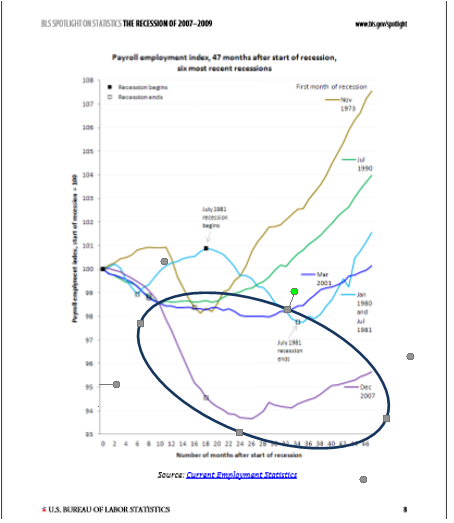
Just how bad were job loss been compared to previous recessions? Much worse. The job losses were much sharper and more severe than in any other post-WWII recession.  The area within the ellipse reflects the losses in 2007-2008.  Notice how much steeper and deeper the losses are compared to other recessions.  (I’m working on a chart that is easier to read.)

17-02-19-bls-job-losses-recent-recessions-with-highlight


        So, if the job losses were significantly worse than previous recessions, wouldn’t you think any economic recovery should take longer?  Not if you’re a politician of the opposing party.  For all those criticized the Obama Administration for not creating more jobs, the critics should remember who was president when the recession started – and why the recession started.

Explaining the Unemployment Rate

Enough politics. Just what is the unemployment rate?   The unemployment rate is total number of people looking for work but unable to find work divided by the total work force.  The result is “unemployment rate” or percent of the workforce considered unemployed.

Part of the confusion lies in the definition of the “total work force.”  Total work force is the sum of people looking for work and people currently employed. If people are unemployed and have given up looking for work, they are not considered part of the workforce. Huh? Really? Yes, really. Here’s an example.

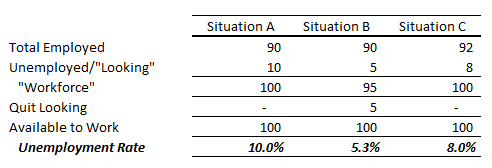
Situation A. 100 people are available to work – 90 are employed and 10 are unemployed and all 10 are actively looking for work.  Thus, the workforce is 90+10, or 100.  The unemployment rate is 10.0% (1-90/100).

17-02-18-unemployment-table


Situation B. Same 100 people as Situation A. However, after several months, 5 out of the 10 people unemployed cannot find work, become frustrated and quit looking for a job. What happens to the unemployment rate? It goes down. Yes, down, even though the total number of people stays the same.

The unemployment rate decreases from 10.0% (10 unemployed out of 100 in the workforce) to 5.3% (5 unemployed out of 95 in the workforce.) The unemployment rate decreases even though the number of people without work stays the same.

Even more confusing is when the economy improves, those who previously quit looking begin looking for jobs.  What happens to the unemployment rate?  The rate may actually increase even though the economy is improving.

Situation C.  Start with Situation B where 10 people were unemployed but 5 of the 10 quit looking for work. Now the economy starts to improve and the five people who quit looking start looking again. Only 2 of the 5 who quit previously find jobs right away but everyone who was not employed is again looking for work.

Situation C now has 92 employed, 8 unemployed.  What happens to the unemployment rate?  The rate jumps from 5.3% in Situation B to 8.0% in Situation C, even though the total number of people employed increased from 90 to 92.  Why?  Because the total workforce – the number of people employed and number looking for work increased from 95 to 100.  (Unemployment rate calculation, (1-92/100=8.0%)

Another problem interpreting the data is the unemployment rate includes workers who have jobs but are working less than full-time. These people are counted as “employed.” Using the same 100 people, if 15 are working say 30 hours per week instead of 40 hours per week, the 15 would be counted as “fully employed,” even if weekly income has been reduced.

While these calculations are not hard to understand, the method used to calculate the unemployment rate is not often explained, especially the effect of “under-employed” or “quit looking for work.” Understanding the methodology will help you explain to others why results of programs to reduce unemployment always lag economic growth.

(Reference material: Bureau of Labor Statistics website has vast array of information about employment, unemployment and how to interpret. http://www.bls.gov)


#235 The Set-Up. Primer from “Practical, Affordable Policies Institute” (Part 1)

22 Sunday Jan 2017

Posted by Jordan Abel in Common Sense Policies, Economics, Gov't Policy, Innovative Thinking: Ideas and Products

≈ 7 Comments

First-time readers, the dialogue in this blog is set in the future (sometime after the year 2020).  Each entry assumes there has been a 5th revolution in the US — the Revenge Revolution.  More about Revenge Revolution and author, Entry #1.  List and general description of entries to date.  Annual assessment whether Revolution plausible.

Note: most characters appear in a number of entries, with many entries building on previous conversations.  Profile of characters.  You’ll catch on quickly.  Thanks for your time and interest…and comments.

Scene: Jordan’s office in Washington, DC

Gelly:  “At the beginning of each year, I clean out some file drawers.  Look what I ran across.”

Jordan:  “I’d forgotten about these.  I must have drafted some of these in about 2010-2011, but never published them.”

092615_2031_Characters7.gifGelly:  “What were they for?”

Jordan:  “Each article was to be a chapter in a primer about how to develop practical, affordable government policies to address key issues.  The primer would be the foundation for an organization I thought of creating – the working name was the Practical, Affordable Policies Institute, as known as…”

Gelly:  “PAPI.  I like that name.  My ‘pappy’ always had good, practical advice for our family.  So you wanted to become Washington’s ‘PAPI’, right?”

fatherly-adviceJordan:  “You know better than that.”

Gelly:  “Well, someone must have wanted your advice, at least some idea about what was in the primer.”

Jordan:  “Not that many people knew about the primer.  As a sense check, I circulated the articles within a fairly small group inside the Beltway.  Wanted to get reactions and ideas how to improve.” 

Gelly:  “That explains the phone call in the early days of the Trump telephoneAdministration.  A couple of staffers asked for copies of the primer.  I wasn’t sure what they were talking about.  Remember when I asked you about it?”

Jordan:  “Yes and I was out of town…somewhere.  I emailed the staffers a copy but you and I never talked about the primer when I got back.  The staffers that called probably were part of the review group.”   

Gelly:  “Now the rest of the conversation with the staffers makes sense.  They were concerned that senior officials in the Trump Administration had no clear policy for addressing many aspects of the economy.”

toss-out-iconJordan:  “You mean they didn’t consider Trump’s tweets and ‘toss out whatever Obama did’ as real policy?”

Gelly:  “I still shudder when I think about Trump’s approach early on.  Do you think these articles actually helped turn things around?”

Jordan:  “In Washington, as you know, a good idea has many fathers.  But, I presume the staffers did distribute the primer to some people in the Trump Administration…very discreetly, of course.”

Gelly:  “As I flipped through the pages, some of the articles seemed to be more about approach than actual policy.”

donald-duck-wishing-wellJordan:  “True.  I thought the articles about approach might be helpful since to make something happen – accelerate economic growth, for example – you can’t simply wish it to be true and expect results.”

Gelly:  “So, to implement a policy and make it work you really do need a plan and a disciplined approach to implementation.”

Jordan:  “Yes, and the statement seems so incredibly obvious.  I remember some people finished an article and asked…and I think rightfully so…’what’s the value here?  What’s being discussed is just common sense.’”

Gelly:  “Funny, I thought the same thing about some topics.  But I agree that common sense seems to get lost on some people when they’re inside the Beltway.”

Jordan:  “Let’s hope it doesn’t get lost for us.”

Gelly:  “Another question.  Do you think if all the ideas in the primer were implemented, the country could have avoided the Revenge Revolution?”

TurtleneckJordan:  “That’s a real stretch.  What I do know is if the Trump Administration had considered more carefully the essence of what was outlined in the primer, then the likelihood of a Revenge Revolution would have diminished.  At a minimum the Revenge Revolution would have been later and less disruptive.”

Gelly:  “You ever going to publish these?”

Jordan:  “Should I?  Whadda think?”

Gelly:  “My vote is ‘yes’ you should publish.”

Jordan:  “I’m not sure what all the topics were.  You have a list?”

Gelly:  “Here’s a list so far.  I think there are a few more.”

  1. You Can’t Drive Fast Looking through the Rearview Mirror
  2. Basic Economics and Common Sense
  3. National Debt Is Too High.  Well, Not Really.
  4. Unemployment: Always a Lagging Indicator
  5. Seasonal Adjustments and Trend Lines
  6. Manufacturing Creates Wealth
  7. Impact of Losing the US Manufacturing Base
  8. Eliminating the Incentive to Pillage
  9. Recruiting New Plants or Overseas Manufacturing
  10. Practical Policies to Rebuild US Manufacturing
  11. Why a Healthy Domestic Auto Industry Is Important
  12. Securing Equity Capital for Start-Ups, Emerging Companies
  13. Capitalizing on Global Warming

Jordan:  “I’d forgotten about a few of those.  Gelly, here’s an idea. I’ll consider publishing the primer…rather we’ll consider publishing the primer…after you edit the various entries.”

bookletGelly:  “You want me to edit?”

Jordan:  “I know some of the data needs to be updated, which I can help with.  But having you edit will make sure the papers are understandable to the average reader.  I tried to make the language simple but not sure I always succeeded.”

Gelly:  “How quickly do you want the editing finished?”

Jordan:  “Weave the editing into your normal schedule.  Finish at least one per week and try to get two finished.  And, then we’ll publish as you finish, OK?”

Gelly:  “We’ll publish?  But these are your papers.”

Jordan:  “No.  They’ll be our papers and we will publish.”

(Entries for the primer will be published at one or two per week.  Entries published to date will be available for download on the “Policy Primer” page of the blog.  Format will be double columns.)  

← Older posts
Newer posts →

Subscribe

  • Entries (RSS)
  • Comments (RSS)

Archives

  • August 2025
  • July 2025
  • June 2025
  • May 2025
  • April 2025
  • March 2025
  • January 2025
  • December 2024
  • November 2024
  • September 2024
  • August 2024
  • July 2024
  • June 2024
  • May 2024
  • April 2024
  • March 2024
  • February 2024
  • January 2024
  • December 2023
  • November 2023
  • October 2023
  • September 2023
  • August 2023
  • July 2023
  • June 2023
  • May 2023
  • April 2023
  • March 2023
  • February 2023
  • January 2023
  • December 2022
  • November 2022
  • October 2022
  • September 2022
  • August 2022
  • July 2022
  • June 2022
  • May 2022
  • April 2022
  • March 2022
  • February 2022
  • January 2022
  • December 2021
  • November 2021
  • October 2021
  • September 2021
  • August 2021
  • July 2021
  • June 2021
  • May 2021
  • April 2021
  • March 2021
  • February 2021
  • January 2021
  • December 2020
  • November 2020
  • October 2020
  • September 2020
  • August 2020
  • July 2020
  • June 2020
  • May 2020
  • April 2020
  • March 2020
  • February 2020
  • January 2020
  • December 2019
  • November 2019
  • October 2019
  • September 2019
  • August 2019
  • July 2019
  • June 2019
  • May 2019
  • April 2019
  • March 2019
  • February 2019
  • January 2019
  • December 2018
  • November 2018
  • October 2018
  • September 2018
  • August 2018
  • July 2018
  • June 2018
  • May 2018
  • April 2018
  • March 2018
  • February 2018
  • January 2018
  • December 2017
  • November 2017
  • October 2017
  • September 2017
  • August 2017
  • July 2017
  • June 2017
  • May 2017
  • April 2017
  • March 2017
  • February 2017
  • January 2017
  • December 2016
  • November 2016
  • October 2016
  • September 2016
  • August 2016
  • July 2016
  • June 2016
  • May 2016
  • April 2016
  • March 2016
  • February 2016
  • January 2016
  • December 2015
  • November 2015
  • October 2015
  • September 2015
  • August 2015
  • July 2015
  • June 2015
  • May 2015
  • April 2015
  • March 2015
  • February 2015
  • January 2015
  • December 2014
  • November 2014
  • October 2014
  • September 2014
  • August 2014
  • July 2014
  • June 2014
  • May 2014
  • April 2014
  • March 2014
  • February 2014
  • January 2014
  • December 2013

Categories

  • Affordable Solutions
  • Back Asswards Thinking
  • Background
  • Background Stupid Is as Stupid Does
  • Benefits of Revolution
  • Causes of the Revolution
  • Common Sense Policies
  • Corporate Policy
  • Definitions
  • Diversions
  • Economics
  • Education Issues
  • Federal Budget
  • General Motors
  • Gov't Policy
  • Infrastructure & Fixed Fuel Prices
  • Innovative Thinking: Ideas and Products
  • Lessons of Revolution
  • Personal Stories
  • Possible Solutions
  • Post Trump Presidency
  • Rebranding Black Community
  • SCOTUS
  • Sense Check
  • Societal Issues
  • Stupid Is as Stupid Does
  • Tech Tsunami
  • Trump 47
  • Uncategorized

Meta

  • Create account
  • Log in

Blog at WordPress.com.

Privacy & Cookies: This site uses cookies. By continuing to use this website, you agree to their use.
To find out more, including how to control cookies, see here: Cookie Policy
  • Subscribe Subscribed
    • usrevolution5
    • Join 32 other subscribers
    • Already have a WordPress.com account? Log in now.
    • usrevolution5
    • Subscribe Subscribed
    • Sign up
    • Log in
    • Report this content
    • View site in Reader
    • Manage subscriptions
    • Collapse this bar
 

Loading Comments...