• Home
  • Booklets/Grouped Entries
  • Tech Tsunami
  • List of Entries to Date
  • About the Author

usrevolution5

~ USA Headed for a 5th Revolution! Why?

usrevolution5

Category Archives: Economics

#230 Post Revenge Revolution Lessons — Republican Economics – 3-Card Monte (Part 6)

11 Sunday Dec 2016

Posted by Jordan Abel in Economics, Lessons of Revolution

≈ Leave a comment

First-time readers, the dialogue in this blog is set in the future (sometime after the year 2020).  Each entry assumes there has been a 5th revolution in the US — the Revenge Revolution.  More about Revenge Revolution and author, Entry #1.  List and general description of entries to date.  Annual assessment whether Revolution plausible.

Note: most characters appear in a number of entries, with many entries building on previous conversations.  Profile of characters.  You’ll catch on quickly.  Thanks for your time and interest…and comments.

Gelly:  “I’m headed to the break room.  Jordan, your cup’s mostly full.  Drone Man, 092615_2031_Characters7.gifwould you like more coffee?

Drone Man:  “Gelly, how ‘bout a stiff drink instead?  All this talk about who ran up the debt is bothering me.  Actually, coffee would be great.  Thanks.”

(Drone Man and Jordan each check phones until Gelly returns with coffee.)

Drone Man:  “Thanks.  Gelly, you’re very kind…unlike your buddy here.”

Jordan:  “C’mon, Drone Man, don’t take all this discussion personally.”

Drone Man:  “How else can I take it?  Your attacking my fundamental beliefs.  On top of that I voted for Trump.  I’m still asking myself why.”

TrumpJordan:  “So you made a mistake and voted for the Trumpster.  Yes, the Trump administration was an absolute disaster.  Look, we all make mistakes.”

Jordan:  “But I should have known better.  I let ideology override good, objective analysis.”

Gelly:  “Are we getting sidetracked?  I thought this conversation was to be about economic policy.”

Drone Man:  “My fault.  It’s hard to admit that you’ve been spouting the wrong line for so long.  OK, Jordan, show me that chart you were talking about.”

Jordan:  “You mean the chart with US debt as a percent of GDP?”

Drone Man:  “Yes.  The debt percentage is what you were pounding into me a few minutes ago.  Really should look at the chart but I’m afraid to.”

Jordan:  “Here’s the chart.”

slide1

Drone Man:  “How do I interpret this chart?”

Greenie:  “May I try to explain this.  Doing so will make sure I understand.”

Jordan:  “Good idea.  Go ahead.”

Gelly:  “When calculating the percentage, the numerator is total outstanding debt and the denominator is gross domestic product, aka GDP, for the year.”

drone-manDrone Man:  “Gelly, don’t confuse me.  Have you turned into some kind of math whiz?  Numerator, denominator.”

Gelly:  “You know, Drone Man, total government debt outstanding at the end of the year divided by the GDP for the year.  That gives you the percentage debt to GDP.”

Drone Man:  “Debt for the year or total debt?  Makes a big difference.”

Gelly:  “Total debt.  You know, like the sum of how much you owe on credit cards, car loans, mortgage, and whatever else.  Right, Jordan?”

Jordan:  “You got it.  Keep going.”

Gelly:  “So if total debt goes up during the year but GDP grows even faster, then the percentage decreases.  The percent also declines if the country pays off some of the debt.”

Drone Man:  “OK, so the chart shows some percentage – ‘a’ divided by ‘b’.  Debt divided by GDP.  But even if percentage declines, the amount of debt can go up, right?  More debt is bad.  Where’s the chart of total debt?”

debtJordan:  “Tell me why you think more debt by itself is automatically bad.”

Drone Man:  “It just is. My gut tells me it is.”

Jordan:  “Let’s say you’re a banker.  What do bankers do?”

Drone Man:  “They take your deposits…and they lend money to other people or businesses.”

Money-clip-artJordan:  “Well, Mr. Banker, you have two customers who want to borrow $100,000,000.”

Drone Man:  “OK, I’m the banker…and it must be a big bank.  Who are the two customers?”

Jordan:  “Say Gelly is one…and the other is Warren Buffett.”

Drone Man:  “No offense, Gelly, but you don’t make the cut for the 100 mil.  But Buffett?  He gets the loan.”

buffettGelly:  “I’m not offended, Drone Man, but why lend $100,000,000 to Warren Buffett?”

Drone Man:  “Simple.  He’s got enough income and assets to pay back the bank.  Paying back $100 mil and he wouldn’t even break a sweat.”

Jordan:  “So, as long as someone has enough income or assets to pay back the note, having debt is OK?”

Drone Man:  “Sure.  I’d lend Buffett $500,000,000 in a heartbeat.  He’s really no risk.”

Jordan:  “If you’d lend to Mr. Buffett, then why are you concerned about lending to the US government?  The US government is actually a better credit risk than Buffett – he can’t print money and the US Treasury can.”

Drone Man:  “Why are you always trying to trap me with these arguments?  Besides the US government has been reckless in running up the debt.  Buffett’s been very careful and very conservative financially.  That’s why there should be a conservative in the White House.”

Jordan:  “Let’s go back to what we talked about earlier and see which administrations have been reckless in running up the debt.”

Drone Man:  “A few minutes ago (Entry #229), you tried to tell me Reagan ran up the debt.  But look at your chart.  At the end of Reagan’s term debt as a percent of GDP was only about 50%.  At the end of Obama’s term it was about 110%.  That proves Obama was reckless and the cause of all the debt problems.  Just look at your own data.  See?”

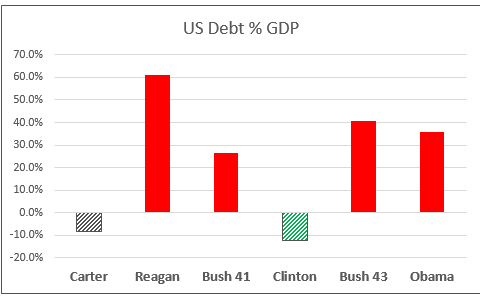
TurtleneckJordan:  “Let’s look at this bar chart.  It’s the same data as the line chart but formatted differently.  The bars represent the relative increase in debt as a percent of GDP for every president since Carter.  The height of the bar represents how much more debt as a percent GDP was there at the end of an administration compared to debt at the beginning of an administration.”

Drone Man:  “Before we go farther, what’s this ‘relative increase’ stuff you’re talking about?  Another way of distorting the truth?”

Jordan:  “Drone Man, do you think I would lie to you?”

Drone Man:  “No, but I just want to make sure I understand.  Gelly, tell me what he’s talking about.  I can understand you.”

pie-with-motherGelly:  “Think of ‘relative increase’ like this.  Your mother makes a pie.  You and your brother each get a slice that equals 25%, or ¼ of the pie.  Then your brother asks for more and your mother gives him another slice, another ¼ of the pie.  You object.  Your mother says she only gave him another 25% or ¼ of the pie, and for you to be quiet.”

Drone Man:  “She’s wrong.  He didn’t get just 25% more.  He got twice as much as I did.  He got 100% more than I did.”

Gelly:  “Now you understand the term ‘relative increase.’  Your brother’s relative increase was not 25% but 100%.”
16-12-10-bar-char-debt-gdp-by-president


Drone Man:  “Ok. I got it.  Thanks Gelly.  Back to your bar chart.  If I’m reading the first bar correctly, under Carter debt as a percent of GDP declined.”

Gelly:  “That’s correct.”

Drone Man:  “Then under Reagan, the relative increase in debt as a percent of GDP was about 60%.  You said that before but I didn’t believe it.”

Jordan:  “If you add Bush 41 to Reagan and compare against when Reagan took office, then debt went up more than 100%.  You can’t just add up the bars since you have to compare end of Bush 41 against end of Carter’s term.”

Drone Man:  “Why hasn’t anyone ever told me this?  I’ve always been lead to believe that Reagan was a fiscal conservative.  He spent money like a drunken sailor.”

Gelly:  “Careful.  My nephew is a sailor.”

Drone Man:  “Look at the Clinton years.  Debt went down.  Under Bush 43 it shot up again.  Why?”

Jordan:  “Bush implemented tax cuts biased toward higher incomes.  The tax cuts didn’t help middle and lower-income families and the economy really didn’t grow fast enough to offset the loss in revenue from tax cuts.  Now you know why professional economists keep saying that trickle-down economics doesn’t work.  Bush 41 called it ‘voodoo economics.’  I think of trickle 3-card-montedown, or supply-side economics, more as a 3-card money game.  You think you should win but only the shills win.  You always seem to lose.”

Drone Man:  “This chart is awful!”

Jordan:  “What’s awful about it, Drone Man?”

Drone Man:  “I’ve been bamboozled all these years.  Are you sure these numbers are right?”

Jordan:  “Yep.”

Drone Man:  “OK, then I confess.  I’ve been wrong a long time about the Republicans’ economic policy.   Tax cuts concentrated at the top aren’t the silver bullet for economic growth.”

Gelly:  “Want a refill Drone Man?

Drone Man:  “No I gotta go and get back to my niece’s tour group.  I hate to say this, guys, but thanks for the lesson in economics.  And the lesson for me — no more Republican 3-card monte games.”

(To be continued)

#229 Post Revenge Revolution: Lessons Learned – Economic Policy Fundamentals: Taxes (Part 5)

04 Sunday Dec 2016

Posted by Jordan Abel in Economics, Federal Budget, Gov't Policy, Lessons of Revolution

≈ 2 Comments

First-time readers, the dialogue in this blog is set in the future (sometime after the year 2020).  Each entry assumes there has been a 5th revolution in the US — the Revenge Revolution.  More about Revenge Revolution and author, Entry #1.  List and general description of entries to date.  Annual assessment whether Revolution plausible.

Note: most characters appear in a number of entries, with many entries building on previous conversations.  Profile of characters.  You’ll catch on quickly.  Thanks for your time and interest…and comments.

Scene: Jordan’s office, Washington, DC, start of work day.  (Conversation starts Entry #225)

Jordan:  “Gelly, whenever you’re ready let’s continue the discussions about lessons learned from the Revenge Revolution.  We’re supposed to talk about economic policy.”

092615_2031_Characters7.gifGelly:  “We can start as soon as a friend of yours arrives.”

Jordan:  “What? Friend visiting?  There are no meetings scheduled now.”

Gelly:  “Drone Man just called and asked if he could stop by.  He should be by shortly.  Is that OK?”

Jordan:  “Of course.  Besides, he and I have periodic conversations about economic policy.  Interested to see if he’s changed his position since the Revenge Revolution.”

Gelly:  “Speaking of Mr. Drone Man.”

Drone Man:  “Gelly, Jordan, nice to see you.”

Jordan:  “Nice to see you Drone Man.  What brings you to the DC, or the Swamp as the Trumpsters called it?”

TrumpDrone Man:  “Probably still a swamp, even after Trump.  I’m here because my granddaughter had a field trip to Washington and she wanted me to be a chaperone.  I’ve got a couple of free hours and thought it might be fun to stop by and chat.”

Jordan:  “Your timing is perfect.  Gelly and I have been discussing lessons learned from the Revenge Revolution.  Next on the list is economic policy — taxes.”

Drone Man:  “May I participate?  I’ll try to be polite.”

Gelly:  “So, Jordan, you were going to explain some of the fundamentals of good economic policy, starting with taxes.”

Drone Man:  “Gelly, all you need to know about economic policy is two words.  You don’t need to know anything else.  The two words are ‘tax cuts.’”

Jordan:  “Forever the Trumpster, despite all that went wrong under that administration.  Let’s take Drone Man’s two-word policy and see if it works.”

drone-manDrone Man:  “Of course tax cuts work.  Tax cuts always work.  Talking to you liberals is so frustrating.  Why don’t you admit we’re right!”

Gelly:  “Oh boys, I thought this was supposed to be a civilized conversation.”

Jordan:  “You’re right Gelly.  Here’s the premise for why tax cuts supposedly work.  The tax rate on the wealthiest in the US is too high.  By lowering the tax rate, the wealthiest will invest more money and create jobs for those with middle and lower incomes.”

Gelly:  “You mean like the benefits of tax cuts for the rich somehow trickle down to the rest of us?”

voodoo-2015958Jordan:  “Yes, that’s the theory.  It’s also what Bush 41 called voodoo economics.”

Drone Man:  “Cut the editorializing and keep to the theory, please.”

Jordan:  “The added investment associated with the tax cuts would create more jobs, which in turn would create more taxes and the added taxes from the middle and lower-income families would more than offset tax cuts for the wealthier. Did I explain the theory about right Drone Man?”

Drone Man:  “Close enough.”

Confused Clip ArtGelly:  “I have what’s probably a really dumb question.”

Jordan:  “I’m sure the question is not dumb.  Fire away.”

Gelly:  “Once taxes are cut, then the wealthy people are supposed to invest the extra money.  But where do they invest it?”

Drone Man:  “More factories to make more goods.  They hire more people.  That’s where all the extra jobs come from…and then the extra tax revenue flows back to the government.  It’s so easy to understand.”

Gelly:  “Here’s what I don’t understand.  If middle and lower-income people only have a little bit more money to spend…or maybe no more money to spend after the tax cuts…then who’s going to buy all the extra products the new factories make?”

TurtleneckJordan:  “Good question.  How ‘bout that Drone Man?”

Drone Man:  “What’s not to understand?”

Gelly:  “Let me ask the question this way.  Drone Man, if you owned a business, under what conditions would you invest and expand the business?”

Drone Man:  “I’d expand when I thought demand for the company’s products was going to exceed production capacity.”

Gelly:  “Would you expand if customers could not afford to buy more of your products?”

Drone Man:  “Of course not.  That would be stupid.  The idea of ‘build it and they will come’ only happens in the movies.  What was the name of that movie about some baseball diamond in a cornfield?”

field-of-dreamsGelly:  “You mean ‘Field of Dreams’?”

Drone Man:  “That’s the one.  ‘Field of Dreams.’  No business can operate like that.”

Gelly:  “Jordon also mentioned ‘Field of Dreams’ to me.”

Drone Man:  “At least we agree on something.”

Gelly:  “If I understand both of you correctly, business owners, even if they have more personal income…say through a tax cut…aren’t going to expand their business unless…”

Drone Man:  “…unless demand is going to increase and outstrip capacity.  Why can’t you guys understand this?”

Gelly:  “Then why would a tax cut that disproportionately favors the wealthy cause these owners to make more…what do the accountants call it, capital investments?  Why wouldn’t the business owners just put the money in the bank or Used Car royalty-free-car-salesman-clipart-illustration-443283the stock market?  Tell me what I’m missing?”

Jordan:  “Now Drone Man, tell Gelly what’s wrong with her logic?”

Drone Man:  “OK, so the wealthy probably won’t increase capital spending and instead purchase bonds or stocks.”

Gelly:  “Here’s another dumb question.  Why wouldn’t putting more money in the pockets of middle and lower-income families create more demand than giving more money to the wealthy?  It seems logical the lower and middle-income people would spend most of the extra money.  Then the additional spending would create extra demand and allow the wealthy business owners to build money-in-pocketmore factories…and make even more money?”

Jordan:  “Gelly, how much someone spends of an extra dollar received is called the marginal propensity to consume, or MPC.”

Gelly:  “You said to remember the letters MPC.  So I assume this MPC, or marginal propensity to consume, is higher for lower and middle-income families?  If someone who doesn’t have much money gets $1,000, they’ll spend most of it.  To someone who’s rich, $1,000 is probably a rounding error and they won’t spend it, right?”

Jordan:  “You got it.  Now Drone Man, what about Gelly’s analysis?  Wouldn’t the Wall Street Signeconomy be better off if the tax cuts or government spending were directed at people who would spend the money and help the economy grow rather than people who will put the money in stocks or bonds?”

Drone Man:  “OK Gelly, you’re right…I mean you might be right.  I mean, no you’re not right.  Tax cuts for the wealthy have proved to be a way to sustain growth in the economy.”

Jordan:  “Really?  You have some hard evidence?”

ronald_reaganDrone Man:  “Look at what Reagan did.  He cut taxes and the economy grew.”

Jordan:  “What if I said Clinton raised taxes and the economy grew even more?  Plus there was a budget surplus under Clinton and a huge deficit under Reagan.  In fact under Reagan…and Bush 41/43… growth in the deficit as a percent of GDP was proportionately much higher than under Obama.  In fact, under the so-called fiscally conservative Reagan-like Republicans, the debt as a percent of GDP increased more than 150%.  The increase would have been much higher if Clinton hadn’t had a budget surplus and lowered debt as a percent of GDP.  Here, let me dig out a chart and show you.”

Drone Man:  “I don’t need to see your phony chart based on made-up data.  You have your facts, I have mine.”

Jordan:  “Excuse me, Drone Man?  You’re claiming data about the deficit and GDP are fabricated?  You think the there are multiple sets of economic data?”

Drone Man:  “What I know is what I know…and I know I’m right.  I don’t need some liberals so-called economic data.  It’s always biased.  Why did I stop by here?”

(To be continued)
#217 Trade Agreements Cost Jobs! But Why? (Part 4 of 4)

11 Sunday Sep 2016

Posted by Jordan Abel in Back Asswards Thinking, Economics

≈ Leave a comment

First-time readers, this blog is set in the future (sometime after the year 2020).  Each entry assumes there has been a 5th revolution in the US — the Revenge Revolution.  More about Revenge Revolution and author, Entry #1.  List and general description of entries to date.  Annual assessment whether Revolution plausible.

Note: most characters appear in a number of entries, with many entries building on previous conversations.  Profile of characters.  You’ll catch on quickly.  Thanks for your time and interest…and comments.

Scene: Jordan’s Office, on phone with nephew of long-time friend.  Nephew is taking advanced economics course and been assigned paper to determine if  trade agreements cost US workers jobs.  Conversation begins Entry #214.

Jordan:  “Billy, you asked if automation might be costing jobs in the service industry.  What do you think?”

Billy:  “I’ve never really thought about it.  All the hype in the 2016 presidential election student clip_art_free_-_school_clip_art_free_20121124_1951589029was on manufacturing jobs.  I don’t remember much talk at all about service jobs.”

Jordan:  “That’s because many jobs in the service are not affected by trade agreements.  As we talked about, if you want to stay in a hotel in Manhattan, a hotel in Cancun is of no value, no matter how inexpensive it is.”

Billy:  “Where should we start?”

Jordan:  “We’ll look at some general categories of service sector jobs.  Let’s start with bofa-logobanking.”

Billy:  “As best I can tell, automation and the internet have been responsible for a major loss in banking jobs.  You know, the only time I’ve been in a bank is with my grandparents.  Other than needing some cash now and then, which I can actually get at the grocery store, why do I need a bank?  If people need a bank, put it in the grocery store.”

Jordan:  “What about safe-deposit boxes for valuables – jewelry, old coins, pictures, important papers?  That kind of stuff.”

multi-story_self_storage_buildingBilly:  “People store furniture and other items in self-storage units.  Why couldn’t you have a self-storage unit of safe-deposit boxes?  Most of those self-storage places are open 24×7…and banks sure aren’t.  You could make the place as secure as a bank.”

Jordan:  “What about the food service industry?  We know most jobs are unaffected by trade agreements…but what about automation?”

panerakiosksBilly:  “Lots of places…at least the ones I go to…have an iPad-like device on the table for ordering.  In most places, people still bring your food but there aren’t many servers around.”

Jordan:  “What about automation in the kitchen?”

Billy:  “I see more automation all the time, especially at fast food places.  And you know what?  I think the quality is more consistent and overall, the food tastes better.”

fedex_logoJordan:  “What about delivery services – pizza, FedEx, UPS, even the Post Office?  How much has automation affected employment?”

Billy:  “From what I understand, a lot.  Most of the automation is in areas we don’t see – back office stuff.  Also, a lot of drivers are being eliminated by self-driving vehicles.  Again, those are in areas we don’t see – one warehouse to another.  The deliveries in the neighbor are still by humans…but who knows how long that will last.”

TurtleneckJordan:  “Two more categories and then we’ll call it a wrap.”

Billy:  “OK, you’ve really got me thinking.”

Jordan:  “What about skilled trades – carpenters, plumbers, electricians, brick layers?”

Billy:  “Did you know another uncle has a construction company?  Mostly new residential.”

Jordan:  “No, tell me more.”

construction_clipart_houseBilly:  “When I was 7 or 8 years old, he used to take me to the job sites to watch homes being built.  Lots of people hammering, sawing, installing stuff.  People everywhere.”

Jordan:  “You still go?”

Billy:  “I did this past summer and wow, what a change.”

Jordan:  “What’s so different?”

Billy:  “Most all the heavy-duty construction is done in a factory.  The job site is more like assembling Lego’s.  He’s even got robot installing lots of bricks.”

Jordan:  “Where are all the skilled trades?”

modular-home-assembly-and-construction-on-siteBilly:  “Some skilled trades are in the factory to make sure everything installed correctly and a few at the job site for final hook-up.  But a lot of skilled trades have been replaced by machines at the factory and workers with fewer skills.”

Jordan:  “But none of the people replaced by robots or constructing in a factory were the result of trade agreements, right?”

Billy:  “All affected by automation.  What’s the final category?”

Jordan:  “There are many more industry categories we could address – medicine, legal, auto technicians, for example – but I want you to think about the effect of trade agreements on software development.”

brick-wall-square-hiBilly:  “Well, it’s really hard to put a wall around electrons.  I suppose you could put some sort of tariff on software development.”

Jordan:  “Any ideas how?”

Billy:  “Not really.  Companies could develop software and then put on servers in another country.  People in the US could easily access software and their files though the cloud.  I just don’t know.”

Jordan:  “Billy, what’s your conclusion now?  Do trade agreements affect employment in the US?”

Billy:  “Some.  The real culprit seems to be innovation.  And innovation is going to occur with or without a trade agreement.”

Jordan:  “What about trying to bring jobs like it used to be in America?”

Billy:  “You mean like the Trump slogan from 2016, ‘Make America Great Again’?”

Jordan:  “Possible or not?”

running_stick_man_clip_art_22430Billy:  “One thing is for certain.  If you try to recreate a by-gone era, it’s guaranteed the rest of the world will run past and the US will fall behind.”

Jordan:  “Now you have the foundation for your paper.  Countries should try to make sure the playing field is reasonably level for any trade agreement.  However…”

Billy:  “…thinking one can recreate the past and avoid being realistic about the impact of technology on jobs is fool hearty.  Right?”

(End of segment on trade agreements.  I know there’s more to cover but enough for now.)

#216 Trade Agreements Cost Jobs! But Why? (Part 3)

04 Sunday Sep 2016

Posted by Jordan Abel in Causes of the Revolution, Corporate Policy, Economics, Gov't Policy

≈ Leave a comment

First-time readers, this blog is set in the future (sometime after the year 2020).  Each entry assumes there has been a 5th revolution in the US — the Revenge Revolution.  More about Revenge Revolution and author, Entry #1.  List and general description of entries to date.  Annual assessment whether Revolution plausible.

Note: most characters appear in a number of entries, with many entries building on previous conversations.  Profile of characters.  You’ll catch on quickly.  Thanks for your time and interest…and comments.

Scene: Jordan’s Office, on phone with nephew of long-time friend.  Nephew is taking advanced economics course and been assigned paper to determine if  trade agreements cost US workers jobs.  Conversation begins Entry #214.

Jordan:  “Billy, I’ve got my coffee refilled.  Back to the question, ‘Do trade agreements cause job losses for US workers?’  For now focus on manufacturing jobs.”

student clip_art_free_-_school_clip_art_free_20121124_1951589029Billy:  “I suppose it depends on what expertise each country has.”

Jordan:  “Give me an example.”

Billy:  “If a country has much lower labor cost, then high labor-content jobs might move to the new country…assuming the skills were there.”

Jordan:  “OK, I’ll buy that argument.  What about jobs where labor content is low?”

Billy:  “Then there’s no reason any jobs should be lost.  Why would you move to a different country if labor content in the US plant is low?  That makes no sense.”

TurtleneckJordan:  “What about moving jobs if the labor cost in the new country is lower but the delivery times are longer and other logistics issues are more complicated?”

Billy:  “That might make sense.  If I were the US company, I’d have to decide if responding to customer orders more quickly was more important than savings a few bucks.  I suppose if you’re making Popsicle sticks that are all the same, cost per stick becomes more important.  However, I think for many products turnaround time and responding the customer requests are more important than a few dollars saved.”

Jordan:  “You mean if you were selling products like clothing, furniture, cars?  Stuff like that?”

t-shirtBilly:  “For clothing it’s probably OK to source overseas generic items like T-shirts, underwear and some other articles that rarely change – maybe some standard jeans, for example.  But for products that are more subject to fashion changes, I’d want to have assembly as close to the marketplace as I could.”

Jordan:  “What about automotive products — cars and trucks?”

Billy:  “If I ran an auto company, I’d want at least some cars and trucks assembled in the US.”

Jordan:  “Seems as if the most of the foreign auto companies agree with you.”

Billy:  “Never thought about how many foreign auto companies have assembly Honda Logo 1plants in the US.  Let’s see, Toyota, Nissan, Honda, BMW, and Hyundai…even Mercedes.    I’d also want key components assembled in the US.  Look what happened to the Japanese auto companies after the earthquake and tsunami in Japan in what 2011 or 2012.  The Japanese auto companies had to cut way back on production until they could find another supplier before resuming production.  Then they had to air freight some of the parts to keep the assembly lines operating.  Talk about expensive.”

Jordan:  “What else do you think is different about auto plants…in fact most manufacturing plants…than 25-30 years ago, and especially 40-50 years ago?”

Billy:  “Not sure what you mean.  I wasn’t around then.”

Selectric_IIJordan:  “Here’s another way to think about it.  Do you know how to use a typewriter?”

Billy:  “I know how to type…but you know what?  I don’t think I’ve ever seen a typewriter, other than photographs in books and in old movies.”

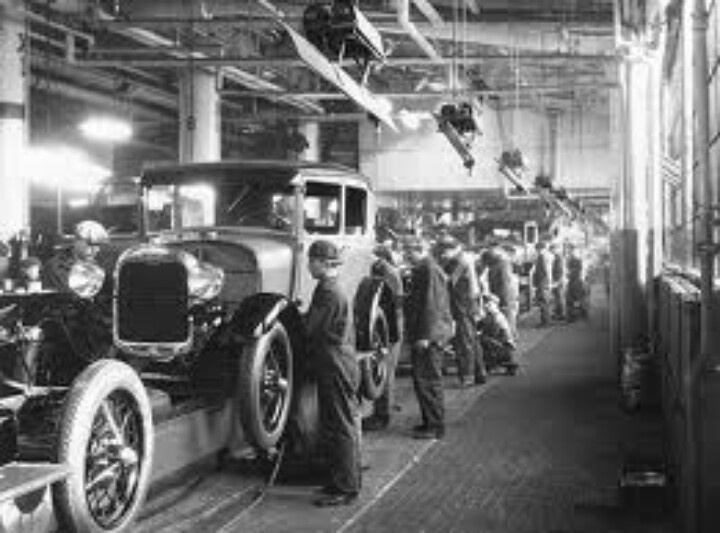
Jordan:  “Ever seen a picture of an old auto assembly plant?”

Assembly Line 3Billy:  “Yeah, lots of people working on an assembly line.”

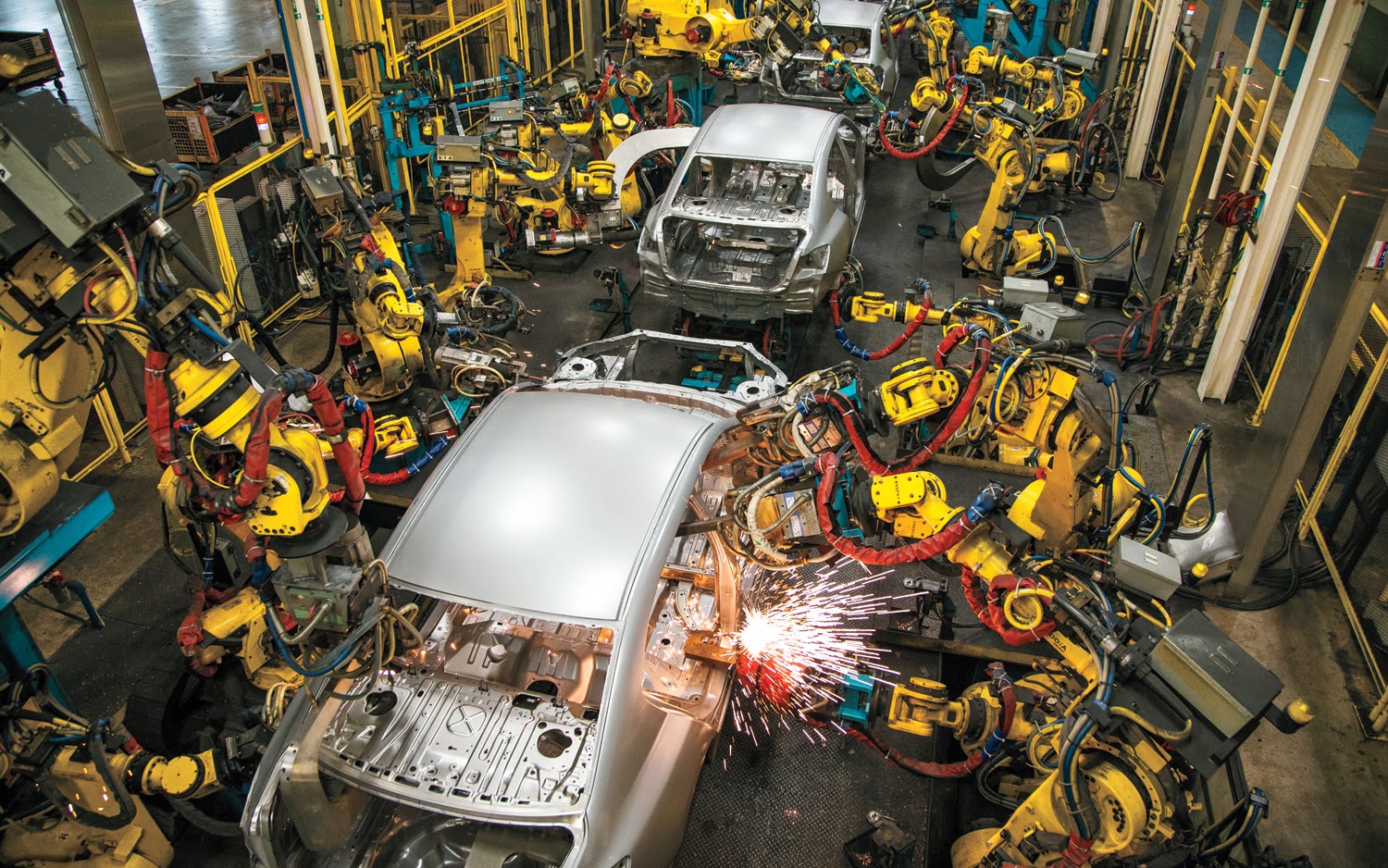
Jordan:  “Have you seen a picture of a modern auto assembly plant?”

Billy:  “Seems as if no one is around.  Most everything is assembled by a robot.  The few people who are around seem to be watching the robots.”

Honda-of-America-Manufacturing-assembly-lineJordan:  “Now do you understand my question about what’s different from 25-30 years ago?”

Billy:  “You mean much of the labor content in putting together cars and trucks has disappeared.”

Jordan:  “With that in mind, now what do you think about the argument by some politicians that countries with which we have trade agreements have stolen many US jobs?”

Billy:  “The jobs in automotive…and probably most manufacturing jobs…were not lost to Mexico or China or wherever…but lost to automation.”

Jordan:  “Claiming jobs were lost because of trade agreements makes for good donald-trump10-second sound bites.  And, yes, some jobs were lost.  But the decline in manufacturing jobs and the decline in jobs requiring say high-school or some college have been lost to automation, not trade agreements.”   

Billy:  “My paper needs to explain that while some jobs in certain industries can be lost due to trade agreements, many of the job losses, in fact possibly most of the job losses in manufacturing, are due to adaptation and implementation of technology.”

Jordan:  “So far we’ve talked about manufacturing jobs.  What about the service sector?”

Billy:  “You know, I don’t think I’ve heard a politician talk about whether trade 75% Pie chartagreements affect jobs in the service sector.  From what I’ve studied so far in economics, the service section is a much greater percentage of GDP than manufacturing.  In terms of employment service sector accounts for about 70.0% of all jobs.”

Jordan:  “Good guess.  It’s a bit higher — 75.0%+.”

Billy:  “Then why don’t politicians talk about the service sector?  Why just manufacturing jobs when they talk trade agreements?”

Jordan:  “Because many service-sector jobs…not all but many…cannot be exported.”

Billy:  “So politicians focus on the sound bite, not the substance.”

Jordan:  “I’m not discounting the importance of manufacturing jobs.  I’m a big 352596-waldorf-astoriabeliever of a very strong manufacturing sector.  But the fact is, service jobs dominate the economy.  If you want to stay in a hotel in Manhattan, you cannot export your stay to a hotel in Cancun.  The hotel, staff, food service all have to be in Manhattan.”

Billy:  “What about the effect of automation on service sector jobs, like what happened to jobs in manufacturing?”

Jordan:  “Great question, Billy.  We’ll talk about that next.  I think many people are in for a big surprise.”

(Continued)     

#215 Trade Agreements Cost Jobs! But Why? (Part 2)

27 Saturday Aug 2016

Posted by Jordan Abel in Back Asswards Thinking, Economics, Gov't Policy

≈ Leave a comment

First-time readers, this blog is set in the future (sometime after the year 2020).  Each entry assumes there has been a 5th revolution in the US — the Revenge Revolution.  More about Revenge Revolution and author, Entry #1.  List and general description of entries to date.  Annual assessment whether Revolution plausible.

Note: most characters appear in a number of entries, with many entries building on previous conversations.  Profile of characters.  You’ll catch on quickly.  Thanks for your time and interest…and comments.

Scene: Jordan’s Office, on phone with nephew of long-time friend.  Nephew is taking advanced economics course and been assigned paper to determine if  trade agreements cost US workers jobs.  Conversation begins Entry #214.

092615_2031_Characters7.gifGelly: (answering in-bound call) “Mr. Abel’s office.  May I help you?”

Caller:  “My name is Billy Belleville.  I believe Mr. Abel talked to my aunt.  I also left a voice mail yesterday that I would call back.”

Gelly:  “Yes, Mr. Belleville, we’ve been expecting your call.  And, FYI, please call Mr. Abel, ‘Jordan.’  I know you’ve had good upbringing, but this is a business call.  I’ll patch you through.”

student clip_art_free_-_school_clip_art_free_20121124_1951589029Billy:  “Thanks.”

Gelly:  “Jordan, Billy Belleville is on line #2.”

Jordan:  “Billy, thanks for calling again.  My apologies for having to leave a voice mail yesterday.  Gelly and I were both out of the office.  How may I help you?”

Billy:  “Did my aunt tell you about my assignment?”

Jordan:  “I have some idea but why don’t you assume I know nothing and start over.”

professor4Billy:  “I’m taking an advanced economics class this semester.  A major portion of the grade is a paper to determine if trade agreements help, hurt or have minimal impact on US employment.”

Jordan:  “Any other instructions?”

Billy:  “Not about the problem.”

Jordan:  “Interesting topic.  I like that your professor kept the instructions vague.  Welcome to the real world.”

Billy:  “I was hoping you could give me some guidance.”

TurtleneckJordan:  “Glad to try.  My first question is, ‘What do you think the impact of trade agreements is on US employment – positive, negative or neutral?’”

Billy:  “I really don’t know.  There seems to be a significant difference of opinion in Washington.”

Jordan:  “What have you heard?”

Billy:  “I remember the 2016 presidential election.  Donald Trump kept saying that trade agreements were bad for US workers.  He also said if elected, he donald-trumpwould tear up the agreements and renegotiate them in favor of the US.”

Jordan:  “So based on Trump logic, you’d conclude that trade agreements are bad, right?”

Billy:  “Yes, but that makes no sense.  I mean, why would the US enter into all these agreements if the agreements are always bad?”

Jordan:  “Welcome to Washington hyperbole.  Just for fun let’s discount the figure-thinking-hiDonald’s logic and assume for a minute that maybe not all trade agreements are bad.  What do you think trade agreements are supposed to do?”

Billy:  “Trade agreements should make it easier for two countries, or even a block or countries, to trade with one another.”

Jordan:  “Good fundamental answer.  I would add that ideally the countries involved in the trade agreement have different skill sets or capabilities.”

Billy:  “So, if we take the US, since we’re a very efficient producer of many agricultural products – corn, soybeans and wheat, for example – the US should seek out countries that might need these products but have some products the US doesn’t produce or where the US cost is too high.  Is that right?”

Jordan:  “Yes.  Now let’s take a trade agreement that is in place and see what naftaeach country could or should bring to the table.  Let’s take NAFTA – the North American Free Trade Agreement that includes Canada, the United States and Mexico.  Let’s start with Canada – what does it bring to the table?”

Billy:  “Agriculture, especially wheat, fish products, manufacturing and lots of minerals and timber products.”

Jordan:  “What about the US?”

Billy:  “Agriculture – as I said corn, wheat, soybeans…and I think even rice.  Huge manufacturing base, although a lot fewer people today that say 40-50 years ago.  Lots of oil and gas.  Many minerals – although not as much as Canada, and software, if that counts.”

Jordan:  “Software counts.  What about Mexico?”

Billy:  “Maybe not fair, but I think Mexico as very limited manufacturing, except Mexican Flagon the Rio Grande border, not much agriculture for export.  I guess mostly tourist locations.  Lots of lower-cost labor.”

Jordan:  “What you described for Mexico is a huge untapped market for goods produced in the US and Canada.”

Billy:  “But don’t the Mexican people need more income to buy the goods.  Don’t they need higher-paying jobs?  They just can’t go buy on credit if they don’t have money to pay it back.”

Jordan:  “Where are those jobs going to come from?”

Billy:  “According to what Trump kept saying, the jobs were coming from US workers.  If not US workers – or Canadian workers — where do they come from?”

Jordan:  “The better question is, ‘How can trade agreements create jobs in both countries and…notice I said both countries.  Or for NAFTA, create jobs in all three countries’?”

Billy:  “I understand your question.  For jobs to be created in one country doesn’t that mean jobs are lost in the other country, or countries.  Is that right?”

Jordan:  “Trade between countries is not a zero-sum game.  Trade agreements should create job opportunities.”

RantBilly:  “Then why did Trump and some other politicians keep ranting that trade agreements are bad for the US?”

Jordan:  “I want to add one more issue to think about…and then we’re going to take a short break.  Why are politicians who oppose trade agreements with other countries not opposed to one state in the US recruiting companies from another state?  Such recruiting, especially by southern states, includes huge taxpayer-funded incentives.  Why should North Carolina use taxpayer money to recruit companies located in say Buffalo, Cleveland, Detroit, New York City?  Allowing states to use taxpayer funds to recruit companies in other states is worse that zero-sum, it’s negative.  Think about that issue over the break.”

(Continued)      

#214 Trade Agreements Cost Jobs! But Why? (Part 1)

21 Sunday Aug 2016

Posted by Jordan Abel in Back Asswards Thinking, Causes of the Revolution, Economics, Gov't Policy, Societal Issues

≈ 3 Comments

First-time readers, this blog is set in the future (sometime after the year 2020).  Each entry assumes there has been a 5th revolution in the US — the Revenge Revolution.  More about Revenge Revolution and author, Entry #1.  List and general description of entries to date.  Annual assessment whether Revolution plausible.

Note: most characters appear in a number of entries, with many entries building on previous conversations.  Profile of characters.  You’ll catch on quickly.  Thanks for your time and interest…and comments.

Scene: Jordan’s Washington, DC Office

092615_2031_Characters7.gifGelly:  “Jordan, Ms is on the phone and would like to talk to you.”

Jordan:  “Really?  What’s she want to talk what?”

Gelly:  “Some question about trade agreements and the impact on American jobs.”

Jordan:  “OK, thanks.”  (Jordan picks up phone.)  “Mr. Abel here.  How may I help you?”

Womens symbolMs:  “Cut the formality, Jordan.  How are you?  Been a while since we chatted.” 

Jordan:  “Agreed it has been too long.  I’m doing OK.  More importantly, how you doing?  You survive the floods in Louisiana?”

Ms:  “Floods were south of here.  I’ve got a lot of friends in that area.  Most of them have lived down there for a long time and never experienced a flood.  But not this time.  Really bad damage.  Awful.”

TurtleneckJordan:  “Sorry to hear about your friends.  But are you OK?”

Ms:  “Just had another check-up and everything looks fine…thankfully.”

Jordan:  “Great.  Now, really why the call?”

Ms:  “My nephew is in college and taking some advanced economics course.  On the first day the professor assigned everyone a paper to analyze and decide whether US trade agreements are good, bad or neutral for US employment.”

DrakeJordan:  “And he thought you might have a contact that could help him?”

Ms:  “He knew for sure that I couldn’t help him.  What does a motorcycle riding aunt know about trade agreements and employment?”

Jordan:  “You never know.”

Ms:  “So what do I tell him?  Can you help?”

Jordan:  “I’ll try.  What’s his name?”

Ms:  “Beaufort Belleville.”

student clip_art_free_-_school_clip_art_free_20121124_1951589029Jordan:  “You kidding me?  Beaufort Belleville.  What kind of name is that?”

Ms:  “You know some old-line southern families use surnames of close relatives for first names of children.  Anyway, he goes by Billy, so please don’t call him Beaufort.”

Jordan:  “Glad to talk to Billy.  Have him call me Wednesday or Thursday this week, if possible.  I’ll give Gelly a heads up about the call.”

Ms:  “Thanks Jordan.  He’ll appreciate it…and I will to.”

Jordan:  “Let’s have dinner next time you’re at the farm up here or when I’m down your way, OK?”

Ms:   “OK, but remember it’s your turn to buy.”

Jordan:  “Alright, I’ll buy.  Take care.”   

#187 Protecting National Security with Domestic Oil (Part #11)

02 Wednesday Mar 2016

Posted by Jordan Abel in Economics, Federal Budget, Societal Issues

≈ Leave a comment

First-time readers, this blog is set in the future (sometime after the year 2020).  Each entry assumes there has been a 5th revolution in the US — the Revenge Revolution.  More about Revenge Revolution and author, Entry #1.  List and general description of entries to date.  Annual assessment whether Revolution plausible.

Note: most characters appear in a number of entries, with many entries building on previous conversations.  Profile of characters.  You’ll catch on quickly.  Thanks for your time and interest…and comments. 

Scene: Jordan still in Charlotte while recovering from prostate surgery. Earlier Jordan and POTUS began conversation about rebuilding US manufacturing and the middle class. Series starts #177; conversation with POTUS, #179.

Jordan: (Phone rings) “Jordan Abel.”

021214_1242_24Resultsof1.gifPOTUS: “Jordan, POTUS. Sorry to bother you. Gotta couple of minutes?”

Jordan: “Absolutely, Mr. President.”

POTUS: “Good. I read your email on reconfiguring US manufacturing. Like the positioning – to make US smarter and more competitive. Forwarded the email to the staff for review and comments.”

TurtleneckJordan: “What else may I help with?”

POTUS: “Oil and gas production.”

Jordan: “In what way?”

POTUS: “The US has spent many years and billions of dollars trying to increase domestic oil production and free ourselves from OPEC. Now, OPEC continues to pump oil and deflate prices. As a result a bunch of US oil companies are ready to declare bankruptcy. They’re upside down on the cost of production for many oil and gas fields and running out of cash.”

oil-clip-art-2589801-illustration-of-oil-rigJordan: “So, the concern is if these companies go BK and US production declines, then the country will again become more dependent on OPEC.”

POTUS: “Exactly. Long-term we can solve the problem with other energy sources but long-term is 25-30 years. I’m looking for ideas how to balance national security and ensure domestic oil and gas production continues, even if oil is $30-35/bbl.”

Jordan: “One approach – and I know this will create angst with certain Republicans – is a national oil tax.”

POTUS: “How much and used for what?”

Tax CutsJordan: “Tax would be enough to bring oil up to at least $60/bbl immediately and $100/bbl longer term.”

POTUS: “That’s a big tax.”

Jordan: “Yes, but recall oil was $140 sometime in what CY2014 and then near $100 for a number of months after. And what happened to the economy? It continued to grow.”

POTUS: “OK, so let’s say we target $100 as the long-term price. Now what do we use the tax revenues for?”

metro-north1Jordan: “Two primary uses. #1 is the email your staff is reviewing — reconfiguring US manufacturing and infrastructure to become more competitive and spur economic growth. The country has lots of highways, railroads, airports and waterways to fix…plus we need to expand high-speed internet. And #2 is…”

POTUS: “…don’t tell me, subsidize the cost of oil and gas production?”

Jordan: “You got it.”

POTUS: “Subsidizing oil companies is such bad PR. No one likes oil companies other than people in Texas and Oklahoma…and some conservative groups. You feeling OK?”

Jordan: “I feel fine and yes, I know all the crap that’s going to fly. But the cost of funding of drilling and operating a new well can easily exceed $50/bbl. People forget the land owner gets 20-25% right off the top. States are not shy about taxing oil and gas production. Plus, you have to transport the stuff to a refinery.”

POTUS: “Point well taken. I’m not shedding tears for the oil companies but we’ve got to keep the US free from OPEC.”

Jordan: “There’s a bunch of oil available in the US. I’ll bet the amount of oil available on shore – not off shore – is 5x what’s been produced so far.”

PigsPOTUS: “That’s encouraging to hear. I know the drilling cost can be high but somehow we need to control the subsidies. We don’t want to oil companies thinking they’re at an ‘all-you-can-eat’ feeding trough.”

Jordan: “If we cap the market price at $100/bbl and limit imports, then the oil companies will have an incentive to continue to find new oil. We also need to encourage the companies to use newer technology for exploration and production.”

POTUS: “Like what?”

questionJordan: “First step would be more integration of software, updated drilling techniques and electronic sensors. Based on my thimbleful of knowledge of the oil and gas industry, they need to think more about how to incorporate newer technologies.”

POTUS: “So the companies that incorporate more technology to find oil…and to minimize environmental damage…would become the winners.”

Jordan: “Call it a ‘modified’ free market. But a market that encourages responsible production and reaps the benefits of lower cost.”

POTUS: “What about developing alternative energy – wind and solar?”

Jordan: “Both of those sources are free and independent of any foreign source. Some of the incentive dollars – oil-tax dollars – should be directed at solar and wind.”

POTUS: “I can hear the Republican protests now. ‘More government subsidies.'”

Jordan: “Maybe it’s time you had a heart-to-heart talk with the American people about fdr_~Fdrwho’s really getting subsidies. You know, an updated version of FDR’s fireside chat.”

POTUS: “Like explaining subsidies to defense contractors, followed closely by farmers. You mean like that?”

Jordan: “I’m not suggesting we stop such subsidies. What people need to understand is why such subsidies exist and how much the subsidies really cost.”

POTUS: “Defense contractors and farmers are needed for national security.”

Jordan: “And so is energy production needed for national security. To make the idea of subsidies more palatable, why not create an institute of technology…but one that’s focused on energy production.”

POTUS: “An institute of technology. (Laughing) Just don’t name the institute of technology for Texas or Sam Houston. People in Washington would have a field day with those acronyms.”

Jordan: “Those names would be funny. I’m certain your staff guys can come up with a good name.”

POTUS: “Let me think about your idea. I’ve got yet another meeting I’m off to. By the way, Jordan, are you back in town soon? We need to sit down away from the maddening crowd and have coffee.”

Jordan: “Should be back in a couple of weeks.”

POTUS: “Good. Let me know when and we can meet. Thanks for your time.”

Jordan: “You’re welcome Mr. President.”

#179 POTUS Calls re Rebuilding US Manufacturing Base, Middle Class (Part #3)

10 Sunday Jan 2016

Posted by Jordan Abel in Corporate Policy, Economics, Education Issues, Gov't Policy, Possible Solutions, Societal Issues

≈ 8 Comments

First-time readers, this blog is set in the future (sometime after the year 2020).  Each entry assumes there has been a 5th revolution in the US — the Revenge Revolution.  More about Revenge Revolution and author, Entry #1.  List and general description of entries to date.  Annual assessment whether Revolution plausible.

Note: most characters appear in a number of entries, with many entries building on previous conversations.  Profile of characters.  You’ll catch on quickly.  Thanks for your time and interest…and comments. 

Scene: Jordan’s office. Regular work day.

Gelly (Jordan’s assistant): “Jordan, sorry to interrupt you but I think you might want 092615_2031_Characters7.gifto take this call.”

Jordan: “Anyone important?”

Gelly: “Try POTUS. He’s calling you personally.”

Jordan: “Oops. Thanks. (Picking up phone.) Good morning, Mr. President.”

POTUS: “Morning, Jordan. Hope all is well with you. Have a nice holiday break?”

Jordan: “Yes, thank you. Had a chance to visit my wife’s family.”

021214_1242_24Resultsof1.gifPOTUS: “That’s what I understand. And don’t ask how I know.”

Jordan: “I know better than to ask.”

POTUS: “Calling to see what you learned on the trip. I can’t really get out and visit with people like you can. What’s up out in the heartland?”

PilotLogoJordan: “One of our stops…really one of my stops…was a truck stop in Central Illinois. Had an interesting chat with a fellow diner.”

POTUS: “Was it productive or the usual politics?”

Jordan: “Very insightful. The guy…his nickname is Doughman…talked about companies Pillsbury-Doughboymoving manufacturing jobs out of the US and relocating in Mexico or China. He just could not understand why we would want to gut the middle class in this country by shipping jobs elsewhere.”

POTUS: “What’d you tell him?”

Jordan: “I could not tell him much he didn’t already know.”

POTUS: “You mean like crazy tax laws that benefit CEO’s and other executives by moving jobs outside the US? And those laws really transfer wealth of the middle class to the executives and to the other country.”

TurtleneckJordan: “Tax laws are part of it. So are the negative perceptions of unions and a few other issues. But…”

POTUS: “…but what? Have you got a solution?”

Jordan: “The solution, at least to me, seems to be more education about why manufacturing in the US can be as profitable, if not more profitable, than manufacturing overseas.”

POTUS: “What about fixing the tax laws, increasing training for workers…ideas like that.”

factory_07Jordan: “Tax laws are out of whack and need to get fixed. But the real problem, I think, is American companies do not understand total costs…or maybe don’t know how to calculate total costs. As a result, they focus on individual components…like wages…and miss the big picture.”

POTUS: “Sort of like some of these yahoo politicians focusing on one part of the problem in the Middle East and pretending the related problems don’t matter. So, OK Swami, what are we going to do about rebuilding the manufacturing base…and rebuilding the middle class?”

swamiJordan: “First step is to find some examples of companies that have expanded US-based operations rather than shipping jobs overseas. We can have them talk about what issues they considered in the decision.”

POTUS: “OK, then what?”

Jordan: “We need to reach out to other CEO’s and CFO’s (chief financial officers) and educate them why it can be cheaper to manufacture in the US. The conversation needs teacherto focus on all costs, not just labor costs.”

POTUS: “That’s a big job. Who are going to get to be the spokesperson? Might need several people.”

Jordan: “The most credible would be CEO’s and CFO’s of companies that have either expanded in the US or brought operations back.”

POTUS: “What about some consumers? Some folks really prefer to buy US-made product.”

Jordan: “Good idea. And maybe you can use the bully pulpit to help persuade some companies to focus more on US manufacturing.”

walmart_logoPOTUS: “You mean like Wal-Mart. Sam Walton must be turning over in his grave. Wal-Mart went from US-made products to “Made in China” for just about everything.”

Jordan: “Wal-Mart might be more receptive than we think about returning to US-made products. They’re struggling.”

POTUS: “Any bully pulpit effort needs to be very quiet and behind the scenes. Can’t give countries the impression I don’t support free trade.”

Jordan: “The naysayers are going to argue that China offers lower costs and therefore that helps the middle class.”

POTUS: “You sound like some politician.”

Jordan: “Should I wave my arms and raise my voice as well? Actually the argument might be true for some items. But when the people who used to buy your goods are out of a job and have no money, what does a lower price do for them? They still can’t afford it.”

POTUS: “Hasn’t much of the price decline for a lot of products been due to technology and not labor cost per se?”

bingo-607633Jordan: “Bingo. And that’s the core argument with the CEO’s and CFO’s. Cheap labor doesn’t matter for many products. Technology has reduced labor content to a much smaller percent of total cost.”

POTUS: “Not sure this is the right example, but your old stomping ground – the auto industry – has reduced labor costs, right?”

Jordan: “Yes. Over the last say 25 years, labor hours per car have decreased dramatically.”

POTUS: “Just thought of another point we need to emphasize. If labor costs in the US are so high, why have so many of the foreign car manufacturers set up assembly plants here?”

Jordan: “Duh. Think those companies might understand the value of manufacturing in the US better than many US companies do?”

questions_answers_5POTUS: “OK, so we’ve identified a problem – the middle class is shrinking; and we’ve identified a partial solution – rebuild US manufacturing base; and we’ve identified a way to get started – educating CEO’s and CFO’s about how to calculate total cost….”

Jordan: “…and educating the public.”

POTUS: “Jordan, I buy the argument and the base solution. We’ve had the Revenge Revolution, which should make people more receptive.  Now, how do we really get started?”

Jordan:  “Want to talk now?”

POTUS:  “Can’t.  Have a cabinet meeting.  I’ll get back to you.”

(Continued)

#152 Real Tax Burden (Part 2 of 2)

15 Saturday Aug 2015

Posted by Jordan Abel in Causes of the Revolution, Economics, Gov't Policy, Societal Issues

≈ Leave a comment

For first-time readers, this blog is set in the future (sometime after 2020).  This entry assumes the Revenge Revolution has occurred.  For more information about the anticipated 5th revolution in the US — the Revenge Revolution — and more background about the author, Entry #1.  One another note: almost all characters appear in a number of entries, with many entries building on previous conversations.  You’ll catch on quickly.  Thanks for your time and interest…and comments. 

Scene: Jordan and Greenie, a friend who went to the same grammar school, having coffee. Greenie asked Jordan to explain the tax burden on individuals…in simple terms. Jordan just asked Greenie to guess at the total tax burden as percent of income by quintile. Conversation starts #151.

Greenie: “OK, so how’d I do? Was I close?”

Jordan: “Very good. Here’s a chart I pulled up while you were guessing.”

(http://www.washingtonpost.com/blogs/wonkblog/wp/2012/09/19/heres-why-the-47-percent-argument-is-an-abuse-of-tax-data)

010414_1635_16TeachingS2.jpgGreenie: “Could you please explain this chart to me?

Jordan: “Why don’t you explain it to me?”

Greenie: “OK, the left bar is labeled 0-20, which I take means the 20% of people with the lowest income – the first quintile.”

Jordan: “Correct.”

Greenie: “That group – the 0-20% group – pays about 17.5% of their total income in some form of tax. We don’t know if its income tax, or sales tax…or whatever the tax…just that about 17.5% goes for taxes.”

Jordan: “What’s next?”

Greenie: “The tax burden for the next three groups, or quintiles – 20-40%, 40-60%, 60-80%, increases gradually to what about 27-28% for the 60-80% group.”

TurtleneckJordan: “What about the highest income group?”

Greenie: “Seems to hover around 30%. And look, for the top 1%, it starts to fall off. Did I read the chart correctly?”

Jordan: “Like a pro.”

Greenie: “My guesses were pretty close. OK, so maybe I got lucky. But all I did was think about it logically. I know income taxes are progressive but almost all other taxes are flat or regressive, so the tax burden is more even than a lot of people think.”

Jordan: “Because most people only talk about income taxes and not total taxes. Besides, you used a phrase that seems to be overlooked in DC – ‘think about it logically.'”

Greenie: “There’s still no logical thinking…even after the Revenge Revolution?”

Jordan: “You tell me. Republicans are still promoting a flat tax. A flat tax would make the share of taxes go down by income quintile. Do Republicans think voters don’t understand what a flat tax does?

Screwed-GuyGreenie: “I’d be a little more diplomatic. I’d ask how long before lower and middle-income voters realize how Republicans are trying to screw them…again.”

Jordan: “You call that statement more diplomatic? Anyway, some Republicans have forgotten…or hope voters have forgotten…what proposals pushed ordinary people over the edge and started the Revenge Revolution.”

Greenie: “You spend a lot of time inside the beltway. Do you have any insight into how Republicans think? That’s assuming they really think.”

Jordan: “Be nice.”

Greenie: “Alright…but just for a little while.”

Jordan: “A few days ago I was invited to play golf with the former Speaker of the House and the former Senate Majority Leader.”

Greenie: “Fun day, huh? Who did you offend? Sorry.”

Jordan: “It was an interesting day. We had some frank discussions about the Republican Party and why they lost their base during the Revenge Revolution.”

Greenie: “Did they listen?  I suppose they want to get their old jobs back.”

Jordan: “Yes, I think so.”

Greenie: “Can you tell me anything else?”

Jordan: “Not really. Promised I would keep the conversation very quiet.  I can tell you to give these guys some time to get their act together and then start to turn around the Republican Party.”

Greenie: “You mean Republicans might become rational again…and not so far off in the math_rational_numbersweeds?”

Jordan: “No guarantee, but they just might.”

Greenie: “There is hope after all.”

#151 The Real Tax Burden – Not What You Think (Part 1)

12 Wednesday Aug 2015

Posted by Jordan Abel in Economics, Federal Budget, Gov't Policy

≈ 2 Comments

For first-time readers, this blog is set in the future (sometime after 2020).  This entry assumes the Revenge Revolution has occurred.  For more information about the anticipated 5th revolution in the US — the Revenge Revolution — and more background about the author, Entry #1.  One another note: almost all characters appear in a number of entries, with many entries building on previous conversations.  You’ll catch on quickly.  Thanks for your time and interest…and comments. 

Scene: Jordan having coffee with Greenie, a friend who attended the same grammar school.

Greenie: “Jordan, it’s been a while. I think the last time we had coffee was with JC.”

Jordan: “That was months ago. How ya’ doing?”

010414_1635_16TeachingS2.jpgGreenie: “Getting back into circulation. Had some tough times. You know, family issues. By the way, thanks for the note.”

Jordan: “You’re welcome. Glad life is getting better.”

Greenie: “Moving on, I need some advice.”

Jordan: “From me?”

Greenie: “I need to understand some economic issues. Nothing personal.”

Jordan: “I’m not good at personal advice. And some people in Washington don’t like my professional advice.”

Greenie: “Well, I do. So there. What I really need to understand is taxes. What is the real tax burden?”

TurtleneckJordan: “In total or by income group?”

Greenie: “By income group. There’s a lot of babble inside the beltway about a flat income tax. Mostly among Republicans, but even some Democrats seem to support the idea.”

Jordan: “And what’s your concern? Flat tax seems fair, doesn’t it? Everyone pays the same percentage of income. What could be more fair?”

Greenie: “You sound like one of the talking heads on Fox News. The argument assumes that income tax is the only tax.”

Jordan: “You and I know it’s not the only tax…but focusing on income tax makes a great sound bite.”

checklistGreenie: “Coming in on the train I made a list of different kinds of taxes…and I probably missed some.”

Jordan: “What’s on your list?”

Greenie: “Income tax – federal, state and for some people, local income tax. Then there are taxes for Social Security and Medicare.”

Jordan: “Just to clarify, Social Security and Medicare are technically insurance programs but for this discussion, leave them as taxes.”

Greenie: “Don’t start confusing me. To me Social Security and Medicare are taxes. I also had on the list sales taxes, excise taxes – you know, your phone bill, property Tax_Time_Clip_Arttaxes, plus all those fees you have to pay for different things. Those seem like taxes to me.”

Jordan: “You mean like the fees you pay when you rent a car?”

Greenie: “Yes. I rented a car in Houston and taxes and fees were 30-35% of the total bill. That seems outrageous. Have I missed any taxes?”

Jordan: “Business taxes. Every year my consulting business has to pay a licensing fee to the state and then pay another fee to file an annual report. That’s on top of the income taxes.”

Greenie: “Speaking of licenses, what about the fee for license-plate renewal and what about the fee for renewing your driver’s license?”

Jordan: “Your list is a great start. We probably have the taxes that affect most people.”

Greenie: “Has anyone ever calculated how much of someone’s income all these taxes and fees account for? If you think about it, many of these taxes and fees might be more of a burden to lower-income groups. I wonder if taxes in the US are more regressive than progressive.”

Jordan: “Hold on. If I sound like a talking head on Fox News, then you sound like a screaming liberal.”

Greenie: “I’ll take that as a compliment.”

Jordan: “Yes, there are some estimates of tax burden by income quintile. Wanna take a guess at the percentages?

Greenie: “If I’m close will you buy me another coffee?”

Jordan: “Have as many refills as you want.”

Greenie: “You want my guesses or what the Republicans would say?”

Jordan: “First, pretend you are a Republican. I know it’s hard, but just pretend.”

flat tax cartoonGreenie: “Republicans would claim the top two quintiles pay most of the taxes. That’s why the system is unfair to higher-income earners and there should be a flat tax.”

Jordan: “The top two quintiles pay most of the taxes because…duh…they earn the most money. What about payment as a percent of income?”

Greenie: “I’ll bet for lower-income people, taxes as a percent of income are a lot higher than most people realize.”

Jordan: “Why? Give me an example.”

Greenie: “Property tax. The flat-tax crowd focuses on income tax. But if you rent, you still pay property taxes. Your rent is a bit higher every month…plus there is no deduction on your income tax.”

Confused Clip ArtJordan: “Alright, give me your guess – all taxes as a percent of income. Guess by income quartile…I mean quintile.”

Greenie: “Here goes. Lowest quintile, probably 15-20% of total income in taxes. The top dogs, maybe 25-30%. The rest of them someplace between. How’d I do?”

(To be continued)

← Older posts
Newer posts →

Subscribe

  • Entries (RSS)
  • Comments (RSS)

Archives

  • August 2025
  • July 2025
  • June 2025
  • May 2025
  • April 2025
  • March 2025
  • January 2025
  • December 2024
  • November 2024
  • September 2024
  • August 2024
  • July 2024
  • June 2024
  • May 2024
  • April 2024
  • March 2024
  • February 2024
  • January 2024
  • December 2023
  • November 2023
  • October 2023
  • September 2023
  • August 2023
  • July 2023
  • June 2023
  • May 2023
  • April 2023
  • March 2023
  • February 2023
  • January 2023
  • December 2022
  • November 2022
  • October 2022
  • September 2022
  • August 2022
  • July 2022
  • June 2022
  • May 2022
  • April 2022
  • March 2022
  • February 2022
  • January 2022
  • December 2021
  • November 2021
  • October 2021
  • September 2021
  • August 2021
  • July 2021
  • June 2021
  • May 2021
  • April 2021
  • March 2021
  • February 2021
  • January 2021
  • December 2020
  • November 2020
  • October 2020
  • September 2020
  • August 2020
  • July 2020
  • June 2020
  • May 2020
  • April 2020
  • March 2020
  • February 2020
  • January 2020
  • December 2019
  • November 2019
  • October 2019
  • September 2019
  • August 2019
  • July 2019
  • June 2019
  • May 2019
  • April 2019
  • March 2019
  • February 2019
  • January 2019
  • December 2018
  • November 2018
  • October 2018
  • September 2018
  • August 2018
  • July 2018
  • June 2018
  • May 2018
  • April 2018
  • March 2018
  • February 2018
  • January 2018
  • December 2017
  • November 2017
  • October 2017
  • September 2017
  • August 2017
  • July 2017
  • June 2017
  • May 2017
  • April 2017
  • March 2017
  • February 2017
  • January 2017
  • December 2016
  • November 2016
  • October 2016
  • September 2016
  • August 2016
  • July 2016
  • June 2016
  • May 2016
  • April 2016
  • March 2016
  • February 2016
  • January 2016
  • December 2015
  • November 2015
  • October 2015
  • September 2015
  • August 2015
  • July 2015
  • June 2015
  • May 2015
  • April 2015
  • March 2015
  • February 2015
  • January 2015
  • December 2014
  • November 2014
  • October 2014
  • September 2014
  • August 2014
  • July 2014
  • June 2014
  • May 2014
  • April 2014
  • March 2014
  • February 2014
  • January 2014
  • December 2013

Categories

  • Affordable Solutions
  • Back Asswards Thinking
  • Background
  • Background Stupid Is as Stupid Does
  • Benefits of Revolution
  • Causes of the Revolution
  • Common Sense Policies
  • Corporate Policy
  • Definitions
  • Diversions
  • Economics
  • Education Issues
  • Federal Budget
  • General Motors
  • Gov't Policy
  • Infrastructure & Fixed Fuel Prices
  • Innovative Thinking: Ideas and Products
  • Lessons of Revolution
  • Personal Stories
  • Possible Solutions
  • Post Trump Presidency
  • Rebranding Black Community
  • SCOTUS
  • Sense Check
  • Societal Issues
  • Stupid Is as Stupid Does
  • Tech Tsunami
  • Trump 47
  • Uncategorized

Meta

  • Create account
  • Log in

Create a free website or blog at WordPress.com.

Privacy & Cookies: This site uses cookies. By continuing to use this website, you agree to their use.
To find out more, including how to control cookies, see here: Cookie Policy
  • Subscribe Subscribed
    • usrevolution5
    • Join 32 other subscribers
    • Already have a WordPress.com account? Log in now.
    • usrevolution5
    • Subscribe Subscribed
    • Sign up
    • Log in
    • Report this content
    • View site in Reader
    • Manage subscriptions
    • Collapse this bar
 

Loading Comments...