• Home
  • Booklets/Grouped Entries
  • Tech Tsunami
  • List of Entries to Date
  • About the Author

usrevolution5

~ USA Headed for a 5th Revolution! Why?

usrevolution5

Category Archives: Gov’t Policy

#320 Personal Experience Developing AI and Implications for Skills and Employment

08 Tuesday Jan 2019

Posted by Jordan Abel in Education Issues, Gov't Policy, Societal Issues, Tech Tsunami

≈ 1 Comment

Readers: this blog is set in the future (sometime after the year 2020). Each entry assumes there has been a 5th revolution in the US — the Revenge Revolution. More about the Revenge Revolution and author, How the 5th US Revolution Begins and About the Author.  Many entries are formatted as conversations. Characters appear in a number of entries, with many entries building on previous conversations.  

Occasionally I do a “sense check” about the likelihood of a Revenge Revolution.  Entry #318 is the most recent “sense check.”  One more note — sometimes I write about another topic that does not quite fit the theme of the blog.  Those comments are available on the page titled “JRD Thoughts and Comments” as well as “Tech Tsunami”, which has more articles about how technology might affect US…and add a dimension to the Revenge Revolution.

Background to Technology Tsunami series focuses on how implementation of technology may change the family earnings structure in the US.

In “Technology Tsunami” (Entry #319) I noted that with the increased use of artificial intelligence, many current workers will need to increase skills in order to remain employed. But just what is artificial intelligence? And how can it be used? To make AI more concrete and less abstract, thought it might be interesting to allocate the next couple of entries to describing some personal experience developing AI and what happened as a result.today

First, let’s go back to define just what constitutes artificial intelligence, or AI? (Readers, please keep in mind this is not an article for an academic journal. The article is aimed at trying to help the general populace understand more about what AI is and how it might affect the workforce.)

The term “artificial intelligence,” which was first used in the 1950’s, seems to be applied to an ever-increasing range of computer-based applications.  Much of AI we hear about today has been developed by applying to very large data bases sophisticated multiple regressions (regressions look for an association between one action/word and another). The algorithms that result become the foundation for software to support an AI application. What has expanded the use of AI is the availability of very large databases and much more computing power.  However, as demonstrated by this example, a useful and effective AI program can be developed without an overly large database and/or staff.

A question associated with AI, “When AI is implemented, will people be replaced?” Yes, but people have always been replaced with the introduction of new technology. Farm hands were replaced by tractors and mechanical harvesting equipment. The printing press replaced scribes. The telegraph replaced the Pony Express. Trains replaced stage coaches. Cars replaced buggies…and endless other examples.

In the current wave of AI, the jobs that seem most vulnerable in the near-term are ones that involve repetition. Jobs where running a software program or using robot could perform most or all of the task. Such jobs might be assembling parts, loading/unloading shelves, providing certain types of information (clerks, including law clerks could be replaced by a more sophisticated Siri, for example), completing forms or completing some basic analysis (proof reading, financial analysis, etc.), steering vehicles and similar jobs.

The list of vulnerable jobs is quite lengthy and includes a considerable number of white-collar positions. For example, when General Motors announced in fall 2018 the intent to close five plants in the US/Canada, more white-collar workers were affected than assembly workers.

OK, how about a real-world example. In 1980…yes, that was many moons ago…I transferred to headquarters of Buick Division of General Motors. One of the staffs I managed was responsible for forecasting sales – short and long-term. The short-term forecast – 180 days – was used to set production schedules at assembly plants and suppliers.

When I arrived, the accuracy of the forecast was abysmal. Even though Buick had been in business about 75 years, it was not uncommon for forecast sales for the current month to miss actual sales by 30-40%…sometimes 50%. Such a variance made it extremely difficult to manage inventory. The forecast/actual discrepancies also caused frustrations with Buick dealers because arrival dates for cars ordered varied widely from the original schedule, which in turn frustrated customers.

To increase the accuracy of the forecast, we developed an application of AI. The AI-based forecast consisted of three key estimates: (i) industry sales; (ii) mix of sales by category – % small cars, % mid-size cars, % full-size, % SUV’s, etc. – within the industry; (iii) Buick % share within the general categories.

Unlike today, at the time most assembly plants were limited to a few models with little variation in size. Further, changing the production mix at an assembly plant could be time consuming and costly.

Buick’s solution to this dilemma (and common in the industry) was to “force” the dealers to take the mix of cars produced. Further, there was little recognition of differences in consumer preference by region of the country. Dealers in New England, where smaller cars were preferred, would end up with mix of small/large cars very similar to the dealers in say Texas, where larger cars were preferred. “Encouraging” dealers to take the production mix required the field staff to spend considerable time with the dealer and often involved some type of costly incentive – free financing, extra cash per car, etc. Dealers would then have to try to steer customers to these “unwanted” cars.

The solution to fixing the problem was conceptually simple: (i) a more accurate forecast; (ii) allowing dealers to order what cars they wanted. Improving the accuracy of the forecast was the critical first step. Doing so required building a math model that would predict more accurately upcoming changes in demand.

Previous sales forecasts had been based on changes in the rate of actual sales. Basing the forecast on “lagging indicators” – sales the past few months – is akin to trying to drive a car by looking only in the rearview mirror. Doing so reduces one’s speed and increases the chance of making a serious error. The previous method of forecasting was always “catching up” to changes in demand rather than being ahead of the curve.

Developing the AI model was remarkably easy – or so it seems now. We ran regressions of historical sales data for the industry as well as Buick. Fortunately, the auto companies had been reporting monthly sales for many years, so the data base was credible. The results of the regressions yielded useful, seasonal patterns. We also analyzed the shift in mix of sales over time. This helped determine if sales of smaller cars were increasing faster or slower than say mid-size or luxury cars. Another task was estimating how many people were switching from cars to what were then early-version SUV’s.

Finally, we had to determine Buick’s likely share of each category. At the time the overall car market was shifting to smaller cars. While Buick had competitive smaller car entries, it was more successful in larger cars. The effect of the shift in consumer preference was profound. Even though in a given month Buick could gain in market share in every major industry category compared to the previous year, that same month could show Buick’s overall share had declined compared to a year ago.   That phenomenon was always fun to try to explain. “Yes, we gained market share in every category…but, no we lost market share overall.”

Within about one year of starting the AI model, the US industry experienced a major economic downturn and vehicle sales took a nosedive. The AI model helped Buick management begin to make more informed decisions about setting production schedules and marketing plans. With the implementation of the AI-model, the accuracy of the forecast improved markedly. Rather than a variance of 30-40% between actual and forecast for a given month, the variance fell to less than 5%. The improvement helped smooth production schedules, reduce short-term layoffs and/or overtime at Buick and suppliers and made lead-times for deliveries to dealers much more accurate.

The increased forecast accuracy allowed Buick to migrate to what is called a “free-expression” forecast and production schedule. Dealers were allowed much more freedom to order the number and model of cars they wanted.

The decision to migrate to “free-expression” forecast/production caused great angst among staff members tied to the old “dealers-will-order-what-we-tell-them” system. In the end, however, most everyone became a convert because the overall production volume and mix were about what the dealers wanted.

Other benefits of the AI forecast model? The field staff was able to spend more time helping dealers with marketing programs, working on customer satisfaction and finding ways to improve profitability. The dealers then started to order more cars from Buick because the turnover rate improved. In the three-year period following implementation of the AI model, Buick increased market share more than any other manufacturer, domestic or foreign. While not all the gain in market share can be attributed to the AI model, the number of new products Buick introduced during the same period was limited, so most of the gain in market share came from “non-product” activities.

What happened to employment? Buick reduced the number of field offices from 26 to 20. Buick also started a call center to increase contact with dealers located outside urban areas. The non-urban dealers still received some personal visits, but less frequently.

Use of AI also changed the skills required of the office staff. To be effective in the new environment, staff members needed more skills in math, statistics, economics and marketing. If today’s computing power were available then, we could have cut the staff in half, possibly more. Even skills of and the number of senior managers would have been affected. At the retirement party of a key sales executive, who’d grown up in the days of gut-feel and seat-of-the-pants forecasts, the retiring executive told me – after several drinks – “I never understood what you were talking about, but I trusted you.” I appreciated the compliment but was a bit taken aback by the admission.

Does this example help us look ahead for what might happen when more AI is implemented? I think so. What did this rather simple application of artificial intelligence help Buick accomplish?

  • + Increased sales
  • + Increased market share
  • + Increased profits
  • + Increased customer satisfaction (dealer and buyer)
  • – Reduced employment
  • – Higher skills required of employees

If you’re a shareholder and/or your compensation is tied to profits, you will view the results of implementing the AI program as positive. If you’re an employee whose job was eliminated and/or you were unable to learn the additional skills required, you will view the AI program as negative.  The inherent conflict between perspectives, unless we quickly start to manage more effectively, will likely be another contributing factor to the Revenge Revolution.

(In the next entry, another real-world example of using AI – an early application of consumer profiling. While the profiling was not as sophisticated as done today by Google, Facebook, Amazon and many others, the effort allowed Buick to spend marketing dollars more effectively.  We’ll also address why it is important that the output of AI programs is understood and trusted. )


#319 Technology Tsunami Headed toward US Shores

01 Tuesday Jan 2019

Posted by Jordan Abel in Causes of the Revolution, Economics, Gov't Policy, Possible Solutions, Tech Tsunami

≈ 9 Comments

Readers: this blog is set in the future (sometime after the year 2020). Each entry assumes there has been a 5th revolution in the US — the Revenge Revolution. More about the Revenge Revolution and author, How the 5th US Revolution Begins and About the Author.  Many entries are formatted as conversations. Characters appear in a number of entries, with many entries building on previous conversations.  

Occasionally I do a “sense check” about the likelihood of a Revenge Revolution.  Entry #318 is the most recent “sense check.”  One more note — sometimes I write about another topic that does not quite fit the theme of the blog.  Those comments are available on the page titled “JRD Thoughts and Comments” as well as “Tech Tsunami”, which has more articles about how technology might affect US…and add a dimension to the Revenge Revolution.

Background to Technology Tsunami Series. Thought it might be worthwhile to take a break from all the craziness in Washington and discuss other issues that likely will contribute to the Revenge Revolution. A key issue that seems to be getting less attention than it deserves….maybe because of all the noise emanating from the Trump White House…is how the implementation of technology will change the family earnings structure in the US.

We’ve seen some of the changes already, with the reduction in manufacturing jobs and the stagnation of wages for a large segment of the population. In my view the changes so far are just a small taste of what is to come. The next several blog entries…and I don’t know how many at this point…will focus on what I’m labeling the coming “technology tsunami.” The first of the entries, which follows, is a bit long but tries to set the stage.

There are already numerous early warning signs of the tsunami. An example – the announcement by General Motors in November 2018 of its intent to close five (5) plants in North America. Another warning sign is a story in the New York Times about a robotic arm playing the piano. While a robot playing a piano may seem like a bit of a novelty, think about the implications. The more dexterous robots become, the more robots can perform tasks of people who are highly skilled. Robots in warehouses and welding or painting in cars/trucks are commonplace. Those tasks are fairly straight forward compared to cooking or performing surgery or a host of other tasks.

As noted in this entry, over the centuries societies have coped with implementation of new technologies. Some societies have adopted new technologies and succeeded; others did not adopt new technologies and fell behind.  An example — in 1910, GDP per capita in Argentina was about 80% of US GDP per capita.  By 2010, 100 years later, GDP per capita in Argentina had fallen to about 30% of US GDP per capita.

Adopting successfully is very difficult. There are a couple of interesting books about adopting new technologies that we’ll discuss in a later entry. For now let’s get started. As you read, keep in mind how the disruption caused by adopting new technologies might compound societal problems currently facing the US. Numerous factors point to another revolution in the US – the technology tsunami could accelerate the Revenge Revolution and make it worse. And, yes, Mrs. Lincoln, enjoy the play.

Entry Begins

After General Motors announced plans to close five (5) plants in North America (November 2018), I was asked by several friends and colleagues for my opinion of the merits of the decision. While I had no inside information, based on my experience at GM and additional analysis, I concluded GM made the correct decision and should be congratulated.

To explain my logic in more detail, I wrote a couple of informal articles and published links on Facebook. The articles included the term “technology tsunami,” which I thought might help explain some of GM’s rationale for closing the plants…and why GM’s decision might portend what’s ahead for other companies. (GM had additional reasons for the closings. Links to articles on Tech Tsunami page.)

Reaction to the term “technology tsunami” seemed to beg for more explanation. So, here goes. I selected the term “technology tsunami” because the characteristics of a tsunami seemed to be a good proxy for how the wave of artificial intelligence (AI), increased use of robots, implementation of the blockchain, and other technologies will affect employment in the US. The effect will not be limited to the manufacturing and some service sectors but include many white-collar professionals (GM, for example, laid off more salaried  white-collar staff, than hourly manufacturing workers.)

First let’s look at the sequence of a tsunami. The start is often an earthquake or volcanic eruption deep in the ocean. The energy from that quake is transferred in the form of a series of powerful ocean waves. In the open ocean, the change in the wave pattern caused by the earthquake is not necessarily apparent. To the naked eye, tsunami waves appear relatively normal.

The strength of the waves becomes more apparent as waves move closer to shore. As the waves start to come ashore, the waves are compressed. The more gradual the slope of the shoreline, the more compression.

And there is not just one wave that is compressed and hits the shore, but a series of waves. The waves are powerful and of such height that virtually everything at or near the shoreline is completely destroyed. The waves continue inland, causing significant damage. A tsunami usually is more powerful and destructive than the surge associated with a hurricane.

An usual characteristic of a tsunami is how it affects the waterline preceding its arrival. As the tsunami gets closer to shore, the water at shore’s edge recedes. The shoreline looks as if there is an exaggerated low tide. This phenomenon might last several minutes. Then, the waterline changes quickly and drastically as repeated high and powerful waves come ashore, destroying virtually everything.

With that picture in mind, let’s examine how a technology tsunami might affect employment in the US. In my view, the earthquake has already occurred that will cause the technology tsunami. The energy from that quake has been transferred to form of a series of large and destructive waves. And those waves are headed toward the US shore. Warning signs of the tsunami are becoming more evident at the shoreline as the waterline has begun receding.

The US shoreline is filled with people. Many at the shore still work in manufacturing and service industries. However, few at the shore seem to understand the implication of the receding water line and even fewer take action to avoid the pending disaster. As the waves roll closer to shore, the beach remains filled with people.

In the next few moments – for this analysis consider next “few moments” as next “few years” – the pending disaster becomes apparent. The waterline begins moving ashore rapidly as the first of a series of giant waves becomes visible. The people at the shore – those with limited education and skills – try to escape, but it is too late and waves overwhelm them.

The powerful waves continue inland, destroying many long-standing structures, once thought invincible. Much is lost and chaos ensues for those who survive.

Am I overreacting to the potential impact of a technology tsunami? Is a technology tsunami even possible? Or, as a couple of people have suggested, am I being like “Chicken Little”?

My concern about a technology tsunami has less to do with whether AI will become smarter than humans and more to do with the potential impact on the stability of society. How many lower-skilled, semi-skilled and even skilled blue and white-collar jobs will technology replace?

Trying to stop implementation of technology is foolhardy. Depending on when such a stop-technology approach was implemented, today we might be travelling by horse and buggy and living without electricity, telephones, tv/radio, computers, internet, etc.

And yes, I agree that societies have survived major technology disruptions in the past. But transitions to new technologies have rarely, if ever, been smooth. Even worse, countries that did not transition to new technologies became also-rans.

During the technology tsunami, what is likely to happen to societal stability in the US? How will people react who are replaced by technology? As middle-class jobs continue to be eliminated…and many new jobs are at lower pay, if available at all…will people sit idly by? (When formulating your answer don’t be misled by the unemployment rates in recent months. Look at constant-dollar median incomes over time compared to GDP per capital. Income has not kept up with productivity. Also significant wealth has transferred toward the very top. The longer-term trend is a much smaller middle class with less wealth accumulation.)

If a technology tsunami seems possible, then what are we…societal we…doing to prevent a likely social upheaval that follows the tsunami? As best I can tell, we are doing nothing of substance. Policies of the Trump Administration seem to be focused on preventing adoption and even overturning technology rather than planning how to manage the transition.

In a way, the logic for why we should prepare for a technology tsunami is similar to the logic of why we should make efforts to prevent further global warming. Who’s right about the cause of accelerated global warming does not matter. If global-warming deniers are correct and man has contributed virtually nothing to global warming, the consequences are the same…and the consequences are not good. By doing something, then there’s a chance to reduce the negative effects.

Since we have a good idea of the effect of a technology tsunami, how do we start preparing? Maybe the first step should be to look at the 1930’s. In response to widespread unemployment (at least 25%), reduced net worth among most families, and no clear prospect for an economic turnaround, FDR and Congress implemented programs to create jobs. Creating jobs had a twofold effect: (i) putting money into people’s pockets so they could begin buying again; (ii) allowing families to regain self-respect.

One can argue about the efficacy of specific New Deal programs. However, there should be little argument that these programs helped bring stability back to US society.

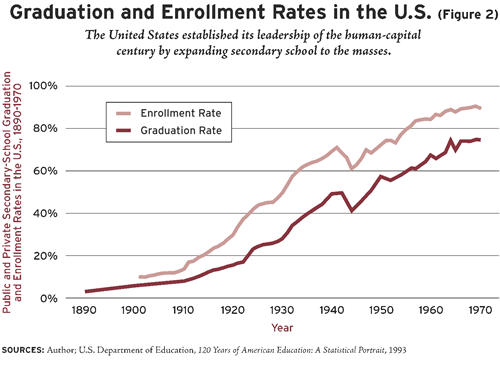
Part of the New Deal not often discussed is the effort to increase participation in public education. During the 1930’s, many grammar and high schools were built and students encouraged to complete high school.

The efforts resulted in a sharp increase in the percentage of the population graduating from high school. The increase in percent graduating from high school continued until the 1970’s when the rates plateaued.[1]

Emphasis on education continued after WWII with the GI Bill of Rights and then with availability of low-cost loans encouraging more students from lower- and middle-income families to attend college.

The lesson of these programs for today? Existing and emerging technologies require more math/analytical skills to utilize capabilities of the technologies. With the need for more math/analytic skills…and the risk of becoming an also-ran country by not adopting the technologies…what actions do we take? How does US society get more people educated, especially those on the shore unaware of the pending technology tsunami?

Following are some ideas. You’ll likely look at the list and say, “What’s so innovative about the list? I’ve heard these ideas before.” And, you’re right. The ideas are not new…but you know what? We’re not implementing them, and in some cases we seem to be regressing.

The list is intended to start the discussion:

  1. Help society understand that expenses for public education are investments, not merely costs. Investments may take time to payback but result in a benefit that spans generations.
  2. Increase pay for…and respect for teachers. Make the qualifications and salaries for teachers competitive with, and possibly slightly above, the private sector.
  3. Reinstitute more technical training in high schools. Almost everyone agrees not everyone is suited for college. Not attending college does not mean one does not have valuable skills. Far from it. The public schools should provide everyone an opportunity for training in how to use, leverage and maintain technology skills. At one time “technical training” was common in high schools. Time for it to return.
  4. Make loans for college affordable with a provision to “earn-out” the loan over a reasonable period. Unlike today, make compliance for the earn-out provision easy to understand and execute. Provide assistance to the participant – not everyone is an expert at filling out government paperwork. Encourage people to become teachers. Don’t discourage them with onerous penalties for slight mistakes in completing paperwork.
  5. Cut back, or eliminate private charter schools. Yes, all organizations need fixing over time. Public education is no exception. But charter schools are not necessary to fix problems in public education. Charter schools destroy the very foundation of public education…and operate with far less accountability. The trend toward charters needs to stop and charters eliminated.
  6. Create meaningful education programs for older workers. The claim by some that “I’m too old to learn” is an excuse, not a reason. My experience has been many older people are embarrassed to ask for help. When assistance is framed the right way, it is rare that someone turns down the opportunity to learn. We…again societal we…need to be flexible in how we approach teaching students, whether the student prospect is in grammar school or a grandparent.
  7. Implement meaningful education programs and works-skills programs in prisons. Incarceration is incredibly expensive. While different studies include different amounts for overhead and other costs, the least amount of cost per year to incarcerate someone is roughly the same as tuition, room and board at a state university. In many studies, the cost is multiples higher than tuition, room and board. Incarceration without rehabilitation is wasted money. Educating prisoners and having prisoners do meaningful work while incarcerated seems to be “common sense.”

How do we implement some of these ideas? More in the next article. Stay tuned.

[1] 120 Years of American Education: a Statistical Portrait, US Department of Education, 1993.

Links to articles re GM Plant Closings

  • JRD Reaction to GM’s Announced Plant Closings
  • GM Plant Closings Tsunami Canary

#318 Tipping Point on the Donald: Fingernails Are Too Long

23 Sunday Dec 2018

Posted by Jordan Abel in Causes of the Revolution, Gov't Policy, Sense Check

≈ 14 Comments

Readers: this blog is set in the future (sometime after the year 2020). Each entry assumes there has been a 5th revolution in the US — the Revenge Revolution. More about the Revenge Revolution and author, Entry #1.  Many entries are formatted as conversations. Characters appear in a number of entries, with many entries building on previous conversations.  

Occasionally I do a “sense check” about the likelihood of a Revenge Revolution.  Entry #318 is a “sense check.”  One more note — sometimes I write about another topic that does not quite fit the theme of the blog.  Those comments are in the page titled “JRD Thoughts and Comments.“

When I started this blog more than five (5) years ago, two guidelines I set were key: (i) avoid spending too much time on political or economic events occurring in the previous week or two; (ii) avoid overreacting to such events. Throughout writing the blog I’ve tried to keep such events in proper perspective and also tried to frame the events in the context of the underlying premise of the blog – sometime after 2020 the US would experience a 5th revolution, which I labeled the “Revenge Revolution.”

Trying to avoid overreacting is borne out by history. Revolutions seem to be caused by events over time. However, a few events during a short period of time, or even one event, can tip the scales, triggering the populace to say, “Enough, already. Throw the bum(s) out. Time for a change!”

Although we rarely think about it, such trigger points happen in our everyday lives. A simple example is one day you look at your fingernails and think they’re too long. And with that realization, most of us feel an urgent need to take action and file the nails. Obviously the fingernails didn’t grow all at once. The fingernails grew a little bit every day and then, suddenly, the fingernails seemed too long.

This phenomenon is described by the Theory of Just Noticeable Difference, (JND). While JND is usually applied to more physical measures – e.g., length of fingernails – the theory seems to apply to less tangible measures as well. For many people, Trump’s behavior the past couple of weeks has been akin to a “fingernails-too-long” moment.

Just why would people think that way? Let’s take a quick review of events of the past couple of weeks. The list is not necessarily in chronological order.

  1. Michael Cohen, long-time Trump lawyer and “fixer” of problems, was sentenced to three (3) years in prison for what the judge called a “veritable smorgasbord of criminal conduct.” Earlier in 2018 Cohen’s offices were raided by the FBI. Cohen eventually became a cooperating witness against Trump in investigations by Mueller and the Southern District of NY. A partial list of crimes by Cohen has been disclosed. One crime of public interest, although one that eventually might prove to be a “lesser” crime, was for payments made immediately preceding the election to two women with whom Trump had affairs. The payments were a violation of campaign laws.
  2. National Enquirer, owned by American Media, Inc. CEO, David Pecker, admitted working with Cohen to help squash negative news about Trump immediately preceding the election. AMI was funneling money to cover a payment to at least one of the women. AMI’s involvement violated campaign finance laws.
  3. Michael Flynn, former Marine Corps general and former National Security Advisor to Trump, was anticipating no jail time at his sentencing. The judge chose to ignore the recommendations of the Special Counsel and dressed down the general in the court proceeding, indicating Flynn would be smart to ask for a delay in sentencing and agree to continue cooperating with Special Counsel for the next six (6) months. Even then the judge told Flynn he was subject to incarceration. Flynn was selected by Trump over widespread objections of the intelligence community.
  4. Matthew Whittaker, Acting Attorney General, refused to recuse himself from any involvement in the Mueller probe. Whittaker, who had been a regular on Fox News criticizing the investigation before being appointed by Trump, was strongly encouraged by the Ethics Office to recuse himself. Whittaker ignored the advice. In addition, there is some question whether his appointment was legal and whether certain actions taken by Justice Department under his appointment would be legal. The nominee to become the permanent head of Justice has been equally critical of the Mueller investigation and appears to have been chosen for that reason.
  5. Ryan Zinke, head of Dep’t of Interior, resigned. Zinke is subject of at least five ongoing investigations for various crimes.
  6. Trump Foundation agreed to dissolve after a lawsuit by the State of New York Attorney General claiming “…shocking pattern of illegality.” Based on claims presented by the State AG, it appears Trump and several members of the Trump family could face significant civil fines and possible criminal indictments.
  7. John Kelly, Trump’s chief of staff and former Marine Corps general, was fired by Trump. Kelly’s replacement – Mick Mulvaney. Mulvaney, a former representative from South Carolina, is currently Director of Office of Management and Budget. Mulvaney supposedly will function as chief of staff and run OMB. The practical effect is Trump has no chief of staff to manage schedules or try to coordinate legislation with Congress. How long will Mulvaney last? Mulvaney once called Trump’s views on a border wall and immigration “simplistic” and “absurd and almost childish.” Mulvaney added a physical barrier would not stop undocumented immigrants from crossing the Mexican border and ranchers at the border say they don’t need a fence.
  8. James Mattis, former Marine Corps 4-star, resigned as head of Dep’t of Defense. For Mattis the “fingernails-too-long” moment was Trump not seeking advice of the military and intelligence community before announcing, via Twitter, that the US would withdraw troops from Syria and probably withdraw half the forces from Afghanistan. The arbitrary decision on Syria shocked people in the US military, Congress and US allies. Since DOD was established in 1947, Mattis is the first head to resign in protest. If you have not read the letter of resignation, please do so.     18 12 21 Mattis Letter of Resignation NYT
  9. Trump Administration lifted sanctions on a Russian oligarch, Oleg V. Deripaska, who has close ties to Putin and Manafort.
  10. Putin publically praised Trump for his decisions re Syria and lifting sanctions on the Russian oligarch. (Sort of makes you wonder whose camp Trump is in, doesn’t it?)
  11. Trump, in a highly unusual public meeting in the White House, attempted to negotiate with Senator Charles Schumer of NY (top Democrat in Senate) and Representative Nancy Pelosi (incoming Speaker of the House) about a budget resolution that would continue to fund the Federal government. During the negotiations, Trump demanded that $5.0 billion be included for part of Trump’s Mexican border wall. If the $5.0 billion were not included, Trump declared in front of rolling cameras that he would be “”proud to shut down the government for border security.” The Senate passed a bill that included additional funding for border security but not a wall. The House, still under Paul Ryan, passed a bill that included funding for a wall. The House bill then forced the bill back to the Senate which refused to fund the wall. Trump then flip-flopped and tried to blame Democrats for the subsequent shutdown what he claimed he would be “proud” to do.
  12. Trump, after claiming that he was responsible for gains in the stock market, then blamed the Federal Reserve chairman for causing the largest percentage loss in value in any December since 1931. To “correct the problem,” Trump indicated he would fire Federal Reserve Chairman Jerome Powell, whom Trump appointed earlier in 2018 after firing Janet Yeltin.

There are probably more events but these are the ones that came to mind…with no further research. Yikes!! Any one of these events would have been a major scandal in a “normal” administration.

What do these events mean for the likelihood of a Revenge Revolution? If we were living during the era of the Wild West, I’d say, “Add another notch to your gun.”

I’ve not conducted a survey that would be considered scientifically valid. However, after listening to a number of people on the left, center and right, I get the sense that many have reached a “fingernails-too-long” moment…and some corrective action needs to be taken. Interesting, even some on the far right seem frustrated, but maybe for a different reason. They might sense that adults could start taking back Washington.

One far-right person that I deal with (data points of one are dangerous except in Washington), suggested he would use armed force to defend his property against any government action. I had limited time and did not dig deeper into what he considered intrusive government action. Nor did I take time to remind him the only reason he can claim ownership of property is…well, because of the legal structure established by the government. I’ll explain that role of government to him on another day.

So where are we? Many people seem to think Trump is so out of control that he needs to be removed from office. And what does that attitude mean for the likelihood of a Revenge Revolution? When I started the blog in 2013, the chances of a Revenge Revolution by the early 2020’s were at the very most 50 (yes):50 (no). Over time the odds seemed to have increased gradually. Now the odds have increased to 75 (yes): 25 (no) – at a minimum. And, without much effort, I could be talked into raising the odds to 90 (yes): 10 (no). It is truly a scary time.

If you’d like to read more about how a Revenge Revolution might get started, take a look at Entries #1-#8. (E-book version of the entries, How the 5th US Revolution Begins and About the Author).  These were my initial blog entries. I recently reread and the entries seem OK. If you are interested in how Trump might be “taken out” – impeached or physically removed from office – try Entries #244-#257. For a PDF e-book, DOWNLOAD Who Took Out the Donald #244-#257. These entries were written in summer 2017. The general content still seems plausible.

Thanks for your time. Comments welcome.


#315 How Technology-Induced Disruptions Impact Societies (#4 in Series)

23 Friday Nov 2018

Posted by Jordan Abel in Economics, Gov't Policy, Societal Issues

≈ Leave a comment

Readers: this blog is set in the future (sometime after the year 2020). Each entry assumes there has been a 5th revolution in the US — the Revenge Revolution. More about the Revenge Revolution and author, Entry #1.  Most entries are formatted as conversations. Characters appear in a number of entries, with many entries building on previous conversations.

Occasionally I do a “sense check.”  Auditing one’s own work is problematic but I try to be objective.  Entries #300 and #301 are the most recent standard “sense checks.”   Entries (#310-#313) broke from conversation format.  

Scene: Jordan’s office, Washington, DC.  Continuing conversation with Gelly, Jordan’s assistant.  Conversation began Entry #308.

Jordan: “OK, Gelly, got my coffee refill. Ready to talk more about how societies cope with technology-induced disruptions?”

Gelly: “Yes, but as a reminder, keep it simple, please. I’m just trying to understand the basics. Not trying to become a PhD candidate.”

Jordan: “Not to worry. Besides, I’m not a PhD.”

092615_2031_Characters7.gifGelly: “Maybe not but you have lots of study time…and a bunch of experience in the real world using economics stuff. Remember, KISS, okay?”

Jordan: “Let’s go back and look at how artificial intelligence (AI) is being used. Another example is your iPhone. Ask Siri a question.”

Gelly: “Siri has artificial intelligence?  And I thought she lived in my iPhone. OK, ‘Hey, Siri, what was the score of last week’s Michigan-Indiana football game?’”

MichiganJordan: “When Siri tells you Michigan beat Indiana, that’s a form of AI.”

Gelly: “I understand that part…I think. Siri hears the question, does a quick search of available databases, finds the answer, and then repeats the score. That easy enough to understand. Not saying easy to make happen, just easy to understand.”

Jordan: “You’re right, not easy to make happen. Now ask Siri to tell you a joke.”

Confused Clip ArtGelly: “How does she do that?”

Jordan: “When the question is more abstract, like ‘Tell me a joke,’ it’s the same procedure as looking for the score of the football game. However, for more abstract questions, sometimes the answer is reasonable and sometimes the answer is off the wall. Remember that AI is more effective when parameters of the task are defined. The Michigan-Indiana score is quite specific. So is picking up boxes, which we talked about earlier. Accuracy of AI also improves as more information is added to the database and algorithms refined.”

PhoneGelly: “So for Siri, Alexa and their siblings, they’re best at providing quick access to available information. At the same time, the working stiffs most affected by Siri and siblings are people employed to provide information. The example might seem a bit  dated but as a kid I remember being able to pick up the phone and have the operator get someone’s number, right?”

Jordan: “Right. Another example is society’s need for newspapers. For a couple of centuries newspapers were a primary source of information for all kinds of activities. People used to buy a paper for say just the sports section. That need has changed. Siri just told you the score of the Michigan-Indiana game. And, if you wanted, you could get real-time updates on your smart phone. Even if the game is not broadcast in your viewing area, you can ge an app on your phone to watch the highlights of the game and a bunch of other games as well.”

Legal ClerkGelly: “What about AI replacing some functions of what lawyers do, or at least law clerks do? Same with some portion of information gathered when visiting a doctor. Seems as if a lot of people could be replaced, or maybe have been replaced already by some form of Siri and siblings. What about using AI for tasks that are a lot more complicated than say picking up boxes or searching a database?”

Jordan: “You mean like people who used to paint cars or weld frames or even lay bricks being replaced by robots?”

Gelly: “Yes, but also tasks that seems even more complicated…like sewing clothes. You might not appreciate it but there are lots of steps in sewing. Lots of turning fabric and moving it back-and-forth. Making even simple clothes requires a lot of steps and precise hand-eye coordination. It’s not easy.”

Sewing MachineJordan: “Well, some clothes are already being made 100% or nearly 100% by machines. And over time, machines will make clothes that require more steps.”

Gelly: “That’s what I still don’t understand. What does happen to all those people in low-cost countries that are making clothes? If they lose their jobs, what happens? By the way, has anyone ever studies what happened to all those telephone operators, or guys that were painting cars?”

Jordan: “Your concern is spot on. What does happen? Unfortunately, the people who are most negatively affected by a disruptive technology, AI or otherwise, have little or no recourse when their job is eliminated. If they’re lucky, some get a handshake and severance pay but in developing countries, these people are SOL.”

Poor PersonGelly: “Another case of the working stiff getting screwed?”

Jordan: “The key for the country is whether the leadership begins adopting new technology and creating new jobs. If not, the country will continue to fall behind.”

Gelly: “How often do these technology disruptions happen? Seems like much faster today.”

Jordan: “Faster today…maybe. But we forget some of the objects or equipment we consider mundane today were really technology disruptions when introduced.”

Gelly: “You mean like the printing press, telegraph, the tractor and combine?”

Jordan: “Think about what was introduced between say 1850-1950. Electricity, cars, planes, trains, repeating rifles, motion pictures, radio, television…and that list doesn’t include any medical advances. So whether change is faster now is debatable. But the same problem exists – what do you do with people replaced by technology?”

Gelly: “OK, what does happen to society? I remember you talking one time about Argentina and the US having roughly the same GDP per capita in 1900. Then 100 or so years later GDP per capita in the US was almost 4x Argentina.  Argentina fell way behind.”

TurtleneckJordan: “Excellent example. I’m impressed you remembered.”

Gelly: “Thank you. Now, what happens in these countries?”

Jordan: “Remember when we first started to talk about the patterns of revolutions in the US?”

Gelly: “You found that there was a pattern of a revolution roughly every 50 years.”

Jordan: “The word ‘roughly’ is the key. Major changes in societal behavior do not follow some precise timeline. People who want to develop a more predictive model are always disappointed in how squishy the approach is.”

Gelly: “There seems to be a reasonable pattern for revolutions. Is there some kind of pattern or technology disruptions?”

Jordan: “There seems to be but the problem is trying to figure out if and how other factors affect the cycle.”

dude-with-questionGelly: “Now I’m starting to get even more confused.  What happened to KISS…keep it simple, stupid?”

Jordan: “Let me say after technology moves out of the lab and first becomes commercially viable, there’s a period of very rapid growth in companies and countries that use the technology. After a while the growth associated with the technology slows and, eventually, the technology and companies mature and decline.”

Gelly: “OK, a new technology is introduced, companies grows fast, and then decline. How long is the cycle?”

Jordan: “Without any of these other interruptions, 50 years more or less like a reasonable number. Keep in mind, if the data about revolutions are squishy, data for technology cycles are really squishy. I think there’s a pattern but the timeline for that pattern likely varies.”

Gelly: “Have you got a couple of examples. What about the auto industry? You know a lot about that? What about computers?”

Jordan: “What about another break, then we’ll talk more. I promise to try to keep it simple. As I said, the data and cycles are a bit messy.”

(Continued)

#309 Can We Talk Economics? Do Tariffs Really Work…or Does the Working Stiff Get Screwed Again? (#2 in Series)

06 Saturday Oct 2018

Posted by Jordan Abel in Economics, Education Issues, Gov't Policy

≈ Leave a comment

Readers: this blog is set in the future (sometime after the year 2020). Each entry assumes there has been a 5th revolution in the US — the Revenge Revolution. More about the Revenge Revolution and author, Entry #1.  Most entries are formatted as conversations. Characters appear in a number of entries, with many entries building on previous conversations.

Occasionally I break from the normal formatting and do a “sense check.”  Auditing one’s own work is problematic but I try to be objective.  Entries #300 and #301 are the most recent “sense checks.”  Your thoughts are welcomed and appreciated.  Thanks for your time and interest…and comments, please.

Scene: Jordan’s office, Washington, DC, start of workday.  “Can We Talk about Economics” conversation began Entry #308.

092615_2031_Characters7.gif

Gelly: “Professor Jordan, now that you’ve had a break, ready to explain more economics?”

Jordan: “Professor, hardly, but yes, let’s continue. Any topic in particular?”

Gelly: “I’d like to know more about tariffs. I think I understand the concept but not sure how effective tariffs really are, especially for worker bees.”

Jordan: “OK, tell me your understanding of tariffs. Why would a country implement a tariff?”

Shaking HandsGelly: “First, let me make sure I understand the idea of trade between two countries. I get the part where one country might have stuff the other country needs, or makes some product more efficiently than the other country. That all seems logical. What also seems logical is that trade should be fair. Maybe I’m being naïve but shouldn’t trade between countries be like what we were all supposed to learn as kids…you know, treat your neighbor as you want to be treated?”

Jordan: “Gelly, how do you boil complex issues down to such basic ideas? You’re right, trade should be fair to both sides.”

Gelly: “Like most any relationship, sometimes trade probably gets out of whack and one country has an advantage that needs to be adjusted. Is that what tariffs are supposed to do? Provide a balance? Or maybe protect some industry or set of products?”

Jordan: “Yes, that’s the theory. However, for trade to work long-term, the industries being protected should be considered ‘critical’ for some legiimate strategic reason.”

Coffee Bean GuyGelly: “Critical such as growing and exporting coffee beans might be critical to the economy and welfare of the people of say Costa Rica? Coffee’s probably a big deal to Costa Rica but hardly of any importance to the US…other than maybe Hawaii.”

Jordan: “Right.  Because coffee has such a major impact on its economy, Costa Rica could add tariffs to any coffee imported from say Brazil or Columbia in order to protect its economy.”

Gelly: “I get that part.  Then what impact would a tariff have on exports from Costa Rica? People in Costa Rica can’t drink all the coffee grown there. If Costa Rica added tariffs to products imported from other countries…and those countries then added tariffs to Costa Rican coffee…wouldn’t that hurt exports? Tariffs seem like a two-edged sword to me.”

Poker PlayersJordan: “For countries with only a few products to export and where those products do not have much competition, tariffs might work. But, for most countries, tariffs are a high-risk poker game. While coffee can’t be grown in every country, in can be grown in many countries. Unless your country is a real big dog for that product or commodity, the country adding tariffs runs the risk of losing exports.”

Gelly: “For countries with lots of different kinds of products – Germany, Canada, China, the US – tariffs seem a lot more complicated.”

Jordan: “I said earlier you were becoming an economist. Keep talking.”

Gelly: “Isn’t trade between countries also affected by currency rates?”

Jordan: “Yes, but put currency rates aside for a few minutes. We’ll cover that later.”

Gelly: “OK, so if the US say claimed China was selling steel at too low a price, the US might put a tariff on steel made in China or goods produced with steel made in China. But what really happens after the tariff is implemented?”

CornJordan: “Well, for one thing, China can then decide to add tariffs to some goods imported in China from the US – say corn or soybeans, which is exactly what they did after Trump put tariffs on Chinese steel.”

Gelly: “Those tit-for-tat tariffs can go on for a long time. And what do they accomplish?”

Jordan: “Good question.  To answer your questions let’s look at what happened after Trump put tariffs on raw steel and aluminum from China…and Canada, of all places.”

Gelly: “Did the price of Chinese steel increase after the tariffs?”

Jordan: “Yes.”

Gelly: “Did American companies start selling more steel?”

Price IncreaseJordan: “Some but the US steel companies did what often happens in the US when tariffs are implemented – the US companies immediately raised prices.”

Gelly: “C’mon, how much could that increase really cost a company? Couldn’t have been that much, could it?”

Jordan: “Soon after the tariffs were announced, Ford said tariffs on steel and aluminum would increase their cost at least $1,000,000,000 per year. And that’s the cost to just one company.”

Gelly: “This might sound dumb but if a company’s costs keep going up, wouldn’t the company raise prices? For Ford, they would have to increase prices of cars and trucks, right?”

Jordan: “You got it.”

ScrewedGelly: “Then, unless I’m missing something, the tariffs really end up being a tax on consumers. The government might collect revenue from the tariffs but the consumer – the working stiffs – are the ones who gets screwed.”

Jordan: “Now, remember what happened to the corn and soybean farmer after Trump put tariffs on Chinese steel and then China retaliated?”

Gelly: “The Chinese didn’t stop consuming corn and soybeans…but the Chinese began buying corn and soybeans from other countries. So the tariffs caused US farmers to lose exports to a major market…and the same farmers ended up paying more for their tractor and pick-up truck. So why do tariffs like the ones Trump imposed seem so stupid?”

Confused Clip ArtJordan: “A lot Trump’s tariffs were head scratchers. In fairness, sometimes trade between countries does get out of whack. And tariffs can help resolve the issue. But tariffs are like a Band-Aid, for small wounds and to help only temporarily. There’s a better way to solve issues when trade gets out of whack…and a better way to manage trade.”

Gelly: “You mean like trade agreements? Agreements such as Nafta or whatever Trump tried to rename it?”

TurtleneckJordan: “Yes, trade agreements. The agreements usually include what you might call a trade court.  That court helps revolve issues and avoids tariffs.”

Gelly: “I’m interested in learning more but need to put this conversation on hold, please. I’ve got a conference call in a few minutes and need to get ready. Let’s continue later, OK?”

Jordan: “Deal.”

(Continued)

#299 Making America Great Again #9: Enforce Fair-Play Rules

30 Saturday Jun 2018

Posted by Jordan Abel in Common Sense Policies, Gov't Policy, Possible Solutions, Societal Issues

≈ Leave a comment

Readers: this blog is set in the future (sometime after the year 2020). Each entry assumes there has been a 5th revolution in the US — the Revenge Revolution. More about the Revenge Revolution and author, Entry #1. List and general description of entries to date.

Note: most entries are formatted as conversations. Characters appear in a number of entries, with many entries building on previous conversations. Profile of characters (see link at top of page). You’ll catch on quickly. Thanks for your time and interest…and comments.

Scene: Jordan’s office, Washington, DC. Conversation began Entry #289.

Jordan:  “OK, break’s over.  Any more thoughts on having Leviticus as the standard for behavior inside the Beltway?”

092615_2031_Characters1.jpgJC:  “Look, I like the idea of ‘treat thy neighbor as thyself’ as the standard for behavior.  But let’s not be naïve.  What do we do about those people who don’t follow the rules?”

Greenie:  “You mean like Trump and his gang?”

JC:  “Exactly.  Trump’s behavior pointed a flaw in the Constitution – the assumption that members of the Legislative and Executive branches would behave reasonably civilly.   And, with a few exceptions, that assumption proved correct for 200+ years.”

092615_2031_Characters12.gifGreenie:  “Until Trump.  Then he and his gang basically gave the finger to everyone.  He even trashed people in his cabinet who supported him from the get go.  Some display of appreciation and loyalty, huh?”

Jordan:  “So what can be done to stop Trump-like behavior in the future?  What do we recommend to the post-Revenge-Revolution Congress…assuming some of them are willing to listen.”

JC:  “Listen or not, we’ve still got to try.  Greenie, any ideas on how to enforce more civilized behavior?”

010414_1635_16TeachingS2.jpgGreenie:  “A start would be to reinstate the 60-vote rule in the Senate for approving appointments, whether for the agencies or the courts.  A 60-vote rule would force the White House to offer nominees toward the middle politically…not the extremes.”

JC:  “Good start.  We’d eliminate some bomb throwers from the courts and the agencies – like Trump’s Pruitt at EPA and Mulvaney as Budget Director and head of Consumer Protection.  Behavior of both was way out of line.  I mean, Pruitt and his quest for a used mattress from a Trump hotel.  That sounds almost kinky.”

JudgeJordan:  “On the Judicial side, even with the 60-vote rule, what about limiting tenure of Senate-approved judges?  Right now these judges have lifetime appointments.”

Greenie:  “Maybe there could be an appointment period – say 20 years – and then some way to renew the appointment.”

JC:  “I don’t have any idea what the average tenure of a Federal judge is but being on the bench without a review for 20 years seems more than fair.”

Greenie:  “Maybe add a clause about a renewal option.   Whadda say in the military when you agree to extend your time?”

TurtleneckJordan:  “Re-upping.”

Greenie:  “That’s it, re-upping.  Maybe the default is the judges re-up automatically unless reviewed and denied by the Senate.  But make the re-up period for 10 years, not 20 years.  Think about it – 30 years on the bench is a long time.”

JC:  “Would you apply the 30-year limit to all time spent on the Federal bench or a specific court?”

Jordan:  “The only judges that I think are approved by the Senate are for the Appellate, Circuit and Supreme Courts.”

supreme_court_buildingGreenie:  “I don’t know if the limit should be at the court level or in total.  For now, let’s assume the limit applies to a specific level.  Otherwise someone might get to SCOTUS with only 6-7 years left out of the 30-year limit.  That doesn’t seem fair.”

Jordan:  “What about rules for enforcing behavior in the agencies and in Congress, especially the Congressional committees.”

JC:  “Such as the Judicial Oversight Committee in the House?  During the Trump Administration, good ol’ boy Chairman Nunes took classified information from the Mueller investigation to the White House?  Some oversight, huh?  Tried to give the keys to the henhouse to the fox.”

PoliceGreenie:  “OK, Jordan, any ideas how to stop such behavior?  And what about all the obvious ethics violations by Trump, the Trump family and some cabinet officials?  How do we stop that going forward?”

Jordan:  “We need to be realistic.  Whatever the rule, someone is going to try and get around it.”

JC:  “You going to answer Greenie’s question or mumble like some politician?”

Jordan:  “I’m trying to buy time while I think of a good response.”

Greenie:  “What about this idea as a start?  The office of Ethics…or whatever it’s officially called…used to have some power and was respected by the Executive and Legislative branches…at least until Trump.  Why not give the office more teeth?”

Sharks TeethJC:  “More teeth and more transparency.  I realize there’s some information cannot be disclosed.  But, and this should be a big but…no comments, please about personal appearance…the baseline should be to make the public as aware as possible of the shenanigans and unethical behavior by people inside the government, especially members of Congress and high-ranking agency personnel.  The disclosures might force some people to stop.”

Greenie:  “For those who don’t stop, then give the Ethics Office the right to take them to court for a public trial.  No plea bargaining, no consent decree, no sealed documents or other copout.  Make the record public.”

Jordan:  “Court instead of impeachment?”

Judge with GavelGreenie:  “Make it in addition to impeachment.  Some of the behavior will be illegal.  Why shouldn’t that behavior get punished like the rest of us are subject to?”

Jordan:  “Theoretically the behavior is subject to punishment.”

Greenie:  “Two words you just stated are the problem – ‘theoretically’ and ‘subject.’  Too often the SOB’s in Congress or the Executive Branch who blatantly screw the public are given a slap on the wrist at worst, then sent home with most of their pilfered goodies.”

JC:  “You’re getting tough, Greenie.”

Greenie:  “We need to get tough on these bums.  Otherwise the Revenge Revolution will have been for naught…and I don’t like naught.”

JC:  “Agreed.  Now, ought naught we should take a break?”


#298: Making America Great Again, #8: Leviticus to the Rescue

24 Sunday Jun 2018

Posted by Jordan Abel in Common Sense Policies, Gov't Policy, Lessons of Revolution, Societal Issues

≈ Leave a comment

Readers: this blog is set in the future (sometime after the year 2020). Each entry assumes there has been a 5th revolution in the US — the Revenge Revolution. More about the Revenge Revolution and author, Entry #1. List and general description of entries to date.

Note: most entries are formatted as conversations. Characters appear in a number of entries, with many entries building on previous conversations. Profile of characters (see link at top of page). You’ll catch on quickly. Thanks for your time and interest…and comments.

Scene: Jordan’s office, Washington, DC. Conversation began Entry #289.

092615_2031_Characters2.jpgGreenie:  “I agree the president and cabinet need to pass the same end-of-year test given to 8th graders.  Let me add another, ‘Duh, are you serious?’ idea.”

JC:  “Ice cream is mandatory at cabinet meetings?”

Greenie:  “Only if the ice cream is from the Custard Cup.”

Jordan:  “That I could go for.  Two scoops of lemon custard topped off with a scoop of cold fudge and some peanuts.  Seriously, what’s the idea?”

Greenie:  “Since lots of people, especially hard-right Republicans, want to link religion and government more closely, why not use a key part of Leviticus as another component that could help make America great again?”

092615_2031_Characters1.jpgJC:  “You mean the idea of treating your neighbor the same way you want to be treated?”

Greenie:  “Yes.  Many moons ago in undergrad days, I took a course titled something like comparative religion.   What we learned was a core principle of almost every religion is to treat others as you want to be treated.”

Jordan:  “I agree but the idea seems so basic.”

JC:  “So basic and so ignored.  Think back to the Trump Administration policy of separating children of parents who were seeking asylum at the southern border.”

SessionsGreenie:  “I don’t know if Sessions had kids or grandkids but do you think he’d want his kids or grandkids separated from their parents?”

JC:  “As cold-hearted and seemingly cruel as Trump acted, do you think he would want his kids separated?”

Jordan:  “Trump aside, because I’m not sure he had empathy for anyone but himself, the policy of separating kids…and many other policies…likely would never have happened if Greenie’s idea of having some form of ‘treat thy neighbor as thyself’ as a check mark for assessing proposed policies and legislation.”

Greenie:  “Obviously, I like the idea but how would you implement the check-mark policy?”

WhyJC:  “Maybe there would a cabinet officer or some high-ranking staffer whose job it is to go around and ask ‘Would you want this whatever-idea-is-being-discussed to happen to your family?’  The person could be titled the ‘sanity-check maven.’”

Jordan:  “This idea of treating each other fairly seems so much like kindergarten.”

Greenie:  “Well, it is like kindergarten.  I know we’ve talked about these kinds of basic ideas before but some people seem to go brain-dead when they start working inside the Beltway.”

fife-drum%201JC:  “Let’s hope going brain-dead is past tense.  We have a new opportunity to begin rebuilding American values post Revenge Revolution.  Even if it is kindergarten like, using ‘treat thy neighbor’ as a check mark for policies and legislation seems like a good way to keep things from getting too out of control again.”

Greenie:  “Jordan, you’ve had a lot of experience with Congress and the White House, do you think we can make this idea work?”

Jordan:  “Why not?  It’s simple, easy to understand and can work for everyone – whether someone is super religious or an atheist.  Really, who wants to be treated like crap?  Selling the idea to the public will likely be the key.”

Trump KingGreenie:  “You mean like when public pressure force king Trump to stop separating children from families at the border?”

Jordan:  “Great example.  We need to work on how to phrase and position the idea but I think we have a winner.”

JC:  “I agree the idea seems simple and should get widespread support.  Just so we make sure we’re not off in the weeds, may we take a break, please, and think about the idea for a few minutes?”


#297 Making America Great Again #7: Presidential Candidates Must Pass 8th-Grade EOY Exams

10 Sunday Jun 2018

Posted by Jordan Abel in Common Sense Policies, Education Issues, Gov't Policy, Lessons of Revolution, Societal Issues

≈ Leave a comment

Readers: this blog is set in the future (sometime after the year 2020). Each entry assumes there has been a 5th revolution in the US — the Revenge Revolution. More about the Revenge Revolution and author, Entry #1. List and general description of entries to date.

Note: most entries are formatted as conversations. Characters appear in a number of entries, with many entries building on previous conversations. Profile of characters (see link at top of page). You’ll catch on quickly. Thanks for your time and interest…and comments.

Scene: Jordan’s office, Washington, DC.  Conversation began Entry #289.

092615_2031_Characters2.jpgGreenie:  “When we were talking about using the rules of golf as a guide to personal and professional behavior, I was reminded how little Trump followed the rules of golf…and then asked myself, ‘Did he really know the rules?’…and, ‘What else didn’t he know?'”

JC:  “Know about what?  He played a lot of golf so he must have known some rules.  You have something else in mind?”

Greenie:  “Yes.  Did Trump even know what most any 8th grader knows.”

092615_2031_Characters1.jpgJC:  “Don’t make me laugh?  Not know what an 8th grader know?  Still not sure what you’re talking about.”

Greenie:  “Remember when Trump held that so-called ‘Patriotic Ceremony” after the Super-Bowl champs Philadelphia Eagles refused to go to the White House?”

JC:  “Oh, you mean the ceremony when the Marine Corps Band played ‘God Bless America’ and it was clear to the world that Trump did not know the words?”

Greenie:  “Some patriot, huh?  Bone-spur and all.”

Canadian FlagJC:  “Now I think I see where you’re headed.  What about Trump implying…or at least asking…if Canada burned down the White House in 1812?  No that was the British.  Gee, Donald, in case you didn’t know Canada has been a long-time friendly neighbor.  Canada is north of the continental US, except for one area near Detroit, and a major trading partner until you tried to ruin the relationship.”

Greenie:  “How long was the list of stuff he didn’t know that virtually every 8th-grader would know?”

JC:  “Like the Department of Justice is supposed to enforce the laws made by Congress and not be the personal defense attorney for the president’s wrong doing?”

TurtleneckJordan:  “So, Greenie, exactly what are you proposing?”

Greenie:  “I’m embarrassed the idea sounds so…well, so imbecilic.  But an idea for Making America Great Again is to make sure the presidential candidates…no, make that all candidates for Federal office and all Cabinet nominees…can pass the end-of-year exams given to 8th graders.”

JC:  “Exams given to 8th graders?  That sounds absurd…but a good idea.  How do we test for stuff like knowing the words to ‘God Bless America’?”

Student ExamGreenie:  “I don’t know how we’d test for some things but by forcing candidates for Federal office and Cabinet nominees to take 8th-grade end-of-year exams, you can assume that those who pass at least paid some attention to teachers along the way.  And anyone who failed…”

JC:  “…Such as the Donald, who very likely would have failed?”

Greenie:  “Yes, like the Donald and some of his merry band of munchkins, would be ineligible to run or hold office.”

Jordan:  “You really think we should propose something so basic – passing an 8th-grade exam?”

JC:  “I’m with Greenie.  Before Trump became president, anyone who made such a proposal would have been sent off to the funny farm.  But now the idea seems reasonable.”

Jordan:  “How do we frame the idea so it does not seem so, as you said Greenie, imbecilic?”

dunce capsGreenie:  “Why not be straightforward?  No reason to sugarcoat.  I think we give some examples of basic information that Trump and the Cabinet members did not know.  There are lots of examples where it looked as if they hadn’t graduated from 8th grade and/or should have been wearing dunce caps.  It was embarrassing for the country.”

Jordan:  “Now that we’ve had the Revenge Revolution, is putting forth passing the 8th-grade exam idea opening old wounds with the Trumpsters?  I know most of the Trumpsters lost and we have many new members of Congress but the idea seems a bit petty.”

Greenie:  “I hear you and point well taken.  I also know, as a country, we can’t ignore the lessons of history.  The idea of passing a test given to 8th graders might get ignored.  However, I think we should at least put the idea on the table and generate some discussion.”

JC:  “What about testing candidates for Federal office, at least presidential candidates, for mental stability and maybe a test for early stage Alzheimer’s?  Throw in Cabinet members as well.”

Jordan:  “That idea will be more controversial and more complicated to get implemented.  Might be worth discussing more…but let’s take a break first.”

(Continued)       


#295 Make America Great Again #5: Increase Gas Tax to Fund Infrastructure

27 Sunday May 2018

Posted by Jordan Abel in Common Sense Policies, Gov't Policy, Possible Solutions

≈ Leave a comment

Readers: this blog is set in the future (sometime after the year 2020). Each entry assumes there has been a 5th revolution in the US — the Revenge Revolution. More about the Revenge Revolution and author, Entry #1. List and general description of entries to date.

Note: most entries are formatted as conversations. Characters appear in a number of entries, with many entries building on previous conversations. Profile of characters (see link at top of page). You’ll catch on quickly. Thanks for your time and interest…and comments.

Scene: Jordan’s office, Washington, DC.  Conversation began Entry #289.

092615_2031_Characters1.jpgJC:  “Alright, now I have an idea for how to make America great again.”

Greenie:  “Could we use another slogan, please?  Making America great again is so Trumpish.”

Jordan:  “I agree the slogan is Trumpish.  However, the ideas we’re discussing, unlike the Donald’s ideas, will make America great again.  At least for now, let’s keep the slogan and try to discuss practical solutions, OK?”

JC:  “Agreed.  The conversation is still among us chickens so using the slogan is ‘no harm, no foul’ so to speak.”

092615_2031_Characters2.jpgGreenie:  “I shouldn’t even smile at that one…but it was pretty good.  Now, JC, stop the puns and tell us your idea.”

JC:  “Simple – increase the gas tax and use the funds to rebuild infrastructure.”

Greenie:  “But we don’t need to destroy more land for a bunch of new roads.”

JC:  “Who said we’re talking only more new roads?”

Jordan:  “Then, if not new roads, what’s your plan?”

albert-einsteinJC:  “Two prongs.  (i) Reconfigure existing roads into smarter roads.  Smarter roads can carry more traffic with a lot less congestion; (ii) rebuild and expand the rail system to handle more passenger trains and freight traffic.”

Greenie:  “I like the idea of better trains but that seems so…well, old fashion.”

Jordan:  “JC, you might be on to something.  Smart highways and smart trains.”

JC:  “Jordan, you’re an experienced commuter in a number of cities.  Which do you prefer, commuting by car or rail?”

metro-north1Jordan:  “Commuting by rail in metro areas is easier, more pleasant, less expensive and faster.  Plus, you can work on the train.”

Greenie:  “What about longer trips – say Washington to Manhattan or even to Boston?  Take the train, plane or drive?”

Jordan:  “Drive, no, unless absolutely necessary.  To NY, train for sure.  By the time you travel to the airport, go through security, wait at the gate, then taxi for takeoff…and probably wait so more, you’re more than halfway to NY.  Then the same wasted time at the destination getting out of the airport, then travelling to the city.  Plus, with a plane and especially driving you end losing lots of productive time.”

JC:  “What about DC to Boston?  That’s about twice as far as NY.”

Jordan:  “That’s where an increase in the gas tax could have the most impact in getting people off the highways and/or out of planes.  Some of the gas tax money could go toward a high-speed rail line.”

Greenie:  “Is high-speed rail practical in the Northeast.  I mean, there are so many curves and old bridges.  Lots of buildings are almost right up against the tracks.  Rebuilding would cause a major tear-up.”

BarriersJordan:  “High-speed rail needs to be defined given the barriers that exist.  High-speed in the Northeast corridor is not going to be like a bullet-train in Japan.  Making that happen would be outrageously expensive and disruptive.”

JC:  “Well, then could high-speed rail in the Northeast average say 100 mph?”

Jordan:  “100 mph average seems like a decent target.  If the trains average 50 mph now, then duh, a 100 mpg average speed would cut travel time in half.  So an 8-hour trip from Boston to DC would be more like 4 hours.”

JC:  “What if we took the major metro areas – DC, NY, Boston, Chicago, LA, San Francisco, Houston, Dallas…and some others – and drew a 200-mile radius around them?  What percent of the population would be covered?”

Pie ChartJordan:  “Don’t know exactly but I’ll bet you’re pushing 85-90%.”

Greenie:  “You really think the existing railbed could be used?  I realize some improvements would be required but how do we avoid just tearing up more land?”

Jordan:  “With some creative thinking and some application of technology, I’ll bet speed could be doubled without much tear-up of new land.”

bullying-20clipart-bullyingJC:  “This sounds great but what about resolving the conflict between freight and passenger traffic?  The little that I know about rail, the freight railroads seem to keep resisting any efforts to add passenger traffic to certain rail lines…in fact, most rail lines.”

Greenie:  “I agree.  Each side seems to want their own dedicated rail lines.  How does that conflict get solved?”

Jordan:  “The solution is in the approach.  In metro areas many of the freight and passenger tracks are likely to be the same.  In less densely populated areas, would be possible to have more dedicated tracks.”

JC:  “I keep coming back to the question, ‘Do we really need two sets of tracks?’  That seems like old-school thinking.  What about smart trains and smart tracks?”

Greenie:  “Surely, smart trains are easier to manage that smart cars or smart trucks.  The trains just can’t wander off the tracks.”

TurtleneckJordan:  “Other than difference in speed between freight trains and passenger trains, I don’t know of a technical reason the two can’t share the tracks.”

JC:  “While we’re at it, why do freight trains have to be so long?  They seem to go on forever…and are so slow.  With all the self-driving technology for cars and trucks, why can’t there be faster, shorter freight trains?”

Greenie:  “Seems like a no-brainer to me.  What’s the real barrier to making these ideas a reality?  Jordan, any thoughts?”

Jordan:  “The discussion about resistance from railroads reminds me of an article we had to read in graduate school.”

JC:  “You can remember that far back?  Just kidding.”

Thumbs DownJordan:  “The article was in the Harvard Business Review and written by Theodore Levitt.  The title was ‘Marketing Myopia.’ An example of the myopia was the railroads viewing themselves as being in railroad business and turning thumbs down to considering being in the transportation business.  As a result, the railroads lost a huge share of the logistics business to the trucking industry.”

Greenie:  “OK, nice observation from ancient history.  But how does that solve the problem we’re talking about?”

Jordan:  “If we think back to some of the other ideas to make America great again, the barrier to accepting the idea was…”

JC:  “…commitment, right?”

Greenie:  “Commitment and support from the Feds, especially Congress.  If that’s the barrier for smarter railroads and faster trains, then what the barriers to improving highways without tearing up new land?”

(Continued)

#288 Crypto-Currency Sent to the Crypt

26 Monday Mar 2018

Posted by Jordan Abel in Benefits of Revolution, Gov't Policy, Societal Issues

≈ Leave a comment

Readers: this blog is set in the future (sometime after the year 2020). Each entry assumes there has been a 5th revolution in the US — the Revenge Revolution. More about the Revenge Revolution and author, Entry #1. List and general description of entries to date.

Note: most entries are formatted as conversations. Characters appear in a number of entries, with many entries building on previous conversations. Profile of characters (see link at top of page). You’ll catch on quickly. Thanks for your time and interest…and comments.

Scene: Jordan’s office, Washington, DC

092615_2031_Characters7.gifGelly: “Jordan, you have a call from a guy named Willie. Want to take it or should I…”

Jordan: “…I’ll take the call. You’ve never met Willie? That’s his nickname. He’s the banker and neighbor in Charlotte.”

Gelly: “Now I know who you mean. Didn’t realize his nickname was Willie.”

Jordan (picking up phone): “Willie, thanks for calling back.”

BankerWillie: “Your voice mail said you wanted to talk about crypto-currency.”

Jordan: “Yes. Need some guidance.”

Willie: “I can help with macro issues but I’m not a technical expert.”

Jordan: “Right now not concerned with the tech side…maybe later. Really want to understand how the Federal government views…or viewed…crypto-currency. What were the perceived implications on policy decisions of crypto-currency?”

Willie: “Where do you want to start?”

Jordan: “First, is crypto-currency considered a real currency or not? From what I gather, crypto-currency is a currency, but not a currency sponsored by a government. You know, it functions like the US dollar or Euro but there’s no government behind it, right?”

Willie: “You got it right. Crypto-currency is a de facto currency created by a non-government entity.”

Abbott CostelloJordan: “In a way, the crypto-currencies remind me of the US prior to the creation of the Federal Reserve. Lots of variation in value and no one quite sure who’s in charge?”

Willie: “Wondering who’s on first is not a bad way to look at it. Crypto-currencies are like a bunch of banks issuing their own currency…except rather than issuing paper notes its digital currency. And rather than backed by gold or silver, it’s backed by what one might term vaporware.”

Jordan: “So, if a bunch of groups issue their own currency, how do you use it? What merchant is going to accept your crypto-currency? The merchant has to get someone else to accept it, otherwise he’s screwed.”

StealingWillie: “Another good question. A lot of the so-called crypto-currencies vanished early on. Some never got any momentum and some were never issued even after investor funds were taken.”

Jordan: “But a couple of the crypto-currencies made it big time. What I still don’t understand is where the value came from? You did say it was like vaporware.”

Willie: “Just thinking about it is somewhat baffling. The most popular crypto-currencies were created out of thin air. OK, the currencies were created using a complex computer algorithm…but essentially out of thin air.”

Jordan: “You mean there was no real value? Zippo…nada…nothing?”

Rabbit Out of HatWillie: “A couple of crypto-currencies were backed by some assets. One was even backed by gold, but most were backed by nothing.”

Jordan: “Who would fall for a scheme like that? Reminds me of the tulip craze in the 17th century. At least for that craze, people bought some asset, albeit a tulip.”

Willie: “Supporters of crypto-currency claimed it was no different from currency issued by governments, so-called FIAT currencies. The FIAT currencies – US dollar, for example – no longer have precious-metal backing. According to these supporters, governments just print money with no underlying value.”

TurtleneckJordan: “While true that governments might have gone off the gold standard, governments do have assets…and a way to generate revenue. Governments can collect taxes. Save one or two, crypto-currencies had no assets and none had authority to collect taxes.”

Willie: “Creators of crypto-currencies claimed value was created because only so many would ever be ‘coined.’ Since the supply of coins was finite, value was created and justified.”

Jordan: “Aside from the illogic that a finite supply of something automatically creates value, what was their view of the real purpose of crypto-currency?”

Willie: “Some will claim my opinion’s biased because I’m in the banking industry. My view crypto-currency was attractive to certain groups for two basic reason: (i) help facilitate illicit transactions, especially drugs; (ii) help avoid taxes.”

Fed Reserve LogoJordan: “Over the years you’ve dealt with the Federal Reserve. How did they view crypto-currency?”

Willie: “At first, crypto-currencies were viewed by the Fed as an annoyance, but not a major issue. Think of a crypto-currency as a mosquito or a gnat.”

Jordan: “Then the mosquito started to grow…like a mosquito on steroids.”

Willie: “You’re right. Once on steroids, the Fed began to look at crypto-currencies as a threat to its control.”

Jordan: “How so?”

Bag of MoneyWillie: “Two primary roles of the Federal Reserve are managing monetary policy and controlling the banking system. The already difficult job of managing monetary policy became much more difficult with the alternative-currency universe.”

Jordan: “So the more crypto-currencies were used instead of dollars…the more crypto-currencies became a larger percentage of the money supply…the more exaggerated the Fed’s actions needed to be to achieve the same desired policy effect. The Fed was dealing with a smaller pie, as it were.”

Wall Street SignWillie: “Most people did not fully appreciate how crypto-currencies forced the Fed’s hand. Crypto-currencies took a bigger and bigger slide out of the Fed’s monetary pie. In order to achieve the same result as before crypto-currencies, the Fed was forced to exaggerate changes in interest rates, both up and down. The exaggeration also affected Wall Street. As a result, the Fed was unhappy, Wall Street was unhappy, many investors were unhappy and the general public was unhappy.”

Jordan: “Anything else?”

Willie: “Two other critical issues. A key reason the Fed was created was to help facilitate trade. Many of the crypto-currencies fluctuated wildly in value, which created uncertainty and slowed trade.”

Jordan: “What’s the second issue?”

TaxesWillie: “Federal revenue. While the Fed is not responsible for collecting taxes, in order to manage monetary policy, the Fed needs to have a good idea of sources and uses of Federal funds.”

Jordan: “Because the flow of crypto-currencies was hard to track and therefore hard to collect taxes on that flow, forecasting Federal revenue became even more uncertain. Right?”

Willie: “You got it. From the Fed’s perspective, and a lot of other people agreed, crypto-currencies were a cancer that was restricting trade, making monetary policy more difficult to manage and reducing potential government revenue. The solution? Ban crypto-currencies. Send crypto-currencies to the crypt. Does that help explain crypto-currencies?”

Jordan: “Yes, very much so. Thanks. Willie, as always, nice to chat. Let’s get together soon.”

← Older posts
Newer posts →

Subscribe

  • Entries (RSS)
  • Comments (RSS)

Archives

  • August 2025
  • July 2025
  • June 2025
  • May 2025
  • April 2025
  • March 2025
  • January 2025
  • December 2024
  • November 2024
  • September 2024
  • August 2024
  • July 2024
  • June 2024
  • May 2024
  • April 2024
  • March 2024
  • February 2024
  • January 2024
  • December 2023
  • November 2023
  • October 2023
  • September 2023
  • August 2023
  • July 2023
  • June 2023
  • May 2023
  • April 2023
  • March 2023
  • February 2023
  • January 2023
  • December 2022
  • November 2022
  • October 2022
  • September 2022
  • August 2022
  • July 2022
  • June 2022
  • May 2022
  • April 2022
  • March 2022
  • February 2022
  • January 2022
  • December 2021
  • November 2021
  • October 2021
  • September 2021
  • August 2021
  • July 2021
  • June 2021
  • May 2021
  • April 2021
  • March 2021
  • February 2021
  • January 2021
  • December 2020
  • November 2020
  • October 2020
  • September 2020
  • August 2020
  • July 2020
  • June 2020
  • May 2020
  • April 2020
  • March 2020
  • February 2020
  • January 2020
  • December 2019
  • November 2019
  • October 2019
  • September 2019
  • August 2019
  • July 2019
  • June 2019
  • May 2019
  • April 2019
  • March 2019
  • February 2019
  • January 2019
  • December 2018
  • November 2018
  • October 2018
  • September 2018
  • August 2018
  • July 2018
  • June 2018
  • May 2018
  • April 2018
  • March 2018
  • February 2018
  • January 2018
  • December 2017
  • November 2017
  • October 2017
  • September 2017
  • August 2017
  • July 2017
  • June 2017
  • May 2017
  • April 2017
  • March 2017
  • February 2017
  • January 2017
  • December 2016
  • November 2016
  • October 2016
  • September 2016
  • August 2016
  • July 2016
  • June 2016
  • May 2016
  • April 2016
  • March 2016
  • February 2016
  • January 2016
  • December 2015
  • November 2015
  • October 2015
  • September 2015
  • August 2015
  • July 2015
  • June 2015
  • May 2015
  • April 2015
  • March 2015
  • February 2015
  • January 2015
  • December 2014
  • November 2014
  • October 2014
  • September 2014
  • August 2014
  • July 2014
  • June 2014
  • May 2014
  • April 2014
  • March 2014
  • February 2014
  • January 2014
  • December 2013

Categories

  • Affordable Solutions
  • Back Asswards Thinking
  • Background
  • Background Stupid Is as Stupid Does
  • Benefits of Revolution
  • Causes of the Revolution
  • Common Sense Policies
  • Corporate Policy
  • Definitions
  • Diversions
  • Economics
  • Education Issues
  • Federal Budget
  • General Motors
  • Gov't Policy
  • Infrastructure & Fixed Fuel Prices
  • Innovative Thinking: Ideas and Products
  • Lessons of Revolution
  • Personal Stories
  • Possible Solutions
  • Post Trump Presidency
  • Rebranding Black Community
  • SCOTUS
  • Sense Check
  • Societal Issues
  • Stupid Is as Stupid Does
  • Tech Tsunami
  • Trump 47
  • Uncategorized

Meta

  • Create account
  • Log in

Create a free website or blog at WordPress.com.

Privacy & Cookies: This site uses cookies. By continuing to use this website, you agree to their use.
To find out more, including how to control cookies, see here: Cookie Policy
  • Subscribe Subscribed
    • usrevolution5
    • Join 32 other subscribers
    • Already have a WordPress.com account? Log in now.
    • usrevolution5
    • Subscribe Subscribed
    • Sign up
    • Log in
    • Report this content
    • View site in Reader
    • Manage subscriptions
    • Collapse this bar
 

Loading Comments...