• Home
  • Booklets/Grouped Entries
  • Tech Tsunami
  • List of Entries to Date
  • About the Author

usrevolution5

~ USA Headed for a 5th Revolution! Why?

usrevolution5

Category Archives: Societal Issues

#139 Water Rights. Managing a Precious Resource. (#9 in Series)

01 Wednesday Jul 2015

Posted by Jordan Abel in Back Asswards Thinking, Causes of the Revolution, Gov't Policy, Societal Issues

≈ 1 Comment

Scene: Continuation of conversation between Jordan and JC, a long-time friend.  Conversation started as deciding on a simple, understandable theme for government policies following Revenge Revolution.  Conversation begins Entry #131.

JC and Jordan concluded the standard measure for future government policies should be ‘treat thy neighbor as thyself.’  They also agreed to assess whether the standard is appropriate for corporate policy.

JC:  “I’m back, let’s talk water rights.  The right to water is a big issue that 010414_1635_16TeachingS1.jpgwe’ve overlooked.”

Jordan:  “We do need to address it.  Many people are really upset about why some people get preferential rights to water.”

JC:  “Seems as if this is an ideal case for the standard, ‘treat thy neighbor as thyself.’”

Jordan:  “I agree.  Water rights might be THE perfect case to test the standard.  Water is critical for human life, animal life and plant life.”

JC:  “There’s plenty of water to go around…but the water is not necessarily clean, or in the right location, or mixed with something else…like salt.”
UnfairJordan:  “Part of the issue is ownership.  Over the years some people and groups have gained or bought preferential rights to the water.  The policy for rights to water needs to be fair.”

JC:  “Agreed that the policy needs to be fair but so does the behavior of those who have existing rights to water.”

Jordan:  “Why should those with rights to extra water share with anyone else?  They bought the rights.  If they want to waste the water, they own it.  It’s their right.”

JC:  “You sound like some lunatic Libertarian.  I paid, therefore…”

Jordan:  “Well pardon me but you sound like some socialist.  Everyone shares.”

ConstitutionJC:  “Let’s just backup and remind ourselves that despite claims by Libertarians and many Republicans, property rights are not an inherent right.”

Jordan:  “Excuse me.  Say that again.”

JC:  “One more time.  Property rights are not an inherent right.   Property rights, including water rights, are granted and protected by that terrible organization called government.  Remember?”

Jordan:  “I know that but a lot of people either never learned that in school or remember it only selectively.”

021214_1242_24Resultsof1.gifJC:  “Part of what POTUS needs to discuss with the public is a reminder of the source of rights to ownership and how rights are maintained.  Rights are granted based on a signature on a piece of paper.”

Jordan:  “Think he’ll buy that argument?”

JC:  “He doesn’t have to buy the argument.  He has no choice.  Citizens of this country, whether left, right or center politically, need to understand government can giveth and government can taketh.”

TurtleneckJordan:  “You talking about suspending ownership rights to water?”

JC:  “Yes. I am.  I don’t think there is a choice.  We’ve already had the Revenge Revolution.  If water rights aren’t resolved fairly, we’ll have another revolution…and it will likely be worse.”

Jordan:  “You’re probably right.  But how do we get started?”

JC:  “Thanks for the compliment about being right.  How do we get started?  Let’s look at some history.  In times of war, certain rights in this country have been suspended.”

Jordan:  “True, but this is not war, at least not yet.”

JC:  “Then look at government actions in non-war crises.”

Jordan:  “You mean like the Great Depression?”

JC:  “Yes.  Also, look at the environmental crises in the 1970’s…you know with widespread air and water pollution.”

epa_logoJordan:  “I guess it’s almost shocking by today’s politics, but we had a Republican president driving the creation of the Environmental Protection Agency.”

JC:  “Hard to believe — a Republican president creating EPA.  Then the EPA set lots of standards that some industries and some of the public thought were too restrictive and invasive.”

Jordan:  “The auto industry being one.  The companies screamed and said the standards could not be met.”

JC:  “But guess what.  The companies put on their big-boy pants and met the standards.”

Jordan:  “And the auto industry continues to reduce emissions.  The result?  Air quality… and water quality…are much better today than when the standards were announced.  So now we need to frame the water distribution issue in a similar way.”

JC:  “We agreed a few minutes ago that deciding on water rights might be the perfect case for implementing the standard ‘treat thy neighbor as thyself’?”

Jordan:  “How do we really make that standard work?”

JC:  “I think there are two issues.  #1, distribution of water.  #2 using existing water more efficiently.”

coin flipJordan:  “Which one should we tackle first?”

JC:  “Flip a coin.  Heads for distribution; tails for efficiency.”

Jordan:  (flips coin)

(To be continued)

More about the origination of the blog and the author, Entry #1.

Ebook format of recent series of entries on Federal Budget.  15 05 23 Do They Really Understand Entries #121-#130

#138 Corporate Behavior: Call Centers (#8 of Series)

27 Saturday Jun 2015

Posted by Jordan Abel in Corporate Policy, Gov't Policy, Innovative Thinking: Ideas and Products, Societal Issues

≈ Leave a comment

Scene: Continuation of conversation between Jordan and JC, a long-time friend.  Conversation started as deciding on a simple, understandable theme for government policies following Revenge Revolution.  Jordan and JC agreed to a one-day deadline to complete the work.  When finished, Jordan would schedule a review with POTUS.  Conversation begins Entry #131.

JC and Jordan concluded the standard measure for future government policies should be ‘treat thy neighbor as thyself.’  They also agreed to assess whether the standard is appropriate for corporate policy.  Disney was the first case.  GM the second case.”

Jordan:  “Now that we’ve given Disney the one-fingered salute…and put GM on double-secret probation…let’s address another corporate behavior that I do not understand.  Location of call centers.”

010414_1635_16TeachingS1.jpgJC: “…Why do these companies locate call centers in outside the United States?  Like the Philippines, Pakistan and India.  Why?”

Jordan:  “You know why.  Cost savings.  But do they really understand the impact on customers of foreign-based call centers?”

JC:  “Obviously you’ve called one of these places.  What was your experience?”

Jordan:  “Not very good.”

call center 2JC:  “Be honest.  How many times have you gotten a satisfactory answer quickly?  Forget the quickly part.  How many times have you gotten a satisfactory…maybe helpful is a better word…helpful answer?”

Jordan:  “Not very often.”

JC:  “Maybe never, right?”

Jordan:  “That’s pretty strong but not often.  But from the company’s thinking, locating outside the US saves boatloads of money.”

JC:  “I thought we reached the opposite conclusion for Disney.”

BeanCounterJordan:  “We did.  But the bean counters inside the companies seem to have the upper hand?”

JC:  “I understand there is nothing wrong with saving money.  But when you piss-off…excuse me, alienate customers, what real money do you save?”

Jordan:  “Well, lots of companies are locating these call centers outside the States so they must think it makes sense.”

JC:  “Let’s just think about the decision in the context of our standard measure for decisions, ‘treat thy neighbor as thyself’.”

TurtleneckJordan:  “OK, what’s your assessment?”

JC:  “First…and probably the biggest problem is differences in cultures.”

Jordan:  “In all fairness to the companies, the call centers are located in English-speaking countries.”

JC:  “Jordan, you’ve travelled outside the States a lot.  Outside of Canada, England is about as close to the US as it gets.”

Jordan:  “Agree.”

JC:  “Turn the situation around.  Do you understand the all cultural nuances when you are in say London or the Lake District?”

When-Yes-means-NoJordan:  “No.  I can’t even figure out some of the Southern culture in the US.  Like when ‘yes’ really means ‘no’ because they think they are being polite.  Just tell me ‘no’.  I’m not smart enough to figure it out.”

JC:  “You’ve made my point.”

Jordan:  “So if I can’t figure out some of the southernisms…whatever you call them…why should someone in say the Philippines understand the US culture?”

JC:  “I’m not blaming the person in the overseas call center.  Not their fault.”

Jordan:  “Agreed.  The person is looking for a job and probably trying their best.”

JC:  “The problem lies with the US companies who decided to move the call centers overseas.  Same question as before.  How much can they really save?”

Jordan:  “Probably not much, if anything, when all costs are included.”

Woman-Pulling-Hair-outJC:  “You mean like costs…or lost profits…because people are so angry at not getting help they quit buying the product.”

Jordan:  “That’s exactly what I mean.”

JC:  “So we ought to ask the CEO and his or her munchkins if they have ever used the call center to fix a problem.”

Jordan:  “You know the answer.”

JC:  “The answer is never.  One of the munchkins gets the problem fixed so the big dog CEO doesn’t have to waste precious time dealing with ‘those type people’.”

Jordan:  “I’ll give you a perfect example.  Here’s the scene: Detroit Metro airport.  Flight to Washington Reagan cancelled.  With the announcement the flight was cancelled, I immediately take out my OAG (Official Airline Guide) – this was pre-smart-phone era – and find a flight to Dulles that leaves in about 30 minutes.”

JC:  “I’m impressed.”

Jordan:  “Also in the waiting area is recently retired chairman of major company whom I met during my GM deer-in-headlights-1days.  He has the deer-in-headlights look so I grab him and walk him to the gate for Dulles.  We both get on.  While he had lots of miles flying, it had been on a company plane or accompanied by a corporate munchkin.  Now that he’s on his own he has no idea how the system works.”

JC:  “Was he grateful?”

Jordan:  “Very.  He was a gracious and polite man.”

JC:  “A gracious and polite CEO.  That’s nice to hear.”

Jordan:  “So lesson here is we need…”

JC:  “Pardon me, Jordan, but who is ‘we’?”

Jordan:  “Good question.  We…with ‘we’ being POTUS and staff…need to encourage companies to use the standard ‘treat thy neighbor as thyself’ for all decisions.  In his remarks, POTUS should direct the question to CEO’s and management of companies, ‘Are you making decisions based on the standard, ‘treat thy neighbor as thyself’?  POTUS should encourage the public to ask the same questions of companies.”

Public OpinionJC:  “Let public opinion sway company decisions.  It worked quickly for same-sex marriage and getting the Confederate battle flag out of many places.”

Jordan:  “Right.  But call centers don’t create the same emotion as same-sex marriage and bars-and-stars.”

JC:  “Then have POTUS push an emotional button, like ‘treat thy neighbor as thyself,’ and make the call centers an example.  Put call centers under the bigger umbrella.”

umbrella-clipart-Umbrella-Clip-art-9Jordan:  “Good idea.  The decision where to house call centers and many other business decisions are not really ones government should make.  But raising the question is fair game.”

JC:  “Will be interesting to see the reaction of the companies and the public…and what companies will get it and lead the change.  What’s the next topic?”

Jordan:  “Water.”

JC:  “Speaking of water.  I don’t need any.  I need to get rid of some.”

Jordan:  “OK, let’s take a break.”

More about the origination of the blog and the author, Entry #1.

Ebook format of recent series of entries on Federal Budget.  15 05 23 Do They Really Understand Entries #121-#130

#137 Corporate Behavior: GM Ignitiongate con’t (#7 in Series)

24 Wednesday Jun 2015

Posted by Jordan Abel in Causes of the Revolution, Corporate Policy, General Motors, Gov't Policy, Societal Issues

≈ Leave a comment

Scene: Continuation of conversation between Jordan and JC, a long-time friend.  Conversation started as deciding on a simple, understandable theme for government policies following Revenge Revolution.  Jordan and JC agreed to a one-day deadline to complete the work.  When finished, Jordan would schedule a review with POTUS.  Conversation begins Entry #131.

JC and Jordan concluded the standard measure for future government policies should be ‘treat thy neighbor as thyself.’  They also agreed to assess whether the standard is appropriate for corporate policy.  Disney was the first case.  GM the second case.”

JC:  “Whew.  I’m back and feel much better.”

Jordan:  “I needed a break, too.”

010414_1635_16TeachingS1.jpgJC:  “OK, back to the list.  Who’s on the list for being at fault in Ignitiongate?”

Jordan:  “We agreed on GM.  #2 could be the driver.”

JC:  “You implied that before the break.  That seems awfully cruel.”

Jordan:  “But what if the driver is under the influence of something – alcohol or drugs?  Remember during two seconds…one thousand one, one thousand two…a car going 60 miles per hour travels 176 feet.”

JC:  “More than half the length of a football field.  I remember.”

figure-thinking-hiJordan:  “So any kind of delay in reacting can have major consequences.  But I think there’s a third element that I’ve not heard anyone talk about.”

JC:  “And that is?”

Jordan:  “Driver education.”

JC:  “You mean good old driver’s ed classes?”

Jordan:  “Exactly.  How many students, especially those under say age 30-35, do you think were taught how to drive the car without power steering or power brakes?  How many students even know that you don’t need power steering or power brakes to operate the car safely?”

JC:  “Probably not many.  And from what I read many accidents after the ignition switch failed involved younger drivers.”

Ignition SwitchJordan:  “The cars with the faulty switch were smaller, lower-priced.  Drivers of these cars are generally younger.”

JC:  “So you’re saying GM’s at fault but others might be at fault as well, right?”

Jordan:  “If we assume that fault is split evenly among GM, drivers and driver’s ed, then merely pointing the finger at GM…or in your case giving the finger to GM…does not address a broader issue – personal responsibility.”

JC:  “How do you address the broader problem?”

TurtleneckJordan:  “Fining GM a huge amount of money might make some people feel good and it might change some behavior inside the company, but it doesn’t address the problem of driver responsibility and certainly not address the scope and quality of driver’s education classes.”

JC:  “Why isn’t GM fighting some of these cases in court?”

Jordan:  “Good question.  They likely have data that indicates some very irresponsible driving.”

JC:  “How would they get that kind of data?”

Jordan:  “You know your car has a black box, much like an airplane’s black box, right?”

black boxJC:  “Say what?  There’s a black box in my car that tracks my driving?”

Jordan:  “Yes, and black boxes have been around since the early 1990’s.  And there were two reason the boxes were installed: #1, safety.  The data were used to help analyze conditions prior to an accident.  #2, and less publicized, the data provided some defense against spurious law suits.”  (Article, 13 07 21 NYT re Black-Boxes in Cars)

JC:  “With all these data, you’d think GM would fight some of these cases.  Why aren’t they?”

Jordan:  “My guess is GM doesn’t want to tarnish their image.  Think about it.  GM clearly was to blame for the faulty ignition switch.  How would it look if they started to pin part of the blame on a driver, even if it’s more than justified?”

JC:  “I see what you mean.  It’s a no-win situation.  Go to court and fight and more media coverage about the faulty switch.  Then blame some or all of the accident on the driver and you look like a real a-hole.”

cowboy-clip-artJordan:  “And gun-slinging lawyers know the image dilemma for high-profile companies like GM.  So what do they do?”

JC:  “File a suit, even of the case is flimsy, because they know the company…GM in this case…likely will settle out of court to avoid tarnishing their image.”

Jordan:  “For GM, the case is a no-win.  For lawyers and the plaintiffs they corral, it’s no lose.  The case is on a contingency basis so plaintiffs have no cost.”

JC:  “Don’t doctors suffer from the same problem…spurious lawsuits?”

Jordan:  “Yes and just for the record, I agree that some, maybe even most of the plaintiffs deserve an award.  There are people injured through no fault of they own.  But, there are many cases…”

starbucksJC:  “…like the one against Starbucks.  The cop gets free coffee…free mind you…then doesn’t check if the lid is tight.  Spills coffee in his crotch and claims some kind of injury.  Except when the facts came out, the injury or condition, or whatever he claimed it was, existed prior to spilling the coffee.  Talk about ungrateful.”

Jordan:  “Fortunately Starbucks won the case.  But in cases with multiple claimants, like GM and the BP spill in the Gulf of Mexico, there are a number of people who file lawsuits who have absolutely no right to any damages.  In fact I know one of the BP plaintiffs who suffered not a single dollar loss yet claimed damages of something like $400,000.”

JC:  “Did he get paid?”

Jordan:  “You know, I never asked.  I was so infuriated with the idea of filing a claim that I never followed up.”

JC:  “Alright, let’s lay out a policy for the GM case based on the standard, ‘treat thy neighbor as thyself’.  What’s the policy?”

Jordan:  “First, GM is at fault.  Everyone agrees, even GM.  Some fine should be levied.  There might have been criminal activity with intentionally covering up the flaw and/or not reporting to NHTSA.”

NHTSA-1990sLogo_svgJC:  “What’s NHTSA?”

Jordan:  “National Highway Traffic Safety Administration.  Any safety related defect you have to report.  Apparently GM did not.  #2, GM should be liable for some of the injuries and deaths that occurred.  However, GM should not be responsible for injury or death where there was excessive speed and/or occupants unbelted.  GM cannot be held liable for irresponsible behavior by a driver or passenger.”

drivers-ed-cartoon2JC:  “What’s the third?”

Jordan:  “Driver education classes, whether private or in public schools, need to include a section of learning to operate the vehicle without power steering and without power brakes.  Make it part of the driver’s test.  You don’t want to take your first lesson in an emergency.”

JC:  “You think any of these changes will occur any time soon?”

Jordan:  “No, unless the public starts to demand them.  As an example of how disconnected some legislators are with reality, Republicans in the North Carolina senate wanted to eliminate all driver training in schools.  Turn age 15, take a test and get a permit with no training whatsoever.”

backwards-dayJC:  “What a back asswards way of thinking.  What happened?”

Jordan:  “The public forced them to drop the idea.  The legislator’s kind of thinking and lots of other issues helped precipitate the Revenge Revolution.  The public is still hungry for change.  This is an ideal time for these proposals.”

JC:  “One last thought.  Does GM deserve the one-fingered salute?”

Jordan:  “Not now.  Their screw-up with Ignitiongate was some years ago.  Management seems committed to improving.  Let’s give them a bit more time before you give the salute.”

call centerJC:  “I’ll wait.  What’s next on the agenda?”

Jordan:  “Call centers based in foreign countries…after we have something to eat.”

More about the origination of the blog and the author, Entry #1.

Ebook format of recent series of entries on Federal Budget.  15 05 23 Do They Really Understand Entries #121-#130

 

#136 Corporate Behavior: GM and Ignitiongate (#6 in Series)

20 Saturday Jun 2015

Posted by Jordan Abel in Causes of the Revolution, Corporate Policy, General Motors, Societal Issues

≈ Leave a comment

Scene: Continuation of conversation between Jordan and JC, a long-time friend.  Conversation centers on themes for government policies following Revenge Revolution.  Jordan and JC have agreed to a deadline of this evening to complete the work.  When finished, Jordan will schedule a review with POTUS.  Conversation begins Entry #131.

Background: JC and Jordan concluded that the standard measure for future government policies should be ‘treat thy neighbor as thyself.’  They also agreed to assess whether the standard is appropriate for corporate policy.  Disney was the first case.  GM the second case.”

JC:  “Ok, Jordan, now that I have beaten up Disney, I have a question for you.”

Jordan:  “Shoot.”

010414_1635_16TeachingS1.jpgJC:  “What about the behavior of your old employer.  I mean, General Motors really screwed up with that ignition switch failure.  Did they treat thy neighbor as thyself?  What do you think happened?”

Jordan:  “Your right, the General made some major mistakes, starting with a poorly designed ignition switch.  How that design passed any kind of durability testing is beyond me.”

JC:  “But what about those indictments?  US Justice Department found criminal wrongdoing…and some charges about wire fraud, which I did not understand.”  (Articles 15 05 22 NYT Justice Dept Finds Criminal Wrongdoing at GM, 15 06 10 US Weighs Charges Against GM)

TurtleneckJordan:  “The wire fraud charges…charges, not convictions…in my view were a circuitous way to bring criminal charges.  And more problematic.”

JC:  “OK, what about the cover-up of bad engineering?”

Jordan:  “Look, I have no inside knowledge of any of what happened – call it Ignitiongate.  I agree GM is at fault for the ignition switch that failed, but…”

JC:  “…but what else is there to the story?  GM releases a poorly designed switch and there’s a bunch of accidents and some people die.  What else is there?  Doesn’t GM deserve the one-fingered salute for bad behavior?”

Jordan:  “Probably…but I think there is more to the story.  If you can sit still for a few minutes, I want to walk you through some other issues that seem to have gotten little attention.”

Used Car royalty-free-car-salesman-clipart-illustration-443283JC:  “I’ll sit here as long as you don’t sound like some PR blowhard.  By the way, what makes you an expert?”

Jordan:  “You know I’m not an expert.  But I did spend a lot of time in product development and spend a lot of time dealing with dealers and customer issues.  Aside from that background, there seems to be a lot of common sense that has been overlooked.”

JC:  “OK, big boy, start your spiel.”

Jordan:  “You might not like my comments but here goes.  Yes, GM is at fault.  There is little question that the ignition switch failed.  And the failure rendered inoperative the power assist for steering and braking and the airbags.  But, my question, ‘Was GM entirely at fault?’”

JC:  “Isn’t that a rather harsh statement?  The driver’s didn’t doing anything wrong?  So all the fault has to lie with GM.”

steering_wheel_aJordan:  “I said GM was at fault for the poor design.  But I also think part of the fault lies elsewhere.  And here’s why I say that.  First some facts about the vehicle.  #1, power steering is not necessary to steer the car effectively, especially at higher speeds.  If the power assist for steering fails, you can still drive the car safely.  Takes a bit more effort but not much.  Power steering is mostly for parking.”

JC:  “Haven’t thought about that for a long time.  But I remember my dad had cars without any power steering.  My mom drove the cars…and she was no weightlifter.  She didn’t like to parallel park those cars but how many people do.  Next item.”

brake-2Jordan:  “#2, same type issue.  Power-assisted brakes are not necessary to slow or stop the car.  Without power assist, the stopping distance likely will increase but you can still stop the car.  Granted it takes more pressure on the pedal but brakes still function.  Besides stopping distance is not just brakes alone.  Other key factors are (a) vehicle speed; (b) driver reaction time; (c) road conditions; (d) amount of tread on the tires.  Remember your physics class?  Braking is a physics problem with several variables…and driver behavior being one of the most important.”

physics classJC:  “Physics class?  Yes, braking really overcomes the kinetic energy of the car.  And the formula for kinetic energy is…ok brain, dig deep…the formula, kinetic energy equals mass, or one-half mass times velocity?”

Jordan:  “You’re close.  I’m impressed.  Kinetic energy equals ½ mass times velocity squared.”

JC:  “I forgot about the squared part.  When you double miles per hour of the car, kinetic energy increases four times.  So speed is a big factor.”

Jordan:  “Along with driver reaction time.  In one second, a car going 60 mph travels 88 feet.  Two seconds, 176 feet.  That’s more than one-half a football field in just two seconds.”

figure-thinking-hiJC:  “Yikes.  Any kind of hesitation deciding what to do makes a huge difference.”

Jordan:  “Which leads to my third point, safety standards.  Cars and light trucks are subject to a plethora of safety standards.”

JC:  “What’s that mean?”

Jordan:  “It means that the front occupants must be able to withstand a frontal crash up to about 30 mph without serious injury.”

JC:  “Is what airbags are for?”

Jordan:  “Airbags are considered supplemental restraints.   You still have to wear your seatbelt.”

seat_belt_required_signJC:  “What if you don’t wear a seatbelt?  The airbag should give you enough protection, right?”

Jordan:  “No, you need the seatbelt.  You can skip the airbag but you can’t skip wearing a seatbelt.”

JC:  “I always wear my seatbelt but I thought the airbag was the key.”

Jordan: “Despite laws about using seatbelts, too many people think that way.  A seatbelt is more important than an airbag. Is that clear?”

JC: “I got it, already.  A seatbelt provides lots of protection even if the airbag doesn’t work.”

Jordan:  “Yes.”

GM,_logoJC:  “Now, where does leave us?  We still need to talk about who’s to blame?”

Jordan:  “We already know GM is at fault.  But let’s list some other candidates of where the fault might lie.”

JC:  “OK…but after we take a break.  Too much coffee.”


More about the origination of the blog and the author, Entry #1.

Ebook format of recent series of entries on Federal Budget.  15 05 23 Do They Really Understand Entries #121-#130

#135 Corporate Behavior: Disney Gets the One-Fingered Salute con’t (Part 5 of Series)

17 Wednesday Jun 2015

Posted by Jordan Abel in Causes of the Revolution, Corporate Policy, Societal Issues

≈ 1 Comment

Scene: Continuation of conversation between Jordan and JC, a long-time friend.  Conversation centers on themes for government policies following Revenge Revolution.  Jordan and JC have agreed to a deadline of this evening to complete the work.  When finished, Jordan will schedule a review with POTUS.  Conversation begins Entry #131.

Background: JC and Jordan concluded that the standard measure for future government policies should be ‘treat thy neighbor as thyself.’  This entry is a continuation whether the standard is appropriate for corporate policy and uses behavior of Disney as an example. (Original article 15 06 03 NYT Disney Layoffs)

Note: June 16 Disney abruptly and with little explanation cancelled layoffs of 35 tech workers.  The cancellation is encouraging even though prompted by a public outcry following the first NYT article.  (NYT 15 06 16 Disney Cancels Tech Worker Layoffs).  This Blog Entry was written before Disney cancelled the layoffs.  I decided to retain the original wording as an example of how the public might react to behavior similar to Disney’s. 

JC:  “OK, time to get started again.  We were talking about behavior by Disney – the company, not Walt – and some visa virus.”

Jordan:  ”You mean the H1-B visa.”

010414_1635_16TeachingS1.jpgJC:  “That’s what I said.  Sounds like a virus.  And from the way Disney used the H1-B, it might be a virus.”

Jordan:  “H1-B is a visa classification that allows companies to bring to the United States high-tech workers when there are not enough Americans available to fill the jobs available.”

JC:  “Are these H1-B virus people mostly computer geeks?  Say for work at Apple, Microsoft, Google and the like?  Is that what they are?”

Jordan:  “H1-B jobs at those companies ae the most visible.  But Disney has some high-tech requirements.”

JC:  “I’ll buy that but Disney had a high-tech staff already working to meet those needs.”

TurtleneckJordan:  “You’re right.  American workers were filling those jobs at Disney.”

JC:  “So, now Disney hires foreign workers using a special visa because supposedly no American workers are available.  Right?”

Jordan:  “That’s my understanding.”

JC:  “Then Disney fires the workers who supposed weren’t there?  Right?”

Jordan:  “You’re two for two.”

JC:  “Is what Disney did legal?  I mean their actions seem exactly opposite of the intent of the visa.”

Jordan:  “I agree with you.  I’m 99% certain what they did was never intended when the legislation was drafted.  Their actions might be illegal but…”

PoliceJC:  “…but they did it anyway and no one is prosecuting them.  When is it going to stop?”

Jordan:  “Well, we had the Revenge Revolution so there is hope.  Let’s go back to our standard.  If we…societal we…begin to encourage companies to set policy based on ‘treat thy neighbor as thyself,’ would Disney still have imported workers from wherever it was, India, Pakistan?”

JC:  “Adding insult to injury, Disney effectively forces the existing tech workers to train the virus workers.”

Jordan:  “You mean the H1-B visa.”

virus_4-999pxJC:  “OK, visa.  But the H1-B has become a virus.  You know what galls me even more?”

Jordan:  “Hard to imagine.  What?”

JC:  “When a Disney shareholder…a shareholder mind you…asked the Disney CEO why they replaced the American workers, you know what the CEO said?”

Jordan:  “No.”

JC:  “We have not broken any laws.”

Jordan:  “That’s it?”

JC:  “There was some other mumbo jumbo that followed but all supporting the legal argument.”

Jordan:  “Any comments about ethics?”

JC:  “None.  The guy is a real a-hole.  Where’s Uncle Walt when you need him?”

sad-face4Jordan:  “Turned over in his grave, shedding a tear.  He can’t stand to watch.”

JC:  “See what I mean that h!-B is like a virus.  Makes me ill.”

Jordan:  “You’re right.  H1-B is more like a virus.  Whadda do when you have a virus?”

JC:  “Try to eradicate the cause.  It’s easy to blame Congress for now wording the legislation correctly.  But…”

Jordan:  “…but people have a responsibility to act ethically regardless of whether there is a legal loophole.”

JC:  “For example, would Mr. A-hole Disney CEO want his neighbor to treat him as he treated the Disney employees?  Unless, of course, he is just too stupid to understand.”

Jordan:  “Let’s not be too hard on Disney.”

JC:  “Why not?”

Jordan:  “I understand they offered the people who were terminationed another job elsewhere in Disney.”

JC:  “Well, pal, you got it wrong.  Disney offered them an opportunity to get another job in the company.  There was no guarantee of anything.  You nad I have that same opportunity.”

Jordan:  “Didn’t Diusney hire other people elsewhere in the company.  I understand there was a net gain in employment.”

JC:  “So what?  Disney would have hired those people anyway.  You sound like some Disney public relations talking head.”

Mickey-Mouse-fingerJordan:  “Calm down.”

JC:  “Look.  Bad behavior is bad behavior.  And Disney is guilty of very bad behavior.  Once again here’s a one-fingered salute to you Disney.”

#134 Corporate Behavior: One-Fingered Salute to Disney (Part 4 in Series)

10 Wednesday Jun 2015

Posted by Jordan Abel in Causes of the Revolution, Corporate Policy, Societal Issues

≈ Leave a comment

Scene: Continuation of conversation between Jordan and JC, a long-time friend.  Conversation centers on themes for government policies following Revenge Revolution.  Jordan and JC have agreed to a deadline of this evening to complete the work.  When finished, Jordan will schedule a review with POTUS.  Conversation begins Entry #131.

Background: JC and Jordan concluded that the standard measure for future government policies should be ‘treat thy neighbor as thyself.’  This entry discussed whether the standard is appropriate for corporate policy.

JC:  “You know, Jordan, we’ve made real progress outlining how government policies 010414_1635_16StudentsL1.jpgshould be developed.”

Jordan:  “Glad you think so, but what’s your point?”

JC:  “We shouldn’t rush this effort.  When we started, I suggested a short deadline so we would keep the conversation focused.”

Jordan:  “And now what?  I’d love to say probably changing her mind just like a woman but I know better.”

JC:  “Finally he has some brains.  But, yes, I am changing my mind…at least about the timing.”

TurtleneckJordan:  “Want to delay the mock Oval Office broadcast?”

JC:  “Only for a couple of days.  We’ve made a lot more progress than I thought we would.”

Jordan:  “OK, let’s delay it.  But let’s also get started on the next topic, corporate policy.”

JC:  “You think linking government policy and corporate policy is smart, or even logical?”

Jordan:  “Not suggesting we make them the same.  Just that the standard measure for setting policy should be the same.”

JC:  “You mean using the standard, ‘treat thy neighbor as thyself.’  Right?”

Jordan:  “Right.  Ready to start?”

JC:  “Yes.  This could be a very long session.  And a very difficult policy to get support for.”

Jordan:  “Alright, pick a company that you think needs to adopt the standard of ‘treat thy neighbor as thyself.’  Any company come to mind?”

JC:  “Disney.”

goofy006Jordan:  “What’s wrong with Mickey and Minnie?  Or was the policy Goofy?  I couldn’t resist.”

JC:  “The policy was goofy because they turned Mickey and Minnie into real rats.”

Jordan:  “Enough of the bad jokes, already.  What’s the issue?”

JC:  “Disney fired a bunch of its tech staff, then had the gall to bring in workers from outside the US to replace them.”

Jordan:  “That’s bad but anything else?”

JC:  “Disney forces the former employees to train the new employees.  Can you imagine?  You’re fire.  Here’s your replacement.  Train ‘em.”

Jordan:  “Disney offer any rationale for replacing them?”

Mickey-Mouse-fingerJC:  “What else from corporate America…cost savings?  Here’s my salute to you Disney.”

Jordan:  “Now that you’ve saluted how did Disney save money?  You said they brought in people from overseas.  Like shipped them here?”

JC:  “Yes, India to the US.  Not Indiana, India.  Plus, as I understand it, the replacements actually work for some employment contract agency, not Disney.”

Jordan:  “Disney’s rationale makes no sense.  Pay for transportation from India, then pay a fee to an employment agency.  How much could the workers be making and Disney still save any serious money??”

JC:  “You’re the financial guru.  You tell me.”

122213_1351_10GurusIdea1.gifJordan:  “Something smells in this deal.  The Indian workers must be paid next to nothing.  I hate to call it slave labor but that’s what it sounds like.  Otherwise the numbers don’t make any sense.”

JC:  “Where’s their ethics.  Excuse me, what a stupid question.  A CEO with ethics?”

Jordan:  “Now, now.”

JC:  “Now you see why I’m upset, especially with Disney?”

Jordan:  “Baffling to me why Disney would make such a move.  Financially, the savings have to be minor to non-existent when you start adding up all the costs.”

JC:  “Not sure what you mean…all the costs.”

Jordan:  “Remember when I ran that smallish electric vehicle company in California?”

JC:  “Some town in Sonoma County.  Right?”

Jordan:  “Yes.  When I joined the Board of Directors wanted to move all the production to China…to save cost.”

JC:  “Did you?”

turn-aroundJordan:  “I told to give me 6-7 months to start a turnaround, then decide whether to move production to China.”

JC:  “So what happened?”

Jordan:  “Over 7 months we increased production by more than 500%.”

JC:  “You must have added a lot of equipment.  How much did that cost?”

Jordan:  “The only equipment we added was stuff we bought at Home Depot — a couple of push carts, some colored duct tape and assorted items.”

JC:  “Change employees or add a bunch of people?”

Jordan:  “The only new employees were in shipping department.  No changes to employees.  And for most employees English was a second language…often a distant second language.  Plus we had at least one and I think two guys on parole from prison.”

JC:  “Not what you call an ideal manufacturing workforce.”

Jordan:  “The difference was we created a real team.”

JC:  “How?”

listening-joeJordan:  “We observed and we listened to suggestions.  It’s not that complicated…if the management wants to work with the employees.  Notice I said work with.”

JC:  “So what about moving production to China to save money?”

Jordan:  “Let me tell what the difference in costs were.  At the end of the 7 months, production had increased so much we could have doubled the wages of the workers in California.  Two times.  If the production were in China we could have paid workers zero.  Even with doubling wages in California it was cheaper to make the product in California.”

JC:  “Huh?  Pay the US workers 2 times as much.  Pay the Chinese workers nothing…and still come out ahead?  Amazing.”

Jordan:  “Amazing is right.  But most people, in fact most companies, do not understand overall cost.  They just look at one part of cost, usually labor cost.”

JC:  “You think that’s what Disney did?  Just look at labor cost?”

PoliceJordan:  “Yes.  And what makes the Disney decision even more baffling, and I would say borderline unethical, even possibly illegal…”

JC:  “This is getting more interesting than I expected.  Sorry…”

Jordan:  “…possibly illegal if the employees from India were brought in under an H1-B visa.”

JC:  “Pardon me.  What is an H1-B visa?  H1-B sounds like some kind of flu virus.  I need a break.”  (To be continued)

NYT article about Disney layoffs.  15 06 03 NYT Disney Layoffs

More about the origination of the blog and the author, Entry #1.

Ebook format of recent series of entries on Federal Budget.  15 05 23 Do They Really Understand Entries #121-#130

#133 Gov’t Policy for Healthcare (Part 3)

03 Wednesday Jun 2015

Posted by Jordan Abel in Gov't Policy, Innovative Thinking: Ideas and Products, Possible Solutions, Societal Issues

≈ Leave a comment

Scene: Continuation of conversation between Jordan and JC.  Conversation centers on themes for government policies following Revenge Revolution.  Jordan and JC have agreed to a deadline of this evening to complete the work.  When finished, Jordan will schedule a review with POTUS.  Conversation begins Entry #131.

Background: JC and Jordan have concluded that the standard measure for future government policies should be ‘treat thy neighbor as thyself.’  This entry uses the policy to address healthcare.

JC:  “OK, Jordan, ready to talk about healthcare?”

010414_1635_16TeachingS1.jpgJordan:  “A good way to start will be having everyone repeat after me, the standard for all government policies is “treat thy neighbor as thyself.”

JC:  “Alright old wise one, now how do we link the mantra to healthcare policy?”

Jordan:  “Ideally the US adopts to a national healthcare program with the option…emphasis on option…for individuals and families to buy additional coverage.”

JC:  “The optional service — you talking about concierge-type healthcare service?  Ya know, where someone can visit the doctor pretty much whenever they want?  Most of the time little or no waiting.  Like having doctors on call.”

doctor-clipart-illustration-31325Jordan:  “That’s what I’m talking about.  For those who insist national healthcare cannot be good enough for them, and they have the money, let them buy the concierge option.”

JC:  “But wouldn’t the basic national healthcare system cover everyone?”

Jordan:  “Yes, covers everyone.  One point that really needs to be emphasized.  The basic system, as you call it, will be comprehensive, covering virtually all situations.  See how simple the approach is.”

JC:  “But the plan won’t work.”

Jordan:  “Why not?”

RantJC:  “Republicans are opposed to any program the government runs.  For Republicans, private industry can always do a better job…and supposedly at less cost.”

Jordan:  “What healthcare program have the Republicans proposed that meets the standard of ‘treat thy neighbor as thyself’?”

JC:  “None.  But still they have no policy other than ‘national healthcare can’t work’.”

Jordan:  “Much of the time Republicans in Congress…and I’ve said before…ought to be called  ‘Republicants’.  Congressional Republicans and the general public need to be reminded about how their policy of ‘no, never, nada’ has consequences.”

JC:  “This story I assume you’re about to tell me — for real or one of those stories with 10% fact and 90% fiction?”

Jordan:  “No the story is for real.  When it happened, there was a lot of coverage locally and then the story went viral.”

JC:  “You talking about that guy in Charlotte, NC?”

Jordan:  “Yes.  Actually near Charlotte just over the border in South Carolina.”

JC:  “Tell me again what happened.”

Jordan:  “The short version is this.  The guy has his own business as a handyman.  Some of the customers are banks which have foreclosed on homes that need repair.  He does do not buy any private insurance and also Mickey-Mouse-fingerrefuses to buy insurance offered through the Affordable Care Act.  And, just to add another dimension to the story, he’s a good right-wing Republican.”

JC:  “Yeah, I remember, then he gets sick, like real sick.”

Jordan:  “Actually, without an operation he will lose eyesight, at least in one eye.  The condition, which I do not remember, was caused in part by diabetes.  He also continued to smoke, which I’m certain didn’t help.”

JC:  “I remember.  Now he needs insurance to pay for the operation and begins complaining because he can’t get coverage, even under Obamacare.”  (One of many articles about the situation.)

Jordan:  “Alleges he was rejected by Obamacare but the reasons for being rejected kept changing, and he never did get very specific.  One time the reason was he kept getting transferred after calling an 800 number.  Another time he claimed Obamacare was too complicated.  Another time he claimed he did not qualify because he had no income.  BTW, at the time he lived in a house valued at $300k…and he still might live there.”

JC:  “Didn’t his wife make some claim also?”

Jordan:  “She thought he should go to the head of the line for medical treatment, bypassing other people who were, as she implied, less worthy.”

Affordable-Care-ActJC:  “I get it.  Refuse to buy insurance.  Blame Obamacare for being too complicated and also blame all those other people who paid for coverage as being less worthy.  Neither the husband nor wife seems like the brightest crayon in the box.  But, in fairness to them, wasn’t a major provision of Obamacare that pre-existing conditions were covered?”

Jordan:  “Pre-existing conditions are covered under the Affordable Care Act…unlike private insurance.  But to participate in Obamacare you must buy insurance during the enrollment period, which lasts several months a year.”

JC:  “He didn’t follow the rules and enroll during the period, but still wanted the Spiralbenefits.  Reminds of some Republican governors and Congressman who complain about Federal government overreach until there’s a flood, tornado or hurricane in their area.  Then ask for government help.”

Jordan:  “And have the gall to complain the government didn’t respond quickly enough.”

JC:  “Of course, those Congressional reps complaining loudest conveniently forget to mention the budget cuts they forced on the government agencies responsible for responding to disasters.  So enough pointing fingers, already.  Where does that leave us?”

TurtleneckJordan:  “I think a way to address health care is to use the guy and his wife as an example.”

JC:  “What was the guy’s name anyway?

Jordan:  “Something like Lois Lane.  But I think his name is Luis Lang.”

JC:  “Sounds right.  By the way, what happened to him?”

Jordan:  “He begged for money.  And some hard-core Democrats contributed to a fund for the operation.”

Money-clip-artJC:  “How ironic.  He’s helped by the some of the very people he despised.  While his behavior smells, I guess using him as an example would help draw attention to why we need national healthcare.”

Jordan:  “I agree we need to drop scolding him for stupid behavior.  But it seems fair to talk about how one’s actions have consequences.”

JC:  “So rather than blame old Luis Lang…I love the link to Lois Lane…we should focus on how national health care would prevent such tragedies.”

Jordan:  “That’s why I keep thinking the benchmark of ‘treat thy neighbor as thyself’ will force more meaningful discussion and action.”

JC:  “But isn’t national health care a case of what Republicans would characterize as classic government overreach?”

Jordan:  “What’s the alternative?”

JC:  “There is no alternative so I guess the Republicans would let Mr. Lang go blind.”

Used Car royalty-free-car-salesman-clipart-illustration-443283Jordan:  “Would a Republican congressman in that situation want his neighbor or family member to go blind?  If they do, then they can vote to reject national health care.  But I don’t think many will.”

JC:  “It’s easy to reject national healthcare as a concept.  It’s much more difficult to reject national healthcare when rejecting it has such negative, specific and identifiable consequences.”

Jordan:  “National healthcare is not without problems, and no doubt a few people will fall through the cracks.”

JC:  “But as you’re suggesting…and I agree…when issue of healthcare is framed in the context of ‘treat thy neighbor as thyself,’ then national healthcare becomes a very obvious and practical solution.”

CongressJordan:  “Obamacare is a great start.  We need to put public pressure on Republicans to support the Affordable Care Act and support filling in the gaps.”

JC:  “By doing so we’ll have far fewer situations like Luis Lang.”

Jordan:  “Exactly.”

JC:  “Good story for tonight’s mock broadcast from the Oval Office.  What’s the next government policy topic?

Jordan:  “Corporate behavior.”

(To be continued)

More about the origination of the blog and the author, Entry #1.

Ebook format of recent series of entries on Federal Budget.  15 05 23 Do They Really Understand Entries #121-#130

#132 Education Policy: Separate but Equal an Improvement?

30 Saturday May 2015

Posted by Jordan Abel in Education Issues, Gov't Policy, Societal Issues

≈ Leave a comment

Scene: Continuation of conversation between Jordan and JC.  Conversation centers on themes for government policies following Revenge Revolution.  Jordan and JC have agreed to a deadline of this evening to complete the work.  When finished, Jordan will attempt to review with POTUS.  Conversation begins Entry #131.

Background: JC and Jordan have concluded that the standard measure for future government policies should be ‘treat thy neighbor as thyself.’  The first ‘test’ of the standard is education policy.

Jordan:  “First criteria for education policy should be a quality education opportunity for all students.”

010414_1635_16TeachingS1.jpgJC:  “Public or private education?”

Jordan:  “Public education.  The country needs to make a quality education available to everyone.  Otherwise the country is not treating citizens fairly.”

JC:  “Does fair mean no private education?”

Jordan:  “No, fair allows private education as long as public education meets acceptable quality standards.”

JC:  “You just implied that separate but equal is OK.  You really mean that?”

Jordan:  “Yes, separate but equal is OK.”

supreme_court_buildingJC:  “That takes the country back to Plessy v. Ferguson and overturns Brown v. Board of Education.”

Jordan:  “Think about this.  We’re more than 100 years after Plessy v. Ferguson and more than 50 years after Brown v. Board of Education.  And what’s changed?  The US does not have even separate but equal public education.”

JC:  “Whoa, Bubba.  You really think so?”

Jordan:  “Pick a city.  Any city.”

JC:  “Alright.  Let’s take Charlotte, NC.  You used to live there.”

TurtleneckJordan:  “Still do when I’m not trapped in Washington.”

JC:  “Charlotte claims it is a world-class city and a leader in all that new south stuff.”

Jordan:  “And what does Charlotte have?  A very strong private school base and a public school system with widely divergent quality and test scores.”

JC:  “Maybe Charlotte should balance out the public schools…with you know, more bussing.”

Jordan:  “Mandated bussing is what caused the boom in private schools.  Charter School-Bus-Clipartschools and vouchers made the problem even worse.”

JC:  “What’s the problem with charter schools?  I thought they were the answer to weak public schools.”

Jordan:  “Charter schools…and vouchers…use public money to fund schools that are privately run with little accountability.  Why should my tax dollars…or anyone’s tax dollars…support someone’s religious brainwashing…excuse me education.”

JC:  “The term ‘brainwashing’ is probably correct.  Many religious-based private schools seem to ban critical thinking.  The schools might as well build robots the kids are so programmed.”

Jordan:  “You asked me whether I supported separate but equal education.  My answer is ‘yes.’”

JC:  “How are you…we, the country…going to manage ‘separate but equal?’?”

Jordan:  “Let’s start with the kids first.  And back to the reference point, ‘treat thy neighbor as thyself.’”

122813_2140_15Education4.jpgJC:  “I agree that kids should have a neighborhood school.  Having a school one can attach to…sort of bond with emotionally…is important.  If possible, the kids should walk or ride a bike to school.  And go to class with other kids from the neighborhood.”

Jordan:  “So what do the kids get with bussing?”

JC:  “Kids get to spend a lot of time on the bus and don’t necessarily know the other kids in the neighborhood.”

Jordan:  “Exactly.  And had we been bussed in grammar school, you and I likely never would have met.  And no comment whether that would have been better.”

JC:  “I’m all for bussing.  Just kidding, Jordan.  I agree with you.  But how do you enforce consistent quality in the different schools?”

Jordan:  “A lot of decisions need to be made at the local level.  But the very first standard for all decisions needs to be ‘treat thy neighbor as thyself.’”

JC:  “I guess that’s what Plessy v. Ferguson was trying to do…but without really enforcing the standard.”

Jordan:  “No one said setting new government policies would be easy.  But a clear standard allows real discussion to take place, especially at the local level.”

JC:  “So the measurement standard for education is ‘treat thy neighbor as thyself?’  That’s it?”

Jordan:  “Well, yes, and why not?”

JC:  “The standard does not seem very clear.”

Jordan:  “Au contraire, I think the standard is very clear.  The standard forces the community into equal educational opportunity for all.”

meeting-clipart-board-clip-artJC:  “You’re counting on the local community to enforce the standard?”

Jordan:  “Who better to enforce it?  Right now, those groups that want unequal educational opportunity find all kinds of ways around supporting public education – private schools, private religious schools, vouchers, charter schools, home schools.  Everything but equal-opportunity public education.”

JC:  “Your logic seems to be the more specific the standard or rule, the more time and creativity some groups will spend on finding a way around it.”

Jordan:  “You got it.  Keep the policy standard simple and easy to understand.”

JC:  “I get it.  The government can then force those who don’t support the standard to justify why.”

Jordan:  “The federal government has been perceived as the bad guy in education, at Constitution-Dayleast by many Republicans.  Let’s turn that image around.  The federal government should set an easy to understand standard that is consistent with the US Constitution…equal justice for all…and consistent with virtually every religion.”

JC:  “Hard to argue with such a standard.”

Jordan:  “Besides, the entire country needs to crank up the focus on education.  The US is way behind much of the developed world in quality of education.”

JC:  “Mmmm.  The ‘treat thy neighbor as thyself’ seems to work with education policy.  What about say health care policy?”

Jordan:  “Let’s tackle that one after a break.”

JC:  “Don’t take too long.  Remember you’ve got a mock broadcast from the Oval Office at 9:00pm tonight.”

(To be continued)

Previous entries: #121-#130, Issues related to Federal budget.  Download in e-book format, 15 05 23 Do They Really Understand Entries #121-#130.

#130 Do They Really Understand? Flat Tax Fallacy. (Part 10)

22 Friday May 2015

Posted by Jordan Abel in Economics, Federal Budget, Societal Issues

≈ Leave a comment

Scene: Jordan and Sandy, a former business colleague, are having coffee.  The discussion begins Entry #121,.  This is the final segment of a series that includes Jordan’s description of a conversation with the Speaker of the House and the Senate Majority Leader, which begins Entry #123

Sandy:  “That conversation with the Speaker of the House and the Senate Majority hunterLeader sounds fascinating.  How often do you get private time with those guys?”

Jordan:  “First time in my career.”

Sandy:  “Maybe the three of you should play golf more often.”

Jordan:  “Not sure they need to be around me very often but your point is well taken.  They need to be around some people who can really help them understand the issues.”

Sandy:  “From what my parents tell me, Washington used to be more like what you guys did.  Sort of informal where people actually talked to one another.”

CongressJordan:  “Your parents are right.  Guys from both parties…it was mostly men then…used to play golf, play poker and whatever.  The families used to socialize and the kids knew one another.”

Sandy:  “You mean they acted like real people?”

Jordan:  “Good way to put it.  Yes, they acted like real people.  And, frankly, a lot more got done in Washington then, too.”

Sandy:  “You think the Revenge Revolution will bring back the old Washington?  How can we make that happen?”

Jordan:  “Shorter political campaigns and public funding of campaigns would be a good start.”

Sandy:  “You mean no more PAC’s (Political Action Committees)?”

TurtleneckJordan:  “No more PAC’s.  Every candidate gets so many dollars for his or her campaign…and that’s it.  No transferring money to other candidates.  No money for personal expenses.”

Sandy:  “How would that really work?”

Jordan:  “Sandy, let’s save that conversation for another day.  Before the break you said you had a couple of questions.  What were they?”

Sandy:  “One big question really.  Why doesn’t Congress implement a flat income tax?”

Jordan:  “What’s the appeal of the flat tax?”

Sandy:  “Two reasons.  One, a flat tax would be much easier to calculate.  Two, and more important, everyone would then pay taxes.”

taxpayerJordan:  “I agree a flat tax would be much easier to calculate.  But when you say everyone would pay taxes, exactly what do you mean?”

Sandy:  “A lot of people pay no tax.  And that’s not fair.  They’re free-loaders.”

Jordan:  “You mean some people don’t pay any income tax or not pay any kind of tax?”

Sandy:  “Never really thought about taxes other than income.  I guess I mean pay no income taxes.”

Jordan:  “And you think it’s not fair that some people don’t pay income taxes.  Right?”

Sandy:  “It’s not fair.  Those of us who work hard pay all the taxes.”

Jordan:  “You mean, pay all the income taxes.”

UnfairSandy:  “What’s the difference?  If someone doesn’t pay income tax, that’s not fair.  Period.”

Jordan:  “First, let’s talk about different type of taxes.  Name a few taxes.”

Sandy:  “Income tax, sales tax, property tax.”

Jordan:  “What about FICA?”

Sandy:  “You mean Social Security…and Medicare?”

Jordan:  “Yes, Social Security and Medicare.  While not a big amount, another one is excise tax?  Check your phone bill every month and see what you pay.”

Sandy:  “OK, there are lots of different taxes.  What’s your point?”

Jordan:  “If I showed you credible data that people who do not pay income tax still pay 15-20% of their income in taxes, would you stop calling these people free-loaders?”

Sandy:  “Yes…but I don’t believe you.”


total-tax-bill by income

Sandy:  “I never knew this.  Why don’t people look at the tax burden this way?

Jordan:  “The same reason people don’t look at debt as a percent of GDP.  They either do not understand percentages…or more likely, the data destroys their argument.”

Sandy:  “The data makes the case for a flat tax almost moot.  While the tax burden is not flat across the board, it’s a lot flatter than I thought.  But what about the argument that higher income people pay all the taxes…and lower income people don’t?  That still seems like a fair argument.”

Jordan:  “I agree higher income people pay a lot more tax.  But, Sandy, higher income people also make a whole lot more money.”

Sandy:  “That seems so obvious when you say it like that.”

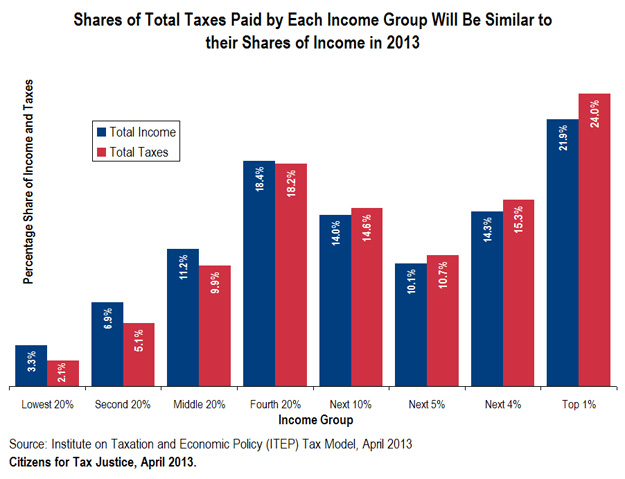
Jordan:  “OK, here’s a chart that shows the percentage of income by group and the percentage of taxes paid by group.  See much difference?”

Share of Taxes by Income

Sandy:  “Not really.  The lowest 20% income group pays a little less tax than their share of income and the highest income group pays a little more tax.  But, overall income and taxes look pretty balanced to me.”

Jordan:  “So I ask you.  Would you rather be in the highest income group and pay a little more tax or the lowest income group and pay a little less tax?

Sandy:  “Another one of those trick questions?  Put me in the highest income group any day.  I’ll gladly pay a little more tax.”

Jordan:  “Feel better that the tax burden is spread evenly among all groups?  Think we need a flat tax?”

Sandy:  “No we don’t need a flat tax.  We have one already.  We need a simpler tax code but we don’t need a flat tax.  Just baffled why no one really talks about the tax burden this way.”

fife-drum%201Jordan:  “Welcome to Washington, the land where objective and fair arguments have been gobbled up by self-interest and greed.”

Sandy:  “Let’s hope the revenge Revolution changes that.  Jordan, you’ve converted me.  I’ll help tell the story.”

Jordan:  “Great.  Really enjoyed seeing you again.”


#127 Do They Really Understand? Federal Deficit con’t (Part 7)

05 Tuesday May 2015

Posted by Jordan Abel in Economics, Federal Budget, Possible Solutions, Societal Issues

≈ 1 Comment

Scene: Jordan and Sandy, a former business colleague, are having coffee.  The discussion begins Entry #121,.  This segment is a continuation of Jordan’s description to Sandy of a conversation with the Speaker of the House and the Senate Majority Leader, which begins Entry #123

John Boy:  “Your point about companies replacing debt with stock…equity…is something I never really thought about.”

occupations_lawyerMackey:  “Me either.  Wonder what would happen if the US Government issued stock instead of debt?”

Jordan:  “Interesting questions but obviously lots of barriers to make it happen.”

John Boy:  “And highly unlikely…no impossible…given the attitude of many Republicans.

Mackey:  “John Boy, I agree the chance of passage is slim to none.  But we should bring it up for discussion.  Doing so would at least make people think.”

Jordan:  “Think?  Ideologues actually think?  Surely you jest.”

man_with_speechJohn Boy:  “Alright you guys let’s get back to the issue at hand – debt as a percent of GDP.  How ‘bout looking at the 230th Century?”

Jordan:  “OK.  Debt jumps in the Civil War…”

Mackey:  “Excuse me, the War of Northern Aggression.”

John Boy:  “Mackey, put that idea to rest.  The war was more than 150 years ago.  And which side wanted to secede?”
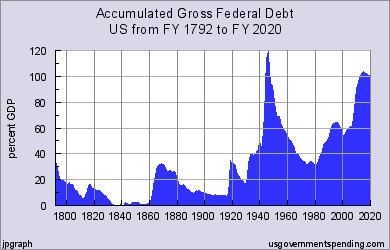
US Debt Percent GDPJordan:  “Children, no bickering.  Debt as percent of GDP (gross domestic product) jumps during the Civil War, then declines, jumps again in WWI, then declines until the Great Depression.”

Mackey:  “Yes, and the crazy public elects that socialist, Mr. ‘spend-at-all-costs’ himself, Franklin Delano Roosevelt.”

John Boy:  “Right.  Just look at how much debt jumped under FDR.  Mackey’s right.  What a socialist!”

fdr_~FdrJordan:  “And just what happened to the economy?”

Mackey:  “The economy recovered…sort of.”

Jordan:  “Sort of?”

Mackey:  “Sort of.  The country didn’t need all those socialist program.  The country could have saved its way out of the Depression.”

John Boy:  “You’re right again, Mackey.”

Jordan:  “And just what do you think drives the economy?”

John Boy:  “Tax cuts.  Incentives to invest.”

TurtleneckJordan:  “Here’s a simple question.  For someone out of work…through no fault of their own…what good is a tax cut?”

Mackey:  “An incentive to work.  Go find a job.”

Jordan:  “And just who is going to hire that unemployed worker?”

John Boy:  “Create your own job.”

Jordan:  “Let’s put politics aside and think this through.”

(John Boy and Mackey both sigh.)

Jordan:  “You own a business.  Why would you hire someone?  Just because the person needs a job?”

Mackey:  “Of course not.  Jordan, where do you come up with these stupid questions?”

John Boy:  “Mackey, I think we’re about ready to have another ‘ah ha’ moment.”

Mackey:  “Whadda mean?”

John Boy:  “As much as I hate to admit it, Jordan’s right.  Why would you hire someone?”

Mackey:  “Because you were busy and needed more help.”

John Boy:  “You got the right answer – because you need more help.”

Mackey:  “Simple isn’t it.  People want to buy your product, eat at your restaurant, whatever.  You need help.  What’s wrong with you guys?”

John Boy:  “And where did the tax breaks fit into that decision?”

Mackey:  “The tax breaks didn’t.  Oops.  What made the difference was demand.”

Jordan:  “Waiter, may we have some more snacks and another round?  Time to celebrate.”

Mackey:  “What are we celebrating?”

mr_know-it-allJohn Boy:  “Our enlightenment…at least enlightenment according to Jordan.  OK Mr. Know-It-All, what’s next?”

Jordan:  “Look, all I’m trying to do is present some basic economic principles.  Not left, not right, just basic economics.”

Mackey:  “So you’re claiming…”

Jordan:  “I’m not claiming anything.  I’m just stating.”

Mackey:  “OK, since you’re buying…you’re stating.  And you’re stating the only real way out of a recession is to stimulate demand.”

Jordan:  “Yes, that’s exactly what I am stating.  Talk about all the other theories you want.  When you do, you have to go back to one basic question?  Is a company going to hire another employee…or even retain existing employees…if enough people are not buying the company’s products?”

John Boy:  “Why do you make economics so simple?”

Jordan:  “The fundamentals of economics are simple…but not always intuitive.”

John Boy:  “Next you are going to tell Mackey and me that if the private sector is not hiring people…or laying off people…then the government needs to stimulate the economy.”

Jordan:  “You’re on a roll.  I told you most of economics was simple.”

OppositeMackey:  “Wait, you’re saying the government should do the exact opposite of what a household should do?  I mean, rather than cut back on spending when times are tough like real people do, the government should spend more?”

Jordan:  “See how easy this lesson is?”

John Boy:  “I don’t believe it.  If it’s bad for business it’s bad for government.”

Jordan:  “I’m going to show you why business benefits and makes more money by supporting a Federal deficit when in a recession.”

(To be continued)

← Older posts
Newer posts →

Subscribe

  • Entries (RSS)
  • Comments (RSS)

Archives

  • August 2025
  • July 2025
  • June 2025
  • May 2025
  • April 2025
  • March 2025
  • January 2025
  • December 2024
  • November 2024
  • September 2024
  • August 2024
  • July 2024
  • June 2024
  • May 2024
  • April 2024
  • March 2024
  • February 2024
  • January 2024
  • December 2023
  • November 2023
  • October 2023
  • September 2023
  • August 2023
  • July 2023
  • June 2023
  • May 2023
  • April 2023
  • March 2023
  • February 2023
  • January 2023
  • December 2022
  • November 2022
  • October 2022
  • September 2022
  • August 2022
  • July 2022
  • June 2022
  • May 2022
  • April 2022
  • March 2022
  • February 2022
  • January 2022
  • December 2021
  • November 2021
  • October 2021
  • September 2021
  • August 2021
  • July 2021
  • June 2021
  • May 2021
  • April 2021
  • March 2021
  • February 2021
  • January 2021
  • December 2020
  • November 2020
  • October 2020
  • September 2020
  • August 2020
  • July 2020
  • June 2020
  • May 2020
  • April 2020
  • March 2020
  • February 2020
  • January 2020
  • December 2019
  • November 2019
  • October 2019
  • September 2019
  • August 2019
  • July 2019
  • June 2019
  • May 2019
  • April 2019
  • March 2019
  • February 2019
  • January 2019
  • December 2018
  • November 2018
  • October 2018
  • September 2018
  • August 2018
  • July 2018
  • June 2018
  • May 2018
  • April 2018
  • March 2018
  • February 2018
  • January 2018
  • December 2017
  • November 2017
  • October 2017
  • September 2017
  • August 2017
  • July 2017
  • June 2017
  • May 2017
  • April 2017
  • March 2017
  • February 2017
  • January 2017
  • December 2016
  • November 2016
  • October 2016
  • September 2016
  • August 2016
  • July 2016
  • June 2016
  • May 2016
  • April 2016
  • March 2016
  • February 2016
  • January 2016
  • December 2015
  • November 2015
  • October 2015
  • September 2015
  • August 2015
  • July 2015
  • June 2015
  • May 2015
  • April 2015
  • March 2015
  • February 2015
  • January 2015
  • December 2014
  • November 2014
  • October 2014
  • September 2014
  • August 2014
  • July 2014
  • June 2014
  • May 2014
  • April 2014
  • March 2014
  • February 2014
  • January 2014
  • December 2013

Categories

  • Affordable Solutions
  • Back Asswards Thinking
  • Background
  • Background Stupid Is as Stupid Does
  • Benefits of Revolution
  • Causes of the Revolution
  • Common Sense Policies
  • Corporate Policy
  • Definitions
  • Diversions
  • Economics
  • Education Issues
  • Federal Budget
  • General Motors
  • Gov't Policy
  • Infrastructure & Fixed Fuel Prices
  • Innovative Thinking: Ideas and Products
  • Lessons of Revolution
  • Personal Stories
  • Possible Solutions
  • Post Trump Presidency
  • Rebranding Black Community
  • SCOTUS
  • Sense Check
  • Societal Issues
  • Stupid Is as Stupid Does
  • Tech Tsunami
  • Trump 47
  • Uncategorized

Meta

  • Create account
  • Log in

Blog at WordPress.com.

Privacy & Cookies: This site uses cookies. By continuing to use this website, you agree to their use.
To find out more, including how to control cookies, see here: Cookie Policy
  • Subscribe Subscribed
    • usrevolution5
    • Join 32 other subscribers
    • Already have a WordPress.com account? Log in now.
    • usrevolution5
    • Subscribe Subscribed
    • Sign up
    • Log in
    • Report this content
    • View site in Reader
    • Manage subscriptions
    • Collapse this bar
 

Loading Comments...